Six Persimmons

Some stray event, a random thought touched a memory the other day, an image. I can’t recall where or when I first saw it. I found a copy online, put it on my desktop, and just gazed. It touched me lightly, deeply, taking me outside myself, back within in ways I have yet to define or explain. I keep looking at it but the picture deflects all reason, focused sight, insight, returning me only to what it is, a picture of six persimmons.
Still, I keep looking.
.
Hamlet

The players have come to Elsinore and just rehearsed extemporaneously at Hamlet’s request Aeneas’ recounting of Priam’s slaughter. Here Hamlet is building resolve for his own action, the settling of his father’s murder, and the players have given him an idea. Yet as much he is putting on a show himself, doubting himself and reveling in that doubt, and, quite frankly, hamming it up. Hamlet is one of the best known characters in all of literature: the sublime, noble youth standing up against so much obvious wrong is universally seductive. But he also gives us a mask for our own indulgences, an excuse to cut loose with our own madness.

Appeared in TriQuarterly, Winter/Spring 2016 (Issue 149)
.
What It’s Like Where I Live

Cupertino now, above. Of course it looks like a blowup of an integrated circuit. Cupertino is in the heart of Silicon Valley, which is more a concept than a precise physical area, extending roughly from Stanford University down to San Jose. During the boom years the tech firms screamed for more green cards, and programmers and would-be entrepreneurs and still others poured in. Ranch houses started going for a million or were leveled and replaced with huge, stucco palaces on small lots. It amazed me anyone had that kind of money. The orchards are gone, and there is housing all the way up into the hills.
Appeared in Numéro Cinq, Vol. I, No. 1, February 2010
.
Above the Roofs of Paris, A Non-Memoir

Any country where I am not bored is a country that teaches me nothing.
Albert Camus, “Death in the Soul”
Appeared in Fourth Genre, 17:1, Spring 2015
Available at JSTOR and Project Muse
.
Bill

It is only by projecting our hearts and minds into the world, and whatever else we can think to project, then looking at what is returned that we have a sense of what the world might be worth. But it is only by testing the world, and ourselves, and doubting both, that we have any sense what we might be worth.
Appeared in Numéro Cinq, August 2017
.
Heart of Darkness

. . . I seemed at one bound to have been transported into some lightless region of subtle horrors, where pure, uncomplicated savagery was a positive relief, being something that had a right to exist—obviously—in the sunshine.
Joseph Conrad, Heart of Darkness

I kind of picked up the thumbs-up from the kids in Al Hillah. Whenever I get into a photo, I never know what to do with my hands, so I probably have a thumbs-up because it’s just something that automatically happens. Like when you get into a photo you want to smile.
Sabrina Harman
Appeared in Numéro Cinq, January 2017
.
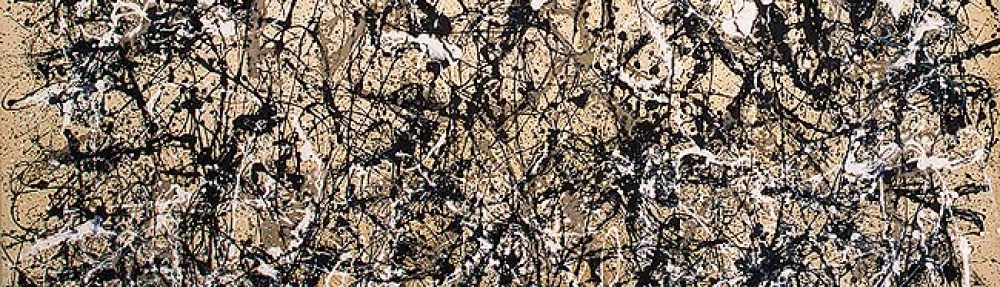
Autumn Rhythm

I think I might yet discover a way to join the moments and trace a plot, gain a perspective that aligns and explains, that I might reach some understanding, yet discover my place in the world, make a connection of life past with life present and whatever lies ahead—
Or at least, at last, find a way to put that memory behind me.
But fear I will fall into another descent from which there may be no escape.
Every glance, every essay risks a small death that flits above the greater.
In the thirty-five years since I only know I do not know how I fit in a world I do not understand or where I belong in a country I no longer recognize, a country that eternally renews itself unrecognizable ways.
But my brother, before the Pollock, looks composed and engaged, all there.
Maybe from the depths, de profundis, release, a revelation—
Of what?
Appeared in Conjunctions Online, November 17, 2015
.
Paris in Black and White / 1973-74

He still stares at me after forty years, the man holding the rope, with a look that even at this poor resolution can only be violation. And the woman with the lithe body, seemingly naked in her light-colored tights, frozen in the moment of lifting a knee and raising both arms in air, preparing for flight, for ecstasy, or for some other abandon, still has her back to me, as does the man beside her, touching, guiding, helping in some way.
Appeared in Numéro Cinq, November 2015
.
Max Schmitt in a Single Scull, Recent Thoughts

I have looked at the painting several times this past week, for confirmation, or reassurance, or to restore a definition, and I realize how the painting has always stood for me, that it shows me what it means to be American, vigorous and assertive yet relaxed and open, and free of historical encumbrance; self-assured but not self-possessed and not afraid.
Written the week of the 2016 election
.
To St. Johns Bridge

I wait at the end of the pier until I realize I am waiting. Nothing ever comes, in fact I put my work aside and let it drift. But I always get this release, this revelation: I am free and I am alive, and I don’t have answers to anything.
.
.Melancholia

There is no contradiction in any of this, as there are no contradictions in art. Nor is there irony, as we see exactly what we should expect. We are shaped by our conflicts and contradictions, our reaches, our misses, and our doubts: these give us life. And the failure to represent the divine visibly points all the more to its invisible presence. It is our balanced, symmetrical representations and our clear resolutions into action that are ironic because they always fall short of our desires, of our projections, and they touch a different kind of madness.
.
Riding to Apocalypse

Slowly, cautiously, I have returned to their coiling, inward gaze. Color has returned to the room, slowly, cautiously, and leaves have returned to trees, and grasses return to barren fields and softly fill furrows and cover mounds though from which chunks of old concrete still protrude, though a grayish mist lingers over all.
.
Under the rainbow: capitalism/the subprime mortgage crash

Later in the game another instrument was created, the synthetic CDO. A synthetic CDO is a bond comprised of CDSs, layered and rated like the others. Let me get the words in: a synthetic Collateral Debt Obligation is a bond which is made of Credit Default Swaps. Synthetic most intrigues me—as if CDO isn’t artificial enough. The term implodes on itself in its oblique attempts at a concept. Try to make some kind of mental picture from those words—I can’t, and I confess here is where I get dizzy.
.
Gloriously Pointless

The essay will be personal and pointless, though perhaps not gloriously so. If it serves any purpose, it might be to encourage readers, as many as can, to write about the experiences that move them, and about the people they share them with, and about where they put them in the world, to find ways to preserve all these before they are lost. There may be a larger point in that.
Appeared in Numéro Cinq, Vol. I, No. 2, March 2010
.
Ridin’ the Rail: On the Ending of Huckleberry Finn

The novel can be explained by a long tradition. Its shallow characters, the satiric cast, the episodic nature of the plot—all of these elements are consistent with the picaresque novel, and Don Quixote is often alluded to, probably an influence. But I still want a principle that explains the logic of its design. I would argue that it is the expectation of a well-made novel set against its absence that determines Huck Finn‘s construction and sets the tone. It is the ghost of rising climax, hovering everywhere, that gives the novel its form and tension. I also prefer to think of it as a novel looking forward to modern forms and to our condition, the fog of the last hundred years.
Appeared in Numéro Cinq, Vol. II, No. 2, February 2011
.
The View from the Masthead: Melville / Moby Dick

If these editors have their say—and they have—this is my greatest regret about writing today, that we can’t have anxious, half-mad, much less fully mad, novels. For me it is enough cause to write one.
Appeared in Numéro Cinq, Vol. 1, No. 3, April 2010
.
.