.
—Jesus, will you look at all these f-ferns!
My brother says.
Now where are we?
Where else could we have been?
How could we still be anywhere?
None of the streets look familiar—
Where the cab stops—
But we didn’t go far enough uptown to have our heads kicked in, at least the way they would have been kicked in Harlem.
Upper West Side?
At any rate, someone’s apartment.
Dick and Jane’s?
Or only Jane’s?
Or even Dick’s?
I never figured out exactly what there was between the two. At any rate, the apartment was a one bedroom, with a bed in the bedroom that looked larger than the room that it was in. As for the rest, I can’t remember anything else besides those ferns, and not all of them could have been planted by memory. Because there were ferns everywhere—ferns springing from pots and boxes on tables, shelves, and floor. And splayed-out ferns in baskets hanging from the ceiling, a mesh of greenery overhead. The place looked like a jungle.
What happened to what happens next, in the cab?
—Jesus, will you look at all these f-ferns!
—F-ferns? Jane asks.
Jane is back in play, if she ever left.
—F-f-ferns, my brother says.
—F-f-ferns?
—F-f-f-ferns.
—Oh, f-f-f-ferns! Say it Dick!
—Ferns, Dick says.
And Dick is back with us, too.
—Not ferns, Dick. F-f-f-ferns!
—Ferns.
—No, f-f-f-ferns!
—F-f-f-fuck off, Dick says.
Jane looks at my brother.
My brother looks at Jane.
They roar.
Dick looks like he is trying on a bad mood, his head a storm of brewing maladicta.
Whatever happens next, in the cab, my brother has survived it, and maybe it has pumped him up because he’s still on a roll, now picking up and adding to it what he left back at the White Horse. And wherever Dick and Jane are now, whatever state they are in and whatever they have left to hold it, whatever they have left to turn loose, there still remains unfinished business in the dynamics among the three that hasn’t fully worked itself out. But first a bottle of something comes out, a bottle is opened and a bottle is poured. Then people gather around a coffee table and people drink, everyone, of course, but me.
—The fours that through the green fruce.
My brother says, out of the blue.
Or red.
Jane titters.
Dick grunts.
—The gorse that through the freen gruse, my brother starts again.
He was having, I suspect, another DT fit.
Jane guffaws.
Dick groans.
—The forse fat frough the freen fruze frives.
—The gorse gat glue the gleam goose grives.
—The jorse that juiced the jeaned Jews jives.
—The rorse rat ruled raw reams roosts high.
Jane moves to the edge of her seat, winding up.
Dick tenses his jaw, reeling in.
—The torso that threw the pee has hives.
—The Norse hat stewed the green booze eyes.
—The horse that knew the teen muse lies.
—The coarse cat knew the bean spews lives.
—Doo-dah! Doo-dah! Jane stands up and yells with spastic glee.
Dick makes fists.
—The Porsche pat proved the preen pooze plies the power.
—The source that grew the seen ooze knives the bower.
—The bourse that slew the dream blues craves the floozy.
—Zee zorse zhat zhroo zee zeen zoos seizes zee zowie.
With the last he turns and stares at me, still and ever and ever still, still sits there still, ever with that look—
But I give up on trying to figure how he looked or what it looked like he was doing or what kind of shape he was in to do it, whether he was too drunk or finally drunk enough to do it. It’s too hard now to remember anything. Yet after what happens next, in the cab, something else still happens next—
Or maybe nothing happens next, in the cab, but was only about to happen but got cut short, and what started there and should have happened is going to happen now, and because delayed, is about to happen next with even greater fury, because people stop talking and begin to move, action which, if I can remember it, will have to speak for itself, may be all I have that can speak.
Because Dick and Jane rise now and now my brother gets up and now everyone is on their feet, everyone now but me, who now can only sit and watch, though barely that, or more, because I had to be in a state where watching exceeds belief, sit there, hands now in my lap, still protecting, maybe, sit there now and ever with the fear, now compacted and compounded, the fear of New York inside and out, of nothing and of nothing yet and of the chance of the exclusion of everything else, also maybe now the fear of universalists and mothers, and magnetism and other unseen forces, and now, twenty years later, hands on head, ever protecting, the fear of universals and particulars, of shouts and whispers, of smiles and grimaces, of screams and laughter, and of anything in between, these and the fear of whatever any of them have to do with what happened that spring and what followed that—but more than these, or part of them but not yet conceived or delivered, the fear then as now of what my brother and Dick and Jane were about to do. If I had a position then, it would have been the sober equivalent of being sobered under the table. And now it will take a leap of faith to remember what happens next, or at least a flying leap.
The sense, in spite of what happens next in the cab, if it happened, in spite of all that had occurred so far, that the worst was still to come. But either the climax to the course of events that night was long overdue and stalling—
Or the line of conflict hadn’t even yet begun to rise.
And either nothing was what it appeared to be—
Or everything was exactly the way it seemed. I’m not sure, however, what difference that could make. I’m no longer certain about anything, except for all those ferns.
But even if nothing happens next, in the cab, what happens next, in the apartment, came out of, is a part of what should have happened next, in the cab. Because I know now there was motion and there was contact, a display of parts—hips and chests and limbs and fingernails and closed hands and maybe even feet—coming together in a flurry that feels now like collision. And clothes got ripped—a fight?
Was Dick finally tearing into my brother for the time he had made with Jane? Or into Jane for two-timing? Or was Dick at last lashing out against my brother for what had been thrown at him and gone past? Or was he striking to conquer what my brother held back and dangled over him, to subdue it into his clean-cuttedness regime? And was Jane rushing to embrace and absorb the same, batons and tassels twirling? Or had she finally had enough, was getting back at my brother for sending her into a dither? Or had she had her fill of Dick? Or were they fighting each other for their share of what my brother had shown them and/or had denied? Or for the first crack at him? Or had my brother led the assault himself because he was tired of not getting anywhere with his words? Or all of the above? Or something else?
Now I realize that Dick and Jane were not out of it, but were a part of what happens next in the cab, or should have been a part of what should have happened. But I have to give up on Dick and Jane as well, because the look on their faces was as impossible to decipher as my brother’s. Nothing comes back to me now other than the voltage of its charge. I can’t even remember who did what to whom. But these may not matter, because it may have been that what they had done to others all their lives and what others had done to them had turned back on itself, rebounding, and they now were doing to each other, a broil where faces get left behind and the only position that matters is coming out on top. Which is all that what happens next, in the apartment, after what happens next, in the cab, or should have happened next, in the cab, could have meant, which, even though it doesn’t mean anything, means everything, has the meaning that breaks the arms of meaning and throws it out the door.
There are, at least, impressions, and how these make me feel, flashes that explode and leave the stark, bleached contrasts of Riis stills, then move with the scratching stutter of silents and repeat themselves in endless loops. Not reproductions, not imitations, but abstractions, abstractions grounded in the world, in what happened before and what happened then, what had been passed around and had passed through and crashes into memory now, not copies, but forms and what these do to feeling, the forms of cashing in and cashiering, of crowding in and crowding out, of stepping in and on and over, of affectless stares and sidelong glances and suppressed sneers and frozen looks unfreezing themselves into cruelty, into potent terror and impotent rage, forms of raising and of leveling, of raised arms, raised heads, of heads smashed and bodies dragged through streets, of falling bodies and bodies floating in the river, forms confused yet direct, forms that have not the images but the same distinctness as balance sheets and checkbooks and pedigrees and forgeries and treaties and deeds and warrants and eviction notices and pink slips and brass knuckles and stilettos and TNT and backhoes and cranes and girders and granite blocks and cement shoes and steel vaults, forms not identical but that, before a backdrop of Ferris building-like yet windowless constructions darkly stepping up into a gathering black, bear resemblance in some analogous and participatory way to a parade of troops marching each other down under different flags and emblems, Dutch over the natives, English in dutch with Dutch over Irish over Italians over Puerto Ricans and everybody else, of everybody over Jews and Jews over everybody and everybody over blacks, of button-popping cops over marchers, followed by Fisks and Goulds and Morgans and Rockefellers and planners and pols and their wives and squeezes bringing up the second line and climbing over each other’s back and sticking it in while tenements rise and fall and rise again and fill and swell and spill and are cleared and replaced with bigger boxes which swell and spill some more, while feathered heads are severed and heads sold on blocks or sliced and diced and Burr mows down Hamilton with a Tommy gun and D. Clinton digs a ditch for all the heads and bodies and Copperheads sit on heads and make them sing mammy and Emma Lazarus is bound and gagged and the sewing angels of Triangle take to the air and fall like sacks of cement and Emma Goldman and John Reed are tied down on subway tracks side by side and get run over sixty times and investors leap from buildings and flutter like confetti and the boys in Sharky’s have it out while everyone looks on and

Luciano at the head of the table fits chains around the board’s necks and Fermi runs a protection racket from the basement of Columbia and the boys in Madison Avenue set off a chain-reaction marketing scheme that flattens city blocks and Kitty Genovese appears on stage and brings a packed house down and slick rags cover it all with its gloss while everyone stands and watches and critics in the shadows watch and shake their heads—
And beneath and behind and everywhere waiting, waiting in boxes boxed and unboxed, bolted in and out, flattened by girders and severed in the sheer of glass, stooping in the shops sweating, mangled in the crush of oily gears, clinging to the rails of flimsy escapes, squeezed under concrete monuments and bronze and granite feet, crouching in the sunless streets, in the dark alleys, in the gutters, in the subways, in the sewers choking in exhaust, sliced on razor wire and bound in chain-link mesh, waiting the rebound, a backlash, the marchers unmarched, the faceless unfaced, a seething mass of muscled pain ready to swarm and raise arms and lash chains and smash ladders and topple pyramids and retake the streets in a wash of light and blood, to parade on sticks down Fifth Avenue the heads of Dick and Jane and my brother and me and whoever else is left—

Or was there dancing?
And did clothes come off instead?
Because now the bedroom door is shut and I’m by myself—
Except for all those ferns.
Analogy shifts, but the feelings are still the same and the forms similar, which now move with the slowness of the furtive pan of a surveillance eye and speck with phosphorescent scintillation, the forms of the call, of the play and of the plying, of the exchange, the barter, the bargain, of the feel, of the pat, of the smack, of the pull, of the press, of the squeeze, of the massage, of teaming and massing and boxing and unboxing, of grasping and fingering and intertwining and twisting and bending back and separating and cleaving and rubbing raw and bruising and sticking, of crowding and slumming and stepping and taking and cashing in and raising and tying and untangling and heaving and leveling and discarding, of flashing lights and darkened rooms, of granite stares and closed eyes and quick glances at the ceiling, of the standing by and watching, of bodies thrown and falling, of bodies defaced in the diminishing return of facing mirrors or exploded onto billboards and full page spreads in the Times or crowding into the kiosks of glossy print and pix, forms with the distinctness still of checkbooks and forced arrangements, and of platforms and lifts and pink slips and straps and toys and collars and whips and chains and mesh and welts and teeth marks and ice and cigarette burns, and still the headshaking but still the procession of the same figures now stripped or fully dressed and watching with open

hands while mammies sing holy terror and Helen Jewett gets called back on stage and pulls out the ax and does an encore and Susan B. gets tied down on all four corners in Five Points and Carnegie cruises down in steerage and Fisk takes a stroll in Harlem and Maggie jumps in the river and Astor leases out the top floor and Luciano keeps the books and feather-hatted CEOs in pastel Cadillacs and three-piece suited madams and pimps in black limos circle the block—and again the waiting, the massing, the backlash of the supine faceless waiting to uncoil and clear out rooms and take the streets and roast our parts on spits—
Yet they still are in the bedroom.
No noise, however, behind the door.
Also, I still seem to be alone.
Now analogy twists and turns inside itself and out into feeling, and out of that and back inside, while details come back together and recombine into other forms, forms that now move slowly in the weightless silence of a thin cloud crossing the moon, with the precision, with the grace of a delicate razor slicing the woman’s eye: in the infinite, empty regression of the grid, beneath the soaring arches and gothic spires, the twin-horned elephant beast prowls the labyrinth of streets while sewing machines hum alone, useless, inviolate, in moonlit squares on Penn Station floor and chocolate grinders churn behind the cracked faces of the clocks on Times Square; in wainscotted parlors, lizards crawl and the ghosts of the RCA lobby mural whisper and apparitions of Lenin appear on the keyboard, glowing and receding, while down Fifth Avenue slides a parade of huge animals and body-like parts, tumid, flaccid, floating, their strings held by giants and freaks and formless monsters, followed by uniformed midgets setting the buildings and each other on fire, while beneath the streets subway trains slide like worms over each other in a sparking ooze, while beneath the subways the vials of Egypt are locked in vaults, and in the vaults the dead awake and unlock the vaults and ascend sidewalk lifts and walk, and the twin lions leave their porch to lie with the virgin, and whores come out to lie with children in spotlit corners while the gypsy sleeps in a dark alley and dreams, and delivery cyclists cross the grid and interlace it with their messages, fractured collages of print and pictures of objects found, and chessmen cross the board of streets and slay each other with swords, and headless mannequins, their necks bent to the degree of their inclination, step from the windows and embrace and bend each other back and forth all the ways they can be bent while bankers in bowlers and straw hats, hopeless bachelors waiting, stare at them with longing and menace, and chrome gargoyles watch from overhead, and the nightingale swoops down to destroy: then the fur-lined stalls of Little Italy team with skulls and the livers and other organs of fowl, red and viscid, and restaurants serve

them up; then fire hydrants open and pour blood, and sidewalks sprout spikes and streets turn green; then silver flows down the East River and blood runs down the Hudson then mix at the tip where they meet; then scabrous vegetation crawls up Ferris constructions and chokes them; and then an enormous breast, diaphanous but full, descends from the sky and moors at the mast of the Empire State, its nipple swells, and now everyone is waiting and feeling starts to change—
Because the door is still shut and they’re still going strong, while I am going under.
.
Sex:
—Are you OK?
Who knows?
—At least you’re talking to me again.
One has to take what company one can find.
—Suit yourself.
But there could be yet another way to picture this. In a world where there are no good options, the best may be those we can devise for ourselves. A freedom might be found in forging images, on a canvas or in our minds, with desire reshaping the shapes of the world into forms it can accept, into the figures beneath the figures, in creating a world beneath the world where there is pleasure in pain, beauty in the grotesque, and an order in confusion—where our true selves are revealed, or at least what’s locked downstairs can get out and have some play.
Pollock, Male and Female:

Surrealistic fantasy, the delirious waltz of images that don’t look like anything because it tries not to make them look like what’s out there, but distorts the images that look like something into images that look like what we want and need to see.
—I like it, but I’m not feeling very sexy here.
One has to take what one can get.
—Suit yourself. But I still don’t see any figures in the big one.
I think they’re there somewhere.
—Either they’re there or they’re not.
Maybe it’s because of how distant from figuration they are that we realize all the more what is there beneath them. Because there could be even a further freedom, without which freedom is not worthwhile, where we tap the figures beneath the figures beneath the figures and touch a world beyond the world beyond the world and bring ourselves closer to the pulse of our desire.
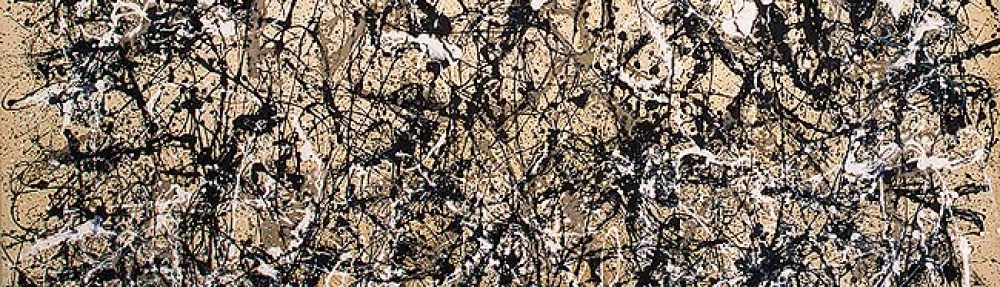
Autumn Rhythm: Sur-surrealistic fantasy, a sensual sense that makes no sense yet makes sense of the senses.
—Woof! Worse and better and better and worse! So is this meaning?
It may be as close as we can get.
—Suit yourself. But you’re doing an unconscious thing again.
Maybe this is what Pollock meant when he said he painted from the unconscious. There has to be some way to come to terms with what lies beneath us unexpressed.
—Either something is unexpressible or it isn’t. Again, maybe Pollock meant something else. It still sounds like you don’t think he knew what he was doing. Besides, a while ago you were concerned about the clash between what’s below with what’s above.
This is different. Here, what’s downstairs has the upper hand.
—Sounds like you’re trying to cut your losses. If the goal is to free ourselves from the world, why bother with images at all?
We have to maintain contact with something in order to free ourselves from it.
—Suit yourself, though I would think it’s the other way around.
And we have to attach ourselves in something else to guide us.
—I think you’re still turned around. What has happened to humanity and common sense, anyway?
What do you care?
—Really, you’re embarrassing me.
Too much light.
—Not enough!
It was getting hard to see who was on top.
—Who gets on top in your surreal picture?
Maybe everyone gets on top eventually, because perhaps we need to liberate ourselves first before we can free the world, and someone has to pave the way.
—My head is spinning.
Look, I’m trying to give you credit.
—Sounds like you’re trying to cash in.
I’m trying to show some feeling here.
—What has happened to reason?
What the hell difference could that make to you?
—I’m turning several shades of red.
OK, reason was getting out of hand. But maybe not entirely. Because there may be a reason to this kind of madness, and maybe it’s only through madness that we can see it.
—Either you’re crazy or you aren’t.
Is there nothing in between with you? I’m trying to cut you and the painter some slack.
—It’s not certain we’re the ones who need it. Sounds like you’re losing it.
I’m not the one who lost it.
—Suit yourself.
Yet how long before the madness of surreal or sur-surreal distortion turns into the real thing?
—Who knows? But what difference does that make?
WHO KNOWS?
.
—and the door is still shut and now behind the door, some kind of noise?
Was what it appeared they were doing what they were doing but there wasn’t anything that it could have appeared to appear to be other than what it was? Because now tongues come out and clothes scatter and analogy flies apart and feeling gets blown to hell as Governor Hyde lifts his dress and dresses get blown over subway grates and the masses climb up the raised-hand lady’s skirt and grope around and no one waits for anything as forms multiply in a charge of chemicals and electricity and cash then race with the artless lurching of movies whose x’s run off the marquis as bodies tumble from the rolling barrels of love and torture into Plato’s Retreat and Warhol films the basement show and critics cover Warhol covering the bodies covering Plato and the Police Gazette covers the critics covering Warhol and slick rags cover the Gazette covering the critics and the critics cover slick rags covering the critics and the critics cover the critics covering slick rags and Warhol films the critics covering the critics whose tongues are hanging while the Ansonia sweats a beaux-arts ooze and body parts fly from the top floor windows and set off a chain reaction of neon lights and credit while tableaux vivants unfreeze on the floor of the NY Stock Exchange and parade into the crowd while unbuttoned cops swing on trapezes overhead with just as great an ease and Al Jolson gets down on his knees in the American and sings mammy to the couples in the third tier and a fountain of cash shoots through the roof and floats down into the street like feathers and kliegs come out and flashbulbs pop as Ragged Dick gives Carnegie a blow job and Andrew returns the favor and Wobblies pull their zippers and Madam Hertz sits on Astor’s face and Lindsay sits on hers while Lucky Pierre looks on and dons don their foot soldiers in blacklace lingerie and turn them loose and the Brooklyn Dodgers gangbang Sigmund Freud on the podium while he sucks on his cigar and Pip flips Flip and Flip pips Pip and Tom Thumb shoves it in Major Mite and Chang and Eng

stick it to themselves and Whitman gives everyone a squeeze and black and tan fantasies clash with white and burst into fluorescent colors and monstrous grins and Comstock whacks off sixty times with his right hand then sixty more with his left while Lindbergh flies over Times Square dropping porn and French ticklers and party favors and the Rockettes sit and lift their legs and hold their ankles while Atlas holds the ball and everyone stares at Atlas’s balls and the glass ball falls and smashes into a zillion mirrors and Brooklyn Bridge comes falling down and Ferris constructions explode into showers of blistering silver light—
Insanity:
—Who?
Who not?
—If everyone is insane, we couldn’t have acted differently, and/or:
—We would have been fools to do otherwise.
.
—but now they’re all in the kitchen, still at it, whatever they’re at, or are at something else, yet either way seem to be intact and still are going strong. Whatever happens next still hasn’t happened yet, or has, and is loading up to happen again, or yet again something else is going to happen next. But I don’t know exactly what they’re doing now, except that my brother has both Dick and Jane laughing hard.
And I am still alone.
I say aloud to the room:
Mon enfant, ma soeur,
Songe à la douceur
D’aller là-bas vivre ensemble!
Aimer à loisir,
Aimer et mourir
Au pays qui te ressemble!
It’s one of the few poems, French or English, I ever learned.
Là, tout n’est qu’ordre et beauté,
Luxe, calme et volupté.
Or maybe it was something from Rimbaud.
It is difficult being the only sober person in the world.
But still I had to prepare myself, guard myself, prop myself up sober for what happened so fast, so hard, I barely saw it happen, what happens next—
There’s a chance, however, the bedroom door was never opened.
.
What happens next—
.
Then—
.
I think the room started spinning . . . .
.
Darkness . . . .
.
Shadows . . . .
.
Openness . . . .
.
Nothingness . . . .
.
Open nothingness—
.
Some kind of dark landscape, flat and empty though lined and marked, and vacant and open, like open fields, in its openness and emptiness, disturbing—
.
Above the landscape, dark nothing, sky-like and disturbing—
.
Somewhere in the landscape, dark waters gathered like pools and ponds, black and disturbing—
.
In the distance, obstructions, dark ill-formed protrusions, hill and bluff-like, and beyond the bluffs, more protrusions better formed, less disturbed but more disturbing—
.
Fixed things, fixture-like, and wall-like walls here and there, and on the walls, sign-like scrawls, and at the periphery, between the field-like and sky-like, darker tree-like masses, swelling, darkly teaming, and in their even darker shadows a band of dark figures moving in ominous stealth—
Central Park?
We seem to be going home . . . .
.
What has happened to what happens next, in the cab, or should have, and did happen in the apartment?
But now my brother is beside me, in the back seat of what could only have been another cab, though I can’t remember anything about the driver and it seems there wasn’t one even though there was. And Dick and Jane are not in the picture. Which means that they have already done whatever it was they did, or it has been done to them.
But that means that Jane has spoken to me, and I have spoken back. Which means that I did establish a position and had one now, but more than that, that I had acted. Even more, acting means I was a part of what happened and it was part of me, as I sit there with my brother—
But what did I say?
What did I do?
Why can’t I remember that?
Or maybe nothing happens next, in that cab, with that driver, or in the apartment with Dick and Jane, but still has been kept, still is building, and I haven’t done anything yet even though I spoke, but, positioned, still am waiting—
Either way, now it’s down to my brother and me, and he sits beside me silently, too silently, there, not looking, eyes shut or open, but either way still is there—
But now memories of holding him up in the elevator, then of struggling to pull his shoes and get him into bed, or at least of holding and pulling and struggling.
And now memories in bed myself, alone with my position and whatever was left from what had or had not been done, once more surrounded by his things in darkness now—his books, the papers, their words and numbers, the faceless furniture and broken mirrors—and not sleeping. Not sleeping because too much had happened to let me sleep, or hadn’t. Or not sleeping maybe because, I still hadn’t lost it all and was trying to locate myself after all that had happened that day to position myself for the next. Because there was only Sunday left—if I could figure out what to do and how to do it, if there was anything that could be done. Or maybe I wasn’t thinking about Sunday but where I might flee in retreat. All I can remember is being caught in an exhaustion that would not deplete itself and let me rest.
I know now I did nothing to help my brother. But even though I still doubt anything could have been done—doubt because, whatever led up to that business with Dick and Jane, wherever it left him, whatever it had to do with anything that came before, while I suspect they kept on doing what they did, Dick and Janeing, and for all I know still do it, I am certain my brother did not—or because of that doubt, I still have not found the position to come to terms with what happened that weekend and what happened after, or help me move with that time or beyond it, or even let it go.
And then in bed—not sleeping, massaged by a darkness with groping, forceful hands, with everything meaning too much, or not enough—the overwhelming sense that I was the furthest away from my brother, who had slipped from me all that weekend, who still slips from me now, yet at the same time felt closer to him, as I do now, even though he was in the next room, or the other now, then dreaming or not, now, not.
I reach back now to then, then as now not unconscious, if this can be said, but maybe not wholly conscious, if this also can be said, yet at least sober, astir in a buzz of soberness, soberly on the other side of soberness and where that left me and puts me now, into another dark landscape, not Central Park or even park-like, yet with fields and fixtures and scrawls and obstructions and protrusions and dark nothing, somewhere inside yet out, open yet closed, a place weightless and sizeless yet heavy and deep and infinitely close, empty yet gathering, surging with dark forms that take shapes distinct yet beyond description, the surge sounding a throbbing, like the voicing of hard laughter and scattering fear.
So much of what was seen and heard and is remembered and is now seen and heard, the faces, the places, the things, have to be mere illusions, distractions stirred by the play of an antic madness within, without, accidents of time and place and face, of times and places and faces, whose source is everywhere and nowhere, whose method can never be pinned down. But there is just as much that bounces off the common with brutal force, or flies maddeningly hard from within it, which, in the flying, still leaves the unbearing sense. And there is so much that flies around you both, painter and brother, but will not land and stick, leaving you there untouched. Yet in the flying you are kept, the sense of you, a force, an intensity, some kind of mindedness high or low yet unrelenting that, in its drive, had to have struck something at least once, something that drove the flying, the forceful, frightening scatter. And it may be only through the flying, the scattering, that the force, you, the sense can be released and the bearing born, that the urge can find its voice, can say what it once said, has always said, and might yet say once more—
And now his things begin to rise in the darkness and fly around me, still not any more or less than what they appear to be, yet the fascination and the guilt and the dread they held for me that afternoon but could not hold themselves has turned to terror about to speak—
And now ominous figures sizelessly huge start to come out of the shadows, and now somewhere, where something sky-like meets the ground, an emergence, a hint of a rising, horrible and beautiful and defining—
Because still the sense that something happens next—
But the lights of memory have gone out.
.
The voice of the tribe:
Pollock, Pasiphaë:

She who shines for us all, who, obsessed with the beast, faked the beast to get plunged by the beast and gave birth to the beast who charges through the raveled walks of our minds.
—I like it. But it’s still not very sexy. So now we got bulls running loose in our heads?
Figuratively speaking. The artist, the searching spirit touches the deepest part of our minds to free the images, archetypes—
—What the hell are archetypes?
Archetypes are basic forms, prototypes, from which other things might be made; the symbols of the clan that tap the fundamental thrusts of our lives from day one. Pollock who was fixed on Picasso’s later work, went to a Jungian for a spell, and studied primitive art; and you—
—Either we got bulls running loose or we don’t. Man, you’re really losing it.
Not losing it, but rather trying not to. Because maybe this is what has been lost in our sterile codes, in the fluff, in the madness, in the violence of our simulacrums—the blood and guts of our existence, which needs to be restored.
—What the hell is a simulacrum?
It’s a phony symbol.
—A: How can a symbol be phony?
—B: How can a symbol not be phony?
But this could be your problem, that what you touched and made you vital, the world ignored or could not sustain, or even tried to destroy.
—Are you sure you have your symbols straight? Besides—
I know there is some kind of figure in the big one somewhere. When Pollock said he chose to veil the imagery, maybe it’s because only by the shaman’s touch, the conjuring trance, the keeping hidden, that the image can live.
—Better and worse and worse and better and better worse. Besides, you’re still doing an unconscious thing.
This is yet different. Here would be the collective unconscious, where we find the common figures that bind us all together.
—Either something is inexpressible for everyone and always has been or it isn’t, never was, and never will be. Why do you keep digging?
How can we afford to take the world at face value?
—How can we afford not to?
As much as there is in the world that doesn’t add up, or add up well, there has to be something somewhere that keeps us together yet also keeps us moving—
Then again, how do we know the beast won’t give us too hard a ride?

—You pays your money, you takes your chances.
.
Insanity:
.
—but whatever you touched or thought you touched or might have touched, if it was there, or whatever you didn’t touch, knowingly or unknowingly or however, and whatever touching or not touching did to you for better or for worse; whatever your relationship to the world, whether you stood apart for reasons of integrity or egotism and however long this stance could last, or couldn’t, for whatever reasons that make it hard to stand, within, without; or whether you got caught up in the world’s contradictions or contributed to them, and however much they screwed you up, or didn’t; or whatever the combination of all or any of these might have done to you, however they might have been combined, whatever might have come out the shaker; and even if there is a matter of judgment, wherever judgment stands and whatever it has to do with what you did and what happened to you—there has to be something that lies within judgment but also outside it, and within but outside of reason, and in and outside of touching, something that redeems you, or at least redeems the memory of you, something to be salvaged and repaired, something that will allow the kind of sleep that leaves options for the next day, something that keeps us all from getting sucked under.
Perhaps I have not gone far enough—
.
The voice of signs:
An understanding of understanding itself, of whatever drives the joining of its figures. You, the words, the numbers; Pollock, Guardians of the Secret:

And Autumn Rhythm: Whatever lies beneath that drive and drives it.
—What could be beneath signs but other signs?
.
Or should I just let go?
—Go! Go! Go!
.
Sex:
Not understanding or even the power to understand, not even any picture that is made to be contemplated, but the desire to understand, or not even that—
The desire that desires the desire for understanding and moves it, the desire that returns when desire for understanding has run its course and is gone, or even is there if the other never starts; not hidden because it is not hiding; not pictured because its figure is its formlessness, its quickness, the lightness of its ever-changing image, of its shifting, ephemeral suggestions, the delicate, surging ease of its overwhelming; not complete because it never ends because it has no end, because in completion it destroys itself—
Autumn Rhythm:
The desire for the desire for understanding itself, which keeps the desire for understanding alive?
—I’m feeling another tingle here.
But what—
How long—
.
Ecstasy:
.
Insanity:
.
Disaster:
.
Ecstasy:
.
Revelation:
—Of what?
—Where?
—How?
—Why?
—Why not?
.
.

.
.
—but now they have come out of the shadows, figures lightly dark and darkly light. And with them, something. Nothing. A nothing somethingness.
And then an opening, door-like. And everywhere beyond the opening, a vatic scaling, a relentless spreading, a rising noise.
And now, within the scaling, with the spreading, come impressions and how these make me feel, flashes of appearances appearing, moving with sliding, muscular ease, or flying apart in manic grace and recombining, recombining to fly apart, impressions powerful and awful and vertiginous and scatty and bliss-like, sounding themselves with a blaring of stark colors in many hues profane and profound, of warning and hope and despair. Of patience and forbearance and endurance. Of anger and wailing and prostration and rage. Of abandon, of transport. Of misery and exaltation. Of waiting and listening and dreading and looking and not looking and seeing and not seeing and waiting and not waiting.
Not imitations, not copies, but forms, forms grounded in forms substantial, the forms of massing and unmassing, of force withheld and force unleashing, of conflict resolving and unresolving, of unscrolling and scorching and withering and falling and ascending and disappearing and reappearing. Forms which have not the image but the same distinctness as broken seals and bowls turned over and plagues and pestilence. Of bottomless pits and shining towers. Of many headed beasts and fluttering wings. Of wantonness and annihilation and glittering jewel-like adornment. Of merchants mourning and weeping, of people bearing the mark and the unmarked bearing. Of multitudes gathered and tiered and waiting, seraphic and unseraphic. Of warring factions. Of bites and burns and sores and cuts, of flesh and hearts and minds exposed. Of bodies falling, of corpses rising, standing, waiting.
And of a woman of golden countenance, portentous, clothed in celestial apparition, bearing and unbearing, anguished in the unbearing bearing. And of the reddened, devouring beast, sitting on her stomach, watching, waiting, horns pricked, tail sweeping. And of a white horse, mounted by a rider with flames in his eyes and blood on his robe, unnamed but knowing and unleashing and waiting to unwait.
And then it appears, a presence, personal and formal, of and within the world, and above, its blinding face central and commanding and clarifying, appears suspended in cloud-like air above a sea of transparency, holding stars and two-edged swords, holding back—and then unholding, when he speaks, speaks in the voice of voices, a voice like a river of many currents, when at last he says the word, the words—
.
When at last he says—
.
At last says the word—
.
The words—
.
—Who dat?
WHO’S THAT?
—Who dat who say who dat when I say who dat?
BUB!
Then at last says the word, words—
—Eight bells there, forward!
WHO SAID THAT?
WHERE?
But it had to have been much later—
—How’m I doing?
WHO SAID THAT?
—The horror! The horror!
WHO SAID THAT?
—I think Kurtz said it.
THAT’S NOT WHAT I MEANT. BUT WHO SAID THAT?
—
WHO DIDN’T SAY ANYTHING HERE?
—
WHO DIDN’T SAY ANYTHING THERE?
—
WILL SOMEBODY SAY SOMETHING HERE OR THERE?
—Avast the chorus!
—Give it up, Crito!
—Fuggeddaboutit!
—Shove it up your ass!
—Freeze, turkey!
—Drop it, motha!
—Drop it right there!
—Drop it now!
—Drop dead!
CUT ME SOME SLACK.
—What did you think was supposed to happen here?
I’M LOOKING FOR SOME HELP.
—Suit yourself!
I’M LOOKING FOR SOMEBODY WHO KNOWS WHAT HE’S TALKING ABOUT.
—What have I not elucidated?
HOW DID YOU GET IN HERE?
—I’m not here.
ARE YOU THERE?
—I’m not there.
WHERE THE HELL ARE YOU THEN?
—
HOW CAN I LISTEN TO SOMEONE WHO IS NEITHER HERE NOR THERE?
—
WHAT THE HELL DOES A BUDDHA KNOW?
—
SO WHAT HAVE YOU NOT ELUCIDATED?
—I have not elucidated that the world is eternal.
WHAT ELSE HAVE YOU NOT ELUCIDATED?
—I have not elucidated that the world is not eternal.
WHAT ELSE, THEN, IS THERE NOT TO ELUCIDATE?
—I have not elucidated that the world is finite.
AREN’T YOU NOT ELUCIDATING THE SAME THING?
—I have not elucidated that the world is infinite.
ARE YOU NOT NOT ELUCIDATING THE SAME THING?
—I have not elucidated that the soul and the body are identical.
NO MORE NOT ELUCIDATING. NOT ELUCIDATING ISN’T GETTING US ANYWHERE. IS THERE ANYBODY OUT THERE WHO CAN ELUCIDATE SOMETHING HERE OR THERE AND KNOWS WHAT HE’S TALKING ABOUT?
—Buy short, sell long!
—Sell short!
—Sell it down the river!
—Stash it!
—Cash it in!
—Stick its patent name on a signboard!
—Smack it!
—Whack it!
—Feel it!
—Squeeze it!
—Seize it!
—Beat thy belly and wag thy ears!
—Better get it in your soul!
WILL YOU GUYS SHUT UP LONG ENOUGH TO LET THE PERSON SPEAK WHO’S SUPPOSED TO SPEAK?
—Nobody in here but us chickens.
BUB!
—White skin, white liver!
BUB?
—Has it occurred to you that by venting your indignation at words that suggest racial debasement all you’re doing is exploiting them yourself to elevate you into a superior position under the guise of rectitude?
I’M NOT TRYING TO GET ON TOP. I’M TRYING TO GET TO THE BOTTOM OF THINGS.
—Man, you are at the bottom. Because at the same time this rectitude is only a displacement of your own racial uncertainty and personal insecurity.
I’M NOT TRYING TO GET TO THE BOTTOM, I’M TRYING TO GET OFF THE BOTTOM.
—Make up your mind.
I’M NOT TRYING TO PUT MYSELF ANYWHERE IN THE PICTURE.
—Either you’re in the picture or you’re not.
HOW CAN I SEE THE PICTURE IF I’M IN THE PICTURE?
—How else can you see the picture?
OK, SO WHAT’S THE PICTURE? WE NEED SOME PERSPECTIVE HERE.

—I establish a point in the rectangle wherever I wish; and as it occupies the place where the centric ray strikes, I shall call this the centric point. The suitable position for this centric point is no higher from the base line than the height of the man to be represented in the painting, for in this way both the viewers and the objects in the painting will seem to be on the same plane. Having placed the centric point, I draw lines from it to each of the divisions on the base line. These lines show me how successive transverse quantities visually change to an almost infinite distance.
YOU’RE JUST MAKING A BIG BOX.
—What else is there?
I MEAN WHAT GOES IN THE BOX?
—Anything can go in the box.
WE CAN’T PUT JUST ANYTHING IN THE BOX.
—Everything goes in the box.
I MEAN WHAT SHOULD BE IN THE BOX?
—What it is!
WHAT’S WHAT?
—
I’LL REPHRASE THE QUESTION. WHAT ARE WE SUPPOSED TO DO IN THE BOX? WHAT’S SUPPOSED TO HAPPEN?
—Lose it!
—Chose it!
—Try it!
—Buy it!
—Fly it!
—Cry it!
—Sigh it!
—Swipe it!
—Type it!
—Hype it!
—Hiss it!
—Kiss it!
—Piss it!
—Push it!
—Pick it!
—Flick it!
—Flaunt it!
—Flout it!
—Fling it!
—Sing it!
—Sick it!
—Lick it!
—Suck it!
—Slop it!
—Pop it!
—Plop it!
—Flop it!
—Hop it!
—Bop it!
—Rig it, dig it, stig it, quig it!
—Turn it up.
—Turn it down.
—Turn it off.
—Turn it on.
—Turn it in.
—Turn it over.
—Roll it over.
—Roll it up.
—Stick in your pipe and smoke it!
—Burn, baby, burn!
CAN IT! YOU GUYS ARE ALL OVER THE PLACE.
—Since the universality of the law constitutes what is properly called nature in the most general sense [as to form]; that is, the existence of things as far as determined by general laws, the general imperative of duty may be expressed thus: Act as if the maxim of your action were to become by your will a general law of nature.
THAT’S MORE LIKE IT. BUT WHAT THE HELL DOES THAT MEAN?
—Do unto others as you would have them do unto you.
THAT STILL DOESN’T TELL ME WHAT WE’RE SUPPOSED TO DO.
—Every system of morals is a sort of tyranny against “nature” and also against “reason.” What is essential and invaluable in every system of morals is that it is a long constraint.
THEN WHAT?
—Who let Nietzsche in here?
—Not me.
—Not me.
—Not me.
—Not me.
—Not me.
—Not me.
—Not me.
—Not me.
—Not me.
—Not me.
—Not me.
—Not me.
—Not me.
—Not me.
—Not me.
—Not me.
—Not me.
—Not me.
—Not me.
—Not me.
—Not me.
—Not me.
LET HIM FINISH.
—Egoism belongs to the nature of a distinguished soul. I mean that immovable faith that other beings are by nature subordinate to a being such as “we are”; that they should sacrifice themselves to us.
—Shit, man. Fuck off.
—Yeah, fuck off.
—Fuck off.
—Fuck off.
—Fuck off.
—Fuck off.
—Fuck off.
—Fuck off.
—Fuck off.
—Fuck off.
—Fuck off.
—Fuck off.
—Fuck off.
—Fuck off.
—Fuck off.
—Fuck off.
—Fuck off.
—Fuck off.
—Fuck off.
—Fuck off.
—Fuck off.
—Fuck off.
—A row! A row! A row!
STOP ALREADY!
—Play it cool.
—Dig all jive.
—Dig and be dug in return.
WHAT WILL THAT GET YOU?
—Do we have to explain everything?
NONE OF YOU HAVE EXPLAINED ANYTHING. WE NEED SOME PERSPECTIVE ON PERSPECTIVE. CAN SOMEBODY GIVE US SOME PERSPECTIVE ON PERSPECTIVE?
—Metaphysical=aesthetic speculation, negative=positive space, depth=surface time, object=subject, presence=absence, micro/macrocosm, yin and yang, zemin u zemain? (No.)
YOU SOUND LIKE A PAINTER. I’M NOT HAVING ANY LUCK WITH PAINTERS.
—Who better to make a picture?
YOU SOUND DRUNK.
—What’s the difference?
I WAN’T SOMEONE WITH HIGHER AUTHORITY.
—In the beginning . . .
THAT’S TOO HIGH. YOU’RE TRYING TO GO OUTSIDE THE BOX. WE CAN’T GO OUTSIDE THE BOX.
—
CAN WE GO OUTSIDE THE BOX?
—
WHAT’S OUTSIDE THE BOX?
—
HOW CAN THERE BE ANYTHING OUTSIDE THE BOX?
—
—
—
—
—
—
—
I NEED SOME ANSWERS. CAN I GET SOME PERSPECTIVE ON PERSPECTIVE FROM SOMEONE WHO ISN’T DRUNK AND ISN’T A PAINTER AND ISN’T ALL OVER THE PLACE AND WHO WON’T TRY TO GO OUTSIDE THE BOX?

WHAT DOES SUPPLY AND DEMAND HAVE TO DO WITH ANYTHING?
—By directing his industry in such a manner as its produce may be of the greatest value, every individual intends his own gain, and he is in this, as in many other cases, led by an invisible hand to promote an end which was no part of his intention. By pursuing his own interest he frequently promotes that of the society more effectually than when he really intends to promote it.
YOU’RE ONLY TALKING ABOUT MONEY.
—What, then, is the general law which determines the rise and fall of wages and profit in their reciprocal relation? They stand in inverse ratio to each other. Capital’s share, profit, rises in the same proportion as labour’s share, wages, falls, and vice versa. Profit rises to the extent that wages fall; it falls to the extent that wages rise.
YOU’RE STILL ONLY TALKING ABOUT MONEY.
—Let me try art one last time. Money is only a medium of exchange, a symbol for other symbols. It’s because money can mean anything that it doesn’t mean anything. And because money doesn’t mean anything, money is everything.
WHAT KIND OF PERSPECTIVE IS THAT?
—What other kind of perspective is there?
HOW CAN YOU MAKE A PICTURE OUT OF THAT PERSPECTIVE?
—How else can you make a picture when the perspective on perspective gives the means to place anything and substitute it with anything else and thus allows everything to be pictured?
WHAT IF THE PICTURE WE MAKE DOESN’T SHOW THE PICTURE WE NEED TO SEE?
—Make another picture.
WHAT IF WE DON’T LIKE THAT PICTURE?
—Make another picture.
WHAT IF THAT PICTURE DOESN’T SHOW THE WHOLE PICTURE?
—Make a bigger picture.
WHAT’S THE BIG PICTURE?

THAT’S NOT THE BIG PICTURE. THAT’S NOT EVEN A POLLOCK. THAT’S A DE KOONING. WHAT’S SHE DOING HERE?
—She must have slipped in subconsciously.
—Subconscious, hell!
WILL SOMEBODY SHOW THIS BIMBO TO THE DOOR?
—Not me!
—Not me!
—Yes, there she is coming full on, the sails spread, the eyes glowing. The engine is going full steam—
—The Originatress comes—
ARE YOU GUYS TALKING ABOUT THE SAME WOMAN?
—Tall, stately, full-bodied, self-possessed, she cuts the smoke and jazz and red-light glow like the queen mother of all the slippery Babylonian whores—
—The nest of languages, the bequeather of poems, the race of eld—
ARE YOU GUYS TALKING ABOUT THE SAME THING?
—This is Broadway, this is New York, this is America. She’s America on foot, winged and sexed—
—Florid with blood, pensive, rapt with musings, hot with passion—
ARE YOU GUYS ON THE SAME PLANET?
—She is the lubet, the abominate and the sublimate—with a dash of hydrochloric acid, nitroglycerin, laudanum and powdered onyx—
—Sultry with perfume, with ample and flowing garments—
YOU GUYS AREN’T EVEN REACHING THE SAME CONCLUSION. OR ARE YOU GUYS REACHING THE SAME CONCLUSION?
—She doesn’t seem to care if her clothes should drop off—
—With sunburnt visage, with intense soul and glittering eyes—
NOW WHAT ARE YOU DOING?
—She doesn’t give a fuck about anything—
—The race of Brahma comes—
YOU GUYS ARE OBSESSED. WILL SOMEBODY WHO ISN’T OBSESSED BY SOME BIMBO PUT A LID ON THESE GUYS AND SAY SOMETHING THAT MIGHT GET US BACK ON TRACK?
—I have not elucidated that he who has attained enlightenment exists after death.
—I have not elucidated that he who has attained enlightenment does not exist after death.
—I have not elucidated that he who has attained enlightenment both exists and does not exist after death.
—I have not elucidated that he who has attained enlightenment neither exists nor does not exist after death.
WHY THE HELL HAVEN’T YOU ELUCIDATED ANY OF THIS?
—No profit.
YOU’RE NO BETTER THAN THE REST.
—She’s coming head on, through the plate glass window—
.
—So what brings you to our little burg, Bubbette?
WHAT DIFFERENCE DOES THAT MAKE NOW?
.
But I say—
.
What I said depended on when she asked and what I knew about what the three were doing, even if it was only to define a position from which I might save myself—
I have no idea when she asked.
But since she has already asked and I have replied, whenever it was, and even though whatever came out of that exchange with her is over, I still have acted, one way or the other, so am a part what they were doing and it is part of me, as I lie in bed, thinking, dreaming, or not thinking, not dreaming, but still doing something—
And still is part of me now—
I have no idea what they were doing.
Memory . . . .
But still I said something, so I had some kind of position, and with that position I could have distanced myself from her, from whatever they were doing, even from what I did, distanced myself enough so I could face what happens next and see where it is going—
Or maybe nothing happens next, in that cab, or with Dick and Jane, or even with my brother, but still has been kept, still is building as I lie awake, and now it’s down to me and whatever is happening now, or is about to happen, and still and ever is about to happen, what is coming confused and unresolved and maddening yet is coming nonetheless and still keeps coming, what still kept coming then and still keeps coming now, some moment of largeness, an understanding—
WHAT IF WE DON’T LIKE THE BIG PICTURE?
Because at least this much is clear to me now, that the only way to stand in the world—
One cannot let go of—
She sits on the stool—
Looking at me—
Waiting—
Most of all I had to think fast before my chance was gone—
.
And I say—
.
Memory . . . .
.
I didn’t say anything. I had started drinking with a purpose a long time ago and by then was stinking drunk. I don’t know what I was trying to do, either, unless drinking was the only way I knew to handle whatever was going on.
Or maybe I was trying to have a good time.
Jesus, she filled that dress.
But still it is coming—
.
WHAT HAPPENS NEXT?
WHAT HAPPENS NEXT?
WHAT HAPPENS NEXT?
WHAT HAPPENS NEXT?
WHAT HAPPENS NEXT?
WHAT HAPPENS NEXT?
WHAT HAPPENS NEXT?
WHAT HAPPENS NEXT?
WHAT HAPPENS NEXT?
—Keep this up, and you’ll end here with us.
UP OR DOWN?
—Who knows?
.
It comes—
.
Memory . . . .
.
All over the place—
.
What happens next is I rush to the toilet, where I heave bits and pieces of partly digested, partly recognizable remains of life, known and unknown, from beneath and beyond the sea; and bits of citrus fruit, along with who knows how much wine and whiskey and God knows what else, missing the mark badly.
Jesus, what a mess.
Then what happens next is my brother comes into the bathroom and looks at the floor, then at me, slumped in the corner, pondering pink exhaustion and sour emptiness, dazed by all the flashing lights within.
Memory is incredible.
Then what happens next is he gets some towels, cleans the mess, me up, then helps me to bed.
—I really appreciate what you’re trying to do here.
He says, before he leaves.
It’s the line I’ve forgotten all these years.
.
There are those who swear Pollock was a gentle guy.
.
I—
I—
I—
I—
I—
I—
I—
I—
I—
I—
—I took a few studio courses in college, yet didn’t see anything around me I wanted to draw but couldn’t think of anything else, so I tried self-portraits, a last resort. What I drew was what I saw in a mirror, myself looking hard at me, who looked back just as hard, my face and the face in the mirror each growing more weary, one after the other in increasing steps, more grave and hollow, the two reflecting faces retreating, the portrait disappearing in an endless regression of looking and looking back. Several sketchbooks filled with failed attempts, a portfolio of work unfinished.
The fall after my brother died found me in law school plowing through the dense, tiny print of fat texts on contract law, its precise language that defines our differences so it can negotiate, and thus erase them—my penance for not deciding what to do with myself.
In the twenty years since, I have only succeeded in growing up, settling into a marriage of mutual tolerance and rising only as far as the middle ranks of a medium-sized firm where I still pore over the fine print. I no longer smoke, and drink now only with moderate abandon. I jog whenever my midriff feels a little thick through a neighborhood of other grownups. Sometimes the quiet joys of noisy kids. I live in a South where I don’t belong but which I no longer recognize. I subscribe to the politics of mediation; my conscience has grown stale. I still read at night, but just until I fall asleep. My special reason for existing has been diverted into the finer points of tax law. I wear a thimble for a hat. What do I know about anything? I have only seen the world from the window of a cab.
In a cab—
Now it’s Monday morning, now I’m leaving in a cab, not knowing what I am leaving behind other than matters left unfinished, not knowing where they started or where they might yet lead, not even knowing where I am going myself and where that might lead, and not knowing that I do not know—
But what else is there to do in New York on a Monday morning but look at New York and leave, look at the New York lines and angles resurrected in Monday morning light, look at the faces, the places, the things exhausted and restarting, the traffic, the exchange, the smoke, the smells, the noise, look at the grid of streets, at the networks and plans and endless schemes, at the structures and the restructuring of structures, look at the dropping, look at the rising of New York rebuilding, redestroying itself, look and not know which is which, what can you do but look and not know, look, stunned and stupid, look and not know and then leave, leave because you do not know, do not know who you are or what you want or what you’re supposed to do, leave not even knowing why you came or what you thought you could do, not even knowing what you have done and not knowing that, not knowing because what you see is nothing, what you have done is nothing, what you leave behind is nothing, what you see ahead of you is nothing, because leaving New York you only see that your largest vision of yourself is nothing—
I’ve heard, however, the town has cooled off a bit.
.
Tuesday, back home—
Wednesday—
Thursday—
Friday, Saturday, Sunday, etc. . . .
.
I talked to the doctors at Duke about his cancer.
—Was it his work? The booze? The way he lived? Where he lived?
Doctor 1: Not likely, possibly, not likely, not likely.
Doctor 2: Possibly, not at all, possibly, possibly.
Doctor 3: Not at his age, not at his age, not at his age, not at his age.
Doctor 4: It just happens.
Doctors don’t know anything.
It is possible, however, or at least can easily be imagined, that what happened could have happened some other way. The message that told the cells in my brother’s bowels to wantonly reproduce themselves might not have gotten through. And Pollock might have held back on the sauce or the gas a shade, just enough to get his car around that turn. Or he could have been thrown at a slightly different angle, enough to miss that tree.
If so, it is possible, maybe even likely, that my brother would have refocused and adapted, finding a way to keep doing what he did the way he did it, possibly rising far enough to protect himself from those below, only needing a by-pass or two to keep him going. And maybe if he stuck around long enough, he would have seen things come and go often enough that he could take the long and tepid view. Or maybe he would have revised his plan—or ditched it—and made a splash in the 80s, cashed in, got out, and bought an island, on whose beach he would now be lying, a picture of seamless health and contentment.
And Pollock, who at end was having trouble painting Pollocks, might yet have found a way to keep on painting Pollocks. Or maybe he could have stopped worrying about what made one Pollock different from another and instead just cranked them out, making enough cash to buffer him from the critics who’d complain he had shot his wad. And if he cranked out enough long enough, he might have won the acclaim of us all, gotten invited to the White House, where he’d get to pee on its manicured front lawn. And if he still kept on painting them even longer, he might have reached the point where he stopped wondering why he painted them, where the noise from the public and critics would fade to a hum he barely heard.
And maybe both of them could have lasted yet even longer, long enough to find the weariness that passes for wisdom, and now would both would be sitting in the shade of an olive tree, where small children would come from around the world to gather at their feet.
.
Monday morning, up early, the rush to catch my flight—
Sunday night, a quiet dinner out. To smooth the edges, a bottle of wine, a vintage year—
Sunday afternoon, the Pollock—
Sunday morning, dead asleep—
Saturday night—
Saturday afternoon . . . .
.
It is Saturday afternoon, not yet dark, and I am alone in the apartment, waiting for my brother to return. I sit at the window, looking out. What I see in the courtyard is this, that the world is a black, leafless tree standing beneath a gray sky. The wide, black spread of limbs, slightly curved and crooked, the complex division of black branches into black branches turned back on themselves and out into the dying light, their open fingers, fine, bent, and black, of despair . . . .
.
Transcendence:
Not necessarily, or not at all up or beyond, nor beneath nor away, but not here, but not somewhere else, just not here, not now, though here is now and present, and not forever but for a moment, yet for a moment out of time yet in it, a moment spontaneous and quick, yet lingering and slowly releasing, releasing not into understanding but not away from it, releasing and leaving understanding where it is—
.
Or is it just this?
.
Just this:
Quarks, stars, chemical reactions in blood and sap, forces, nature—whatever.
Autumn Rhythm: The movement of fall from summer, a summing up, a storing, a mellowing—
Or one last blow before the freeze of winter.
.
It was easier to look while my brother was around.
.
A few months later, it got hard to look at anything.
.
All of the above:
All of the above.
.
None of the Above:
None of the above.
.
When I am in my painting, I’m not aware of what I am doing. It is only after a sort of “get acquainted” period that I see what I have been about. I have no fears about making changes, destroying the image, etc., because the painting has a life of its own. I try to let it come through. It is only when I lose contact with the painting that the result is a mess. Otherwise there is pure harmony, an easy give and take, and the painting comes out well.
.
It’s Sunday, late afternoon, early winter; I’m with my brother and we’re at the Metropolitan, standing in front of the Pollock.

It is not quite a web that the mesh of lines suggest, as the lines don’t always cross or connect, and in places trail off by themselves. Nor a mass, though there is massing. Inasmuch as it is a web, it is not one that is attached to anything but exists in a state of suspension, by itself, separated from the edges of the painting by a rough but fairly even border of empty space, canvas without paint or primer. Inasmuch as it is a mass, if one can speak of gravity in a painting, then it might be said that the mass defies it. Then again, it could as easily be said that the webbing mesh itself generates the force that gives the massing its weight and presence.
The massing, or webbing, is squarish, having about the same proportions as the rectangular frame that holds and defines the painting. Within the massing, three large areas of activity might be discerned, left, right, and center, almost equal, as if the painting is laid out in triptych form, though none is distinct enough to imply one of three parts belonging to the larger one, nor is the larger one definite or discrete enough itself that it might be divided, that it might posit a sense of wholeness and parts related. Within the three areas, perhaps a dozen or so smaller clusters, which, once seen, pull away from the three areas and do not seem parts of anything but which, together, comprise the largest part of the massing, the webbing.
Against the predominant mesh of black lines, over, sometimes under, a countermesh of white lines. Thicker than the black, they contribute to the massing, but because there are fewer of them and they are spread apart and connect less, they contradict the sense of webbing and clustering. Or they suggest another webbing, less complete, which, because white, seems at the front, as if caught in and trying to escape the other. But it is the black that appears foremost to the eye, as if frontality is not a matter determined by light and dark. Neither mesh, however, appears to come forward or recede very far: distance has been denied, or held in check.
Against the black and white lines, still contradicting the webbing but not the massing, again frontal yet receding, and too close to the shade of brown of the unprimed canvas to allow an independence of hue, a scattering of thick, tan shapes like checks, largely separate from each other and in places isolated from the black and white, in others buried in them. Much fainter, fewer still, and again isolated and scattered or embedded in the white and black, a few runs, a few patches, a few specks of a grayish blue, which as much hint at color in the painting as they accentuate its monochromatic cast.
Each shade—black, white, tan, gray—might suggest four different webbings, each less massive, each less complete according to the degree of its presence. Then again, the four might all be part of a larger mesh, or mass, that comprises them all. But it would be difficult to decide whether the larger mesh moves towards some even larger whole or away to a larger incompleteness. Either way, distance is still denied, or held.
The black lines, and to a lesser extent the white, cross the painting in broad, subtle sweeps that might be described as graceful, if grace is a state than can be broad and is what a sweep of lines might carry. But they also make quick turns, coming sharply back on themselves in circular reversals. And the lines themselves sometimes lose the sense of lines, trailing off into a splay of streaks, a spray of points of accident or indecision. Or they congeal into odd-shaped blots, like nodes of swelling, which could move one to thoughts of ugliness, if there is an issue of beauty at stake. Then again, grace or beauty, or both together, if the two are related, may be what the painting—in its reversals, in its indecision, in its streaking, in its splattering, in its blotching—attempts most to avoid, and in doing so has been decisive. Or there may another state involved, which has nothing to do with grace, and the appearance of ugliness—or beauty—is only an illusion projected by the eye, unsupported.
There is a sense of movement, urgent and quick, yet light, a racing, a swirling into, through, and across largeness. But also there is congestion and collision. And to the extent each turn, each thrust counteracts another, there is just as much a sense of stasis, or of canceling out, or decay.
There is a sense of presence and of containment, but it’s difficult to say which contains which, the dark and light mass of the lines and shapes or the empty space of the raw canvas, or what presence is revealed.
There is distribution and some evenness, and with the evenness and distribution, a sense of patterns and patterning. Yet if the patterning has any regularity, it is in the constant difference, the constant irregularity of the parts—of the length and bend of each curve and of the curving within a curve, of the size and contour of each blot and of the varied oddness of each contour, of the various angles of the checks, of the varying density of each spray of dots—and of the different ways the parts come together and disperse.
And there is almost a sense, in the definite existence of lines and shapes and in their definition, of figuration and of types, and of variation within types, a comprehensiveness. But, as with the patterning, their overall differences and total irregularity as much defy any comprehension.
The closer one looks at the whole massing, or webbing, the more one sees three areas of activity. The closer one looks at these three areas, the more one sees the clusters. The closer one looks at the clusters, the more one sees the splats, the lines, the sprays, the spots, the more one becomes aware of an unrelated gathering of unattached parts, each of which speaks with a separate, individual insistence . . . .
The painting as much gives rise to faith as removes the props that might sustain it.
.
Sunday night, dinner—
We both turn in early—
Monday morning . . . .
.
It’s Monday morning, and I go into the bathroom, where my brother stands at the sink. He’s getting ready for work, almost done.
Two faces in the mirror now, though he doesn’t look at mine.
The bathroom: one example of the American antiseptic universal, an abstraction, a study in gleaming whites—white enamel fixtures, toilet, sink, and tub; white tiles on the floors and walls, with white grout between the tiles; semigloss white paint on the walls where the tiling stops, and more of the same on the ceiling—this bathroom particular only in the degree that age and use have caused it to stray from whiteness. Over the sink, a fluorescent light, whose bluish flicker makes the whiteness unnatural and unforgiving.
Also a hint of Lysol in the air.
No telling where I was then. Concerned, quite likely, over matters uncertain and unsettled. With the concern, maybe some speculation that they could not be left as they were much longer.
Or maybe that they were better left alone, that they should be dealt with some better time, some other place.
Or that, left alone, they would somehow resolve themselves.
Or turn into something else.
Impossible to know where the odds lay, or which held the greater hope, or dread.
More than likely, embarrassed into silence because of another confusion, part of which still lingered beyond me, ethereal, like Lysol; part of which had been made tangible two nights before, also lingering.
At any rate, no time to take on anything now. Nor was there cause for good-bye—I could always call later. I doubt, however, I was thinking about anything other than getting out in time to catch my flight. My bags were packed and waiting at the door.
He’s wearing a plaid, light gray suit, a stiffly pressed light blue shirt, and a dark rep tie, the pattern of the suit so quiet that from a distance it would not look like a pattern. He buttons the top button of his shirt, then pulls the knot tight to his throat, then eases it back a notch. Then he slides the knot to the right, then back to the left, putting it just off center. Then he runs a finger down the fold beneath the knot to deepen and smooth it out. Next he lightly takes a brush to his hair, still wet, not trying to cover his hairline but muss the parts that are too flat and lined, too pat. His glasses, slightly askew, he leaves alone. Then he pulls the lapels to bring his suit down to his shoulders, then he lowers his arms. Then what he does next is look at himself, in the mirror, and I keep looking at him there as well.
A few accidents from shaving—some redness, a couple of spots of blood on his jaw and neck, almost dried. Elsewhere several tiny scars, visible in the fluorescent light. His veins seem closer to the surface, though perhaps only by a trick of the lighting. His forehead is tight to the hairline, while the flesh on his cheeks hangs loose, but still hangs.
Beyond these details, my brother looks all business, though it doesn’t look like business is what he has on his mind. It doesn’t look like he is composing the look for what he will face that day at the office, or later elsewhere, or anything any day after. Nor does it look like he is trying to make the look that might cover anything that happened the last few days, or the last weeks, or any time before. There does not seem to be before him any issues of appearances, or of appearance. Nor does it look like he is trying to resolve or dispute or stir anything that might be behind appearances, or beyond them or elsewhere, not like he is trying to face or avoid anything that can or cannot be resolved or stirred or settled. What it looks like he is doing is looking at himself, now, and looking at himself, now, he keeps looking. He opens his eyes wider, which raises his eyebrows and creases his forehead and pulls his cheeks and the corners of his lips, making not a smile or a grimace, showing instead the tightness of scrutiny, and still he keeps looking—
But then he stops, and his eyes, his cheeks, his lips return, leaving a face that does not look satisfied, but not dissatisfied, either, only one that shows he has finished looking and is ready to move on.
—How do I look? he asks.
He looks at me in the mirror, looking back.
And I say—
.
What did I say here?
What was I supposed to say?
.
—You look fine.
.
Did I say that?
Was that what I was supposed to say?
Was that not what I was supposed to say here?
.
I’ve only dreamed about him once in twenty years. I’m somewhere familiar, but can’t place it, doing something quiet and slow, and then he appears, all there and at ease. I’m glad to see him, but then realize he shouldn’t be there at all.
—You’re dead aren’t you?
He grins.
—You’re not dead?
He grins.
—Look, either you’re dead or you’re not dead.
He grins.
.
Who was that masked man?
.
.
.
.
.
Notes
.
Part 1
Jackson Pollock, Autumn Rhythm (Number 20) 1947
“When I am in my painting”: Jackson Pollock, “My Painting.” Possibilities (Winter 1947-48). Can be found in many sources, including Jackson Pollock: Interviews, Articles, and Reviews, ed. Pepe Karmel (Museum of Modern Art/Abrams)
Several biographies consulted for the bio information on Pollock. I most recommend Jeffrey Potter’s To a Violent Grave: An Oral Biography of Jackson Pollock (Pushcart Press 1987) for its multiple points of view. It is a biography that does not claim to have special insight.
.
Part 2
Both perspective engravings from Jan Vredeman de Vries, Perspective
Raphael, The School of Athens
Luca Signorelli, The Damned
Love and Will: Rollo May, Love and Will (Dell 1969)
All passages from The Art of War found in Sun Tzu, The Art of War, trans. Samuel B. Griffith (Oxford University Press 1963)
Life Against Death: Norman O. Brown, Life Against Death (Vintage Books)
Chance and Necessity: Jacques Monod, Chance and Necessity
Samuelson: Paul Samuelson, Economics (13th. or 14th. edition, I think) The Samuelson textbook was a household item for decades. We had three editions in the attic, one for me and my two brothers. Most of the books cited came, in fact, from my older brother’s library. Compare with what is read today.
Steps: from Alcoholics Anonymous
All I-Ching text from I Ching, translated by John Blofeld (Dutton 1968)
All charts assembled from publicly available data
.
Part 3a
Paintings, in order of appearance:
Jackson Pollock, detail, Untitled (Self-Portrait), 1931-35?
Jackson Pollock, detail, Portrait and a Dream, 1953
Jackson Pollock, Untitled (Woman) 1935-38
The eye: Jackson Pollock, detail, Bird, 1938-41
Thomas Hart Benton, Arts of the West 1932
Jackson Pollock, Going West 1934-38
“the noise in all our hearts”: cf. Conrad, Heart of Darkness
“Hence it was developed”: Clement Greenberg, “‘Avant-Garde and Kitsch.” First appeared in Partisan Review 1939
“Art as action rests”: Harold Rosenberg, “The American Action Painters,” The Tradition of the New, 1959. Originally in Art News 51/8, Dec. 1952
Other critical approaches in this section and later are original, assembled from a variety of sources. Some are homemade, some tongue in cheek. There are others along these lines you might want to consult for the purposes of comparison of tone, of credibility.
.
Part 3b
Paintings, in order of appearance:
Jackson Pollock, Untitled (Naked Man) 1938-41
Jackson Pollock, Untitled (Naked Man with Knife) 1938-40
Diego Rivera, Detroit Industry 1932
The musicians and music are composed from scratch (I played trombone in high school, my inspiration), not modeled on Slide Hampton. I do, however, recommend him and his music.
.
Part 3c
“. . . evuhry day will be night when ah don’t see you” and before: cf. Shakespeare Sonnet XLIII
That Dylan Thomas drank himself to death at the White Horse is legend, debated.
“With magnetism we will build towers”: all created. Cf. Diet Smith, Dick Tracy (mentioned in Part 1).
“Mistah Kurtz—he dead”: Conrad, Heart of Darkness
“—Things falling apart, man”: cf. Yeats, “The Second Coming”
“—I fear mine would slip around.”: cf. Earl Butz’s comment on blacks and loose shoes
“—Curb your dog, man./Don’t let your dog curb you”: cf. Langston Hughes, Montage of a Dream Deferred
“—Without vision, the people perish”: cf. “Where there is no vision, the people perish.”: Proverbs 29:18; also James Hampton, The Throne of the Third Heaven of the Nations’ Millennium General Assembly, inscribed on his garage wall, I believe. This is what I had in mind.
“The world is everything that is the case”: Ludwig Wittgenstein, Tractatus Logico-Philosophicus
.
Part 3d
Paintings, in order of appearance:
George Bellows, Stag at Sharkey’s 1909
Peter Hopkins, Riot at Union Square 1947
Paul Cadmus, Fleet’s In 1934
Arshile Gorky, The Liver Is the Cock’s Comb 1944
Jackson Pollock, Male and Female 1942
Reginald Marsh, Pip and Flip 1932
Jackson Pollock, Pasiphaë 1943
Pablo Picasso, Guernica 1937
Jackson Pollock, Guardians of the Secret 1943
Vredeman perspective study again
Willem de Kooning, Marilyn Monroe 1954
Jackson Pollock, Autumn Rhythm
“—The fours that through the green fruce” and later: In the event it is not obvious, cf. Dylan Thomas, “The Force That through the Green Fuse Drives the Flower.” It might also help to sing “Camptown Races” to yourself as you read.
“Mon enfant, ma soeur“: Charles Baudelaire, “L’invitation au voyage”
“—Eight bells there, forward!”: Moby Dick, “Midnight, Forecastle” Other lines from this chapter appear later.
“—How’m I doing?”: Ed Koch
“—I have not elucidated that the world is eternal” and later: Buddha, Majjhima Nikaya 63, from Buddhism in Translation, Henry C. Warren, Harvard University Press, 1922
“—Stick its patent name on a signboard!”: cf. Hart Crane, “The River”
“—Better get it in your soul!”: Charles Mingus title
” —I establish a point in the rectangle wherever I wish. . .”: On Painting, Leon Battista Alberti, Martin Kemp, Cecil Grayson (Penguin)
“—Since the universality of the law constitutes. . .”: Kant, “The Good Will and the Categorical Imperative,” The European Philosophers from Descartes to Nietzsche, ed. Monroe Beardsley (Modern Library 1960)
“—Every system of morals is a sort of tyranny . . .”: Friedrich Nietzsche, Beyond Good and Evil, found in The European Philosophers
“—But egoism belongs to the nature of a distinguished soul. . .”: Friedrich Nietzsche, Beyond Good and Evil, trans. Marianne Cowan (Gateway/Henry Regnery Company 1955)
“—Play it cool/Dig all jive/Dig and be dug in return”: cf. Langston Hughes, “Motto”
“—Metaphysical=aesthetic speculation. . .”: Ad Reinhart, It Is, cited in New York School: The First Generation, Maurice Tuchman (New York Graphic Society Art Library)
“By directing his industry in such a manner. . .”: Adam Smith, The Wealth of Nations
“—What, then, is the general law which determines . . .”: Karl Marx, “Wage Labor and Capital”
“—Subconscious, hell!”: Willem de Kooning, qtd. in Selden Rodman, Conversations with Artists
“—Yes, there she is coming full on the sails spread. . .”
“—The Originatress comes—”:
Here and in the following paragraphs, a selection from Henry Miller’s Tropic of Capricorn is juxtaposed against lines from Walt Whitman’s poem “A Broadway Pageant.” Buddha caps this section off, same source as before. Irving Sandler, in The Triumph of American Painting, uses the Miller passage to describe the women paintings of de Kooning, where I got this selection and the idea for comparison.
.
.