Max Schmitt in a Single Scull, Recent Thoughts

November 2016

Max Schmitt and his reflection have been with me some sixty years, almost my entire life. I first saw him as a child, browsing through the only art book we had on the shelves, Modern American Painting, by Peyton Boswell, Jr., published in 1939. My mother’s influence, but perhaps my father’s. Schmitt gazed towards but not directly at me, with a look that wasn’t recognition or identification yet which made contact and left an opening I haven’t yet closed. With the opening, a proposition that I couldn’t understand then but may have felt, or maybe just a simple statement I still don’t wish to refute. I bought a print some fifteen years ago and he has been on a wall as I’ve moved around the last years, a protracted season of dislocation.

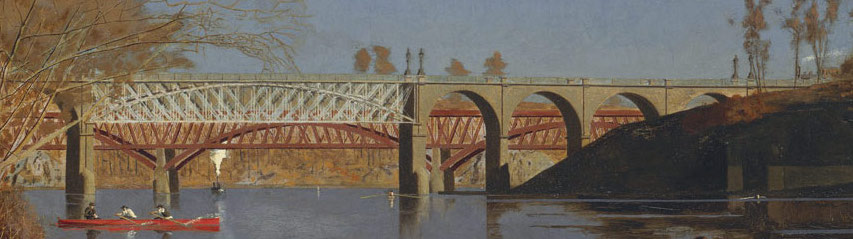
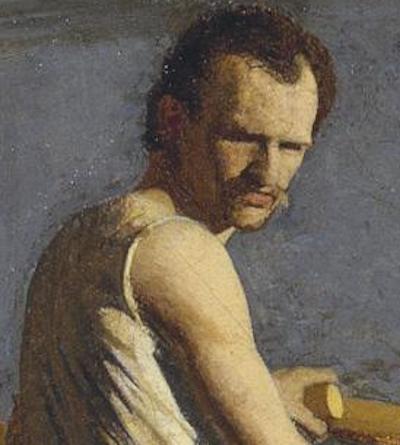
The painting is Thomas Eakins’s The Champion Single Sculls, also known as Max Schmitt in a Single Scull, completed in 1871. Click the image above for full enlargement. Schmitt, a friend of the painter, was Philadelphia’s single-scull champion several years. Rowing was popular then, and he was a well-known and well-loved figure in amateur sports across the nation, forgotten now. But I did not know that until much later, nor does Eakins show crowds teeming on the shores cheering him on at the height of victory as he crosses the finish line. He doesn’t even show him demonstrating his strength and skill executing a hard pull on the oars in tense, charged exertion. Rather he presents him dressed in casual gear during a practice session on a crisp autumn day, by himself, in a nearly deserted scene made luminous by a clarifying late-afternoon sun. Schmitt has just made a turn on the Schuylkill River and now relaxes, the wakes from his scull and oars leaving broad trailing curves that take us into the painting and set its composition, giving it its energy. To me, for so many years, he was only a man named Schmitt and he was just there, resting above the still water, looking out, balancing the oars in one hand, which more and more I realize is a marvelous feat.

The bridges are rendered in sharp, accurate perspective—Eakins was a master of the technique—but other painters had already begun to flatten space and dismantle it, taking art in rapid acceleration on an unknown path. And we see on the horizon the developing technology of the time, the train about to cross one bridge, a steam boat to pass under, this when our technology was taking off, with it, our mounting wonder.

Nor does Eakins show influence of the Impressionists, who had already begun exploring the transience of light and stating the primacy of paint, of colors. Above, Claude Monet’s Bathers at La Grenouillère, painted in 1869.

There is no evidence Eakins even visited the Salon des Refusés, and he had his chance. He was in Paris at the time, studying under Jean-Léon Gérôme, an academic painter who enjoyed considerable popular and critical success, for example with his Ave Caesar! Morituri te salutant (Hail Caesar! We Who Are about to Die Salute You).

Eakins has done nothing to alter the esthetic course of art or change our perceptions. He presents the world as solid, and academic rigor anchors his work. Yet the painting is alive, in the shimmering blur of brush along the shore, the erratic reach of the trees, the brisk scrape of clouds above. It succeeds at what makes any work endure, working within a form and giving it life and expression. I have never tired of looking. Each time it is fresh and vital.

He does make a break, however, and it comes from his subject matter, which was rejected by the official salons of Paris and shocked established Philadelphia. He has given us a common man not posing but relaxing in informal clothes, performing an everyday behavior without ceremony, without appropriation of past claims and pretense, in an ordinary place without hierarchy of space or institution. We have begun to look at ourselves and it is liberating.

Perhaps Schmitt is looking at someone on the shore, perhaps he is taken in a thought, or perhaps he is deflecting one. There’s a severity in his face and he seems to scowl, but he’s only frowning in the glare of the sun. His look did not put me off as a boy and must have instilled this note back then, that whoever, wherever we are, whatever we hope to be, we need to maintain vigilance, skepticism, and a measure of reserve.

Really, Eakins doesn’t give us much to identify him as an individual, but his portrait is made in the whole landscape, of which he is a part but where he keeps his separation. There is light. And there is transcendence, but where it takes us is back to exactly what we see, the clouds, the trees, the brush, the trailing curves in the river, and Max Schmitt resting above still water, looking out, balancing oars in one hand.

I have looked at the painting several times this past week, the week of election, for confirmation, or reassurance, or to restore a definition, and I realize how the painting has always stood for me, that it shows me what it means to be American, vigorous and assertive yet relaxed and open, and free of historical encumbrance; self-assured but not self-possessed and not afraid.

Failing that, it is a picture of what it means to be alive, to be oneself by oneself, and not be alone.

There’s a kind of idealism in realism, or can be, a belief that the simple fact of our existence is worth stating and preserving.

.

.

To St. Johns Bridge

And Thee, across the harbor, silver-paced
As though the sun took step of thee, yet left
Some motion ever unspent in thy stride,—
Implicitly thy freedom staying thee!

from Hart Crane, “To Brooklyn Bridge”

A routine is a repetition that both breaks the day and places us in it, giving our lives the appearance of structure, of order. A bridge is a repetition of structural elements that orders a way beyond our routines, to thoughts of other things, or that appearance.

I have a routine where after the morning’s work I walk to the St. Johns Bridge and down to the Willamette River. If I miss a day my life feels incomplete. I live across the street from the playground of an elementary school and leave late morning to avoid the shouts and shrieks of the kids at recess, an inseparable mix of joy and chaos, though sometimes I take their noise with me. By that time I’m fatigued anyway, and bogged down in some unresolved disorder. I leave thinking the walk will provide inspiration, that I will return with fresh insight and rejuvenated resolve.

From the east entrance

I descend a side street

down to Cathedral Park, beneath the bridge, where north Portlanders run their dogs, fly drones, and get married.

Then, after following a long viaduct of approach,

I reach a small floating pier, beneath the span, and walk to its end, my terminus,

where I take a break—I have a bit of a climb back.

And I stand and look out on the river, and free my mind, and wait to see what comes, from without, from within.

Designed by David Steinman, an engineer of considerable reputation, the bridge was the result of local initiative and remains a source of civic pride and identity. Boosters staged vaudeville acts throughout Multnomah County to promote funding; images have since multiplied across St. Johns, on the banner of the neighborhood newspaper, on storefronts, on posted bills and t-shirts. Construction started a month before the Crash of ’29.

Yet while it set several records when built, the St. Johns Bridge is not well known and pales before more recent structures that move us to greater awe. Really, there was no compelling need to build it and it serves no large purpose now. The plan then was to connect the small industrial communities of Linnton and St. Johns, some five miles north of downtown Portland. Today it joins no major freeways on either side. But that is what I like about it, a modesty that encourages intimacy, that it is not especially useful, that it is largely there for itself, that it is distant from the noise of our wonder.

The east anchorage expresses its mass in a squat concrete structure, the energy of its function in steeply curved posts and buttresses, this function formalized in a compressed stance embellished with abstract emblems and stabilized and capped with cornice work,

the energy released in the ascent of the cables to the towers, the cables carrying a tension hard to imagine,

the tension easing into the sweeping curves of the cables that hold the deck. The suspense of anchorage discharges in the process of suspension. The bridge entire, in the arcade of concrete piers, the latticework of trusses supporting the road deck, the network of thin cables holding the deck from above, scarcely visible, in the division of bracing within the towers—is a complex orchestration of compression and tension brought together into a whole that is graceful, effortless, seemingly weightless, almost ethereal. To me, with my limited knowledge of engineering, such a feat isn’t possible and the bridge is simply marvelous. My spirits lift every time I see it.

The bridge was built at a time when the ruling esthetic demanded an honesty of structure, a welding of form to function, and Steinman spoke to the integrity of his design. But another desire, another wish, competed with utility, the American technological sublime, which complemented then supplanted the natural sublime once found in the American landscape. John Roebling’s Brooklyn Bridge carried the spirit, and Steinman, like Hart Crane, grew up in proximity and professed his close attachment, its influence.

Then there is the other spirit. The gothic arch, once used to elevate belief and bring in light, provides the motif played throughout, in the concrete piers and components of the towers, arches of varying width, height, and pitch. According to Steinman the pointed arch added contrapuntal tension to the rhythm of the suspending cables, but the structure he called “a prayer in steel” also brought past associations and higher thoughts. Today, maybe only nostalgia, and fading questions.

I’ve had a touch of vertigo the times I have walked across, however. That used not to bother me. Yet it’s two hundred feet down, and when I look out from the deck I feel the downward temptation. There is this about bridges as well, that they move us to the edge, to another launching point. In the movie Pay It Forward a woman climbs on its railing to make the leap but is saved by a recovering drug addict who walks by and talks her down.

Still, the bridge is always there, a point of continuity and stability, an anchor of connection and communication with, yet also of structural separation from, with, from nature that surrounds, its variations through the seasons, with, from the ambiguous, overcast moods of Portland weather that call for some kind of brightness, with my shifting thoughts, from the fog of my moods.

But only this is certain one day to the next: our structures are just structures, our function is undefined.

I wait at the end of the pier until I realize I am waiting. Nothing ever comes, in fact I put my work aside and let it drift. But I always get this release, this revelation: I am free and I am alive, and I don’t have answers to anything.

.

.

Melancholia

We…advocate that melancholia be positioned as a distinct, identifiable and specifically treatable affective syndrome in the DSM-5 classification.

Melancholic patients respond better to broad-action tricyclic anti­depressants than to narrow-action antidepressants (e.g., serotonin uptake inhibitors). They respond well to ECT. In comparison to those with nonmelancholic mood disorders, melancholic patients rarely respond to placebos, psychotherapies, or social interventions.

from “Issues for DSM-5: Whither Melancholia?”
The American Journal of Psychiatry

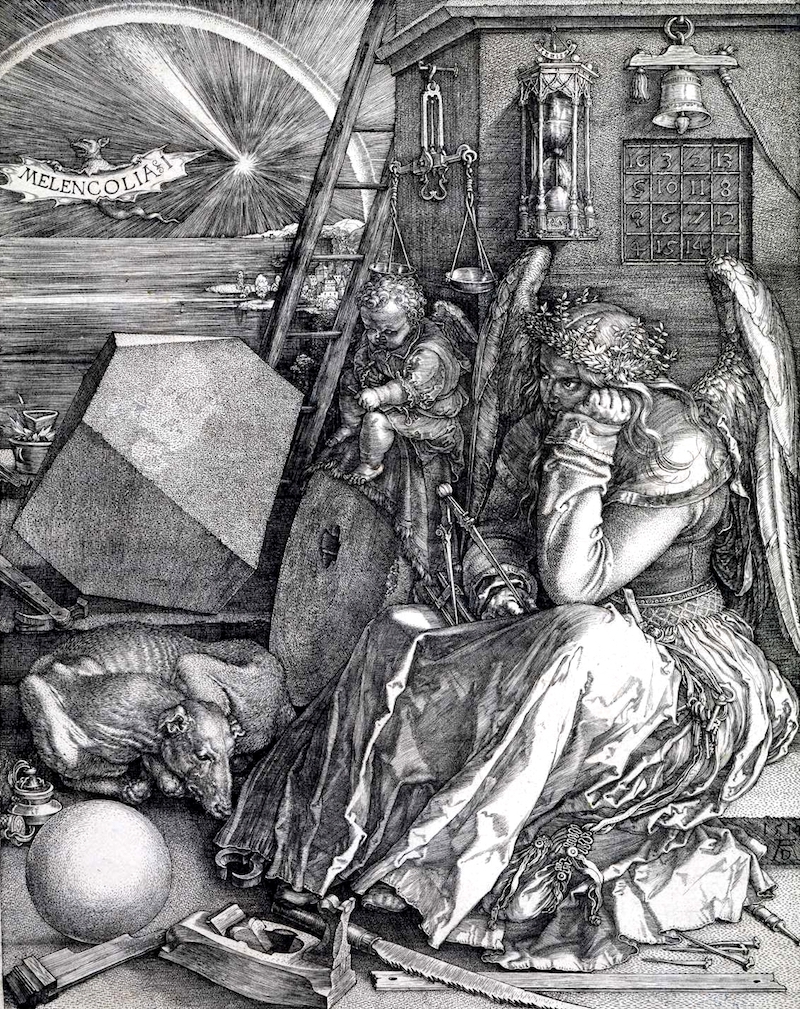
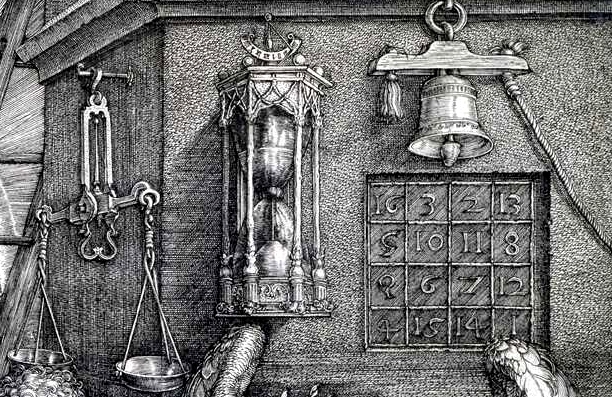
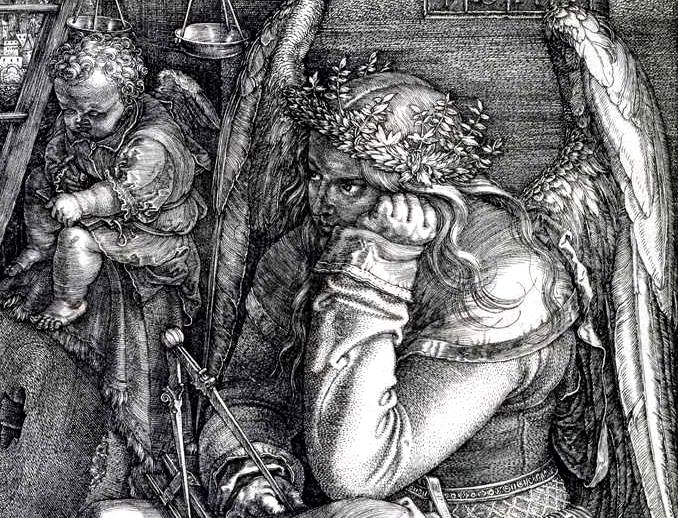
Dürer’s engraving Melencolia I draws from the theory of humors that goes back to classical times, where states of body and mind were determined by four essential fluids. It once was the basis of medical practice and found widespread cultural representation. Balance of the four brought health, but that was an ideal that we could not always maintain, or that not all of us could not find, or, in Christian times, a perfection none of us could reach at all since and because of the Fall of Man. A predominance of one in excess led to pathology, but in lesser amounts set phases we all went through or determined different personality types among us. I regret loss of this system, as it gave us variety and cut us some slack. Moody was something we could be. Today our vast catalog of mental aberration depends solely upon the empty term “normal” that is defined only by what it is not, that denotes a state that is a balance of nothing. Yet we stray from it at our peril.

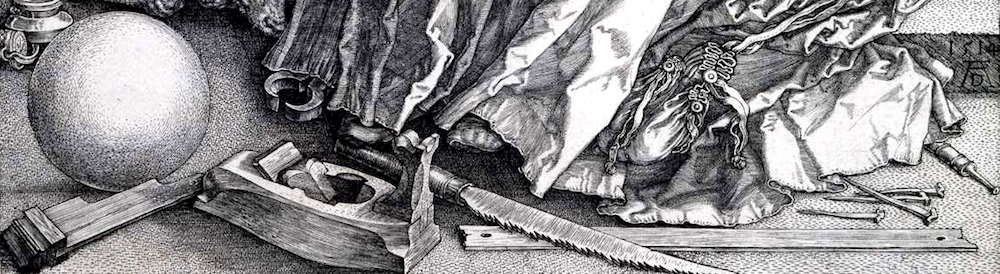
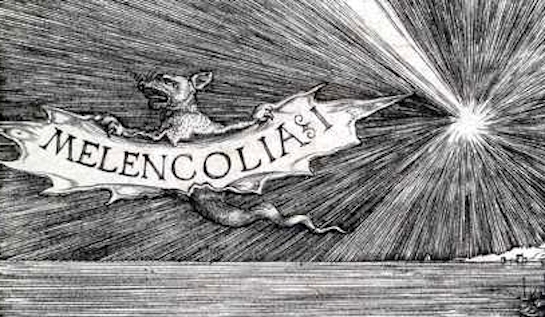
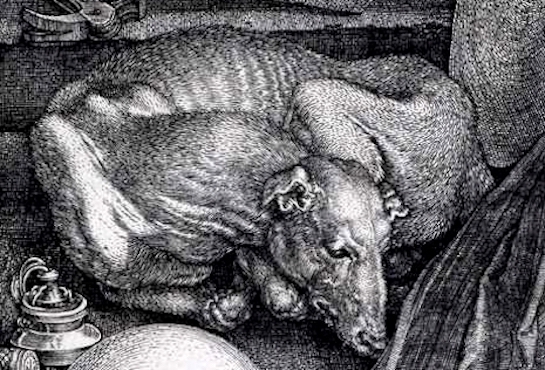
Black bile was the fluid of melancholy, which brought lethargy and stinginess. The melancholic was the most dreaded of the four personality types, as surfeit could lead to insanity and even death. Its representations, a grim miser clenching his purse, an indolent woman asleep at her spinning wheel, were sedative expressions that suppressed that fear. And intrigue—madness and death have always had that pull on us. Dürer’s figure, however, is not a common person but a winged angel, intensely alert and deep in thought, surrounded by the elements and tools of creation. Dürer has given us a picture of the artist, and in her face we see the power of her potential. But the tools lie scattered at her feet, untouched. She is grounded, locked in thought, does not fly, does not create, while in the background a comet flares and a bat cries terror. The dread has been released in a scene of darkness and disorder. I’ve had a print on a wall for decades, and every now and then I look at her for inspiration. She does not look back. This is as it should be.

Perhaps her block and the disarray show the broil and fruitless mulling that precede creation. But according to Erwin Panofsky, in The Life and Art of Albrecht Dürer, from which I take my material, that work will never come:

Hers is the inertia of a being which renounces what it could reach because it cannot reach for what it longs.

The artist is limited to the visible, what can be shown, what can be represented, and is removed from higher thought that might transcend, from the light of divine understanding, always beyond us.

But Dürer’s stalled angel also gives us one of the most compelling images of the artist we have. A picture that shows failure to create is a complete creation itself, consummate and marvelous in its workmanship, its expression. The midnight figure is bright in contrasts, the whites of her eyes against her somber face, the luminous folds of her robe against a darkened space. A scene of inactivity is charged with dynamic, in the energy of her arched wings, the push from the outlines of the many shapes, in the spiraling line of composition that runs from the eyes of the bat through the eyes of the putto, of the angel, of the sullen dog.

There is no contradiction in any of this, as there are no contradictions in art. Nor is there irony, as we see exactly what we should expect. We are shaped by our conflicts and contradictions, our reaches, our misses, and our doubts: these give us life. And the failure to represent the divine visibly points all the more to its invisible presence. It is our balanced, symmetrical representations and our clear resolutions into action that are ironic because they always fall short of our desires, of our projections, and they touch a different kind of madness.

The engraving is built on a correspondence of symbols based on theology, philosophy, and common understanding that connected the universe from the material to the celestial, that ran deep in Dürer’s culture. The four humors “were supposed to be coessential with the four elements, the four winds (or directions of space), the four seasons, the four times of day, and the four phases of life.” His angel, holding a compass, beneath instruments of measurement, echoes a prior woodcut “Typus Geometriae,” a woman representing geometry, the study that in the Renaissance was the foundation for creating art and understanding the structure of the world. Saturn, the original creator, inspired geometry as well as fueled imagination with furor melancholicus. The dog and bat were his. I won’t develop all the sources and connections, however, because I’d only repeat what Panofsky has so thoroughly and beautifully written. Also we know today none of the assumptions and correspondences are true.

But what we know is false now wasn’t true then, yet still we have Melencolia I, who still holds us captive. There’s a paradox here that needs to be sounded. If we reject the divine, and we have, we need to replace it with something else. Our lives, like our art, depend upon how much we can draw from within and reach without.

I will leave the magic square and the devices for measuring weight, time, and space hanging on the wall and ignore them. Mathematics, like our logic, we now know talks only to itself. They will also serve as reminders to deflect a world that cannot tolerate imprecision or imperfection, or indulges them too much.

I will keep the tools on the floor because I still have dreams of constructing and peopling homes and cities and worlds. But I will add a jackhammer and wrecking ball to test their strength, or demolish the facile abstractions that now surround us or any I might create.

The bat stays where he is, soaring above a leaden sea, who will scream my every waking minute to help me maintain vigilance, see terror overlooked, or induce it when I fall complacent.

I will get a dog, lean, clenched, and perpetually morose, and have him lie at my feet to anchor my flights.

And I will ponder my next project, moved by what is not there, what might be, what always never will be. Or let my amanuensis putto scribble away idly while I brood in dark brilliance and do nothing.

.

.

Riding to Apocalypse

And I saw, and behold, a pale horse, and its rider’s name was Death, and Hades followed him; and they were given power over a fourth of the earth, to kill with sword and with famine and with pestilence and by wild beasts of the earth.

Revelation 6:8

Franz Marc’s The Large Blue Horses—another work of art that has been with me almost my entire life, a print of which also has hung on a wall for some fifteen years, and I can’t remember when or where I first saw it. My best guess is in the library of elementary school, high up in childhood memory, among other paintings on the walls surrounding the low shelves that held books within reach of our hands and hearts and minds, appropriate for the course our lives were supposed to follow.

The blueness of the horses did not strike me as strange but rather was a given supported by the mass of their collective surge and the energy of the overall composition, their motion made significant by their self-possession, the color itself part of some larger motion I did not question and wouldn’t have grasped if explained. But what I took from it then, I think, is that there could be power in reflection and composure.

And the painting has survived the process of school, its ideas of itself, its upward gradations; and the rising flood of images that followed on screens and in popular print; and, when I studied art in college, the outline taught that put art on an ascending conveyor belt of movements. There is no such thing as progress in art or any permanence in our ideas and distractions.

Events from the last years and changes in my life and recent reading, however, have unsettled the painting and made me question its place now over my hearth.

Marc painted The Large Blue Horses in 1911, for many a time of alienation from and revolt against rapid industrial growth in Germany and the materialist Wilhelmine society it brought, when Nietzsche’s appeals for a return to Dionysian passions flourished, when crisis in the Balkans increased in pitch and European instabilities made global war seem inevitable, a war which many others found attractive, a world whose vast web of motives and intrigues most of us have forgotten, if we ever learned it.

What I’m supposed to say is that Marc was a German Expressionist, who looked not at the facts and impressions of people and nature and society but at subjective realities beneath the surface, at undercurrents of self and culture, and, hopefully, at something beyond and higher. The animals he painted represented human states and a desire to return to uncorrupted nature, nature expressed in ideal landscape. Marc created his own color symbolism, and blue stood for the male principle, serious and spiritual.

All these terms are as intriguing as they are slippery, ultimately meaningless.

Of course the painting is sexual, but that slant obscures as much as it makes clear.

But there is no escaping the sensuous, sinuous, swelling flesh of the horses or the suggestive pull of their movement or the tension of the contrasting colors. The rhythm of their bodies continues into and complements that of the hills and sky, positing larger context. The horses’ blue, a color that optically recedes, is placed in front, while the distant hills are painted the forward red, this atmospheric reversal closing foreground and background and increasing the break from expectations, moving us from the nature we think we know.

Horses themselves give pause—such large animals that are not predators, that possess great strength yet are graceful and reserved. A horse without a rider lifts the burden of possession and use, opening up possibilities and raising questions. With their bowed heads Marc’s blue horses submit to the rhythm and yet push against, parting the distended white trees that divide the canvas.

In 1913, the world closer to war, Marc painted The Tower of Blue Horses, where there are four blue horses now, vertical and rising, open-eyed and agitated, their flesh taking on the angles of Cubism.

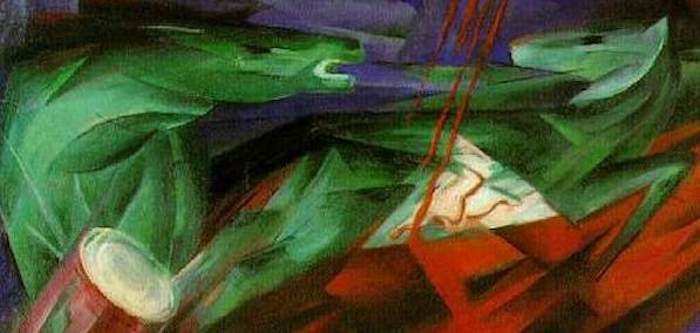
A few months later, war still closer, in Fate of the Animals the horses, frenzied and in peril, turn green, blue mixed with yellow, which, Marc tells us, “cannot still the brutality of red,”

in a picture that takes animals and landscape to the point of annihilation by the slashing diagonal lines, red flames, that dominate the canvas and set the fractured composition. An irony here—the painting was actually damaged in a fire and Paul Klee only partially restored the area on the right.

Fate of the Animals recalls Picasso’s Guernica, another painting of wholesale destruction and disruptive composition, his response to Franco’s request to bomb the town, Germany’s tuneup for the next world war. Both have since stood as pictures of the horrors of war in general, of civilization on the brink.

Marc also shows the influence of the dynamism of Futurism, though with inverted intent; Picasso continues his cubist experiments in his synthetic phase, with clearer representation in his angled shapes. These maneuvers are not advances, however, but adjustments to match the subject. But the breakup and rearrangement of parts does not create chaos but rather gives coherence to disorder, and with coherence, the terror of beauty.

Most have taken the bull as the source of the massacre, representing fascist brutality, and the horse stands for the slain innocents, their agony and death. The bull alone is passive, however, with a stilled face that is hard to read, and Picasso used the figure for other representations, including of himself. Guernica is direct in its images and but ambiguous in its meanings, leaving unanswered questions. The bull also leads us to the Minotaur and the labyrinth of mythical meaning. Still, there is the overpowering sense of revulsion at something we have done to ourselves.

But in Fate of the Animals the source of destruction is external, coming from some unseen force above, beyond our agency, entering the canvas in the flames at the upper left and rebounding and continuing their destructive course across the picture plane. It is, in fact, a picture of apocalypse. Frederick Levine, in The Apocalyptic Vision, makes a convincing case, explaining how Marc drew cataclysm from Wagner, from Nordic myth. The long column that slants left against the flames is Yggdrasil, the eternal ash, which shelters the four willowy deer on the right, who alone will survive to start a new race. Apocalypse is not just inevitable, it is desired.

We know that everything can be destroyed if the germination of a spiritual race does not endure the test of the greed and impurity of the masses. We struggle for pure ideas, for a world in which pure ideas can be thought and can be expressed without becoming impure.

Marc saw the war as the coming apocalypse and volunteered early, before conscription. It was something he had to witness and endure. But the imagined glory of the past that others wanted restored was what he wished to see destroyed. Like them, he had no idea what was to follow.

The combat of the infantrymen which I witnessed yesterday was incredibly hideous, more horrifying than anything I have ever seen. I was totally shaken last night. The courage with which they advance, and the indifference, indeed, the enthusiasm for death and for wounds has something mystical about it. Naturally, it is a mood of reconciliation, the clarification of something that was previously uncertain.

Purity is a trap, a dead end, and this is pathology. Marc, who was given to bouts of depression, has surrendered to his mood and in self-immolation projected it into unnamed abstraction. Spiritual shell shock here as well, as the pathology of the self meets the pathology of the world in a landscape of death and shattered mirrors.

And the apocalypse of Fate is what The Large Blue Horses leads up to, what stirs the trio in their lowered gaze above my mantle. Reading Levine forced reexamination of the painting and led me in downward spiral. My living room deadened in its plane and turned into a no man’s land, a grayness spreading to lifeless winter trees outside my windows, to lifeless streets, and lifelessness beyond, endlessly. Everywhere I went I saw entrenched lives and, on faces, in reports from around the world, the signs of dissolution and breakage. I avoided looking at the painting, then started avoiding the room. I long debated taking it down, not finding resolve.

Nietzsche’s descent into madness, legend goes, began with the sight of a beaten horse.

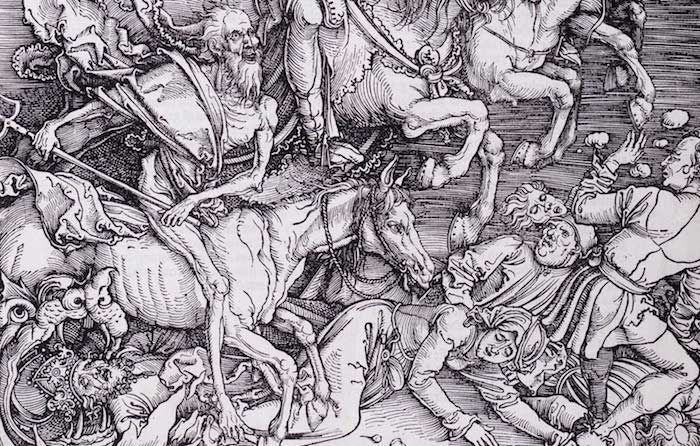
But psychology is sterile reduction. And to reject myth as superstition is to deny its power and persistence. Some notion of apocalypse has been with us a long time. It may be one of our earliest formations. In Dürer’s gorgeous woodcut the four horses unleashed in Revelation take the riders who scourge the land, necessary preparation for a new heaven and new earth. Destruction precedes renewal—or is it merely the underside of our highest, purist aspirations?

It is impossible to recreate the confusion of thought and emotion of Marc’s time and get a fix, but it is just as impossible to gain footing now in a world certain only of itself, not going anywhere at breakneck speed, where wars are fought by others and victims most often are others and apocalypse has become a casual diversion in movies and video games.

Too often when we read biography into art we only read ourselves. What I most became aware of looking at the Blue Horses was myself, a depression that came from within and radiated out. The signs of breakage were still there outside my windows, however. They are still there. They have always been there. If I hadn’t noticed them before it was because I wasn’t looking.

And I don’t know if a glance towards apocalypse isn’t what drew me to the painting over fifty years ago.

Only by risking everything do we know what anything is worth.

Or:

We risk everything because we do not know what else to do.

I have no idea which is true, if either.

I only know the old man will always be with us.

And that if I take the Blue Horses down I will be lost.

Slowly, cautiously, I have returned to their coiling, inward gaze. Color has returned to the room, slowly, cautiously, and leaves have returned to trees, and grasses return to barren fields and softly fill furrows and cover mounds though from which chunks of old concrete still protrude, though a grayish mist lingers over all.

March 4, 1916, near Verdun, Lieutenant Franz Marc rode a chestnut bay out on a reconnaissance mission and did not return. He was killed by shrapnel, French or German, no one knew. Another irony. The world is littered with ironies.

.

.

Above the Roofs of Paris, A Non-Memoir

Tout pays où je ne m’ennuie pas est un pays qui ne m’apprend rien.
Any country where I am not bored is a county that teaches me nothing.

Camus, “Death in the Soul”/“La mort dans l’âme”

I’m not sure bored is the right translation—s’ennuyer touches on several different moods and I wonder if English handles well the reflexive verbs. But I think boredom means something else to the French, certainly to Camus, different from what it means to us.

I arrived in Paris the summer of ’73, late morning to a cloudless sky, with little money and almost no French, not knowing where I was going to sleep that night. I had no strong reason for being there. I was 20, and like the rest of the U.S. I was full of anticipation not based on much anything substantial.

Why look back at that time now?

I had finished my junior year in college and felt I should learn another language, thinking I might learn it better in place. French because several works engaged me, Camus’ The Fall, for example, for its absolute irony, what that pointed to, for its introspection, an inward cast that threw the outside world into a different light, unrelenting.

The last thing I want to do is write a memoir. I am not a remarkable person and I do not want to be in that position. Nor am I interested in being interesting, least of all to myself. Besides, it’s impossible to get anyone’s attention now. And if I’m supposed to make a confession, what am I supposed to confess, to whom, and why?

The Alliance Française was my first stop from the airport, the state school that teaches its language to the world. I enrolled for classes and at its bulletin boards ran into another student who told me about a hostel across the Seine where I was able to stay a week, having to change rooms twice. My plan was to remain for the summer. I had about enough cash to fund myself if I were careful. I started classes and kept looking for another place to live, beginning my branching out into the streets of Paris, hobbled by my lack of French and knowing little about the city. The first days were charged with uncertainty and possibilities beyond imagining.

Really those days were a static nothing. Only now do I realize what I felt was exposed. Nothing remarkable happened in the months after. I have nothing exciting to report, nothing that might entice, that might set me off from the crowd who preceded me. But plot works on the assumption that we have power to act in the world and effect some kind of difference, that action matters, that change is always possible, always worth the while. I gain nothing by trumping up the superficial, and it may be the expectation of plot that I most want to defuse.

At the Alliance Française I ran into a Cuban woman from Michigan who told me about her room that she was soon leaving in a house in Arcueil, a commune just south of Paris. I met her there to check it out. It was close to a Métro station and I could afford it. We talked for some time, opening up—travel does that to you. She had just returned from Italy where she said standing before Michelangelo’s David gave her an orgasm—

If you need sex, watch René Clair’s movie. Better yet, read Henry Miller’s Under the Roofs of Paris. None of us can top that.

By the end of the summer I hadn’t learned much French and felt I had accomplished nothing, so I decided to stay. I did find some work that stretched my funds, again at the school bulletin boards, small jobs getting paid to hold conversations in English with French students and employees learning our language, for which there was demand. English had established itself as the international language, or at least the language of international business. Later I got a part-time job teaching English to bank employees that allowed me to stay another ten months, giving me more time for whatever I hoped to happen that hadn’t happened yet.

I am not going to add judgments of the French, unless I let a few slip. I hadn’t developed much perspective on anything that might have led to insight. Also a year is nothing and my exposure was slight. I wouldn’t trust anything I might have to say now, either, based on what the next forty years have brought, in fact would trust it less. I do want to note, however, that once I broke the crust of their exterior, the urban reserve, the formal skepticism, I didn’t encounter any Parisians who were not kind.

More, I don’t see the point in piling up details, interesting or not, as if accumulating them means anything, as if recording my experience somehow puts me in the world and makes that place significant, gives my life some sharp cast, makes it “real.” Authenticity is an illusion, a trap. Still, I will need to try to locate myself, and there are places, and moments, and people whose existence I want to preserve.

Really I didn’t go to Paris because I wanted to learn French. I only wanted to get away—somewhere. I didn’t want to return not because I had something to stay for but because I had no idea what to do with myself when I returned. At 20, I was already stalled in my life. I had every reason to believe I could pursue a life of material comfort with some kind of status, but I couldn’t see myself in any profession, lacked confidence, and had no conviction, much less desire. I had no special talents, had developed no craft or set of skills, no body of experience or knowledge about anything to make any kind of judgment or decision.

The received notion—idée reçue—is that I hadn’t yet learned how to live, that Paris opened me up and helped me find myself. There are serious problems with all the terms, though in a way that is true. But Paris wouldn’t change my lack of resolve, rather, though I didn’t know it then and couldn’t have, made me acutely aware.

Yet really that is what I most want to recapture, the uncertainty, the exposure, the stripping of the self, to see what might be left, or maybe just the stripping. I don’t gain anything by moving from A to B with climax C in between or by going back to see where I am now and making some kind of comparison. What I want to do is find again that point, a place not for starting over or revision or regret, but for resetting, or better just rest there, discover once more what might have been overlooked had there been remarkable events, what it might mean to be bored.

.

There is a time for action, however. There is always a time for action.

.

“Death in the Soul” is an early literary attempt about a week Camus spent alone in Prague. He was only a few years older than I and like me had little cash and didn’t know the language. His days were spent wandering the streets, and he recounts largely mundane events and simple, meaningless contacts, feeling trapped by aging Europe, the walls of the past. He experiences an intense despair that appears gratuitous, though with Camus we know that is not the case, his despair relieved only by his journey further south, to open, warmer climes, a warmer spirit.

Man is face to face with himself: I defy him to be happy. . . And yet this is how travel enlightens him. A great discord occurs between him and the things he sees. The music of the world finds its way more easily into this heart grown less secure.

Yet he qualifies himself, as he does in his remark about the lesson of boredom. It was a thought, he says, that helped him get to sleep. The Prague he visited returned a bitter smell and anguish, not enlightenment, noise instead of harmony, a dead man instead of life. Camus will not rest in his debate between the individual spirit and the world, will not rest with anything, and if his despair appears gratuitous it is because in the face of uncertainty—uncertainty in the larger, or, really, its immeasurable sense—everything we might conclude is tentative, any action without anchor. Absurdity for him is not a stance for a pose. And “Death in the Soul” is not a memoir but a literary staging for youthful mood and later thought.

So much of my time was spent wandering the streets of Paris as well, getting lost in the labyrinth of the narrow, old alleys only to be released into wide boulevards, the plan of Baron Haussmann, its argument between the state and its people—the suspicion has been leveled that Napoléon III wanted to broaden the streets to make it easier to bring in troops. Read a history of Paris and the streets fill with the shouts of protest and run with centuries of blood. There were other arguments, other expressions, other architectural containers and releases, the accents and structural reasoning that gave them face, the flying buttresses that held them up. And there were other places where one could get lost, dark containers of hidden life. Paris is a public encyclopedia of a millennium of the debates between order and chaos, between the passion for order and the order of desire, so many unfamiliar. I didn’t feel trapped but overwhelmed and uninvolved. Yet Paris is a horizontal city, closer to a human scale, seldom rising above seven or so stories. When you look up, you see only the sky.

Language connects us to the world; not having it cuts all ties. Simple but essential day-to-day transactions—buying food, finding a place to live, knowing the laws so as to follow them or steer clear—were a strain, and I often failed. Not knowing the names of the multitude of routine things that define daily life made them hard to get. Even when I developed a functional control, Parisians often pretended not to understand me, probably because of how I butchered the words. They are proud of their language in ways we are not. I lacked sensitivity for the sounds of vowels, which carry sense, and was stuck in my thick, Southern ar, unable to make the French (Crachez!—spit!—one instructor told me). Nor did I ever learn to deliver their formalities of address, which I found excessive, with any confidence or grace. Informalities, the words that breach walls and initiate closeness, I missed at every turn. False steps in both led to injury, offense, or pity. As for slang, forget it. Slang is for the adept. I was always on guard and almost never felt at ease when I spoke. Most, it is irony and intonation that give language meaning, the art of slanting words to put them in their place or take them to heart. I could manage neither, and the sentence Je suis seul was only a sterile formula that had no impact whatsoever.

As for my own language, my English words were seldom returned. I steered clear of the hordes of American tourists, the tourist spots. My faith in talking to myself in my own tongue, my means of self-reflection and self-definition, began to slide. My patron saint, I suppose, was Denis, who, decapitated by Roman pagans in the early years, picked up his head and wandered Paris, legend goes. Saint Denis, however, preached all the way he walked. Where he stopped and died, a shrine was built, later a church, a burial place for kings, the church later enlarged and opened up by Abbot Suger to allow entry of the light of the Word, its union with royal power. I could only mumble and never stopped wandering. Built on top, all the lines of construction around and above me where I found no intersection.

.

While Camus knew unrest and oppression at home in Algeria and was sympathetic, neither “Death in the Soul” nor the other early lyrical essays, written in the mid-1930s, anticipate our soul’s greatest crisis, the massive disruption of reason and wholesale death of the coming war that charged his later writing. Maybe in his despair, the deadness, a hint, but the next years may have beyond the imagination of most of us then. Then again, it was from our imagination that the beasts stirred.

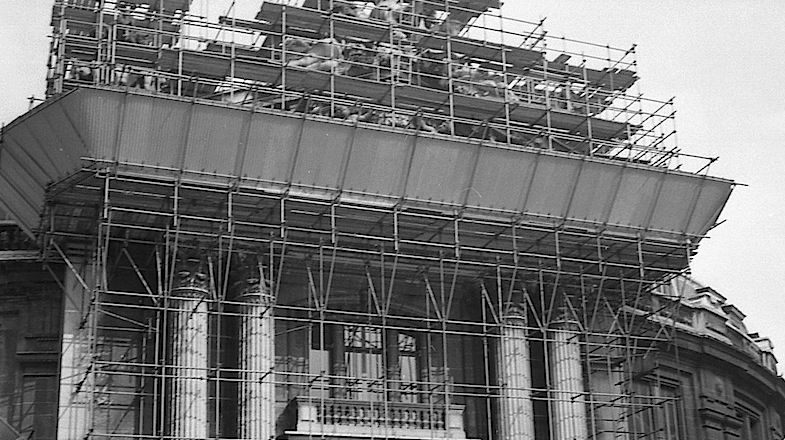
When I arrived, the defining events of WWII had long passed, but with what resolution or understanding? Paris was in the last stages of the Malraux plan to clean its buildings—there was still scaffolding up throughout—while France was adjusting to its declining influence. Restoration gave the buildings a fresh face on the present but lost the impact of the past, surface without the wear of turmoil, display without visible reference. Like the rest of the western world, France was in recession, and the foreign workers welcomed in better times were gathering in slums on the city’s borders. Demolition of Les Halles, the ancient central market made stately in the 1850s with elaborate iron and glass framing, was nearly complete, leaving a huge pit the city debated how to fill. That pit was also the setting for the climatic scene of Touche pas à la femme blanche—I saw it when it opened—a rather glib movie that appropriated Custer’s last stand to represent France’s capitulation to the influence of power and money, notably ours, the waning of native ideologies.

There were student demonstrations in the streets, though none that approached the fervor of May 1968, protests against what they thought the CIA, and by extension the U.S., had wrought in the postwar world and in fact had, still tremors against the overthrow of Allende in Chile, the persistence of our Shah of Iran, and whatever else they thought we might be doing elsewhere in the world and probably were. More generally, resentment lingered over the recently completed Tour Montparnasse, an utterly bland sixty-story skyscraper that broke the horizontal line of the city, blamed on a corrupting American influence. I simply took the tower as a given, what I had learned to accept as a symbol of progress, or maybe better an idée reçue, which I began to question. At six-foot-three I was a tower myself among the French, often brought to my attention—I was dubbed le grand Américain. Bland yet imposing, like Montparnasse, I began to doubt my own construction, what I showed the world, what I contained.

Meanwhile at home—I’d read the Herald Tribune on occasion—with the signing of the Paris Peace Accords we were quickly putting Vietnam behind us. The Watergate hearings gathered momentum; long lines appeared at gas pumps.

I don’t think anyone knew what would happen next or what was supposed to happen or had solid plans or substantial purpose. Like me, the western world was in a stall, that world left with what it had brought within its borders, what it had left unresolved without.

.

There is a time for action. There is always a time for action. But the times when we have moved ourselves to act the time for action has long passed.

.

I think it was early morning I saw him, daylight even, a faint, grayish sky not promising, not anything, but that still cleared shadows from the buildings. Maybe I was returning from seeing F—. A street cleaner, he was standing bent over his broom, looking but not looking at the street or beyond him, at the receding prospect of his work, the endless web of streets, the broom an impossible device with a long handle and narrow, conical head, long bristled, like a witch’s. African, most likely from one of France’s former colonies, his face was beaded with tribal scars and he was wearing the official thin, pale blue smock given by the city and on his head a flopping knit cap, rainbow colored, his own touch, his culture’s, but the bright colors not illuminating but withdrawing from the grayness, his face showing not an expression but its removal, and in his eyes a burning look that still burns in memory, of pain, of complete isolation, and still of something else and nothing, a stark nothing. . . .

.

I was not alone.

I was not alone, only distant. And my life in Paris was not idle but full of contact. Yet while Paris is supposed to be the city of style and lavish emotion, most I encountered, even as I went up the scale, lived closely to their means and practiced a material reserve I hadn’t known. Clothes were put into service for long stretches; appliances were not a given. My landlord took his bike to work, and the doctor who came late one night when I had an attack of appendicitis rode a motor scooter. I felt a superiority that embarrasses me now, if it didn’t then. But I had to adjust myself as I was living on only about two hundred a month. Of course that was not hard to do and my condition was only temporary. I did learn a leanness, however, that has since served me well. My poverty in language meant I also had to practice another kind of reserve, guarding my emotions since I did not have the means to purchase them. At least what I could not accomplish in spirit did not get poured into costly substitutes.

The house in Arcueil was in a working class neighborhood of other small houses abutting, where many were communist by circumstance and tradition, not intellectual choice. My landlord once showed me a slideshow of his vacation in Moscow; we were both impressed by the subway stations. It was a simple stucco two-story with a tiled roof and little ornament. The family lived on the first floor, my landlord and his wife and two daughters, and they rented out the second, three bedrooms, a small bath, and kitchen. My room had just a single bed, a simple desk and chair I think, some kind of armoire, and one lamp, all the furniture needed, though, for philosophy or a revolution. My window opened south, looking out on Paris but not showing much. Jacques had the other front room with his girlfriend, largely accounted for by its double bed. A couple from Martinique had the back. The kitchen was our common room, where complex arrangements had to be made for cooking, along with others in the bathroom.

One or both of the Martiniquais worked for a ministry, as did Jacques, Youth and Sports. The Martinique couple were quiet and forcibly polite, the brief moments I saw them in the kitchen. When their bedroom door was closed they fought incessantly, shouting at each other in rapid fire. One morning I found blood in the bathroom. I won’t even hazard a guess as to causes. The source of their tension was hermetically sealed from the rest of us, maybe from themselves as well.

Jacques, however, was open, befriended me, and became an unofficial ambassador of culture, high and low, formal and counter. He winced at what I ate, and one Sunday took me to the nearby outdoor market to shop, then prepared a full course meal, inexpensive but distinctive, the hallmark of French cuisine, a kindness that was probably also meant for my instruction. He taught me the slang and standard jokes, none of which I dared try, and corrected me when I attempted standard French and passed on his copy of Grammaire Larousse, along with his little red book, L’indispensable Paris par arrondissement, the collection of maps of streets, both of which I still have. He mentioned in passing literature recent and past, encouraging me to read Bouvard et Péchuchet, Flaubert’s novel about two bonhommes who try their hand at just about everything and fail—for the vocabulary, he said, but I did identify with them. I also received brief lessons on French history as well as current events, along with opinions on the newspapers that covered them. Le Monde had his respect, as did Charlie Hebdo, with a sideways laugh. In case I had missed it, I got the standard criticism of the U.S., but also of France—corruption, alcoholism, the oppression of institutions, including his, his concerns for the future of his, its youth. And I got tips on shoplifting, minor, of course, and only at the large stores, for the principle, a way of getting back. Not tried.

Some of his knowledge came from school, but I suspect he picked up most of it on his own, not for diversion, however, or appearances, but for survival. He had it rough growing up and had to fend for himself early on, so he needed to build an identity based on something that would hold him up, that he could live with, one that pitted knowledge against what he saw in life, that could not afford to indulge itself in affected stance. Liberté, égalité, fraternité, the French three-part motto, often came from his lips with pride as much with skepticism and even derision because of their absence, a questioning of those who said them, their motives, as well as of the qualities themselves. Freedom does not come cheap.

We had to speak in English, though, where he struggled, as I couldn’t hold my own in French, and this is my great regret, that I put him in an inferior position that did not allow him to speak full voice. I know it was a strain.

My first work, holding English conversation, took me across the social spectrum and into many quarters I would otherwise have overlooked, inside the personal interiors of apartments, up to attic rooms, and out to sidewalk cafes, their mix of local traffic. The employment bulletin board at the Alliance Française was always covered and served as much as an informal portal for interchange, exploration, and ritual connection, one, I’m sure, of many in Paris. I talked with university students from whom I heard the student rant and banter. It was how I met F—, who was studying for her maîtrise. Also a spirited secretary, a virtuoso at gossip, and I had a chance at an artist, who interviewed me in his studio but turned me down. A young ministry employee, lower level, learning English to advance, whom I met at a café, was soon joined by friends in his or other ministries, who grew to a crowd, ministers themselves to political positions across the board—a cheery communist, a Peronist, socialists of varying degrees, a few who were apolitical, one seriously, another seriously not, still others, and even a sullen National Socialist—yes, a Nazi. Politics got debated in lively crossfire, along with just about everything else under the sun. And in one of the better quarters I tutored a ten year old boy, J.P., whose parents were quite well off and well connected. His mother, Mme S— traced her ancestry down to a Roman solider passing through southern France. However much I might have resented what they stood for, I did not recognize the signs of their status, foreign to me. But they did not force those on me, in fact, after the lesson, I sat at their table for the lengthy family déjeuner, formally casual, and was treated as a guest, where cultural debate took other turns, though largely was politely avoided.

All the talk was in English, since that was my job, so it varied in completeness and perfection. As with Jacques, I was putting them at disadvantage. But I was the one who held back, not knowing what to say before lives similar in some ways but in many others different, ever uncertain of what I represented, ever distant, distant from any self I could name.

.

J.P. soon wearied of his lesson, and I sometimes filled out the rest of the time sitting with Mme S— in baroquely curved chairs at the dining room table, chatting idly, a fleeting intimacy beneath the glints from the crystal chandelier overhead, feeling, maybe, but only slightly, I had stumbled into a Henry James novel. She was an open, gracious woman, and it was one of the few times I felt comfortable speaking French.

One day, while I was at the café waiting for my ministers to arrive, I noticed a woman sitting at another table, striking in several regards, lâche in others, her posture, her pose worth a Manet study, her hair the same color as the Irish setter who lay at her feet, striking himself. Two men came up to compliment her on her dog. The one with the mustache began petting him with increasing vigor.

Doucement, she said.

When Jacques took me to the open market to shop for the dinner, he stopped at a stall to buy grapes and asked for a smaller bunch.

Je peux vous les couperI can cut them for you—the woman behind, provincial, young but worn, said with acid. Jacques recoiled with a smile.

It was a common joke, a rallying cry of sorts. What could be cut, he explained later, were the male parts. A pair of severed testicles once appeared on the front page of Charlie Hebdo with the headline Ne coupez pas!

Desire, of course, was everywhere on the surface, and its obverse edge.

.

Culture, learning the language, did not cost much at all.

The Alliance Française, on Boulevard Raspail, was close to the Latin Quarter, near the Luxemburg Gardens, the universities, the sidewalk book stalls. Tuition was modest, and classes ran in units lasting a few weeks, a constant rotation of instructors and students from around the world with varying needs to learn the language.

A random few students:

A black Algerian worker out of work, who battled his version of the language against the state’s.

Nuns from New York, preparing for parochial school, probably. How flat their voices, how little music, the Irish woman next to me once said, whose husband had relocated to Paris for business.

A Cambodian who saw no problems with the Khmer Rouge back home and was planning to return.

Two instructors, memories of whom have most survived:

Mme Veulter, a handsome older woman with a long face that showed dignity and ironic reserve prevailing over the lines of wear, who was well versed in many fields, stately, magisterial even, but also forgiving, who endured our stumbling without disdain.

Mme Beaurain, young, short, with a straight posture not rigid and a strong, attractive Gallic face, her head always up, her hair in a tail that hung to her waist, her poise, like her voice, a springboard of energy and intelligence, her tail keeping the beat with her vibrance. And she’d look at us and listen as if we were spirited and intelligent, too. She was working on her doctorate, in political science, I think, or comparative literature, or maybe both.

For both women, speaking French, as well as teaching it, was a way of being, and their bearing as much as anything they said or did encouraged us to persevere and believe in our study. Both, too, I’m sure, had higher ambitions. I doubt they were paid much.

I went to every art museum I could find as well as some plays and movies, all inexpensive, though with the latter I had to rely largely on faces and gestures. I did develop an ability to listen to formal speech and sat in on lectures at the Sorbonne and other university branches. If I knew the subject I could follow fairly well. I doubt, however, knowing the language better would have helped me with the poststructuralist F— recommended, where I discovered new ways to get lost. I also learned to read French and read its literature for myself, without plan or guides. I crawled through Balzac’s Le Père Goriot on my hands and knees, looking up words about every other sentence, struggling with the student Rastignac to escape the squalor of Mme Vauquer’s boarding house, richly detailed by Balzac, and make my way through the novel and up, out into its world, powered by his moral engine. But I persisted, and words began to return familiar and take on the emotional cast that give a novel’s world coherence, or at least this appearance. I also read Zola’s Germinal, descending into the bowels of France, the coal mines, emerging with the strike, and Stendhal, and Flaubert, and later Proust. I found it easier to live in the 19th century works, steered by the authors’ direct passions, or Flaubert’s passionate distance, their clearer sense of motive, of failing, of conflict within the self, within the world, between the two, or those appearances. I could even rise to Proust’s meditative reflections, the quiet, subtle mysteries of ordinary things and common sensation, to the possibility of transcendent connection, of climbing his enchanted ladder, yet another appearance.

All of which fell apart in Camus’ simple Stranger, which I did not find simple at all. Informal speech in life is difficult, clipped as it is by what we assume is understood by our listeners, what we cut off from them and even from ourselves that is not. In a first person narrative the cutting extends several levels more to what the writer, the world, clip from themselves, the gaps between the words compounded to orders beyond sortable complexity. Aujourd’hui, maman est morte—the first sentence took me nowhere, not even to Meursault’s disaffection. I had to keep the English translation close by to enter the novel’s mood and distance, and still may have missed.

The simple things in life are always hard.

The first effect of all this exposure is destructive. Learning a language from the start is to trap yourself in the basic yet unfamiliar structure of its grammar and be left with the filling in of slots with words without creating meaning or connection. Sitting at desks and writing the dictées, speaking the other drills, is to be reduced to a child in grade school again, sitting lost at your desk, hands folded, straining to keep up, to pay attention. Répétez, s’il vous plaît—the words often repeated themselves by our instructors—still echo in my head. Going to museums and standing for hours is to endure sore feet and tired eyes and an aching head while you try to come to terms once more with the basic language of space, the possibilities, the possible meanings of perspective, from the flat, gilt, ritual space of saints and Christ to the vast stages set, deeply reasoned, for rulers, other superior persons, their conquests and trials, the figurative display of the ideas of state and religion, of belief and social order, then to be thrown back to the close, ambiguous spaces of ordinary people and common scenes, transient impressions and interior moods, unreasoned yet sensual, yet expressive, only to see space exploded, perspective challenged and thrown out. Art forces you to question how and what you see, your ability to stand in the world, the terms of stance.

As much, however, to look at art is to be exposed not just to the world’s projections, but also to its own uncertainties and doubts, its disarray, its turmoil, its explosions and collapses, winged Nike of Samothrace celebrating victory armless and headless, flying above the starved, maddened wreck of humanity left stranded on the raft of the Medusa.

And to read for yourself is to cut yourself adrift.

Culture, like freedom, does not come cheap either. I don’t know how we got the idea that art is supposed to divert us.

I also was exposed to something else quite common, not of culture but its depletion, or its antithesis, or its failure, yet which at twenty I had not yet experienced, the grind of routine, the questioning, pervasive and unresolved, from the wear of life day to day. On a tip from another American at the Alliance Française I discovered an agency that brokered English teachers, and after a cursory interview was given an address off the Champs Élysées, where I taught from scratch beginning English to bank employees, who stayed after work several nights a week and bolstered themselves after a long day to learn our language and meet the challenge of the growing influence of the world’s business. While roles were reversed—I was now the teacher—I was still constrained to converse on a basic level. I also found I didn’t know our language as well as I thought—our verbs, for example, while irregular in construction, give a complex dissection of time—and had to relearn it. Then, after the lesson, it was on the ride home I learned the meaning of another three-part expression Jacques taught me and often repeated, what I’d see on his face when he returned from the ministry, then saw on all the faces, métro, bureau, dodosubway, work, sleep, though he gave dodo another interpretation he explained with a gesture—that countered liberté, égalité, fraternité, or left it hanging in air, that dissolved distinctions one might make in time.

I took the southern perimeter line, Ligne 6, that ran from Charles de Gaulle/Étoile to Nation, that had not yet been modernized, that still had the old metal cars with wood seats, that still ran on steel rails, ran slowly, seemingly endlessly with its many stops, home, the next day, distant thoughts, put on hold, a timeless stalling, and all the cars were always crowded to capacity and most of us had to stand, standing close to but not looking at each other, or at anything, not even at the distant view of Paris opened up where Ligne 6 ascended on elevated tracks and crossed the Seine, that tower, the parks, the monuments, the boulevards of Haussmann, and we were always silent, our weary faces without expression, our suits and dresses rumpled, our painted faces smeared, our hairstyling unraveling as the train lurched and screeched and the mass of us absorbed the jolts and readjusted and returned to our weariness, our massing, our not looking, the burnt, electric smell of the train, the ozone of its sparking mixing with our stale breath, the stale wine on our breath, the faded perfume, the unsortable mix of smells of perpetual mass human wear and use, vaguely foul and uncertainly human, and as the train moved away from the Elysian Fields, the more affluent got off, leaving the less, their dress, their unraveling, other smells of mass the same or slightly different or greatly so but no more or less sortable, and then the train descended once more underground, taking us, the apparitions of our faces fading, wilted petals, down to a blackness. . . .

.

As I told you, it’s a matter of dodging judgment. Since it is hard to dodge it, tricky to get one’s nature simultaneously admired and excused, they all strive to be rich. Why? Did you ever ask yourself? For power, of course. But especially because wealth shields from immediate judgment. . . . Wealth, cher ami, is not quite acquittal, but reprieve, and that’s always worth the taking.

Jean-Baptiste Clamence, Camus’ judge-penitent, tells us in The Fall, speaking from the heart of Amsterdam, a city he likens to an inferno peopled with bad dreams.

What have we accomplished in the last forty years other than build more tall, bland towers and wage senseless wars and run ourselves into debt?

And write memoirs. James Atlas, in “Confessing for Voyeurs,” which came out some years back, reviews the deluge of memoirs from writers and academics, who detail their sex lives, their obsessions and their other oddities, in a rush of words embracing the urge to confess and be seen. The masses have joined in with similar. Another writer for the Times found at Amazon from 40,000 to 160,00 books of memoirs, depending on the search. Personal blogs now number in the millions. I wonder, though, if it is a matter of confessing—do we really care what anyone else thinks?—but rather we are deflecting judgment with another kind of reprieve.

Clamence speaks to us directly and on every page strips the mask, peeling the onion of the self. The successful lawyer in Paris, held in high esteem, richly rewarded in bed, charitable, even kind, reveals the motive behind his every action, the protection and preservation of the self against all. But, as he tells us at the end, he is not confessing his life but holding up a mirror. There are no holes in his argument. The logic of the self is airtight. He has moved himself to a plane beyond judgment, perhaps discovering what we have been putting off, that judgment doesn’t have a place to stand.

It might be as simple as this, that we have finally learned to stop fooling ourselves with the illusions of beliefs and the perspectives that might contain them. There is nothing to base them on; there are no forms that touch on anything beyond us that might give them shape. Even progress, the false word I grew up with yet still believed, seems to have been discarded or has lost its sense, if it ever had one. I suppose it takes some kind of perspective to reject perspective. Then again, we may have learned to move beyond framing comparisons. So our only guiding theme is the endless projection of ourselves, the only form that matters is the one that tracks one detail after the next in a present moment that doesn’t look past itself or forward, an accelerating plot that shoots straight into the void. It is a way to avoid extinction. Debt, after all, can be postponed or passed off on others. These are skills we have perfected. The same may be true for the reprieve we grant ourselves with memoirs, which may well last a lifetime.

The greater temptation, however, is not to write a single word or even say one, to think of nothing, hope for nothing, except, perhaps, self-annihilation.

And yet—

I didn’t see them at first because of the crowd, then caught glimpses of their hands and faces through the shifting mass but couldn’t tell what they were doing. I was returning from my stint with the bank employees, Ligne 6 again, back in the Métro, the timeless stall, the jolts, the smells, the weary faces, the not looking. But they kept maneuvering for openings, and I’d see their faces appear with looks of frustration but also eagerness as they reached and found gaps for the gestures from their hands and caught each other’s eye. They were two deaf men in common dress holding a conversation, the only two people in the car talking. As the train moved further around the circle, and descended, and the crowd thinned, they found seats close together, freeing them to unobstructed exchange, their hands moving quicker with what they were passing, their faces brightening with what had been received and what they had yet to say, with where their conversation might be going, unknown but drawing them in quickening anticipation. I had left Arcueil and moved to another room further west, thus stayed on the train longer, and as I approach my stop the car is nearly empty and the timeless stalling longer, seemingly interminable now, the darkness of the tunnel darker and the figurative comparison to hell becomes more literal, the silence now seemingly absolute but for the deaf men’s conversation, yet still they talk, faster, with greater animation, and on their faces a building joy that doesn’t seem it will ever find a stopping place, a rest.

The Fall is not a confession, but an examination of confession taken to extreme, its utmost limits. However careful Clamence’s investigation, how deep his sounding, how great his reach, how unassailable his argument, what we realize most is what he has left out, what he has not captured, what he cannot capture, what escapes him, what penetrates the fortress of the self, yet that which wordlessly illuminates his darkest thoughts and releases another kind of joy. Our best arguments fall apart before what we do not and cannot understand, yet which stubbornly persists.

Where Ligne 6 takes me now, however, is back to the house in Arcueil, once or several times, late afternoon, after so many months of self dissolution brought by the language and the culture and the streets of Paris, by my distant, failed connection with its people. I am sitting at the kitchen window with a bottle of wine, looking out. The small yards behind the houses on my street and the houses on the next street are enclosed by a grid of rough block fences, squaring the backyards and joining them. Each yard has something that distinguishes it, and the rural influence remains here, just outside Paris—a vegetable garden, pens and sheds for animals. Someone has chickens, someone else a goat. Also sheds for storage or some personal labor, hidden. In my yard, a swing set the girls no longer use, a rusting memory of childhood. There is nothing else to see, other than a high-rise apartment building in the distance, modernish and sterile, not even the setting sun, off to the side and behind several houses. There is no streaking light, no dramatic break of clouds, no place for saints or angels to sit or a chariot to descend, nor the lurid glare from war or revolution, just a pale blue diminishing into grayness. The world is silent, save for an occasional ratcheting cry from the goat, the flutter and coo and cluck from the hens. As the sky darkens, cats come out and negotiate the grid of walls and climb the roofs of the houses in their liquid, feline stealth.

I have no thoughts of leaving the window. I feel I have found a place, feel myself in place, but it is not a place I can name. I think about nothing, don’t even think to think, have no thoughts of that day or of the past months or the coming, of who I am or what I am supposed to do. I do not feel depressed. I do not feel anything. I only feel alive, and all I am aware of is the quiet hum of existence in the lingering light.

I was not alone. I am not alone. I will never be alone.

To put yourself in this moment is not an act of humility, or contrition, or the backward arrogance of denial. It isn’t anything, and being there is doing nothing. To try to locate it is to get lost, as it isn’t anywhere and everywhere at the same time, perhaps to realize the error of trying to find, of location.

We could use what this moment reveals to build a philosophy, even a religion, but could just as easily use it to tear apart all thought and faith. It is only by tearing the self apart and seeing what is left, however, that we can start again and rebuild.

Trying to create a psychology would be a waste of time.

Clamence, at the end of The Fall, lies in his bed, feverish—dying?—staring at The Just Judges, a stolen painting rescued from a bar at the center of his infernal Amsterdam, a side panel from the van Eyck altarpiece, the judges riding on horseback to adore the sacred Lamb. . .

I want to believe it was my exposure to art, its tearing down and all its divergent and conflicting paths for reconstruction, that brought me to this moment. I also want to believe that the moment at the window is the source for the creative act. I don’t know if either is true, however, and have no way of proving them. I will make this leap of faith, that the creative act is our best shot at staying alive. What I know for certain is that all creative expressions and forms are necessary, and necessarily incomplete. We always have to start over. And we always need a place to return.

Quelles jolies fleurs!

And sometimes, once dismantled, we are taken by surprise. I am holding them, the flowers—a large bouquet of gladiolas, a clumsy mistake in floral language I didn’t know, and I later learned she did not like them, gladiolas—and am horribly self-conscious about them and feel wholly exposed but I have no way to hide them as I leave the flower shop and a little girl ahead of me on the sidewalk turns and looks at them and makes that remark. I am walking to Rue Serpente, a narrow, winding street in the heart of Paris, off boulevard Saint-Michel, and I am on the threshold of a declaration, exhilarated and torn apart by fear and doubt and anticipation, afraid of failure, of success, anticipating results that could end quickly or last I did not think about how long or where they might take me, and I try not to look at the people and hope they will not look at me, at the flowers, fearing their judgments, but they are not looking or judging, I was, thinking what I was about to do was beneath me, was beyond me, I was not worth it, I didn’t know what I was worth, I didn’t think I was worth anything, and the faces on the street blur and I question my direction and the familiar streets look strange and begin to blur themselves and their intersections seem to rise and disperse and the flowers loom larger, weightless, and then there is only the smell, a fragrance subtle and immaterial that overwhelms the smells of the street and I can’t think about anything else, but I find it, Rue Serpente, and begin the slow climb on the narrow stairs four flights up to F—’s small room in the attic where one wall angles with the roof and has a window that looks out—

.

.

Notes

“Paris in Black and White/1973-74” shows more of my photographs from this time along with further reflection. The photographs are quite rough—and remain my favorite images of the city.

James Atlas, “Confessing for Voyeurs: The Age of the Literary Memoir Is Now.” The New York Times Magazine, May 12 1996. 

Neil Genzlinger, “The Problem with Memoirs.” The New York Times, January 28, 2011.

Six Persimmons


Summer 2021

Some stray event, a random thought touched a memory the other day, an image. I can’t recall where or when I first saw it. I found a copy online, put it on my desktop, and just gazed. It touched me lightly, deeply, taking me outside myself, back within in ways I have yet to define or explain. I keep looking at it but the picture deflects all reason, focused sight, insight, returning me only to what it is, a picture of six persimmons.

Still, I keep looking.

It is early summer, after fifteen months of isolation, disbelief, despondency. The virus, they say, is passing, but another variant has appeared and now spreads.

During those months, mass demonstrations and disruption—we got out for these, with masks, without masks, gathering in collective passion or scattered disarray, voicing our dissent, our convictions, asserting our identities, assailing the identities of those not ourselves, aligning ourselves with the belief that our lives matter, that our freedom should be protected at all costs. Banners were raised, symbols flew, hollow symbols, symbols with larger meanings, with meanings too familiar, meanings beyond meaning.

Meanwhile the movement to prove the last election was stolen persists in its efforts to return to office the man who has been diagnosed, convincingly, a malignant narcissist. It is hard to tell whether the movement, like the virus, is in decline or might yet gather fresh momentum. It is impossible to know if their efforts are serious or whether that makes a difference.

And last week the temperature rose to 112 one day, 115 the next, this in Portland. Once more, cause to isolate myself, stay inside.

Six Persimmons, ink brushed on paper, is the work of Muqi Fachang, a Chan Buddhist monk, 13th century, Song dynasty, China, who also painted a crane, a gibbon, tigers and dragons, the enlightened, and landscapes, mists, clouds. Little is known about Muqi. While Six Persimmons is similar to other work of the period in its openness and free brush, other work later, elsewhere, nothing is known about it when made, why it was made, how it was used, what Muqi intended, if he intended anything. Chan—the Chinese transliteration of Sanskrit dhyana, profound meditation, of which the Japanese pronunciation is Zen. But for centuries nothing was written about the six persimmons that has survived until it was recorded as a gift early 17th century to a Zen temple complex in Japan, little written centuries after. It remains in the complex, is seldom shown.

The persimmons rest together, slightly separated, towards the bottom, off-center, yet stand poised and balanced in a vacant field. It is what impresses me about the painting, its sense of itself, of what it is.

For well over a year the virus has kept us distant. Outside, we step away from strangers. When we meet those we know, we smile behind our masks, project our spirits, our public sense of ourselves, our belief that all is as well, as well as might be expected, still at a distance. But back home, after we remove our masks, a reserve returns, questions we cannot answer.

I have kept busy and done well enough, I suppose, but when idle, often, I see no point in anything. I avoid looking in a mirror.

The heat outside was invisible and still, yet palpable, oppressive, like a mass that would absorb you if you stepped in. Indoors, the cooler air was outlined with the edges of its presence. For days the heat blocked all thoughts other than the one that it is hot. When the heat passed, fatigue set in, an emptiness that took me with it.

The virus is invisible, passed on in mists of breath and germs, even from those who have no symptoms. It manifests itself in incessant, dry coughs and shades of orange on a map, pale to violent. While the odds of serious effect are not great, we live with the suspicion, submerged, kept at bay, that all humanity is diseased. We exaggerate small things—a sniffle, a dryness of the throat—and numbly accept large numbers, 600 thousand dead here and counting, in the world, millions.

Like a mutation, the variation of the movement that centers itself on the man whose guiding mantras were hate the bitch, drain the swamp, build the wall. Like the new virus strain, this one appears more malicious, more easily spread. Restricting voting rights, freeing guns, fighting masks and vaccines—all in the name of invisible freedom.

There are other voices, but it is not certain they are heard, that they can listen, that they can speak as one.

The six persimmons do not sink, do not float in emptiness. They just are there. But as I keep staring at them and try to concentrate, they separate and scatter, vision breaks apart. When I back away, clear my mind, return, they reappear.

Likely I saw them decades ago in a popular book about Zen—I had passing interest—but I can’t find it. Modern interpreters took the painting as an apt expression of Zen thought, Zen belief, Zen practice, and the persimmons have since been cast widely in that light. The general idea of Zen is that we learn to see behind illusions, past pain, through doubts, to deny the self to find our inner self, to look out into to the essential nature that is everything and nothing, breaking the split, removing the barrier that separates us from the world. This way we find balance, true perception, enlightenment that transforms us, which can be perceived in anything, in everything, in ordinary things such as six persimmons that Muqi depicts suspended in an open field.

I/not I, not this/not that, everything/nothing—the words are attractive, suspect, possibly, likely meaningless, meaningless at least to me. They are just words without reference, that deny reference. As for the six persimmons, they do not, cannot speak for themselves.

Words—I stare at mine and see nothing in them, in the empty space in which they appear. As I write, every sentence feels like my last. Revising, I want to remove them all.

Words—the Chan monks maneuvered words into perplexing sentences to guide disciples, public statements, koans in Japanese. The sound of one hand clapping, our face before we were born—their purpose is to spring traps and break down the barriers of the intellect to free the mind to enlightenment, awakening, satori.

Words—Trump made public statements in his tweets, thousands and thousands, quick, direct incantations, a handful of simple words juggled, recombined, repeated, repeated, repeated incessantly, a daily onslaught of denial, ridicule, debasement, accusation, falsity, unreality, of attacks on individuals, any who set themselves apart, on whole parts of the US, whole groups, whole nations, statements whose most common term of affirmation was his simple name, a term that had no reference beyond itself, himself, whose gathering mass wore us down to moral stupor.

Or freed us to belief.

Malignant narcissist—Erich Fromm introduced the term to analyze totalitarian personalities of his time. Self-love becomes destructive when it loses its center, tears down borders and replaces them with its own. When malignant narcissists feel threatened, and they will always feel threatened, fear turns to rage. Their only recourse is to expand their borders, deny, destroy anyone, anything that is not I, enlarging the self, widening the range of projected opposition, increasing the fear, the rage, the destruction in widening spiral as long as they, the world exist, turning everything into nothing.

But how bold, how confident they appear in public, the malignant narcissists, how much they displace our insecurities, our hardships, our doubts, how much they feed our base suspicions, such a simple, direct message they give us, easily recognized, easily absorbed, reducing our confusion to a single word, channeling our emotions, offering a simple, direct course of action. We believe, we act, we destroy. We get caught up in the cycle, we feed it.

The virus is indifferent to the self, or rather promotes itself through us at our expense, with this difference: it doesn’t matter to it what we believe. We are everything to the virus, we are nothing.

The heat was supremely distant to all life, bringing with it a hint of annihilation. It was caused by a heat dome, an interchange of a high pressure system with the dry, warming ground, a rare event, exacerbated by global warming. We had a hand in this.

As for myself, in my worst moments, I am timid, anxious, afraid or irritable, indignant. What I once thought was solid now appears ephemeral. What I once believed I now doubt as little seems to support it. I do not know what to think, but I find myself hating half the country.

I—

I—

I—

I know better.

There is more I have not tapped, more from the past that has been buried and will resurrect, more to come beyond vision. Still, life could be worse, as we have seen past centuries. But plagues passed, madness came to some kind of order.

I keep up with the news, watching fresh news cover old, washing it into oblivion. Persisting only this, our desire to believe we are OK people and all is OK.

I have no confidence we are prepared to meet the challenges of whatever happens next.

I myself am ill equipped.

Muqi must have spent a lifetime with his beliefs, with his art, with the life around him: looking, observing, sensing; meditating, forgoing, letting go; putting brush to paper, feeling the oblong shape of its handle, its hardness in his hand, the flexing and gliding of its bristles against, across paper, watching the strokes move with his brush, with his hand, seeing the image emerge, the screen fill. Each, his beliefs, his art, his perception of the world, must have influenced the other two, all he did in his life. All three must have taken years of practice, of discipline. What amazes me is how fresh, how spontaneous, how sure his work still appears after all the centuries, through the aging, darkening paper, beyond the incidental marks and wear over time.

Discipline, practice, and, most of all, the experience are what define Zen, I am told. Perhaps if I meditated long hours, days, years, I would think differently, see clearly, be different, become someone else, become myself. But it is hard for me to sit still, and even if I did put the time in I am skeptical I would accomplish anything beyond moving myself into a wordless state.

But we think when we give something a name we have somehow captured, explained it. We do not have words to identify what most matters in life.

So I keep looking at a painting of six persimmons.


They have different sizes, one small, the others larger, not the same but close to each other, and different degrees of roundness, none wholly round, each varying in irregular curve. And they have different stances, leaning at varying degrees, not leaning, swelling against, relaxing within their edges, the edges in places indistinct, and different composures, from squat to upright. All are rendered on a monotone scale, tones black to not quite white. We do not see the bright orange colors of persimmons or sense their tart, sweet taste. Then again, this absence makes us all the more aware of how much they are not there, the taste, the color. Nothing is denied.

The six do not sit on a table with an edge, a plane receding into depths. No focal point defines them or diminishes them into projected space. There is no horizon, a line marking the distance from here to there. Five do almost align themselves on a straight line but sit slightly off, calling into doubt where that line might be. They are not quite centered, left and right, but are framed within borders. Two pairs touch, or come close to touching. One is overlapped, one overlaps, one stands forward, or below, suggesting space, though depth is questioned by the frontal character of each.

Above, below, everywhere, an open field, not the sky, not a wall, but another presence, substantial, not substantial, like a cloud, like a mist. This field is not empty but textured with quiet variations that do not repeat themselves in patterns, asserting itself but not commanding, resting back but not receding. Again, the persimmons do not float, do not sink within, inside, before the field. They have weight and mass, or something mass-like, once more in varying degrees, degrees not related to their size, but the force involved is not gravity keeping them in check, pulling them down, but their variously weighted presence. They are there, in the field. That is the focus.

The temptation is to say their different shadings present different degrees of ripeness, but the contrasts among them are too great for natural gradation. Spherical depth by shading is only lightly suggested in three. Whether the flanking persimmons, both having thick but faint outlines without shading within, reflect light or contain the field are questions that cannot be answered, or if answered may not have a point. There are other temptations that likely would have the same result. What they do is contain the group and establish the group’s relationship with the field, while at the same time opening out to it. That all are positioned towards the bottom calls attention to the large field, while their darker tones and solid shapes offset that field, its largeness, resulting in a measure of counterpoise, a kind of communication.

Opened up, freely, loosely expressed but not dismissed, the sense that they are a group together, a group of persimmons.

The small persimmon turns from the two on the left and looks to the largest, the black, and to the faint one on the right, overlapped, which has a similar rightward, upward bulge. But it also has a tone close to that of the second, bringing back the left two. And it rests beneath the open space between the other five, making us aware of the field, existing in a different relationship to it, qualifying our sense of the field.

The black persimmon, scarcely shaded, stands upright and provides the greatest contrast among the six, is the most insistent. Its blackness anchors the group and counters the lightness, the openness all around. It is not a culmination of some sort, however, but a pause that provides release back into the field.

The other three fall off in shading and degree of light, of darkness, leading in tone to the open two, a quick progression that keeps them all together.

The stems and sprays of leaves on each are black, too, the stems mostly upright, their tops together archly pointing right and up, towards the open field above, and left and down. Each stem and spray is different, abrupt and precise in its expression, in fact together the stems and sprays suggest some kind of expression. Just as much they are individual, idiosyncratic, separately, collectively in their arrangement, statements made apart from characters, expression. Together they charge the field.

The brush strokes throughout, from their soft suggestion, their modest blush, their curving grace, their emphatic strikes, look quick, effortless, certain, at complete ease.

There is more to see, more to say, more, different ways to say what I have said, more relationships to establish and question. Doing so would reinforce the sureness, the ambiguity of the composition. Yet however sure this composition, you realize the six persimmons could have been arranged in other ways, perhaps countless, no less ambiguous, no less sure.

Close your eyes, abstract the composition, imagine the varying axes of the persimmons, of the stems. Draw diagonals from the corners of the frame intersecting on the black persimmon, below, off-center, away from stasis, and project the other lines within, and watch them engage, move from engagement. Let the lines go and engage the field, its openness, its textures. Stay there as long as you can.

Open your eyes, and you see what you expect to see, six persimmons, and what you might have missed, the picture’s quiet energy, its composure, the shimmering tonal contrasts.


1

I’m getting on in years, and what I most have come to realize is how much I don’t understand, how much I’ll never understand. It is liberating.

2

Everything is what it appears to be, if we let it to appear to be what it is.

3

Vigilance, always vigilance, quick, light, unassuming.

4

We are alone, separately, collectively, together.

5

There are always options.

6

I am alive in the world, and the world has life.


A Visit to Étienne-Louis Boullée’s Cenotaph for Sir Isaac Newton

The scale of Étienne-Louis Boullée’s cenotaph for Sir Isaac Newton is enormous. The sphere alone has a diameter of 500 feet. Cypress trees, symbols of mourning, circle the monument on three levels, tightly spaced. A cenotaph is a monument honoring a person whose remains lie elsewhere.

Boullée was the son of an architect, a brilliant student who went on to teach and become a first-class member of Royal Academy of Architecture in Paris. It is late eighteenth century. Neoclassicism was in full bloom and ideas of the Enlightenment were in the air.

Holes are cut in the exterior to simulate inside the points of light of stars in the universe, the interior otherwise black:

At night a central hanging light illumines:

O Newton! With the range of your intelligence and the sublime nature of your Genius, you have defined the shape of the earth; I have conceived the idea of enveloping you with your discovery. That is as it were to envelop you in your own self.

Boullée says about his monument in a treatise.

The cenotaph rests on a solid foundation, a belief in reason and basic truths and the truth of basic forms, in an orderly fitting together of parts, the power of architecture to reform. It was never built, however, because practically it was unfeasible. Boullée was a visionary.

The French Revolution was around the corner.

Postmodernists took a liking, for a while.

Almost no one was there the day we went, so we had it to ourselves. We climbed the broad stairs and entered through a round opening, large yet still dwarfed by the sphere. Then we walked through a long tunnel that took us to the interior, to the center, where rested the empty sarcophagus. We glanced at the sarcophagus, then looked up at the stars.

Newtonian physics still works well enough for us, day to day. Of course the universe is expanding, of course it is made of stuff we only somewhat understand, but we were content to see it fixed on the ceiling and we spent the rest of the day enveloping ourselves in ourselves and each other, reaching out into a space that seemed endless.

Night, when the light went on, we were blinded.

.

.

Double-Edged

.

He saw him enter the street mid block, before Helen’s warning, so had plenty of time to stop and wait for him to cross. The man doesn’t cross, however, but walks an uneven path up to their car, in front, where he stands straight, touching the bumper with his legs. He stares through the windshield without facial expression, with a look that is intense yet hard to unpack, and while his eyes are directly on him Robert doesn’t sense the man actually sees him.

The man is large, well over six feet, white, pale white, but has dirt etched in his face. His hair is partly matted, somewhat combed. His clothes are worn and somewhat soiled. He looks powerful yet passive, as if contained within an understanding only he knows, or as if restrained by another that is beyond him, over which he has no control.

Or he is is building energy for release.

They are coming back from seeing friends in San Jose, a desultory afternoon of disjointed, dispirited talk eased by wine, and have exited 880 into the neighborhoods of Oakland, where Robert can finally start to relax after the tension from the push of traffic, bad even on Saturday—the mass of cars driving too fast, too close, where sudden shifts in the flow can make drivers slam on brakes. This is the fabric of life now, normal day-to-day. You can’t let such distractions get to you else they overwhelm. They won’t get better. They will only only get worse. Before them, down the receding parallel lanes of the highway, and above, on the horizon, the gray haze.

That look—

The man doesn’t change it as he pulls from his jacket pocket a straight razor with a bright, silver handle, unfolds it slowly, as if by method, and holds the blade up in the air, tensely poised by his face. His face, however, now is calm, composed, almost comforting. Robert can only keep looking back. He can deal with conflict. He knows he can deal with conflict. He also knows when to walk away. Backing up wouldn’t be right and might be dangerous. If he takes his eyes off he won’t be prepared for whatever happens next. But he isn’t thinking about what to do next. He isn’t thinking about Helen. He isn’t thinking about himself. He isn’t thinking about anything. He can’t. He is frozen in the man’s gaze.

That look—

Without taking his eyes off Robert or changing the look, the man touches the top of his left cheek with the blade and delicately, slowly, carefully, still as if by the same method, draws it to the bottom with a slight, curving motion. Only a split second of nothing, then the red crescent, then the generous flow, bright against the dirt and pallor of his face. It is beautiful.

What this is is familiar yet Robert has no idea what it is. There is nothing he can do. All instincts collide into indecision and paralysis.

Then the man moves the blade to the other cheek and draws once more, tracing a curve that approximates the other in length and shape, but this time Robert does not see the results. He only sees the man’s eyes, or doesn’t them, rather is lost in the intensity of the gaze.

Then the man’s eyes rise and ease to an expression that resembles resolution, even satisfaction.

Then the man folds the blade into brightness with precise gesture, as if by another method, and puts the razor back in his pocket.

Then he moves to the sidewalk and walks off. Before long he is out of sight.

“Call 911,” Helen says, but he has already begun to pull to the curb to get his phone out. Waiting with the ring tones, he turns to her, whose stunned face must match his, yet it startles him.

The woman at 911 asks a litany of questions. Is he in danger? The man is gone. Is the man a threat? No, he doesn’t think so, he doesn’t know. Tall,  black hair, jeans, brown jacket—he realizes he can’t remember much else to describe him, even the color of his eyes or if he is shaven. But obviously the man won’t be hard to spot. He doesn’t know where he went and isn’t even sure exactly where they are themselves and has to lean out and look at street signs.

“I need a minute,” he says, then draws a breath. It is if all time rushed to this moment, has suddenly stopped, and he has to wait for it to start again. They sit in silence, impossible to think how long, not finding words, exchanging glances that in reciprocation diminish them both. Finally he realizes he has regained sufficient composure and that there is nothing else to do but drive home.

A dozen blocks up and over he sees a police car pulled to the curb, its lights flashing, and further off, on the sidewalk, the man. One officer stands before him at some distance, hands on hips. Another is talking to people on a lawn, Black and Asian, who wave their hands wildly. They must have called him in as well. The man’s face is horribly bloody. Robert can’t tell if he has cut himself further.

“Should we stop?” Helen asks.

“And tell them what? What can we say that the others won’t tell them? That they can’t see for themselves? The police understand this.”

Robert debates his argument, but Helen doesn’t disagree, perhaps looks relieved. So he drives on carrying a memory he waits to dissolve, past the modest craftsman houses and sterile apartment blocks whose faces are closed and quiet, where all sees are the bars on windows and the steel mesh covering front doors, the bars and mesh diminishing as he approaches the Oakland hills but not the closed faces, their silence./p>

That look—

In memory the man’s eyes pierce through the blood, or from it draw their strength. It is a look of possession and abandon at the same time, of wonder but not revelation but the whatever the opposite of that might be. Everything comes together in their sight, nothing is illumined, yet in them them Robert feels he is known and touched to the core.

.

“What will happen to him?”

They’re having a late, light supper, scarcely eating. Robert does not look up to see if Helen looks at him when she asks, though senses she does not. He is not ready himself.

“They’ll probably take him to the emergency room and patch him up and turn him loose. There are rules.”

“Where will he go?”

“I don’t know. Where he always goes. Anywhere. Everywhere. He’s a loner. I doubt he lives in a camp.”

“Can no one help him? We have clinics.”

“I’m sure they are filled. But what do you think they could do? Do you think he’d even go there?”

“The man needs help.”

“The man is on drugs.”

“How do you know that?”

“Didn’t you see his face?”

“He can be treated.”

“The man is crazy.”

“He can be treated.”

“The man is gone.”

“You know nothing about this man.”

“What is there to know? He’s in his thirties. Think about how decades of isolation, neglect, and self-abuse have wired and undone him. Think about what he has decided. Think about all that he has let go. Think about what he has left. He has nothing.”

“He’s in his twenties, and his jacket was blue not brown.”

“He’s in his thirties. But fine, get him clean. Ease his mind. Then what? What does he have waiting for him when he returns to the world? Do you think anyone will give him a job? Doing what?”

“He can learn a trade.”

“Do you think he’ll get training? Do you think anyone will pay? Fine, give him a scholarship. Sign him up for training. Do you think he can cope with that? Do you think he’ll stay and finish?”

“Fine, he graduates, he completes the training. Do you think anyone will still give him a job?”

“Fine. Give him a job. Doing what? Do you think he’ll keep it? If he does, do you think he’ll be able to afford to live on what he gets paid? Do you think he’ll keep his spirit? Keep his mind? He’ll just be back where he is now.”

All this he tells the sandwich on his plate.

“The man is hurting.”

“The pain is all he has.”

“How can you have no feelings for him?”

“How can I? And I can tell you the man neither needs nor wants our sympathy.”

Then he looks at her and sees Helen staring at him with horror. The long, narrow face he has always found attractive now looks emaciated, her auburn hair thinner, paler. There are lines he hasn’t noticed before or else has put aside that can’t be accounted for by her wrenched expression. Her eyes flee from her face, as if they don’t belong. For the second time today he is looked at but not seen.

“Jesus, he was big. I wonder where he gets the food,” Robert says.

Helen stands abruptly, knocking the table and rattling plates, and without excusing herself turns and leaves.

Robert is shaken. This isn’t like her, he thinks. She is not fragile. She is upset. Naturally. Understandably. Only now does he realize he raised his voice.

But the marriage is OK. He doesn’t take her for granted and they seldom fight. Life at home has been quiet, but all couples go through that. At some point you run out of things to say and have to stay on an even keel.

They’re OK. Work is work. It’s OK. It’s fine. There have been shakeups at the office, but he has survived and is in good shape with his position. Helen was moved to part-time, but they decided that made this a good time to have a child. Still, he is already dreading the cost of college for an unborn, that and all else that will follow. Their mortgage payments are steep for a house they couldn’t afford if they tried to buy it now. But he’s always worked things out before, and there’s no reason to think he can’t continue doing so now. That their lives could be better, however, is not a luxury he can afford.

He’s OK. He’s sitting on other stuff, but who isn’t? There’s no point in dredging up what can’t be dealt with or changed, what no one cares about, what gets exacerbated with the dredging.

Many are far worse off. There’s no solace in that recognition, but it should should temper any move to self-pity. The homeless camps have cropped up in the news, and he’s seen the one by the Fruitvale Home Depot, a mass of dingy tents, dented campers, and flimsy plywood constructions cemented by junk and trash. Here and there faces, furtive, defiant, listless. There are layers of existence above and layers below. What lies at the bottom?

Then there is the world. The country is having a rough patch as well. Mood is bad, and nothing feels good, stable, certain, or sane. People are divided and angry, or remote. No one can believe what anyone says. Like wildfires they have spread, the rallies from the man in the White House, his incoherent, rambling words feeding the single passion in the crowds.

Ride it out. Stay sharp, keep calm. Concern yourself only with what you can manage. And he has done that. At any rate he’s done all he can with what he hopes is good faith.

Then there is the thing no one talks about. There is always the thing no one talks about. He wonders what that might be. How can you think about a thing when no one talks about it, when they might not know what it is?

He picks up his sandwich, stares at it, then puts it down. He looks up to see Helen passing by in the hall, carrying a small bag on her shoulder.

“Don’t call,” she says. He only sees her back. The front door closes soundlessly.

Don’t call, he knows, means don’t call. She’s being irrational. He’ll need to give this a few days.

.

The flames don’t dance but leap wildly, sending jagged sprites into the sky, following an erratic choreography scattered across the terrain. Fire embraces and consumes whole structures of houses; blackened trees stand in silhouette against lurid shimmer. From above, dense smoke, massive and soft like storm clouds, spreads across the land through which appear a constellation of spot fires and red tears in the hills, open wounds. It is late, and, sunk in an armchair, Robert is watching news footage of the Sonoma conflagration.

The newscaster strains for the right emotion, tempering small certainties against large unknowns, not finding a note of reassurance. She shows and explains an animation that plays the growth of the fire since Wednesday, which, in its size and speed, approaches vast inevitability, uncontained and uncontainable. Then the screen returns to footage on the ground and from the air, repetition with variations searching for a theme, or tearing away from any.

He tunes out the voiceover and in quiet contemplation surrenders to the images. Whatever gloss they might provide for the day’s events dissipates in the insistence of the flames, their resolute, bright colors, orange and red, whose inner pulse soothes him, slips him towards a trance. He is tired.

The winds will shift Sunday, the newscaster says before he turns off the set, and they will be strong.

At the door to their bedroom he pauses, surveying the layout, studying the vacancy on one side of the bed. The room rearranges itself to make the subtraction, then returns to exactly what it was before but now has become a cubic void. A welter of emotions stir inside while reason deflects from the absence. That will have to wait, he thinks. Everything will have to wait. It is time to let go and give himself to restoring sleep. Already his body is heavy, and he fumbles with undressing, keeping his shorts, then slides into bed.

But when he turns out the lights, pulls the covers, and closes his eyes, suddenly he is struck wide awake, as if the alarm of eternal vigilance has gone off inside his head. He doesn’t know how to turn it off, so he lies in bed waiting for it to quiet and sleep to come.

He checks the clock to see only a few minutes have passed.

When he checks again a half hour has disappeared.

His eyes have adjusted to a darkness, where he can see outlines, the dimness seemingly pooling within their edges yet not moving. The darkness looks dirty. The darkness is dirty. He can feel it on his skin.

Get up, do something, he thinks. He can’t lie awake this way all night. He goes to the bathroom, flips the switch, flinches in the sudden blare of light, then adjusts. At the mirror he stands to see his naked chest and above, on his face, the day’s stubble. It looks dirty. He feels dirty.

Then let’s shave.

He picks up the razor from the counter and holds it before him a moment, as always impressed by its heft and balance, its thick, sure chrome plating. It’s a double edge—safety—razor. His father used one, one of few traditions Robert has left, but only a remnant of a memory. His is made in Germany and cost a few bucks, a small luxury he decided was justified. Something in our lives has to be well made. He remembers the blade was dulling this morning, so twists the handle. The mechanism is a marvel of precision and firmness, and the wings unfold slowly, smoothly, without the least stutter, to reveal the blade. The blade looks dirty. He rinses thoroughly, every time, but the blade still looks dirty. He removes it and sets it down.

Then he gets the pack from a drawer and slides the used blade in the bottom and carefully—always carefully, with finger tips only, it’s part of the ritual—pulls a fresh blade. It is clean. Instead of inserting it, however, he holds it up before him. Twin, gleaming ridges line the gray rectangle, pure and sharp. There is writing, a cryptic name and the place of origin—Japan. The blade inspires confidence as well. Down the middle, where the blade goes in and is held, a straight, toothy grin. But instead of inserting he moves it next to his left cheek, close, without touching.

Why would anyone do this?

It’s not a question he can answer. He’s still wide awake, the alarm is still going off, sounding more questions he cannot answer, including the one as to why he is standing there, questions raised by the day, questions that have always been there, questions yet to come, questions that multiply into still more questions, questions without end. He’s been here before. Who hasn’t? Ride it out. Stay sharp, keep calm. Concern yourself only with what you can manage.

Instead he traces a curve down his cheek, barely touching skin. But it’s too much, it is enough—blood has begun to flow, red and clean. The sting from the cut is bracing, and he stares at the arc, at the blood, wonder chasing horror. His head ratchets up another level of alertness.

Too much, not enough. He feels incomplete, lopsided, that sideways smile against a blank. How to solve the discrepancy? He only gives that question a second’s thought before he takes the blade to his other cheek and draws down again. The blood flows graciously, like a benediction. The pain on the right matches the pain on the left, joining it in resonance. His mind races to a charged peak, illuminating in its intensity, burning clean.

Stop.

What next?

Possibilities, the vectors of possibilities fan out rapidly and turn against themselves and contort and turn into signs and symbols that break apart into beads and blots that coalesce, faster, and straighten into more lines that radiate once more in his mind, from his face, from the blood, and transform again, still faster, do not rest. What next? Streaks and bolts and zigzags? Camouflage? To hide himself from what? Another face to go against his own? Which one? A face that reveals his inner self? Or hides it? What if he doesn’t have an inner self? Tribal markings? Which tribe? A fierce mask that strikes fear in foes and fends off plagues and devils and hunger? A graceful array that pictures serenity? An intricate configuration of contrasts that boosts presence? An exotic design that ensures fertility and restores the land? Geometric patterns that bring order but mean nothing? Special markings only he will comprehend? That he will spend the rest of his days trying to grasp? A spastic scatter that makes no sense to anyone? Twining lines of flora, the ferocious scowl of an attacking beast, twisting strands of DNA, a chart of distant stars?

Scarcely, only on the periphery of his vision, does he notice the blood rivulets down his chest or the red streaks against the white porcelain bowl gathering at the bottom. Nor, in the mirror, does he see directly his sheeted cheeks. What he sees are his eyes, looking back, only sees a look. It is that look, the look of the man with the straight razor, and it is his look, and it isn’t anyone’s look at all.

He understands everything now.

.

.

.

Pillar of Salt

.

—Pillar of salt.

Walker thinks.

If he turns around, she will turn into a pillar of salt.

No, that isn’t it. She will disappear.

Or will he disappear?

Or will they both?

What has put this thought in his head?

A detail from something he once heard, but he can’t remember how it goes. It is hard to keep straight what you were told at church as a kid from what you learned at school. It is hard to keep anything straight anymore—but damn, she is doing it again! Julia is lagging behind him, she has let him go ahead, in the mall, by himself!

It is Tuesday, they went out to eat. Lisa, their daughter, fifteen, who hasn’t yet fleshed out into their expectations, is off somewhere for the night with other girls in the neighborhood about whom they have no opinion. They only see friends on weekends, and have no plans for the one coming up. Julia didn’t want to stay at the restaurant for a few more drinks. Walker didn’t want to go to a movie. Neither wanted to go home. They settled on the mall.

What else is there to do?

Walker asks himself.

But Walker does not like malls. The massive columns painted in pastel colors, the quiet expanse of concrete floating over walls of glass, a gushing fountain, the sedative music he can barely hear—it is all irritating. And there is something pointless and vaguely illicit in going out in the middle of the week, the pointlessness multiplied into something else, large and disturbing, by the low, complex murmur of the voice of shoppers that settles over him like a heavy fog. The mall is crowded, two tiers full. People Walker does not know and does not want to know, who assault him at every step. They look on edge, predatory. Consumers consuming. Watchers, gawkers gawking, watching. Walker is getting edgy himself.

And Julia is somewhere behind him in all this noise, taking, he is sure, short, mincing steps.

—Pillar of salt.

Not that she is delicate, though he feels she sometimes affects this manner for her purposes. Or slow. When they first got together, at the university, they would go for long hikes in the Berkeley Hills. Then she marched at a brisk, vigorous pace, competing for the lead, and he’d let her go by, liked to watch her as she passed, Julia, being Julia, moving ahead. Love with Julia was sudden and frank, a postulate, not a posture, not a pose.

But after they had been married for a while, when they were out in public places, she began to slow down and let him keep walking until he left her some distance behind—until he realized he had left her behind. Then he had to stop and wait for her to catch up, or she stopped and stood waiting, and he had to go back until they were together again. It was her way of letting him know that he walked too fast, that he had stretched the invisible tether of their relationship.

Was being headstrong.

Or insensitive.

Or blind.

Or some such offense. She never explained. There was only that look on her face, at once a shrinking from injury, a flash of wordless anger, a look gone too soon for him to ask, leaving him guessing what was wrong. Walker did not expect miracles when he got married, but he thought when you took this step you might at least be able to put some of the nonsense in life aside.

—Pillar of salt.

Yet now it is just something she does, a gesture become habit, whose meaning has faded with repetition, with years of married life. Her eyes, not quite gray or green, opened so her irises are rimmed with white, stare through you without recognition, and the look has blurred into an expression too indistinct for Walker to describe.

—Not pillar of salt. Disappear.

Walker may be given to moments of abstraction, when he is absorbed in the progress of some thought and loses track of where he is, but he sees nothing in this behavior that should disturb her.

Worse, that she has to stage a demonstration to make a point. Matters important enough for gesture should find language, words that are succinct and clear. If you have something on your mind, you should say it, not let it fester. It is the unsaid that leads to fights, to harm.

Even worse, to act this way but forget why—which she seems to have done, which is something she does, forget things, she forgets things all the time—and not be aware she still does it, letting him go ahead, leaving him exposed before strangers, before strangers at a mall, keeping him in the eye of judgment, as if putting him on trial for all to see, as if he were an abuser of women, some callous male supreme, and even if it is only judgment past, maybe judgment gone and judgment only he remembers, it still is judgment, and the judgment of memory is a judgment from which there is no escape—

This is careless!

But what Walker most dislikes is making mountains out of molehills.

Lighten up.

Mellow out.

A mall is just a mall. It is part of the American landscape. It is the fruit of free enterprise. Julia is his wife, and he loves her. They have been married nearly twenty years. Walker, Walker thinks, is Walker. He is a middle manager in a Silicon Valley firm that makes computers, who has never claimed to be anything more or less than what he is. It should be enough, Walker believes, to be who you are. Sometimes it is all you can do.

So Walker reflects: The last few years have not been easy for her, and lately she has seemed adrift. Her career plans are up in the air; Lisa’s at high school, out of the house more often than in. Even Julia’s school—she went back to get a graduate degree—has proven to be a wash. And from the way she stares in the bathroom mirror, she probably thinks her looks have started to go as well. Slogging through your forties must be harder on women than men.

And Walker realizes: Julia is not devious, she is not hysterical. It is not a big deal, what she does, not worth argument. And once together, they start over; their marriage, their life goes on. Besides, if you had to account for everything you said and did—

Turn around. Go back to her.

—Pillar of salt.

Still the sense something will happen to her if he turns around. A foreboding. Not that Walker heeds those voices that sometimes pop into your head with special insistence, as if they could determine the course of your life. All kinds of things run around inside the brain. Yet there are things we hear that stay with, might change us, if we could only sort them out.

—Pillar of salt.

Or perhaps something will happen to him. But it’s a myth, he’s sure of this, probably a Greek myth. A story about metamorphosis, where people change into plants or animals or things.

Which Greek turns back?

Who changes into a pillar of salt?

Not that Walker is superstitious, either. He doesn’t believe that Greeks actually turned into plants or animals or pillars of salt, anymore than he believes anything will actually happen to anyone if he turns around. His beliefs do not have to be confirmed by mysterious events.

—Pillar of salt.

Or is it a Roman myth?

Or a story from the Bible?

And neither do angels hover over Walker’s head, beckoning with songs of bliss, nor demons torment him, trying to drag him down below. We only have each other to look at, ourselves to figure out. He has long since learned to come to terms with the strain religion puts on belief, the props of guilt placed there to give someone else the upper hand.

Still, he doesn’t pretend you can understand everything that goes on inside the head, that all can be explained by reason. He knows that the light of reason also casts shadows. And there has to be something within us and between us, or life would be a hopeless mess. Yet even Protestantism, back in Walnut Creek, was the aspirin pitch of admen, trying not to scare their suburban flocks away. And who else is there to listen to now? Those fundamentalists who have started to run for office, the bogeymen of faith? Or New Age flakes? Or pop psychologists and self-help philosophers, whose advice lasts as long as the sales of their books?

—Pillar of salt.

What’s a myth?

It is something that is not true. But there must be reasons myths have hung around—

Or will something happen to her if he doesn’t turn around?

Or to him?

Is it something he should try to prevent?

What does he believe can happen in the world?

And there must be reasons why it’s hard to get myths right. But Walker is getting confused. It has been a long time since he went to church, was in school.

Keep walking, Walker tells himself. You are not a bad person, he thinks.

Yet all these people at the mall—it is impossible to move forward, much less think straight. He treads on the heels of the slow and aimless while the impetuous shove from behind. Mothers plow through with baby carriages; small children trip on his feet. Everywhere the flow is broken by more people, people going the wrong way, people struck by the urge to go to stores on the other side.

And this mall has gone downhill. One anchor, I. Magnin’s, has pulled out; its windows remain vacant. No more the angular and nervous, yet aloof, yet sublime mannequins in shimmering gold and silver gowns. Macy’s, across the way, is struggling. Sears holds down the fort behind him. Woolworth’s looms ahead. Between them, the little stores that come and go, suing for a piece of your heart, a corner of your wallet:

Plastic furniture and greeting cards.

Sports shoes and software and gourmet cookies.

Jewelry for fingers, necks, wrists, and toes, for pierced ears, lips, noses, and bellies.

This is supposed to be an upscale neighborhood.

Mall arts and crafts, little booths in the walkway, disrupting the flow even more:

Driftwood sculpture and chrome license plate holders.

Stuffed animals in primary hues; exotic animals inlaid in stained wood.

Computer generated pictures, scattered colors, from which a three-dimensional image is supposed to emerge.

A mall, Walker thinks, is a substitute for something else.

A toy store—an arsenal of plastic, fantastic weapons; two aisles for girls, a pink and purple haze.

T-shirts and posters—pictures of sports, movie, and rock stars poised and frozen in a moment of climax; printed slogans that scream at you with their brass, their wit.

Frederick’s of Hollywood—a host of impassive seraphim with frosted hair and glassy stares, steely legs and high, hard breasts, wearing lacy see-through teddies and camisoles trimmed with fluff, and garter belts and mesh stockings, and sheer bras and panties red and black.

Signs of some language Walker does not wish to know. He keeps his arms close to his sides, balancing his composure, his sense of who he is. It is the way he feels every morning when he gets on I-280 to go to work.

A video game arcade—phosphorous monsters, aliens, thugs, and Nazis, and a welter of kids waiting to get at them; the sounds of hands slapping buttons, of shouts of anguish and ecstasy, of mass electronic slaughter.

Perhaps it is he who will disappear.

Or he will turn into a pillar of salt.

Sale signs everywhere. Stores going out of business. Stores reworking their facades with neon lights and fake stone, with classical columns that support nothing—postmodern glitz. Stores boarded up and painted with sentimental pictures of parks and old-time villages, but without indication of what is coming soon. Most of the stores he remembers when they first moved to Menlo Park—real antiques, a bookstore that sold books, a men’s store with clothes he could wear—are gone, and the ones that have replaced them are cheaper:

Budget rugs, Dollar Daze.

Or more gimmicky:

Party gags and novelties.

Gadgets impossibly complex and small.

More singular, more desperate in their appeal:

A store that sells only trolls.

As if the invisible hand has lost its grip.

California has taken several hits the last few years. Defense cuts, the exodus of high-tech, the perennial budget botch in Sacramento. But the Valley has always been overpriced and overgrown. It was only a matter of time. Pundits blame the lean years for their problems, when they should look back to when times were flush. Yet more than this, or less, or not this at all, because he does not think economics fully explains the decline, that what he sees at the mall can be located on the cycle of slumps and booms.

Because while Walker does believe in free enterprise, he doesn’t think anyone has stopped to consider what it can and cannot do, just as he believes in high-tech but does not buy his company’s hype that computers will revolutionize our lives. What matters is what computers process, and will what they process now become better in the future, or even different, or will it just be more of the same, processed faster?

Russian imports.

This was here the last time. Some enterprising émigré has capitalized on the fall of the Soviets. On the shelves, cloisonné boxes, chess sets, and gilt icons. Hanging in the window, hockey jerseys and army uniforms with red stars. On the ledge, rows of those nested dolls, opened and arranged in descending order. Identical peasant girls, large to small, with the same painted cheeks, the same folk smile. Then another set: Yeltsin, Gorbachev, Khrushchev, Stalin, down to a tiny Lenin—

Not smiling.

Nasty business, Walker thinks, what he hears is happening in Russia, in the new republics whose names he has not yet learned. He wonders what those Marxists back at Berkeley think now.

Four years of protests, the burn of egos among palm trees and littered streets—he should have gone to Stanford, or maybe gone East, where he might have belonged, instead. He screwed around for a while because Berkeley was a good place to screw around. Then he turned ascetic when everyone got ascetic, which proved only to be another form of self-indulgence. Then it was time to get serious, but he couldn’t find anything in class to get serious about. Marx, Freud; class oppression, psychic repression—life was one big squeeze. He majored in electrical engineering because the logic of chips gave him some room. And at least there was a kind of music in what ran through the gates of NAND, AND, OR, and NOR; the rest was post-structuralist noise.

Whatever post-structuralism is.

With graduation, the need for pragmatism, a job market that supported little else. Grad school, then, and the trek to the Valley. If you can’t make a good choice, don’t make a dumb one. He wouldn’t do himself or anyone else any good by going broke. But he still tries to keep some sense of culture, some sense of something, which has survived deconstruction by Berkeley profs, that violence of sardonic minds. Because there has to more to our existence than that mechanism which negotiates the distance between our money and our desire. He has seen what has happened to some guys at the office, who can’t even sluice their salaries to women on the side but pour it directly into the pockets of their shrinks.

—Pillar of salt.

We have all lost touch with the Greeks.

Or the Romans.

Or the Christians or the Jews.

It doesn’t matter who turned around or what really happened. It doesn’t matter what is really happening now. To get bogged down in details, to focus on the literal, is to miss some larger point. Long ago, someone actually turned around somewhere, someone saw an actual pillar of salt, was reminded of something that happened, made a connection, told a story, and the story caught on and stayed. It meant something to someone then, it has meant something to us through the ages, and it must mean something to Walker now.

What matters is the point the story tells.

What?

Or maybe someone turned around and saw someone disappear, not really, but in a sense. But then that wouldn’t be metamorphosis.

Or maybe someone turned around, saw a pillar of salt, and disappeared himself, in a sense. But that doesn’t make any sense at all.

Or maybe someone didn’t turn around and something happened to him or to someone else.

Then what?

Whoever it was who saw whatever, whatever it was that happened to him or to someone else, whoever it was who made the story up, Walker decides, he must have been a married man.

What is a pillar of salt, anyway?

What comes after post-structuralism?

Post-post-structuralism?

Clothes.

Little boutiques and huge discount outlets up and down the hall. What the world has revealed to Walker is that most stores at a mall sell clothes.

Clothes in colors that run a ragged spectrum from stark white and black to earthy to fleshy to fluorescents, or colors that do not look like colors, off the scale,

Clothes cut tight cut baggy cut short cut long, the cuts hiding, suggesting, revealing, boasting but not defining what they might dress,

Clothes with pockets that tell us they are pockets, clothes that see no need for their use; clothes with padded shoulders, the statement of a pointed shrug; clothes with lapels that taunt the concept of lapels, lapels thin, evanescent, lapels stately fat,

Plain clothes in natural fibers, affectedly austere; clothes embellished with obvious pleats and stitching, showy sequins and brass studs; brand name clothes branded with the logos of their brands; sports clothes sporting odd prints and loud plaids, abstract patterns chaotic and campy, Fiftyish fatuousness revived and reveled in,

Clothes for all occasions, a whole vocabulary of clothes, the cuts, the prints, the colors combined in so many different variations, phrasing each a different stance, a way of appearing, a way of being, a place to be,

Or flaunting, flirting with some stance, casual, slack in their acceptance of, or flouting, emphatically slack in their offhand rejection of yet still determined by the same need, the same itch,

Or flaunting, flirting, rejecting as if there were a need, a place, a way,

More slack now than ever, Walker thinks, more offhand, more off, more distant from, thus more desperately casual in the lock it has on them, their claim, the pretense of that which they cannot or will not embrace in the eternal ephemerality of their stance: the assertion of identity apart from yet premised by the argument of a gathering, of an order, of a plan, a plan posited, discounted, and displaced by mannequins who wear the clothes in perfect fits.

Clothes for all occasions in a place where there are no occasions.

Endless babble.

As goes the mall, so go the people. They look excited, scattered, lost. And what looks only crisp in the windows looks shoddy on the people, because they have them on, the shoppers, the clothes with the logos and slogans and designs, and they have washed the newness out of them, and what looks distinctive and almost possible on the mannequins looks cheap and improbable on the people as the clothes yield to the vagaries of the spirit, of the flesh, the bulging, the withering, the varying stages of decline from fitness, from resolve. It is like looking at distorted images in a hall of mirrors at a carnival of bad taste.

Is it the stores that reflect the people’s longing, or the people the stores’? A moot point—the machine is on and running and all there is to do now is wait and see where it will end, the appeal, the looking, the pitch, the buying, the reflection of reflections to exhaustion.

Mirrors upon mirrors.

Do his neighbors no longer shop here, have invasions from tract housing in San Jose come to fill the void? But when the rich dress down and anyone can buy imitations, how can you tell people apart?

Not money, this is not what bothers him. The car, the big house, the lawn he could do without. Not the loss of class lines, because Walker is not a bigot, not a toady for Republican crass. But the lack of some vital distinction.

Not the people, because Walker does not hate people, but there are times when you see too many of them all at once, and there is something about having large numbers together in public places—at a mall—that brings the worst out. You can see it in their faces as they mill through glass and concrete, their expectant but hollow stares, a gaze that touches meanness.

Not a way of being, but a reason for being together. A reason, Walker thinks, and some structure that might contain it.

—Pillar of salt.

Not disappear. In the story he’s trying to recall, someone turns around and someone turns into a pillar of salt. And even though it’s a myth and didn’t happen and couldn’t happen, it doesn’t have to happen to mean something.

—The cities of the plain.

What were their names? But not Greek. It is from the Bible, Genesis if he remembers right, and now he wishes his parents had dragged him to church more often, and that he had paid more attention when they did.

—In the beginning . . .

It’s a story about man’s fall from grace. The cities have gone to pot; the outcry against the sinners is great. God is displeased, so Abraham—

Abraham. Venerable, upright Abraham. This is the one. It is Abraham who turns around, and—

But Walker is not a prude. There is much he can take or leave. Nor does he believe people are wicked. Civilization has progressed beyond such simple views black and white. And we don’t need some transcendental paternal to tell us all how to behave. Still, the world has turned soft and weird, and when we lose our sense of direction, someone pays the price.

Teenagers are the worst.

A group of them have just elbowed their way around him—

Alone, put to task, they are whiny and timid. In a pack, turned loose, they are rude and loud. Before the displays in store windows, however, they are quiet and amazed.

Is that his daughter?

But he only sees their backs as they disappear into the crowd, shouting fuck.

—Sodom and Gomorrah.

So God sends two angels disguised as strangers to take a look around. Then the men of Sodom come and knock, wanting to know the strangers—

Knock on Abraham’s door?

Then what? When does Abraham turn around?

Who turns into a pillar of salt?

Where does Walker fit in?

Has Lisa been known?

Because Walker knows what wanting to know in the Bible means.

And what is Abraham’s wife’s name?

Because Julia is still behind him, thinking god knows what or worse, not thinking, making what comes next more difficult, because now there’s the problem of how to turn around and join her. Should he go back, nonchalant, as if nothing has happened? But something has happened, he has been walking by himself all this time, has already made the turn at the glaring lights of Woolworth’s and is going back the other way. A gap has been created between them that has become too large to dismiss and is growing larger. Has she wandered off into one of the stores without telling him, because she can do that, too, because she likes to shop, leaving it to him to search for her in this junkyard of American life?

Turn around. Go back.

Don’t turn around. Don’t go back.

Keep walking.

Because it has become one of those idle moments when the backwash of your life returns, swirling. You have to find some way to come to an understanding—or pull away before you’re sucked into a vortex of doubt that can stay with you for days.

But how do you assess a marriage, weigh the fights against the closeness, the eventual settling down against the trade-off of affection? Or make sense of the gray periods about which nothing can be said, of those large feelings that have reified into little things lifeless and opaque?

No thought of divorce. The topic has not come up in years. For both their first and only marriage. This has to be worth something. There was a time when he didn’t think they would make it, the charged silences, the dinner arguments that turned into week long battles, the truces broken in bed. But Walker did not enter marriage with illusions.

Yet how do you know when you’re giving in or giving up, compromising or being compromised? How can you even know yourself in marriage? Because it is difficult to see your own heart in the heat of anger, even in the warmth of love. Because the few times he put his foot down, he was brutal, not the Walker he thought he knew—

his father—

Back down, give in, give up—be a modern husband. The issues are never that important.

Turn around. Go back and find her.

Yet her suspicions—

And her criticism—

And her complaints—

But any virtue, on a bad day, can bleed into a vice, and self-assertion turn to self-righteousness. Julia is Julia. He cannot expect her to be someone else. Marriage is learning to live with what first caused you to fall in love—

Up ahead, some commotion, a dozen stores down—

And learning when to put love aside.

Before the fountain, next to deserted I. Magnin’s, a disturbance, and the people spread out like ants in broken ranks—

His love for Julia, who is somewhere behind him, Julia who probably isn’t thinking about anything at all.

It was Silicon Valley, he once thought, the Valley and the pressure of her work. His job is still secure, his company has stayed afloat. But after an initial spurt, her firm, a peripherals start-up, was on the ropes, and her department, PR, was always the first they wanted to sub out. And the high-tech egos, the exaggerated sense of purpose. The artificial sense of time, an urgency measured in microseconds that consumes the daylight hours yet ignores the advance of seasons and years. The euphoria from the feeling of boundless growth that keeps you from seeing how fickle the industry really is.

But now he’s not so sure, because Walker went through the same pressures, yet he learned how to cope. He left hardware design and worked his way into management before the abstract juices ran dry and kids fresh out of school pushed him out. There he learned how to make himself essential without being obtrusive, how to weigh ambition against the risks. When they brought in the fast-food king to run the show, he kept low and weathered the storm.

You need perspective to keep your head in this business, and perspective, he thinks, is what Julia lacks, Julia who is or is not behind him, who has faded from his life—

Someone’s shouting, people have turned to watch—

Lisa was a long, sober debate: their careers, their time, their marriage. When Julia got pregnant—had they really decided?—her stomach seemed to grow not with daughter but their swollen misgivings. A difficult labor, she came weeks late, and then there wasn’t the time or energy to fight. But instantly, magically Julia changed into a mother, a woman he didn’t know was there—

his mother—

Too much a mother. But the bawling baby turned into a sweet kid. And they didn’t argue about how to raise her; on matters of discipline, Julia and he agreed. And when Lisa turned six they both had to join forces against education in California, the crap going on in the schools.

Be a husband, be a father. There are worse things in life to do. Because Walker used to look on those years with fondness—

By the fountain, hands flying, shirts flapping—

Now he wonders why.

It is two boys horsing around—

He wonders why he hasn’t wondered why before.

Damn kids!

Because when it seemed they had most made a life together, even after her company had been saved by merger, Julia said she wasn’t going anywhere in her life. She then enrolled at some school in Palo Alto he had never heard of to get an advanced degree.

Clinical psychology!

Again their marriage was upset—the strain of night classes, the tension of deadlines both from work and school. Her all-nighters, the nights alone, the weekends he had to take Lisa out while Julia pounded away at her papers in manic fits. She made herself crazy studying craziness. It must have been the pressure women had started putting on themselves.

Mumbo jumbo, psychology. DSM-III-R, the manual of insanity at her side, she could only talk about disorders couched in terminology as freakish and fuzzy as the behavior it was supposed to describe. Friends who came to the house sane and healthy transformed, after they left, into figures of limping disease.

What is the point?

She didn’t even tell him when she quit work to go to school full-time. She only said, a week after giving notice, that at the rate she was going, she’d be too old to do anything with her degree if and when she got it. Julia, who is Julia, who had to be Julia, so he helped foot the bill and retrenched, waiting for this phase to pass—

The shouting is louder, a crowd has gathered—

Soft stuff, psychology. Once, for no reason, she hauled him to a marriage counselor, who only bored them both with sappy platitudes. For the experience, she said. A waste, anyway, because they—because Julia decided what they would say before each session.

What is the point?

But a master’s was not enough. She said you had to have a doctorate if you wanted a decent job. So then the dissertation, then the internship, then the boards, more years of this possession—

The crowd has formed a circle, thickening towards the stores. The people are silent, their faces illumined, moved by what they see—

The possession of Julia, with whom he once hiked in the Berkeley Hills, who is somewhere behind him, Julia who is Julia but who is not Julia, who has become someone else, because in his mind he sees her face, feels the blank stare burning through the people between them into the back of his head, Julia who has left it to him to go back and close the gap, has left him with the burden of their marriage, because she must not care, but he does, he cares about her, he cares about their marriage, and there is so much more that he cares about that he will never be able to explain but all he can hear now is the boys’ shouting and it’s getting harder to think—

What is the point?

—The purpose of therapy is know yourself, to uncover the traumas of the past that bind the way you now behave.

She once said.

Why glorify the mess of your childhood, why saddle the present with the past?

—To adapt, to make adjustments.

Adjust to what? Adapt how? Better to blow off steam by slamming the ball around at the courts than worry yourself with old wounds and work yourself up to a froth. What is the point?

—To lead a normal life!

Behind, above the people, water from the fountain shoots up and drops in careless play, looking as if it is falling on their heads. Macy’s mannequins, sheltered, calmly look down on the scene, hands in pockets. On their faces, the contempt that lures. Or laid-back, hands open in half gesture, they look up and beyond the people, blithely amused—

Then the age of analysis. When she found work, she took on a new demeanor, detached, distant, and cool. An intense composure, focused yet evasive: the therapist. Talk at the table got hard, night talk even harder. He was never saying what he thought he was saying, and even the same old marital quarrels somehow got maneuvered around fights into a no man’s land in which there was only the smell of war.

And then they didn’t talk.

Things in the house began to shift and waver with analysis, undergoing a continual transformation back into themselves. The Mission chairs and Navaho rugs and modern art prints turned into Mission chairs and Navaho rugs and modern art prints with new clarity that shed no light.

The crowd shifts, he sees again the hands, the shirts. The boys are not horsing around but fighting—

—Pillar of salt.

And the people keep coming, swarming towards the circle, pressing closer behind him, he is stuck—

—Sodom and Gomorrah.

And they keep flailing away, the kids, in the frenzied, artless combat of adolescents, exposed to each other’s blows without any attempt at defense, a flurry of arms and legs and violent faces, their flapping, floppy oversized plaid shirts—

—The wrath of God.

Not Abraham. Abraham is the one who tries to stay God’s hand, who cuts this deal with Him: if fifty righteous men can be found among the sinners, the cities of the plain will be spared.

Because why should the good be taken with the bad?

Not Abraham but Lot. Lot is who he’s been trying to remember. Abraham cuts the deal, then God sends two Angels disguised as strangers, who find only Lot, modest Lot, who takes them into his home. Then the men of Sodom, young and old, come banging on Lot’s door, wanting to know the strangers. The last straw. It is time to clear the slate. The angels strike the men of Sodom with blindness and tell Lot to take his family and flee, Lot who is not exemplary but merely good. For this he walks alone.

Does Lot’s wife have a name?

Because it is not Lot, but his wife who turns around. All Lot does is stay the course. It is Lot’s wife who has to linger. There is something she has to see. And it is Lot’s wife who turns into—

It’s a myth. More than a story, but less than some miraculous event. It couldn’t happen then and can’t happen now, but it refers to something that could happen and happens all the time. Because myths touch something deep inside all of us that escapes the eyes of shrinks—this is what he learned at school. Myths give shape to inner turmoil, substance to what else might lie beyond. The plot of our lives, the course of the stuff our hearts pump through our heads find connection with a Word:

He is not insensitive.

Or headstrong.

Or blind.

He has nothing to be ashamed of, nothing for which he should be greatly blamed. He has made the best decisions he can, and given the chance, if he had his life to do all over, he would make different, not better choices.

He does not exploit the vanity of people, nor squander his time and money in mindless consumption.

He worked hard to reach his position in the firm but did not break toes along the way. He helps manage the manufacture of computers, which, in the right hands, could do marvelous things.

He has been a dutiful father. His daughter has not dropped out of school, is not pregnant, and does not smoke crack.

He has abided his wife’s whims and moods, has been faithful to her during the times his faith was stretched. At least he has given their marriage a good shot.

And he does not walk too fast. Because when there are no good choices, the best plan is to make a decision and move on, go directly from point A to point B without haste but without hesitation, before the world drags you down into its decay.

But now he can’t see the boys or even the people. There is only a blur of faces, the mass of paunches and elbows and hands against him, the stench of sweat, stale clothes, and cheap perfume, their rank collected breath—

What is he supposed to do now, what does she expect him to do, go back and apologize? Should he slouch back with his tail between his legs, contrite and worried, overcome?

Because she does know what she is doing. A ruse, her weary look. The absent-minded way she lingers behind is a guise, a way of showing his supposed abuses have reached a new level, beyond injury, which now can only be patiently endured—

A strong hand, purple with grotesque tattoo, grabs his arm and pushes him aside—

A bearded lout in a Ferrari T-shirt going for the front row!

Adjust to what? To a society that cannot adjust itself? Adjust to feebs with nothing better to do than watch a couple of brats tear each other apart?

Or should he go back a raving madman?

Because he realizes that this face of worn tolerance is the face of the therapist gone bad, and that the face of the therapist is the same old face he has always known, a platform to stage her old complaints.

Psychology—Psyche. Who is she?

She must be a manipulating woman.

Because what is the motive for studying motives?

Who has to be what for whom?

Why else study psychology but to put him in his place?

And once at breakfast she flatly stated, regarding nothing, merely for his information is how she put it, that he had a passive-aggressive personality.

Water shoots from the fountain, and falls and cracks and spits—

Yet last week, after all the trouble she had gone through, after all the trouble she had caused them at home, after she finally passed the state boards, after she got hired on at the clinic where she did her internship, a solid outfit with a healthy clientele, after only one year of work there, after he had finally resigned himself not to Julia Thompson but Julia Guerrant, Licensed Psychologist, Ph.D.—

Last week she quit again.

Julia the careless, Julia of mincing step. She now talks about going back into PR. The degree in psychology should help, she says.

The floor shakes—

The ceiling falls—

Fire and brimstone rain destruction on the people of the Valley—

—Don’t look back.

Is what the angels say.

Keep walking, Walker thinks. Put these people, this mall, this world behind you. Put her behind you. Not divorce, because that would be avoidance, an indecision, a concession to failure. It has not become necessary yet. But for now, let her be the one who turns and looks, the one who turns into a pillar of salt. Because if she has to look on sick people with her sick, clinical eyes only to decide to pander to their disease, then let her shrivel with her self-absorption and self-indulgence, with her sterile analysis, her bitterness, and her defeat.

Damn borderline bitch!

The image of the body of Walker’s wife starts to dry and harden, to turn into a slender saline post—

And take the goddamn mall with you!

But the shouting stops—

A break in the crowd—

It is not two boys, but a boy and a girl who are fighting, and he sees she is more a woman than a girl because her shirt is ripped open, and they no longer fight because the man who pushed him aside has the boy clenched against his chest.

Walker’s heart bolts, but it only shoots a blank.

Walker, Walker realizes, has made a large mistake.

The girl kneels in the center of the circle with white expression, fending off aid with one hand, gathering her shirt in the other. The boy, his head on the Ferrari emblem, sags in the man’s flexed arms, docile beneath the coils of an immaculately trimmed beard springing from a stern and stoic face.

A trickle of blood leaks from the girl’s ear.

Blood flows freely from the boy’s nose onto a pattern of rippling muscles and sinuous tattoos.

Blood burns in Walker’s head, then drains.

Hitting women is not something men are supposed to do.

And they probably shouldn’t keep on walking while their wives are turning into pillars of salt.

Perhaps, then, this is not the myth that applies to him.

Or perhaps he is not as merely good as he thought.

Or perhaps he does not live in a world of myth. Because no mythic angels have visited Walker. The closest he has come are the Jehovah’s Witness and his son who came to his door one Sunday in stiff white shirts and black ties, who inquired about his faith. Walker, incensed by this invasion, told them solicitors were not allowed.

At any rate, it is mythic God who destroys the cities of the plain. It’s unlikely, however, He would raze a mall for being tacky.

The world is what it is.

But keep walking, Walker, Walker thinks.

Because Walker, not feeling mythic anymore, is too ashamed to turn around.

And point B is no longer in sight.

.

No one looks at him.

Massive columns painted in pastel colors rise from the ashes. Behind, the tempered voices of security guards, a whimper of youth, the sound of gushing water. Here and there, the stillness of indoor trees.

A smoldering conscience—

his—

cools and contracts to form a span of concrete floating on walls of glass.

No one looks at anyone.

But resurrected, they have returned, the dawdlers, the shovers, the mothers with baby carriages, the small children who trip over his feet, and they walk and watch as they walked and watched before, without plan or apparent purpose. They look, if they are looking, with acid eyes at merchandise, which, in the dim ventral cavity of the first floor, glows with unearthly glitter. Or they look at the sharply mannered faces of mannequins loosely grouped in the windows, who, ever blithe, look down, or look away from each other, or look above the heads of the people with casual, crafty disdain, over at mannequins on the other side.

The mannequins on the other side also look down, or away, or up to the second level, where there are more people who look at the stores, if they are looking, at more mannequins who do not look at them but also look off or down or still upward, through the vast open space of the hall, to a latticework of steel girders, to skylights above. Hovering over them all, like unsought grace, a soothing music he can barely hear.

He makes the turn at Sears—

Before he knows it, the bright lights of Woolworth’s—

Now behind him once more, once more the vastness of the mall. Walker looks up again, following the delicate tracery of gazes that do not intersect, up past the cantilevered walkways of the second level, across the space, past steel lace, through glass to a dark sky where fluttering spirits soar to fleeing horizons. Then he looks back down at the faces of the people, and they have changed. Not meanness. This is not what he sees, but wistfulness, inverted. Not guile in the mannequins, but chasteness, disguised and finely tuned. They all have the face of innocence, the people and their sculpted likenesses, of innocence transfigured, which, even turned, is still innocence, in whose wash he is gently absolved.

Then he sees what he has always seen but never noticed before, that not only do most stores sell clothes, but sell clothes for women. So many variations on the theme of women, so many mannequin legs and lips and poses and infinitely subtle curves, so many visions of women, so many ways to wrap and shape the body that eludes the covering—it is where the figure is missed, how well it is missed, that the feminine tenor is revealed. And it is in the bodies of the abstract mannequins—lithe yet featureless plastic hulls, or headless, armless torsos, or just tubing with a cranial circle and a few dorsal bends on which cloth loosely hangs—that the possibilities are most elusive, most alive.

But the real women who model lingerie in the full length, soft color photographs at Victoria’s Secret are subtly pretty, and seriously sensuous—

Then Julia will disappear.

She was dead asleep when he woke this morning, curled and buried in the sheets, and still asleep when he left for work, even though she had an interview with a software firm in San Jose.

—No one’s hiring.

She said at the restaurant.

Another dinner of civil conversation, avoided eyes, a duet of knives and forks. Her guard was up, her face stiff and formal—the professional face—but she looked distracted.

Is she seeing someone else?

Not distracted, but beset, on her face a webbing etched in lines around her eyes, a worrying of the years, a creasing as if from fear.

It is the look that appears in the bathroom mirror at night, when she takes off her face to go to bed.

It was the way Julia the psychologist looked when she got back from the clinic—another day with the beasts of Silicon Valley, obsessives and neurotics and narcissists, their minds fouled by money and chips, who came to her and forced her with their complaints.

—Turn around.

He is supposed to turn around.

—Go back and find her.

He is supposed to go back and find her.

—Take her home.

He is supposed to take her home.

Treeless hills, in summer brown and dry—

And as Walker turns and works his way back through the crowd, composing himself in memory and song, feeling the stir of myth once more, a pillar of salt dissolves and changes to quickness, into a living image of—

Bare hills, back in Berkeley, back in school, now in spring, now fully green, lush from winter rain, the greenness sensual and transcendent, like a woman’s presence, surging yet measured by the soft contours beneath a fluid sky, and he did not mind letting her go ahead when they went hiking, because he would watch her walk in her determined pace, follow the pulse of her calves rise through her thighs to the willful yet cadent bump of the seat of his desire, rise through the slender resolution of a strapless back to impatient shoulders held high, their blades pedaling the rhythm of imagined breasts, and still rise to a head that did not bob yet was fast with the shake of auburn hair, with the breath of her intent, the intent of Julia, emerging yet hidden in the direction of her eyes, he followed the motion of Julia moving through Julia into Julia, a motion separate yet confluent with the motion of the hills, with the motion of his passion for Julia, herself—

And Walker keeps searching among the faces of the people, this memory playing on the strings of his heart, and he hears returned soft music and low voices, a murmur of innocence more melodic, less confused.

Not Lot—

The next day, the apartment on Hillegass, Julia, rising from his bed, moving, yet not moving away from him but with him, before him, before the career that lay ahead of him that held only the logic of tedium and tension, a wasting of his years, Julia rising from his sheets, standing, facing the window, rising in the morning light, as if born there, as if stepping from a shell, but born not virginal but whole, embraced by his old T-shirt, on her luminous and filled, facing him, looking at him, Walker looking back, thinking there is this, if nothing else, but more than anything else there is this, Walker who told himself then what he remembers now, that if he couldn’t be anything in life there will always be—

Not Lot, but Orpheus—

Another myth.

Orpheus the poet, Orpheus the musician, who can charm beasts, stones, and trees. Orpheus the hero and lover, who conquers the world with song. This is the story he’s been trying to remember. It was the pillar of salt that tripped him up. It’s stories like that which screw us all up. Because there’s more to life, Walker thinks, than being good or bad.

Orpheus who turns and finds—

Eurydice—

His wife.

Julia.

But where is she?

Something is not right.

Walker slows yet keeps walking through the crowd, seeing not Julia but glass and concrete, and people and dummies and things. Not people, but a mob, and their faces have changed once more. They turn on him and glare, like the spirits of the damned, brushing, bumping against him, scratching him with their eyes. He no longer hears music but Muzak and the noise of their looks, the sounds of pure boredom, of menace and revenge.

—Don’t look back.

Innocence is the illusion.

—The ascent from hell.

There’s more: Eurydice, after wed to Orpheus, has to flee the lust of another man, and running, steps on a snake and dies. So Orpheus goes down to the underworld and sings to savage Hades, who lets him return her to the living, to his life—on one condition:

Don’t look back until she is in the light of the sun.

So Orpheus leads Eurydice from darkness with the sound of his lyre, but Orpheus turns around a moment too soon. Eurydice, only following him, turns into nothing, and Orpheus must enter the light alone.

But what does Orpheus do wrong?

Is he impatient? Does he love too much?

Or too little?

What has he, Walker, done wrong?

What is the light, and where is it?

How do you know when you’ve seen it?

When are you supposed to turn around in life?

But there she is—

On the escalator, past the fountain, Julia weightlessly descending—

Now at the landing—

And she turns and comes his way, but does not see him—

Go to her.

And Walker picks up his pace.

She is still as ever an attractive woman, who walks with an easy, flat-footed step—

Lisa—

yet walks with strength and poise. With her step, the verdant flow of her dress, a dress of forest green that she wears well, but which he does not recognize even though this evening he watched her put it on. Her face appears and disappears in the crowd, quiet and certain among the moil of stares. And she still hasn’t seen him, and still he goes to her, still not letting her out of his sight, in case she might yet still disappear—

Then Walker stops, not knowing why.

—Myths often run in cycles.

Another voice.

—In a sense they never end. What is solved in one is undone in the next; the cycle begins again.

His humanities instructor, an old, aloof, gray-witted prof, back at Berkeley, back in school.

There is still more, he recalls: After Lot flees Sodom and Gomorrah and is safe in the hills, his daughters get him drunk at night and sleep with him in turn. This way two races of men are born. He heard this not at First Pres in Walnut Creek, but in Western Civ 101.

What is that supposed to mean?

—Some cultures try to separate love from duty, some try to put the two together. Sometimes it’s hard to tell what they are doing. It’s easy to get the two mixed up.

And wifeless, desolate Orpheus is ripped limb from limb by crazed Thracian women, following the word of a jealous, murderous god.

Or that?

—The significance of myths is as much defined by what escapes them as what they manage to contain.

A joker, that prof, an ass—

But Julia still hasn’t seen him.

—We thought we got rid of them, but the desire for myths lives on. What we replaced them with still are myths, but myths turned inside out and displaced.

Yet still she comes, still closer—

Then Macy’s mannequins stare at him, and unseen faces gather and circle around him, closing in. Then he notices the fountain, then looks down. On the dirty white linoleum floor, by his feet, a spot of blood. He realizes where he stands.

But here she is, almost close enough to touch—

And now she sees him—

Her eyes—

Grayish green—

Opened wide—

Rimmed with white—

Not smiling.

Nor in them are Walker’s contained.

Where has she been? What has she been doing? Or thinking about, or of whom? Walker cannot tell. But now he remembers something else she does that happened early in their marriage and still occurs: the only time he ever sees her let her guard down is when he turns a corner at the house and suddenly comes upon her, and she is frankly startled, as if by a stranger.

Her face undergoes vague transformations, a hard beauty turning into harder beauty, without settling on any expression. There is movement in her hair, a writhing, as if from separate, living things.

Snakes, Walker thinks, now feeling a stiffening inside, and fabulous petrifaction.

Yet another myth—

.

.

Winter, 2017

It should be possible to build a pagoda of crispbread, to think of nothing, to hear no thunder, no rain, no splashing from the gutter, no gurgling around the house. Perhaps no pagoda will emerge, but the night will pass.

Max Frisch, Man in the Holocene

.

January, well over a year ago, while I was descending the first flight of stairs of my condo to go out for a walk, my left foot slipped forward, landing hard on the next step, that leg straight, then my knees collapsed and folded and I landed on them full weight. I’m not infirm. I was taking the steps with pace, as I had been for some sixty years. I simply missed my stride a little bit, likely less than an inch. Only weeks later did I learn I fractured my left fibula and ripped the quad tendons in both legs.

Surgery was still weeks more off, after which I had to strap both legs in braces without bend for two months so the repairs could take hold. I spent another few weeks in convalescence then was sent home, where I managed walking straight-legged and stiffly, with a walker, only when necessary. I sat at my desk a few hours a day in a wheelchair with my legs straight out on supports and made limited excursions to the kitchen downstairs, third to second floor, with difficulty, with caution, with pain and no small fear. Bend was gradually added to the braces and they eventually came off, but I could only perform light exercise and it was easy to overdo it. Muscles, especially at my age, atrophy from disuse at a rate so fast I immediately forgot it after a PA told me. Simple tasks taxed and wore me out; constant pain kept me up at night. Even now I have to restrict myself and get out little. I am run down and dispirited.

There were people. I had just moved to Portland, but neighbors I scarcely knew helped out, showing kindness I had no reason to expect, and the first months I had frequent visits from the Kaiser home therapists. But otherwise I was alone, and my only physical exposure with the external world came from partial views from windows—in my bedroom, the condo unit next door; in my office, trees and the playground of an elementary school across the street above which opened a thin slice of skies above. Most of my time was spent in the bedroom, sparsely furnished, in need of repair. I still had much to do to settle in, now put on hold. In all windows appeared the weather—snow, drifting, swirling, piling down, the heaviest in over a decade; a summer in the sun, the hottest in as long. In between, perpetual Portland rain and grayness. With my body weak and inactive my mind dulled, I read fitfully, couldn’t write. I also followed the news on my computer or, while in bed, on my pad—I don’t have cable tv hookup because I can no longer handle the glut of our culture that window lets in.

I also built a house, or a model of one.

The news, of course, was not good. I saw what was a few months before believed impossible, the inauguration of a man who in behavior, thought, and appearance grossly exceeded the worst caricature of his kind, and every day brought yet another onslaught of abuse. Global warming moved more solidly from theory to fact with the fresh evidence, severe hurricanes in Texas, Florida, and Puerto Rico, and I saw pictures of their devastation, their swallowing up. That summer, wildfires in Oregon. Later California burned, more pictures of widespread devastation. I learned about the opioid epidemic throughout our heartland, sex monsters were exposed, swastikas appeared in public, statues came down, security ruptured at online databases exposing, spilling our identities, and a man in Las Vegas opened fire from the 32nd floor of a hotel on an open-air concert, killing 58 and wounding hundreds more and his motives were never found.

But most I just dozed off or floated, keeping at bay doubts and an unease I couldn’t do anything about, though not forgetting where floating might lead. I tried to maintain a framework of a self, bare yet functional, and keep a thread of contact with some belief, or an outline of one, or its ghost. Now I want to see what I can add, what I might strengthen, what might need revision, what I might take forward in the years to come.

Worse can happen, much worse. I’m not looking for sympathy, which doesn’t do me or anyone else any good. Nor do I want to dwell on the details, which no one wants to hear, though I will have to visit a few and work my way through them. Besides, I will recover in some fashion and get back out into the world. But I do want to recall that first night, which felt like a dream about someone else, or a vision in which I was an outsider observing, or was transformed into a generic character in some universal fiction. There were fifteen inches of snow on the ground, the streets were frozen, and Portland, ill-equipped, was paralyzed, the hospitals were packed, there wasn’t a free bed. I had spent some eight hours in the emergency room, where my PA kept trying to stand me up—I shouted the first time—then gave me Valium and oxycodone, which eased my ascent and I finally succeeded. He decided I could leave for follow-up later, gave me a walker, and called a cab. It was around 1:00 am, and the streets were empty as I rode alongside the Willamette under a clearing sky, the moon, quiet and serene, illuminating the white ground everywhere with a light that dissolved all discord. I felt euphoric from adrenalin, from the drugs angelic. When I arrived at the complex I had to negotiate by myself, on the walker, some thirty feet from the cab to my front door, the corridor between my unit and the next. Snow was crusted and runoff from the roofs had frozen solid on the walks and stoops. I was walking on ice.

And I made it, and once inside I got up the stairs with the walker, somehow, and stood for a moment by the kitchen, pausing, surveying my living space, glad at last to be back home after a day in emergency, thinking this is not so bad, I can manage this, this will pass.

Then my legs collapsed and I fell flat on the floor.

.

What difference does it make what the motives are for someone who kills 58?

.

An essay is a type of construction in which an author enters the world and gathers its facts, its ideas of itself, from which he or she builds. It should have a guiding structure that leads to discovery, to illumination, to a point towards which everything aligns in revelation.

Architecture gives actual construction, with thought behind. Making a model of a building offers a way to experience its physical presence close hand, over time, to examine its structure, the relationship of its parts, to think about one’s possible place in it and its place in the world, about its meanings, as well as engage in the practice and ritual of construction. A model also provides a platform to contemplate structures and relationships in general, what might be suggested analogically, what might be applied elsewhere.

Laid up, I wanted to do something with my hands, a way to counter my seclusion and immobility. Construction sets were a childhood passion I revived some time ago, and I’ve long had an interest in architecture. I don’t know why I settled on Peter Eisenman’s House II. I’m not even sure how I knew it. Likely I saw in a general architecture history a diagram of a complex lozenge that engaged but baffled, only given scant explanation in the text, a memory of which resurrected. I got curious and ordered books and tracked down all the drawings and pictures I could find online.

House II is the second of eleven experimental houses, of which only it and three others were built. In the design process Eisenman started with a grid of nine squares and a two-level cube determined by 4 x 4 posts, evenly spaced.

The grid and basic shape go through a series of transformations—shifts, extrusions, displacements, and omissions—which generate the design.

There’s a point to all this, or a deflection of one.

But it must have been pictures of the house when first built that most struck me—the bare, white structure on a snow-covered hill beneath a stark, gray sky, looking out on empty, seemingly endless space yet withdrawn in inward questioning—where I sensed a recognition, a proposition that propelled me forward.

.

Imagine:

We live deep underground in a cave, sitting before screens, chained in such a way that the screens are all we can see. The screens have cameras that record our faces looking at the screens and capture what we say. Behind us, unseen, unknown, more of us behind screens that play what is recorded by the cameras in the front, which they edit and send back to the screens in front, and so on in endless loop. There is no opening to the cave, or if there is it has not been found. It has not been found because no one is looking for it. No one knows what is outside. When the screens turn off, there is darkness.

.

I have been months staring at a screen where words have piled up without coherence or direction. Some days there are blizzards of loose thoughts and stray details I list as fast as I can, scarcely keeping up. Other days there are droughts when nothing comes. I have attempted outlines several times, but these trail off inconclusively and lose themselves in dissipation. Still, I keep everything and the file is quite long, but when I scroll down and scan it I see I have repeated myself many times, the same details, the same inconsequential thoughts, similar aborted outlines. There are days I just sit, waiting for inspiration to move forward, am fatigued when it comes hours later and have to stop, only to find the next morning it has disappeared.

The election was a shock, a piercing injury. I was not alone. That night, leaving the bar where I watched the returns, I saw fallen faces, and saw more days later on the sidewalks, elsewhere, everywhere. I won’t slip into the pathetic fallacy of saying the world fell into dissolution, but I did begin to see what escaped notice before, cracks in the pavement, shooting weeds, mud beneath thinning grass, stagnant pools, peeling paint, scattered trash. Only now does it occur to me that my—our—depression was always there, pooling beneath.

Torture absolutely works, the president has told us. He can feel it. We elected a man whose basic tropes are cruelty and fear. His purpose, however, conscious or not—can that distinction be made?—is not to end terrorism but keep it alive. He needs it. Torture intensifies its target, gets our attention and aligns it, projecting our insecurities, our unknown fears, our hidden terrors, our failing conscience onto a different face we can attack, all the while fixing the president at the center. The more severe the methods the better. We are being waterboarded into rage and submission. As with terrorism, so with the rest of the nation, the world, all those he has exiled or targeted, all those he wants to wall off, their circle widening. Alongside torture and related, obstacles have been removed from the conduits of money, whose surging transmission to the top exceeds basis or purpose and looks to have no limits. All this in the name of freedom. Actually, we haven’t been given a name, other than his. Any other naming, all ideals, ideology itself are dead—or their illusion has finally lifted. In their place, the architecture of golden towers, bearing hugely the five letters. Capitalism, or his—our—brand of it, ultimately is personal.

From the inauguration on, my months confined in recovery were a time of lingering pain and spreading disbelief as the world slipped into unreality. Or rather the world became too real when abstract fears from November were given concrete manifestation each morning when I checked the news. Each day launched fresh assaults that stretched credibility yet which, accumulating, defined the expected and set the ground for what topped it the next. The details stayed with me the rest of the day in uneasy contemplation that spread like a plague. Isolated, without the mediation of employment and social communion, was I indulging myself and exaggerating the grossness? Or, alone, without distractions, with time to think, was I seeing it more clearly and letting it sink in? I could not stop checking the news because without it I would lose my only contact with the outside world. Yet how could I keep myself intact within it? What gives continuity one day to the next, or at least keeps one from going under?

But those months were also a time of memory, of reflection. I realized how much the election was not a freak aberration but rather a continuation of the last decades, inevitable, necessary. All the threads were in place, the hollow calculations of past elections, the closed loop between media and campaigners, the lowest common denominator of their appeal. The ascendance of self-interest masked by self-righteousness, the vacuum exposed by the fall of towers, the senseless wars. The noise of self-abandon and self-absorption. We delight in personal chaos yet deflect complexity of any kind, giving ourselves instead to the most direct, the simplest expression, which speaks loudest. No wonder many of us promote the purist color and want to build protective walls and throw others out.

I could build a wall around myself—the Chinese built one, long ago—mine fortified with indignation, to protect me from all that assails and threatens to destroy. But that would cut me off, isolate conscience, and leave me alone with a moral stance difficult to maintain without ever increasing reinforcement that would lock me in all the more and, inversely, sap resolve.

Or I could tear down the walls others have put up, but then what? What do I carry over the breach? What would contain the resulting flood?

Conscience built on what? On reflection what I realized was that I had retreated the previous decades into a haven of denial and forgetting, had not supported myself with anything solid, had simply put the world aside because it depressed and disgusted me, and thus, in a sense, was complicit. There were days when, after a night sleepless from soreness, I lay in bed drifting, losing focus, when the pain in my legs, like the news, felt outside me and seemed to come from the same source, were the same thing, both contained by the four walls of my room, as if the world had been reduced to a closed, aching box I had somehow created.

Then there were days when I lost track altogether. Each news report of abuse, factual, verbatim, too obviously damning, came and went without consequence, as if the gears of the machine of our society had been stripped, as if we had moved beyond outrage or had been consumed by it. I also discovered the other sources I had ignored all these years. While in the convalescent home I did watch cable news, nonstop, and discovered the other networks, and back home scanned the alternative voices online, clarifying in their collective furor, separately chaotic in their denials, distortions, and frank biases, each voice feeding the other endlessly, the pages online seemingly infinite, like Piranesi carceri receding into depths I could never sound.

Beneath the fury, a deathly torpor. I also discovered in reports, in pictures what had been hidden or ignored, the opioid epidemic in our hills, in our heartland, throughout the country—the numbers, the listless faces, the despair, the drugged stupor, the deaths piling up in homes, on the streets.

Still they kept coming without reprieve, our president’s abbreviated assaults, self-expanding and self-serving, brutal, rash, and shameless, horribly embarrassing. They brought to the surface my own faults, and I questioned whether a self was something I wanted to have. What I didn’t ask myself was whether I was moved by much more than my hatred of that man. Only recently have I realized it was my anger that stirred me all those months in bed and helped keep me going. There will only be emptiness when that man leaves, or is removed.

I did try to take the longer view and maintain perspective. I read history and streamed series on my pad. I had the time, and spent much time there. History’s walls, their breaches, the shifting borders, the massive dislocations, the holocausts, the wholesale wars—it was impossible to find a center. Many parallels, none promising. Throughout, talk of progress, an endless stutter.

Last summer wildfires in nearby reserves spread, out of control. Portland darkened with the smoke, ashes drifted in air and settled on my sills and stuck to my screens, filling my room for weeks with unseen particles and an acrid smell that burned my eyes and turned my stomach. More sleepless nights, and in a doubtful moment in a darkened room I thought, or perhaps didn’t voice inside but breathed it, this is the smell of the world now, this is the beginning, the beginning of the way the world will end.

I could build a tower of silence—the Zoroastrians had one—a circular stone pit atop a mountain where bodies are gathered, the sun bleaches corrupting flesh, vultures pick my bones.

There is no reason to write an essay.

.

Whoever thou art, if thou seekest to extol the glory of these doors,
Marvel not at the gold and the expense but at the craftsmanship of the work.
Bright is the noble work; but, being nobly bright, the work
Should brighten the minds, so that they may travel, through the true lights,
To the True Light where Christ is the true door.
In what manner it be inherent in this world the golden door defines:
The dull mind rises to truth through that which is material
And, in seeing this light, is resurrected from its former submersion.

One can build for salvation here and in a life hereafter. Above, the gilded verse on the main doors of Abbot Suger’s renovation of St. Denis. His addition of the arched choir was inspired by Neoplatonist thought, an architectural solution to the problem as to how the physical world might be reconciled with the ideal, the temporal with the eternal, us with our maker. The pointed arch, vault rib, and buttress, elements of the coming Gothic style, distribute load to allow maximum space for the stained glass windows, through which the light of the spirit passes, where glow the patterns and messages of their figures.

There are problems with all the terms, even among believers, and a reduction of mystery, of sacrifice. Still, one has been here before, and one returns, and stands and pauses beneath the distant vaults, looking up, not without contrition, recalling in the cool, gray silence echoes of past upward yearning, waiting for the Word.

It is not the stained glass, however, but the buttresses outside, flying in English, thrusting in French, gathered in their parallel support, that still hold me and shadow my thoughts, solid, stone heavy, yet light and lifting, spreading stress and containing it in complex coordination all these centuries, endlessly, eternally, or never.

But self-reformation, like charity, begins at home.

.

Much of House II is devoted to openness. Architecturally it is negative space. Philosophically it is the void.

For weeks I was wholly engaged in the process of understanding, planning, and building, and making mistakes and getting lost and tearing down and revisiting and revising and rebuilding, and with the construction and destruction and reconstruction came a host of thoughts that hovered but landed nowhere, returning me only to House II, its structure, the relationship of its parts, which sent me flying into thought once again.

The actual house, completed 1970, is situated on top of a once treeless hill in Vermont and looks out on the surrounding countryside, isolated, without recognition. Its nonobjective forms and stark white and glass surfaces mark its separation from the land, from nature, from any kind of connection. The second floor is broken up into three levels containing what could be three bedrooms, with some room left over, and the whole interior is defined by openness and circulation throughout, especially the first floor, which has scant partition. Frank Lloyd Wright, who introduced architecture to the open plan, offers contrast. Against his integrated and comprehensive flowing space, that space guided by natural metaphors and a program for living, we see in House II the opposite, detailed and intricate openness without program or allusion.

Eisenman’s essential intent is formal, and House II belongs to a dialogue architecture has had with itself the last century and that century’s debates with the centuries before. A construction built of forms, however, still raises, in its exclusion of reference, the specter of other kinds of forms, thus, in their absence, still leaves open matters of whether they exist, what they may or may not mean. We are aware of their presence by their absence. If nothing else, we think why they are not there, how much they are not there, and have to decide where that takes us. With forms come analogies of values, and systems of values, their possibilities, or the fact of their absence.

And it is still a house, however problematic, a place to enter and live, and we have to figure out how to live there, or wonder why the life we lead doesn’t fit.

And it exists in a context of history, its constructions and destructions: of the twentieth century, its massive thrusts and disruptions, its innovations and retreats, its confidences and absences, and of the past centuries the twentieth turned its back on. And of a present, uncertain, and of a future, still uncertain in spite of our certainties, our hopeful projections, our illusions, our absences.

With history, centuries of thought, to which Eisenman makes a nod, the twentieth, where ideas past are taken apart or inverted or doubted and dispelled or left up for grabs.

Then there is my context, lying on my bed, diminished and incomplete, trying to assemble myself, maintain myself, attempting to position myself in my world, our present, in time itself, place myself in its continuum at a time when the world and I had gone off track.

House II is alive with how much it makes us think about and all it does not show, like a mind itself, as if a model of consciousness, at least or if only a consciousness of itself.

A grid suggests order and regularity and enclosure, perhaps a Cartesian scheme reaching out into space and comprehending it. What the house most shows is a basic shape, the cube, that has been extensively modified. A physical cube might bring associations of the cube in abstract—a unit for construction, a building block, a starting point. It is one of the Platonic solids and has had associations throughout the history of our culture of solidity, of some truth, and with truth, some virtue, some value.

All such associations are quickly dismantled. Constructing a building—and constructing a model of a building—is usually is a matter of expectations and repetition. Walls and floors align, doors and windows follow consistent patterns related to their uses and their relationship to the whole. That almost never happened in my model. Even traditional architectural markers of openings are not clear. Throughout my construction scale drifted in and out, in my hands, before my eyes. It was hard to find the human scale. Often the building seemed quite large, when in fact it is a modest house, about 45 x 45 feet.

Even, or especially, structure is ambiguous. The structural function of the initial grid is disguised or undercut. Some elements are stranded, posts don’t rise to support what we think they should support or support nothing. We are left with the question as to what exactly is holding the house up and don’t have a definite answer. The modernist dictum that form follows function has been subverted.

Then the house as built is not, Eisenman tells us, the real architecture, but rather is a model, or is made to look like a model, and exists as but one part of the flow of his efforts—his own models and over 2,000 drawings—an artifact of the overall concept, his conception. That ambiguity makes us aware of the process of design and construction, of process itself, of possibilities suggested, not yet realized, of possibilities absent, leaving us with questions that can be answered in several ways—or can’t be answered at all. And I was building a model of a model, disturbing another current in the stream, raising more questions.

I first built a flat, green base, the ground, on which I raised the 4 x 4 grid of white posts, pristine and terse, perfect, and contemplated it for days while I studied the floor plans and drawings and pictures. Then I started filling in, though lacking confidence of how to proceed, my understanding of the house imperfect.

Alterations were made to the house over the years by its owners, and I tried to correct those and restore it to the original form I saw in the first photographs. But there was much in those pictures I couldn’t see and I had to make my best guesses. The drawings were of limited help, as there were variations among them and between them and the final construction. Then, because of the limitations of my model parts, I had to make compromises, omissions and simplifications where I could go one way or the other, or distort proportions I couldn’t quite capture, whose basis I didn’t understand.

I kept checking the pictures and drawings throughout, only to realize several times I had made a mistake early in construction. Or I changed my mind about a compromise, which had rippling effects throughout the structure. Walls, sections, the entire second floor were demolished, and I had to pick up the trail and start over, disheartened. Yet I woke early and worked late, without fatigue, my mind alive, the time engaged, until I finally made all the decisions I thought I could make and realized I was done, or rather had taken it as far as I could. With the finished model, I assembled in my head a catalog of necessary compromises along with the uncertain ones, an uneasy cross referencing of them, and a nexus of uncertainties about the drawings and the final built house; with those a host of thoughts, voiced and unvoiced, or their spirits, the catalog full and alive with uncertain possibilities, possibly pointless.

House II is complete in its provisionality and has a kind of structural honesty, one that allows questions and doubt, that thinks beyond function, or within, or outside it. It shows complexity and carefulness, precision and proportion, which, even if only formal, have value in themselves yet which might be applied elsewhere.

And it shows intelligence, a mind working out problems in space, perhaps a way of seeing and fixing problems. Eisenman was influenced by Chomsky’s theory of deep structure that opens up thought in language. Analogously, the regular grid, with its simple logic, its certainty of solution, has been shifted into complex relationships where extension and solutions are possible but outcomes are as yet unknown. We are given a model of a process to reach beyond what we see, what we think we know, what exceeds our simple assumptions. The imperfect cube suggests a structure that could be extended with variety, with complexity perhaps endlessly.

Or we come to realize any final form is elusive, or illusory.

Or House II is merely an idle formal exercise, of value only in itself, to itself, and whatever it tells architecture, and nothing else, merely an esthetic retreat. There is, however, some virtue in that.

Or in its open structure and its branching into vast, empty space, we are aware of the immensity of nothing, and nothing else.

Or only discover uncertain, complex ways of dealing with uncertainty that lead us nowhere.

When I consider it in the context of my disrepair and attempts to assemble myself, of the time of that winter, its barrage of bad news, and in the context of the past, its barrages, and set it against millennia of constructed architectures, their colonnaded processions, their symmetry and composure, their expansion and projections and enclosures, while it may not have been Eisenman’s intent, the house looks like a fragment of a house, inwardly conflicted, a carefully constructed ruin, a complex rendering of our own incompleteness, our breaking down in a world that has broken down itself, where there is nothing we can do, save despair.

But none of those thoughts settled, rather returned me where I started, the same person with a model of a house rising from a board on my lap while in bed, alone in the empty box of my bedroom, its four walls in need of patching and repainting, bare save for a window in one that saw nothing.

It was the closest I came to ecstasy.

.

These long chains of reasonings, quite simple and easy, which geometers are accustomed to using to teach their most difficult demonstrations, had given me cause to imagine that everything which can be encompassed by man’s knowledge is linked in the same way, and that, provided only that one abstains from accepting any for true which is not true, and that one always keeps the right order for one thing to be deduced from that which precedes it, there can be nothing so distant that one does not reach it eventually, or so hidden that one cannot discover it.

Alone with our thoughts we have all we need to get started. Descartes, as he tells us in his Discourse, secluded himself to discover essential truth, beginning with the fact of his existence, which he claimed to prove by the act of his thinking. From there he created a perfect God and, riding the back of geometry, mapped out an orderly universe that takes our breath and leaves us breathless.

Putting ourselves in the world has always been an obstacle in philosophy that requires a leap. Self itself is a term that dissolves the more we try to define it. Eventually we realized truth was a word, that finding it was a matter of language, a problem of its cracks and closures. Ultimately we are left with metaphors, have to take one over the other, see how it fits. Metaphors are always true, metaphors are always false.

Descartes isolated the mind because he believed the evidence of the senses could not be trusted. But the mind is the body, the body is the mind. Also too often the things that we are most certain about cannot be trusted and it is the uncertain things that cannot be trusted that most need attention.

For me alone in my room, during the day drowsy and fading off, or at night barely conscious, the basic truth that proved my existence was pain. My legs hurt, therefore I must still be alive. There were days in the early going when the pain around my knees radiated out into the skies with clarifying passion, resonant with the music of the spheres, glorious and tormented. Other days I felt only spreading dullness spiked with stray flashes, as if I were only a frayed being disconnected from anything beyond me in a pained, dull world itself disconnected and spread out and scattered across the grid. I have no way of disproving either.

We avoid thinking about pain because it is distasteful, as if it is unreal. There is common sense here, however. Most times we can put pain aside and push through it, it goes away. Focusing on it makes it worse and can interfere with healing. Obsessing about it is an indulgence that unchecked can lead to paralysis. But pain, after all, is our body’s way of telling us something is not right, and my only route to recovery, to reentry into the world depended on listening to its messages, beginning with the chorus of screams above both knees the first day when I tried to get up, which still echoes in the chambers of memory every time I attempt to rise.

My first revelation came in the convalescent home when the braces were removed to change the dressings: six-inch scars down my knees, not quite parallel, red, and, surprisingly, bloodless—the incisions had been glued shut, not sutured. They held a fascination for some of the nurses; I could barely look. Above my knees, large, irregular mounds of swelling above the places of repair, some small swelling elsewhere, unexplained. Beyond that, all muscles were attenuated, limp, and feeble from the waist down. Movement was hard to conceive. Within my legs, invisible and unknown, a lapsed structure of alignment of joints and ligaments and tendons and muscles, fallen from interconnection and function. Also invisible, an imperfect memory, atrophying itself, of the structure my legs had before, what they then could do. Before me, still invisible, still unknown, then and still now, the time of its knowing also unknown, the future structure that might be created in recovery and where that will take me. The only way to build that structure was to take what I had and get up and move, which began the second day after surgery, and push against the pain that rebounded with every effort.

Along with checks of my temperature, blood pressure, pulse, and blood oxygen, the therapists and nurses asked me to rate my pain according to a scale:

0 No Pain
I am pain-free.

1–3 Functional
I have pain.
It does not affect my daily activities or my life.

4–6 Uncomfortable
It is hard to move.
I cannot concentrate.
Pain is impacting my abilities.
The pain affects my daily activities and my life.

7–9 Severe
I am not able to leave my home.
I am unable to do anything—I am in bed.
The pain has a significant effect on my daily activities and my life.

10 Unbearable
I feel out of control and overwhelmed.
I cannot tolerate the pain sensation.
I need urgent or emergency care.

Such a scale was instituted some decades ago by the profession, an attempt to add reason and quantitative measurement to our state of being. Pain is now considered a vital sign. My replies were recorded and I assume put in my record, although nothing of came of them. The ritual only served to keep pain in mind and remind me of my limitations, my place on a scale of existence ranging from contentment to utter helplessness and terror. I always downplayed my responses.

Exercise was slight at first and seemingly ineffectual, yet still exacted its toll in pain. With each repetition the tendons and ligaments and muscles strained, slipped, and pulled against each other and tugged at the parts swollen. I couldn’t really begin effective recovery until I got some bend in the braces or exercise in earnest until the braces came off. At first I could only bend my knees about 50 degrees, and the only way to increase the angle was to try to pull my legs shut and stretch, which never felt like stretching and sent tremors throughout my recalcitrant legs, not yielding.

I had to live within a limited range of motions and develop strict mental restraints not to exceed it as well as fight habits, all I before took for granted without a thought. Start a squat and I might not be able to stop my weight on weakened joints. Getting down on my hands and knees is still not something I think about. Once, while I was hobbling sideways down the stairs, the doorbell rang and I turned and almost rushed straight down to answer, which would have been disastrous had I not checked myself. Sitting, standing, rising and descending; getting into my car, pushing the brake, knowing I could slam it hard—the full specific list is long, and I had to break each action down into details and gradations. With increased motion, I went further out into the world, but largely short walks or drives for necessities—trips to Kaiser, the grocery store, later visits to the gym. Now, still not much else.

Everything had to be carefully tested, and my essential feedback was pain. But it was impossible to know what it meant, what relationship it bore to the nascent structure of recovery. My knees could ache in complex, coordinated points of stress, reflecting the contacts and interconnection of their many parts. Or I felt random stabs that didn’t add up to anything. My basic problem was to know when to push and when to back off, to distinguish helping myself from harming, but I didn’t get clear answers. I had sharp, loud twinges in small spots, likely structurally insignificant, whose noise was out of proportion to actual stress, that could bring me to the point of collapse but abated once I walked a bit, others that persisted. Throbbing pains appeared in odd places, away from joints and damage, that might have been referred from elsewhere. Muscle soreness lessened as I warmed up in exercise or got progressively worse, and I couldn’t find correlation with my cautious efforts. Developing muscles, as they grew larger and worked into alignment, sent the same message as the swollen. What I didn’t feel was the pleasurable burn of exertion. I was always working against some soreness. I came to mistrust the rare days that I had little pain and felt resilience throughout, which would only be undermined the next with overall malaise. Once, a year out, when I felt I had made steady progress and was feeling better, I woke up to a stiff, nearly immobile right leg whose pain made it unstable. I had strained a ligament or tendon but had no idea how I did it. I had to retreat for two weeks, favoring that leg, only to have the same thing happen to my left and lost another two, with both a month of recovery gone.

With the limited range of motion and weakened body, a weakened mind that strained to reach, to conclude, to make connections in a cloud of pain.

With the weakened mind, a self pushing and pulling back its sense of itself, of its structure, projecting, retreating, doubting its possibilities.

What I could not afford to do was hope or torture myself with a picture of perfect health. I would always fall short of some projected ideal I never achieved in the past and wouldn’t capture in the future, and it was impossible to remain upbeat and sustain functional hope on a daily basis a year and more when the evidence day to day was uncertain and too often dismaying. I didn’t even have concrete proof the repairs were successful or that they might not come undone. It was highly likely they were and would hold, but my physical therapist couldn’t give a definite answer. Too much within was invisible and unknown, and answers wouldn’t be certain until some indefinite time in the future when movement was firm and sure. With those doubts came others—if a slight slip could lead to my present state what else might happen, would I be struck down again in some circumstance more perilous, even slightly so, whether the other twinges and aches I felt elsewhere, and I felt them all the time, were symptomatic of a cancer or some other disease, of impending organ failure, of total system collapse—and I fell into a despair total and without limits.

I think I had to let despair run its course. At any rate I couldn’t stop. But it cleared the air and set the ground for the only option I had, to persevere.

And what I was constructing in my knees I needed to build inside my head.

The nurses kept offering oxycodone, and here is where the pain scale comes into play. Report high enough, you get the drug. The nation roared and the medical profession and pharmaceutical industry responded, leading to the epidemic from which we all now suffer. I didn’t like it and went off a few days after surgery. It put me to sleep and didn’t alleviate pain that much when conscious, rather put it in a place where I was aware of it but just didn’t care. So many in our country literally must be in the same state, figuratively too many more.

There’s a metaphor in all of this, of course. The nation is a limp, swollen joint, strained and ripped out of alignment, screaming in conflict and retreating in avoidance. If I want to come to terms with it I will have to feel its pains and try to understand them, or look for ways past and around, and build from them a self in the world that can take care of itself and is worth having and find a structure to hold it. The nation would do well to follow suit.

From here, extension is invited. A general principle of ethics comes quickly to mind: one should not pass pain on to others. But that should be self-evident and we were told long ago.

nothing so distant that one does not reach it eventually—the temptation is to go further, not stop, make connections out into the void. I have made a few forays, as well as taken other efforts apart and tried to reconstruct them. Here, however, is where we get into trouble and I have no confidence anyway. We will always bump our heads. Credit has to be given to the marvels of healing, the body’s vastly intricate ability to close its wounds. But we cannot posit a focal point, a terminus, some vision of nature or a perfect God, both of which, whom, from the evidence, are indifferent.

Besides, such an effort misses the point. Living, and thinking about living, is a complex process that requires constant self-examination and exploration and excavation and reconstruction, whose main result and essential purpose is to live and think about living.

.

I walked down to the Willamette the other day, first time since, a mile or two down a hill from my condo, with a cane, sore and a little wobbly all the way. At river’s edge I passed the pollution warnings and walked out beneath the St. Johns bridge onto a floating pier that swayed with the silent currents, where I could see the other bridges, further out the modest skyline of downtown Portland, rising. Beyond Portland, the rest of the nation. Beyond the rest of the nation, the rest of world.

There is still time, time to repair ourselves. There is always time.

Time has run out, in which case we need to find the best way to manage ourselves in the meantime.

.

In the future glass towers, clean and fresh, with hanging gardens, monuments to our irrepressible spirits, will rise weightless from the ground, self-assured, transparent, and transcendent, and soar into the heavens and disappear.

In the future, x years from now, I will hold the matrix of some important thought aching in my head that I won’t be able to unpack and will constantly forget.

.

An essay should:

Start in one place and end in another.

Reach within itself—

Beyond itself—

And come up short.

Structure itself any way it can, then pull out all supports and see what still stands.

There is no reason to write an essay.

.

.

.

.

.

——————————————————————————–

Drawings of Peter Eisenman, House II, 1969–70, courtesy Eisenman Architects.

St. Denis verse translated by Erwin Panosky, from Abbot Suger

Autumn Rhythm

.

It’s the image that often returns and holds me, of standing next to my brother at the Metropolitan before the Pollock, Autumn Rhythm, seventeen feet of swirling black lines and streaks of white, black and white blotches, slaps of muted colors, all on unprimed canvas, the canvas itself browning with age, as if expounding the painting’s mortality, the memory, like the Pollock, a forceful dispersion where nothing settles.

If you stand too close you only see disconnected lines, the splatters, the idiosyncratic blots, Rorschachs of indeterminate personality.

If you stand too far you just see a mass of paint squared on the wall among other masses of paint from the other paintings in the gallery.

But if you stand just far enough away the lines move, the painting engulfs and absorbs you in its patterns, in its rhythms, so that there isn’t anything else but the paint, the lines, the motion. One moment it flies apart, you are scattered in an exploding universe; the next it contracts, falling back into itself, you shrink, back into yourself, nowhere, into nothing, you are lost. When you close your eyes, an afterimage of chaos.

Madness.

Yet the large painting has presence and looks to point to something still larger, as if it stands at the threshold of some kind of meaning within us, without, within and without and beyond.

Assumed is that art has anything to do with life.

And it’s the painting that most engages my brother among the other abstract paintings, after all the other galleries, after all the centuries when painters painted pictures that looked like something, that represented whatever they thought worth representing—fruit, flowers, and skulls; landscapes and cities and interiors, and battlefields and ruins; peasants and rural folk set in genres and allegories; royalty, nobles, statesmen, and generals, their outer lives, epic scenes of their triumphs and defeats; the inner strain, the quiet joys, the vague room of unknown people; soft, fleshy nudes and hard-edged gilded saints; gods and demons and monsters and heroes of varying alignments, from around the world, from above and beyond and beneath it; and Christ and his followers, their trials and blood, and his unscathed mother, sitting; and Socrates, also sitting, taking the drink, pointing the finger up; and Buddha, not pointing, squatting, taking the break: the faces, the places, the objects of longing and despair; people, nature, the culture contained in perspective boxes or turned loose in flights into infinity or flattened on the picture plane, space disrupted, perspective collapsed—it’s the Pollock that makes him stop and look.

With the image of his standing there, a possible connection, an identification of my brother with the painter: my brother looking, motionless and absorbed; Pollock moving when he paints, absorbed—I have seen the Namuth footage and photographs—Pollock stepping over and around and in and on the canvas he spreads on the floor before he nails it on a stretcher, dancing with a halting yet certain grace.

—Hey Vito.

Seven years later I am looking at my brother propped up in a hospital bed in the oncology ward at Duke, his voice weak and hoarse.

—Sheesh, all this stuff they do to youse here, he says. It makes you sound like a gangstah.

Forty pounds gone, his hair thinned to baldness, his cheeks limp, their flesh yellow and blotched, his hollowed face nearly a skull.

—Hey Vito. Come and kiss my hand.

A sense of humor, my brother.

A few months later he was dead.

That was thirty-five years ago. I have never been closer to anyone else since or yet closed the breach.

I think I might yet discover a way to join the moments and trace a plot, gain a perspective that aligns and explains, that I might reach some understanding, might yet discover my place in the world, make a connection of life past with life present and whatever lies ahead—

Or at least, at last, find a way to put the last memory behind me.

But fear I will fall into another descent from which there may be no escape.

Every glance, every essay, risks a small death that flits above the greater.

In the thirty-five years since I only know I do not know how I fit in a world I do not understand or where I belong in a country I no longer recognize, a country that eternally renews itself in unrecognizable ways.

But my brother, before the Pollock, looks composed and engaged, all there.

Maybe from the depths, de profundis, release, a revelation—

Of what?

.

What is needed is a chart, a plan, a set of rules. Or at least a dance chart to tell us where to put one foot after the other …

.

Plot:

We all want to believe that a light shines on us individually and makes us each protagonists in life’s contests. Plot restores our faith in action and makes our lives seem real. It is a way to order events and give them direction in the stories we tell about ourselves, to take us from beginnings to endings, to chart our paths in the world. A mistake, a flaw, a motive separates us from the baseline of the world, causing tension that rises over time and propels the plot and increases our distance from the world until a point is reached beyond which the strain can go no further, the climax, which is followed by an unwinding that returns us to the world, a falling into one kind of resolution or another.

Plot depends not just on our understanding of who we are and what makes us tick, but also on the way the world works, or the way we think it works, and what moves it. But more than that. Plot can also be built on an idea, an understanding, a projection of who we can be, should be, what matters, how our lives should begin and end, what is beyond us. Plot implies perspective.

.

Perspective:

A horizon is set towards which lines that define space converge, theoretically at infinity. A central point on the horizon, the eye point, marks the spot and determines the overall cast. It’s a device for creating the appearance of depth in two-dimensional pictures that look like something, a way of establishing relationships, consistent and proportional, between up and down, here and there, anywhere in the frame.

But more than an appearance, a metaphor. There’s a figure in the figure. Not just a way of relating parts, of ordering space consistently and proportionally, but also a vehicle for notions of consistency and proportion. Not just an orderly picture, but a picture of order. Not just deep space, but a schema for the concept of depth. Since the eye point lies at an infinite distance, we are given a container for all the world. And since we can see that point and all it determines, we have the means to comprehend it. Perspective implies perspective, a framework that holds the world we see, a world where we see each other and are seen, where we have a place, where everything fits, a world governed by whatever it is that exists between and beyond us and holds all things together.

In his fresco The School of Athens, Raphael set the Greek philosophers in a volume of Renaissance architecture. At the center stand Plato and Aristotle, representatives of ideal forms beyond and their particular manifestations here on earth, these two surrounded by the others in animated talk and gestures, their disputation contained by and aligned within the receding vaults determined by lines of perspective, those lines leading in the distance to soft clouds and open blue sky, their focal point placed behind the two commanding figures. In Leonardo’s The Last Supper, the vanishing point, God’s eye, is directly behind Christ’s head, which sets the perspective that frames the chamber and aligns what he lays before his agitated disciples. In the distance, mysterious blue hills and the fading light. In both a box is constructed that proposes, contains, and opens up, each holding and balancing turmoil and reason, spirit and the body, each setting a trajectory that tells a story about disorder and resolution, fall and redemption, each plotting a course for our life on earth and a life everlasting.

.

Supply and demand:

A graph that tells a story and paints a picture, where desire and assertion find happy intersection in the world.

.

On the face of things, they could not have been more different. Pollock came out black, strangled by the cord, and grew up in a poor family, out West. His father split. His education was spotty, and he only had brief, fragmented training in his field. Rough in manner and reticent to the point of pain, he was given to periods of total withdrawal and sporadic bursts of violence, usually harmless but senseless, or could break into tears over nothing. Professionals and amateurs alike diagnosed him with a bouquet of psychological disorders. We never would have heard of him had he not become an artist. Friends and family, however, remained closely attached. And he did become an artist, the leading figure of the Abstract Expressionist movement. Left behind all those paintings.

A poster baby, my brother grew up in a stable middle-class family down South, and his life was a straight line to success. Valedictorian in high school, he received a full scholarship through college, Chapel Hill, and went to Harvard for his MBA. After graduating he worked in investment banking, first with a small outfit in New York, followed by a few years with American General in Houston—his exile, he called it—then back in New York with First Boston, in its day the firm where Ivy Leaguers would have sold their soul to land a job, if souls are what we have. Articulate and charming, even courtly, he had a strong, flexible mind and a quick wit. He could put on the mask of sobriety and order one moment, then, with a quick grin, a sudden wide-eyed glance, and an open-handed gesture, throw everything up for grabs. Perhaps that is not a difference, but he stayed in control and by all current standards was considered sane. Didn’t leave anything behind.

He did write reports for First Boston, though the exec above him put his name on top, a sore point. I still have them, but, as they are impenetrable in dense, arcane financial language, I don’t know what to make of them or how they might relate to anything outside the world of finance. Also the Wall Street Journal called for his opinion. He analyzed banks, his angle on the economy, and created a computer model for doing so that the firm praised.

Reputation cannot be the point, however, as it doesn’t matter, or doesn’t matter to me now. What matters is who they were, how they lived, a way of being, a way to keep oneself whole—

Or keep oneself from going under—

What matters most is finding out what matters.

Surface differences, however, can cover essential similarities. Both were ambitious and driven, both made their splash in New York, and both hit their stride in the postwar boom, Pollock in the lead. Both drank a lot. Both had a way of holding a cigarette as if defining a point around which the world might gather. Neither was political or believed in anything specific, though both had a sense of something Out There towards which they directed their gaze. Both acted in such a way that their own lives didn’t matter. I don’t know if that is faith or self-destruction. And both went out early, Pollock at forty-four, a car crash while drunk with two others on board; my brother, thirty-four, from an illness for which his doctors could not pin down a cause. But both showed signs of strain well before, prematurely receding hairlines and loss of definition in their faces. Pollock’s death was preceded by years of inactivity and depression, while my brother was starting to lose control. A year before he died I got an urgent phone call, incoherent and desperate. I flew over to try to help and saw he had smashed every mirror in his apartment.

What is essential here, what is noise?

But a plot is suggested, a familiar story with a point. Insecurity can propel leaps as much as certainty and drive ambition. Pollock broke the rules of convention and flung paint, projecting himself as the artist in the act of painting, leaving the traces on huge canvases to distinguish himself from the crowd and become the great painter. My brother, ever sure of himself, took the route of money, endless in how much it can inflate. Pollock increased his output for the annual shows, fifty paintings one year, making paintings that didn’t look like anything, that didn’t look like anything in different ways, ever pushing the ceiling of what we thought we were supposed to see. My brother put in eighty-hour weeks, looking to extend his grip on the upward flow of cash. Either way, both followed a course that returned nothing but the demand to keep pushing and provided no image of themselves other than the face of what they sought, the demand feeding the image in endless reflection.

We have often been told such stories before, though do not hear them much now. Their purpose, I suppose, is to restore balance in the world, though it is not always clear what is being weighed or what value there is in balance. Not considered in those stories, however, is the world in which they tried to find a place, above which they tried to soar.

Pollock came of age between the wars that leveled assumptions western civilization rested on, during the Depression, which leveled still more. He lived off scant WPA checks for artists at a time when there was not much support or interest in the visual arts other than the regional mannerisms of Thomas Hart Benton, under whom he briefly studied, Grant Wood, John Steuart Curry, and others, who painted pictures of basic folk in fabled rural settings at a time when the Dust Bowl and farm foreclosures forced mass migrations, when Hoovervilles spread in urban fields and bread lines stretched for blocks and factories lay empty, even though Americans had the desire and ability to make and buy and plow and reap. As Pollock’s work developed there still was little recognition outside Manhattan of much art that strayed from the familiar. When his reputation took hold, the early 1950s, he was a few years from his death, my brother grew up, and I was born, a time of fabled materialism, conformity, and suspicion, when faith in the invisible hand was ascendent. Really, though, it was a era of its own wildness and excess. Joe McCarthy after all, a hard drinking and freewheeling player, was a beat in his own way, who cut loose in the hearings, staging happenings that gave us a spectacle we could not find elsewhere.

In my brother’s time, when I was growing up, before the lights went back up in Times Square, New York’s extravagant palaces of spectacle had been sectioned off into small screening rooms and portaled cubicles that smelled of Lysol, Times Square now both the locus and symbol of urban pathology, represented in many films. The city was in debt and talked of default, its infrastructure was in disrepair, and the murder rate soared, over fifty one week. Off the streets, dark recesses not entered; on them, the habit of keeping to oneself and avoiding glances. As for the nation, riots and assassinations and another war that divided us down the middle, while on the horizon, beyond and above us, the vanishing point of nuclear annihilation. Then, as I went out into the world, a period of economic stagnation and decades without focus that I have trouble accounting for. Yet still we we kept our faith in the market and our native ways.

How can our course be plotted when the ground beneath is slipping? Or pathologies of the self be separated from those in the world? Or a complete picture made when our ways of looking are narrow and insubstantial?

.

Perspective, concerns:

The place we have in the order of things may not be the place we want. Perspective space was also used to sound the depths of hell or, in the works of Piranesi, set ruins of antiquity in deserted landscapes or create vast, dark prisons, intricate and seemingly endless.

It is hard to stare down the throat of infinity very long.

There are no absolutes.

Corot, Cézanne, cubism, etc.

.

Dizziness …

.

I suppose there is indulgence in analyzing bank stocks and making paintings that don’t look like anything. Then again we have to do something with ourselves and express it and give it some kind of value. But Pollock’s sales and recognition came late, not long before his death, and his larger exposure in the country stirred only curiosity and derision. My brother invested little and didn’t do much with what he had. Neither had much of a life outside their work. Both, however, were once engaged by much that lay beyond.

Banks represent the agency that manages value and negotiates the possibilities that underwrite the world, which must have been the attraction. Lately I have gone through my files of the papers he left to see what I can glean. His model to assess banks, adopted by the firm and passed on to the industry, looks, as he states, beyond the volatility of surface transactions to an understanding of how bank management and bank functions work together and translate into performance, using levels of assumptions built in to assess the data, assumptions that could be adjusted to meet changes in the financial world, at the time uncertain. I have also given his First Boston reports another shot, one on refinancing New York’s debt with some hope for the short term but doubts about long-term financing, others on Morgan Stanley, J. P. Morgan, Chase, and Citicorp, where he looks ahead critically and cautiously. Between the lines the light of hope—or is the glare of recognition?

Pollock was a serious artist, for which he was later mocked. Formal and expressive demands mattered to him, and he insisted he always had an image in mind, but that he veiled it. He was sensitive to the motions of nature, within, without. The vast, open spaces of the West and its subdued colors left an impression. While his exposure to art was not extensive, he held close the artists who moved him, past and present, touching in them the essential. As a boy he was taken by Orozco’s Prometheus, Prometheus the Titan who gave us fire and inspiration, whose muscular figure pushes up and strains against the gothic arch that frames the mural while surrounded by bowed or lifted heads of us around him, troubled and diminished. Under Benton, at the Art Students League, he copied Rubens, Michelangelo, Rembrandt, and El Greco, from whom he learned the possibilities of size and the energy of rhythms and the subtleties of tonal contrasts. Along with Orozco, the other Mexican muralists Siqueiros and Rivera, who projected size and message into the world. From Europe, the surrealists Miró and Masson, what they turned loose from from what they thought lay within, the cryptic messages of desire, but also Mondrian, his strict forms of geometry, his precise compositions. At home he was moved by the dark, brooding landscapes of Ryder as well as Native American masks and totems, faces of tribal identity, emblems of collective restraint, that externalized common fears and contained communal desires and displaced the desire for violence. And, like the other artists of his time, by Picasso, who changed the landscape.

Everything my brother touched came to life, and looking at what he discovered as I grew up opened up the world. It wasn’t so much the things themselves but what he invested in them and what they returned, a quickness of the spirit, a fullness of understanding, precise and robust, those and still something else. First it was science and science fiction, their possibilities. He read Asimov and Scientific American, experimented and made things—a simple computer, a model of the moon circling the earth—and excelled in math, broaching its more abstruse operations. He was also accepted at MIT undergrad, though I don’t know what his plan was. Then he branched out into the stuff of life and its contradictions, reaching for other insights and the larger view. At UNC he double-majored in English and economics, complements perhaps in his thinking or a division to maintain a complex self in a complex world. He also took courses in political science and psychology, while extramurally his study was sex. And he kept reading by himself, for himself, outside the classroom and after he left school. The standard works from the past, and Hemingway and Roth, models of the male stance and of edge and detachment, but also Joyce, Beckett, Barth, and Pynchon, their long, difficult novels of systems and meanings, or nonmeanings, of large schemes and larger doubts, of assertion and comic undercutting. There wasn’t anything he closed out or would not entertain.

Reading means nothing unless you become absorbed in the details, unless it charges the blood, breaks thought, expands it, and takes you someplace else. It was seeing that in my brother that got me started reading myself, and he encouraged me and passed on recommendations. I still have his copies of Moby-Dick, books by and on Marx and Freud, and Norman O. Brown’s Life against Death, extensively underlined. These became part of a growing conversation between us that went on for years. While in college I studied art, literature, and philosophy, moving further out on my own and adding to our exploration. When I visited him in New York I found the museums and galleries and theaters off and off-off-Broadway—Long Day’s Journey into NightBuried ChildAmerican Buffalo—those visits followed by more talk in bars or back at his apartment or months later over the phone, where we spent hours deep into the night, finding threads or cutting them, extending the conversation, further out, further in, getting lost yet still returning.

To be engaged, however, is not the same as being located or whole. Guernica was the Picasso that most struck Pollock, the monumental tableau of twentieth-century slaughter and mutilation under the light of a single, naked bulb, painted at a time when tribal violence had been unleashed throughout the world. My brother also read closely Mailer’s The Naked and the Dead and Heller’s Catch-22, novels looking at that war to view present corruption, and Gaddis’s JR, his dissection of capitalism and the American dream.

Pollock went to a Jungian therapist to treat his mental disorder and was asked to bring sketches to the sessions, the therapist’s idea being that by tapping universal images of the cycles of life and death he could find balance and restoration within. Really he was working out images he took from Picasso—a wounded horse, painfully involuted, a mesmeric bull in heavy outline—and other figures that found their way into his work—monsters impacted and convoluted, impossible to identify, groups of them compressed into inseparable mass—and frenetic linear drawings without clear suggested image—angular or sinuous, dense and taut or openly released across the paper—that anticipated the allover paintings. What part of Picasso’s world, still his, did Pollock try to tap, what did he internalize to express what was going on inside his head? How can it be decided if the images moved towards resolution or away from it, exacerbating his conflicts? Or that he didn’t find balance in compromises with what could not be taken head on or resolved?

What is flight, what is garbling, what is obsession, what is vision, what is seeing closely what most of us manage to avoid? The critical interpretations are no help. His work invites as much as it deflects.

The time of our talk also marked the beginning of a period of deepening stress and isolation for us both. I got an ulcer at twenty-five; my brother could not sleep. Still we talked, but found no causes or solutions, or too many, and our conversations often collapsed into silence.

I have another file of notes on legal pads my brother made in his last years, where in lists and charts he reviews his performance, his place, his role in the firm, and First Boston’s performance, its position in the financial world, his objective being to set for himself one-, five-, and ten-to-fifteen-year plans—not completed. On other pages he reviews himself as a person in more lists, critical, introspective, and comprehensive, with bullet points of his strengths and doubts and fears and uncertainties—inconclusive.

Many saw the Pollock drip paintings as the high point of his work, a culmination, as progress and an influence on later artists. Progress towards what, with what influence? Missed is the variety and formal invention and expressive power and originality in all his work, start to end, how much he looked back at what he had done before, how much he did not follow trends or match expectations, how much he left unresolved. Direct figuration reappeared in his late work, which caused a stir. In one of his last paintings, Portrait and a Dream, another large, wide canvas, he painted on the right a face—self-portrait, he tells us—drawn in heavy outline and partly filled in with black forms and colored shadings. On the right side of the face there is a large bulge that covers the eye and cheek, that swells towards and looks at the other side of the canvas, at a large, black linear mass of disturbingly suggestive but unidentifiable shapes—the dream. Between the portrait and the dream and surrounding them, a field of blank space.

.

Perspective, concerns:

Modern artists rejected perspective space as a trick, an illusion, that could not capture fleeting light, the transience of surfaces. Or its balance and hierarchy of scale could not express the disproportions artists felt within and saw without. Or it forced design and constrained the possibilities of composition. Or it violated the integrity of the picture plane, of the materiality of paint, of the point of art itself.

Our spiritual aspirations, we have realized, can oppress, and our orderly schemes can mask cultural imposition or project inverted desires and disorders into the appearance of depth and resolution. Those discoveries were a source of marvel for a while, though they fizzle now.

Nor have we found a way to connect a subject with an object or even make sense of those terms. Our logical propositions we now concede cannot see outside themselves.

We flounder with ethics because we cannot anchor such thought. We don’t tell stories with a moral because we have suspicions about that term as well, or do not understand it, or have replaced it with others.

We have information that we accumulate in prodigious amounts, ever increasing prodigiously, its size and the process of accumulation themselves sources of wonder, yet we have nothing to bring facts together other than the terms we input to guide the gathering, those determined by our shifting whims and needs.

The world, we have discovered, is flat after all.

What is sober realization, what is our own exalted deflation?

.

It would take long catalogs to plot the movements in painting after Pollock, and this has been done. If a chart were made of them, it would show dispersion. If a demographic survey taken, diaspora. The argument between form and content was taken to its limits, by some in disjunctive juxtaposition, or to the realization there were never grounds for the debate. Artists reduced forms to their simplest expression in hard-edge shapes or diaphanous fields of color, or sharpened them for optical effect. They sounded the quiet mysteries of chance and subtle patterns, or turned themselves loose in formal chaos. Words appeared, and concepts without words or image. Or they denied the rectangular canvas was a window on anything, and they reshaped or attacked or abandoned it; brush strokes were erased or reemerged in excrescent globs. Or they returned to representation in paintings that reproduced the world exactly, without comment, or, one step removed, represented photographs of the world, revealing it to be nothing other than what it was. Or they attacked the world in sharp social comment, or they embraced all the world threw at it, its detritus and camp and kitsch and guileless self-promotion, breaking down the distinction between high and low, taking the world straight or giving it a comic side glance or setting themselves apart at a distance too rarefied to be called irony. Distinctions were made, the divisions of gender and orientation and skin color asserted. The body and its parts were reproduced in lassitude or brought to the point of excitation. Faces and questions of identity fractured into states of self-consciousness, self-absorption, self-denial, self-anesthetization, and self-annihilation.

Taken together, all the work provides a complete, accurate picture of the world and how we stand in it. There is a point that defines the dispersion and sets the tension that sustains our engagement with this art, but if you blink it is gone, you are left nowhere. I have followed a parallel course on my own in my thoughts and readings and work, and have been influenced by art’s reflections, deflections, and retreats, by its moods and arguments, becoming maddened, exhilarated, and critically refracted by turns. The temptation is to say we exhausted all the possibilities. Then again I don’t know that exhaustion wasn’t the goal. I don’t know where we are now or why we exist or what is left to create.

First Boston, in my brother’s last years, made its mark handling mergers and acquisitions, for which it received hefty fees, part of a trend at the time, the leveraging of debt with junk bonds to consolidate and restructure the corporate scene or feed corporate predatory instincts. After my brother died the rules loosened and the financial landscape changed, creating a world where neither I nor anything I have done has any value, that world moved by a spirit Alan Greenspan called irrational exuberance. There have been four major market corrections since, notably the dot-com bust, its bubble fed both by the power of and our wonder in our devices and systems. Money and art even met in mutual exchange as the rich bought art to make themselves inviolable and hip or use it as a precious tangible for speculation, of which the world is running short, and there was a boom and bust in the modern-art market as well.

First Boston also took the lead in securitizing home mortgages, and it is the housing bubble years later that most takes one’s breath for its size and complexity and rarefied thought, a creation that topped anything artists showed us. Huge pools of subprime—doubtful—home loans were bundled by the investment houses and sliced into layers, then sold off in bonds whose returns varied according to their quality and risks. Complex mathematical formulas were brought into play, but at at the core lay the assumption that housing prices would never fall. Then the loans in the lowest tranches were bundled and sliced and sold again in CDOs, collateralized debt obligations. Both passed through the rating firms with triple-A grades, those firms caught themselves in the euphoria and the pressure to show growth and profit. An instrument was also created for investors to hedge their bets, CDSs, credit-default swaps, and these were bundled too, into synthetic CDOs, bonds comprised of CDSs layered and rated like the others. The language of the terms refers to nothing any of us can recognize; trillions were invested in the devices whose value, by one casual guess, was a hundred times over the value of the loans beneath them. No one knew what lay at the bottom—all the bad loans—because there were so many and they had become obscured in the vast construction no one understood.

Dominance, the gambler’s urge, an opening for corruption—the standard accusations don’t fully explain. The creators did follow a logic of risk in their devices, which, after all, were derivatives of competition and the free spirit. But also Wall Street invested heavily itself. Major firms were leveraged out thirty times and more. My brother, in his notes, talked about the need for positioning in the financial world, and this is a powerful motive that can lead to substitutes and diversions. Maybe, as with the artists, there was the desire to see how far things could be pushed. Or maybe, like the artists, they got pushed by the world they saw before them, which they helped make, where they got caught in an endless loop. Yet there was a faith and sacrifice invested in their architecture that resembled the sacred as they built a towering glass cathedral to debt beyond imagination.

The bubble burst and the stock market collapsed, taking the economy with it. The banking system reeled. AIG, who absorbed American General, my brother’s second firm, was badly exposed to the subprime market and had to be bailed out by our government, as were the banks he studied, or the corporations who absorbed them, one to the point of insolvency, who had to be bailed out as well. Millions lost their homes.

Everything we once thought solid melted into air.

We elected a congenial man who made us feel good about ourselves and promised us a shining city on a hill, who preached the gospel of the supply side and defeated the Evil Empire.

Yet new faces have emerged with fresh menace, and wars continue to be fought on shifting sands. The market has rebounded; vast wealth remains, anxious to move again.

.

Perspective, concerns:

The Lord commanded us not to make unto ourselves graven images.

Andy Warhol told us we would all be world famous for fifteen minutes.

Martin Luther saw the hand of Satan, prince of the world, God of his age, in the rise of capitalism.

Gordon Gekko thrilled us when he told us greed was good.

Marx believed capitalism contained within itself the seeds of its own destruction.

Schumpeter, taking his cues from Marx, found that destruction creative, part of the cycle of economic regeneration.

Norman O. Brown, taking his cues from Freud, saw in capitalism neurosis, the indefinite deferral of our essential desires.

Freud, however, late in his career, had doubts we were going to make it anyway. Our instinct to assert ourselves—and self-destruct—he feared was greater than any reactions we might form to divert the urge, than any concessions civilization might toss us in its desperate attempts to keep us all together.

But we no longer create pictures and tell stories about what we think lies inside our individual and collective minds. Instead we make chemical adjustments, using marvelous and complex pills to enhance performance and restore balance.

For what?

.

Dizziness …

.

Perspective:

Still there is a desire for the spirit, though it comes out in odd places, out of any proportion.

Still there is the dream of political communion, though, like the City of God, it has vanished from visible form on earth.

And desire has taken wing, on its own.

Maybe we are uneasy and sense we have indulged ourselves, but just as much we have lost ourselves in the things that absorb us.

Everywhere the sense our lives are wonderful and wonderfully moving forward; everywhere our delight we are on the threshold of collapse.

.

Dizziness:

Dizziness is a psychophysiological state tied to confusion and the mental processes of understanding, with a possible ontological component, if it makes sense to talk about ontology. There are many variations. You have just come to grasp a basic principle, a unity that breaks down barriers between the disparate things before you, and can see it, in the totality of its relevance, racing endlessly to comprehend them. Or you see the unity, but it careens off the walls of all the things it does not comprehend and scatters everywhere beyond them, while the things it does pervade dissolve into endless nothing. Or you only see the principle but sense no walls at all, only the outlines of what you think is there, the boundless extension of their empty possibilities. Or see the mesh of possibilities in things, but not the principle that might align them, only the chance of a principle, ever endless in its evasion. Or see neither the principle nor possible connections, only endless endlessness.

In each there is the same feeling, similar to that of physical dizziness, like an irritation in the ears, a tickling of equilibrium, and it is difficult to tell whether the sensation is one of rising or falling. In each also come feelings of doubt and confidence, of anxiety and elation, but it is not clear that the dread doesn’t belong to the confidence, the transport to the doubt. With these feelings, another emotion impossible to name, diffuse yet more intense, and with its movement, a stillness, a white mist spreading in a blinding sun—

.

Revelation:

And lo, in heaven an open door!

Before an iridescent sky a celestial-like Being appears who is half man and half woman, whose face is kindly and open and accepting, in whose look all discord disappears. And around the Being there are seven screens, and each screen shows the Being and the seven screens, and the seven screens on the seven screens show the Being and the seven screens, and the reproduction continues as far as the eye can see, endlessly. And the face is a voice and the voice is a face, and the voice says come hither and I will show you what must take place after this.

And the Being holds in her/his left hand a scroll sealed with seven seals, and asks in a loud voice who is worthy to break the seals. A large beast who is half lion and half man, greatly maned, steps forward and roars the seven encrypted words that no one can recognize, and the scroll opens but then disappears and the screens go blank. The Lion roars again, and seven angels, young and sharp and clear, each with seven eyes and seven corporate bodies, appear and are given seven horns, and each in turn sounds her or his horn in wrathful scorn, and the screens turn on again. One shows darkness in the skies above the earth. In the next fire and cosmic rays ravage the land. In the next leaves fall from trees, in the next the land is torn by tornadoes, in the next the land is scraped clean by hurricanes. In the next social diseases infect our bodies, in the last diseases infect our systems.

Then the seven angels blow their horns together in blaring judgment and the screens dissolve into the iridescent sky, and the sky then fills with final battle. Legions of demons and the stressed and the foul in spirit, with strange faces and strange tongues, take the field, the wastelands of the world from wars past and present, to do battle against legions of angels called to duty, bright and clean, whose words are pure, and both turn loose the machines of war against the other. Great is the battle, and great is the loss of life and limb, and the field turns red with blood. And there is great respawning at points across the field as the angels and demons and foul in spirit reappear, larger, more powerful, and stranger, wielding stranger, more marvelous machines, and the two sides start to resemble each other in their fury, and they come now from beneath the world and beyond it. And the battle lasts a thousand times a thousand years, and the respawning multiplies a thousand times that, and the pile of carnage a thousand times that, and the noise of battle rises louder a thousand times that, and the two sides cannot be told apart and no words can be distinguished.

And then the sky turns to gray static and nothing can be heard.

Then the Lion appears again, standing on a rock, and proclaims the circle of life has been restored. And behind him, behind the rock, the New City appears in which glass towers in fantastic, angelic shapes soar, and beneath them there are golden arches, and the Sacred Ghost of the Brothers L, and the Virgin, and the Toys That Will Be Us. And through the city runs a river of light, an endless flow of changing colors and images and faces and words and numbers and signs. And great is the rejoicing from the multitude who have passed judgment and been saved, and their rejoicing becomes the river. And alongside the river strolls the Cowboy Who Is Naked, playing a guitar trimmed in red and white and blue, singing hakuna matata, don’t worry, be happy—

.

My brother spent many of his long hours fronting for First Boston with the institutional accounts, traveling widely, a source of frustration and wear. He made yearly swings out to San Francisco, and while I was at Berkeley I caught him for a few hours after the meetings, each time seeing his building exhaustion. On his last trip it seemed total, so I talked him into taking a break and driving down to Big Sur just to get away, which I needed to do myself. We went on a hike, exercise we often took in the Appalachians before he started his career, a ritual of retreat, challenge, and renewal, of ascent and a view from the top. The trail we took was fairly steep but not that long, yet, with both of us at odds with life, it taxed us. We rose from the shade of redwoods and balm of ferns alongside a creek up into hills shadeless, but for a scattering of forest oaks, and hot and windless and brown and dry, months past the renewal of winter rains. We didn’t take water. When we reached the top we were spent and sweated out, still without breeze to cool us, the smell of dried grass and scrub scratching our noses, the heat parching our dry skin and resolve. We could see for miles, but only saw the Pacific, extending out and diminishing into a glare at the horizon beneath an indifferently colored sky, that and a seemingly endless expanse of rolling hills without contrast or momentum. It is the image of California that often returns to me when its mist lifts.

The hike and view comprise another memory I want to keep now, alongside the one of our trip to the Metropolitan, both of which sustain me and remind me who and where I am. To use my brother’s death as a focus, a point of theme and exploration, would only leave me with varied stories about angles on health and life that would not tell me anything about who he was or what he would have had to have given up to survive and where that would have left him, or even if survival were possible. There is never an otherwise in such stories and they never tell me what I need to understand. Nor can I think of any stories told now where I can or want to place him. A great many of all stories told end with death. It is a way to heighten tension and give direction towards a pinnacle, the climax, but as much it is a concession that we don’t know what we are doing and can’t think of another end.

Death, of course, is an abstraction. About the thing itself we know nothing.

It is not possible to explain the void in my life left when he died and there is no point in trying. I can only attempt to get some sense of its size and maintain it. What I also remember now and want to preserve are memories of the late nights we’d spend talking about all we had seen and read, drinking, smoking, filling his apartment with a haze, adding to and trying to see through it. There are few times in my life I have felt more alive.

.

Autumn Rhythm:

It is not quite a web that the mesh of lines suggests, as the lines don’t always cross or connect and in places trail off by themselves. Nor a mass, though there is massing. Inasmuch as it is a web, it is not one that is attached to anything but exists in a state of suspension, by itself, separated from the edges of the painting by a rough but fairly even border of empty space, canvas without paint or primer. Inasmuch as it is a mass, if one can speak of gravity in a painting it might be said that the mass defies it. Then again, it could as easily be said that the webbing itself generates the force that gives the massing its weight and presence.

The massing, or webbing, is squarish, having about the same proportions as the rectangular frame that holds and defines the painting. Within the massing, three large areas of activity might be discerned, left, right, and center, almost equal, as if the painting is laid out in triptych form, though there is no sense of clear moments or purpose or progression among the three and none is distinct enough to imply it belongs to the large massing, or webbing, nor is the large massing definite or discrete enough itself that it might be divided, that it might posit a sense of wholeness and parts related. Within the three areas, perhaps a dozen or so smaller clusters, which, once seen, pull away from them and do not seem parts of anything but which, together, comprise the largest part of the massing, or the webbing.

Against the predominant mesh of black lines, over, sometimes under, a pattern of white lines. Thicker than the black, they contribute to the massing, but because there are fewer of them and they are spread apart and scarcely connect, they contradict the sense of webbing and clustering. Or they suggest another webbing countering the black but less complete, which, because white, seems at the front, as if caught in and trying to escape it. But it is the black that appears foremost to the eye, as if frontality is not a matter determined by light and dark. Neither mesh, however, appears to come forward or recede very far: Distance has been denied, or held in check. Yet the space seems endless.

Against the black and white lines, still contradicting the webbing but not the massing, again frontal yet receding and too close to the shade of brown of the unprimed canvas to allow an independence of hue, a scattering of thick, tan shapes like checks, largely separate from each other and in places isolated from the black and white, in others buried in them. Much fainter, fewer still, and again isolated and scattered or embedded in the white and black, a few runs, a few patches, a few specks of a grayish blue, which as much hint at color in the painting as they accentuate its monochromatic cast.

Each color—black, white, tan, gray—might suggest four different webbings, each less massive, each less complete according to the degree of its presence. Then again, the four might all be part of a larger mesh, or mass, that comprises them all and lies beyond them, if the painting encourages us to look elsewhere. But it would be difficult to decide whether that larger mesh itself moves towards some larger whole or away to a larger incompleteness. Either way, distance is still denied, or held, yet still seems endless. Depth remains suspended in endless debate.

The black lines, and to a lesser extent the white, cross the painting in broad, subtle sweeps that might be described as graceful and even approach beauty, if grace is a state than can be broad and is what a sweep of lines might carry. But they also make quick turns, coming sharply back on themselves in circular reversals that anxiously disturb the grace and the beauty. And the lines themselves sometimes lose the sense of lines, trailing off into a splay of streaks or a spray of points of accident or indecision. Or they congeal into odd-shaped blots, like nodes of swelling, which could move one to thoughts of ugliness and despair, if there is an issue of beauty and grace at stake for contrast. Which prevails, grace or anxiety, changes with every glance. Then again, grace or beauty, or both together if the two are related, may be what the painting—in its reversals, in its indecision, in its streaking, in its splattering, in its blotching—attempts most to avoid, and in doing so has been decisive. Or there may be another state involved, which has nothing to do with grace and beauty, or anxiety and despair, and the appearance of ugliness—or beauty—is only an illusion projected by the eye, unsupported.

There is a sense of movement, urgent and quick, yet light, a racing, a swirling into, through, and across largeness. But also there is congestion and collision. And to the extent each turn and each thrust counteract, there is just as much a sense of stasis, or of canceling out, or decay.

There is a sense of presence and of containment, but it’s difficult to say which contains which, the mass of the lines and shapes, the empty space of the raw canvas, and impossible to know what presence is revealed.

There is distribution and some evenness, and with the evenness and distribution a sense of patterns and patterning, of order. Yet if the patterning has any regularity, it is in the constant difference, the constant irregularity of the parts—of the length and bend of each curve and of the curving within a curve, of the size of the blots and their varied contours, of the various angles of the checks, of the varying density of each spray of dots—and in the consistently different ways the parts come together and disperse.

And there is almost a sense, in the definite existence of lines and shapes and in their definition, of figuration and of types, and of variation within types, a comprehensiveness, a comprehension. But, as with the patterning, their overall differences and total irregularity defy any figure or understanding.

The closer one looks at the whole massing, or webbing, the more one sees three areas of activity. The closer one looks at those three areas, the more one sees the clusters. The closer one looks at the clusters, the more one sees the splats, the lines, the sprays, the spots, the more one becomes aware of an unrelated gathering of unattached parts, each of which speaks with a separate, individual insistence.

The painting as much gives rise to hope—or despair—as removes the props that might support either.

.

We destroy ourselves when we reach beyond ourselves. We languish if we do not try.

.

.

.

.

Blue Skies / 3

.

But Deep Blue defeated Kasparov in chess with only well crafted algorithms and sheer computational force.

And another computer-guided air war cleansed Yugoslavia of ethnic malice.

And Y2K proved not to be the end of the world but just another reason to upgrade our software and equipment, giving the industry yet another push.

And the Internet grew beyond all expectation, taking the stock market with it. Our doubts had been washed away; what held before no longer seemed to apply. We were entering another shift.

We measured information, its mass and movement, and talked in terms of networking and being connected, even those of who were not. Pervasive was the word we used to describe computing, which we thought synonymous with the future and saw spreading to fill it. All hardware would be hooked together, everyone to the hardware, and with hyperlinks on the Web, anything to everything. With the spreading we believed our lives transformed in ways that were palpable but had not yet been defined. Or perhaps had moved beyond going from one thing to another and touched the substance of transformation itself.

It was left to us to write the software that would bridge the gaps. The industry called us, really screamed, and we poured in. More than ever the Valley was astir with the buzz of coding, which had taken another step towards transcendence, HTML, XML, Java, and Perl, the languages of the Web, platform independent. We coded not just pages for the dotcoms that came and went, but also helped change the structure of computing, making local networks global. And we wrote the programs that allowed sites to probe and query, and store and retrieve what they got and act on that, and once more updated systems to accommodate the advance in processors and transmission hardware, the cabling and cards and routers, to manage the greater traffic and larger files, the huge databases and files of sounds and of graphics still and moving, of the messages now crossing everyone’s path.

Almost as much and overwhelming as all that we were doing, what we had passed through quickly and left behind, languages scarcely born now dead, solutions and technologies that, with the changes and advances, were now beside the point—so much code, so many ideas, all the words to explain them to ourselves and others in our documentation and books and manuals that had not just become out of date and useless, but might soon be unintelligible.

Yet we had accomplished so much and moved so far so fast. The challenges that once taxed us now seemed pat, and it didn’t seem that anything could slow us down. We were on a curve to diminish complexity and size and distance to next to nothing. While we didn’t know what the future would bring, we knew it would bring something and that whatever this was would surpass even what we had before us now. Not only were certain we would be able to engineer what it required, but also, with all the money that had gone from Wall Street to Sand Hill, that our efforts would get funded. The wonder we now felt was that nothing could move us to wonder.

And we had whole bookstores now, devoted entirely to programming and IT. And computer superstores that sold all makes of computer parts and systems and peripherals and software, and deodorant and junk food at the checkout so we didn’t have to lose time making other stops.

And community colleges now offered night courses on how to manage stock options and program in C++ and Java.

And we now kept our eye on the Nasdaq instead of the Dow Jones.

And everyone seemed to have a plan for something, even those of us who weren’t in the trade, and throughout the Valley there was a lightness in the air—an uplifting, a looking up—that didn’t come entirely from the hope for cash.

As for me, I saw the collapse of Summit and loss of employment not as a failure but just another step, the destruction that precedes creation, part of the process. But I was ready for some rest. I was tired but not worn down, just in need of recharging. Also it was time catch up with the family. So I stayed home, and to stay sharp went back to writing games and utilities and odds and ends, but now for web sites, contract work for which the owners were paying big bucks. Better work would be waiting for me when I was ready to jump back in, and, because of my experience with Summix, I had the self-assurance I could do it.

And we were getting connected, more and more of us, consumers to small retailers as well as to the chains; patients to dentists and chiropractors, the HMOs; readers to library catalogs, the Library of Congress; kids and parents to teachers, PTAs, and state boards K-12; uninformed voters to newspapers and political campaigns and government agencies, local, state, and national; the unemployed to work throughout the US, and beyond.

And it no longer mattered who we were or where we were, independent parties or less known authors or independent presses or grass root movements or self-help gurus or consumer advocates or priests and pastors and rabbis, because there wasn’t anywhere anyone couldn’t find space on a server or where whoever followed them could not be reached.

And we extended the links further out, coordinating our mailing lists and research and inventories and suppliers overseas to match supply to demand, to target buyers and undecideds and unbelievers so we could better persuade them to accept our products and promises and views, or just tell them what they needed to buy or believe or know, or could adjust ourselves and tailor what we offered to better fit their needs, or simply give them what they wanted, and do all this in time that was almost real.

And meshed them further in so we could quickly spread the word to get all of us in the office or church or party on the same page, or pass it down from the top to keep us all in line. Or we could form our own groups within the group and bypass the chain of command and those around us.

Or we could cut loose from the group entirely and form our own companies, parties, and sects, and host them on the Web.

And there were sites to link sites across, with search engines that scoured the Web to feed them, that gave access to the sites that had what we needed to buy and believe and know. And sites to link them up and down, that gave market quotes and analysis and the home pages of investment houses and of the firms whose stocks we bought and sold, or that checked prices against all sellers of a book, or that gave reality checks to campaign speeches and consolidated research on global warming and offered us different slants on events with articles from papers in Albuquerque, New York, London, and Beijing.

And if we weren’t satisfied with what we found in those we could still break free and start our own sites, and build them across or up and down, or slice them anyway we wanted—

For what?

.

.

But now our pitcher, the coach’s son, raises both hands, glove and ball, to his chest. Runners scratch leads, the batter digs in and coils, our fielders, on their toes, do the stutter dance, that fine, back-and-forth movement—all tuning themselves to probabilities and means and meanings, to the odds of where the ball will go, and to their ability, what they can do with it from there, and to what they are supposed to do according to techniques and the definitions of their positions and set plays, to these and to ways they might break free of them in improvisation with sudden charges or dashes back or dives left or right or upward thrusts, the field a lattice charged with plays, tense with possibilities not yet discharged, conclusions not yet concluded, playing themselves out and back into themselves and out with trajectories and connections and flying leaps, now.

And now he takes his arm straight back, exactly the simplistic way they are taught in Little League handbooks, but the way he does it strikes an Attic pose. I doubt he is even thinking about the score.

Or this may be all there is, or all that matters, just to reach this level, this tone of alertness and control, and try to maintain it. Results, either way, are side issues.

Now he pushes off the mound and lets go.

Now the ball comes to the plate, sinking below the batter’s knees.

Now the batter swings and tops it—another grounder to short, who scoops it cleanly and trots across second for the final out.

Now, once again, the mound and field are clear.

Bottom of the fifth coming up, and Allen will appear at the plate.

I have no idea where faith comes from or on what it should be based.

I also can’t figure out what Allen has gotten from me.

What I most can’t decide is if Allen has a problem, and if he does, what it is.

.

.

He’s a sweet kid, much more considerate than I ever was, though I fear that much of his kindness comes from timidity and dependence. While he can make my heart stop when he jumps from curbs on his skateboard and his bike, he often seems at a loss, waiting for a word from me, though seldom takes it. He has shown flashes of talent, with his head and with his arms and legs, but they disperse before they turn into anything. And he seems more anxious, yet isn’t fazed by the things that once haunted me, late at night. I don’t even know if he is happier than I was, or less.

Baseball was his idea. I’m not sure where he got it.

His teachers praise him for his spirit, but then say he’s easily distracted. One referred us to the school psychologist, who dropped the hint of ADHD, raising the specter of Ritalin. There have also been chest complaints, nagging though not serious, but that his pediatrician says may be pre-asthmatic and may or may not go away. He prescribed Abuterol nonetheless, still sitting on the shelf. I think he was just covering his bases, like that teacher and the shrink. Lots of kids wheeze and fidget, and while there is a lot of stuff floating around—pollen, exhaust, other junk, and a host of mental irritants—there is also the desire to pin down precise conditions, the need to make specific, powerful, and expensive drugs to treat them. Marilyn and I have done our best to avoid the hard names and strong cures because we know with them come side effects and stigmas. He seems healthy enough to us, and his agitation may just be energy waiting to land.

Because Marilyn and I are not self-absorbed or just as bad self-sacrificing, or even worse trendy. We do what makes sense to us, and when we aren’t sure, try to have the sense to hold off. We neither spoil nor deprive. We don’t do everything for him, nor throw him in the water and tell him to swim. We show, we urge, we nudge, but let him take over from there. We know it is his life he has before him, not ours, and don’t want him to look down from an aerie of ego or view it from beneath a pit of guilt, much less only skim it off the top.

And it isn’t that we haven’t found the time. When he was born Marilyn insisted on taking extended leave, then let her job with Montevista go and gave Allen full time. First things first, she said. If she couldn’t set her priorities at home, how could she set them for a town? Montevista could wait. His first years, flex time at Summit gave me late mornings and I was home for nights. Nor did I shrug the changing, the feeding, the waking up in the middle of the night, the things our fathers thought beneath them—a mistake, because doing these remind you what a kid is and as well as what you’ve put behind, the other side of reason, and help you appreciate the years that follow. Work had taught me that sleep could be condensed and moved around.

My years at Summix were a strain, but I found some slots and Marilyn filled in without complaint. When Summit bottomed up and I took work at home, I could arrange my schedule around him, a better time for me now that he was talking and moving around and I could find things to do we both understood. By then Marilyn was ready to return to the world and was welcomed back at Montevista part-time, later full, so we took shifts so one of us was always with him. And all along we had the devices to stay connected, a monitor in the crib, emails back and forth from work, and cell phones we took everywhere, but we didn’t bypass our presence with him, our touch. All told he got as much attention as I did, maybe more. Now I wonder if he got too much.

Still, there were gaps, and sometimes when I look at him, I wonder who he is.

Then there is the problem of the only child. We were putting off the second until our careers solidified and we felt settled, or this is what we told ourselves, but maybe one was what we really wanted. And at first, there were no kids at the townhouse complex where we lived, then a place where singles, couples started out. We went to daycare as a last resort just to find some other kids, but he took to it immediately and it became a second home. When real estate went berserk, other families settled for townhouses and kids roamed our narrow streets. When we divorced, I moved into a rental at another complex, almost identical, so both homes would look familiar. Allen has made friends at both, though, like their parents, they come and go. But he has always been able to pick up where he leaves off with an adroitness that should serve him well later on.

He runs with the pack and fits in, though with what I’m not sure. I’ve started watching the older kids to get a sense of what he’s approaching now, although it’s hard to get a fix on kids whose response to difficulty is “whatever” and sole way of describing desirable behavior is “normal”—something I usually am not. The little things that once made all the difference to us don’t seem to matter any more. As for the larger, with the ethnic mix at school and the neighborhoods, acceptance is not an ideal but a given. I’m not clear what distinctions they do make, even for the better. At least as to status, who’s on top, they seem to be indifferent, and while they haven’t learned that whatever puts one there may be suspect, perhaps they have been up and down with us enough to realize position is provisional. This is sane.

Like us they dress down, the kids even further, for the same reason, I suppose, a rejection of convention in favor of comfort, though we don’t have that much custom now. Or maybe they see the pretense in our look, as we aren’t always at ease, and our stabs at comfort may be what they reject. They flaunt what they flout with oversize sweatshirts whose sleeves cover hands, and baggy pants that slip at their hips, show undershorts, and trail the ground, dressed in which they walk in a flopping display of loose encumbrance. Also hip-hop, or its latest mutation, whatever style has filtered its way up from rap and inner cities and can be grasped by suburban mood. I hear its thumping bass from Allen’s room, on our placid streets. I don’t know what our kids are reacting against, though, and am not sure they do either, which may be the reason their rebellion, if it is one, lacks passion. Nor are they that relaxed themselves. At any rate, all I see for certain in Allen is the flop and his shorts.

Not against school, which they take seriously, or at least do not question, which has taken on an urgency, beyond assault. Yet in spite of all the money here, state budget woes keep it on the edge. His has ongoing campaigns for music, sports, and art; his teachers ask we donate supplies. The campus itself looks third world, with its crowded classrooms, the stark temporary buildings that hold them and have been around long enough to show decline. Still, as ever, school smells of institution, yet unlike mine is charged with purpose. Education has taken on meanings with capital letters, and he has to compete with the offspring of industry brains here and from around the world, with the sons and daughters of Asia, for many of whom education is the primary track for making it, or for others just a means of survival, or for a few a way into Stanford, their single source of salvation—before all of whom our work ethic pales.

He’s well ahead of where I was in math at his age, to which neither of us see the point. Homework in his other studies is piled on. While his teachers promote hands-on, it’s hard to see the subject past all the procedures he has to follow or divine the sense of the systems that lie behind them. I get headaches trying to sort out all he has to do, all the forms he has to fill out, where he has to keep them or when he has to turn them in. Handouts are scattered everywhere at both his homes. Education meeting the demands of our advanced society, the industry of our Valley, I suppose, or maybe his teachers are just trying to justify all the attention they have received and maybe have gone off course, maybe could use some pills themselves. Yet they are laid-back and committed, and encourage the kids to find themselves, think for themselves, and question what they see. He’s learning now all the things my school prettied up or ignored. And he should develop discipline and mental toughness, as well as have something worth thinking about later on. In spite of the load and the concerns about his attention, Allen fends for himself well enough and should be ready if anything takes hold.

He shows no interest in following in my footsteps, in fact hasn’t given any thought to what he wants to be when he grows up, which doesn’t bother me at all. It is too soon. He has enough before him now, just being a kid, and whatever he does later should come from what he discovers there. Our technology itself means little to him beyond what it does, but he has little skill and no patience with it, aside from the tube and his PS2. His computer is a perpetual mess from all the Web throws at kids—games, chat rooms with other kids from all over, pictures of anything he might desire, the miracles of free offers, big prizes, contact with the stars—and what these hide—freaks, scams, hardcore porn, adware, spyware, incompatibilities, and viruses. His email address belongs to the world and he’s given up trying to read all that it returns. He has several pages of passwords, to what he has no idea because he doesn’t keep track. When he logs on, he just creates another password and new identity, then adds these to the list.

That he might have some control over his machine and the world hasn’t sunk in, no matter how many times I purge and reinstall his system and try to teach him how to protect it and himself. I suppose it’s still too early, but many of his friends have already learned the knack. To him, what he does is what he does; what happens just the way things work, part of some natural chain of things, not to be doubted. His innocence is refreshing, though also a little scary. I’ve since come to wonder, however, if the path of least resistance may not be the best course. At least it leaves rooms for hope.

Besides, technology isn’t everything, it is nothing but a means, and other means exist. But if there is anything out there that he wants to grasp, caress, wield, or stack, or take apart and try to put back together and call his own, I haven’t seen it.

Perhaps what has worked for me won’t work for him because his world is different and will require a different tact. And much changed, I think, those years I was secluded at Summit. Then again, you don’t fully see the world until you look at it through the eyes of a kid, and when I started doing so I wasn’t sure what kind of world it was.

It is frightening all that technology lets in, all that he has seen that we were sheltered from or simply didn’t know about because even our parents we were not told. My concern is not that he can’t distinguish between virtual and real when he stares at the screen—news glitter, flashes of war and disasters, and the glitzy monsters he blithely destroys in his video games, it’s getting harder for all of us to tell the difference—but that he takes both for granted and is not especially wowed by either. Yet he hasn’t lost sight of what is wrong or mean or gross, of how real people—parents, other kids—should be treated. He’s a decent kid. Still I worry about the effects from all this exposure, where the habit of inuring might leave him later.

What I regret more, however, is that we have no place to turn him loose. There are parks and our neighborhoods are safe, but in them kids do not play unless we arrange it. The world outside the complex is unknown to him, and in many ways to us.

His lungs, his spirit—Allen is not alone. He tells me a lot of kids may or may not have similar problems of mind and body that we never knew or even heard of, problems much worse. Other parents talk about them as well, but only to the extent they can be fixed, not what they might represent. It’s hard not to believe that the problems, if they are problems, are ones we have created ourselves by trying so hard to find and fix them. Or maybe the world has changed and the problems are real. Or maybe we weren’t that OK as kids. Maybe we just covered problems up back then and suffered without knowing it, and now have simply taken off the lid.

I like to think that I am calm and reasonably well adjusted, but what I most do is worry. I worry that I haven’t done all that I need to do, I worry that I have done too much. Most, I worry because I don’t know what I’m supposed to do. Maybe I am part of the problem, because I worry too much when everything is fine, the way it is supposed to be, or at least is as well as it’s ever been.

But all told, we have adapted, and Allen has more in place than I ever had. Maybe our only shortcoming is that we haven’t given him enough to react against or been the kind of parents he could hate, at least provisionally, so he can find himself. Yet we have offered him what most counts, the freedom to be whatever, whoever he wants to be, and provided the tools to achieve this. Yet I as stare at him in the dugout, at his face, full like his mother’s, an open, soft circle that approaches serenity but also deflects and hides and could just as easily be a rounding out of fear, I doubt he is thinking about his appearance at the plate, much less anything that might happen after.

He has my heart, all of it, but I feel from here on out I will only be watching him from the sidelines. I don’t know what to expect from a ten-year old, if anything is to be expected. I realize don’t know much about Allen. I don’t know much about kids at all. I do know, however, what will happen if nothing takes, that he will be a lamb for slaughter.

.

.

The catcher’s mitt has been smacking loud and hard during warm-up, a slow, deliberate pounding, like a howitzer sending shells into the night.

It is what Allen will have to face.

New pitcher for the Dodgers, who seems to have taken inspiration from Shiva’s performance as well, but translated his mystery into unequivocal power, ominous and final. He’s a heavy kid, but whose fat covers strength and he puts his weight behind the ball. Yet he has a friendly, open face that only says all he’s doing is giving it all he’s got, and he does so without malice or preconception. His face, along with the bowl of sandy hair on top, makes me want to think he might be a descendent of farmers in Iowa or, more likely, the Sacramento Valley, though I don’t know anything about those parts nor am sure what remains to be known. Still, there is something decidedly all-American about him, forceful but unassuming, which reassures in one way but disturbs in another.

Now he is done, and now he waits. He slugs his glove and blows a puff that shakes the loose flesh of his body.

Our first batter leaves the dugout and walks to the plate blinking, as if he’s been out of the light for some time. We cheer him on, but only as polite parents who curb their expectation. It’s late in the game, we’re down in the order, and it’s time for the subs to hit.

He’s a tall, gangly kid who makes you want to say lank. His face shows defiance but lacks conviction, and his practice swings have the action of some spindly machine from the past. There is something decidedly all-American in him as well, as he shows traits that plant him somewhere between our shores and, before that, to something indeterminately Irish and/or Scotch and/or northern European. Instead of being unassuming, however, he is merely awkward.

It isn’t the kind of thing we think about much, being American, not because of the adjustments we’ve made to accommodate all the recent immigrants with whom we work and live, but because of what those of us who grew up here left behind ourselves, what we have before us now. Yet the scene—a baseball field cleared in our midst, kids and parents gathered in common diversion, the atypical prototypes, Bear and Stretch squaring off—is inescapably American, whatever that is. It almost suggests a Norman Rockwell illustration, one that pushes no large meanings and says all it has to say with graceless charm, except that these kids are dead serious and show real nerves, and such sentiment, no matter how many concessions we make for our kids, is not one we can allow for them, or ourselves, as I’m sure we couldn’t back Rockwell’s time, either.

“Heave it, Harry!” A poet in the Dodger stands.

And he does, and it’s a hard pitch down the middle, one that you can hear.

But Stretch uncoils with a surprisingly fluid swing, extends his arms, and follows all the way through, sending the ball over the center field fence with just a quick crack.

Loud cheers from our stands, openhearted and unqualified, which continue while Stretch circles the bases, biting down a grin, and they don’t stop after he disappears into the dugout. 4-2, but it’s not just that the odds have changed and the game might be in reach, that he may have gotten something started. A spell has been broken elsewhere, possibilities have been freed, the unexpected become seemingly natural, all because of a bit of luck and a principle of simple mechanics.

But we subdue ourselves for the next sub and modulate our shouts into gentleness to encourage him, a small kid, smaller and younger than Allen, who looks like he is thinking backward as he moves forward to the plate. His uniform doesn’t fit, the batting helmet wobbles on his head, and his arms are too short and thin to work any leverage. His matchup with this pitcher even biblically seems too uneven. The field, the game itself look much too big for him, and the way he props the bat on his shoulder and meekly peers towards the mound suggests he isn’t going to swing.

And he doesn’t at the first pitch, still hard and fast, but a little high.

“Good eye! Good eye!”

Which, I’ve heard, is bad advice for kids in Little League who need to get the bat off their shoulder.

The next pitch comes to the same spot and again he just watches.

To the third, higher, he does give a feeble swing, but bat down and nowhere near the ball.

The fourth bounces in the dirt.

The pitcher steps off the rubber, and huffs and shakes, his face a mass of bulky consternation. Maybe he has given some thought to easing up on the kid but is struggling because hard and fast is all he knows, though I doubt it. The homerun has rattled him and he can’t find the kid’s narrow zone.

The third-base coach signals to the batter.

The pitcher slugs his glove again and sets.

The kid backs further off the plate.

“You can do it!”

Norman Vincent appears once more, but what the dad probably wants the kid to do is take and get a walk, which has to be the meaning of the sign from the third-base coach. And he does take, standing straight up with bat limp as the ball races at the level of his eyes. Then he tosses his bat and scoots to first.

Mixed, complex cheers of compromise, because we have praised a kid for doing nothing and are torn in three directions, what we want for our kids, for the team, and for ourselves, here, now, elsewhere, later, noise that does not resolve itself though tones back down to politeness when Allen emerges from the dugout—our last sub.

He walks to the plate slowly, but without hesitation, his face as ever quietly inscrutable, or impossibly withdrawn. Outside the box he takes a few slow, uneven cuts, but they are the swings of loosening up, not what he intends to use when he steps in. I do wonder why he’s batting after the other kid, but I trust the coach’s judgment and can’t decide myself if I wouldn’t prefer to put him back to ease the pressure. Still, batting last is batting last.

The pitcher takes a moment to reload his composure, then slugs his glove three times, breaths deep, and draws inside himself for all he’s got. If he was going easy before, he won’t now.

Allen digs in just off the plate, on his toes, leaning forward, unafraid, not nervous, focused and attuned, all there—yet somehow not. Or maybe he is so full of nerves and fear that they can’t get out but push against his deceptive smooth.

I try myself to search for something within that I might send him through the air to help. I doubt, however, anything can break the circle that contains him. And all I find inside myself is the welter where desire runs into love, where everything is selfish but it is impossible to be selfless, where nothing—pushing, pulling, backing off, or wanting, not wanting, or caring, not caring—can be tempered or put together and any word is the wrong one. Still I have to do something.

“You can do it!” I shout.

The pitcher lets go what he’s got, his hardest pitch yet, high, marginally hittable—

And Allen swings—

A beautiful swing—

His swing has always looked good, but never like this and I don’t know where he got it, a stroke that is lightning fast yet isn’t rushed, where everything is used and nothing is wasted or odd or off, and his head is down, still and silent, above a flexing coordination of hands and arms and body and legs and feet powering into full extension and a complete release that traces an even, sweeping curve that lingers after he follows through and catches his balance at the top—

But he swings several inches below the ball.

Ah-h-hs from parents, genuinely impressed, but also a few sighs. Also some groans from the kids in the dugout. What’s a kid his size doing, swinging for the fence when he should only try to make contact, or, since the pitcher’s struggling, just work the count?

The next pitch is just as hard but higher, and the beauty to his swing here is how perfectly it matches the first, but again has the same result.

Oh-h-hs from the parents, disappointment that inadvertently escapes. Louder groans from the dugout, intended, which the head coach stares down. Allen, however, doesn’t seem to notice.

There is nothing hidden about the sign from the third-base coach. He repeatedly shows Allen short swings and Allen nods, but his blank look suggests the message isn’t getting through. Sternness yields to exasperation as the coach keeps repeating the swing, more to force his point than to make it clear. But then the head coach steps out of the opening to the dugout, calls time, and beckons Allen to come over.

He kneels so he can look Allen eye to eye and puts a hand on his shoulder. He’s probably giving Allen the same message, but does so calmly, with an earnest look that has a kind smile behind it, and I want to believe that while he’s telling Allen to protect, he’s trying to protect Allen at the same time.

Because we have someone who we can trust.

I don’t think Allen heard a word. He does, however, seem to be cycling something as he returns to the plate.

The third pitch, ever hard, but still higher, gets the same swing, exactly like the first and second, but the third repetition turns beauty into ugliness.

Polite parent cheers again, but this time mixed in other ways. Allen doesn’t show anything as he returns to the dugout, where he sits by himself because the other kids have cleared a space.

Now a chorus of cheers, voices of one mind, welcoming the regulars, as top of the order, the third-base coach’s son comes out, who is stopped and has a long talk with his father. Only one out, not much lost, and everything to hope for. I can only think about getting this one over, however, and what I will say to him tonight.

But the pitcher finds the plate and top of the order pops up after five pitches, and what I sense happening but can’t quite see but have seen too often becomes clearer when the next batter works the count but hits a feeble grounder, easily thrown to first, and Allen gets stares from the other kids, which he ignores, or silently endures.

That the little kid just stood there is beside the point. That the last two batters didn’t do anything is beside the point as well. That Allen might be responsible for getting the pitcher on track is relevant but still beside the point. Allen will get blamed no matter what because he was first, because he is unknown, because he called attention to himself. It will take him a long time to work this one off, if he can. Even his coaches, adults who can take the long view, will eventually have to concede what happened here will keep happening, let Allen go, and move on.

As for myself, that he won’t have a chance to redeem himself today doesn’t matter so much, or even that getting a hit the next game will be harder, as what comes later. But still not that, but what I think he’s doing, and it isn’t that he tried to miss the ball but that hitting it was not in his plan. Whether it happens consciously or unconsciously is a moot point. Not that he is embracing failure, but because of what he is creating and giving a gorgeous sheen, a wholeness, roundly complete, from which there may be no escape.

Parents stand and applaud nonetheless, mustering hope for the last inning.

My heart is in my stomach.

.

.

Of course there was the divorce.

It was Marilyn who, winter some three years ago, without warning, urged we see a counselor, at the time to save the marriage. What needed saving, I asked. We had survived perhaps the hardest years and, I thought, were closer for the effort. She didn’t disagree. When I asked her what was wrong, she said there wasn’t anything wrong, it was what we had become. When I asked her what we had become, she said that was why we needed to see a counselor.

I balked at first. Though therapy is now part of our routine, I had never gone before not because I was afraid of what might be raised from the depths or that I thought I was beyond improvement, but because I doubted a therapist had kept up with what we barely kept up with ourselves—our work, our lives, their pace, how one played off the other. He would only stir up what I thought I had managed as well as it could have been managed and raise the obvious problems, what lay outside me and was beyond my control but which I felt I kept at bay. Or maybe I was afraid of what was down there in the bowels of my mind, but I couldn’t believe he would know any more about what all the brilliant, tortured minds in the history of our culture had yet been able to figure out. I was content in my ignorance that I was satisfied with my life.

As for the marriage, we had made compromises, but only those that couldn’t be avoided. The sessions would just replace one set for another and in the process open wounds. But I trusted Marilyn, more centered, more sure of herself, and respected her sense, her sensitivity, her ability to articulate the less obvious. Even when she made mistakes she could unearth insights. And if nothing else, it was one of those times where I had to show my trust in her and go along.

My apprehensions lifted, however, when I found that our counselor, a woman, not tortured but genial, didn’t make us dredge up faults and couch them in odd, nasty terms, but simply encouraged us to talk. Therapy had changed with the times. The air had cleared, our cultural plumbing been flushed out; centuries of demons, formless and distinct, vanished. We were given a clean, unthreatening slate to start afresh wherever we had to start.

Also a process to guide where we went from there. While I thought we were good at this, talking, the sessions provided procedures and a formal setting. She put two mats on the floor for each of us, one from which we were to speak, the other, to listen. On the speaking mat, a circle marked off in separate sections to stand and express our thoughts, our feelings, our wants and needs, others to review the evidence of our behavior, past and present, and actions we projected. At the heart of the circle, the issue to address, which the counselor left for us to decide. On the listening mat, areas to ask questions and repeat and acknowledge what the other said. On both mats, a space to review the process itself and see if we were following it, another to take time out.

When we got on mats, Marilyn started screaming.

Not injury, but some emotion that had its pain.

Not injury, but not guilt, because there was no self-reproach.

Not guilt, but not rage but some other kind of passion that had its violence.

Not guilt, not rage, because it didn’t seem to come from anything inside her or was directed anywhere out, but rather was something that filtered through and she gave voice. While I never was the object, at first I withered before its heat. I had never seen her this moved, or heard her so loud. Everything came at once—home, Allen, us, her work. I doubt she planned to say all she said, but once out it kept on coming, maybe catching her by surprise as much as me. I could only stand on the listening mat, but not to listen but try to keep up while our counselor scribbled notes.

Yet it wasn’t as if she had lost control because she moved deftly, in a kind of dance from spot to spot on her mat, stating her thoughts with a conviction that matched the volume of her cries, her feelings with precision and strident delicacy. She was just as definite about what was not wrong, her denials so emphatic that they cut like accusations.

Not me, I wasn’t insensitive, I hadn’t neglected her.

Not my work, not my absorption by the hours, because I wouldn’t be who I was without it, she said, and she was proud of what I had accomplished and was ready to stand behind me, whatever I did next.

Not the ups and downs, not the uncertainty of the industry, not the collapse of Summit, not the transience of the contract work after, because she always wanted to be there for me, hard times as much as soft.

Not money, which anyway then was good enough. Her salary plus the odd work I picked up, which paid very well, keep us in the black. She had enough, she had plenty, she had too much. She didn’t have to drive around town in a Boxster like the others.

Nor had I held her back in her own work with City Planning, in anything, because she knew I was behind her as well. Just as important, I also gave her outs.

Not over Allen, no division about what we wanted or how to raise him. Against my doubts, she showed a faith in him that brought me to tears.

And not cheating, which she mentioned for the counselor’s benefit, not mine. She never questioned me, I never gave her cause to ask. As for her, scarcely the thought, and besides, she added with a firmness that stilled the air, she wasn’t into shell games.

She was so incisive about what the problem was not that I didn’t know what else to conclude other than that the standard issues weren’t relevant in our case, maybe didn’t apply anymore. The closer we tried to move her to what the problem might be, however, the counselor with prompts, I with questions, the further away she went.

A townhouse that wasn’t a house in a neighborhood that wasn’t a neighborhood in a town that wasn’t a town.

A security gate for the townhouse complex that didn’t keep anything out, but through which nothing passed.

A social life that was full and empty.

She couldn’t decide if there were too many people in her life or not enough.

A job in which she was only spinning her wheels.

A valley that was going everywhere and nowhere.

Everything, she said, was full and empty.

And it isn’t that what she said lacked substance, because though the sessions went on for months, she didn’t waste a minute, not even for time-outs to compose herself and regroup. Her denials weren’t left unsupported—what I had done, had done for her, what we had done together—were given long review that would have heartened me if they weren’t so much beside the point. Nor were her assertions left hanging but surrounded by evidence—my friends, our friends, her circle of friends and their endless lunches, what everyone said, how they kept saying the same things, what was left unsaid, what no one seemed to know how to say. How everyone was too busy, how nothing was getting done.

An association for our complex that could only agree on restrictions and bland color schemes for the townhouses and couldn’t look more than a few years ahead to build stronger retaining walls against the hills. How good our schools were, but problems they had I didn’t know, yet how bad they were elsewhere, another reason everyone wanted to live here and our houses cost so much and classes were so crowded and schools had trouble getting teachers and staff because they couldn’t afford the houses. The bonds they had to keep floating to keep the schools going which residents might stop voting for if the economy turned or when their kids grew up—still more off course, yet the more off she went, the more her cries modulated into a purposeful, even burn.

A city that had simply happened, whose open space had been eaten up by housing, whose downtown core was congested by day yet dead at night, its widened boulevards cutting into frontage and only generating more traffic, cars knotting up by all the lights they had to add for cross streets, the corporate high-rises and the clusters of R&D boxes they sprouted bringing ever more traffic as well as pushing rents and forcing out small stores, specialty stores, books and clothes and stationery and music, and cafes and bars and restaurants, and letting the superstores in, not leaving much place to walk and little else to do, buildings whose sterile, reductive architecture, eager to pare down and push ahead had no sense of what it was replacing though there wasn’t that much to replace since paring down and trying to look ahead were what they’d been doing for some time, that only replaced logos with other logos, blank walls with larger blank walls.

There are other cycles we have not tamed, she said.

Substance and also form, or what felt like form, the structures of the ideas she touched, primary uses, secondary uses, mixed uses, and density and diversity and visual order, how these should determine the layout of streets and buildings—she was a disciple of Jane Jacobs, subscribing to a system that housed some ideal yet that was practical and was not fixed or pushed from above but was flexible and came from within, from whatever made people people and where their desires might take them, given the means, the chance, a little vision—these ideas and what their structures contained, or rather what they did not contain since she could only talk about them to the extent that the city fell short of understanding and filling them.

If we can’t get the little things right, she asked, what hope do we have for the large?

Yet since raised, the structures were still structures, containers uncontaining yet which still might hold something worthwhile, because even though she kept going further off I more appreciated who she was, what she knew, was moved by all the things that moved her. In the sessions I could sense another city rising, not of buildings but of spirit, a place where our conflict might be discovered and resolved, where we at least might find ourselves and from there move on.

Ideas, structures—and conditions, states of what fell outside of the ideas but still had to be measured and controlled, conditions and their risks, acceptable and unacceptable, and our tolerances of them, how much they could be pushed. Grungy streets, streets torn up by the cable companies for their cables; smog, noise levels from traffic, sound walls that just bounced the noise around; the two hundred and fifty tons of particulate emissions from the quarries in the hills, the diesel fumes, the noise of trucks that served the quarries, the eyesore of the liquor store where the trucks stopped; the proliferation of wireless service facilities, their obtrusive towers, the increased radio frequency radiation; the difficulty in disposing of old monitors and computers, all the toxic substances that went into their making, where they leaked, in the air, in the ground, in the water, which were left in the Superfund site, acres of land that lay fallow near the city’s center, which had gone to factories outsourced overseas, what they could do to the nervous and reproductive systems, chlorofluorocarbons and glycol ethers and arsine and TCE and TCA.

Everything is connected, she said, but hard to separate and track down.

The taxing of the water supply and power grid; runoff problems from all the development, the chances of mudslides in the hills from winter rain, of an Oakland-sized fire in summer when the hills were dry; the building near, on fault lines, what would happen when the San Andreas slipped again. She tried to discuss trade-offs, health and environmental impact and the cost of maintenance deferred against the need for growth, but stalled—so much that was perhaps marginal, maybe negligible, so much that was not, so much that was uncertain or just not known, no way to calculate the odds or know how together it might all add up or be weighed against what we produced and what it was worth and what we earned, no settled frame of reference.

No time-outs, but also no process checks. If there was a process to what she was doing, I don’t know what it was unless it was exactly the way she did what she did, whatever it was that she was doing. I wondered if her time off from work, while with Allen, might have slowed her down and left her unprepared. Then again it might have given her fresh perspective. And maybe the world had changed that much, that fast.

And maybe process was what Marilyn was trying to escape, because with the ideas and structures and against the conditions, the power and abilities we had to realize, to deal with them, or didn’t, had to be factored in. The city’s general plan was simplistic and naive, its implementation nothing but concessions to development. The people she worked with couldn’t see past procedure. Then again, with the continuing fallout from Prop 13 and the scramble for revenues, concessions and procedure were what kept them going and there wasn’t much time or energy or money left for anything else. Against the plan, the push from the industry to get what it wanted, which it usually did. Not that she was opposed to the industry, which after all defined us and had potential, she just didn’t think we knew what we were doing or even what we wanted. After what I had seen at Summit, I couldn’t disagree. And if she had trouble locating herself and settling on a course, her work hadn’t given her much practice. Still, she hadn’t learned what I had, how bracket problems and build from certainty, which may have been the problem.

I did get impatient, yet I found myself shifting with her—so much she identified that I was unaware of or dimly knew or knew and didn’t think about, so much that I didn’t understand, didn’t know how to understand yet still was there—because my worries over Allen were given specific fears. And she got me looking, inside and out, and left me wondering what else I hadn’t noticed, had taken for granted or simply gotten used to and didn’t question.

Houses divided into apartments for all those pouring in to make a strike; apartment complexes crowded with immigrants, whole families in one and two bedroom apartments, how their rents shot up; the lack of low and middle income housing; the hundred or so homeless who slept under freeway bridges or in the hills or in their cars or who moved from church to church staying in their rotating shelters. The salaries of CEOs, the parties at Larry Ellison’s; the Latinos who gathered early mornings in the parking lot of Home Depot looking for day work, their legality, debates over the legality of their being there, the look on their faces, menacing and expectant.

Because there were larger purposes, which maybe we confused with progress, along with social structures and a simple matter of fairness, which we had left behind. I began to wonder what we had become myself and didn’t have any answers.

But there are several orders of poverty, she said, and she was just as amazed how much those of us who had the money still deprived and abused ourselves.

Workaholics and alcoholics, drug habits I didn’t know about with drugs I thought we had grown out of or new ones whose names I hadn’t heard before. I knew we worked hard, but I thought we had healthy habits. The effects of second, third marriages on kids. Domestic violence in Asian homes, tensions East versus West not exactly ethnic but migrating in that direction. Kids showing signs of stress in the schools and turning up in college with ulcers and depression, an increase is scoliosis. Groups of kids not quite gangs but moving that way as well, some ethnic, some not, a rash of burglaries by one of them in a ranch house spread, the chase of a car thief that ended in his death.

Not urban blight, not suburban sprawl, she said, but some other kind of malaise. Because after all Silicon Valley wasn’t Orange County or South Central, either. She wasn’t sure what it was.

And the more I looked and thought, the more I became disturbed. What I first feared a therapist might stir up instead came from her, questions about what was out there, and what we all might hold inside. No demons appeared, however, rather a widening blur. Yet little of what she said applied to our family. We didn’t have the reactions or show the symptoms others had. Most of what she raised only touched us indirectly, if at all, unless there was something else in the shadows she was struggling to bring out.

Our counselor, however, remained calm start to finish, showing only sympathy and a caring face, sometimes even adding to what Marilyn said. Not that she was passive, because she continued to try to get us back on course, talking about marriage and what made it work, though didn’t say anything we didn’t know or hadn’t tried.

Nor was Marilyn covering up a blind spot or deflecting out from some obsession, any more than she was trying to reduce the world to some narrow conception of herself. I can’t recall her ever standing on the spot on the mat where she was supposed to state her wants and needs. What she was trying to do was see. Because at some point, or maybe all the way through, she did talk about herself, and her self-questioning was intense. But nothing she said amounted to much and still wasn’t relevant. She couldn’t convince us of her faults—or herself—so returned to the matters that pressed.

For the most part, our counselor just let her go. This must be an important part of therapy, just saying things, if for no other reason than to relieve their pressure and get them out of the way—except that it didn’t seem the Marilyn would ever stop.

I can’t decide if Marilyn felt supported in her digression or instead reacted against the therapist’s calm, trying to get her to reflect the gravity of what only she seemed to feel. Only now do I realize that she had nowhere else, least of all work, and not even me, to say all the things that concerned her, that the mats finally gave her a platform and an audience, someone who by training and inclination might understand. I liked our counselor and felt she took an interest, and while I know she had to be clinically distant—not just for us but also for herself, because from all Marilyn said there must have been many others with problems much worse, so she had to do the best she could with the time she had, make the best of what she got and cut her losses, as well as protect herself—it also occurs to me now there’s a chance that there wasn’t much behind her gentle smiles, that she wasn’t that much there for us at all, that we were simply being processed, and this might have been what set Marilyn off.

But what stays with me most from the sessions and redeems all the time spent, and what sets Marilyn apart from all of us, is that I saw she had a kind of vision. Because beyond theories and conditions she added individual perceptions of mood and style that didn’t fit into ideas and couldn’t be measured yet had a place and a design, or could and should have, and beyond perceptions, other bits of pieces of something that should have fit somewhere into some part of the structure she was trying to raise and set against the structure we had where there was so much that didn’t fit.

Monster homes that covered entire lots, privacy complaints from their lowly neighbors; the neighborhood of Eichlers, modern glass houses, the stones thrown by Eichler owners to preserve their Eichler neighborhood; the new housing development that edged a cemetery, the skirmishes over matters of life and death that went back and forth between the two; problems the town had in finding names for parks and public buildings, battles when a name was picked; the demolition of the old train depot, the last landmark of any age; the age of oak trees cut down, the disease that was killing cherry trees; the overpopulation of ducks at Civic Center Park, abandoned cats in our complex; the heavy smell that blew in from Gilroy when garlic was in season, springtime depression, her sense of a spirit of weariness and concession, not seasonal, unspecified; the euphoric fits of the kid next door, the fifty pipe bombs another kid had made to blow up a high school; flight patterns overhead, the ozone layer, space debris, a prehistoric jawbone, Native American, that someone dug up in her back yard, what should be done with it, the chance more bones lay below; the trials of St. Joseph of Cupertino, Joseph the dolt, Joseph the gaper, St. Joseph the flying saint, the patron saint of passengers and pilots, who could be sent into a trance at the sound of a church bell and couldn’t be brought out of it by yelling, beating, or burning by his fellow friars but who rose and floated in the air in ecstasy, faith in whom was brought to us by Spanish explorers on their way to the Port of San Francisco and after whom a creek was named as well as our neighbor, Cupertino, home of Apple, Compaq, Portal, and HP, tales of the exploits of their explorers, of the flights of their saints—

She said more, much more, but it’s impossible to remember everything because I never grasped the structure of what she said. I couldn’t tell what went with what, and any order that I give it now is not the order in which it came. She may simply have gotten lost in all she felt needed to be said, but it’s possible that I was the one who couldn’t trace the thread. It’s also possible there was not a thread to trace. But it is too easy and simply wrong to say that she became uncontained herself, because what remained intact throughout, amid the scatter, was the coherence of her heart. I want to believe, I do believe that there is more to understand about her, because what I saw in her I haven’t seen in anyone else. What this is, however, I’ll never know. It is something else I will have to put aside.

But while we have to respect the things we do not understand, at some point we have make a choice, even if we’re not sure what we are doing. Then and there some decision had to be made. While nothing she said amounted to anything serious, I realized there wasn’t as much going for the town as I had thought. There had to be better places to raise Allen, and whatever was disturbing Marilyn might materialize and get worse if we stayed. I proposed that we move. I could find something else to do.

How? she shouted.

The change would be too hard on me, and on Allen.

Where?

Is anything that better, that different anywhere else?

Why?

We have all we need here, the resources, the best minds in the world.

Besides!

As for herself, she had more in her life than she ever thought she’d have.

As for Montevista, she called it home.

What was not brought up in the sessions was passion itself, but here we had a silent understanding. We didn’t need to talk about what can’t be talked about anyway, what gets diminished when you try to look at and explain it, and lost when comparisons are made. I only know we had it, that when we put it aside it came back when we were ready. There was, however, the passion of the sessions, like the other, an abandon, a selfless, senseless fracturing that might have made us whole, the passion of the fervent talk, intense in its indirection, a gorgeous flame that burned for months, bright, clarifying, and pure. I hoped that something would come just from it, this passion, that it would scorch through nonsense and take us past words into light. Because I was moved by this passion, and my love for her grew ever stronger, and had taken turns I wanted to explore. But what braced me wracked her, what it built up in me in her got destroyed. And it was a passion that only existed in the counselor’s office, on the mats, that had seemingly created itself from itself by itself, which had its own momentum and ran its own course—and consumed itself in the process. Though we had no reason to end our marriage, after three months there was nothing left to sustain it. Our love was gone and the only option that made sense was divorce.

Our counselor pulled out a fresh pad, and we stepped our way quickly through the details. We did try separation, but nothing changed and we decided we should get it over as soon as we could before Allen got older and further on in school. The only time lost was the year spent convincing our lawyers to do what we wanted.

I insisted she keep the house, of course, for all the standard reasons. But I also wanted her to be there for the first blooming of the wisteria she planted when we moved in, which she had trained to cover the entire back wall.

We discussed at length how to break the news to Allen. We knew he wouldn’t understand, and he still must hold questions inside he doesn’t know how to ask. Yet he has taken the divorce in stride, as he has everything else, part of the course of things, the way they work. I know I couldn’t have handled it as well. At least he is not alone. Half the parents of his friends are divorced as well.

Really, though, in many ways our lives are not that different. We still work together as smoothly as before. And we talk all the time, though only about Allen.

I have no idea how she is.

I have many times since tried to look at myself and consider what there is about me that might have been a problem but which she would not say. Everything comes to mind, and nothing. In love it is impossible to know what matters, or what side of the ledger to put it on, or how to reach the bottom line. But I had to make a decision and only had one choice, to make the cut and move on. I went through that blackout everyone has, but now feel I am coming out of it and can see possibilities emerging, can think of starting over, am starting to imagine who might take her place—

Winters, the wisteria was a vast mesh of dead vines, but in spring would burst madly into leaves, its vines spreading further, clinging, lacing, reaching. I wondered if its name was related to insanity, but found this was not the case. Still, the word sticks with me and sets a tone, a new term that defines something I am trying to grasp, one formed by a combination of wistfulness and hysteria.

I have nights when I lie not awake but am not dreaming but am conscious without being conscious of anything other than something processing itself endlessly without processing itself into anything, or anything yet, whole and perfect in what it doesn’t process itself into, yet, but I don’t dream but lie charged by how much isn’t there, yet, so much that towers out of sleep and soars into the night and through and past it and am terrified or exhilarated or both or neither—

.

.

Our coach’s son is in trouble.

He gave up a bloop hit to the first batter, but struck the second out. Yet the third batter hit a line drive to right center that put men on the corners, then the next worked the count and, after fouling off several pitches, connected hard and drove in a run. One out, men again on first and third, down 5-2, the heart of the Dodger order coming up. What our homerun last inning put within reach last inning has taken another step away and looks to flee.

At least Allen still hasn’t seen anything out in left, a blessing against the odds, given all the right-handers strong enough to pull the ball. He still seems alert, watching, moving with the play, and has remembered to cover third, though done so timidly. The odds, however, are set to break, and here, in this context, and after his strikeout last inning and its reception, a botched chance would only put another latch on the prison of childhood.

But all our attention is on the pitcher, yet as we focus on him we are silent and withdraw, as our encouragement would be out of place. Even his father clamps down on a lip and shows a crack in his reserve, an anxious twist.

It isn’t that he’s lost his stuff, but that it just isn’t working now. Nor has he lost his courage, or his determination, or maybe his incipient faith, but his confidence he brackets and holds in suspension. Because there is nothing to ground it in when his only task now in life is to hold on, and maybe keep the faith, if he has it.

.

.

.

Part 1 ↔ Part 2  ↔ Part 3 ↔ Part 4 ↔ Part 5

.

.

.

Blue Skies / 2

.

Late in his career, Freud, our god of psychic disturbance, had concerns as to whether or not we as a species were going to make it. Our instinct to assert ourselves, along with our tendency to self-destruct, he feared, was greater than any reactions we might form to divert the urge, than any concessions civilization might toss us in its desperate attempts to keep us all together.

Indians for centuries feared a god of death and destruction. But they worshipped him openly, calling him Shiva, the auspicious. Rationalization, maybe—flattering him thus put a positive spin on what would happen anyway, maybe gave a cover for their own disruptive desires. But they saw him as the force behind creation: through destruction we might be born again. And it was Shiva, ever alert in his eyes and below, who struck down Apasmara, the demon of insanity, and danced upon the prostrate body, blissfully waving his four arms in air.

Who’s right?

Our second winter in winterless California, ’91, while Marilyn was city planning with Montevista and trying to figure out what made Silicon Valley tick, while cruise missiles blissfully homed in on Baghdad and turned its night sky into floral splendor, finding their targets with a program that compared downloaded satellite maps with what cameras in their noses told them, I was madly writing drivers for a company that made network cards. A year later, while Allen was in the offing, I dove into Summit, a firm that made an operating system for networks themselves, a system that ran a server and managed the connection of PCs into local networks and local networks to each other, and, when the Internet burgeoned, networks to the world. We were developing the power to connect any point A with any point B: the world was within our digital grasp. Some good had to come out of getting it to talk to itself, in sending files instead of Tomahawks. Distinctions, however, have a way of breaking down.

But any ambition not only has to follow method and be tempered by means, but also face facts. In programming you not only have to know how to take all the small steps needed to reach a simple goal, but also find ways to direct traffic, resolve differences, and bridge gaps—create an interface—simply to let messages go through, and do so within what you and the machine can handle. On top of this put a face that a user will recognize and know how to use.

Then you have to factor in what happens when the logic of a program meets the logic of the world.

To write a program for the machine, you have to understand its resources and know how it runs its tasks, know its workarounds and find ways to work around them. And know not just the process, the execution of lines of code, the flow of data in and out, its storage and retrieval, but also how to manage interruptions when a user taps a key, another program, another machine calls. To be a programmer of the machine, you have to focus and keep track, stay beneath the ceiling of its logic, walk within the corridors of the process. And know how to manage your resources and handle disruptions and push distractions aside, but also push walls and find shortcuts with your energy, if you can. And you have to look ahead, to how well your program might face the future, to the time you have to face the fact that it has become obsolete, as well as look back, making sure your program is compatible with what has come before, and still keep an eye on the present, the machine’s current system, the programs with which it has to run. But you also have to look at what you have in front of you, now, and make time stop, now, freeze your program to debug it, stepping through it line by line and seeing what each returns, where it goes afoul, stop yourself to find what you may have missed running down your line of thought. What it most takes is a straight head and long patience, every now and then a flash of insight.

To write a program for the machine when its processor’s speed is doubling every few years and its memory and storage growing just as fast, when the buses that pipe data and instructions between memory and storage and processor are getting wider, faster, and its system is getting larger, faster, and the files it has to store and pass, graphics and databases and text, larger, and the other programs it runs more capable, larger, faster, and the devices, the other machines that connect to it more capable, faster, and the interruptions from all these are growing even faster—you have to come to terms with speed and size and conflict. To be a programmer for a larger, faster, more capable machine, you still have to manage and still push aside and still push yourself, but manage and push more, faster, push the size of what you know and manage to retrieve it, push faster to write more lines of code that tell the faster, larger machine what to process and store and retrieve, still have to focus and keep track, but focus and keep track of more paths, longer paths, of the multitude of possible crossings of piled on bits of simple logic, keep track and handle all the breaks, the interruptions, and still find shortcuts but also watch for detours and dead ends and be prepared for the unexpected when a dash down a straight corridor leads to an inexplicable crash. And still look forward, to the future, to obsolescence that approaches faster, and back to a past that recedes just as fast, and ever keep an eye on a present that seems to keep time with the processor’s accelerating beat, yet still stop time and debug, and stop and go more often, and stop and go faster, stop and keep debugging and revising and running and debugging and revising and running until you see your way through a stuttering now—or stop and throw everything out and start from scratch when your workarounds don’t work and keep starting over until they do. Along with a straight head, patience, and an occasional insight, needed are a few breaks.

To write a program for the larger, faster machine when its faster, larger chips and drives are getting cheaper, when anyone can make a clone and the market is suddenly flooded with cheap machines that everyone is buying and connecting, when the faster more capable devices are getting cheaper, when other software firms are turning out programs left and right that any and everyone would want to buy for their larger, faster, more capable cheap machines and devices, giving them the simple interface, point and click, and loading them up with features to point and click, then rushing them out to steal the march while Redmond is breathing down all our necks—you have to plan for chaos. More than ever you have to focus and keep track, more pick up speed and manage size and handle all the interruptions that come from all the other programs and devices, but also manage what you can’t keep track of, what comes from all the hands in the making, your team that has grown larger to make the even larger program, which, since larger, has become more incompatible with what comes from all the other hands that make the other programs with which you have to run, and more have to take shortcuts as well as make cuts and push aside what should be kept but can’t be figured out and settle for bottom lines. And then there is the world, less certain yet more sure of itself, its programs, its needs, its desires, its halls and crashes, and what can be cut and saved from those, what comes from all the things users can do, want to do with your program when they point and click, from all the ways they can screw up, and what comes from the guys who run your firm, the calls from management, their desires, their demands, their bottom lines, all the ways they can screw up, their proprietary maneuvers to make your program different, more special, and thus more difficult and incompatible, their deadlines to steal the march that come from nowhere and don’t give you time to design your program or test what might happen when users point and click all there is to point and click, the calls from marketing eager to give users something to point and click, anything, everything they might want to point and click so they won’t want to point and click your competition’s programs, that one more feature demanded at the last minute that you rush and throw in and that brings the ceiling crashing down. As ever do you look, but to a future that races towards you and slips past while time gets lost in department meetings, turf wars, pulled plugs, and projects that suddenly come out of the blue and leave it just as fast, the present becoming a spastic now that you don’t know how to stop but have to, so you make time, cram months into weeks pulling fifteen, sixteen, seventeen hour days five, six, seven days a week, fit yourself into the cycle of crunch time to get a project done followed by crash time to recoup so you can crunch once more, performing hack after hack, taking routes you don’t understand but somehow get you where you’re supposed to go all the while knowing your program will never work exactly right and all clarity and patience and insight and luck become subsumed into the prayer that you meet your deadline and your module works when the release is pushed out the door.

Not, of course, that we didn’t do it, write programs that worked, or worked well enough with the next decimal revision or two, or four or eight.

But the next years are a blur.

A network card is a piece of hardware that plugs into a PC and takes the cable that runs to a server. A network card driver is just the software that tells the PC the card is there and binds it to the PC’s system, allowing the PC to speak to a network and let data come and go, the user to use it. But there are layers of software to negotiate, and strategies that have to be deployed to grab the PC processor’s attention, to break into network traffic. Also matters of address and issues of compatibility, hard and soft. And a driver has to be both compact and efficient so it doesn’t tax the PC or create a bottleneck and leave the user wondering what is going on. It can take hundreds of lines of code.

Nothing I had done before prepared me for this work, but it didn’t take long to get up to speed. If you think in terms of the machine and software layers, instead of those of users and management, and find an appetite for details, a program falls into place. I met my deadlines and kept my code, my nose clean, even found a few spots in their drivers I could tweak. No one at the firm was impressed, but then again they weren’t unimpressed, so I supposed I was accepted and settled down in my cubicle, my box among many boxes in one of the many low-lying buildings off 101 whose form clung hard to function, coding away alongside the SF/Silicon Valley push. The job was not without its attractions. A driver can be a work of elegance, a gem with many polished facets, but after a while it just becomes so much bookkeeping, a taking into account all the standards that aren’t so standard. It wasn’t long before I started looking for work where the details added up to something more substantial.

A network operating system is a universe unto itself, self-contained and self-expanding, moved by the spirit of rapid flow and orderly division. And, when it connects users, it can be all-embracing. Not only does it have to manage itself and control and conserve the server’s hardware, but also work through the layers of communication and connect itself to all the PCs on a network and negotiate their different systems. It must know where the PCs are and keep track of them when they change, and show itself to them and what it holds, and open itself up to handle all their requests. It lines them up for a printer, routes their messages, takes and passes the files they send and ask for, and stores and organizes the files in hierarchies and keeps track of any changes here. If it connects to other servers, other networks, it has to organize and show and keep track of what they hold, and handle the requests that come from them. If databases and other network applications are added, it has to negotiate, show, and handle those. And it has to show and open itself up to the system administrator, who has to install and arrange the network and keep it up and running. And it has to be able protect itself from the PCs, decide what their users can do and keep them from doing what they should not, as well as safeguard what it holds by backing up files and deciding who can see what, which file can be changed by whom. And protect itself from breaks in the flow, and resolve conflicts and deal with errors and collisions. And it has to do all this with speed and transparency so users don’t have to wait and wonder about what is going on beneath the hood, yet remain stable so the network doesn’t overload and shut down and throw users in the void. Its code can run into the millions.

Summit, before it was called Summit, was a small network package with a quasi-technical, obscure name, which, like NetWare, was built from scratch, but which lagged well behind in market share. Then appeared everywhere, on billboards, in two page glossy spreads, only this, a thick black line that followed the contour of Mount Hamilton, breaking through a wisp of clouds—their new logo, soon followed by a beefed-up release of the system with its new name. Sales, stock soared, and while the technical press gave it mixed reviews, they treated it as a contender. It was a fluke they took me on because jobs with a firm that size and status were going to grad students from the best schools, to the guys with much more expertise and experience hopping around for top pay. I got the job because one Sunday, out running, I stopped in a park for a blow and was approached by K, a lead engineer at Summit, there taking laps.

Tall and pared to the bone, like a Giacometti statue, he spoke with a terseness that seemed to have been cut from something larger, which made one kind of sense, but perhaps not another. I don’t know where he got the K since none of his names had one. Kilobyte would have been too mundane, and while I doubt he took it from that Kafka character who found himself in a society whose system had bogged down and gone awry, I had the sense of someone who was all there and knew what he was about in a world that didn’t, then soon suspected the opposite was true. It wasn’t until I worked with him that I began to see how he thought, but still didn’t get very far.

Later I would doubt everything.

He told me he was impressed with the way I ran and I protested, because I don’t run that well at all. He persisted, though. He said he liked the way I kept my pace. What made me question him was what he might have concluded from that, because we started talking shop and I quickly saw he was out of my league, yet when I told him I was looking for a better job he said he’d put in a word.

What looked to be a flight from logic on his part became a leap of faith for me. I bluffed my way through the interview, showing an intimacy with drivers, shifting their questions to ones I could answer, or holding back when I could with a straight knowing face. Sometimes silence, played right, can go a long way. Or maybe K had more pull than I realized.

But not bluff, or bluff entirely. You’ll never know what you can do until you push yourself and try, and won’t get far if you don’t push yourself hard. Around here, you won’t get anywhere. Then I woke up one morning and found myself mired in a system that overwhelmed me, wondering how long I would survive.

I was put on the team revising the redirector, the other piece of network software installed in a PC that loads after the driver and presents the network, and decides whether requests from a user, from another application, can be handled by the computer or should go out into the network and be taken by the server. The issues of interface and complexity I saw in drivers were compounded, the relationship between the server’s system and the PC’s taken down a level, closer and more problematic. I now spent hours in a maddening rush, trimming, jockeying the code that handled all the exchanges and maneuvers to get the program to fit within the PC’s memory, and tracking down bugs that cropped up where I thought the program had been tamed, and trying to figure out why a PC crawled when connected to our system or what ran into its system from ours and made it hang and turn its video screen black.

Nothing in the code did exactly what I thought it was supposed to do. Everything I thought I knew was called into doubt. The parts I was assigned to rework that looked simple, a night’s dash at the keyboard, could take a week, most of that time spent in fruitless debugging, a rolling of rocks up hills only to have them fall back down once close to the top, each step towards order only inching me closer to my unraveling. Shipping dates that first seemed reasonable appeared out of reach, my dismissal imminent. In a world ruled by logic and peopled by the best minds, I could only assume that the difficulty came from my own failings. Only after I got my bearings did I see that much of the confusion was not mine.

Summit, I came to learn, was something of a bluff itself. The firm got venture bucks from Sand Hill to fund its expansion with a business plan that was largely smoke and mirrors. They undercut Novell in price, yet their sales projections were surreal. And while they pointed to their graphic interface, their ability to scale to larger networks, and a global directory service to manage and keep track of all the files spread across the servers, all this stuff was already in the works at Novell. When NetWare 4.1 appeared, a half year later, essentially the products were the same and the only real differences were bells and whistles.

A good part of the money went to us, the programmers; another chunk to build our campus, here in Montevista, which had the sparse, modern architecture you see in sci-fi movies where it appears the future has brought order and harmony but something is not quite right. A ton went to marketing, whose slick campaign caught on and kept attention. When they finally descended the slope of the Summit logo, they showed ads of us, the users, working in the same places we had always known, doing the same things we had done before, but now in ways which, while not quite mystical, were not quite of this world, the Summit logo now appearing in the background on the screen of our PCs. When they finally got around to actually referring to the product, they trumped up the minor differences and rephrased standard features to make them sound phenomenal and new, while their performance figures came from tests that simulated conditions less than real life. As much went to sales, an aggressive force who made their pitch to large firms shifting from mainframes to PCs and hit hard those not yet connected—small, medium-sized businesses, and local government and private institutions, especially the schools, who had more than open ears—maybe talking them into a system larger than they needed.

Meanwhile Summit, the company, was bleeding cash, which accounting found creative ways to disguise to keep Sand Hill and Wall Street content. Where the money didn’t go was testing for us, or for users tech support, whose small staff couldn’t handle all the calls. Summit, the system, was buggy and crash prone, a resource hog that couldn’t run well on anything less than a 486 Intel chip, then the fastest, and even there was sluggish. And despite their claims of GUI ease, Summit was a bear to set up and maintain, a puzzle to users once installed.

Nothing new here, not that Summit was alone in misdirection. Besides, sales is sales, advertising is advertising. We all are suckers because we like getting sucked in, every now and then. It lifts us off the ground and takes us outside ourselves, makes us think of other things. And we were thinking of other things, and believed getting connected would help us see those things more clearly. And we were getting connected. Prices of hardware and connections were falling fast and we were hooking up just as quickly—Netware at the time was adding a million of us a month—in addition to the banks and insurance companies and airlines and major corporations, now retail outlets and brokerage firms and publishers and ad agencies and PR departments and lawyers for the rest of us, the service industry and social services and charities, and hospitals and libraries and license bureaus and the police, getting connected and printing out and passing on memos and reports and spreadsheets and graphs and graphics, inventories and identities and vital statistics and layouts and emendations, balance sheets and projections and spins and takes and spreads and symptoms, and diagnoses and precedents for the rest of us, updating lists of customers and suppliers and donors and suspects and absent fathers, linking not just admissions and records, and science and computer science, but now English and philosophy departments, passing on whatever it was they passed. Summit only had to get its share and build from there.

And bluff is part of the game. Or not bluff, because everything was smoke and mirrors then. Reality wasn’t what we needed to discover then adjust ourselves to but what we were in the process of redefining, or recreating. For us, the users, it was impossible to predict where networking would take us; for us, the programmers, it was impossible to anticipate all the problems we would encounter with a system so large and complex. We all first had to get in and get going, then figure out the rest as it came. As for Summit, they had to get in quick, build a user base, and worry about cash and details in the program later. Nothing here comes to patient. Netware showed no signs of letting up and Microsoft was giving away their small network manager dirt cheap while hammering away at Windows NT, the system to serve all our computing needs, and then some.

Summit placed its faith in us, who made the system. They loaded up with everyone who caught someone’s eye and turned us loose—hackers, self-taught whizzes; the roaming pros, industry adepts; top grads and some of their professors, masters of theory and the arcane—swivel chair riders turned mavericks and gunslingers and warriors and tribal chiefs, the cowboys and Indians tearing across our western plains. Also long shots, like me, as well as K, whatever category he fit in, if he did, although I scarcely saw him the first year, then he dropped out of sight. They believed we could do anything, the more of us the better. Some of us were beginning to believe it ourselves.

And still not entirely bluff. If you don’t stretch belief you won’t see past what you already know and remain stuck there. Reach, solve problems, and their magnitude diminishes, thresholds become small steps.

And we had reached and moved on. We had advanced in not that many years from the Gates box that analyzed traffic on corners of Seattle to writing systems that could handle the city’s business, had moved so far so fast, several orders of size and complexity, that we could only look ahead.

And I had reached and moved on. I figured out what I needed to do and within a year was inside the system itself, working on its memory allocation code, then tuning its scheduler to wake up faster and push larger files through the larger, faster lines. And I began to look ahead. I could think in larger terms, of the possibilities of a whole, its possibilities.

Maybe we looked so far ahead that we lost sight of what we were doing, although I’m not sure all of us were certain what that was.

Creating a new system, however, would have required years Summit couldn’t spare, so we had to build on the previous system and work with its assumptions of only a few seasons back, these based on hardware capabilities and processes of the time, too entrenched to change but already out of date. Add to this the push from management to get Summit, the system, up and running as soon as possible, who had no idea what this would take.

While I suppose it worked well enough for what it was designed to do, the old version, manage small networks, it didn’t itself have a clear sense of itself within itself, of what held its parts together and how they passed data back and forth. Or without, of how users broached the system, what they could do within it, or with each other. We had to build on top of its uncertainty and scale up from there for the larger drives, the larger, faster CPUs, taking it on its own shaky terms but adding restrictions and special cases to what should have been reworked and left alone. Or we threw out the obsolete where we could and tacked on our own parts, redefining for ourselves what we were doing without having a central scheme to guide us as we tried to build the new system to manage the larger networks of the world.

But we also needed to look at ourselves, at our assumptions, at the spirit that moved us. The problems Summit posed were huge, and thus required answers, we believed, of a size to match, that could only be found by pushing the limits of our abilities and our ideas. We wanted to prove ourselves, and strove to outdo ourselves and each other. We also didn’t talk well—and didn’t see the irony in that, considering what we were making—but clashed and ran together in ways that could not be sorted out. Meetings lasted forever, going everywhere and nowhere, where whiteboards became fields of battles over game plans that resulted in busted plays. Or we kept to ourselves, either not deigning to spell out what anyone who knew his stuff should understand, or not questioning so as not appear as one who didn’t. Commenting in our code was sparse and cryptic, or nonexistent; in our units we talked of other things.

I don’t think it was just ego, though, but also the nature of our field, necessarily removed because of its large technical demands, which, in their difficulty, their loftiness, called us to reach their heights. This and something else we felt but did not know how to express, that we and what we were doing belonged to some higher realm that couldn’t be grounded in the obvious but would reveal itself in ways no one could imagine, our place there confirmed by the world who had begun to watch us and wait eagerly to see what we would turn out next. Or maybe it was only ego. The campus was charged with wonder and the tension from what was left unsaid.

As for us, for our system, mystery and angst. Our solutions tended to abstraction and complexity, resulting in components that were theoretically marvelous but opaque and fragile. Where theory didn’t quite reach came the kludges. Code should explain itself, in its writing make apparent what it does and how it does it. Not only did one team have to struggle to understand the parts another had made, we had trouble putting in words how our own functioned, so rarefied was our thought. A program should be composed of modules that fit cleanly and work together without interfering with one another. The interfaces between ours were thick and involved, and they intruded on one another in hidden ways. A software firm has libraries of code for reuse. I got so frustrated trying to figure out ours and getting it to work that I wrote my own, as did many others. At least I knew what I was doing, though I thought I was wasting time and was uneasy about how well what I wrote would work later when other code got piled on top. When we ran a build it was hard to tell what went wrong where, or even when we hit the mark. Our system was a universe of wormholes and black stars.

For us, and for our users. Summit rewrote the language of networking, inventing its own terms for setting up a network and for identifying users and their place in its domain and describing what they could do there when they entered, terms that tried to express both the ease of being there and the specialness of being there with Summit and its wizards, but did neither and left them in the dark. Where we couldn’t think of a term that might comfort and promote, we resorted to technical terms that didn’t suggest anything and technically referred to nothing outside of the techniques we had devised for ourselves. To explain ourselves, our manuals, which labored the obvious, skirted the difficult, and left holes for questions that we hadn’t anticipated or thought important.

Along with our language, our pictures, our GUI—our windows on our world—which, while they might make users feel at home, can only go so far in a network system, yet were trendy, and thus thought essential. Also because of Windows, and they gave Summit a chance to get its logo on every dialog box and spread the Summit mystique. The coding for simple boxes, buttons, and pull-down menus, however, is complex and takes volumes of special code; our solutions here were messy. On top of these, lapses of simple reason. Our picture of a printer did not look like any printer our users had ever seen, our error messages didn’t make sense. Users had trouble just finding basic commands, weren’t even sure how they were supposed to log on. And giving complicated tasks a simple appearance only makes them harder because you can’t see what goes on behind the pictures. Administrators who had to get inside the system screamed for more control so they could make Summit do what it had to do for them. I don’t think it’s so much that we thought our users were idiots, rather that we were uncertain of their existence. The icon of a person, the image we used to represent our user, was rather cute.

What most mattered was what lay beneath the surface, and above. Summit didn’t stand up well to what we had opened the flood gates, the push of the real world. Our hacks on the kernel, the system’s core, to boost performance made Summit prone to panics and corruption. What was not well defined and separated was left exposed. Summit could not protect itself from itself when processes ran afoul, or from users who strayed, or protect users from each other, a problem that didn’t hit home until we added a hookup to the Internet and diseases spread, break-ins became epidemic. And the code was so large and involved that some of us doubted we could ever get it to perform as it should or be able to plug all the leaks, that it wouldn’t stand up to what the future was going to throw.

Still, we did get converts, and many of our followers stayed with us and learned once more how to follow. And we flushed out the worst bugs and got Summit, the system, running well enough. Our pride and incomes, after all, depended that we did. Ultimately we were engineers, makers whose identities were based on making things that worked. Also we were good, some of us the best, and reasonable at heart, or wanted to be, though many of our sins were covered by the larger memory and faster chips. But really Summit, the system, didn’t perform well except with a ton of RAM on a Pentium chip when it came out, which, in terms of price, put it out of reach for many. So Summit, the company, had to bide its time until prices for both came down. In the meantime, they were stuck with a program that didn’t distinguish itself in any significant way from the others for the better, a user base that wasn’t growing fast enough in a PC market that was saturated, or so the industry analysts feared in ’94. All the while they were still bleeding cash.

And while my paycheck and status kept going up, I never settled in. The time I spent climbing Summit, pushing Summit time and memory, had warped my sense of both. Months rushed by, standing still. The more I learned, the less sure I felt about what I did, what I knew, or what I should remember. The only thing I can point to is that I wasn’t left standing when the music stopped, the system crashed, and the problem could be traced to me.

I wasn’t going anywhere, rather felt like I was back where I started, in Detroit patching up a botchy system, with only this difference, that one kind of shortsightedness had been replaced with another, that the compromises once made from inertia, meanness, and ineptitude now came from excess, property, and show. I got an ulcer at 27 and couldn’t sleep, when I did, had dreams of people I didn’t quite recognize doing things in a hazy place, who weren’t quite of this world or any other. When I woke up, I went to work and saw the same.

.

.

New pitcher for our team—the coaches don’t want to run their kids too long this early in the season.

Our head coach’s son—he must be, now that I see him on the mound, because he has the same reserve, the same gently sloping forehead, emerging, a slight but forceful plow, the same open gaze that shows not hope though maybe faith, or faith emerging, but largely sheer confidence, stirred, perhaps, by his counterpart’s performance and sharpened by the moment, the task at hand.

Something is in the air that wasn’t there before.

And now, looking forward, he stares down the chute.

And now he sets and winds.

.

.

Summit, I discovered, had hedged its bet. At a time when the major outfits were blitzing the nation and working behind the scenes to become the PC operating system of choice, Summit decided they had to do better what they were doing, make a network system that worked well and that most of us could use well enough. Really, given the others’ money and clout, it was the only option they had. To do this, they remade their system once more, this time putting it on top of Unix, transforming Summit, the system, into Summix, only a year after Summit hit the shelves and still hung in the mists.

It was a time, not long ago at all, when the industry paid a lot of us to sit in back rooms and think, believing that anything we came up with that was strange and new and pushed the machine to its limits could be turned into cash, a time of oddities and our most creative work. Unix was K’s idea, though there was nothing extreme or new about it. First appearing some twenty years before, back in the days of the big boxes, when a system had to be written for a specific machine and programs had to run straight through in batches, Unix was designed by a pair of transcendent minds at Bell Labs, Ritchie and Thompson, who wanted a system that was machine independent and would allow programmers to halt the ponderous beast and interact, whose ruling passion was to keep it simple. Antitrust wouldn’t let AT&T sell Unix, so they gave it away, and hackers and universities added to and fine tuned it ever since. But other than Sun’s version and a few others for work stations and high end machines, it hadn’t had much commercial success. Businesses, lay users found its interface weird and saw it as the system of geeks.

K’s motives were technical, however, not economic. Or maybe moral. Or esthetic. Or all three or none of those but something else. I never did understand what moved him, there were things he did not explain. At any rate, his argument was that Unix was robust, a term that appealed to management egos and soothed their unvoiced fears about Summit, the system and the firm, their uneasiness about where both, they stood. PCs were large and fast enough to handle Unix now and they could add any user interface they wanted. But they had to find the code. When AT&T split they took control of their version, then later sold it to an outfit that wanted to make Unix all its own. So K talked Summit into buying out Rosebud, a company that years before tried to make a go of Unix and hadn’t gotten anywhere. Then he went off site with eleven others to create Summix in secret, away from the fray—the reason I hadn’t seen him.

I also don’t know why he asked me to join the team as I didn’t think I had done much more than keep my head above the waters. It was something else you didn’t ask him. I was ready for any kind of break, however, and once again jumped at an offer without knowing what I was getting into, then spent the next three years with K and his disciples, coding away in one of the faceless buildings on Bubb Road, quiet except when the middle school around the corner let out and kids trudged by with loaded backpacks, a caravan of mothers in minivans and SUVs passed.

Basically a basic box, with a small, obscure sign out front that conjured nothing, 16954 Bubb was an apt place to work on Unix, itself a system that separates itself from noise so it can focus on its work. At its heart, the kernel, which sits on top of the hardware, handles the basic functions of storage and memory, and schedules and runs tasks on the CPU, the processing in and out of requests from above. Above, applications and users, who make the requests to tell the hardware to do whatever it is they want done. Between the kernel and applications and users, however, the shell, which translates requests into calls for the kernel, thus separating what comes from above from what goes on down below.

Only a small part of the kernel has to be written to meet the specifics of the hardware. The rest of the kernel and the shell are written for themselves, and applications are written for the shell, which is what makes Unix independent and portable. Also its memory management won’t let one process creep into another’s memory space, and users are kept apart by a system of privileges. Because of this separation and translation, applications and users don’t have to worry about the hardware’s innards, users are protected from each other, and the kernel is protected from errant runs that can screw a system up. And GUI pictures can be placed on top of everything so users don’t have to type commands into the shell but point and click without having to know or worry about anything except what they are trying to do.

Along with the kernel and shell, hundreds of utilities and commands, accessed through the shell, that do one thing and that can be easily combined to do another, which are used to shape the system however its needs to be shaped. Also tools to write, compile, and debug whatever else needs to be written, and large libraries of functions to support programming, code that can be reused. Add to this vast archives of the work of Unix programmers across the spectrum. As much an actual system, it is a system of possibilities, waiting to be put together.

At least I knew the language, C, designed by Ritchie along with Unix to make the system intelligible, but I didn’t know much else and was anxious about what I could do, how the others would take me. Unlike Summit, the system and the firm, in both Unix and our closed box on Bubb mistakes showed up fast. And these guys were sharp. They talked with an easy precision that showed how much they had in place, and their pauses implied even more. But I was never singled out, comparisons were not made. They simply put me to work and let my work speak for me. When it didn’t, it was left to me to come to the obvious conclusion to hit the keys and start again.

I have since come to believe that the only people who really know what they are doing don’t show it, or feel they have to mask it in a backward guise of modesty or show others up. Perhaps because people who know what they are about have nothing to prove, or are smart enough to realize that proving oneself doesn’t prove anything. Or maybe because once away from Summit they were removed from the need for pretense and were allowed to do what they wanted, and what they wanted to do was do what they knew how to do and do it right. Or maybe some of us had given show a good run there and got to see it for what it was. And saw that pretense, like humility, was just a waste of time.

Or maybe humility after all, or not humility but the sober recognition that comes to anyone who really knows his stuff and has been around long enough to learn that there’s only so much one can grasp, so much one can do. With us, it was the realization that our programs now were becoming so large and complex, their relationships with users and other software just as involved, that however we made them we’d never be able to predict all the circumstances they’d have to meet, all the interactions with which they’d have to contend. There were no silver bullets. This difficulty was magnified by what our systems now had to face, what we had created and had taken off without us, the worlds of networks, ever growing larger. We were moving from unpredictability to the unfathomable and approaching chaos.

And/or maybe they took their cues from Unix. Unix is as much a philosophy as a specific implementation, a theory of making a whole from separate, solid parts. With philosophy comes practice, guidelines that determine how a system is put together and steer it from conflict and confusion. Learning these helped me understand Unix, write for it, and avoid the same. Make a program that does one thing, and one thing well. Build it with simple modules, and design the methods, the conventions that determine what passes between them—their interfaces—clean. Have a clear sense of what a program is supposed to do as well as how it is supposed to do it, respecting the integrity of its mechanics and not letting uses, what comes from above, intrude and compromise the works. Following these rules not only helps you see what you are doing, but also keeps problems in your programs local instead of spreading out into the system where they can’t be tracked down.

Not just define purpose and mechanics, but show them. What most helped me learn is the Unix tenet that a system should reveal itself and talk, that process be should be made visible, the implicit made understood. Thinking should approach the self-evident, the model that describes how a program is supposed to act be devised in such a way, direct and simple, that is readily apparent. What you can’t explain to yourself now won’t make sense to you or anyone else later who has to go back in to modify or fix what you have done. Facilities should be built in to display a program’s internal states so you can trace the process. Wherever possible pass text, not opaque machine code, and have programs talk to each other in words that people can read and manage. Name parts, variables and functions, with terms that refer to something that can be conceived now and will mean something later. Comment on your code as if writing for someone other than yourself; document for the world.

What goes for Unix went for the group, they talked and assumed that I would join them. Knowledge was shared and gathered in upward building, not hoarded, or chiseled out by attrition, our tearing each other apart until the last man, the last idea stood. When we had questions, we asked them. When we understood something, we said it. When we didn’t, we said that as well. And we reveled in announcing our mistakes and failures because at least we were able to identify with certainty something that wasn’t right, deal with it and put it behind us.

Talk not just because we needed to pass on what we did know, but as much because we had to have a way to approach all that we did not. Because our goal was not to design some Platonic system reached through intense, internal contemplation of absolutes that would send documents between ideal, sexless gods in some ethereal, eternal realm. Rather make one that could meet the unexpected and face the worst case, wade through mud and handle the traffic of the place we found ourselves in and whatever place might follow that, a system based on certainties but left options and questions open, which could only be made through trial and error, with hit or miss talk.

Not that we lived the lives of saints. When we had arguments, we fought robustly. Really, though, our fights were staged, and the roles we took in them quickly discarded. They were part of the process, not just a way of blowing off steam, but also of clearing the air and seeing our work afresh. Every now and then something new and useful appeared once the dust had settled.

This is what gave me hope starting out, that Unix is pragmatic, and skeptical about what it is supposed to be. Start with the solid, what you know, and build from there. If a plan doesn’t work, it doesn’t work, throw it out. But more, start somewhere, prototype first, get a program up and running, and save the fine tuning for later. Make sure a program does what it is supposed to do without worrying about what you can’t predict, yet at the same time leave room in your data formats and code for growth so revisions can be made later. Make it separate and independent, but keep its channels open so it can be modified later for other uses.

The result for me was that I soon quieted my doubts and wrote components I understood and could repair, then pass on with confidence. With confidence came growth. I found my place with the team and the place of my work within the system, then was able to move on from there.

The result for us was a system that was graceful, coherent, stable, and efficient, that could handle the rush of the present with less chance of crashing and was prepared to adapt itself to whatever the future might bring.

So much was already in place. The package we bought from Rosebud itself was a version of Unix developed at Berkeley, brought to Rosebud by grad students once there, and had most of the basic parts as well as a history of networking, an intimacy with TCP/IP, the protocols of the internet, with which the Berkeley system had grown up, with the blessings of the Department of Defense. Rosebud had ported it to the 386 chip so the system could run on PCs and added its own refinements. Other parts—a file system, a graphics engine for our user interface, an email server, other utilities, were freely available from the schools or other Unix firms. Or from open source, independent hackers who wrote from scratch Unixlike versions of their own to avoid legal hassles with AT&T, from whom we later got Apache, the web server then barebacking across the Internet plains.

So a great deal of our work was a matter of fine tuning and optimizing and adapting what was already there—speeding up file retrieval, tightening security, ironing out compatibility issues with the other platforms, other network systems, including our own, Summit, which posed the greatest problems—and filling in—writing drivers, an installer, and other odds and ends, and rewriting for Unix the directory services and the few other features we retained from Summit—and pulling all of this together and integrating it into a consistent whole, following open standards ourselves so we could stay with the Unix movement and not fall into proprietary traps.

As much our work was a matter of fixing appearance and giving definition, deciding what to show users and how it looked, setting the terms in their dialogs with the system—simple matters that proved not to be simple at all but presented challenges technical as well as those of logic and sense. It is not always obvious how to make obvious the obvious, and just as difficult to recognize what is subtle and has to broken down into its subordinate parts and given names. Terms, icons, the placement of commands in menus should follow practice, but where there were no strong customs we had to create our own, ones that were consistent within themselves and with what a network system had to do.

We kept as many of the current terms as we could and were reluctant to add our own, but still had to rewrite much of the language of networking as well as the special languages of Unix and Summit for Summix, coining words that were direct and generic and, if possible, concrete. We also tried to retain the look of Summit so Summix would follow Summit in orderly succession and maintain our user base. But we modified Summit’s pictures to match the common representations of files and folders and cursors that users now saw on their desktop systems, and we made its other icons refer to common objects. Where we couldn’t find an object, we threw the picture out and replaced it with a word. In the end, all we kept from Summit was its icon of a user, which we had a designer dignify, and its logo, the thick, black line of a mountain peak above the clouds.

The order of our design, in the layout of windows and the location of commands, reflected the order of what lay underneath, the placement and working of the parts, as well as gave users a picture of their place within the system to reinforce their sense that they moved in a system of order. But we also structured what we showed in levels, putting core services and basic commands on top, nesting beneath these the more complex preferences and functions so users could ascend Summix in steps. Our installer told them what was happening, what was being put where and why, and began to teach them what they’d need to know later, identifying settings and processes and the terms they’d see in dialog boxes, all of which was picked up and fully explained in our manuals. And we left the system open so skilled administrators could work directly on the shell and do with the system whatever they wanted. It was the one directive we got from Summit that we fully embraced, that we make a system easy for small firms and casual users to get up and running as well as one that could scale up and meet the needs of an enterprise. Our motives here were partly democratic, though probably as much still egocentric. With all the time we spent, we wanted to get Summix out there and make a presence.

We worked independently, separately, following the spirit of what moved us, taking on the projects that touched our special interests, our rare talents. It was being given this freedom that not only allowed us to work together but also find that what most moved us was doing whatever we had to do to get the project done, and we took on the tedious and trivial as well. In my case I tuned the virtual memory system for greater throughput, and took on a few other tasks of equal challenge. But I also spent a lot of time writing drivers for the newer network cards so they could ship with the package, as well as testing and debugging whatever was passed around—the same tedious work I had done before, but with this difference, that it had a coherent purpose. And I was involved in the interface sessions, working with the designers, from which, to my surprise, I learned a few things about programming I didn’t know.

Always there but invisible at our center, K, who did the hairy work of rewriting the hardware layer of the kernel for the 486 and Pentium chips, as well as oversaw the project, dividing and assigning tasks without telling anyone what to do. He was an architect in every sense of the word. In some people you can see buildings rising. In K you saw an entire city, flagpoles atop skyscrapers down to sewer pipes and all the connections in between. He had the whole design in his head and was attentive to the smallest detail. He could smell out bugs and sense ideas that wouldn’t work before they had been written. Rumor had it he could think in machine code. K inspired something close to awe, and even the best of us deferred to him.

Neither of which he would indulge, our worship or our respect. While he wasn’t self-deprecating, his terseness of words and manner and the utter absence of self-promotion gave that impression. In other ways he was strange, even for a programmer, ways that were hard to pin down—I never could remove him from the realm of Kafka. Yet the strangeness was not something that belonged to him but rather was what he held before him, something sizable and moving, that he couldn’t wrap his mind around or fit into a plan, yet still saw with precision and which somehow defined him, and sensing this in him moved me at least to withhold judgment of him, maybe judgment itself. Nor was he graceful in any sense of the word, yet he did foster a kind of ease. There was nothing about him to dislike, though I can’t say I especially liked him. Yet I liked not especially liking him a great deal, and while I never felt close to him he made me feel closer to myself.

But he did defer to us. He listened to our ideas when they were good, sometimes when they were not. Because he wanted us in on the planning and would talk to us about the overall design as if we understood, even if we didn’t. Only after we left him did we realize he had told us what to do, which we did. The temptation is to say that he was trying to validate our egos and boost morale, but again I suspect he was only being practical. Getting us involved and turning us loose was the only way the work would get done.

Not all the code we got from the other sources had been perfected, and what worked in Rosebud and the other Unixes didn’t necessarily work well in ours. Unix is a method, not a cure, for wallowing in the dark. The more heads you have working on a problem from different angles, the better chance you have of coming up with a solution. And no matter how well laid out the Unix procedures, a large part of writing its programs is still spent testing and debugging. Against the time needed here, the pressure from Summit to get Summix out fast, who along with NetWare was losing market share to Windows NT, barreling down the tracks. But the only way we could compete with them was to make a product that got it right, so we put in the long hours, gearing ourselves to a stepped-up patience.

So still and as ever do you have to manage and push, push the size of what you know and manage to retrieve it, push the limits of what you can produce, still have to focus and keep track of all the possible crossings of piled on bits of simple logic, keep track and handle all the breaks, the interruptions, and still find shortcuts but also watch for detours and dead ends and be prepared for the unexpected when a dash down a straight corridor leads to an unexpected crash, still and ever keep time with the processor’s accelerated beat while time slips away, weeks, months, years, even as you put more time in, the long days, the nights you slept on the floor, and yet but still have to stop time and debug, and stop and go more often, and stop and go faster, stop and keep debugging and revising and running builds and keeping track of versions and going back to an earlier one when the newer goes astray and debugging and revising and running until you see your way through a stuttering now—or stop once again and throw everything out once more and again start over.

I found out what K meant in his remark about my running, back when I first met him in the park, about how I kept my pace. Keeping pace, I discovered, is not so much a matter of reserve, of spelling yourself out to go the distance, but rather a kind of vision, the ability to see past present fatigue and through despair so you can stay focused and keep going. Distance is a state of mind, which can be altered. With Unix, I learned how to avoid going places where I couldn’t see what would happen or know how to fix when I got there. And I built a kernel of the self, a functioning core of mind and spirit that handled the basic tasks before me, and separated and protected itself from the ache of stress, from the noise of my confusion, the noise above.

Above, outside us, while Summit kept going downhill and while the state was still in another recession and its hills burned in summer and the burned-out hills flooded in winter and Californians moved out in U-Hauls or filled its prisons on their third strikes—we stayed put in our box on Bubb and kept on coding.

There wasn’t time, but still the questions came, how work might have changed me, what my effort was worth. The hours, the strain—what toll they might take. The narrow framework I had fit myself into so I could produce—how that shaped me and affected my life as a whole. Really, though, I didn’t have a good system of organizing my energies before, and with Summix I found a way to focus and get something done. And with the making and doing something right came a sense of completion, with completion, wholeness, with wholeness, restoration. Time and memory had come together and were making sense. My stomach healed and I felt stronger and more capable than I ever had before.

After a while, however, you don’t think about yourself anymore, but about what you’re doing. You stop wondering if you are good at what you do, but whether you are doing it right, even stop thinking whether you are good in any sense—or maybe this is what goodness is.

Then there was what we had put aside, the world outside our box, where it was going without us, what our work might worth to it when done. But there had to be some value, at least in itself, in our coming together, in forming a community that stayed together to make something well, and other value in what we were making, a network system strong enough to handle whatever faith the world might invest it.

And push, stay focused, and keep going, and at some point you reach a plane of abstraction where logic begins to glide and programming thrives. Push turns to pull, strain becomes the stress that purifies and charges. What came out of me the screen returned in an ever widening loop, opening up possibilities not just of our system but of systems outside of computers, of the notion of system itself and what possibilities a system might free—and I didn’t want to stop to sleep and when I slept I saw horizons spreading out and dreamed about what might lie past them and about flying there and when I woke I rushed to pick up where I left off and didn’t think about limits but what else I could do, what we could do, talking, coding, asking and returning, receiving and passing light in our windowless cathedral on Bubb from which the light of order poured.

When Netscape came out with its friendly browser in ’95, we all got a boost. PC sales took off once again, and we picked up the pace. Then the sessions with the tech writers, and with the testers, the revisions that came from these. Only silence from the brass at Summit, who now banked all their hopes on us.

Then the last stretch, the polishing and cleaning up.

In ’97 Summix shipped—

The trade journals praised it for its performance. On a 486 machine Summix marched in step, on a Pentium it waltzed across a network floor. The popular magazines gave rave reviews for its ease of use. Summit launched another large campaign, this one subdued and direct, which got a sigh of relief from the people who watched that sort of thing.

And Summix didn’t make a dent. The world had gone to Redmond, and wanted to keep its look.

Summit limped along for another year, then the music stopped. The firm went under, I got laid off, and was left holding worthless stock options.

Our careers and personal lives aside, I think our real regret was that our effort was to an extent wasted. There wasn’t any way we could have kept up with what Torvalds and thousands of open source programmers were perfecting on their own and giving away for free, Linux, then gaining market share and showing no signs of letting up, making Redmond sweat.

At least Marilyn and I had bought our house.

.

.

Two outs, but two on. Our pitcher, however, has been in control. He’s kept his head, his pitches down, and the first two batters hit grounders easily fielded. And while he walked the third and the fourth legged out a slow roller to short, he’s ahead in the count.

Now he pauses on the mound and stares off, with right hip hunched on his back foot, without question about what he has to do next.

Such confidence inspires, makes you take a breath and hold it. Maybe not that much, just enough for a kids game, yet not a copy nor its mask, not something he is trying on for size, but the thing itself, and possibly all he needs. And there’s nothing mysterious or ambiguous about it. Part of this confidence comes from the mind and body he got from Dad, but most of it has to be learned, and if learned enough times will grow strong enough to stay. And even though it may not make a difference, three runs down with two at bats left, what he gains here he will have later when outcomes matter more, or at least will help him face whatever comes.

And the team looks sharp, and have executed well behind him. Set on their toes and flexed, like the pitcher they are attentive to the moment, what it holds, what it can release.

Yet still nothing has gone to Allen. Though he leans into the game with the others, I don’t know where his mind is. He has his mother’s face.

.

.

.

Part 1 ↔ Part 2  ↔ Part 3 ↔ Part 4 ↔ Part 5

.

.

.

Blue Skies / 4

.

There comes a time when one realizes one has to go outside for help.

Also that one is alone.

I decided to go online.

As hard as I worked writing software for networks, I scarcely used them. I don’t know if there is any irony in this or not. But I didn’t have the time or, I thought, the need.

I did roam the tech bulletin boards, when I moved to California settled on one, WCX, the West Coast Exchange, run by a programmer in Santa Cruz who only took on work when he needed money and spent the rest of his time on his own projects. WCX was followed by a small group of those of us in the trade, in the computer science departments, and some hackers—guys devoted to what they were doing and had nothing else to prove. In part it was a way for us pass on what we learned that couldn’t be found elsewhere. For those of us who coded for pay, it helped us keep our professional identities intact. But it also gave us somewhere to hang out and voice our beefs about what was going on in the industry, in our lives. Divided into separate forums for processors, other hardware, operating systems, other software, networking, and the like, where topics could be raised and which branched out in threads of response, WCX also had a miscellaneous forum where we posted whatever else was on our minds, when the mood struck. My first years at Summit it was a place for me to come up for air, while working on Summix, my source for all that was happening at breakneck speed outside our box.

It wasn’t until Summit folded and I contracted out with the dotcoms that I really started looking at what was happening on the Web so I could get a sense of what I was dealing with and had to do. I felt like a modern day Rip Van Winkle who had awakened to a different world. The proliferation of sites that ran the gamut, the gimmicks, the commercial seepage—what I found was overwhelming. A lot of it was pretty slick, a lot more a little cheap. When I hit the search engines, I was as much amazed by all the questions to which I could not find answers as by those I could. Trips through hyperlinks took me to unexpected pages and unknown places, or to dead ends, sites barely up that had already disappeared. Prophets and visionaries lurked on every corner. Yet the activity itself was exhilarating—all the sites, all the links, all the words and pictures, the lists my searches returned that could run for hundreds of pages—as was just the thought of the incomprehensible number of bits passing across the lines. There had to be potential here that what I saw was just testing and trying out.

As far as the technology, I really was out of the loop now, working at home, so I spent more time in WCX. In ’97 Phil moved the forum to the Web to reach a larger crowd, getting advertising from Slak, a hip hardware supplier, to offset the cost. Membership took off, and while it was heartening to see how many of us were involved, anyone who had a PC and was hooked up considered himself an authority of some sort and a lot of the information wasn’t good. Others started showing up I couldn’t place who were still running with tech but also moving in other areas, some on the fringes of fields I didn’t know. Even among some of us who had been there all along, the attitude shifted towards the revolutionary and/or messianic. The platform wars, the browser wars, the debates over what we were doing and what our next step should be were heated with an intensity that approached religious fervor, ultimately tedious. The language, the naming of the parts, had ascended to yet another level—more proprietary trumping up of the simple, our own flights into arcane—and it was harder to know what was what and what it did. But so much of what we wrote now was geared for the Web, and with the incompatibilities and uncertainties this brought, along with the uncertainty of the future, of the industry, of the technology itself, of the problems caused by scaling up for the world—a lot of what was being done was genuinely mysterious. Still I knew how to find those I trusted and let what they had to say speak for itself. After all, looking at what comes in and how it goes out was what I had trained myself to do.

And after the separation, when Allen was with Marilyn, company was hard to find. Families got together with families; my divorced friends were busier than I. I wrote long emails to friends and relatives back East, but no one had the time or inclination. Ties with the guys at Summix vanished with Summit. I don’t know what happened to K himself. The rumors—that he sold out and got a job in Redmond, or was meditating in Tibet, or had secluded himself to work on some other project by himself, or had put programming behind him and moved on to something else unfathomably higher, or had taken a long walk into the Pacific—reflected our own suspicions and further showed we didn’t know anything about him. At any rate, no one knew where he was.

So I hit the streets only to find out what Marilyn meant about the town being dead at night. There never was that much, yet the spots I remembered from less hectic days, where I’d run into others and talk shop—the modest restaurants, an unpretentious cafe, a low-key bar—were gone, the restaurants replaced by the chic and overpriced, or by prodigy of the chains working volume over slim margins and cheap labor, the cafe by a carpet store doing the same, the bar by a Chinese joint that looked working class and where I got hard stares. Drives around town looking for quiet out of the way places took me nowhere. Trips up 280, I’d be haunted by the giant faces of Picasso and Einstein, hanging on Apple’s walls at Infinite Loop, who exhorted me to think different.

If anyone went out at night, I couldn’t find where, except for Click, a large bar at an intersection on 280 with a California contemporary decor that had been distressed, which featured live bands every night and was always packed. The music was a mix, different camps featured every night—rock, its offshoots and offshoots of the offshoots, some sort of jazz, and even country western—all of it played loud, old stuff being pushed somewhere. I did see some guys I knew and a lot of familiar faces, but also many that weren’t, even though many had to have been in the trade as well, along with still others I’m sure weren’t but acted as if they were. But I didn’t recognize the look on anyone, a pumped up exuberance that didn’t seem to have a source. I doubt they went there for the music, but rather were looking for a place to give their own volume knobs a turn.

So I turned to WCX, where I could at least hear myself and think. But now I spent my time in Misc, not saying much but listening, just to put some social time in and have some kind of contact.

And one night, a little drunk, I posted this question:

What’s wrong with all these ducks?

But I didn’t explain. The Nasdaq was still climbing, as was mood everywhere, with no end in sight to either, yet I was getting more and more depressed. Not because of my work. The projects I took on were manageable and quick, the programming interesting enough, and I liked being on my own for a change. Fairly simple stuff, really, but the people I worked for now invested me with extraordinary powers and looked on what I did with awe, which embarrassed me more than flattered.

Not wholly because of the separation and pending divorce, which I had more or less contained. Rather it was because I felt something was wrong with me, and the proof was all around. Why was I down when everyone else was up?

But still not entirely that, or maybe not that at all, but something outside me. The scatter Marilyn raised in the counseling sessions had begun to settle and disturb. What I was referring to in my question was the throng of ducks at Civic Center Park. I had taken Allen there for years and hadn’t really noticed, but it’s possible the problem had taken a sudden surge the last year and now approached a little crisis. They were all over the place, along with Canadian geese, crows, and our native birds, fighting for territory and food. Everything was streaked with dried grayish droppings, the walks, the benches, the swings and slides. The pond had turned to an opaque foulness. When not feeding or fighting, the ducks waddled aimlessly in crowds or swam in traffic, their comic faces desperately inane, their honks the maddened cries from bedlam. The geese, however, were seriously aggressive, menacing to a kid.

The situation at the park was sad, of course, but only in a minor way when put in the larger scheme of things. Change perspective, however, put yourself in the place of a duck, and it becomes cataclysmic. Not that I could do this, or that trying got me anywhere, yet one sight struck me I couldn’t shake, that of a few ducklings who didn’t make it through our traffic following their mother across the road, seeing on asphalt only their flat, tiny beaks and some feet and feathers distinct among the smear of their splayed, smashed organs. And I think this may be what really got me started, that I was seeing through Allen’s eyes, then saw him on the street.

Of course I got the responses I should have expected, psychoanalyses of Daffy and Donald, the thread on viaduct that took off in a long Marxbrotherian chain of nonsense.

But others in Misc did know what I was talking about and another thread started on probable causes and effects. The absence of predators, nothing else to keep their numbers in check. Our feeding them, their becoming dependent on us; ducklings taking their cues from their parents. Stomachs designed for vegetation not processed bread, the possible effects of this food on their systems after a few generations. As for the migrating birds, because of suburban development, fewer places to stop and rest, some taking to temperate climes like ours and settling down. With their responses came links to other city parks, environmentalist and naturalist groups, and schools doing research.

All of which I pretty much guessed, but it didn’t seem enough. But there were also discussions about larger causes, changes in society, in patterns of urban growth, that affected the ducks in ways less direct than our feeding or running them over. And in nature, shifts in weather patterns, in the behavior of birds themselves, again the extent these might be caused by us, what nature did on its own. Someone even wrote up a quick program to calculate bird populations with relevant variables to work, which was followed with links to chaos/complexity sites that spelled out theories accounting for seemingly random phenomena and offered programs to download that simulated growth, flight, and other processes in life. No one, however, had a good solution, and many thought there might not be one.

What surprised me more was that Misc knew I had something else in mind, that what was going on with the ducks might be analogous in some way to what was happening in our own lives. The extent we had become too dependent on others, on institutions, were processing less than wholesome stuff, foods, certain ideas. Shifts in our ways of thinking, in the economy, in how we lived and got along. Random events in society, in nature; their diffuse effects. Discussions on how small changes, worked enough, could have large and unpredictable results—which brought links to other chaos/complexity sites, theories about how these studies might be applied to social sciences. New threads started on parenting and endangered species and overcrowding, on pollution and alternative energy sources, and game theory in economics. With the threads came more links to sites devoted to these.

This discussion overlapped the first in other ways, but with the difference that there was not much consensus over how serious the problems were, or even if they were problems. But also there was the general feeling that whatever problems we had could be solved by finding the right approach, changing the technology, or taking a blind leap. Someone saw the ducks, or whatever they might represent in the turbulence of our lives, as just the broil that preceded radical transformation, on its way.

None of which was helpful or erased the image I saw on the road. But I was impressed by Misc’s knowledge and the apparent depth of its thought, its reach. And there seemed to be genuine engagement, and I felt a community I was missing. So I thought I’d try again and another night, sober, posted this question:

What shall it profit a man, if he shall gain the whole world, and lose his own soul?

Which got no response, but it wasn’t the question I meant to ask. A few days later, maybe sober or maybe not, I asked this:

Where are the snows of yesteryear?

Which wasn’t related to the question I meant to ask and wasn’t the kind of thing I might say. In fact I couldn’t recall ever hearing the expression before. So much, however, finds its way into our heads we don’t know how to retrieve until it gets shaken out. I suppose I had Marilyn on my mind. It was what Misc reminded me of, the confusion of the counseling sessions. Yet Misc seemed to thrive on what undid Marilyn and I wanted to get closer to its heart, or maybe hers.

This post set off another chain reaction of where are’s—five cent stamps, five cent cigars, pension plans, good mechanics, doctors who made house calls, politicians who spoke in complete sentences, Fortran and a half dozen other languages, hardwood floors, platinum blondes, tailfins—and hundreds more, one liners that ran for pages.

Someone else posted the question:

Where are the Snowdens of yesteryear?

A line from Joseph Heller’s novel, someone else explained, about the bombardier who got disemboweled by Nazi flak, which started two more quick chain reactions, one of friends, strangers, or brief acquaintances who had fallen by the way, hapless victims or saps or martyrs of recent frays, I supposed but couldn’t tell as I didn’t recognize any names. The other of catch-22’s today, bureaucratic traps, political absurdities, and quirks in nature, both of which went on for pages as well, few of them very serious, some so serious they couldn’t be taken seriously.

I hadn’t realized how large WCX had grown, as each post brought more usernames I didn’t recognize either. The mood of Misc was hard to gauge as well. I couldn’t tell if it was beyond sentiment, or that there was something real behind its sarcasm, or if it was just genuinely confused.

Someone noted that the question was the refrain from a poem by Francois Villon, a French writer of the Middle Ages, and I found that there were people with literary interests in Misc, also a few scholars. He posted the text in French, and others followed with background on Villon’s life and various translations, which led to debate over these and the poem’s interpretation.

Villon, I discovered, was a rogue and a lover, who spent a good part of his life either on the streets of Paris or in prison, but was also was something of a scholar himself and a poet who took his craft seriously. The poem simply asks where they are now, women from his time and ages past and from legends and lore, heroines, whores, and queens, whose lives were ruled by various passions, then poses the question he asks in his refrain.

Queen Blanche who had a siren’s voice,
white as a lily on the plain;
Big-Footed Bertha, by Heaven’s choice
mother of great Charlemagne;
and Joan of Arc from proud Lorraine
the English burned from cruel fear—
where are they, where, O Mother of Men?
      Where are the snows of yesteryear?

I was also told that it was part of a much larger work, The Testament, which followed a mock form of the time, though it wasn’t clear how much Villon had his tongue in his cheek. In his version, a summing up of a hard life and love lost, a settling of scores, a bequeathing of what little he had, an outlining of details for his funeral, and appeals to above. But he was only in his early thirties when he wrote it and might have died soon after, probably broke and worn out.

I’m fairly certain I’d never read the poem, but like the ducks it struck another note and stayed with me, as did the poet, though we had nothing in common, save our age and a sense of loss. The simple poem, however, became more baffling the more times I read it What should be made of the women’s deaths and where should we look for causes? Nor was I sure how the refrain should be taken—did the French back then attach the same sentiment to snow as we did now? If so, what did that mean?

Most of literary Misc saw snow as a symbol of transience, the poem a contemplation of our mortality. Someone, however, thought the coldness of snow served to mark a contrast that set in relief the poem’s, the poet’s passion. Someone else said “yesterday” was a better translation than “yesteryear,” placing Villon’s interest in his present time, and claimed snow was a sign of affirmation because what melted in winter provided water for life in spring. In either case, Villon had no regrets over how he lived his life or what he had spent for love, an attitude I found bracing yet disturbing.

What can you expect, someone asked, given Villon’s world—the interminable wars, the corruption in clergy and state, the epidemics and famine and roaming marauders, the hungry wolves in the streets? And I found out we had historians, and that once again Misc realized I had more in mind than snow or an ex-wife. Threads ran debating whether the Middle Ages were as bad as we thought, if the Renaissance, around the corner, was all it was cracked up to be, these followed by parallels drawn to our times, more debates as to whether we were in a dark age, though in ways less obvious and cataclysmic, or were flourishing in a renaissance ourselves, the pros and cons here.

With all the discussions, more links all over, to more universities, and literary and historical societies, some French, and places to buy hardwood floors online.

The poem touched other nerves, and tentatively at first, but then in quick unraveling came the threads on love and gender roles, and I found out there were many more women in Misc than I thought. I couldn’t tell where Misc was on gender, though, whether we were going back or forward, or were going anywhere, or even what the differences between one and the other were supposed to be, and the postings on love were effusive and maudlin.

So another night, drinking this time to get sober, I posted this declaration:

The Towers of Hanoi.

Maybe I was being sentimental again, but I think I was trying to restore order. Or maybe, if Allen inspired the ducks post and Marilyn the snow, this one may have come from my own questions about myself and what I had been doing.

The Towers of Hanoi is an ancient game where the goal is to move a pyramid of disks from one rod to another, passing through a third in the middle, following a few rules. Writing a program that does this is a standard problem we all had in first year CS. It is a simple game, but the number of moves it takes to solve it increases exponentially with the number of disks used. The program, however, is an easy matter of devising a recursive routine to handle the game in its simplest form, then letting the computer run the repetition of moves, which it can rip through in an instant. This is the strength of computers, that they can quickly repeat little steps numerous times to get large results, making something substantial out of what for us would be trivial and unwieldy, and perhaps in some similar way this is what I hoped might happen in Misc.

In the game of legend, however, monks in a temple in the Far East had 64 disks, made of gold. The time it would take to move the stack by hand is unthinkable, forty times the age of the universe. Even a computer would take millions of years to work the puzzle, assuming it could store all the moves. And according to the legend, when the last disk was placed the temple would turn to dust, the world collapse with a crash of thunder—the point to the story being, perhaps, that something unnatural was being pushed. My post may have been influenced by another construction.

Or maybe nature, taken head on, is a different beast.

At any rate, Towers got big response from the programmers in Misc, a raft of encomiums that may or may not have been sincere, along with solutions in several languages and debate over whether or not recursive routines made best use of a computer’s resources and code for alternative solutions. And links to sites with Java applets to play the game on screen, some in 3D, and to sites with similar games, their programs, to the vast shareware libraries of the world, ever growing yet larger.

The game was also a favorite with mathematicians, who joined in with number theory and different versions of the legend, of who did what where and what was supposed to happen at the end.

But I also got threads on the Petronas Towers in Malaysia, explanation of the forest of concrete piling that held it up, and of the massive moving damper at the top of Citigroup Center in New York that controlled its sway. On the explosion of development around the Pearl River Delta in China and in Houston, on Houstonization, the freewheeling, soaring construction everywhere. On the projects of Rem Koolhaas, postmodern styles and theories. On the Claes Oldenburg baseball bat in Chicago and Christo drapes around the world. And threads on the web itself, online communities, virtual cities, other virtual realities, their virtues, followed by discussions on computer technology itself, in the abstract, and its potential, which was boundless in expectation but thin on application.

On top of these came other apocalyptic visions on other ways the world would end, drawing from legends from across the globe and back into the ages, and the latest from astrophysics.

And Towers still took other unexpected turns. Vietnam today, arguments over normalization of trade, debates even on the war itself that I didn’t know were still alive. Cold War musings, where we were now, if anywhere, where we should go from there.

And there were still other turns, many, but so seemingly tangential that I can’t think of any connection that might resurrect them in memory now.

It is possible that what I was after wasn’t so simple after all. And that simple things, compounded, can quickly get out of hand.

Someone soberly noted, however, that the game was called Tower of Hanoi, not Towers, that it was created by a French mathematician only in the 1800s, and that the legend itself was made up to popularize the game, which left me doubting everything that had come before.

Another link took me to a site that had a version of the game with all 64 disks and allowed visitors to move them, and according to its counter quite a few had come. It didn’t say what would happen, however, when the puzzle was done. I suspect the site was a deadpan joke, though maybe not.

It was in the Towers posting that the mood of Misc most emerged, yet remained the most elusive. Tongues were in cheeks everywhere I knew, though I wasn’t sure where or why. Aware of itself, self-confident, and to a heightened degree self-conscious, Misc, also appeared naive and fickle. It acted as if it had seen everything under the sun and that nothing could shake or surprise it, and yet still held before itself an unqualified but unspecified wonder. And while it didn’t seem that there wasn’t anything that couldn’t be done, or at least Misc gave this impression, it was hard to imagine anything that might match this wonder or Misc would think worth doing.

I’m still not sure what I was really trying to do myself with my questions, except maybe put love, my life, and my world together in some meaningful way, maybe find solutions. I may not have been trying to do anything, however, other than occupy myself at a time when I needed some distraction, and Misc may have been doing the same. I suppose in some cosmic sense this all we do anyway. Yet the energy of Misc was compelling, its diversity and its sudden growth at least cause for marvel, and I was seeing something new every day, and thinking about the things I had never thought about before, and wondering what else might be out there, waiting. The threads took me out so far, away from the places and things I knew, away from my home, the state, and even outside the country. And even when I was inside it I still thought I was seeing another place, that the America I thought I knew was virtually or in reality somewhere else.

And so it went that summer, when not working for the dotcoms or taking care of Allen, I waded through the threads in Misc, trying make sense of all they said.

And in the posts in ducks and snow and towers, and everywhere in the Valley, in the country, in the world, came talk of the Nasdaq and hot tips and industry musings, the bar of our expectation being raised every day.

But Phil must have gotten overwhelmed by what had happened to his site, or maybe fed up, or had moved on to something else himself. Whatever the case, late that summer he asked me if I wanted to take over. As with K, I never heard from him again.

Misc and the rest of WCX now rested on my hands.

.

.

Our coach’s son kept his composure and whatever else he had.

An infield hit loaded the bases, no one scoring.

And while the next batter connected and hit a hard line drive, it went straight to short who returned the ball sharply home for a play at the plate, the second out.

But the next hitter worked the count ten pitches and finally got a walk, forcing in a run.

Still he bore down, but still he got behind in the count but still came back and battled until the last hitter, their slugger, just missed a pitch and hit a towering popup our coach’s son fielded himself for the third out.

But damage done, 6-2, bottom of the sixth, the final inning, coming up.

But now once more for a moment the field is clear, but briefly filled with moment, with the endless ghosts of endless possibilities.

Or however many possibilities might be contained in the end.

Allen, at the end of the order, will only watch.

.

.

Perspective changes when you stand at the center, when everything comes to you and radiates back out. And when you stand at the center, you have to think about what you want and your motives, about who you are and what you might become, how you might influence the shape of the world. But you also have to put yourself aside and listen and be guided by all that is around you so you don’t become corrupted and spoil the picture.

It wasn’t so much wasn’t responsibility I felt as a large desire that I might in some way harness and direct. All the energy, all the knowledge that had gone into the posts, and all the voices, a membership that was growing every day—there had to be something we could do, if we ever came together. Change of some sort was in the air for better and/or worse—who could tell?—and maybe we could reach some common understanding, perhaps even mobilize to help direct its course. But there was so much in Misc that was beyond me. Everything seemed germane to something yet at the same time esoteric. In my work I had learned to manage size and complexity, but I couldn’t find any layers to sort my way through, much less project how Misc might coalesce or where it might go from there.

As for myself, while I have some basic strengths and at heart I don’t believe there is anything about my character offensive, I didn’t know what I had to offer, or even what I wanted. Finding myself was why I entered WCX in the first place. Also I had no experience. All my efforts up to then had been put in making systems for others to govern. I hope I was moved, as I think we all were, by a spirit egalitarian, though I’m not quite sure what that means. A moot point, though—really I had no other choice.

My only plan, then, was to do what I had been doing all along, just get started, see what worked, and build from there, in the meantime keeping everything provisional, my sense of myself, of the future of the world.

I had to spring for a broadband connection and settle a few minor legal issues, but technically there wasn’t much involved at all, just a matter of setting up my machine as a server, installing the forum software, then downloading the databases of member info and all the posts and plugging them in—only a few weeks’ work to get it up and running. My system was Linux, of course. My faith in open source had only grown.

Esthetically, I wanted to keep WCX as it was, simple and direct. No graphics, only text. Let us speak for ourselves in words and not entice, nor diffuse our intent with pictures. We could add links to them if we felt they were needed, as we had been doing before. There was ideology in this decision as well. Graphics files can get quite large and come in different formats. Access to a forum should be quick and universal; WCX had to reach all browsers and connections and not slow down entry to its gates. And practically, I didn’t want to tax my server and not leave room for growth.

My real problems, then, were organizational and political, if any distinction can be made here. What we did, however, would depend on who we were, yet who we were would determine what we did. So my first step was to establish the terms of the group. I created a new forum, Call to Order, which I put at the top and where in separate topics I addressed the issues of deciding who else could join, whether content should be censored, and how miscreants should be handled. I also suggested an election of moderators for the different forums so later I could pass control. I even left open the possibility that someone might take over my spot as administrator down the road, as I thought my stay was temporary and that someone more capable would turn up. The only thing I didn’t do that other forums did was give my email address. If WCX had issues, they should be brought out in the open, not to me.

Once we got organized and if we were moved to act, I planned to create another forum, Call to Action, to set an agenda. In the meantime I left membership open, as Phil had. A quick count from the database surprised me—our ranks had grown to over ten thousand.

But moderators had to have forums to moderate, their forums category topics. And who we were and what we talked about and what we might do would depend on what we knew and what we wanted, none of which was clear. Yet in spite of its confusion, or maybe because of it, I felt the topics should come from Misc where our interests were broadest, the participants most varied. Several nights were spent and lost, however, trying to come up with a scheme of classification. I tried the standard categories—politics, arts, education, environment, and so on—but much of the discussion didn’t fit any of them well, or crossed borders and could be placed in all. I experimented with other schemes and got the same results. So I had to assume Misc knew what it was doing, and even if it didn’t, or didn’t yet, Misc would have to be the ones who figured out the scheme. Maybe once issues in Call to Order were resolved, topics and an agenda might emerge.

I needed some kind of organization, however, so I created three more forums, Ducks, Snow, and Towers, the largest of all the discussions, and pulled out their threads from Misc and placed them there, several nights’ more work. Perhaps it was because they were arbitrary categories that I thought they might work, at least for time being, as what I was after was so uncertain and what I was dealing with so scattered that whatever needed to be done might best be reached by random hits. Or maybe there was a logic in them that I couldn’t yet see, that they were the three distinct points that determined some large circle whose border was still beyond me. Beneath Ducks, Snow, and Towers, I put another Misc with all the threads left over, just so we’d have a misc. for our miscellaneous needs and in case something else might take hold.

The order of the tech sections, however, was apparent, and I left them as they were, though to simplify the homepage I made them subcategories under a forum I called Means.

Finally, I added one more forum, Services, which, much as I hated to think this way, was in effect advertising, the fuel of dotcoms. But I thought Services might give WCX access to out-of-the-way firms in tune with its interests, and that only such firms would post an ad. In keeping with the rest of the forum, I wanted to make Services simple, fair, and picture free. Any concern that wanted to place an ad there had to follow this format, a brief heading in bold, which when clicked led to a text statement, followed by a link to its site. Let businesses explain themselves and defend their goods in words, as we did. That way the small firm would have equal footing with the large and the site wouldn’t be clogged with banners and graphics that would take more time to load. I did legacy in Slak, however, who decided to stay on. Its banner ad with grunge type and a lounging chip provided a familiar face for the transition and I hoped would help keep the tone of the site subdued.

Really, I didn’t see what I proposed so much as adverting as just giving those firms a chance to tell us what we needed to know and might in fact find useful. I did, however, ask for payment, but I wasn’t out to make big money. I didn’t even expect to break even, rather wanted to make enough to allow WCX a future, if it had one. I didn’t think the ads, given their format, would get enough attention to justify the trouble for advertisers or me of counting clicks on the links. So I would simply ask them to pay what they thought their ads were worth, suggesting a modest two hundred dollars a quarter year for large outfits and fifty for small, letting them decide what size they thought they were. Payments would be handled online through a third party that would give me reports and deposit money in an account I set up for the forum.

Services did get heated debate in Call to Order, but opinion was evenly divided. Commercialization, selling out, many screamed. Not selling out but fighting back others countered, some of them claiming that democracy had bypassed Washington, that the real action in this country, and not just in this country but in the world, was online, that we were voting now with dollars and bits and shares in the market. My only point was that we mentioned brand names so much in the tech forums that we were advertising anyway, though that didn’t slow down either side. Some in both camps accused the other of being Marxists, some in both used Marx in defense, and the battle took off on lines pointedly personal or horribly abstruse. Too much over nothing, I felt, because I doubted we would get very many subscribers.

Meanwhile an obituary for Marx appeared in Ducks, and another for Adam Smith in Towers, which set off still more chain reactions in Snow that ran for pages.

I don’t know if I was naive or hopeful in what I did, if a distinction can be made here, either. But I didn’t expect much of anything, in fact my only concern was that the site would die the weeks it was down. Yet the first night, after I checked my settings and booted up, I sat and watched but didn’t have to wait, as WCX picked up where it left off and my screen quickly filled with new posts.

After that, it was all I could do to keep up.

.

.

Actually, his mechanics look good, as far as I understand baseball mechanics, Bear, the Dodger pitcher, this throwback from our past, now warming up. He winds thickly, but goes back slow and straight, without quirks or embellishment, and releases with unhurried bulk propelled by a strong push from his legs, the motion only interrupted by a heavy skip when he lets go, a recoil of flesh in his jowls and stomach. And his eyes are on the ball all the way in, and on his face there is no look of guile or planning or anticipation or memory, memory of the homerun he gave up last inning or the strikeout of the little kid who is my son that got him back on track, memory of anything, not even a look of recognition of what he’s doing, but rather a blank, outward expression of following, as if he’s not the one determining the pitch but the pitch is guiding him and he’s just going along for the ride.

Which is all he has to do this last inning with a four run lead.

And the ball pounds as heavily as before into the catcher’s mitt, a heavy thudding in a light that has begun to dim.

.

.

The debates in Call to Order should have tipped me off as to what was coming. The topic on censorship got as much reaction as Services, but on this issue WCX was unanimous and opposed. Not only were they confident they could handle anything that came up, they believed they should. Free speech was invoked, and even hate speech and gross sex, the cases they most argued, they believed should be tolerated, which struck me as odd as we hadn’t had either in the forums. I felt WCX was eager to be tested, that its mood was bring it on. But compared to what we all could see elsewhere on the Web and probably had, anything that might appear in words in our forums would be tame. And I couldn’t argue against the principle, though I sensed maneuvering in the discussions, that the real motive of some was to protect topics close to them that others might reject.

Similarly, WCX was against any hard rule on offenders, except for spammers, again arguing they could and should deal with anyone else who turned up, though they couldn’t settle on a clear definition as to what was spam and what was not.

On the issue of membership, WCX couldn’t reach any consensus at all. It was also here the various factions within the group most made themselves heard. Most of the programmers and their followers didn’t care and thought there should be no criteria at all, many of them arguing adamantly that keeping things open was what their trade was all about. Many in the industry who weren’t programmers, however, and the tech theorists, or those who sounded like tech theorists, along with the educators in the forum, also embraced fair representation yet at the same time pled the need for background in the technology, claiming that only those who understood our devices would be able to use them well, which struck me as odd again as our devices were getting more and more simple to work.

The same was true for many academics, or those who sounded like academics, their criteria divided by the lines of their disciplines, though sometimes crossing these. Their ideological stance was sharp and self-effacing, their fervor a scorching light before which I think we all were supposed to wither then maybe see our way clear, but their arguments were hard to follow, in part because of their language, in part because much of their support came from lengthy MLA citations, lists of names and years within parentheses, identifying, I assumed, the works of other academics who backed them up, few of the names familiar, or familiar at least to me. Those posts led to more debate, or I assumed it was a debate, as the threads were comprised largely of more citations with the only differences I could see being that the lists were longer and the years of publications more recent. There may also have been factions within their factions, but I couldn’t tell.

Inevitably and probably necessarily, politics of some sort lay behind all the discussions, but aside from that of single issue groups such as the environmentalists, I wasn’t certain exactly what the politics of the others were. Most sounded moderate to left, and in principle were opposed to criteria, though they seemed a little smug, perhaps believing that only like-minded people would join. They didn’t name party affiliation, however, or that of their opposition, perhaps because they assumed everyone knew who they were and that their opposition couldn’t be taken seriously and wasn’t worth mention. Other posts began to appear however, and in great numbers, that argued the need for careful selection. Their criteria for membership had the cue words of “basic values” that made me think they came from the right, religious or other, and were trying to get a toehold in by making some vague but universal appeal. These posts got strong reaction from the first group, or maybe from still others, who rejected their values and countered with basic principles, this time adding their own set of criteria, no more concrete and I suppose just as universal, which set off several more rounds of debate, both sides pumping themselves up by prostration before something otherwise and beyond, these followed by yet more debate where I lost track. Ideas and ideals were so abstractly couched and the arguments so diffuse that it wasn’t clear what the differences were between one set and the other, or even who was arguing against whom, whether it was left against right, or far right against the merely right, or far left against the merely left, or those in the middle lashing out against both sides.

Another group seemed political, though I couldn’t place them anywhere on the scale left or right, as they talked as if they had moved past such distinction into some new world that belonged to them, who believed they who were the ones who should join and set the course. Others approached anarchy, whether for ideological reasons or for its own sake, whose sole criteria was rejecting anyone who set criteria. Others were decidedly apolitical and just wanted to keep things loose and wild for the hell of it, which, given all the dissension, is what I had to do for the time being.

Criteria for moderators got the same arguments from all sides, but were stepped up yet a few more degrees, with one group who called itself One-eyed Jacks claiming we didn’t need no stinking moderators. I put elections off to a later date.

Still, all the dissension in itself gave me heart because it meant WCX was involved, and my hope was that once the debates ran their course WCX would settle and get down to business, which I thought would be in everyone’s interest, though it wasn’t always apparent anyone was listening to anyone else.

One thing I didn’t have to do was solicit members, in fact I intentionally didn’t do so because I wanted to start slow and build gradually. Every time I checked the database, however, I found the list had grown, and at an accelerating rate. Within a month our ranks had tripled. Word of mouth, I suppose, which can spread quickly on the Web. Also with all those now online looking and with all the topics broached in the forums, search engines might have brought them to WCX. The numbers didn’t necessarily mean anything beyond a whim, as all that was involved was a quick registration process, automatic and without commitment. Yet the software kept track of the amount of posts for each, and most were active.

I don’t know, however, why they stayed once they found us. Usenet was still going strong and there were other forums on the Web older, better known and focused. Maybe some rushed in just to keep someone else from getting the upper hand. Or maybe it looked like something was happening, or was about to, or might, and they got in case it did, but that presupposes some intent and purpose. It’s possible the attraction of WCX came not from what it was, but from what it wasn’t.

Still the numbers were encouraging, yet at the same time problematic, as the larger the forum grew, the less likely it would ever come together. Not just the numbers, however, because the more it grew the less sure I was who we were. Email addresses, from those who gave them, provided some clues. Many had institutional accounts, and their addresses gave the names of their institutions, though I started getting .edu’s and .org’s that were unfamiliar and looked a little strange. Individual email accounts were getting cheap, though, and in most I saw only their ISPs and whatever name they chose to put before them. These and their usernames gave some indications, hacker puns and snips of code, coded references to cultural figures high and low. But most were only abbreviated real names, or I had to assume that. Some were just anonymous tags, arbitrary strings of letters and numbers. Then again for all I knew they were cryptic signs of something else out there I didn’t know.

The forum kept profiles on each member, and there he could put his profession, her interests, his or her hometown, though many left these blank and I had no way of knowing what the others put was true. The cities that were listed crossed the nation and reached out into the world, which suggested we represented something far and wide, if anyone was honest. But even among those who gave this information or could be identified by other means, I couldn’t make any correlation between members and the forums, who participated in which and what that might mean. A great many participated in several, some in all, some just in those that matched their field of interest, some in forums wholly unrelated.

What I didn’t ask for were their real names because I wanted to protect their identity. Besides, especially with the numbers, there wasn’t any practical way of checking up. But I wasn’t sure anyone was who he said he was, or if he wasn’t a she, or if several different members were actually one person, or one name stood for many, or if he or she did what she or he told WCX she did, or he or she or they meant anything they said.

But after all, ours is a free country where we should have a place to freely speak. Some might be emboldened to show their true selves online and say what they might not say before the eyes of a crowd. Yet they would have an online presence that would have to answer to the others, and build their trust to get them to listen. Anonymity presented temptations, power or psychological side trips. But who was to say that an alter ego wasn’t worth hearing and didn’t touch on something vital, maybe wasn’t in its own way true, that needed to be heard wherever it might lead? And anything such a voice might say would still have to pass review. If WCX couldn’t see the deception a post masked, then that was the problem WCX needed to look at and would have to hash out itself.

In many cases it did. Posts in Snow that misrepresented the Chechen rebels and denied Russian army abuses were traced to agencies in Moscow; http://www.makah.org, purported to be the official site of the Makahs, a Washington coastal tribe, was shown to be a fake started by opponents who wanted to stop their harvest of gray whales. It took Snow a while, however, to discover that the essay “Pre-imperialist Hegemonic Subtexts and Polymorphous Perversion in the Poetry of Jacques Villon: Pimp Daddy Works the ‘Hood,” published in an academic journal, was a hoax by someone bucking academic trends, though discussion on it continued well after, many claiming that authorship was beside the point. In Towers the Nigerian bank scam proved to be a familiar face and was quickly dispatched, as was the post in Ducks vaunting Bush Jr.’s stellar record on the environment.

While the World Trade Organization meeting in Seattle was hit on all fronts, the primaries, coming up, only got scant mention in any of the forums, and I got the sense that WCX felt the election was beneath them. Or maybe with the economy going well, or at least the indicators up, and no war in sight, they didn’t have hard issues around which to gather, though it’s hard to believe there weren’t other matters that should have engaged them. Many, despite all the political debate, didn’t seem to be involved in any actual process, ours or any other, and I wondered what that boded for WCX if it ever decided to come together and act—or, if WCX represented the political climate, for the rest of us the following November.

Nonetheless the forums from the former Misc went on as before, and at an accelerated rate, with more environmental studies and cosmic musings, more solutions to the Tower of Hanoi problem, many of them redundant, more speculation on urban conditions and environmental shifts, more tracings of fault lines in history and fractures in lit, the material now coming not from links but the texts themselves, stats and briefs and excerpts from articles and whole graduate dissertations.

At the same time the forums moved further in—

Pet care advice and diet plans and even recipes started turning up in Ducks, which I pulled out as I thought they were trivial, but Call to Order protested and they came back with a vengeance anyway, so I let them go. Job queries appeared in Towers, and reviews of recent books and movies in Snow, who praised them for their trashiness or trashed them for their pretension, as well as personal poetry and personals, such-and-such men or women seeking same or different. More to my concerns was the legal and medical advice given in all the forums when the context of a discussion suggested its solicitation. At least WCX was providing a service and many who replied were doctors and lawyers, or said they were, and much of their advice looked good, and was either validated or corrected by others. Some suggestions, however, looked off the wall, though I had no way of knowing and could only hope that WCX knew best. I worried we exceeded our authority and ran legal risks ourselves. But if anyone suffered from a bum steer, at least he or she didn’t say so.

And further out on further tangents—

Dinosaurs and other extinct species showed up in Ducks, along with electric sheep, while the paintings of Hieronymus Bosch heated up Snow. In Towers came Sputnik and cloning and the chess games of Paul Morphy. And imaginary cities rose, space colonies and metropolises of utopian visions, the cities of the future from the past, with links to sites showing pictures of winged cars and fantastic buildings, streamlined wonders that I suspect were supposed to draw a smirk. They also spelled out Y2K scenarios, painting a picture of factories stalled, banks and agencies mobbed, airports closed, a nation shut down. I think once again they were just their giving imaginations a run, though with all the old code still around of the sort I saw in Detroit there was room for doubt.

More tongues were in cheeks, I was sure, pointing now in all directions, or maybe not, maybe there was a pointedness to the tongue pointing because many seemed dead serious and seemed to be pointing to something, but I had no idea what or where, as there weren’t any threads that might tie anything together in any meaningful way. If I had to describe the mood of WCX, I don’t know how else to do it but repeat verbatim everything that was said and see what kind of picture that might make.

It was possible, however, there was some larger picture emerging that had not yet come into focus, or that at any rate was my hope.

But some threads simply defied logic, or any logic I understood—

The Ofili painting that caused such a stink in New York that fall—a portrait of an African Virgin Mary ornamented with cutouts of porn and elephant dung—got lengthy discussion in Towers and Ducks, but none in Snow where I thought it belonged. More than the scabrous delight and outrage against threatened censorship that I expected came expressions of affection, even reverence, and a kind of awe, though one that wasn’t religious or esthetic. Not faith, more like its opposite, but still something that had its feel. I checked the link to see for myself and found the painting rather touching and sweet.

offili1

Cargo cults sprang up in Ducks and invoked similar reactions, with special attention to John Frum—cargo cults the religions that began in the South Pacific in World War II, inspired by natives’ awe at all the money and goods American soldiers brought, the dollars and jeeps and planes and candy and canned goods, whose rites were designed to bring their magic back; John Frum being one island’s saint, veneration of whom was still going strong by natives who every February donned GI uniforms and raised our flag.

And reactions were the same for the tech stocks and dotcoms, the talk of all the forums, whose threads spread like roots and seemed to hold them up. The online pet and grocery stores did not appear in Ducks, nor the book stores in Snow, nor the tech infrastructure firms in Towers—again placement defied logic—but I got the sense those were just mundane details, that more was at stake than flea collars and lettuce or novels and histories or fiber optic lines and routers.

I thought all the posts belonged in Services, as ultimately there was the issue of making cash. WCX was obviously heavily invested, and in many cases I suspected they came from the firms themselves or from speculators pushing up a stock before they unloaded. Word from the VC pundits on Sand Hill and the business journal prophets and the guys on CNBC passed freely, along with personal views, but the arguments did not fit on any balance sheet. Stock valuation had moved to another level, where earnings went out the window and what was measured was potential, the profits belonging to a future that was fast upon us but on which no one could put a date. In the case of the dotcoms this potential could only be measured by the number of eyes on their sites and the money spent in advertising to get them there.

There was reason here, as the firms had to build first and get in quick and attract a consumer base if they were to stand a chance, but their talk tended more to exposure than profits, seeing and being seen. Money, or the prospects of making it, was largely what they talked about, yet it seemed to be both the point and beside it. While I’m sure there were opportunists going along for the ride, gauging when to pull out, and I don’t think anyone really believed all that was said, at the same time I believe everyone believed everything with all his heart, whether she had invested or not. Burn rates, the speed with which dotcoms ran through cash, had mystical power and were a matter of personal pride. Sharing them contributed to the communal vibes, and to what everyone had in sight and was being pushed, to what the Nasdaq, which in a few months had risen over 2000 points, seemed to reach for and push itself, whatever might exist beyond seeing and being seen and being counted, what might break free from the horizon when they forced it and it unhinged.

The Means forum went on as orderly as before, with its own debates, still the platform wars and others, and its talk of upgrades and incompatibilities, of hardware architecture and ways to overclock chips, the hackers pushing some horizon themselves.

Services, to my surprise, provided useful information about subscribers’ products, at least at first. The products themselves—more hard- and software from small suppliers and several of the large, specialty books, out-of-the way services, handcrafted furniture, other tools for the day-to-day—were useful, or had this potential. And even though I didn’t solicit the ads, I got quite a few. What surprised me more was that even though I had an honor system that I didn’t plan to enforce, not only did they all pay, but almost all paid full price, some even more, no one accepting my distinction of large and small. After only a month WCX was well in the black.

The new Misc forum I created, however, completely fizzled out.

.

.

Now the bear is ready, and he now stands and waits, his loose bulk at rest atop the mound.

And now it is time, down four runs, for the Giants to face bravely what remains, what already has been concluded but still has to be played out.

Or this, at any rate, is what our coach is trying to do as he talks to our players before they leave the dugout for their last at bat.

.

.

.

Part 1 ↔ Part 2  ↔ Part 3 ↔ Part 4 ↔ Part 5

.

.

.

Willy

.

South/mid 1970s

.

Almost without motion, without expression, Willy sits in the chair beside my desk. Short, thin, yet tough; white, but dark, reddened with age, maybe with dirt; his long face vacant, yet grave, yet durable, yet distinct with deeply cut features, yet pensive in the branching, in the involution of its complex lines—he seems large, and older than he probably is.

He leans forward and stares in my direction, but does not see my eyes or speak. His eyes, yellow, hard, and dull, glisten like glazed pots. And looking at him, at his empty gaze, at his taut jaw, at his thin lips split and dried shut, you would think that he has never spoken before in his life, or if he has, will not speak again. Only his hands move, above his lap, as if he is trying to join them but misses. I can’t remember if I said anything when he came in or if he replied, even though he just got here. A presence like his is disconcerting.

I sit back in my chair, trying to decide what I am supposed to do. I’m in a lousy mood and can’t shake it. Seeing Willy has sent it somewhere else, but nowhere higher. It is cold and gray out, but hot inside the building. Willy hasn’t taken off his coat, though, a denim jacket whose blue has faded. He also has on ribless corduroys and a pair of cowboy boots whose baroque tooled pattern has become obscured by the white cracks of wear. Nor has he taken off his hat—

That hat—

It’s one of those fleece lined leather caps with a visor, turned up, ear flaps, down, and a strap that dangles by his chin. On anyone else the hat would look moronic. On him, I don’t know what to think. Then again, when you’re down, simple things make little sense.

There is, of course, something about him, but in this job we see all kinds and learn not to take notice. Better to be patient until he says what he wants. His is a silence I am reluctant to disturb.

No smell of booze, however.

When the receptionist said there was a Willy Newhouse in the waiting room, the name didn’t ring any bells. It is easy to forget names and faces here—I have a caseload of over two hundred—but I don’t see many men. AFDC—welfare—is for kids and their mothers. Last week the only guy I saw was Freddy Angel, who was working an angle to claim his ex-wife’s check. Not so fast, Freddy. The few men I do see usually come in to try to get IV-D off their backs. IV-D: the agency that tracks down absent fathers to collect support.

Or the name Willy, a throwback to our days of Uncle Willys, made me think he might be a black grandfather whose daughter had run out, who had taken custody of the kids and come to continue their aid. I don’t see many white grandfathers, but it is not because their daughters are good mothers.

Yet this Willy is white, and there isn’t anything about him that tells me he is trying to get out of something or take charge of anything else. There is nothing about him that tells me anything at all. I have no idea who he is or why he is here.

That hat—

Reception has made a mistake.

“Letty.”

Did he say that? I look at him. His lips are welded, his eyes are fixed somewhere on my chest. But Letty does ring a bell. Letty Newhouse was once in my caseload; Willy must be her husband. And since the case was in her name, since only Letty came for the reviews, I have never seen him before.

Then I remember: this is the man I tried but couldn’t reach all summer a few summers ago. I needed to talk to him, not Letty, to make some adjustment, the nature of which now escapes me. I assume that is why he is here, and I tell him this, though I don’t think he has followed. He does, however, watch me when I leave the room to get the file.

That hat—

Another bell—

I feel I have seen him before—

But bells ring all the time here, and when they do they lack resonance. The things that come together seldom add up to very much.

Then in the hall it occurs to me: I’m the one who got this started, and he hasn’t spoken because he’s waiting for me to say what I want. Yet I don’t know why he hasn’t brought Letty or why he’s taken so long to come. I remember now I gave up on the case.

But Social Services is also a place where it’s easy to forget what you have done.

.

There’s a mob at the counter—Reception keeps the records. I weave my way up to the front and still have to shout the number of Willy’s file. Behind me, the push of clients. Hands, faces, the padding of winter coats; the smell of stale wool and sweat. Anxious voices, angry voices, the struggle to make oneself heard. You get used to it. I stay and stand my ground because I want to get back to the office. I don’t feel right leaving Willy there by himself.

But Judy brings the wrong folder. She glares at me, as if I have made the mistake, then goes back into the file room. After a few minutes, she still hasn’t returned, so I retreat and lean against the back wall, settling down. Letty’s file has probably been misplaced. You get used to this, too.

I was in good spirits this morning, almost elated, really for no reason. Moods come and go around here. You learn not to trust them. Also, you have to be careful: let yourself get too high and you only see how far you have to fall, and this is what happened, I was working on a good depression when Willy came.

Better to keep to yourself, because what I feel is not important compared to what my clients go through. Better, too, to be guarded, because they can turn on you for what has brought them here.

Next to me, the waiting room, also packed. Clients who have made it past reception. They look tired and worried—and are tired and worried—but loud voices have subsided to the low moan of boredom. Cold weather is now the problem, as winter is an expensive season. Bills pile up, they run out of money. Oil tanks empty in the middle of the month. So they come in to get a supplement to their check. Reception sends them to the department that handles emergencies, who sometimes send them to us, Eligibility, but we send them back to Emergency Services because this is not our job, and for each contact they have to go through Reception again and return to the waiting room until they lose heart and leave, or find someone who gives in and can get his supervisor to authorize a check. This is not a procedure. It just works out that way. Supplements are discouraged—bad form—but we also don’t have enough money to cover very many.

Some clients, when they run out of oil, try heating the house with their kitchen stoves, and then get stuck when the electric bill comes due. We’ve also run into a few fires.

Some come in not knowing what they want. Maybe this is somewhere to go on a winter day.

Some clients, however, know the system better than we do. Perhaps they even know us better than we know ourselves, because they know if they persist we usually do give in. They have a role to play, we have a role to play; the system keeps the game going.

Social Services is not a depressing place, though, only dismal. But here is an accomplishment, that we are able to subdue misery to the gray mood of a waiting room. The state keeps their checks at a precise amount just below what they need so that they scrape by without feeling too comfortable in the bosom of the state’s good grace. Because the state has more than the feelings of clients to weigh. Mood management, after all, is what we really do. A balance has to be struck between the guilt of those who see the poor as the saintly oppressed and the outrage of others who see demons on our backs. And because Raleigh answers to Washington, we have to consider the mood of the nation as well. Race, whatever is left of our old Southern business, complicates the equation one factor more. Like fashions our regulations change by slight degrees to reflect the shifts in mood. But it’s not easy telling devils from angels, someone’s benevolence from another’s malice. Everyone feels queasy about welfare, so it has to be kept out of the way, in its place. No one can stomach his ideals very long. If I side with my clients, it’s because the other players are harder to take.

It’s a difficult job, modulating the conscience of the world. And it’s a hard world, but it’s delicately constructed.

I’m on my fifth—sixth?—year here, still holding. Eligibility is largely clerical work: we fill out forms and add up numbers. There are other jobs at Social Services where I could make better use of my skills, other agencies where I could apply—and I have looked into these and I am going to school nights to get a MSW—but I feel I should stay put, because it is here, in Eligibility, that I probably do the most good. At least I get something tangible—money—into my clients’ hands.

Besides, after the last round of cuts, hiring is off everywhere.

Judy brings the right folder this time. Holding it, gauging its thickness, touching the softness years have worn into once stiff cardboard covers, seeing the fleshy beige color, I remember two things: Letty is still in my caseload, but also Letty is dead.

Willy, wifeless, sits in the chair beside my desk.

I carry the folder back through the institutional silence of our halls. Over an inch of forms—it is heavy, and feels heavier with what it no longer contains. I try to shape the appropriate emotion, but it is not sadness I can create. The best way to show compassion is not to give it. Clients neither want nor need nor believe our hearts. And my feelings won’t bring Letty back, or make his life or my work any lighter. There is no reason to add the weight of my sorrow to the burden he must presently bear.

Better, sometimes, to go under. It doesn’t matter what I feel. Still, I have discovered this much, the virtue of distance.

.

He is staring out the window when I return and doesn’t look at me when I sit down or at the file I rest between us on the desk. The coat lies in a heap beside his chair; the hat has been strapped tight around his jaw.

I apologize for the delay. Willy doesn’t move, doesn’t speak. I ask him if he is comfortable. He looks at his hands; his fingertips touch. His expression has not changed, or rather he has not found one.

I’m down. Willy is wherever Willy is. I won’t be able to bridge the space between us. I start to mention Letty, but what can I say? What is there to say? What else is there to do, what else can I do but get on with it?

I flip through the file, trying to figure out what needs to be done. After a few months here, names and numbers bleed together, and only through our forms can we find the order our grace has given. On the right side of the folder, Food Stamp forms. Below Food Stamps, agency memos, my notes, and other stuff we don’t know where else to put. On the left, AFDC review forms, the latest, mine, on top. Beneath mine, other reviews in other hands, gradually, increasingly yellow, filled out by the caseworkers before me, none of which I’ve had time to read.

Starting at the bottom, with the original application, I work my way up through the reviews that follow. It begins to fall into place. The check—about $200—was set up seven years ago for Letty’s two daughters from a previous marriage, Sarah and June, not long after she married Willy. The girls’ father had taken off or died—I can’t find which. Soon, a son with Willy, Sears, who was not added to the check. Sears was not eligible for AFDC because both parents were in the home. Letty was not eligible because she had Willy. Willy was not eligible because he was able to work—and did have a job. Only the daughters were eligible. The whole family, however, because of their income, could buy Food Stamps. My job depends upon understanding such subtleties.

The other reviews, a quick series in different hands, don’t tell me much, except that the family got shuffled around the department. Then I reach my handwriting, which tells me less. I return to the bottom. On the back of the application, crammed in unlined space, a long narrative from Letty’s first caseworker. He says that Willy is profoundly retarded, and in so many details of income and capability, outlines the situation of a man for whom he sees no hope. Willy must have come in with Letty for the initial interview. This caseworker also has his doubts about Letty and doesn’t think the family will hold together long.

Such analysis is not part of our job, however, nor does it serve any purpose. We’re not here to assess our clients’ character, their abilities, or their fate. And our work can distort vision; more often than not, our judgment is wrong. I remember the guy. He seemed serious and intense, but he burned out after a few years, quitting about the time I started. Letty lasted much longer at what she did than he.

Also, he was confused. Someone who is profoundly retarded would have trouble just tying his shoes. Profoundly retarded—I am struck by the term though, and find it somehow apt. There is something here, which might explain Willy’s silence.

I look at Willy. His eyes are still on his hands, restless before him. He begins working them together, fumbling, forcing his fingers in air, as if in something stiff.

He still has not looked at me.

I search for his age—57: another eight years before he can collect Social Security. On the other side of the folder there is a memo from Family Services, undated—something about child abuse. I don’t remember what this was about, but there must not have been anything to it. All kinds of things creep into our files. The memo, unfathomable in our cryptic jargon, tells me nothing. Also a memo from the fraud unit, warning me about my delay. I look back at my last review and wince. It is dated over two years ago. The law says we have to check up on our clients every six months. I’m not a stickler for rules, but I’m not careless, and the best way to keep from getting mired in regulations is to follow them.

What has happened? I go over my notes. The last time Letty was in my office, she said Willy’s back had given out, that he had to quit work. I told her he should look into Disability, though apparently nothing came of it. Going back through the Food Stamp forms, I see that I did reduce the amount they had to pay since their income went down when he lost his wages.

Letty. For a brief moment she comes alive. Also white, but also with a reddish complexion, Letty was a squat, confused, yet good-natured woman who always managed a smile, though it seemed to hurt. Now she is gone, I can only hope, to a place where her spirit brings less pain and more coherence. I only saw her two or three times. I found out she had died when I called one summer after she missed an appointment for her review, and one of the girls answered. Sandwiched between my notes, a clipping from the obits. We have to verify everything.

The next time I called, the phone was disconnected. Then I sent out four or five appointment letters that got no reply but were not returned by the post office. Later that summer, I went by the house. My notes stop there, and I can’t find anything else to account for the time since. I remember, however, why I put the case aside. I wanted to leave it alone to give the family time for their grief. I probably also knew it would be a hassle. Still, the delay—I should have eventually done something.

I remember my supervisor now, too—her memos I did not file. She told me to take care of Letty immediately and hounded me about her for weeks. The agency was getting bad press, and dead people receiving welfare was not a story we could afford, no matter what the circumstances. Besides, she said, you never know about some people.

What else is there to know?

She hasn’t mentioned the case since, however. No follow-up from Fraud—or Family Services, whatever their concern was. The last recession must have knocked us all for a loop.

But there is really only a slight technicality involved. The family is still receiving Letty’s share of the Food Stamps, yet only about twenty bucks. The check is still going out in her name, but Willy, as stepfather, is not legally responsible for the girls’ support, and they have not yet turned eighteen, so they can continue receiving the check in his name. Everyone can keep the Food Stamps—though I will have to subtract Letty’s portion—but I first have to terminate Letty’s case and have Willy fill out a new application. This is why I needed to have him come in.

I explain this to Willy and he nods without looking up. I don’t think he has followed, however, or knows what I am doing. His eyes, still on his hands, still fumbling, show not concentration but whatever its opposite is, yet an opposite equally intense.

Profoundly retarded—

Keep going. I pull out a fresh form and start the eligibility routine. I inform him that he is entitled to receive assistance from the state regardless of his race or creed.

No response.

I ask for the names of two people who are not relatives, who can testify to the information he gives.

No response, but his fingers straighten and spread out wide.

I look at the names on the last review.

Can I use Mrs. Wilson Porter, Mr. Justin Clyde?

He closes his hands. I decide this means I can.

Do they still live at the same address?

He squeezes his hands into fists.

I copy their addresses down.

Does he still live at the same address?

He puts one fist above the other.

But if he weren’t, he wouldn’t be getting the checks. The post office won’t forward them. The last review says he lives in a trailer park off I-85, at the edge of town. I copy this address, too.

Is anyone else living in the home, other than his two daughters, his son, and him?

His fingers fan out again.

What does that mean? Yet we’ve got a dialogue going, we’re making progress, and I continue down the page in this fashion, asking questions, looking at his hands and at the information on the last review, making my best guess. Letty’s interviews, I recall, went about the same way. The closer I get to the end of the form, however, the more I doubt what I have done.

Race?—but this is a sensitive question that we usually answer ourselves. I start to put white, then check the other reviews to make sure. The caseworker before me thinks Willy and Letty are half Lumbee. Perhaps I am wrong—his skin color suggests several shades. Newhouse, Lumbee. The name could be some kind of translation, but then again, it could be anything. Other than the cowboy boots, there is little to place him.

I turn back another year, to the worker before him, and she lists Letty as white and Willy as black. The caseworker before her says they are both black. The next checked Other for both, and the guy who took the application left the ethnic boxes blank. I can’t find anyone who agrees with me that Willy is white. Race, of course, does not matter here—though I wonder about some of us—but how can something that doesn’t matter yet has mattered so much so long be so uncertain?

I return to my notes. I did try to call the references after Letty died. The man who answered Mrs. Wilson Porter’s number did not know any Newhouses or Porters. Mr. Justin Clyde’s cousin, Mattie Hayes, answered his number and said he had moved out of state. She didn’t know any Newhouses, either. Then I went out to the trailer park—

Not a trailer park, more a scattering of mobile homes, wrecked cars, and mud among a clearing in the pines. I went out four times that summer. His trailer—a two-tone, off-white and a scabrous pastel—seemed bent, and listed on cinder blocks. No one answered when I knocked and the mailbox was empty. I didn’t see anyone inside when I stepped up to the small window on the door. Dust covered the kitchen countertops. Dry dishes were piled in the sink. What little furniture there was in the main room had no obvious arrangement, as if it had been left behind. Each time I went back, everything looked the same—

You never know about some people—

He still hasn’t looked at me—

Blood rushes to my head; his darkens with suspicion. Of all the things I should be used to here, this is the one that always catches me unprepared. It never happens the way you expect, but then that’s the way it always happens, and if there is anything familiar about Willy, this is what it is. His hands grope through air again, now in an awkward gesture of guilt. The image I had when he first came in undergoes vague racial transformations, then disappears, leaving in its wake the ghost of a fraud.

If I didn’t think of fraud that summer, it’s probably because it was too obvious, too simple, too sloppy. But he could have packed the kids off to a relative, and now live somewhere else, in another county for all I know, stopping by the trailer once a month for the check, which doesn’t make much sense, but it doesn’t have to. He probably couldn’t unload the thing anyway, which might be what got him started. And he may yet be in the trailer, because what I saw is how he lives, who he is, what I see before me. If he has come in today, it could be to find what else he can get from us, which doesn’t make sense either, but it’s how he would do this, too. There are other possibilities I can build, none of them neat, but they all come to the same conclusion.

I think of the questions I now have to ask, realize the futility, then consider calling Fraud. I look out the window, feeling angry and sick. I may have felt this way before.

The investigation would be a mess. It wouldn’t be my mess, but still it would be something I passed off, and too much gets passed off here as it is. Yet what would happen? We’d have to track down the kids, but then return them to Willy because while he’s not legally responsible for their support,  he is still their legal guardian. Maybe we’d try to take them away because he’s not a suitable parent. But we couldn’t do that without a court hearing to find him incompetent, which is unlikely. And even if he’s declared incompetent, then what? They go back to where he sent them? Not without another hearing. Get placed in foster care? If anyone would take them. Odds are, whatever we do, they’d still get stuck with Willy.

I don’t know what to do.

I have to do something.

I look at him, he looks at his hands. They still work their awkward massage of the space between them, define and knead it, then, collapsing together, destroy it—but they take my anger with their embrace.

What is at stake here? Who would gain what? What is right for whom? If we pursue this, he won’t get thrown in jail, which shouldn’t satisfy anyone anyway because it would cost the state a ton. And we’ll never see the money. When we return the kids, he gets to keep AFDC, but we still have to nail him for fraud, which, though it’s not that much a month, over years runs into thousands, which he won’t have, so we’ll take a small percentage from the check, token installments for the integrity of our system. Whatever life the kids had with Willy before he sent them away will at best get slightly worse. The kids are probably OK where they are, certainly better off than with Willy. And what about Willy himself? His crime is not heinous and he still deserves some kind of life. Two hundred bucks a month is hardly plush, even if I leave things alone and he keeps it all to himself. And if we do pursue and do manage to place the kids, he’ll lose the check yet still have to pay, but then he will have nothing—

Unless he has gone back to his old job, or found another.

His hands are now apart, his curled fingers upturned, searching for what they just lost.

Not likely. But I look at my notes to see where he last worked: Triad Brick.

Another bell—

Memories of heat and darkness, the hellish world of a kiln—

I worked there.

I don’t know why this didn’t strike me when Letty last came in, because I had to call the place to verify he had quit. Perhaps it did. Perhaps I even mentioned it to Letty, but I can imagine how far that went.

When I finished school, I took junk jobs while I looked for real work. In one I was a brick palletizer at Triad, a complicated title for a simple task. At the beginning of each day four of us, two to a team, would enter one of a dozen large dome kilns by a small opening, climb the pile, and lift, lower, and stack bricks on wood pallets so a forklift could come and take them someplace else.

We may have worked there at the same time—

But that year is a fog. I signed up at a temp agency and was sent from job to job. Some lasted only a few weeks; others I’d quit because I got fed up with the work, the pay, only to move on to another, just as bad. Between jobs, the interviews that didn’t pan out.

We had to have worked at the same time—

But there is little worth remembering from that time, because it was a time when I was young and stupid, easily impressed, and just as easily overwhelmed.

Time at the kiln was measured in bricks: twenty to fifty bricks a pallet, depending on their size, two or three pallets an hour, sixteen to twenty-four pallets a day. Cramped between a mound of bricks and the curved wall of a kiln, we moved time, lifting, lowering, stacking, and thus diminishing it, only to return to a kiln full of bricks the next day. It was a time of endless subtraction.

Yet the fog lifts, the last seven years vanish, as if to reveal a landscape, a pattern, a world—

We may have worked there together—

But once inside the kiln, you couldn’t see who you worked with, and after a while didn’t care. All I can remember from Triad is bricks. They were sharp edged, heavy, and rough; we had to use thick rubber gloves to hold them that we’d wear out in a week. Stacked close to the ceiling, smallest on top, largest at the bottom, bricks blocked out, seemed to absorb what little light came in. You couldn’t even hear yourself think or cuss, because outside the opening fans the size of airplane propellers roared to cool us, the bricks off. As we worked, we bumped, dragged, and scraped the bricks against each other and ourselves, raising a dust the fans returned that burned our eyes and, mixed with our sweat, seeped into cuts and scratches. Our hands cramped, sometimes locked. The bricks, still warm from the firing, got hotter the closer we worked to the center of the pile, as if in some inferno. Even on the cold mornings—it was winter—we stripped to our waists ten or fifteen minutes into the day—

Except for the old man—

Who never took off his jacket—

Or that hat—

Willy.

Now I see him in a kiln, crawling crablike over a pallet of bricks, his face covered with soupy, reddish paste, as if he secreted it, as if he were made of it, not flesh. Now I look at him on the chair beside my desk and see the same dark color, the same man—

I start to tell him—

But he still hasn’t looked at me.

Tell him what? He wouldn’t recognize me. And what could I mean to him if he did? I was just one of many others, and we couldn’t have worked together long. Teams changed, we came and went, mostly part-timers like me on the part-time circuit.

One day, we were together only one day—yet I know it was Willy who I worked with seven years ago. He moved slowly and deliberately, but with economy of effort, and I had trouble keeping up. I had the position on top, Willy, below. I was always stopping to straighten my back and catch my breath, and my halting labor broke the cadence of his. This irritated him, I could tell, but he never said anything about it. He never spoke about anything, or swore, or shrank, or groaned. The only interchange we had was the passing of hot, heavy bricks. Nor did he look up; he saw no further than arm’s length, than the bricks that came down in irregular rhythm—

Just as he now stares no farther than the form on my desk. His eyes, not focused, streaked with brown veins, moist but lifeless—do not show the light needed for recognition.

His hands, their quivering tendons, the large, knotted knuckles, his long, bent fingers, sinewy and scarred—clutch at something he cannot grasp.

Not a fraud—

But here he is, the man I spent a summer trying to track down, the man I once worked with one day seven winters ago, perhaps even the same day as today—it may not mean anything to him, but it must mean something. And though it may only be a coincidence, it is a large one, and like the blow that brings revelation, it strikes me with near celestial ring.

It was about the time he got married.

It was about the time Letty first came to Social Services.

It wasn’t long before the time I took this job.

And it was a time when I was young and stupid, but it was a time when I saw things precise and clear. While my body got stiff from the bending, the lifting, the lowering, my head grew sharp. Holding the bricks, I felt the weight of ideas, in the repetition of the labor, sensed an outline of new order. From the fatigue, the burning, the ill use of our bodies, I extrapolated the possibilities of meanings. And in the darkness of a kiln, I could see the afterimage of invisible cities, radiant, harmonious, and light—

The old man, one of the guys told me during a break, had been there twenty years. I only lasted a few weeks. Profoundly retarded—what could twenty years at Triad do to someone’s mind?

Not a fraud. It is no more likely he has cheated the state than it is he would realize that his wife’s death meant he’d have to come in so a name could be changed on a check. And it’s even more unlikely he has sent the kids packing. Willy is what he is, what I should have seen when he first came in, what I should have seen all along. He is a small man who has kept his family, his life together as well as he can, as well as can be expected—how much worse than any of us?—a man colored but not yet broken by the machinery of a huge and senseless plan—

But all I can do for him is finish the application so he’ll be square with the state, yet at least I have this to do. There are only a few lines left.

“Willy,” he says. “Name’s Willy Newhouse, not Will’m.”

He points to where I have written his name on the form.

And he looks at me, and his eyes flash.

And I tell him what I told his wife, that he might be eligible for Disability.

And he seems surprised, as if this is the first time he has heard about it. I tell him that if they do find him sufficiently disabled, he will recieve a check from Social Security, I will add him and his son to our check, and he’ll also get Medicare so someone can look at his back. Willy nods with me as I explain the procedure.

And there is so much more to be said, so much more I want to tell him, but I don’t know what or how—

I rise from my desk and go to the window, pointing out the Social Security building. He comes and, back bent, looks out.

But I still don’t think he has followed.

On one side of Social Security, the bus station; on the other a liquor store where a few drunks are standing. Beyond Social Security, beneath gray skies, a visible city: our city: a gray city, with buildings made of glass and steel and bricks.

The coincidence doesn’t mean anything. We did shit work together for a day. I moved on to Social Services. He stayed at Triad until his back gave out.

But his face, no longer vacant, is now eager, and as we return to our seats, his eyes, now alive, still look at mine. He’s waiting for me to say something else, but I don’t want to tell him what I haven’t yet told him that I know I won’t be able to explain. If he does receive Disability, we will have to count the extra income against his Food Stamps and it will also have to be considered for his son’s support, so the check from us I’m contemplating will need to be adjusted. My head races with the numbers, but I can’t figure it out. He should come out ahead, but not by much. I’ll have to wait several months for a notice from Social Security and then make the revision, which I will also have to explain—

If I can get him back in.

I doubt he’s thinking about a check from Social Security, however. I am afraid that, from all the letters I sent him, from my visits to the trailer that his neighbors must have told him about, from the widely spaced block letters of the words Social Services on the sign outside our building, from the hours he has just spent in my office—from all this, he might feel more is involved than my turning his wife’s check over to him or recommending other types of aid. I’m afraid he’s waiting for me to tell him something else, something he has been waiting to hear all his life.

He keeps looking at me, making me look down. When I raise my eyes, his fall, and though still glazed, once again look dull and dead. Then he looks at his hands, then begins to ply some new stuff he has found. This stuff is larger and stiffer.

I stare at the file, wondering how he and the kids have gotten by since he left his job. Their only income has to be Letty’s check.

A sweet guy, a nice man. Also a good worker. I remember this now—it’s what the secretary at Triad said when I called after I last saw Letty to verify he had quit. I asked if Willy had insurance or a pension. She said she thought we handled those things.

A pervert. Now I remember this, too. A woman phoned the agency, who referred her to Family Services, who sent me the memo in the file. And here they are, buried in the right side of the folder—my notes on the memo, dated that summer. The woman said he had an eye on one of the daughters, that we had to get that man out of the trailer, that Willy was dangerous. Family Services asked her how she knew this, and she said she knew what she knew. They doubted, however, there was anything to it. They got calls like that all the time. Also the informer was on our roll, and clients often strike at each other. Still, they staked out the trailer for several nights, as is their procedure, and didn’t see anything definite. A tossup, maybe, they said. At any rate, they needed hard proof before they could act, and let the case go. In my notes, the informer’s name: Mattie Hayes. The cousin of Willy’s reference, whom I called that summer, who said she didn’t know him. Did I make any connection then? What connection is there to be made?

A sweet guy, a good worker, a pervert—but what does anyone know about this man? What can any of us know about another?

Profoundly retarded—but how can we measure a man? How can we compare what he is with what he might have become, had his life been different, or gauge what he is or was or might have been against the endless workings of a world where things don’t work out?

Still, that hat—

But we protect ourselves as best we can.

Not a fraud—

Not a pervert—

I have to believe in something.

Profoundly retarded—I feel there is depth to what he cannot say. His silence is not the vacuum of empty mind, but has presence and weight, like the stuff his hands now try to mold. And there is something large in his perseverance, something lasting, something permanent in what must be his resolve, something monumental purely in the fact that he is here today before me. This is what I realize, the only significance my few hours with Willy might contain, that when you only have yourself to count on, you’d better learn how to count. I want to ask him how he has done it, where he has found the strength—

What I ask him is what I read from the last page of the form: Has he given his answers to the best of his abilities, does he understand that any deliberate misinformation constitutes fraud? Does he know the penalties for such behavior, a fine, imprisonment, or both?

He does not look up from his hands, still laboring with that stuff. The stuff has gotten larger.

I only need his signature to complete the application. I tell him to make an X, show him one, and rise to get a witness, but he leans over my desk, takes the pen from my hand, and pushes it against the form with his fist. He writes in large wavy letters:

N–E–W

—the letters falling away from the line.

He stops, ponders, then continues:

H–U–E–O–S

—down to the bottom edge of the page.

Twenty to fifty bricks a pallet times two or three pallets an hour times eight hours a day times two hundred and fifty days a year times over twenty years would make how many buildings, how many hueoses?

How small, how insignificant my life, I think.

He returns my pen and sits back.

There is nothing else I can do for him. I look towards the door. He looks at his hands, and goes back to working that stuff. Whatever he holds now is unmanageable and threatening, and he works it harder and struggles, and panic strikes his eyes—

It is a large coincidence that has brought us together again, but it occurs to me that our situation is really the same, that there is little difference between what I did seven years ago in a kiln and what I am doing now.

I am late for my eleven o’clock appointment.

There are others in the waiting room, waiting for me.

I fear he will sit there forever, and try to think of a way to get him to leave.

That hat—

I had one when I was a kid and hated it.

What I think next is that it is time to quit this job and move on if I’m ever going to get anything out of life.

“Mr. Newhouse, I was sorry to hear about Letty.”

But it’s too much. The old fool starts to cry.

.

Hamlet

The National Theater on Elm, our main street, opened in 1921 and for several years was Greensboro’s premier showcase. Vaudeville and silents played there, I understand, maybe live stage, later followed by sound and color. While its exterior was modest, inside the National displayed the complexity and splash of theater as well as its decorum, an embellishment of its spaces. It had side and rear balconies, a mezzanine, a proscenium, a raised stage with rows of curtains and back rooms, and damask carpeting throughout; the Robert Morton organ featured a full percussion set—drums, cymbals, chimes, Chinese blocks, a tambourine, maybe a klaxon. When fully lit for cleaning, the interior looked exposed, unsure of itself, the plaster flourishes frail, the gilt trim garish, but when the lights went down, the chamber expanded into deep, glowing involvement. Aside from our churches, there were few other establishments in town that sustained such a mood or gave us a way to escape our lives, to see past them.

When I knew the theater in the ’60s, however, it was the kind of place you’d expect to find condoms and switchblades, not that I ever did because I seldom went there. Urban decline had slid a block past, putting the National in the somewhat—nothing in Greensboro was that extreme—bad part of town. Or maybe our small downtown never had that much going for it. At any rate the second runs and B movies it then showed didn’t interest me. For several years, however, my father had his office on the second floor and I’d visit on occasion. I was only attacked once. He was district manager of a chain of theaters in the South, and there he negotiated entertainment, propriety, and profit, more and more an iffy proposition. The mezzanine and balconies had been closed, so he had the whole upper levels to himself. In the foyer behind the mezzanine the stuff of his business spread, ledgers, stacks of posters of varying sizes, ad copy, offset blankets, and I don’t know what else, dust dulling the gloss of promotion.

Beyond the foyer, other rooms, including his office proper. While the rest of the South was racing to catch up with modern times, his office held back, its decor reminiscent of an office scene from a ’40s movie, It’s a Wonderful Life, even, with its row of wood filing cabinets, an ancient Underwood that later became mine, and the bulky, dark-stained desk where my father sat wearing a business suit and rimless gold-framed glasses that may well have come from that time. At least one of its walls had a large glass window through which he could look out on his domain, the fading possibilities from the past. I believe he was happiest there. Maybe he took his jacket off.

I think I have the details right. The National was demolished in the late ’60s, so I have to rely on recollection from boyhood. Yet my time spent wandering the theater made a strong impression not because of what it was but because of what it projected. I never thought about acting. I wasn’t even that interested in movies. Instead it offered a mental space to strut and fret, to put myself into some kind of darkness and think of higher things, as it still does, in memory.

So we went to the Carolina, which opened in 1927, also in the chain, larger and finer, touted in fact as the finest theater between Washington and Atlanta, and two blocks away from decline. While the facade was appropriated from a Greek temple, still it was a nod to classical times and the Greeks weren’t beyond some gaudy showmanship themselves. For many years the Carolina got the major runs in town, box office that didn’t offend. Then the only nude you saw there was a plaster statue of armless Venus, standing in a niche. It was a place to take the family, especially to watch Disney, Disney packaging of our culture, of our past, Disney reading of our fate, Disney conventional wisdom, Disney smiles and frowns: Disney setting us in our place in the Disney scheme of things—getting us to accept the yellow puppy for the dead rabid dog and other Disney sops. I couldn’t. I shouldn’t complain, however. Disney put food on the table and helped get me through college.

At least once, though, I stood on the marquee of the National, up among its lights, to watch our Christmas parade. North Carolinians are reserved people who do not think too highly of themselves—there is virtue here—but also then were uncertain, so the parades were tentative affairs of tempered civic pride and fragile display, city officials waving shyly from convertibles, indifferent high school bands, a few forgettable floats.

Then came the Shriners Oriental Band, some thirty turbaned men dressed in billowing, bright-colored silks, the front line swashing fake scimitars grandly, without menace, the band behind them playing odd flutes that made a tweedling noise, their music reflecting Occidental not Eastern weirdness. I didn’t know any Shriners then and still don’t know who they are or why they wear fezzes. But the old guy who led them was something else, and he kept leading the band for decades, even after a heart operation or two. He raced from curb to curb, zigzagging, flinging himself with abandon, kicking his feet high above his head, performing some exotic dance that transcended or at least flew from place and definition but kept us all there, and I can tell you he had south Greensboro’s approval.

Then down South Elm you’d hear approaching a muted, syncopated roll of snares counterpointed by pulsing basses, by fifty or more players in step—the A&T college marching band, bringing up the rear, cautiously exuberant and proud. When they reached the main street stage they’d break out in Christmas standards with precision but also with art, with a bounce, reinvigorating the songs we’d heard so many times before, the drums rolling, thumping with unexpected emphasis in rhythm that was kept, their full-throated brass sounding in single voice, warm not blaring. When they played “The First Noël” the angels did sing.

I hope I have these details right.

But I know the band was good. They were invited to the Macy’s parade in the ’70s and I understand are going back again. They moved us where we stood, moved us in spite of ourselves, in spite of where we had been standing for so many years. Woolworth’s 5 & 10 was only a few blocks down from the National, where in 1960 four A&T students walked up to the lunch counter and asked to be served. Blacks could buy goods at the store but not sit down and eat. In just a few months the sit-in movement spread throughout the South and beyond, beginning a long period of other marches, other staging of civil demonstration, and of slow change and mounting tensions—including mass protests at the National and Carolina.

And here the parade stops. I do remember “Colored” entrances to the theaters and darkened faces up, behind me—blacks sat in the balconies. Both were integrated about three years after the sit-in. My father would have been involved—and probably resisted. Yet I don’t remember anything at all about that change or the demonstrations. I didn’t have a concrete sense of what they were protesting until after college, when I got a job with Social Services and finally saw the rest of town.

Not just blacks and whites, their separation, the tensions, not just colorful displays. There is so much else that slips away now, in memory.

I am standing on an empty stage.

.

O, what a rogue and peasant slave am I!
Is it not monstrous that this player here,
But in a fiction, in a dream of passion,
Could force his soul so to his own conceit

The players have come to Elsinore and one has just rehearsed extemporaneously at Hamlet’s request Aeneas’ recounting of Priam’s slaughter. Here Hamlet is building resolve for his own action, the settling of his father’s murder, and the players have given him an idea. Yet as much he is putting on a show himself, doubting himself and reveling in that doubt, and, quite frankly, hamming it up. Hamlet is one of the best known characters in all of literature: the sublime, noble youth standing up against so much obvious wrong is universally seductive. But he also gives us a mask for our own indulgences, an excuse to cut loose with our own madness.

That from her working all his visage wanned,
Tears in his eyes, distraction in his aspect,
A broken voice, and his whole function suiting
With forms to his conceit? And all for nothing!

And he pulls the rug from under everything.

I am sure I saw Richard Burton’s Hamlet at the National. It was a filming of the Broadway production directed by John Gielgud, simultaneously released for short runs throughout the nation in 1964. I was 12. The movie was probably shown at the National instead of the Carolina because my father didn’t think they could make any money from it, and they didn’t. I can’t remember why I went—my interests in culture then were pretty thin—and it wasn’t the kind of thing my parents would have pushed. I don’t remember anything at all about the play at all except that it was three hours of torture without the relief of action, in black and white yet. The actors largely only talked and gestured, and I couldn’t follow Shakespeare’s packed language or make sense of so much emotional overflow that I didn’t hear at home. By the time the cast finally got down to business at the end, I was too exhausted to care. I only remember clearly the ghost of Hamlet’s father, just a black shadow projected on a wall, and his voice—Gielgud’s—when he shouts the words:

Remember me

Which hit me hard without my knowing why. Twelve year olds carry a lot of baggage about facing their fathers and keeping promises.

I have seen the film version on DVD several times since, however, and it has become my favorite Hamlet. The actors wear rehearsal dress—casual street—removing the trappings of what we no longer care about or believe, cosmic underpinnings of our station. Royalty in Shakespeare now just gives us a way to take ourselves seriously, a metaphor for a realm in the mind, at least, where we don’t have to worry about being thrown off the stage. Hamlet is an individual play, or, if it wasn’t in Shakespeare’s time, it is now. The set itself is bare, imitating back stage—a brick wall, a few common props, rough platforms, some steps—minimally modern, or, as I prefer to think of it, not timeless but without time. Palatial adornment, all the tracery where an individual might get distracted has been stripped. This abstraction allows us to fill in ourselves what we want to add and close out all the things that now need closing out. Or consider what we have put in the place of royalty and where that has left us.

I’m not a Richard Burton fan, yet I most like his Hamlet. He’s not some simple youthful hero racked by injury, defined by a noble stance and given to heroic postures. Rather he shows a range of moods that run the gamut, a complexity of character that cannot be unraveled. His voice breaks, he gives himself to a conceit; the ideals he promotes hang in precarious balance. He is a Hamlet who questions Hamlet even as he asserts him, pumping up the moody Dane only to deflate him the next turn. Every line he delivers reflects this ambiguity, and when Burton’s Hamlet goes mad, it’s hard to tell if he’s feigning madness or really has lost it. An artificial distinction has been removed.

And it’s seeing Hamlet at the National, seeing it as I remember it now—the film’s sparse staging unmoored from fading ghosts, played itself in the nearly empty theatre with its sticky floors and creaking lumpy seats and peeling paint and threadbare carpet and fading patterns, its ghosts—that gives me a diminishing perspective to look down, a place to stand alone and reflect, to brood on boyhood indignation and all that was rotten in the state of Greensboro, on youthful indecision and errancy as well as on present uncertainty, if not a Burton, at least a bughouse Hamlet.

.

To be or not to be—

To be a Southerner is to live with contradictions that endured divide and corrupt you, but which opposed leave you without a self, without a kingdom to inherit. To leave the South, however, is to be set adrift with complexes no one cares about or even understands.

I grew up in a world that cared about and supported me, a world built on an understanding of place and order, governed by genuine values and terms for acceptance, which, followed, promised belonging. Within that scheme, racial prejudice and segregation, these with their own well-mannered refinements and gradations, which as a boy, of course, I did not question. How could I separate from that world what our parents could not remove themselves?

You can adopt a critical stance, condemn and reject, as I did, but to reject puts you on an ethereal plane, the place of the critic, where you are defined by the terms of rejection without anything to assert positively for yourself other than your rejection. And it is a lofty place where it is easy to make a misstep and fall, with nothing to catch you when you do.

Race remains an awkward subject for whites to talk about, potentially volatile. Most avoid it. We are asked to take seriously in others what we can’t take seriously ourselves, or shouldn’t—our race. In effect we assume that race is something others have. White still means privilege and position, which materially is everything, but nothing else, nothing that might give us meaningful footing in the world, a vital self. We can condemn ourselves as racists because we are white and share that past, but that doesn’t tell us what we are, only what is wrong with us, which can result in an endless loop of self-reprisal against which, sooner or later, we will react. But to keep quiet is to bury self-doubts and ignore what still is a problem in this country—race.

Yet rejection dovetailed nicely with youthful outrage and raised those my age above the meddling of parents who held us back. It also set us against the gentle people who cared. Like Hamlet I was left talking to myself or was given to moods that had everyone wondering what was wrong. Or I’d break out in paroxysms of protest, most often with my father because of what he represented and because he stood his ground, also because he was closest. Not shouting matches—raised voices and extended argument were serious breaches of family ethic—so a few pointed words were enough to disturb the order and represent where the argument might go and what it meant, what it threatened. But also I didn’t have the exhibits to arm myself that the nation saw elsewhere in the South, the tear gas, the hosing, the dogs turned loose. Overt racism, like anything extreme, was not tolerated where I lived. We prided ourselves as being civil and progressive, and had that reputation.

This civility, however, was the problem. Protest violated the spirit of getting along, the fabric that held us together, and thus could not be considered valid recourse. Because we did not think highly of ourselves, we did not want to make exceptions or create special rules. It was a formula for maintaining the status quo.

For years the demonstrations, while insistent, increasingly so, stayed within the bounds, incredibly, of civility and the law. Doing so was a necessity—blacks lacked the inside power to force the issue—but also civility and character were traits they cared about themselves. Many civic models from the other side of town came to the fore, informed, patient, and forbearing people who most of us did not know—and largely dismissed. So they could work only so much influence and were not heard. Each proposal was resisted at every step, and the changes after the Woolworth’s sit-in were superficial. Signs were taken down, outer doors were opened but not inner, the openings that gave access to opportunity and advancement. The school board dragged its feet on integration, then finally moved to a voluntary plan that made slight progress and had HEW on its back. Freedom was defined in favor of owners, their right to do as they saw fit. Hiring practices did not move.

Tensions mounted on both sides, fed by what was reported in the rest of the nation, the toll of stalling—riots, the murders of King and Malcolm X. With the tensions came questioning of method and a shift to charged rhetoric. Stokely Carmichael spoke to the A&T campus and the Black Panthers offered alternative models; the city looked more to the police and National Guard. Then, in 1969, after a series of protests at the school and elsewhere in town, clashes escalated into open confrontation. The police and Guard stormed the campus, shots were fired from both sides, then the Guard proceeded to clear out the campus, smashing in dorm doors. One student was killed.

But all indications are that the city grossly overreacted and may have been responsible for the death. The city had been listening to radicals, not the black civic leaders, and must have been seeing Watts and Newark rather than Greensboro. And they looked at the present moment, not the past, decades of neglect and denial. What they also weren’t looking at were their own suspicions, heightened to the pitch of conspiracy, bordering on paranoia.

Yet while A&T was only a few miles away, it might as well have been a thousand, so great was the separation white from black. Our desire to avoid the offensive blinded us to offense. Our distance, the enforced alienation, kept us from discourse with the others and left us only to ourselves and all that had gone unsaid. However civil we tried to be—and were—the assumptions beneath our civility and our interpretation of civil rights, politely unexamined, were monstrous. We had created a breeding ground for perversion with no checks to stop its growth. It is a terrifying spectacle to watch kindness turn to cruelty.

Even my own revolt was abstract, uninformed and self-serving, because I was just as removed as everyone else. I don’t remember anything at all about the Woolworth’s sit-in or the events that followed because I did not witness them nor know much about them other than what I might have caught in the news, itself cautious, polite, still distant—and civil in its disapproval. My parents would have protected me, but we seldom went downtown anyway. All I was exposed to directly was the forced silence in my world, tense but ever civil, but from which might slip a few words of violation over what was being argued by blacks, with that, generalized concerns about the fate of the rest of the world, fears of its collapse. With those, what their silence kept. The near wordless battles with my father grew more personal and increased in pitch, made all the more intense because there was no prospect of release or resolution. It was a time when we thought our fathers were not our fathers but some corrupt version who had stepped in to take their place. Virtual stepfathers can be just as pernicious as real ones and are harder to deal with.

But when alone I found myself uncertain and ineffectual, haunted by my own monsters.

Thus conscience does make cowards of us all

Hamlet again, later in that soliloquy. The note in my text interprets “conscience” as “self-consciousness, introspection,” but given the context the moral sense of the word cannot be excluded. And can there be a self without a conscience to be conscious of?

Hamlet sees no options to his dilemma, no means in his world to take action, so contemplates suicide as the solution to his woes. It is thought of the afterlife, however, what it represents, that slows him, its word on crimes against life, even one’s own. The ghost of his good father should be in mind here, who in the first act revealed he burns in the fires of purgatory, penance for his own youthful sins. It is conscience in the sense we know that is the other ghost in the play, that never appears in person but which tugs at Hamlet’s motive, stalls the plot, and tortures us for three hours without release or resolution, denying us what his father wants, what Hamlet wants, what we all want—

Does Hamlet recognize the irony in what he says?

Do we?

There can’t even be a whisper of justification for the cause, but I should be grateful to blacks for their years of speaking up, and I am. I was given what should be the foundation of any education, a push to step outside my world and question it rather than follow the course of its contradictions. I had the chance to exercise all meanings of conscience and try to put them together. It was also a time we thought about the meanings of other words—civil rights, for example. But it wasn’t just an exercise in abstractions. Conscience was grounded in reality, one prerequisite for sanity. We did go to integrated schools and at last saw the others, several of them the sons and daughters of faculty and administrators, again, at A&T. What we found were students like us, eager to get along and get ahead, though they were better prepared for handling the past.

What we learned is that we didn’t want it.

Not just those my age. In the late ’60s and early ’70s much of the town opened up and talked, in city councils and civic groups, in the churches and the schools and at home. Perhaps the talk was slow and grudging, but there was serious reexamination and I don’t think there were many who didn’t reconsider, even if only a moment. I haven’t heard such engaged public discussion since.

What Hamlet does not consider is a world without conscience in any sense. Then again it may not matter. Whom of the other characters, exactly, do we admire for his character, her loyalty, her strength of mind, his taste, his wisdom, his vision, their channeling of passion? What supports them? What do they hold up themselves? Royalty in Elsinore, like Southern segregationists, think themselves Christians.

I’m not sure how well it served me either when, after college, I took the job at Social Services and finally saw the neighborhoods across town, not all of them black. Not race, that isn’t what I saw, not even poverty, which the state managed to a level, but housing projects that did not project, a structure, or a structured lack of structure, pervasive and closed, closed to change and hope and meanings, and seemingly unbreakable.

Nor could I exercise conscience well in my own world. It’s a mistake to think that race wholly shaped our lives, and there was more to my life growing up, but so much slips away in its abstractions as I try to look back now. School was defined by standards and procedures, process without much purpose. We were encouraged to be good citizens but weren’t taught how to exercise that power or question the powers that existed. Life was the way it was; our task was to learn and repeat and follow. And the suburbs were the suburbs, a world unto itself but that looked only at itself. It was hard to believe anyone lived differently, but just as hard to know how we were supposed to live ourselves. We weren’t just separated by race, but also from just about everything else, from the larger world, from any kind of center. The decay of downtown Greensboro was blamed on integration, but really we gave ourselves to the suburbs and continued to move commerce and culture further out. The Carolina followed the National in decline, and my father moved his office to the Terrace, a new theater miles away in a shopping center, modernish and nondescript.

Then add the hours, the possible memories sucked away by TV shows and advertising, the poison they poured into the porches of our ears, their world of promotion and sensation, where we were encouraged to believe anything and nothing, and learned not to trust anyone or anything we heard.

There were suburban releases. For my sixth or seventh birthday, my father paid a projectionist one afternoon to show The Blob at the Carolina to a dozen or so of my friends, Steve McQueen in an early role, our guide to coolness in the face of adversity. It’s a movie about an alien thing that falls from outer space, escapes from its shell, and proceeds to devour everyone in Anytown, U.S.A., growing larger with every meal. We had the theater to ourselves, and when the blob, now huge, invades the Anytown theater, we ran up and down the aisles of the Carolina ourselves, screaming for our lives. The Blob fit into a pattern that has grown larger itself and continues to devour us with its formula for our distraction: alien entity utterly unlike us—though strangely familiar—maybe from outer space, maybe from other distant places, distant times, appears out of the blue and mounts a threat not related to anything recognizable in our world, presenting no moral complexity or dilemma. We unite to destroy it and in the process close out any worldly concern we might have. The aliens are finally destroyed, though not always, purging us for a while but increasing our appetite for the next invasion.

As for my father, the proposition of entertainment, propriety, and profit got further pulled apart. At the Terrace he resorted to the latest Disney or by reaching back to old standbys and giving them long runs, a month or more, Disney’s Mary Poppins, The Sound of Music, Gone with the Wind, and Doctor ZhivagoZhivago still baffles me. Meanwhile I went to the rival Janus, an art theater, where I saw Woodstock, Easy Rider, and if. . . . I did watch Little Big Man at the Carolina, however. Also Bullitt—Steve McQueen again—where I saw my first car chase and real blood, both of which jolted me, also staples since of Hollywood reality. It is also a movie that asks questions about constant exposure to violence. How tame Bullitt looks now. Curiously, the Billy Jack movies, low-rent counterculture, played well at his drive-ins, and my father got behind them.

Yet it was, after all, a business, and more and more I suspect that was all it was to him then, a maneuvering of abstract numbers. But also the company changed owners and was absorbed by larger firms, and where once he had influence and freedom to make decisions, he now had to answer to higher ups, their abstractions. More and more Greensboro itself—like the South, like the nation—gave itself to business, much of which remained downtown, at our center. There was talk of tearing down the Carolina to make room for more office parking.

But take all those movies, map their settings real and manufactured, diagram the plots, outline the themes, and overlap these pictures. Now try to put yourself in time and place, then build a world, a future. It is a blueprint for cultural chaos.

To be or not to be. . . .

.

Claudius kept Hamlet from returning to the university at Wittenberg so he could keep an eye on him. I, however, left the South for grad school, Berkeley. Friends of mine who went to northeastern colleges in the ’70s told me Southerners got put on the stand, as had been happening elsewhere in the nation, though often it was a matter of de factos accusing de jures, whose method of dealing with race was to castigate the South. I went to California planning to drop my accent and keep a low profile, but also arm myself with arguments defending the place where, after all, I was born. You don’t understand, I was going to say—but how could I defend what I had criticized myself and couldn’t explain anyway? With those debates, the weighing of responsibility for a past I had rejected but still was part of me and had only imperfectly engaged, guilt lingering like a spectral mist. But really I argued with myself as my background seldom came up in the ’80s or later. For most Californians the South is a foreign place.

Berkeley did have its own refinements on race and culture couched in language that required an apprenticeship to understand, arguments that were intense and impersonal and unforgiving, abstract and self-reflexive, whose light left no shadows. What my years at Berkeley sheltered me from was how much the nation had changed in the way it saw itself and what it looked it, its ways of talking about itself. Reagan’s landslide victory over Carter, one of our own and a man of conscience, came as a shock. The presidential debate sets the date for me when public discussion lost traction. It is also the date I assign for our collective loss of memory.

With what ease he joined contradictions and deflected our anxieties, how much he put our minds at rest by ignoring matters like race and encouraging us to look elsewhere, how much he fed our need to feel good about ourselves, what a supernal shine he put on self-interest. He was the president of the fathers who were not our fathers.

And how easily the next thirty years slide away. I moved to Silicon Valley to teach, where the wonder of our devices fed itself with the belief they were transforming our lives, proof of which came from stellar advancements in their ability to process, to remake the process into new process. More self-reflection and self-referral, a looking forward without looking back. There I continued to drift in irresolution, carrying conflicts and anxieties that seemed necessary but had nowhere to ground themselves, feeling more and more out of place in California, the land of the laid back, where the people are relaxed and friendly—and coolly uncivil.

In the rest of the nation, the continued ratcheting of our distractions on our screens, a repackaging of the same stale ideas in our public discussion, the continual burying and forgetting. Now the impasse over Obama’s budget, that discussion, the leeching of the weal, another market slide. When I was in high school, one debate topic was whether 4% unemployment was acceptable. With the discussion, our faith in our markets, the push to feed them in spite of their collapses, the graphs that give no sense of a baseline, of economic reality, of material sanity, or of a bottom.

We are an OK people in an OK nation and everything is OK. We must protect our OKness at all costs, and when it is threatened we need to do all we can to prop it up. Then we realized we didn’t feel OK but didn’t know why, our discomfort compounded by what we had been told and believed, that we were supposed to feel OK about ourselves. Beneath our OKness and our doubts about it, what we had not looked at, assumptions unexamined, what was left unsaid, what had been allowed to grow.

The horror of 9/11 wasn’t that it came from beyond, unexpected, but rather that it gave us a spectacle of what we most feared at home ourselves and had been waiting for but could not admit, how easily our world could collapse. But we got the alien threat we needed, whose strange desert lands displaced us into a place we could act, whose strange people with their strange passions, familiar but not recognized, opposed and matched our own. The Afghan war was too quick, too easy, however, so we still looked elsewhere. We needed Iraq 2 to pump us up. And since we could not find Bin Laden, we especially needed that other face so hostile, so strange, yet so direct, so clear, so familiar though not familiar, a face to assault personally what had been too abstract and impersonal for us and too messy and too uncertain, that face inflated by our suspicions, by what had grown monstrous inside us, a face against whom we could fulfill what gnawed at us and remained unfulfilled, against whom we could finally exact our deepest desire—

As I felt myself, withdrawn and angry and conflicted and alienated from everything and myself, the need to strike out if not abroad then elsewhere, anywhere, really, everywhere, not just against virtual fathers who were not our fathers, but others, anyone, really, the need to get—

What is galling about turning the other cheek is that it exposes us, leaving us uncertain, freezing us in inaction.

What else is revenge but a way to prove we still exist?

.

This quarry cries on havoc. O proud Death,
What feast is toward in thine eternal cell
That thou so many princes at a shot
So bloodily hast struck?

Fortinbras of Norway has just returned and surveys the carnage at the end. The court of Elsinore has effectively been wiped out.

Who wasn’t relieved when the statue of Saddam Hussein came down?

Who was prepared for what followed the next eight years?

How many of us know the extent of the destruction, there, here, the number of dead, or cares?

But now the credits run and the lights come on at the National. I blink, we adjust our eyes, watching emerge faintly the faded patterns and tarnished glitter on the walls, thinking about returning home.

What Hamlet was to Shakespeare’s world I can only guess and never feel. Did it show the widespread effects when those on high were corrupt and threatened the natural order? Or was order the illusion Shakespeare created to reveal by contrast the contradictions, the possibilities of disorder and desperation, of corruption, there at the Danish court, anywhere, to which princes and queens and kings were not immune?

If not then, the latter has to be the case for Hamlet now. We cannot project a world and hand it off to those above us. Our Hamlet throws us back on ourselves. But it had to be exhilarating then as it is now to have the scaffolding collapse and see the world so thoroughly shaken. The power of the play is not in what it resolves but how much it contains without resolving, how much it raises and takes away, how much it makes us doubt.

Enough, at least, to give us pause.

It is also a play that exercises our conscience without letting us rest with easy—or any—answers. Hamlet is not a fiction about revenge, but a fiction about our fictions of revenge, which it teases us with and frustrates interminably, and however strong the personal urge, the felt rightness, we see what happens when those fictions get played out on a larger stage.

Moments earlier, the stage littered with corpses, the Burton Hamlet, himself at the point of death, stares at Claudius, whom he has just dispatched, and laughs, in fact chuckles. I suppose it is an expression of contempt for the pathetic king, but the escape of humor opens up something else suppressed throughout the play, the laughter of absurdity. Revenge, like the play, is darkly comic. Because Burton next delivers his last line with the thought that terrifies us all with its laugh, that the rest is silence.

We admire Hamlet for his ideals and noble character, his aspiration for something higher, or its illusion, still attractive, but what draws us is that he can act and does—eventually—while we have to hold back. It’s his humanity, however, with its passions, imperfect and unruly, that binds us to him, humanity in all its contradictions, most in its resistance to our definitions. Yet if we have been paying attention, we have to confess he has been rather sloppy. Directly or indirectly he has left a trail of dead. He unhinges Ophelia with his madness, and his slaying of her father, unintentional but rash, finishes her off. He is especially cavalier with his sentence on Rosencrantz and Guildenstern. To say he gets caught up in circumstances beyond his control, that he, too, is a victim of the corruption, makes him a mere agent, a thing.

I have been careless myself.

Only now, after thirty years in California, do I miss the Carolina accent that embarrassed me for so long, its modulating vowels that take two beats, its flattened consonants, its lingering, guttural ars—sounds unstudied but cultivated with fondness, a voice that takes the edges off, that does not try to assert with plosives or separate or distinguish, but join. I cannot recall meeting a cruel or indifferent person there, black or white.

My father was not a king or a bad king, but he was a good man. I condemned his reserve because I knew what it held back. What I did not consider was what his reserve kept him from thinking, from doing—or what else it kept alive. Finally I have come to understand in my life its necessity—reserve is another requirement for sanity—and even its virtue. When he was a boy growing up in a small town in South Carolina in the ’20s, the Klan marched in the holiday parades, as they did in Washington and throughout the nation, not in anger but as an open display of civic pride. That was his world, and ours. Maybe the Klan even gave the town what it lacked, some mystery, a twist of the exotic, a flash of spectacle.

His parents did not have much money, but somehow his mother saw him through college in Spartanburg, where they then lived. To help make ends meet, he got a job at the local theater, taking, tearing tickets, which is where he made his start. After the war he was offered a position in the chain and was glad to get the job. He stayed with them for forty years. Only late in his life did he tell me when young he wanted to go to New York to do what he didn’t say.

A few year after my father died, my mother sent me a stack of letters from lawyers in New York, dense with legal language. Lowes Cineplex, the corporation that then owned his company, was going bankrupt, the term set so it could be absorbed by another. She was worried about her retirement check. It wasn’t much, but it was all that remained of his years of loyal service, so I spent weeks trying to sort it out, phone calls that shuttled me from one office to another without getting any answer. I finally found out from one of my father’s former managers that that her plan was vested.

We lost interest, the palaces and temples decayed, their balconies and back stages and prosceniums and niches and trim and flourishes were razed, their theater organs sold or trashed, making way for the suburban boxes that spread further out, in malls, out by highways, out nowhere, worlds unto worlds unto worlds unto themselves, like cells their screens splitting, where play the revenge of our abstractions, our abstractions of ourselves. I searched the bankruptcy notice to look for my father and couldn’t find him. I later learned that Wilby-Kincey, who first hired him—he always spoke highly of Mr. Kincey and knew him well, in fact was in line for succession—had merged and changed names again, then was absorbed by Plitt Southern, whose name I saw in tiny print in the list of companies Lowes was turning over, some 250 of them, corporate containers representing all those boxes, tens of thousands. . . .

.

.

.

The Adventures of Little Willy

.

Winter 2008

.

The man standing beside them in produce, squat, bald, and muscular, casually thoughtful and apparently self-assured, picks up a cantaloupe and holds it before him, examining the network of its veins. He raises and lowers it a few times, testing its weight, which makes his arm muscles flex. He is wearing a sleeveless T-shirt. On his upper arm, a tattoo of a well-known planet, circled twice by barbed wire. As his muscles expand, the planet pumps against the wire.

Then he lifts the melon to his nose and smells the crater left where it was pulled from the vine.

Then he looks at the price and winces.

“No way, Jose!” he says.

“No way Jose!” Willy, behind him, repeats joyously.

“What’s that?” William asks.

“No way Jose!” he says again, giving the carrier, a kind of backpack, a shake.

“Settle down back there, William.”

“Willy!” he shouts.

William was against Willy having his name, but at least he isn’t a junior, as he took his middle name from his wife’s father, about whom William has mixed opinion. He was especially opposed to Willy, but somehow it happened and stuck. And every now then Miriam and even he let Little Willy slip, which doesn’t upset Willy at all but rather transports him into a smile.

“Right. We’re going to hear that the next few days, aren’t we, Willy?”

“No way Jose!”

“That’s what I thought.”

At tomatoes William picks one up and studies it, realizing he doesn’t know what to look for.

He believes he should help out with all the tasks at home, in part from principle, in part because it is expected, though Miriam usually takes over shopping and cooking, and he has almost no experience in either. Before Willy came, they usually went out, and if he works late now, which is often, he eats at the office, the food provided all hours by a fine catering service, one of the perks at the firm.

The tomato doesn’t smell like anything and feels as hard as a baseball. He holds it like one, clutched between thumb and two fingers, and reaches back so Willy can see.

“What do you think?”

“No way Jose!”

Then he looks at the price.

“Jesus,” he says.

“Ease-us!” Willy says.

“I didn’t mean that. Don’t say that, Willy. Don’t let your mother hear you say that. Not that Mom’s religious. Not that she isn’t religious. I don’t know what your mother is. Say ‘No way, Jose.’”

“No way Jose!”

“There you go. I hope the farm workers are getting their share.”

“No way Jose!”

“You’re probably right.”

Because William does have principles and believes that fairness should be a universal given, the starting point for all discussions. At Stanford he majored in history, years spent unveiling the masks of power to show the abuses of class and race, the underside of economics. If he doesn’t yet have a clear picture of the way the world should be, he can project the lines of possibilities where it ought to go. And at first he saw his work as a way to realize these possibilities—they all did there—or at least it had this potential in a world that was transforming itself into something else. There was so much in the air, not that long ago.

He tries several more tomatoes, and they all look, feel, and smell the same. He wonders how long it will take them to ripen and develop taste, if they ever will. He read somewhere tomatoes were being genetically engineered to be hard for shipping and wonders if this is the case here, and if so, why a sign does not tell him so, and if they are and he hasn’t been told, whether or not there might be some kind of problem down the road.

He wants to ask the bald man for his advice, but the man has disappeared, so he selects four at random,

“No way Jose!”

“We need tomatoes, Willy.”

He estimates the total price, feeling inside somewhere a sideways lurch.

Economy, not being extravagant or wasteful, is also a matter in which he believes, at least in principle. But when he started work no one thought much about the actual facts of money or the basis of its existence. Their pay was good and had every chance of going higher. But not the money—that was never the goal—yet it just happened to be there, and elsewhere in the world there seemed to be plenty to go around and more was being created every day. They were the ones, after all, who helped retool the machinery that passed it around. More than their technology, and perhaps because of it, it seemed the exigencies of money itself had been transcended, part of world’s transformation. He has begun to consider, however, the necessity of putting economy into practice. The payments on their townhouse in Sunnyvale are, in fact, quite steep.

He works his way down Miriam’s list and through produce, negotiating the narrow aisles among the others—it is Saturday and the store is crowded—who, like him, sort and pick and squeeze and stare at prices. Nothing looks right to him, everything seems off in some way. But he cannot tell what is pliant because it has been squeezed several times before, nor knows what size is right or what might be abnormally small and scraggly or overly large and tumescent. He does not know what to make of smells that are faintly suggestive or too much so, nor how to read the bright colors that have been painted on skins, enticing and unconvincing. He has no idea what the skins have been treated with to fend off whatever there is that attacks them. He has no idea what relationship anything he sees bears to the natural world, about which he wishes he knew more. He is beginning to feel a little lost.

And he thinks he heard on the news the other day that some produce item was linked to an outbreak of E. coli.

What was it?

Also a little sick.

“Onward!” he says.

“On-word!” Willy replies.

“Vision!”

“Vizzen!”

“There isn’t anything that can’t be solved with spirit and a little imagination.”

It’s the way they talk at the firm.

But at lettuce a burst of thunder gives both of them a start—a recorded sound from small speakers announcing a misting spray to keep the leaves fresh, which soon follows.

He took the job in the years that followed the dot-com bust, but after the clearing out and consolidating and restructuring, the enthusiasm of before returned and the picture started to look bright again, especially for those who laid low and waited to go public. He works for AskUS, an internet search site, who revamped their pages and launched a publicity campaign, hoping to displace the other whose homepage sported only one word.

His degree from Stanford got him an interview. His major in history, however, was good only for a job in sales, though they don’t call it that. Everything at AskUS is called something else, this renaming stemming from the desire that what they do not rest grounded in the mundane. When he makes his pitch to prospective clients, he ascends into an abstruse world of technical details about the special algorithm of their search engine and the powers of their banks of servers, then moves up into an abstract realm of strategies and initiatives and global action, his talk sprinkled with sentimental buzzwords—synergism and creativity and proactive solutions—that do get a rise from his clients, and sometimes from him as well, sometimes so much so that there are times he forgets what it is he actually does.

But it is one thing to be sentimental, yet entirely another to aspire, and the place the words posit seems moved by the desire they all share that they look beyond themselves to create a better world. The firm has genuine commitment to common causes. Nor does he have to hide his views but can speak openly there. He wouldn’t have enjoyed such freedom on a corporate ladder, or maybe even in academia, where he gave some casual thought.

What he does is sell sponsored links advertising related products that appear on the page when a user makes a search, for which clients pay pennies a click, AskUS’s bread and butter. Still, there is nothing base in making and selling products, or telling people about them. And earning profits from the process is the way the whole world has gone. Any drive needs sustenance; profits will feed the future of the country, as well as theirs. The Web, all the information out there, all the hands in the U.S., in the world, that might provide it and into which it might be put—there has to potential, and possibilities that can’t even be imagined until they start to unfold. His hope is to move into product development, where he does have some input.

Tension at the firm now, however, undercurrents of uneasiness running through the grid of cubicles. However much AskUS promotes its community—and they have another word for that—programmers and higher ups in management lately have been looking at him askance, or it seems that way, as if he does not belong or is not holding up his end. He knows, however, he is not alone, and that there are other conflicts, unvoiced and unresolved. Most, the news has not been good. While they did receive favorable notice and had a successful IPO, they have been losing ground ever since. But no one gets anywhere looking back or second guessing, especially in Silicon Valley. Better not to express doubts but look ahead and maintain the spirit that got them started, which will sustain them now and on into the future. They will figure something out, as will he, whatever happens next.

Laundry detergent.

He is staring at half an aisle of detergents scented and scentless, plastic bottles in colors bright and subdued with pictures of arms and hammers and concentric circle targets and sunny beaches and mountain streams and bursts of light, with many different names and signs both subtle and direct, signs, names, and pictures of cleanliness and power and purity, plotting the way to domestic bliss.

“History, Willy, is a series of moveable stories told about the facts.”

To which Willy does not respond and William adds no further comment. He isn’t sure himself where the passion of reading meanings that moved them all at Stanford has left him now. Also he has forgotten what brand Miriam uses.

He studies the labels, hoping one will jog his memory. Most, though not all, say they contain no phosphates, the nourishment that once fed the algae explosion that choked our lakes and streams. Few say what they do have, however, and he wonders about their claims of environmental safety, especially when he notes the warnings on the back, the need to keep them out of the hands of small children, for which he makes a mental note. While he can get the unit price from the tag on the shelf, he can’t figure out which might be too harsh or so soft and safe that it may not do its job, whether any can actually deliver on its claims. Nothing rings a bell and he’s on his own.

“Which one, Willy?”

“Boo.” He lunges for the soft blue bottle with a picture of mountain streams.

“Good choice. You’re a boon companion, Willy.”

“Boom!”

“You screw up words on purpose, don’t you?”

“No way Jose!”

But he is good company, and William enjoys taking him along. His buoyant spirit, his ability to see the world with fresh surprise—Willy always lifts him and helps him see afresh himself. And there is another tendency that strikes him, the way Willy looks and ingests and pauses in rapt absorption, which may only be childish yet still is mysterious and possibly insightful, though which might develop into other tendencies later that might lead him astray when he is older, where William has some concerns. He has begun to worry about what will happen to Willy when he goes out into the world, what the world, in turn, will hold in store for him.

In many ways the world has come to them. So many different faces at the store, in the crowd—Pacific Rim and India and Eastern Europe, and even Middle East, which he does not remember from previous trips, and others whose origins he cannot place, their look and manner unfamiliar. A great many don’t appear to be entrepreneurs or engineers, in fact they do not look well off at all and their faces are rather grim. He wonders how they make it here, given how expensive this place has become. Some look like recent arrivals—the Chinese couple in front of him, elderly, the wife pushing the cart, the husband strolling with his hands clasped behind his back, his chest set gracefully forward in an open, accepting pose not occidental, who stares at an aisle with awe and maybe a little fear.

William understands his reaction because he feels the same when he sees what the man is looking at, nearly an entire aisle filled top to bottom with shampoos and conditioners and hair colors running the whole spectrum, options more varied and complex than those for detergents. He attempts some observation as to what might be concluded about all the attention to our hair, but gets a little dizzy. He is relieved shampoo is not on the list.

Fear turns to dread the next aisles. Condoms and tampons and douches and lubricants—how on earth will he explain these later?—treatments for infections of the feet and groin, wart removers and lice killers, digestive and sleep aids, a host of medicines for ailments of the head and stomach—who needs all this stuff, and why, and when, and how often?—razor blades and other body cutting tools, heavy duty cleaners with concentrations of bleach and ammonia he can smell, and poisons to kill ants and roaches and mice and rats. Again many brands, many choices, all with different claims and different signs and different colors, as well as many different warnings on the front, and as they pass by Willy reaches out right and left.

“Settle down back there.”

A supermarket, he thinks, is a minefield.

He continues down the list and across the store, working his way through the traffic of carts and around the shoppers who stand back to look, fending off the noise of all that calls to him and his wallet, the calling pushed up one notch more—sticking out in the aisles, coupon dispensers with flashing LEDs, where Willy snags a few.

“Settle down back there.”

Yet dread flies to sudden rapture when he drops his guard and lets the calling in and follows it where it takes him, to an elaborate, specialized physical world of special preservatives and boosters and enhancers, compounds that only a chemist could understand, all capable of God knows what; a sheer verbal universe with a language unto itself, its own way of spelling the names of its brandz and produx—Huggies, Jell-O, Drano, Nexxus, Gas-X, Durex, Zantac, Ex-Lax, Renuzit, and, at the head of one aisle, a special on Cheez-Its—and its own way of giving special meanings to ordinary words—Pampers, Depend, Resolve, Glad, Glade, Gentle Glide, and Joy—or which frees itself from conventional meanings and creates its own; a whole new culture, or cultures, or a multitude of cultures, with styles ranging from the delicate and floral and herbal to the unabashedly ramped up, with signs and pictures that point in all directions.

Such utter diversity of voices and choices competing freely with each other for his attention, and not just for his but for that of all the faces in the store from around the world and of anyone and everyone everywhere, taking him and them all to some special place, or places, or to seemingly infinite places unto themselves—it is empowering, and exhilarating, and still something else.

But after passing through three aisles of morgue-like freezers filled with packaged foods, he feels a chill and rapture falls to somber reflection.

There lie underneath, he knows, issues of limited resources and delicate balances in nature disrupted, and of labor, of working conditions and status, of distribution of wealth here and across the globe, which, if investigated, would raise many questions. Still, the exuberance is compelling and it is hard not to believe that something would remain after the leveling of such analysis, that there is some whole much greater than the sum of all the parts, or vastly, ecstatically less, or which has nothing to do with parts, a passion that cannot be dissected or suppressed.

What would Adam Smith have to say?

Or Karl Marx?

Yet the noise is overwhelming and rapture quickly falls to fatigue. It is the way he feels when makes a search at AskUS and scans the hundreds of pages it returns.

But ultimately it is his world—he is a salesman who sells ads, one link in the business chain—something he has always known but hasn’t fully let sink in. What he hasn’t realized until now is how much he is a stranger to this world, as much as he is to the one that feeds the stuff that churns through the banks of servers at AskUS night and day, the exuberance of information, the passion of the flow of bits and bytes, of all the pennies from all the clicks. What he still cannot fathom is the revelation at a meeting last week that has spread through the firm and set faces aglow, made without irony or qualification and accepted without reservation: advertising is AskUS’s mission.

“Settle down back there.”

While Wiliam is running down, Willy grows more restless. And heavier—it’s really time to move him to the grocery cart seat. He sees far enough ahead to avoid the racks with cheap plastic toys, but at the next aisle runs into candy, towards which Willy strains and grunts.

“Settle down back there.”

And has the same problem when he pushes past the sugared cereals.

“Settle down back there.”

Fortunately, bread is next, loaves with one to fifteen grains, a superfluity of wholesomeness and roughage. Also fortunately, the name of the kind he is supposed to buy is on the list. But it’s one he’s never liked—it goes down dry and hard—and, he suspects, costs a dollar more than it did the last time he made this trip.

There are other things about the list that do not sit well with him today.

Still, Miriam manages this world, or seems to, just as she seems to manage the world at AskUS, without strain or disbelief. She got on board a year after him and is a human resources partner there, another of the firm’s innovations, a position where she has freedom to cross the borders between departments. She opens up channels of communication and passes on complaints, as well as coaches employees up and down on conflict resolution techniques, all so AskUS can stay focused and together and everyone feels he belongs and she has input and a place. His path and hers, however, seldom cross, probably just as well.

And every day Miriam comes home satisfied, charged with purpose, more so lately, in spite of the tensions at the firm—or maybe because of them? He has always wondered how she does it, and why, what moves her, just as he wonders now how she has handled most of the shopping without wearing down and losing faith. He also wonders why she doesn’t realize what he himself was late in seeing, that the people they work with at AskUS are flakes.

The mistakes he makes shopping today will not be brought to his attention, yet he suspects somehow he will become aware of them, that they will be added to an unseen ledger, where he might be in the red.

But he is projecting. She never complains about anything or brings him up short. They have a good marriage

Yet what also sinks in today is that their marriage is settling down, new territory where he does not know his way around. There may be hidden problems and false perceptions that they could put aside the first years, now waiting to surface.

But he is speculating idly, perhaps stirring up trouble. All marriages have conflicts; moving past is what makes them stronger. Besides, he is almost done and is eager to leave and go home.

Meat, rows of it, however, freezes him, where he stares at all the packaged cuts, raw and frankly red. He is not used to seeing meat this way, and the meat seems to be staring back. But he doesn’t think about cows crammed into pens and stuffed with antibiotics, but rather about the war.

What has brought this to mind?

“In Guantanamo Bay—“

“Whackamollay!”

“What?”

“Whackamollay!”

“Oh, right. Guacamole. Guantanamo, guacamole. In Guantanamo Bay we strapped interrogees down and poured water over their faces, making them gag and think they were drowning. Glub! Glub! Glub!”

“Gub gub gub!”

“It’s called waterboarding. Test subjects with the CIA could only take it fifteen seconds. I don’t know if we do it anymore. I’d tell them anything they wanted, wouldn’t you?”

“No way Jose!”

“You’re a trouper, Willy. Good thing you don’t understand any of this.”

But he wonders if we are still doing it, and what else we might still be doing there now. And other images come to mind from Abu Ghraib, Saddam’s place of torture then ours, of the mass of naked bodies piled up beneath our smiling faces, of the man standing on a box wearing a grotesque parody of a Halloween costume, a quizzically pointed hood and ragged poncho-like cloak, with his arms splayed out in a suggestive pose, and on his fingers electrodes. Hovering over the images, the gross irony that no one there or higher up seemed to grasp.

He does not like the administration, of course, but at first he thought it harmless and believed the country could manage on its own. There was so much else going on, and we had our own energies to direct us. Still, when the Iraq invasion, mercifully quick, was over and the statue fell, he felt the relief we all did, that a toxin had been removed and the world could continue on its forward course.

But there has been an uneasy settling down the last years, and all kinds of things have surfaced since, here and there, in the Arab world itself with its sectarian passions, the violence that seems to feed itself.

What else might be hiding, waiting to be released?

And on top of the passions, theirs and ours, all the signs, both subtle and direct, of cleanliness and power and purity and global bliss, all the talk, years of it, all the arguments, all the pitches, our ascent into an abstruse world plotted by the technical details of our devices, and beyond, up into an abstract realm of strategies and initiatives and global action, the talk laced with its own brand of sentimental buzzwords that cut the spirit when they are heard.

What has he been thinking about all this time?

What has anyone thought?

He is glad to make the checkout stand at last but then stares at all the harried faces of our actors and singers and other personalities perched above the conveyor belt, appearing on the covers of the tabloids that headline their weight problems, under and over, their operations and divorces, their time in rehab. It wasn’t that long ago that they looked happy and healthy and seemed to be having a good time.

“Jesus, this country is screwed up.”

“Ease-us!”

“Sorry, Willy. I slipped again. No way, Jose.”

“No way Jose!”

He realizes he doesn’t know what anything is really worth.

Nor does he know what kind of shape the economy is in or what its signs actually mean, nor who is getting a fair shake or not, nor who is getting along with whom or isn’t, nor where any of us are headed.

He also wonders what else he needs to wonder about and realizes he doesn’t know that as well.

And he has no idea what he will do when AskUs goes under.

At the bank card machine, while he fumbles at the buttons, demoralized and tired, Willy reaches up and touches his hair, playing with it in lingering caress.

“Settle down back there.”

But William tries to remember the last time he was touched so softly, if ever.

.

Off center and by itself in the small box in the grid of weathered and colorless redwood fencing that encloses and separates the other backyards from each other, before the back of the nearly identical unit behind, in the midst of all the nearly identical units, modernish and nondescript, a jacaranda, the mesh of its many slender branches, gently crooked and slightly tortured, splaying outward away from themselves yet rising together to the late afternoon sun, a complex straining yet with single intent, and appearing everywhere at the ends of the branches, in spite of the unseasonable chill a cold front pushed in last night, or perhaps, in a sense, because of it, the tips of purple buds, barely visible and beyond counting, delicate and bracing.

There is wisdom in small things, she thinks.

The world is what it is.

There is no point in racking ourselves over the things we cannot change.

But there is a natural course in the world we can follow, if we learn to listen and do not force ourselves upon it.

And even if there isn’t, we might as well act as if there were.

What are the other options?

It is only by paying attention to small things that we have any hope of changing the large.

There is wisdom in small things.

Soon the suspense of buds will be released into a flurry of silent blossoms, seemingly weightless, floating like a mist, yet substantial, whose sight will make everything else around them fade and drift, immaterial. . . .

One should not lose sight of the present, and what Miriam turns to now is what to do about a husband who may be showing the signs of several years of stress. He is not alone, and she wonders why no one saw it coming. Taking care of present concerns is also the best way to deal with her own recent bouts with depression.

“What on earth am I supposed to do with these?”

She is staring at four tomatoes.

“No way Jose!”

Willy is sitting on the counter under a watchful eye, helping out.

“What’s that?”

“No way Jose!”

“Must be something you got up from your father. The salad doesn’t have to have tomatoes. Don’t tell him, OK?”

“No way Jose!”

“You’re a saint, Little Willy.”

Willy beams.

She puts the tomatoes on the window sill, just in case.

“Let’s see what we can do to pick your father up.”

At the small table in the kitchen, Willy sits between them in his highchair, his tray just above their plates. On the plates, the everyday plates, veal marsala, veal which had to be pounded into submission, and fettuccini, and to the side salad highlighting variations on green, everything lightly seasoned and carefully, casually placed. By the plates, crystal and a bottle of Merlot she had been saving—for what?

“You’re a wonder, Miriam.”

“It is nothing.”

He is trying, she thinks.

Willy pauses a moment to look and ponder, about, at the food before him, theirs and his from jars and boxes, a small pile of fettuccini and the veal she scraped of sauce and shallots and mushrooms and cut neatly into small pieces, small portions of the other she arranged around the plate. Then he gets down to business, sounding out the timbre of the plate with his fork, mixing and stirring and pushing food around, and picking up and testing it and debating and spitting it out and putting it back and picking up and testing once more and chewing, wholly absorbed and for the most part content.

William, however, only stares at his.

“No politics, no work,” she says.

“That is the problem.”

“What problem?”

“No politics, no work.”

“There is a time and place for everything.”

“When?”

He looks up, as if accusing her—of what?

“When one is fed and settled.”

“That is the problem.”

“What problem?”

“No politics, no work.”

 “Excuse me?”

“I’m not going to talk about politics or work at the table.”

“This isn’t like you,” she says.

“What?”

“Being cryptic and not eating.”

His face softens with apology, and he sets himself to eating as well, though without method or desire.

This one isn’t over.

She stops to consider a plan of action. She is not going to get into a fight. No beauty in victory and everyone loses in defeat. The best plan is no plan. It is only by not taking this head on, whatever it is, that it can be resolved. Step away and wait. Let him work on it himself. He will come back when he is ready.

It is the plan that has always worked, and when they do talk she brackets goals and leaves slots open for alternatives, and concedes and compromises where she can, then looks at what emerges. If they aren’t brought to closeness, they at least come to an agreement. Always take what you can get.

While Willy ups the tempo in his eating, William slows down, testing and debating, picking up and putting back, pushing around something else that must be stirring his stomach juice. Also the Merlot has taken a heavy hit.

This one, however, may be different.

She is not going to be the counselor: she is his wife. Besides, it isn’t easy for her to step into the role herself. Not that she doesn’t put her heart into her work, but there are things she says and does at work, the platitudes, the playacting, that she can only provisionally accept and in which does not invest great belief. It is what is behind them that counts, and where they might lead. They are only props, and what matters more is the effort. What matters most is what will be left when the props are removed, what will stand on its own.

Sometimes, however, all she can see are the props, and it seems all she does is put them up. But at least they are there, holding up. Always take what you can get.

As for AskUS, you have to start somewhere, and it doesn’t matter where you start. You might as well work at a place where there is support and some spirit, and the wherewithal to get something done. Their enthusiasm can be forgiven. Even if they mouth virtuous words, there might yet be a way to make them take hold and stick. As for AskUS’s future, thinking about it will not get her anywhere now.

But she has always admired the distance William keeps and wonders how he does it, how he sets the look of confidence and fends off uncertainty, how he manages not to get swept in and carried off.

There are times she feels that if all the props were removed, everything would collapse.

She realizes she is not eating, either.

“For heaven’s sake, let it out.”

“We are a nation of idiots,” he says, still staring at his plate.

“Willy, William.”

Willy, however, is still busy eating.

“I didn’t vote for them and you didn’t either.”

“They’re not the only ones I have in mind.”

“Who else, then?”

He looks at her but doesn’t answer, his face caught between outrage and bemusement without finding either.

“I don’t know why it’s taken me so long to learn this, and I still have trouble believing it. Whenever people do mean and stupid and petty things, it’s not because they’re trying to be mean or stupid or petty but because they’re trying to do what they think is right.”

He says instead.

“Why is that so alarming?”

“It means they will never stop to realize they are mean and stupid and petty, so they will keep on doing mean and stupid and petty things, and do so with conviction and clean conscience.”

“What is new here?”

“We keep finding new ways to fool ourselves.”

“I don’t like the way things are going in this country any more than you do, but we won’t get anywhere by calling the people who run it idiots. We don’t have all the answers ourselves. And even if they are being stupid, we demean ourselves when we stoop to their level.”

“If we don’t, who will?”

“Besides, dismissing them as idiots takes us out of any discussion with them and gives them free rein.”

“They have it anyway.”

“We can look for common ground.”

“What common ground?”

“We can set the example of being reasonable ourselves and give them a chance to follow.”

“They will think us the fools.”

“Then we can let the force of our arguments persuade them, not the bitterness of our invective.”

“They won’t know what we’re talking about.”

He looks back down at his plate, still stirring.

This one isn’t going anywhere and it’s getting there fast.

She respects his opinion and has always felt he is more perceptive than she, and smarter. But there are times when she doesn’t know where he is, when she isn’t sure he knows himself, yet for some reason she pictures now a hooded man with bent head and helpless arms, standing on a little box.

He is being evasive.

He has always supported her.

Evasion is a form of attack.

He loves her.

He is attacking her.

He never judges her.

What has she done wrong?

Let it go, she thinks.

She continues. Something might yet be salvaged.

“We can at least take care of ourselves and see what we can create for those around us.”

“We don’t have all the answers.”

“It is not always easy to know what is right, but we make the best choices we can and hope for the best.”

“We might do more harm than good.”

“Then at least let us not be stupid ourselves and not do stupid things.”

“What if we are the idiots?”

“Then we can look to those around us and follow their example.”

“It is blindness.”

“It is vision.”

“It is a way to be led by the nose.”

“It is sanity.”

“It is a way to let the monsters in.”

“They already seem to be here. Jesus Christ, William, you’re being perverse.”

“No way Jose!”

Why is Willy looking at her? Was she the one who raised her voice? And now William looks at her and shows the same face.

“The problem with this country is that it lacks perspective,” he says.

 “The problem with this country is that it doesn’t believe in itself,” she says, softly, she thinks, but she doesn’t know where she is headed.

“It believes in itself too much,” he says, his face moving to a clearness, beyond irony and rage.

“This country doesn’t believe in anything,” she says, still softly, and realizes she believes it.

“This country believes in everything.”

“It doesn’t love itself.”

“It loves itself too much.”

“This country hates itself,” she says, and realizes all three might be true.

She also realizes she is lost.

“No way Jose!”

And she may have raised her voice again.

“Willy, I’m sorry. Willy, William.”

“This country doesn’t hate itself enough,” he says, ignoring her plea.

“No way Jose!”

Now Willy looks at him, but William doesn’t notice.

“The country has lost its self-respect,” she says, softly, she is sure.

“No way Jose!”

But Willy looks at her.

“The country has never respected anything,” he shouts.

“No way Jose!”

“The country is too aggressive,” she barely whispers.

“No way Jose!”

“The country is too passive,” he shouts again.

“No way Jose!”

 “The problem with this country is that it is a self-absorbed prick.”

Did she say that?

“The problem with this country is that it is a passive-aggressive bitch.”

Did he?

But then there is a wordless bawl, and she collapses over Willy, and William joins her, both with a flurry of gentle hands.

.

It took him a long time to convince Mom and Dad that he was asleep, and even longer to be certain that whatever attacked them had finally left the room. He stares at the ceiling, at the many fluorescent stars, now fading, which they stuck up there to serve as a night-light and stimulate his imagination, but which, quite frankly, have always frightened him.

When he closes his eyes, he sees afterimages of other stars, and of targets and mountain streams and sunny beaches and flowers and bursting lights, and of bright and subtle colors, and along with these a multitude of strange signs and strange words, strangely subtle and subtly direct, all presided over by a vision of that open-mouthed cherub of astonishment who has appeared on jars and boxes of his food all this time and whose name, apparently, is Gerber.

There is much to think about.

He doesn’t know why Mom and Dad thought they had hurt him or what moved them to shower him with affection.

But always take what you can get.

He also wonders why they don’t say what they mean when they talk to each other instead of beating around the bush.

Or maybe they don’t know what they mean to say but are doing the best they can?

Then again, maybe they did say exactly what they meant. In which case, he wonders it means, what kind of country it is he lives in that it could contain so many marvelous contradictions.

There are other questions he cannot answer.

If the good people who make all the products we consume want us to have them so much, why don’t they just give them to us? Why go to so much trouble?

Maybe if they didn’t put on such a show we wouldn’t want them?

Or are they hiding something, and the products are not worth having, but we have to be fooled into believing that they are?

Or is the lavish attention they pay us really what matters, and the products themselves, somehow, are beside the point?

And why, in Guacamole Bay, would we strap a man down and fake drowning him instead of doing the real thing? Wouldn’t that be easier?

Then again, if there is something we want to know, why don’t we just ask someone else, or better yet, find out ourselves?

Or maybe if we jazzed up our asking with glitzy slogans and flashy smiles and offered two-for-one, then he’d want to talk?

But maybe we really don’t want to know anything and the strapping down is what matters.

In spite of the obvious differences, the more he thinks about both situations, the more he sees similarities. But trying to find a connection makes him really dizzy and hurts his head, and he has to give this one up as well.

He wonders, too, what other kids his age stare at on their ceilings and what they see when they close their eyes.

He wonders what their parents talk about.

He wonders what all parents talk about, when their kids aren’t there to listen.

And he wonders what else exists in our country that might attack them.

Most, he wonders if anyone gets along.

One thing seems fairly certain, though, that life will only get more difficult, and not less.

For some reason he feels he is standing on an enormous box and he doesn’t know how to get down. And the stars continue to dim, and the darkness grows darker, and everything is dissolving into uncertainty, and sleep is pulling him and he is weary and afraid, and as he keeps staring at the ceiling, all his questions fade as well into this wish, that there might be someone out there who could ease us.

.

.

The Clinic

.

I went to doctors all over town, and they couldn’t help me. My wife got tired of hearing me complain. I even got tired of hearing myself complain. I had reached the stage where I only had to pick up a racket for the pain to start, a sharp shooting pain that felt like a pin had been stuck through my shoulder. And when my damn arm really did begin to hurt, I finally had to give it up.

I never understood tennis anyway. The game was like some rite into which I had never been initiated. Whatever happened between the serve and the end of the point was a mystery of motion and involvement. I felt as if each time I slammed the ball into my opponent’s court I had touched off the release of a sudden fury that I could only fluster my way through in some awful kind of waltz.

The moment still comes back to me, when I’m facing a new client in the office, sometimes when I’m just walking uptown against the crowd, where I’ve charged the net and stand waiting for the return, tense, poised, and anxious—

I don’t know which makes us more miserable, the things we do from commitment and obligation, or those we do for joy.

Still, I’m sorry I quit. Somehow I think that if I had mastered the game I might be a better person for it today, more in control, more on top of things. I was too impatient: I didn’t get set, I rushed my strokes. Hell, I don’t need a psychiatrist. What I need now was a good pro, back then. I could serve, though, and hard. I will say that about my game. Win with your serve, and you only have to break your opponent’s once to take the set.

But how can you try to save the world if you don’t have a decent backhand?

The deal, at any rate, was this: if the kids stuck the program out for the summer, the Association would let them keep the shoes and rackets. They had to have the shoes. Even though Kirkwood Center was a public facility, it had good courts, which required some care. And that was my job back then, summers before I went to law school, collecting the fees, maintaining the courts—and trying to keep the public from tearing them up. Half those kids showed up the first day in street shoes. I doubt any of them had even been on a tennis court before.

The clinic was the brainchild of a local branch of the SLTA, though I don’t know why it’s called the Southern Lawn Tennis Association, because I’ve never seen a grass court anywhere in the South. There used to be a lot of clay, not the soft, grayish composition we had that everyone calls clay now, but thick red clay like the stuff that lies an inch below everywhere in the state. Even some of those raw little country towns with nothing more than a gas station and a post office used to have one or two of the old courts. It’s amazing, though, how many good players they produced. You could always spot them at the state tournament by the faint orange stain in their socks and shoes and the deep red crescent above their collars.

And I don’t know what the Association thought they could accomplish with their clinic, but then reform was in the air then—this was some twenty-five years ago, back in the 60s—and everyone was trying to do something, one way or the other. Better, maybe their reasoning, to show those kids something civil before someone else got to them. Maybe they wanted to turn them into proper Southern gentlemen. Really, I doubt they put much thought into their reasons, or their motives.

I suppose they meant well enough, though, and responded from within their means. They were, after all, a tennis association, tennis was what they understood, and tennis was what they offered. And they weren’t really a bad crowd. Nothing that snotty or exclusive about them—white collar, blue collar, even a few blacks, along with the guys who forked out ten grand a year at the Club. Everyone who played joined. You didn’t even have to be good at the game, you only had to show it a certain respect and take it seriously.

Too seriously, some of them. There were players for whom the game was an infernal labor, and it didn’t matter how good they were, their agony began the second they stepped on the court to pay penance for their fall from a heaven presided over by Bill Tilden. And tennis could bring out the worst side of others. Staid and sober men would cuss and hurl their rackets into the net with every mishit and bad shot they made. Line calls could become matters of personal injury, of righteous indignation. There would be moments when play on all courts stopped as everyone turned to watch someone who, having stormed from his side of the court to his opponent’s, stood over the tape, lowered his racket to a welter of ball marks, and then shouted for all he was worth that the one touching the line was his, as if the whole of an unfair world had reached consummation in a single point. It’s a fine line, I suppose, that separates justice from perversion.

Still, they all kept playing, they all managed to get along. And they all played at Kirkwood. Even the guys who belonged to the Club would put in an appearance. It was a community, of sorts.

At least they did know how to plan. The Association made the arrangements and had everything mapped out to the last day of summer. Members volunteered to teach and donated the rackets and balls, while a sporting goods store chipped in the shoes. An elaborate schedule was devised that allowed for rotations and substitutes so that there would be at least six instructors each day. God knows what they had in mind, because they even arranged to enter the kids in the city’s juniors tournament at the end of August.

The problem was that they didn’t know where to find the kids. They went to Parks and Recreation, who had the courts, who went to the Human Relations Council, who didn’t have anything but knew to call Social Services, who did have kids, who went to the Housing Authority, who had the bus. And, of course, Parks and Recreation knew where to find me, the public servant, and told me to have the courts in tournament shape for the first day.

I ran players off late morning so I could get them ready, sweeping twice, up and down and then across, pulling like a plow horse a large two-handled broom behind me. Then I brushed off the tapes, bringing into sharp relief the outlines of middle class obsession, given the clarity and dedication that only geometry can bring, and stood back to admire my work: so many different, well proportioned rectangles within larger rectangles laid out on a pristine gray-green field, bisected by eight nets stretched taut and tapered towards the center straps that I adjusted daily by the accepted and unimpeachable measurement, the length of a Jack Kramer plus the width of its face. Tennis, at last liberated from the dark halls of European aristocracy, from the back yards of the elite, into the wide open spaces of American democracy.

Then at noon, the bus came, on time, an old wreck, a converted school bus with “Brookview Homes” stenciled on the side. The driver squeezed out first, a fat cracker Baptist with a crew cut, who walked around while rubbing his hands together, surveying the place with ponderous skepticism. Next he looked for the nearest shade tree, beneath which he spent the rest of the summer sipping cokes and humming hymns to himself.

For a moment I wondered if the Association hadn’t found their kids after all, because from where I was standing the bus looked empty, but, as if on some unseen cue, they poured out the doors, twenty or so, and went straight for the courts. They ran helter-skelter all over them, cutting and scraping the surface with their leather and hard-soled basketball shoes. Some swung imaginary bats as they ran, while others sat on and tugged at the nets. Then a group lined up at one end, took a running start, and slid as far as they could in the grit, trying to see who could make the longest mark.

Needless to say, the kids were all black. When anyone talked about society back then, they meant problems, and problems meant race, and race meant black.

And these were raw kids. Not mean, not vicious, just raw. They were supposed to be ten to fourteen, but some looked older and much larger. Most had on jeans and ratty t-shirts several sizes too big. Their hair was cut close to the skull, and they all seemed to have a scar somewhere on them, which they wore with indifference. All their faces looked as if they had been scrubbed clean of any design or emotion, leaving only a lean, stark gaze. When they looked at you they had a way of looking through you, at some point beyond, as if you were in their way. If they were the ones the would-be reformers targeted for whatever had moved them, their anxieties or good will, the kids didn’t seem to know it.

The instructors herded them up, explained the business about the shoes, and gave a brief lecture on court etiquette. Then they took them to the storage room to pass out the equipment. The equipment should have been what tipped me off about their scheme, if I hadn’t been suspicious already. The shoes were mostly odd sizes and styles the store couldn’t unload. They had to stuff toilet paper in some to make them fit. Most of the balls you could squeeze together, and the rackets made for an odd and sorry arsenal. Ladies rackets. Sears rackets. Beginners rackets, feeble things, thin framed and loosely strung, the kind of rackets plumbers and hacks use, or the kind your father first buys you when he wants to see whether or not you’re going to take to the game, but obviously doesn’t want to blow too many bucks. And warped old models, relics from the attic, strung with brown, sagging gut, sporting on their throats pictures of players I’d never heard of.

It was the metal, though, that the kids went after, and a couple of fights broke out over who got them. There were about a half-dozen, aluminum and steel rackets with bright chrome or gold finishes, and all were split or had popped rivets. They were just coming out then and didn’t last long. The sound one made whenever a kid struck the ball was unnerving, like a cracked bell.

The equipment was serviceable in one respect, however, because after the instructors led them back on the courts to begin the lesson, it didn’t take them ten minutes to knock every one of some two hundred balls clear over the fence, and the rest of the hour was spent finding them. I had to stay late that night, filling in and sweeping over all the marks those kids had left.

The next day and the rest of the week the instructors managed something that resembled order, though not as much so tennis. I suppose from some perspective it might have looked funny, watching the staunch and not so staunch Southern fathers try to tame so many wild kids. Then again, I can’t imagine what that point of view might be, because even though the kids settled down somewhat, the instructors grew increasingly on edge. You could see it, as some leaned over the net and spoke to the kids with exaggerated politeness, or others just stood there and looked above their heads, working to regain composure, that their patience was being strained, as was some principle or reservation within they hadn’t resolved, perhaps were seeing for the first time. The kids picked up on the instructors’ frustration, though maybe misreading it, and they followed their advice as if being punished, sullenly hitting the ball and not caring whether it cleared the net or landed hard in the back fence. They had probably seen this routine before.

The second week substitutes had to be called in.

The third week was the start of the worst heat wave we’d had in decades. Eight days running the high hit over a hundred. The sun blared like a warning throughout the town, stirring memories of other summers and other cities, reminding us that though we had been spared the worst so far, the problems of society were not over yet. A curfew was reinstated on the coast, and there was an incident here, a police shooting in the projects, that had everyone talking about riots. This was the sense, that the unrest was some external contagion, bred in the Newarks and Watts’, not related to anything anyone was doing in the South, or to what had been going on all along for so long.

The courts dried out by noon and turned to dust that puffed up when a ball hit, or swirled in clouds with the slightest breeze. Just playing those days was challenge enough, but for the instructors the dust and heat were the catalysts that sped the transformation of their resolve into something else. Whatever magnanimity or faith the Association brought to the clinic soon turned to the look of grim tolerance.

They ran out of substitutes the fourth week, and the fifth week, with a show of excuses and apologies and complaints, there was wholesale desertion. Williams said he had to go on a business trip for a few days and never returned. Horton said it was a damn fine thing they were trying to do the day before he ducked out. McIntyre didn’t think tennis was the game for this kind of kid. Cowens wanted to know if there were any poor white kids in town. Brauer asked how they could take over where the kids’ parents had failed. Johnson was profuse in his apology and confessed he couldn’t take any more. Morehead simply quit, saying he didn’t have to give a reason. Dr. Greenfeld and Lucas, a black PE teacher, alone were quiet; but whatever their silence covered, both showed up every Monday for the rest of the summer.

Still, the kids kept coming, in fact, perversely, more of them came each week. And the bus kept coming, each day on schedule, as if nothing were wrong, bringing more and more kids to fewer and fewer instructors. The sixth week started with forty kids and just Greenfeld and Lucas, who somehow managed. Tuesday, only one instructor showed up, who could only handle a few and had to ignore the rest. The rest tried to carry on by themselves, but soon tired of that. One group started up a baseball game behind the locker room, using their rackets as bats. Another used them to attack bees swarming over the trash cans. I had to spend the hour running around to make sure the others, scattering all over the place, didn’t do anything worse. Wednesday no instructor came, but before I realized that, a handful had already taken off across the park and into the neighborhood.

The calls finally made their way to Wilson, our boss, the director of Parks and Recreation, a man who had a talent for appearing sufficiently harried in his job—when you could find him—and who bragged he’d never taken an hour’s exercise in his life. The next morning he met with Larry, the guy I worked with, and me at the Center. Wilson expressed his irritation at having been dragged from his office with a look down at the heavy wing-tip he ground into the grit on one court. The clinic, he let us know, wasn’t his idea, and he wouldn’t have approved of it had anyone asked him. However, he said, these were dangerous times. One had to be careful and appearances had to be kept up. Besides, he wasn’t going to let the botched efforts of others mar the image of his department. The clinic had started and was going to continue as planned. Against the Association itself or its instructors, however, he said nothing specific, and stared at us in a way that told us we shouldn’t, either. With a side-glance he suggested it would be an awfully fine gesture if Larry and I both be there at noon that day, even though we worked opposite shifts, to take over the lessons in case the instructors didn’t show up again. He then looked at us with a scowl we later decided meant there damn well better not be any talk about extra pay.

If any instructors intended to come back, they didn’t bother that afternoon, the following, or any other, aside from the conscientious Monday duo. I never found out if the Association pushed Wilson to get them off the hook, but doubt they did. Rather, this was just the way it happened, the way these things always happen, that messes are made and left for others to clean up. That, after all, is the reason here why government is created. The instructors eventually did return, but after work and weekends, this time to play, and Larry and I both got heavy looks that showed perhaps the anger that covers guilt, or maybe indignation that what we were finally doing was what we should have been doing from the start.

At any rate, we had their clinic now, a few hours after we talked to Wilson, and kept it for the rest of the summer. I don’t remember what Larry felt, but I was furious. Not only were we given an impossible task, not only did we have the Association’s half-baked scheme dumped on us, but I also felt as if we had been called upon to mediate the whole town’s failing conscience. Also, I didn’t know the first thing about teaching tennis.

Yet there we were, with all those kids, and I can still see not them but their life, its starkness, its otherness, and the distance and utter difference. Then as now, I was a liberal, but then as now, I wasn’t a sap. What they had gone through none of us could understand, and the only thing I knew with certainty was that what they needed would take more than manners and games we hadn’t learned ourselves.

Still, there we were, with all those kids, and we had to do something. Larry and I split them up, Larry taking half to the back courts, while I assembled the rest on the front. And then there I was, now alone with those kids, all eyes on me, and I didn’t know what to say. I looked back at them, restless under the noon sun, feeling awfully white and a little scared.

“You’ll probably find,” I told them with the only inspiration that came, “that the forehand is easier to learn. But don’t be afraid of the backhand. It’s supposed to be the more natural stroke.” I then demonstrated both, taking a few unsteady swings at invisible balls. A couple of them repeated the strokes with me, but stopped when the others glared. I didn’t know what they had already learned so decided to start from scratch. Mustering courage, I next showed them the serve and volley. No one cared about my work at the net, but several were impressed with my serve and gave it a shot. Next I broke them up into groups among the courts and told them to take turns hitting to each other, trying to get them to rally—and failing. They only went through the motions without moving balls back and forth across the nets. Larry fared about as well.

Yet this became the program the following weeks because it was the only one I could figure out that might be appropriate for their level, demonstration followed by practice. Not that I saw results or had any confidence in my plan, because even the instructors who had tried and did know what they were doing hadn’t gotten anywhere. Then again, the half-hearted effort of the others must have left the kids confused and the desertion had to have had some effect. Still, I had to do something. After I broke them up into groups, I’d go from court to court, giving advice to anyone who listened. Mostly, they ignored me, treating me like an intruder. Really, though, it didn’t make any difference what I did, because as I gingerly worked my way through the desultory groups, stepping on balls, getting stares, I also kept an eye myself on the park outside and the houses across the street. Because this had to be the unspoken directive from Wilson, not to teach but keep them out of trouble.

Maybe the Association did mean well, but so what? It doesn’t matter what their intentions were, because fickle behavior can do more harm than good. But to say the road to our modern hell is paved with good intentions would be giving too many people too much credit. It’s hard to believe the Association’s real purpose on some broader scale wasn’t the same as Wilson’s. And this was what angered me most, that I was I one who got stuck to fulfill it.

I suppose if I had protested loud enough, I could have gotten out, though I couldn’t imagine any argument I might make that wouldn’t sound selfish or dumb. And much as I resented the clinic, leaving it wouldn’t have felt right. It’s the problem you run into when you go against the words behind the words. But if I didn’t complain it was because I lacked the nerve, and for no better reason saw the clinic through to the end. Yet it was hard to hold any conviction in doing something that not only didn’t have a chance but I also didn’t believe in. My only solution to this dilemma was to fake engagement without thinking about society or its problems or its motives and what lay beneath them, and try to make the lessons as interesting as I could, as much for myself as them.

The kids, of course, remained bored; their rallying got even worse. So I was surprised when a couple of kids said they wanted to play for real and demanded I explain how to keep score, as if I were holding out or keeping a secret from them. I was saving that for last, and really didn’t care if we got to it or not. Matches are tedious and dull until you learn to keep the ball in play. Also, scoring in tennis is complicated—fifteen-love, fifteen-all, thirty-fifteen, but next, the way we said it, forty-five; deuce, ad in, ad out; game, set, and match—and as I explained these details, the whole business sounded strange and silly. Still, they picked it up, and quicker and better than anything else I told them. Then I turned them loose to compete. With the numbers, I had to improvise, setting up singles on one court and doubles, triples, and worse on the others. But while the kids didn’t hit any better and it was hard to say that what they were doing was tennis—the way they played, a set could take five minutes or last into the next century—they played with a passion approaching frenzy, a relief from so many days of heat and boredom.

And the rules. They wanted to know the rules—all of them. I had to pull out the book. It wasn’t long before I heard the shout: “Footfault, you cocksucker!” Footfaults. They called each other on footfaults. Nobody called footfaults there—it’d start a fight. Even in serious match play, learning rules is as much a matter of knowing which to follow as well as which you’re supposed to ignore. How could I explain that?

I think it would have been easier for me if someone had donated tennis shirts and shorts as well. Not that I care about decorum, but some appearances count for something. Also the clothes might have smoothed the edges of some of the rougher guys. Yet I don’t know why I was intimidated by them. That harsh gaze of theirs—but maybe they didn’t trust me as well. And after a while I realized that they weren’t really looking at me or at anything. They simply weren’t looking, as if I or anything else beyond a point in their vision had only uncertain existence. Nor did they seem to know each other, even after being together almost two months. I’d ask why someone dropped out and they’d say they didn’t know him. The next day, however, someone else—or two—would come to take his place.

I suppose I got sucked in somewhat, because, standing on the sideline shouting and cheering them on or entering a match to give advice, I began paying more attention to what was going on within the fence than what might happen without. Not that I got involved, it was just hard to see them play and not have the strokes down. They still didn’t listen, but I got used to that. What was harder was when they did—and I did get a small following—because then the burden fell on me to teach them what I wasn’t so sure about myself. And when they repeated what I showed them, I grew self-conscious about my own game, seeing my form mimicked by several kids in unison, more often than not exaggerated. But I had to wince when I saw the kinks in my backhand so faithfully repeated. Then again, in watching them copy me, I saw what I was doing wrong: I was hitting down on the ball and chopping at it instead of lifting it smoothly with a full follow-through. It is the natural stroke, swinging away from the body.

What hurt most was seeing a few take interest in the game. Even with the right environment, tennis is tough to break into. When you start out there’s little return for your efforts, and however much you practice, it always seems you’re doing more wrong than right. I resisted my father’s attempts for so many years that he finally gave up on me. I didn’t take the game seriously until I was in high school, and it still took several years before I played well enough to feel comfortable on a court. But even after you’ve played a long time and think you have a stroke grooved, you find days when it doesn’t work. The game’s all control and concentration. Luck counts for nothing. And when you think about all that has to be put together just to execute a single swing, then consider that you have to repeat it consistently, hundreds of times throughout a match, you realize that beating somebody is really beside the point. You look for a rhythm to carry you and try not to get too upset for a while.

But then the kids would never even know that much, because the city hadn’t yet put any courts on their side of town. And even if they did have courts, they wouldn’t have gotten far without some guidance. Yet the Association wasn’t going make the same mistake twice by following the clinic up the next summer—and didn’t.

None of which should have been news to them. And if they didn’t know from the start, they had to have realized soon that whatever they did that summer would be as far as they went with tennis. Still they kept coming, though I don’t know why. I don’t think the game even appealed to that many. I don’t know why they came in the first place. Tennis was still a white game, maybe they wanted to break a barrier, though I doubt they thought on those terms. Maybe they came because the same system that built their housing, paid their mothers’ checks, and tried to keep them in school no matter what they learned had designed another way to contain them, so when bus rolled up and opened its doors, they decided they were supposed to get in.

Or maybe they didn’t have anything else to do.

My concern about match play was borne out. After a few weeks, despite my encouragement, their initial fervor died down to a mechanical keeping of the score. To spark motivation, I told them about how well Ashe was doing that summer, and they didn’t know who I was talking about. I showed them a picture in Tennis, and one kid said, “Him? He’s a—he’s a colored boy.” If he didn’t use the other word, it may have been a sign they were beginning to accept me, or at any rate had gotten used to having me around. It was the first time I realized that not only was race in their heads, too, but that they had their hang-ups about it as well.

The picture of Ashe, however, was only good for a day, and towards the end I had to work harder to keep them going—

Except with one kid, who never let up—

Rudy.

This kid was intense, and I don’t think he took his eyes off me the entire summer. He was a lanky kid who never smiled, who moved with a hitch and a stalk. And he not only looked mean, he was mean, but I suppose he had to be because of his hand. He only had one hand, or rather his left was clubbed or mangled. It must have been a birth defect—he only had the vestiges of fingers—but I never looked at it closely. I didn’t want him to think I noticed.

Rudy paid absolute attention to me, nodding anxiously at whatever I showed him, and then repeating it vigorously until I told him he had it right. Not that he ever did, but I think he would have kept me the whole hour, repeating myself, if I didn’t make the excuse of needing to go on to the others. Really, I just wanted a break. He had a way of fixing and bearing down on you as if his eyes were guns. I felt I was always in their sights, even when we weren’t on the same court, even when he had gone home for the day.

Jesus, that kid scared me.

When he wasn’t tracking me down, he was maneuvering on the other courts to get the best to play against him and whatever partner he could find. Tennis is one of the few one-handed games. Maybe that was the attraction.

We worked out a serve, though I can’t imagine how he managed the toss since he couldn’t hold a ball with his left. I never could get him to stop running around his backhand.

Rudy aside, the final week the kids not only showed no life in their play, but also had lost their wildness. It was as if their spirit had been beaten out of them. While I couldn’t fault myself and knew where to place blame, I still felt guilty. After all, in a sense I was involved—so many weeks of taming them for nothing. Yet they still showed up, except the last day when we passed out the shoes and rackets. Then only half of them came. Larry and I thought some sort of ceremony was in order, but after we fumbled a few minutes while they stared at the ground, they got on the bus and we didn’t see them again—

No, seven came back two weeks later, for the juniors tournament. Wilson said we had to stick with the Association’s original plan, though we argued the experience would be bad for them. Tennis is hard enough in informal matches; tournament play is a different game altogether. The ball bounces differently. It requires a different set of nerves. On the grit, your coordination, your composure—everything can slip out from under you quickly. The kids didn’t have much to support them and had a long way to fall.

We did what we could, waiving the entry fees and even rigging the draw so that none of our kids would have to go up against the top seeds. Maybe we even fooled ourselves into thinking a few of them at least had a shot at close matches. There weren’t that many kids in town with talent, and most of the entrants weren’t far themselves from beginners. But our vision had been blurred by having spent so much time with our kids. It was a shock just seeing them scattered on the courts with all the white kids in tennis whites, who, good or not, flashed tennis in every move they made, as if the game were in their genes. They, the whites, were polite, but then they could afford to be. They blew our kids off the courts. Hard not to wonder if that wasn’t what the Association, at least unconsciously, had wanted from the start. Even if not, the effect was just the same.

Not that poor kids can’t learn, that’s not the point. There are real clinics in the ghettoes now, and shoe companies are pulling black talent out of college for their harems, luring them with big bucks. And if blacks ever got bored with basketball, you wouldn’t see a white guy again on center court. But what does this prove? That blacks can play other sports? They’re only draining their energy into entertaining the world without tapping into its power.

And winning championships, being the best isn’t what’s important. What matters is everybody else. From the smallest local tournament to Forest Hills, we live in a pyramid of competition that recognizes only the single winner and turns the rest into losers. We don’t need games to prove our insignificance. We don’t need to find our place, what we need is a place where we can get out of ourselves—

Rudy made it past the first round, the one-handed kid.

His opponent wasn’t white, he was pink, and spoiled rotten. His parents must have dropped over a hundred dollars on his clothes and racket, not to mention what they paid for lessons at the Club. His mother stood beside me on the porch, all agog in admiration of her little prince as he stretched out at the net, who, staying there, took practice swings, showing his good club form, while Rudy waited to begin the warm-up. But when His Highness finally made his way to the base line, he declared he was ready to play.

Rudy wasn’t pretty to watch, and it drove me crazy to see him still running around his backhand. Yet he ran like the devil, managing to cover the whole court, chasing down every ball, returning it in whatever way he could fashion. Not that he returned that many, because he lost the first set quickly. Nonetheless, he made the mother nervous. The first time Rudy hit that serve we worked out, she turned to me and asked, “He can’t do that, can he?”

There was a tense moment in the second set, when the pink kid hit a ball just out—I saw the mark. Rudy walked up to the line and stood over it in silence, as if afraid of it, but then hollered “Out!” The pink kid puffed up, his mother grabbed my arm, and Rudy turned and stared into the porch at me. From his expression, I couldn’t tell whether he wanted me to confirm his call or was daring me to defy it. Not a line judge, of course I couldn’t say anything. After that call, he just shouted and ignored me. And his game picked up from there.

The other kid did have the strokes, but he didn’t have the head. When he approached the net, Rudy lobbed over him. When he played back, Rudy chopped the ball short, where it skipped and dribbled a few times before rolling to the kid’s feet. And Rudy kept dogging him, finding his weaknesses, until the pink kid’s game fell apart.

1-6, 9-7, 6-0.

The match over, the pink kid ran to his mother, shunning the handshake at the net. Both looked hurt and offended, as if they both had been cheated. Rudy stayed where he was, alone in the middle of the court while matches continued around him. I was ecstatic, yet Rudy looked mad, and bore down with his eyes not on me or the kid or the mother, but on the court itself, fixing himself in the intersection of all those meaningless lines.

Or maybe he was just waiting for things to settle down, because in another moment he broke into a smile and walked off.

It’s not a bad game. There’s not that much people can do together to let off a little steam without someone getting hurt. There’s not that much people can do together at all. And every now and then, after you’ve given up worrying about how well you’re doing, maybe for a brief and passing moment you experience a feeling that is almost marvelous. You’re on the court, but you’re not aware of it, because you’re caught up in the cadence of the fall-bounce-swing of play. The weight and beat of your heart become absorbed into the pressure of the ball against the strings and then are released in its flight over the net, as it plots a trajectory arcing somewhere between the coordinates of elation and despair. You give in and lose yourself to the feeling because you know you are not giving anything up—

Latham.

We had one player at the courts—Morris Latham. Conqueror of the South in his prime, he even made it to the quarters at Wimbledon. But I don’t care about his record, it was the way he looked, the way he hit the ball. Much as I’ve tried to put all that Southern crap behind me, there has to be something redeeming about this place, because only the South could have produced a Latham. On the court his manner was reserved, almost withdrawn, and he had a stoic look on his face that belied his clean, powerful shots, the smooth, easy grace of his swing. And he did it—hit that way—every single time. But not even that—

His backhand . . . was gorgeous. Pure, simple, seemingly effortless. Yet still not there, but somewhere between the time he snaps his head and racket back together, recoiling in anticipation of the bounce, and the time the ball meshes with the strings, in that fraction of a second that he stands there waiting, accepting, gravely holding at arm’s length a universe of infinite possibilities of all the possible paths, spins, and turns of the ball—it’s there you felt a surge inside as if the world were being drawn to a balance, and watching him you could almost believe that there were such a thing as grace.

Of course there isn’t. Even if there were, you couldn’t teach, much less learn or comprehend it. The essence of grace would lie in its rarity, in its inexpressible beauty.

The world doesn’t turn on my opinion, but I don’t think things are any better. There has been some change, but not much beyond what we have covered by the smile of our guilt, the shadow of our good intentions. We only have to look at the riots last year in LA to see what has been kept under the lid. As for us, I don’t think we can make laws fast enough to keep us from tearing each other apart.

The pink kid is probably out of law school now, climbing the ladder in a big firm. No telling what happened to Rudy. Not much hope for a kid like that.

I think I got him to pin the ball against the throat of the racket with his bad hand, and he tossed by throwing hand, racket, and ball up in the air and letting go.

Jesus, he could serve, and hard!

.

Nocturne

.

.

. . . after I go to bed but before I fall asleep and begin to dream, after I drop the mask of my profession and at last relax the grip my work holds over me dur­ing the day, the way it has me think and speak, I am freed to an elu­sive and indistinct group of selves, that scattered collection of memories and faces and feelings which linger behind my thoughts like many faint, overlapping shadows cast from an object by many faint points of light but which together join to form the only shape and substance that carries my name, and I listen in the dark to the sounds outside my bedroom window, trying to remember who I am and where I have been, to think how I fit in the order of things that fit together, the order of things that do not, the order of things to hope for, the order of things to fear.

I live between those who live in the neighborhoods of poverty and vio­lence by the bay and those who can afford to live peaceably in the hills, near the center of town, at the edge of the business district, which, like a box that has been turned over, has been emptied of its activity at night. It is late and almost quiet. There is not much to do now and little reason to be out. None­theless, there is much to be heard:

Cars and trucks, released from rush hour communion, still con­tinuing their cautious daytime plodding, or racing from light to light with reck­less exuberance, their grinding pitch rising and falling with the shifting gears—

My neighbor in the apartment below, persisting in his diligent and flawed practice of Bach Inventions, those quick, twittering formulae of unattain­able perfection—

The couple in the apartment beside me, taking up once again their end­less marital quarrel in which he keeps time with his peremptory bass protests around which she flutters in a falsetto panic—

Some nights I hear only his voice and the time passes slowly with his deep, metrical anger. Others, only hers, and the night rushes by in dizzy­ing flight.

The pianist’s halting execution on the keyboard sounds more like some argument he holds with himself. For months they have been the only pieces he has played, as if he has decided he can go no further in his life until he has worked these out.

And the whirring, shifting gears of the cars and trucks echo the work­ings of some internal machinery, transmissions of laboring thought. The further away they are, the softer their sounds, sounds like the suspiration of distant, restless winds. . . .

It is a time of deliberation and agitation, a variable and imperfect time, a time not measured by the carefully reasoned time of Bach my neighbor tries but cannot grasp, a time different from the one that counts my hours at work, different from that counted by the clock which sits beside my bed, still differ­ent from that counted by the clock which ticks inside my head, as if time itself questions but cannot resolve the value of each pass­ing moment. Even the buses which stop outside my building do not follow their schedule, or do not seem to, and each arrival—fatal, with a scream of brakes, the shudder of opening doors—comes unexpected.

In the distance, a hard, insistent clatter, riveters working overtime, pounding away on a beam in the upper floors of a skyscraper whose height and need the city still debates, its whole steel skel­eton ringing dully with purpose—

A noise from above, somewhat resonant, thus somewhat celestial. Closer, from below, destructive noises:

Someone busting bottles on the courthouse steps—

A city crew out with jackhammers, tearing up a street, the blades sinking into the pliant asphalt with furious murmur, throwing off my heart with a fast and heavy, ominous beat—

Sounds somewhat menacing, somewhat infernal.

Bottles: a gang of kids, who come from the neighborhoods by the bay to wage their wars of juvenile aggression, who speak in a drumming, dis­sonant language I do not understand and am not meant to.

Other voices, isolated and sporadic, testing the night air with the tem­per of their hearts:

Drunks leaving a nearby bar in expansive moods, filling it with their beery egos—

Hookers camped out by our front door, slicing it with their cryptic chatter—

Somewhere, someone trying to shatter it with the cry of religion—

Somewhere else, someone else serenading it with a song of madness—

Everywhere, derelicts and mismatched lovers, cooing, venting, gar­bling the varying degrees of their abandon or discontent, confusing the expres­sion of love and despair—

Somewhat blissful voices of the somewhat saved, somewhat tor­mented voices of the somewhat damned.

But which is which?

Which is mine?

Closer, trees in the park across the street, swaying in an intermittent, hesitant breeze, their leaves sliding, brushing, a crepitant, electric sound, the sound of the itch of unfulfilled desire—

Yet closer, more kids, other kids, quiet kids—I do not know how they break in or whose they are—getting stoned in the well beneath my kitchen, whispering in furtive, susurrant tones—

Still closer, the nighthawks, coming out for no reason I can tell other than to stay perpetually awake, not speaking, leaving no trace other than the leather scratch of their shoes when they pass beneath my bed­room window—

So many random sounds—it is as if the city, too, has dropped its work­day mask and has been freed to the stirrings of its many selves, and I cannot think of its name apart from the shades and shadows of this noise. These sounds, however, do not keep me from sleep, rather, they feed my wakeful­ness of the hour. From their direction, from the way shouting or laughter is reflected off walls and reverberates in the empty space between, I can recon­struct the city in rough perspective, fixing the contours of buildings, laying out the gridwork of streets that stretches away from yet contains me. From their timbre, from what I can gather is said and done, I try to determine what yet eludes me, the content of this city where I have lived for many years.

And from the time that passes, I try to retrace the path my life has fol­lowed in the course the world has run. Each noise, each voice I hear touches some voice, some noise within. The gang’s shouting shakes loose the turbu­lence I thought I had buried with my youth, while the couple’s fights air my anger over some recent outrage I still try to contain. Lovers recall the loves I have had and lost, resurrecting the ache of spent passion, and other voices recall those who once were close, but have been left behind, or like derelicts, have fallen from my life.

My life, the world seem only to know the history of long­ing and regret.

Yet there are other possibilities:

To have loved once means I might love again, and those who once were close to me might still be close, in ways I cannot see. One recollection leads to another, populating the terrain of this vacant hour with the many voices of memory. I sense the threads of conti­nuities, connec­tions to be made, a structure of the world unfolding around me, and my life can feel full with these possibilities—

Two cars crash with sudden terror, not far off—

Something, someone thuds against the wall, next door—

But such geometry rests on difficult, slippery calculations. My love can reach across a plane of infinite extension, or feel like the tremor of a brief and inconsequential moment. Going back into my past leads me to the present, but when I look at my life now it already seems distant and lost. The more I focus on the voices of memory the more they sound like my own, but when I listen to my own voice it breaks into the words of many vague and separate persons.

And when I turn to check the clock, I feel I have been deceived: the time has vanished, or has not moved at all, and I start to doubt the next bus will ever come.

And listening to the random sounds outside my window only leads me to the scatter and fall of random things.

The pianist struggles with a lengthy trill, his left hand fumbling. . . .

.

.

Start over; listen:

More noises, other things scraping, grating, hissing—sounds of irrita­tion and unrest—

I don’t know what they are.

More voices, the homeless and displaced, plying the night with their tim­orous lament, as if they can only say in the dark what troubled them during the day—

In the park—

Named for the Welshman who seized the land in the name of our Republic from the Spanish don, granted it by his king to pay off the debts of war, who seized it from the natives who once led here, legend goes, a simple and contented pastoral life, the Welshman and his descendants waiting for the Chinese to come build the railroads, blacks from planta­tions in Texas and Louisiana to build the ports, the Republic to extend its grasp,

—the same transient, erupting in fits with his nightly diatribes against a varying and interchangeable group of oppressors, his screams now sus­tained by the shouts of the gang, who have left the courthouse steps to join him—

The same old woman—a bag lady? Who is she, whom does she recall?—heading for my building, taking the same path at the same time, follow­ing I don’t know what plan or schedule, muttering loudly and bitterly her complaint over what must be decades of a difficult life, railing against the mayor, her children, her hus­band, even her parents, who cannot still be alive—

So many random sounds—it is as if the apparent order of the visible world has lifted only to reveal this audible disorder, as if the notion of order itself is only a kind of illusion, the wish that flees from a troubled dream.

So many random sounds—there’s a sadness that can weigh heavily in this hour, as if the day can only conclude with a failure of reason, a loss of heart, the desperation of the vast, unredeemed space set by city walls.

Think:

Voices:

I cannot always make out the words, but the texture of their concern is easy enough to figure and can be explained by some inner compulsion or outer strain, linked to the way people feel they must act or cannot help acting towards themselves and each other, to all the things that can or cannot be done in a city:

1. The transient made a slip early in the chain of his reason­ing, or was abandoned and exposed to too much of the city too early in his life.

2. The old woman was rejected by her children when they grew up and took to the streets, and her husband died or left her as well, so she was forced from her home by rising rents and a shrinking income.

3. The kids come from poor and broken homes, have not been cared for, have not learned and have no use for restraint.

4. The man next door hates his job, his wife, himself, or all three, and one or both of them—it is diffi­cult to sort out their accusa­tions—have been unfaithful.

But I cannot always trust the surface of what I hear, and motives are hard to place. La Guardia is the old woman’s mayor and the transient’s oppressors sometimes come from Mars. The couple will fight over noth­ing, while the kids direct their scorn not against the fathers who have deserted them or the city fathers but rival gangs and passersby. And I really do not know where these kids come from, whether, in fact, they do not come from the hills instead and it is their parents’ order and wealth against which they rebel. Nor do I know if the old woman is poor or even if she ever had a family, and it may be the family she never had that most upsets her. There is only at best an uneven correlation between per­sonal distress and general disorder. It is diffi­cult to picture the world from the way it appears, to plot the dis­tance between lucid realities and the crystal­line look one might give them.

Yet the emotion in the voices is not always simple, nor the one I might expect. There’s a delight in the transient’s discontent and exuberance in the gang’s aggression. The couple’s fights have a purity and art that belie the vio­lence of their words, and even the old woman manages a lilt in her muttering.

And still, there are the other possibilities:

1. The transient may suddenly break out in an unrestrained and unin­tel­ligible rhapsody.

2. And the couple’s shouting fall to the low, muffled sounds of unconscious love.

3. The kids may turn on the transient and shower him with their impre­cations—

4. Or cheer him on with riotous jubilation.

And there’s a joy I know only at this hour that happens for no reason but falls like unsought grace, a joy that can only come from the play of random things. I can shed the constraints of the day that has passed, ignore the pull of the day to come. I could be anyone, anywhere, or don’t have to be anyone at all—

And if I fix my ears in a certain way, a kind of aural squint, noises take on the character of utterance, as if responding to some common urge, and voices lose their sense and take on another meaning, beyond inner strain, beyond the content of the words—

And a bus jolts and stammers as it stops outside my building, then groans with longing as it takes off with its charge, rattling my windows and shaking the floor as if by an earthquake, and up the street the last crowd leaves the theater, releas­ing a murmur confused and excited with whatever mood of thought or love or violence the movie has put them in, and two more drunks, caught in the momentum of some enor­mous joke, stumble down the sidewalk letting out laughter that rises to seraphic glee then falls to deep, ominous thunder, laughter some­what celestial, some­what infernal, and I hear more sounds of some­thing else being built or torn apart but cannot tell which, and the kids in the park turn on them­selves and break out in a fight, their fervid shouting mounting to a point of elation that transcends their hostility, as if they are moved by some supernal passion—

So many random sounds, yet they repeat themselves in patterns and variations on those patterns each night, so many different textures of sound counterpointing each other into one complex sound, so many different tempi of the different noises and voices orchestrated into one complex time, a time that might relent, or accelerate towards climax —

A kind of music, an atonal music that has no fixed key but still is music, a music that moves with time and matches my variable moods and seems closer to the world than the Bach I hear below, and it is only when my neighbor’s fingers stumble that his music sounds right—

More than music, a kind of desire, a driving passion that charges the walls of the heart and sets the edge to city streets, the desire which called me to this city—

And my wakefulness itself is a kind of desire, an itch to be close to the world. Each sound, soft and harsh, stirs this longing and quickens the desire, speaks with the same urgency, the same necessity to fit all the details of my affection into one blinding conclusion—

More than music, more than desire: since patterns and repetitions, signs of something larger, of an active, restless metaphysic which sets in motion the turbulence of things, juggling the order into which they fall and fly from and fall into again—

And I think: it is only through desperation and disorder that we know our hearts, only through our hearts that we can know our minds. Despair sets the ground from which hope can soar, disorder and destruction free from what has been the possibilities of what might yet be, and the space around me measures the breadth of these possibilities, the depth of my desire, the possi­bility that I might wake the next morning a new man in a new world—

At last discover the light of the divine—

Or failing this, create it—

.

.

—or signs of nothing more than large and meaningless confluence.

.

.

With a shattering of fragile thought and feeling, the world comes crash­ing down. But when I get up, go to the window, and raise the shades, I see that the buildings are still intact. Beneath them, in the park, the kids stand mutely around a fallen warrior. . . .

.

.

Start over: listen, think again:

I live between those who live in the neighborhoods of poverty and vio­lence by the bay and those who can afford to live peaceably in the hills, near the business district, the center of town. But I have no place here. The city in which we all live belongs to none of us, and the gangs who roam the streets can claim only a spirit of derision that keeps the rest of us inside.

There is a difference between the desire for order and the order of desire.

One night, in the park, another old woman—who was she, whom does she recall?—was beaten and stabbed, and left to bleed lifeless into the next morning.

One morning the mutilated body of a prostitute was found on the court­house steps.

Another night a black gang from the projects by the bay, caught in the middle of a robbery of an electronics store, took hostages and shot them one by one, throwing them out, until the SWAT team descended.

It was several months, though, before the police found the gang of middle-class white kids who had been bombing Asian stores.

And it was in the park that daytime order was disrupted by the mer­chants of nighttime desire, drug lords fighting over territory, who shot at each other across the open field while kindergarten kids wandered through the cross fire, erect and dazed, except for the Vietnamese and Cambodians, who were prepared and knew what to do, hitting the ground at the first shot.

Drugs, at least, have given the city a purpose, or at least a face that it recognizes. Funds have been freed, morals clarified, forces mobilized. Cries have come from everywhere for a crackdown on crime, a return to order—

But I do not know if the order that controls daytime commerce is dif­fer­ent from that which traffics nighttime desire.

The desire for order might know no order but the order of desire.

For weeks the rumblings could be heard, as if of a distant war, as tene­ments were razed to build a throughway to the interstate by the bay. Neigh­borhoods were gutted, and I know that if I hear more voices at night it is because the residents who were evicted were not given someplace else to live. And if I hear a chorus of madness now, it is because the state cleared out its psych wards many years ago and dumped the patients on the streets.

The city seems only to know the need to build, which is not the same as the need for space and order. Though the streets are crowded, offices go unlet, and yet the banks continue to pour money into high-rises. The time, they say, is ripe for speculation.

And the city knows no time, has only the means to efface it, to build glass boxes that mirror each other in silvery distortion. When we look at them from the street as we walk by, we only see ourselves, looking. There is no plan other than that determined by what people can or cannot afford; between these possibilities lies the center, the business district, a place to negotiate this disparity.

Between these possibilities lie violence and the desire for order.

I do not know if a city can have a heart and mind.

I do know, however, that one should be cautious about the outward look given to inner turmoil. And I know about the many disorders of desire. There exists a vast and interrelated universe of causes and symp­toms, a catalog of precise names for specific afflictions—

But to study these would reduce the world to the order of disease, which I assume is not the order of the world.

If it were, how could we ever hope to effect a cure?

And to say the world is sick implies some standard by which this judg­ment can be made, but I do not know what this standard might be: sanity’s catalog is not so well reasoned.

The desire for order might not be the order of desire.

Nor do I know that if I identified and cured the afflictions the world would be a better place, or even different.

Because it is a violent world, which cannot be contained by an idea.

Or if it could, I cannot think what violence would be needed to contain it. . . .

.

.

Just as quickly, just as easily, the world falls to mere randomness. . . .

.

.

and silence. . . .

.

.

Few test the streets now, leaving them to whatever we fear or imagine there is to be feared, which may or may not manifest itself in a scream in the dead of night, or more shouting, or the peal of an alarm from another store that has been broken into.

Or the cry of a siren, the slow pulse of light from a squad car that has just stopped outside my window.

To think and reflect at this hour is like holding a mirror up to myself in the dark, to a dark glass where, without the assurance of the visible world, the images I most clearly see may be the ones I project. And it is at night that I realize that there is much that is unsettled in my life, much that I have forgot­ten or hidden. If I were attentive, I might find the clues that would indicate the symptoms of some problem I have refused to deal with. But when I con­sider the many bits and pieces and try to follow their suggestions, I see that they lead to one problem as well as another, and it is only by deciding that I have a problem that I can put this order in my life.

What seemed hard and fast during the day is no longer so certain. The many doubts and disturbances I could dismiss in its light as petty and out of place now claim ascendance over my thoughts. The reason that guides my work, any of the work that has tried to reason the heart and mind all seem built on careful, exact—useless distinctions, elaborate constructions easily toppled, as if all thought has never been nor ever will be more than an endless stutter.

It must be my job that has brought me to this state, but then there was a time when I believed my work would settle my life’s uncertainties.

When I think about it at night, I see that I have always felt this way.

And when the last bus leaves, stopping only a second because no one is waiting, and my floor and windows settle after it leaves, when my neighbor below plays his last note, and the kids who get stoned beneath my kitchen announce they are finished by knocking over a trash can, when all is quiet and still, I know only that I am lost. I have to remind myself who and where I am.

But it doesn’t matter what name I give to myself or what name the city has. I could be anyone, anywhere, but I cannot think of the name that might resolve this confusion. Reason turns to barest vigilance, an inward listening. All I am aware of is the quiet, sometimes troubled voic­ing of my uncertain existence. I feel unformed and uncreated, ever stuck in a proc­ess of becoming from which there is no issue.

This moment of uncertainty, though, does not last long. I know I will eventually fall asleep, that I will wake tomorrow morning and that day will fol­low in some approximation of the one now ending. Whatever has hap­pened in the streets tonight may or may not turn up in the paper. The couple on next door will leave without making a noise, or I might run into them on the land­ing and see their quiet, sober faces, see that they are more rested than I. The pianist, too, will be silent, because he has not yet found work and is sleeping in. The kids who got stoned will have left some inde­cipherable rune spray­painted on the wall. The transient will be asleep inside the park’s foun­tain, which the city turned off years ago because another one drowned in it.

And I will wake up and go to work.

But during this moment, it seems it will never end, as if all time has led only to this time, beyond which there is no other. I can hear now only the hum of so many nerves transmitting their messages of hope and despair in one monotonous drone, as if my life has no other significance than this tedi­ous buzzing that resounds indefinitely in the indefinite, infinite, wan­ton space of the world. . . .

.

.

. . . when I do fall asleep and dream, I dream of nothing, have dreams that move like large empty boxes, sliding, scraping, crashing in a large empty room. . . .

.

.

.

Autumn Rhythm

.

.

for my brother — nowhere in these pages

.

.

.

I hate to repeat myself.
—Jackson Pollock

.

.

.

Christmas 2001

.

It’s Sunday, late afternoon, early winter; I’m with my brother and we’re at the Metropolitan, standing in front of the Pollock, the painting made more of what­ever it is by our hangovers, Autumn Rhythm, one of his allover jobs, some twenty feet of swirling lines, streaks, and blotches of black and white paint, slaps of khaki, a few punches of some kind of gray on unprimed canvas, the canvas itself browning with age, as if expounding the painting’s mortality.

If you stand too close, you only see disconnected lines, the splatters, the idiosyncratic blots, Rorschachs of indeterminate personality.

If you stand too far, you just see a mass of paint squared on the wall among more masses of paint, more abstract paintings in this gallery after all the other galleries at the museum, all the other centuries of other paintings representing whatever other artists thought worth representing—fruit, flowers, skulls, and machines; landscapes, cities, interiors, and battlefields and ruins; peasants and rustics set in genres and allegories; royalty, nobles, statesmen, and generals, their outer lives, epic scenes of their triumphs and defeats; the inner strain, the quiet joys, the vague room of unknown people; soft, fleshy nudes and hard-edged gilded saints; gods and demons and monsters and heroes of varying alignments, from around the world, from above and beyond and beneath it; and Christ, his followers, their trials and blood, his unscathed mother, sitting; and Socrates, also sitting, taking the drink, pointing the finger up; and Buddha, squatting, taking the break: the faces, the places, the objects of longing and despair; nature, the culture contained in perspective boxes or turned loose in stabs at infinity or flattened on the picture plane, space disrupted, perspective collapsed—as if the modern Americans ran out of things to paint.

But if you stand just far enough away from the Pollock, the lines move, the painting engulfs and absorbs you in its patterns, in its rhythms, so that there isn’t anything else but the paint, the lines, the motion. One moment it flies apart, you are scattered in an exploding universe; the next it contracts, falling back into itself, you shrink, back into yourself, nowhere, you are lost. When you close your eyes, an afterimage of confusion. Open them again, when you’re hungover, the painting is frightening—

Illusions, the depth, the motion, the fear.

Actually, I think I only had a few the night before, but we were out late. Add to that where I am, New York, and to that whatever is going on with my brother, where those leave me, and the effect is still the same. Because there is some kind of problem, a big problem, and I’m supposed to be here in New York to help. But I haven’t done anything yet. I tried to get him to open up Friday, the night I flew in, but didn’t get very far, and yesterday was a wash. Nor was going out last night in the plan. So it was my idea to go to the museum this Sunday, a place where we might yet talk. We’re not the kind who go to church. Yet as I look at the painting, I still debate what to say.

I don’t want to say the wrong thing.

I don’t know what the right thing is.

It’s hard to think of anything to say when you’re staring at a Pollock

Hungover, then, is only how the painting makes you feel, wherever you are, whatever has happened, whatever you’ve done, scattered, ragged, at loose ends—

Another illusion, maybe.

And actually my brother is sober, or looks it, as I recall. He may have held off as well. Or maybe not. Seven years older, with more times around the block, he’s had a lot more practice.

But I’m the one who is afraid. Afraid because New York has always scared me. The first time I went to see him, a kid in high school, a hot summer, there were fifty-one murders that week, a record at the time, and all the while I was there I was calculating my odds. This Sunday, afraid because of what is hap­pening to my brother, or what I think is happening, of whatever made him call a few days before, shout and cry in wordless rage, and then hang up, whatever caused him to do what I found when I got there, smash every mirror in his apartment.

It’s what the painting can make you feel, stupid and weak.

It’s what the painting reminds you of, the exhilaration of violence—

More illusions?

Because my brother, before the Pollock, looks focused, composed, together—all there. And this is the only painting in the museum that interests him, the one that makes him stop and look. And it’s the image I have of him, looking at the Pollock, the only one that comes back to me and stays. The rest of the weekend is hard to remember because all this happened over twenty years ago, because there was too much from that weekend, from what came before and followed, that was too strange and upsetting, too much that is too hard to see again, to live again, too much I’ve wanted to forget. Since then, in memory, a twenty-plus year blackout. Only now have I begun to try to put the pieces together of a brother I thought was falling apart, who still falls apart as I try to remember him, but who before the Pollock looks as if he is in touch, in com­munion with something I am not.

Somewhere else, some other time, there is Pollock who paints the canvas, and I have seen pictures of him in action, the Namuth photographs of Pollock painting, Pollock, his arms, his face, the paint a blur of motion over an expanse of canvas unrolled across the floor. Here, at the Metropolitan, is my brother, looking at the painting, motionless but moved. And here I am, some twenty years removed, remembering my brother before the Pollock, seeing an image of the painter. I think that there may be some connection, some identity between the two, for reasons I have yet to sort out. That if I’m ever to know anything worth knowing about my brother, maybe myself, I need to figure it out, this moment, present in memory, present in whatever there is that a moment might contain yet which doesn’t exist just in time or memory yet touches both, and touches us all, yet survives us, and survives the past and will not be corrupted by the future—

Or so, in which, we would all like to believe.

And between them, my brother, Pollock, there is the painting, Autumn Rhythm, its present, its presence, and the image that will remain after it has fallen from sight, after the actual paint has fallen from rotted threads, the image and whatever it suggests, whatever else there might be, an understanding—

Of what?

I studied art, even gave it a stab myself, and I know that interpretation is a tough knot. That Pollock’s paintings don’t look like anything isn’t the problem. That they so largely and emphatically don’t look like anything must be what has moved us all to thought. So we try to give them meaning, put them in some context, place them in a world of recognizable signs. A picture of apocalypse, of twentieth century self-destruction. A Pollock has been paired with an atomic cloud: See, look, this is where we are. Or of modern dislocation, the tangle from our loss of purpose, our alienation: See, look, this is where we are not.

We are assuming here that art has something to do with life.

My brother, though, before the Pollock, does not look like he is worried that the world will blow up, at least any time soon. He does, however, show the wear—his hairline, the lines on his face—the result of pushing himself and/or being pushed too hard. And maybe his eyes reflect this strain, as they struggle to comprehend the painting, or see through it, or past it. But maybe it is just the look of engagement, because looking at the Pollock, he seems to know just where he is. And Pollock obviously has been put through the ringer as well—also tonsured, also worn in the Namuth photographs, the lines in his face clenched in a pained scowl as he paints—yet he doesn’t look lost but full of pur­pose and he moves about the canvas in angular yet dance-like grace.

Which doesn’t mean, of course, the world won’t blow up sooner or later.

Or that anyone in modern times knows where he is, ever has, or ever will.

—It’s a big painting, my brother says.

I look at him, looking at the Pollock, then look at the Pollock. I am struck more not by how the painting doesn’t look like anything, but by how it continu­ally doesn’t look like anything and doesn’t look like anything in different ways, and looking at it makes me wonder what all the other paintings in the museum that do look like something can mean.

If you can relax and stop thinking about yourself and meanings, you see a kind of dignity and fluency in the swirling lines, an ecstasy of muted colors. Still an illusion, but it occurs to me, now settled in a settled life, that the worst illu­sions may be the ones we don’t see as illusions but take as solid and real, then burden with our beliefs.

Then again, Pollock and my brother may not have seen what was coming.

But there have to be meanings, and they have to mean something.

I still had time to talk, or thought I did, yet I left Monday morning without saying anything and never got another chance. I never even found out what the problem was. And I haven’t yet learned what I should have said, or decided what there is to say. It doesn’t matter, however, what I told him that Sunday before the Pollock, because the following spring he was dead.

.

Friday night, just in from the airport. My brother sits on the sofa, holding a water glass full of unwatered scotch.

He’s talking about—

.

Not scotch—

.

When I am in my painting, I’m not aware of what I’m doing. It is only after a sort of “get acquainted” period that I see what I have been about. I have no fears about making changes, destroying the image, etc., because the painting has a life of its own. I try to let it come through. It is only when I lose contact with the painting that the result is a mess. Otherwise there is pure harmony, an easy give and take, and the painting comes out well.

Pollock, on his work.

The focus on profit margins is encouraging, but it is not clear to us that the environment will necessarily offer the volume opportunities at above-current marginal spreads to afford both higher margins and bet­ter earnings growth. Return on assets can be improved by reducing low margin assets but perhaps also shrinking absolute earnings dollars. Our modeling suggests . . . .

My brother, from one of his reports.

.

My brother, Jackson Pollock—differences:

Pollock My brother
Last of five. Came out black, strangled by the cord. Born into a poor family that moved around a lot, out West. First of two, a poster baby, eight pounds of health. Born into in a boring middle class family that stayed put, down South.
No clear read on his father, but not quite with it. Some sympathies for people on the bottom of the heap, though not far above it himself. Encouraged Pollock vaguely. Once took Pollock, when a kid, to a work camp and let the other guys get him drunk, watch him dance. Eventually split. Conservative father. Middle of the heap. With it well enough. Encouraged brother to succeed, discouraged excess. Didn’t split.
Came of age in the Depression. Grew up in the golden years, 50s and early 60s.
Thrown out of high school a couple of times. Later dropped out. Studied off and on at the Art Students League, NYC. A model student, valedictorian in high school. Got full scholarship for college, double major in English and economics. Grad work at Harvard, MBA.
Studied under Thomas Hart Benton, a regionalist painter whom he admired for a while then rejected. Some affinities for Surrealists, others. Didn’t admire anyone I know of. Once, however, had favorable things to say about Volcker; later changed his mind.
Brief affair with politics, on the left. Stayed away from politics. His job, other suggestions move him towards the right.
Survived on WPA checks, sponged off family and friends. Paid his way, all the way.
Grown up, wore T-shirts and jeans, went out to a barn and splattered paint on unstretched canvas. Wore Brooks Brothers suits, took the subway to work, investment banking.
Was broke most of his career. Made a hefty salary.
Left behind all those paintings. Didn’t leave anything behind.

When I am in my painting . . . have no fears—

The focus on profit margins—

Pollock’s words seem to match better my brother’s life and my brother’s sound more like those of someone who made convoluted paintings, as if their lives and words got mixed up.

Or maybe Pollock and my brother were mixed up.

Or maybe lives and words don’t fit the way we think they should.

Pollock was a boozer, but that bit about his father letting him get drunk as a kid sounds more like legend. I’ve read a few books about his life, and it’s diffi­cult to read what others have made of him without wondering what they are making up. Like his paintings, he is hard to take or leave. There are those who wish to elevate the artist, others to put him in his place. But perhaps both have to have a kid get drunk and dance before the eyes of men before they let him hurl paint at a canvas.

Our desire to destroy myths is as strong as the urge to create them.

Still, there’s something that sets Pollock apart from others. I have seen early photos: on his face, the look of a kid who thinks he’s going to be someone. And something that sets my brother apart as well. It’s not fair to call my parents boring, because they are good people, and it’s not fair to call them that, either, but from the family the sense he came from nowhere, or at least did not come from us. You can see it even in pictures of him on Mom’s lap, the beam, the pos­session, his look beyond the frame. Though they deny it, it’s hard to believe that after having him my parents didn’t decide to break the mold, the reason I trail him by seven years.

And sometimes great differences can mask greater similarities.

Similarities:

  • Both hit their stride in the postwar boom, Pollock in the lead.
  • Both made their splash in New York.
  • Both were intense.
  • Both drank a lot.
  • Both had a way of holding a cigarette, as if defining a point around which the world might gather.
  • Both wanted to turn the world on end.
  • Neither believed in anything specific, but both seemed to have a general sense of something Out There that absorbed them.
  • And both acted in such a way that their own lives didn’t matter. I don’t know if this is faith or self-destruction.
  • Both went out early, Pollock 44, a car crash while cruising with a girlfriend and her friend, the friend crushed, Pollock and girlfriend thrown clear, but Pollock into a tree; my brother 34, cancer.
  • Both their deaths caused, it has been speculated, by the way they both lived.
  • Both their mothers adored them.

What is essential here, what is dumb?

OK, my brother wasn’t an artist and didn’t make it into all the art books. Then again, I’m not sure what distinction can be made about someone’s being an artist, or, if there is one, which way it goes. Besides, my brother had a reputa­tion himself—the Wall Street Journal often called for inside dope. And I sup­pose he did leave behind those reports. But fame is not the point here. And output can’t be the point either.

What is the point?

Those reports—their careful yet twisted strings of numbers and terms, the cautious, torturous progress to predictions. I’ve started reading through them again and still find them impenetrable.

Those reports—he worked at the firm half the Ivy League graduates would have given their souls to work for in the 80s, if souls are what we have, the 80s when you didn’t have to be smart to make a ton, only shrewd and relentless. But he started there in the early 70s, the years of debt, before the splurge, before the money came pouring back in from around the world, before the lights went up in the dark places of Times Square, before the towers fell, before whatever hap­pens next, whatever pours in next or falls. He wasn’t in it for the big bucks. He couldn’t have been. He could have made much more doing some­thing else. Because his head was somewhere else, because his head mattered to him, because he was an analyst, because he did what the others hadn’t done before starting work, he read.

First it was science fiction, then it was science, he was going to be an inven­tor though never said what he was going to invent. And he got into MIT yet went elsewhere, because then it was literature and sex. He read the ego boys, Hemingway, Mailer, and Roth; also he got laid a lot. But he read other lit, Proust, Musil, Beckett, and Joyce, books I could only stumble through, Ulysses, even Finnegans Wake—who knows how much of it he understood? And he read the other stuff, Marx and Sartre and Freud; also the Kamasutra. He read every­thing, read books I never had the nerve to crack open, big books of big schemes, of manias and myths, of larger meanings posited and meanings largely dis­placed, he must have read them as much for what they held as what they left out, whatever else was left to figure out, they must not have said enough because he kept on reading. And with the lit and other stuff he read economics, because then it was business and whatever business meant, whatever business held, whatever business left out, so an MBA, Harvard, he got into Harvard, then right off the bat landed a job with a firm on Wall Street, then soon left it for the better pace, the one with a Park Avenue address, with an office with a view. And still he dated around and still read lit, Heller, Barth, Pynchon, and Gaddis—he read JR, and wasn’t fazed—and other stuff I never heard of as he worked his way up the ladder.

He analyzed bank stocks, his angle on the market. You have to see the big picture, he’d say, you have to know how the world works, how to play the good breaks against the bad, and it was the bad that were good for playing the market. Because it wasn’t just his head, it was intelligence and the risk. Because, he said, it’s a crapshoot, predicting the economy and the market, and this must have been what drove him, pitting his head against the odds. Intelligence, the risk, and something else, there had to be more to it than that—

Or maybe it got to him, the speculation, the doubt.

I don’t know, because then we were apart and I’d lost touch. Because then my last years in college, where I learned something but never learned what to do with it, then a period that is hard to account for, those years when I couldn’t decide what to do with myself. A year abroad, Paris, it was somewhere to go, and when I returned I was supposed to be sorting my life out, making plans. Law school, maybe, it’s what everyone else was doing, I had to do something, and maybe I thought I could do something with it, the law.

Except for brief phone calls and a couple of days together with the parents at Christmas, I hadn’t talked with him much in several years. Then all I got were a few complaints about work, the hours, but nothing he couldn’t handle. From the parents, parent worries. Some concern about his drinking, but we never did have to do that much to get the parents going.

Then Wednesday he calls, he shouts, he cries, he screams. He’s only drunk, I think, no big deal. But after he hangs up it occurs to me he’s really drunk. And no crier, no shouter, my brother, so I call back, only to hear his answering machine:

I’m not in right now. If you’re opportunity, knock once. If you’re a friend or relative, leave your name and number, and I’ll get back to you as soon as I can. If you’re an insurance salesman, forget it.

A sense of humor, my brother, I haven’t heard this one before, but I don’t laugh, I’m worried, so I leave a message. Yet he doesn’t call back and he doesn’t return the calls I make all day Thursday, and now I’m scared. So I make plane reservations and call once more, telling the machine my flight plans.

And then it’s Friday night, I’m in the back of a cab, sitting on this fear as I stare at Manhattan lights across the water, as the driver—impassively manic, a thyroid case with bulging eyes and a twitching neck, who’s got on his hack license a consonant loaded name I can’t pronounce much less place—tears through lanes of traffic on the Triborough Bridge in a run of near misses. He isn’t even looking at the road, he isn’t looking at anything, he’s showing that look, the look of not looking, the look that says I can take this, this is nothing kid, you haven’t seen anything yet. It’s the look you’re supposed to have in New York, it’s the look that makes you feel like a kid, it’s what New York makes you feel like, a kid wide-eyed and afraid, but you aren’t supposed to show that in New York, the fear. Yet I look, I can’t help looking at all those lights, and only then do I think that it could be something big, what’s happening to my brother, that he might be flipping out. And I didn’t see it coming.

But I couldn’t think about that back then, why I didn’t see it coming, for reasons I couldn’t think about, either. Maybe because I was too wrapped up in my own life. Maybe because I hadn’t seen enough, didn’t know how to think about what it meant to flip out. College hadn’t prepared me for that. Or maybe for other reasons I couldn’t then and still can’t touch, but may yet need to.

Scared for him, scared, too, for myself, again for reasons still unknown. But scared maybe because he took me under his wing and I always followed him, and though he had a seven-year head start and I knew I’d never catch up, still I followed and had never been closer to anyone else, and if something happened to him, who would there be left to follow? Because he’s the one who passed down books and got me to read, who taught me the ontological urgency of love, the point of drinking, the art of making a point, he’s the one who got me started looking.

But you aren’t supposed to look in New York and you’re not supposed to show fear because what you should be afraid of is what you haven’t seen yet, a largeness not contained by city streets, the possibilities of unseen violence, you’re not supposed to look because this is nothing, what you see now, you haven’t seen anything yet, and if you look and show fear you won’t be prepared for it when it happens, you won’t even know what it is, you’ll only be caught by what there is now, nothing, nothing yet.

Yet still I look, can’t help looking, speeding down FDR, seeing a stutter in the skyline, the crescendo of buildings, the pattern of lights, the grid of streets and skyscrapers, the structures, the structure of New York held together by structured debt—but all of this still nothing. And then we turn off and get stuck in traffic, creep through the night crowd, the night business, the ashy, electric smell, the garbage, the junk floating in the air, the bottled frenzy, the noise of things being built or torn apart—the faces, the places, the things of my fear of New York, the faces and places and things of the New York, the city that Ford told to drop dead—but still the things of nothing yet but when I look at the driver frozen in his seat he looks like he’s about to jump out of his skin and I get really scared, my fear swelling as large as New York, which is as large as fear can swell.

Only now, twenty years later, do I see it’s what I should have been waiting for all along, my brother going on a bender and flipping out, and given what I know now, flipping out and more. Because what else is there to do in New York? Because this is the place where fifty-one people can get murdered in a week, a record that has probably been broken many times since, if anyone’s keeping score. Because this is the place where people with too many consonants in their names end up, fleeing whatever has chased them from those unknown lands, the place where they go out in a guttural explosion of unseen violence and nameless noise. Because this is the place where Pollock cracked up, ran from shrink to shrink, went on binges, staged drunken rages in the streets, the place where he started painting those paintings that didn’t look like anything, or like anything anyone had seen yet. And he kept painting those large sprawling canvases that assault our sense of what is what, which don’t leave us with easy answers, which don’t leave us with any answers at all.

And Friday night, just in from the airport, I see him open the door, but I don’t see him, what I see is what I don’t see, myself, in the cardboard backing of the mirror in the hallway. Then I see my brother on the sofa, holding a water glass full of—

Gin, it is a water glass filled with straight gin.

And he talks about—

Debt.

It is debt he talks about as he sits there plastered, passive, and ponderous, yet looking like he’s about to erupt—

.

Autumn Rhythm:

Still, art has to tell us something. Just because the painting doesn’t look like anything doesn’t mean it doesn’t mean anything. It’s hard to believe there isn’t something driving those swirls, the blots, the splatters. The painting challenges you with its restlessness, the thrusts that seem to grope for expression, like the urge to speak—

Or come from an insanity that can’t find words.

But there’s nothing easy in doing a Pollock. I tried one in college and all I got was a muddy mess. Look at the painting and it directs your gaze across, away, up, down, and back in complex and unpredictable ways. Get lost and it picks you up, then leads you somewhere else. It takes skill to know how to move the eye, maybe more.

Besides, insanity—that’s what everyone said when they first saw Pollock’s work. Or thought him an impostor, his work a hoax. Jack the Dripper, they called him, and put him on the cover of Life for all of us to see and mock. But which is crazier, throwing paint on a canvas, creating art we don’t understand, or getting rabid because the art is beyond us? And which is the hoax, the worse pose, making paintings that don’t look like anything, or giving us what we rec­ognize, what we already know, what we want to see, and see again and again?

But after he died we took to him, and now, of course, when we see a big can­vas with all those splatters, we don’t even get a rise. We say, Oh, that’s a Pollock, and the thing looks rather tame. We’ve gotten used to Pollock, or found a way to put him behind us. There must be an insanity in complacency as well.

There were those who saw the large Pollocks and got it, or said they did, but thought they didn’t go far enough, even said they looked too pretty. Also those who thought they went too far, made too much about too little. Or that they weren’t going in the right direction, weren’t going anywhere we needed to go.

Maybe a complacency, an insanity, too, in thinking we know what we need to know and where to go from there, even how far we can go once we start. Maybe in thinking we know what should look pretty and what should not.

If it is a picture of madness, we may all need to decide on which side of the canvas the madness lies.

If it isn’t a picture of madness, we may need to think about what madness and sanity look like, and learn to tell the difference.

At any rate, Pollock, painting in the Namuth photographs, seems to know what he is doing, though he doesn’t look like he knows all he wants or needs to know.

And my brother, that Sunday at the Metropolitan, sober before the Pollock, does not look perplexed or insane, or anything close to omniscient.

And more seems to be involved in my brother’s soberness than just being sober.

Which doesn’t mean either was sane.

Which doesn’t mean either wasn’t.

Or that the world won’t blow up sooner or later.

But there’s nothing complacent about the way one paints, the way the other looks.

.

Not gin—

Not drunk—

Not erupt—

Maybe I was too close to my brother.

Maybe I wasn’t close enough.

But I don’t think I was that worked up or scared.

Or maybe I was too scared to be worked up.

Maybe I am not close enough to myself . . . .

.

Memory cannot be trusted . . . .

.

Memory is all I have.

.

—Debt is an interesting concept.

He sits on the sofa, nursing a water glass full of—

Water.

—On the wagon, he says, pointing to the glass.

But I didn’t pay much attention. That week wasn’t the first time. Every now and then he’d take a break. Still, out of respect for his resolution of the moment—who doesn’t make these?—I probably drank the same.

Friday, just in from the airport. We must have talked about something, and we probably talked about his work.

—Conventional wisdom tells us to keep debt down and pay it off, but the conventionally wise are fools. The trick has always been to know how to mas­sage it. Yet now we seem to have found a way to leverage debt, make it rise, then run out from under it.

—What happens when it falls? I ask.

I must have asked questions.

—Who knows? Maybe it won’t. We live in mysterious times.

But it was hard to keep the ball rolling.

He lights his first cigarette, draws deep, holds, then releases the smoke, watching it spread with a look that approaches satisfaction but disappears when the mist dissolves. Then he stares with vacant curiosity at the cigarette in his cupped hand, as if he doesn’t know what it is or how it got there.

A detail I’m probably adding, not the smoke but his reaction. However, the night went like that, his saying random things that drifted and vanished before they came together and made sense. I think we both killed a couple of packs.

Then silence. There was a lot of silence that night. I remember the silence more than words.

—You look good, I tell him.

He doesn’t. Puffy and blue, he looks beat up. Also too much older. Also too sober. And also like he doesn’t want to talk. So I hold back, I am patient. He must have been upset and I don’t want to push him—

Or maybe I was scared to hear what he had to say. I remember spending a lot of time staring about the room.

Not much in the living room, basic living room stuff, small living room things not arranged but put down, a few concessions to decoration. Not much that was different from the last time, except an oriental rug that must have cost a wad, which was all he had for show.

Nothing to be afraid of here.

Black against the picture window, his angle of New York.

Over the bookcase another glassless mirror, all the shards removed. Neat work—a perfectionist, my brother. It matches the one in the hall. I pretend not to notice, but remember why else I should be patient.

By the sofa, a dead fern.

—Getting domestic. Where’d that come from?

—Girlfriend.

—How’s that going?

He makes a flourish that ends at the plant.

—Why don’t you throw it away?

—I guess you could say I’m a sentimental kind of guy.

—That’s what I’ve always thought. This isn’t the one who didn’t like you because she thought you were Jewish?

—She thought I looked Jewish.

—What’s the difference?

He shrugs.

—Besides, he says, that was another one.

More silence.

Also on the floor, which maybe I only just then notice because it is partly hidden by the bookcase, a grossly fat junk store Buddha sitting in the position, painted red head to toe. It was the kind of red that makes you think of anger or fire trucks, but on his face, a blissful, moronic smile.

—Girlfriend.

He anticipates my question.

—Another one, he says.

The one who ran personnel at the firm, who got him to try coke.

—Where’d she get it?

—It’s everywhere.

—No, I mean the Buddha.

He shrugs.

—Did she paint it?

He shrugs.

I don’t want to ask why he hasn’t tossed that out as well.

Then still more silence. And his silences got longer as the night went on. But I waited, I’m sure I was patient—

—About the mirrors, Bub.

Or maybe I tried to get him on track.

—They seem to be broken.

—That’s what I thought.

Again, silence, but this time he seems to be considering what to say, though what he is thinking about doesn’t look like it can come out easily. But he opens up, somewhat.

—I didn’t go into work this week.

—You could use a break.

—I didn’t go in last week either.

—Two weeks is standard.

—Not in my racket. Besides, I didn’t set it up. I didn’t even call.

Heavy business this, and I don’t know how to reply.

—They tried to get me. The phone rang off the hook.

—And?

—I didn’t answer.

He tells me he finally did phone in a few days ago, and the brass decided to call it a vacation. He isn’t sure, however, exactly what that means.

—They’re behind you, all the way. Up to a point.

—What about next week?

He shrugs.

Then slowly he starts to talk about the job. About the office, a loose-run ship without a clear chain of command but where power makes itself felt and where power can quickly change. About the eighty hour weeks. About the time spent on the road with the institutional accounts, fronting for the firm.

—Sales, he says, with distaste.

While the boys in M&A are getting the attention, bringing in the bucks.

I look at him.

—Mergers and Acquisitions, he says, with an expression that is hard to read.

But I still don’t know what he is talking about. I think the merger craze was only just then cranking up and this may have been the first time I heard the term. He doesn’t explain further, however, but goes back talking about his work. About the time spent on research, keeping up with banks and bank managers, with the money coming in, going out. With all the things that can be done with money, with all the forces that control what money does.

—Miss a factor and everything is thrown out of whack. There’s a connect­edness in things.

Maybe he becomes animated here, maybe we are at last getting somewhere, because his face lightens and he lifts his head and begins to move his hands before him in quick but careful articulation, his fingers grasping, shuffling small, invisible pieces, as if finding and placing the terms of the idea he is building.

Keeping up with inflation, with interest rates, with the money supply. With the Feds. With business, or what anyone can figure out business is doing.

—Everything is rising and falling now. It can be hard to tell what is doing what.

His hands turn palms up, his fingers open with proposal.

—Patterns are easy to find. The patterns most find, however, aren’t worth much.

Then he waves and spreads his hands apart, in a sweep at larger meanings. Then he joins them in imperfect closure, then moves them again as before, finding more details to add to his construction.

With oil prices, with Arabs and Israel, with Europe and the Russians. With developing technologies, developing nations, with collapsing nations and failing technologies.

—Sometimes it’s the small factor that can make a big difference, if you run it through the loop enough times.

With trends, with fads, with shifts in mood and taste.

—Sometimes it’s hard to tell what is small and what is big.

With anything that touches money or influences the way money is touched.

—Where you start is everything, but you can never start in the same place twice.

And I try to follow all this, waiting for him to get to the point, yet he keeps going, keeps building, because there’s more to keep up with, but his hands start moving faster, faster than what he’s saying, out of sync. And maybe he gets anxious, lost in the complexity of what he’s trying to do, yet still his hands keep moving, keep adding and placing details, still faster—

Too many details to remember now. But I couldn’t see what they had to do with whether or not bank stocks were worth sticking in someone’s portfolio, much less with whatever was wrong with him.

Or with anything else.

—If all the factors could be worked out, he says at some point, but doesn’t finish.

—Then what?

He shrugs.

His hands stop, close into fists, and drop on his lap. Then his face returns to that raw, beaten look.

Then more silence.

We didn’t get anywhere that night. All I saw was that he had dumped his life into a job that returned nothing more than a half-empty room with scattered things and some casual observations on debt.

I stare at the red Buddha. The Buddha smiles the smile, his eyes pushed closed by bulging cheeks.

A detail I know I’m adding, not the Buddha or his cheeks or the smile, but the timing. Yet I’m certain I listened and was patient—

—Why don’t you get out?

Did I ask that? I must have, because he rears, glaring back at me with con­tempt, and I see the brother who can smash mirrors and scream—

.

More differences:

When drunk, out of control. In control, sober or drunk.
Reticent, sullen, withdrawn. Didn’t even have much to say about his art. Voluble, charming, and quick. Had something to say about everything.
Let his health go to hell. Ran around shouting at people. Peed on things. Started fights, usually got beat up. Some arrests. Played tennis; later lifted weights, tried to keep in shape. Didn’t start fights, etc. No arrests.
Diagnosed as schizophrenic by a pro, and just about everything else by just about everyone else. Never went to a shrink. Universally assumed to be sane.
Dependent on, abusive with friends, strangers, wife. Not dependent on anyone. Reserved, civil to everyone, related or not.
Dysfunctional, destructive marriage. Never got married.

But the last is a similarity because it’s difficult to imagine either one settling down into marriage or anything else, if there is any virtue in settling down. And both fooled around, though the jury today is out as to how we should take this one.

There are plenty of accounts about Pollock getting into fights, smashing things, peeing on them. The evidence here is strong. My brother—but then there’s the way he bolted at my question, along with the business with the mir­rors and the phone call Wednesday. And as I recall, things got out of hand Saturday night. Still, not much here.

The view from some, however, that Pollock was only putting on an act. More than anything he did, it was what he held back, stronger, whatever it was, maybe more frightening than anything he actually let loose. And the same went for my brother. Pollock, who would shut himself up for days of impenetrable silence and could not paint. My brother, his vacation, and even before the call Wednesday he got harder to talk to on the phone, who that Friday night seemed to move further into himself, not in quiet, inward gathering, but as if contracting into some black hole of thought.

Also, his last year my brother stopped exercising and put on weight, proba­bly hit the sauce too much, and wasn’t seeing anyone. And while Pollock fooled around, there is some question about how well he fooled around.

Silence/noise—either way, we’re talking pathology.

.

Autumn Rhythm:

But just because the painting doesn’t look like anything doesn’t mean that nothing is pictured for us to see. While it obviously isn’t a direct imitation of an object in the physical world, it could be a representation of something the artist felt without, which he abstracted from his experience, something too large, too complex for simple, direct expression.

It could be a picture of the turbulence that underlies the seeming order, the seeming calmness of the appearance of things.

Or it could be a picture of the apparent noise of things moving to a silence.

Or it could be a picture of the disorder beneath calm perception, beneath the veneer that covers what we see, the way we see, an image unmovable yet moving yet strepitous of something deep inside the artist—

Something deep inside us all—

Yet Pollock painting, my brother at the Metropolitan looking—

Nothing complacent about the way Pollock paints, the way my brother looks, but no large disturbance on their faces either. Nor does it look like any greater one lies within.

Which still doesn’t mean both were sane, because there’s a kind of calm that comes from looking madness in the eye, one’s own or any other.

But which still doesn’t mean both weren’t.

.

Wednesday night he calls, he screams—

Thursday he doesn’t return my calls—

Or maybe he called Thursday night. I don’t remember calling back that much.

Friday night, the cab ride, I get there, we talk—

About what?

—Why don’t you get out?

Maybe I asked something else. But I said something that ticked him off.

Or maybe he said something that ticked me off. It didn’t take that much to get me started, back then.

Maybe he only glares at me . . . .

.

He glares, but then composes himself, then his look softens into the look of the tolerant older brother. Then this look fades into a look that doesn’t look like anything.

Still sitting on the sofa, still drinking a glass of water.

—On the wagon, he says again.

Sober as a deacon, or more.

He shifts the glass in his hand, as if uncertain how to hold it, then looks down the mouth, imagining, perhaps, what is not inside. Then he puts it down and lights another cigarette. Again he sucks and blows, again the mist appears, and once again it’s gone.

—Going to AA, he says.

I’ve forgotten about this.

—Not what you think, he says, looking at me.

Maybe I reacted again. If I did, he didn’t notice.

They tone it down, he explains, lay off the religious schmaltz, go easy on the Twelve Step mumbo jumbo. It’s at an upscale church downtown, Episco­pal, run by guys who know their clientele, a pinstripe crowd, all professionals, all first-rate. Lots of guys in his trade. They listen, they tell their stories. After a session, the exchange of business cards—phone numbers in case they fall, but also con­tacts. Good business, AA.

—And if you’re lucky, a good date. In this town, you find company where you can.

He looks up again, and his face brightens once more.

—Also trendy. Maybe a trend.

As if, he says, some train of events has brought them together at the same time to the same place. There’s something here he feels is worth some thought.

I listened but probably didn’t pay attention. Hokey stuff, AA. If he had a problem with drinking, he would have found another way to deal with it. He couldn’t have been serious—yet it occurs to me that AA may have been where he started, not debt, and that he wasn’t that quiet or scattered, at least here. His job, those factors, and all the silences must have come later.

They meet in the basement, chugging coffee and smoking their lungs out while they listen to the stories. And sitting on metal folding chairs, keeping their cool, their poise, the pose, they position themselves to get up.

He lights up another cigarette, off the first one’s butt.

And I may have realized that this one wasn’t going to be short. It also occurs to me now I was the one who was silent. There wasn’t anything I wanted to hear. Yet I was patient, I know I was patient, and let him get off his chest what needed getting off. Whatever this routine was, I listened and let it go, perhaps the reason I have forgotten about AA. He couldn’t have been serious. We still had plenty of time, I must have thought. The real talk could come later. Now, however, was probably when I started lighting up myself. I may have also wished I was holding something other than water.

—We’ve spent our entire lives positioning ourselves.

He continues, yet this is new and they aren’t sure how to do it, or know where they’re trying to put themselves except someplace where they’ll be in some way different, maybe even better. But they don’t know what they’ll be like, who they’ll be when they get there.

—It’s what makes the positioning hard.

He forces a grin.

—Kind of funny, too.

Because as they sit on those creaking metal chairs—guys with status, power, and bucks, trying to keep their cool, working for the position—little girls going to choir practice peep in the back door and giggle.

—What better place than the basement of a church?

The grin turns into a broad smile, which on his worn face looks grotesque. If I wasn’t scared before, I was now, because I realized there was a good chance he was serious. And if I was silent then, it was because there wasn’t anything I could say back.

They do get up, he says, because telling stories is what AA is all about. The chronicling of the habit, the naming of places and events. Tales of taking account, setting the record straight, of coming to terms with oneself, of wres­tling with the beast. Of the drowning, the wallowing, the falling.

—No one hates himself or loves hating himself more than an alcoholic.

So many stories, he says, so many variations on the basic plot, but they all lead to the same conclusion, seeing the light, the whatever. Maybe they fake it, maybe make parts up, maybe not. It really doesn’t matter. Telling the stories is not an art of accuracy, but of precision, of framing, of getting the feeling right and trying it on for size. Of setting yourself in the right spot on the scale between ecstasy and agony, from which you can make your leap.

—Listening, you get to know them. There’s something you feel with the guys at AA that comes from what brings us all there, not togetherness but some other kind of closeness.

Then a pause that was hard to bear. He lifts, then stares through a transpar­ent glass of equally transparent water, then puts the glass down and lights up again, then gathers and composes himself, and all humor goes from his face, leaving a pained mask that sends me close to horror. Because I realize he did get down to business with whatever was wrong with him, or tried to, which may have had something to do with booze and AA. Because now he’s positioning himself for his story. And as I looked at his face, and as I remember it now, it looks like he looks dead serious. No wonder I have forgotten about AA.

First, the details, a catalog of the amounts, the types, their subtleties, their strengths—maybe here is where he began moving his hands before him, grab­bing, placing invisible things in the air, as if moving props to set the stage, with the cigarette he holds leaving swirling traces. And now, recalling those details, I can’t stop the rest from coming.

The clock that booze sets, the business lunch drinks, the after work drinks, and the before and during and after dinner drinks. The late night drinks to get him through the work he brings home, the later night drinks to help him unwind, the drink in the morning to ease the burn on waking—maybe here is where he talked about the job, the hours and office politics and pressures, and M&A.

The drinks to break time, to make time; drinks for special occasions, drinks to make up for the lack of anything special to celebrate. The drinks for nothing special. The drinks to set or find a mood. The drinks to loosen up, the drinks to get sharp, the drinks to loosen up again when he gets too sharp.

—It’s incredible, he says.

Though I couldn’t tell how his belief was stretched, whether he was shamed by the nature of his excess or was simply dumbfounded by its variety and size. Against the severity in his face, somewhere in memory, a suppressed titter. While I didn’t hear the laughter of little girls, it did feel like someone was peep­ing in and giggling. Still, I was patient, I tried to be patient, I know I was patient—

Yet there are still more details. He gives a guided tour of local bars, telling legends of fellow travelers, still moving his hands, wider out, and the living room becomes crowded with stumbling drunks and smoke. Then his hands stop grabbing and moving but start to wander and drift away, still further out, as the faces and places become faceless and uncertain. Then his hands start to come back, and the faces and places recede until he is down to his apartment and the guy at the liquor store across the street, who makes late night deliveries and knows his name.

And then there’s only smoke.

—At last, he says, hands up but quiet and together.

Maybe they were folded.

At last the feeling, the place where drinking has brought him—

Or hasn’t. Nothing, nowhere, he says, he’s become nothing, gone nowhere. It’s as if he has been stripped to bare sensation, as if he’s become a giant eye exposed, floating above a fading world.

—It’s not that booze makes you fuzzy. It’s that everything else is fuzzy. Booze is what makes this clear.

He could soar for days in perfect serenity above the haze. Next would come the crash, the plunge into vision of infinite, painful brilliance.

—You don’t know what life really looks like until you’ve seen it from the bottom.

Then finally—

—Finally, he says.

The moment, the realization that makes him decide to go in, which wasn’t so much a revelation—

—What is there to know you don’t know already?

As a blossoming, a release.

Then he looks not at me but nowhere, and his face—

That face—

I can still see the blue depressions, the veins, the swollen flesh—

Yet that face—

Somehow loosens into seraphic bliss.

—It’s incredible, he says.

And my brother turns to the Buddha and smiles some kind of smile.

And the Buddha smiles his smile.

And I turn and stare at the mirror so I won’t have to look at either one.

—Not what you think.

What did I think?

It was hard not to be moved at least by the intensity of his performance, nor could I easily dismiss his look, which had to be sincere. And it hurt to see the pain on his beat-up face. But what did I think?

Crap, I thought, sheer crap. Because the thing I least expected, the thing that scared me most was this AA bit. He’d copped out, swallowed the line whole, and turned into one of their saints. I didn’t fly up to New York to find out he was a lush, or worse a lush who had been saved. What I now remember is worrying not that my brother was flipping, but rather flaking out.

—When did you become an alcoholic? I ask.

Maybe I was loud.

He shrugs.

.

Attempts at spiritualism and cures:

Early on, a tour with a Theosophist. Later, visits to a White Russian exile, a Jungian and other therapists of varying stripes. Also to medical specialists and GPs, a homeopath and a quack. Several pilgrimages to Bellevue. AA.

.

Friday night—

His hands—

His face—

—Not what you think.

I suspect the jury has come back too soon with a verdict on substances and their abuse. OK, heavy drinking isn’t a good idea and won’t make us heroes, but not drinking won’t make us different, either. There’s more to our lives than what we do or do not put into our bodies, or less.

Still, I may have to concede what wouldn’t have bothered me then and may not even have noticed the other times I saw him, that my brother hit the sauce too hard. I was still young enough to believe that nothing I did to myself could harm me, at least nothing I put inside. Nor could I accept that anything that went wrong inside one’s head could ever be so simple. But I know now how it happens, and can happen easily, and how much easier it happened back then. To booze add the job. He’d worked his butt off, didn’t have much to show for it, and maybe was seeing his position slip away. Against the push of work, the pull of booze. But then the problem of booze, so he lays off, which gives the illusion of solu­tion. Yet all he really has now is work, so back to work and then back to booze. Going on the wagon was just a way of resting up to give the wheel another spin. What I didn’t know then is how we can kid ourselves, how easy it is draw a blank.

If there’s anything I have learned since, it is that we all have to jump in somewhere, then flounder the best we can and not expect too much. And there’s a perspective here, where my brother, those details fit, not one that pulls them together, but the kind that makes everything fly apart.

Still, that face—

Yet it could have been a boozer’s face.

Still, AA—

But we find comfort where we can.

Still, the mirrors—

Or let it out when we have to.

Hard to believe Pollock didn’t fall into the same trap.

And that once both started falling, they couldn’t stop.

.

Autumn Rhythm:

It may be a painting of something simple, but there’s nothing simple or easy about it.

Pollock painting . . . .

My brother looking . . . .

But word is that Pollock painted the big ones sober—

.

—and my brother handled booze well enough before. I think we all handled it better back then than we think now. Also if he had gone off the ledge, I would have gotten some signal, if not from him, then from the parents. Nor was it like him to do anything without a more deliberate plan and better method. He would have found another way to pull himself up, if, in fact, he was down. Besides, if he was serious about AA, and he seemed to be, then he had to have been on the wagon when he ducked out of work, as well as Thursday when he called and screamed.

Does this mean he laid off Saturday night as well?

Which means—

I have take this one step at a time, resolve Friday before I can make it to Sat­urday. This much seems clear so far, however, that he was still avoiding the problem, whatever his problem was, which must have been the cause for my reaction as well as the reason I have forgotten about AA. Yet if he hadn’t fallen, what should be made of AA?

—It’s incredible.

A temporary lapse, a misreading?

—It’s incredible.

Or was he flaking out?

—It’s incredible.

Yet I’m not sure which he found more incredible, his drinking or AA bliss.

—It’s incredible.

And seeing him now, telling his story, it doesn’t look like he is astonished by anything he has done.

—It’s incredible.

Or even is talking about himself or his habits.

—It’s incredible.

Or even about booze.

—It’s incredible.

Or at least about booze the way you’re supposed to. If there’s a method here, it seems designed for something else. And the more I think about his words, those details, the less they add up to the confession of someone trying to go straight.

Or up.

That smile—

I wonder now if he didn’t fake his own story.

But if he wasn’t telling his story, whose was he telling? What was it about?

And if he wasn’t kidding himself, who was being kidded? What’s the joke?

That smile—

I don’t think he dropped it when he started talking about—

.

Junk.

I have forgotten about junk.

.

—You don’t have to be a rocket scientist to do what the boys in M&A do.

He says without missing a beat.

—They act the middleman, bringing companies and buyers together, and all they do is broker the deals.

Still on the sofa, still holding a glass of water, still smoking up a storm. And still he keeps talking, ever with a smile that flits with angels and hovers over faceless demons and smashed mirrors. I can’t remember where I was then, unless, having just heard his AA story and bought it wholesale, I was scrambling for somewhere in between.

Just find a corporation that’s ripe, he explains, then get on the horn and call around until you find someone who wants to buy. For this they get their whop­ping fees. But the buyers are happy to pay.

—And why not pay? It’s not their money.

I didn’t bother to ask what had happened to AA.

—Whose is it?

He stares at me, incredulous.

But I must have kept on asking questions. Maybe I was trying to recoup from my outrage, if I showed it a moment before. Maybe I was still trying to be patient.

—Where do buyers get the money?

—Junk.

—Junk?

I know I hadn’t heard about junk before.

—Junk bonds. They float junk bonds to leverage the deals, putting up the target’s assets as collateral.

—How can they put up what they don’t have?

He stares at me again.

—Why do they call it junk?

—Low grade, high risk.

—Why would anyone buy junk?

—High yield. Besides, junk is sexy, so everyone wants it, or soon will.

Then again, maybe I only put on the face of patience and was humoring him. Not only was he avoiding his problem, he wasn’t coming close.

—There are other ways the game can be played.

M&A can help the clout go private and buy the corporation for themselves.

Or M&A can side with the target and help its clout from being taken over.

And if other companies want the target, the game gets hot, more M&A is called in, and junk begins to fly.

—They’ll figure out yet other ways. Only the limits of their imagina­tion hold them back.

But I don’t know how long I could have kept it up, my patience real or phony. His AA story had displaced my concern to one distance; in a quantum leap, M&A had displaced my displacement to yet another.

—What is the purpose? I ask.

I was probably loud again, maybe louder.

He stares at me in mock exasperation and, grinning grossly, throws his hands in the air.

—Why does there have to be a purpose?

Or maybe his exasperation was real. Or maybe he had a real reason to fake it. Or maybe the reason and his look were both fake, for reasons real or phony. Wherever he was coming from, however tight his grip, it now looked like he was the one who was trying to humor, as if I were the one who was screwed up and needed help. Which must have displaced my displaced displacement to some place infinitely distant and scary.

—Junk and the deals aren’t as bad as they sound, or don’t have to be.

He says, toning it down, and working back into that smile. Most corpora­tions, he explains, are undervalued, and the conglomerates can stand some shaking up. Junk, played right, can pay off.

—Value, however, is not the issue here.

Yet before I can ask what the issue is, he starts going into the details of merg­ers, returning to his hands, extending his fingers between us yet more carefully, more precisely, pushing the details of AA out of the way to make room for M&A.

Details of assets and financing and taxes, of stock prices and good reads on the market. Of deferring payment and contingency plans. Of playing the SEC, who sometimes looks this way, sometimes that, but usually looks the other way.

—And timing.

Which is everything, he says.

I don’t know how he knew all this since M&A wasn’t his line. Nor am I sure whether he was describing what was going on then or was projecting scenarios down the line. My brother, though, was someone who kept his ear to the ground as well as looked ahead. And I am certain that as he talked and moved his hands I was having trouble seeing straight in any direction.

—I suppose if a deal goes bad, they can dump employees and sell off assets.

I also realize my brother wasn’t quiet at all, but spent the whole night talk­ing. If it feels now like he was silent, it was because he wasn’t making sense, or any sense that made sense to me. And if I was silent that night, it is because I couldn’t find any place to jump in.

But junk may have been where he started, not debt or AA. And if anything was flaky, it was those deals. It sounded like business was on a mammoth binge itself, which made his own, if he had gone on one, seem inconsequential. Maybe AA came later only as a side trip, because it occurs to me that junk was what he most talked about, the focal point around which his other words turned. His wings, however, if he had them on, weren’t lifting him above the clouds but swooping both of us down somewhere well below. If I felt anything strongly that night, it wasn’t queasiness from some church basement confession, but a more pervasive and heavier disgust. The deals stank of corruption, and even though he didn’t have anything to do with them, a lot of the smell was coming from him.

Still, I was patient, I know I was patient, and kept my feelings to myself. He was hurting, and this wasn’t the time for scruples or cross-examination. Maybe I kept them too well, maybe that is why I have forgotten about junk.

Yet still he goes on, now getting into the finer points of contracts, and these are not so simple. Defining the conditions, setting the terms. Pricing the target, representing the facts. Making promises and protecting the players from liabili­ties unforeseen.

But arcane and slangy, I didn’t recognize the terms he used, nor did they suggest anything I could picture then much less remember now. And while whatever he was talking about had a real place in the world and a plan and some kind of order, the reasoning behind it seemed to defy reason.

And still he goes on, and as he talks his smile lowers, drawn by the motion of his words and the discourse of his hands, until at last it yields to the look that looks dead serious—here must have been where that look came. Because now I see that face, the hollows that look like bruises, the blotches that don’t look like flesh. Around his eyes, the lines of pain, though I don’t know if these were caused by the perversity of what he was saying or by the difficulty in explaining it.

—Minds and paper, that’s all there is.

Maybe he invested business with the same stupid wonder we all have at what­ever business conjures up. Maybe he had kidded himself into the simple, quiet illusion that covers a brawl. Even insiders can get sucked in. And M&A may have been what launched him into AA. Booze was the sacrament he drank at the altar of the Invisible Hand, AA his penance so he wouldn’t feel so bad about being so faithful. Maybe he had been through the rinse and spin-dry cycle of this belief so many times that it washed him out. This one happens, too.

—Except, of course, for all this amazing debt.

Or maybe junk took him to debt instead, then to the economy, all those factors, and out into the world. Maybe he wasn’t kidding himself at all, but had reached, in fatalistic absorption, the sober recognition of how screwed up what he and everyone else had been doing was. Which sets us all up for AA, or worse.

But whatever the source of his obsession, however great his recognition, the smell was still the same. And either way, he was only going further from what­ever was wrong with him. As I listened and tried to follow, I also tried to keep track of the reason why I was there, but this, too, went off on some unchartable course. At some point exhaustion had to have taken over. After the worry I had carried at least a day, after a night of seeing that face and its pain, after hours of stifling a disgust that was burrowing itself deeper, of getting lost in the endless twists and turns of junk, I began to lose my sense of what was what and started to go under. From the cloud of confusion, a headache. From all that smoke in the room, his and mine, burning eyes that felt like they had detached themselves from their sockets. It was getting hard just to see.

As I sink, however, my brother gains momentum. Because there are still more details. Strategy, he talks next about strategy, which seems more impor­tant to him than the deals themselves. Defensive maneuvers and offensive strikes, depending upon who hires you, which side you’re on. Knowing the players, their strengths and weaknesses, how to play one against the other. Focusing, keeping clear on objectives, but also finding the best way to distort these for the press and keep shareholders quiet and content. Establishing credi­bility, respecting sensitivities, maintaining civility. Being firm, staying in control. But also knowing when to chuck the niceties, when to let go and play confusion and anger to advantage.

Strategy was even harder to follow because it got awfully abstract. He didn’t even use numbers I could grasp. Yet he went on another hour, or seemed to, still moving his hands faster, with even greater precision. I don’t think he ever lost control of what he was doing, whatever it was; rather his control shaped it more precisely into something I recognized less. But at this point all I can remember is dizziness, which maybe is what felt like little girls peeping in and giggling.

Or were they singing?

Because with the dizziness came a kind of awe. It was hard not to be impressed by the deals, by their size and complexity, their airy splendor.

—Finally—

And somehow sometime later, with a stillness and closing of hands, a con­clusion emerges from the haze, a revelation which may not have been a revela­tion—what had he said that anyone knew about, much less could under­stand?—but has the shape and lightness of one, when at last that smile returns and he looks at the Buddha and says—

But he may have started and ended yet somewhere else, because in memory the smoke still rises and drifts. Because I remember there are still more details about other things he talked about that night, with centers that pull away from junk, but these are too distant and scattered to place. So it might have been somewhere else again that his gravity turned to lightness, when he smiled that smile and said—

Or maybe I have the order right as I have remembered it, but there’s no order to what he said. Because how could I have expected him to put his words in any kind of order, given what he had just gone through, whatever it was, wherever it took him? He had to have been too upset for coherence. And his was a world of squander and excess. It couldn’t have prepared him well for what he was trying to do. Or maybe it prepared him too well. So at some point, regard­ing nothing, he took a flying leap and said—

Just as much, however, how can I accept now anything I registered then or trust any order I give it? I was upset myself, and not just at seeing him hurt. I was hurt myself, because all his bewildering talk left me feeling isolated and strange. He wasn’t even giving me a handle to grab and help him in whatever way I could. But which couldn’t have been much, because what did I know about anything? I was still just a kid who hadn’t seen much, had only seen nothing, nothing yet.

Yet finally he says—

—Finally—

Finally?

—Finally—

That smile—

I couldn’t even tell where he stood on those deals.

.

Memory . . . .

.

It’s Friday night, and my brother sits on the sofa, holding a glass of some­thing, talking about God knows what.

This much is certain.

Somewhere there are smashed mirrors.

This is too close to certain not to be.

Also somewhere there is a problem to explain and a brother who needs help.

This may need some work.

And at some point, he gets serious about something—or doesn’t but looks serious, or seriously doesn’t look serious—moving his hands as he talks, placing and removing things until everything is in the place he wants, when his hands stop and he looks up and smiles a smile that levitates in the ether or elsewhere and says about junk or debt or booze or AA or the world or something else or nothing at all—

—It’s incredible.

And almost as certain, not knowing what anything had to do with anything else, definitely exhausted, definitely confused and giddy, probably worried, probably hurt, probably quiet, possibly angry, possibly sick with disgust, possi­bly wallowing in self-pity and youthful obtuseness, I wanted to pin him down somewhere and asked, referring to I don’t know what—

—Incredible in what sense? Incredible in the sense that it’s so absurd that it’s beneath our understanding, or in the sense that it’s in some way marvelous, beyond belief?

He stares at me.

I may have shouted.

Maybe he looks at the Buddha.

Or maybe I do.

Or maybe the Buddha looks at us with those closed eyes and neither of us looks back.

Or maybe we all stare at the mirror over the bookcase.

But it occurs to me my brother and the Buddha weren’t smiling but had an expression that looked like a smile, yet wasn’t.

—Both, he says.

.

Still, it could have been something simple, and it could have something sim­pler yet. There remains the obvious thing that stares me in the face. If he wasn’t going anywhere in his talk, it could be where he wasn’t going that mattered most. Junk is also hard to remember because, aside from how much it took off after he died, I still don’t know much more than what I’ve since read in the paper. Yet there can’t be anything mysterious about junk: behind all the hocus-pocus are hustlers finding ways to cash in.

Maybe this is all there is to it, because there’s a point around which booze and junk can orbit, and maybe the rest is just cosmic fluff. Maybe his problem, maybe what upset him and made it difficult for him to talk clearly was also what was hardest for him to admit because he cared too much about it, thus had to exalt in some baffling way, was what I have forgotten because it was and still is hard to accept, what now most hurts to remember, but what, once remembered, cannot be forgotten—

Is that maybe he was on the take himself.

And this may have been what took him out.

Or not on the take, but wanted to be. He was too bummed out because he had missed out on deals. Because now I remember what he says next or first or somewhere, but it doesn’t matter when:

.

—I got a lousy bonus.

.

This must have been where I reacted

He stares at me.

—Not the money, he says. It’s the firm, it’s their way of sizing you up.

Maybe I reacted again.

—Not the firm, but what you’re worth.

Maybe here is where he got serious.

—Not the money, not the firm, not what you’re worth, but what money means.

Maybe this is what was incredible.

—Not what it means.

He looks at me as if what he wants to say is beyond me.

—You’re in six figures as it is. What do you care about money?

I may have shouted.

—Not what you think.

I think I screamed.

And he struggles to explain, heated, pained, as if it is even beyond himself—

.

Autumn Rhythm:

It could be a depiction of enlightenment.

Or it could be the picture that hides it.

Because there are things about ourselves we cannot face but bury, yet still cannot let go—or they cannot let go of us—so they emerge in some unrecogniz­able form we can accept.

Because there’s a satisfaction in rendering the obvious unintelligible.

But also a price to pay, which can come sooner as well as later.

Pollock, my brother, painting, looking—

.

Mothers:

Independent; doting yet hard and distant. When she visited Pollock, grown up, he’d go on a bender. Soft, yielding, affectionate; follower of social codes. When my brother went home he played the Southern gent..

But in both their eyes, neither son could do any wrong.

Maybe they were too much their mamas’ boys.

Maybe it was the money.

Hard to tell where the jury is on this one.

.

Ambitions in life:

Said he wanted to be the world’s greatest painter. The money—
The money—
The money—
The money—

.

Or was he still smiling the smile that was not a smile yet still looked like a smile just the same?

—Not the money.

—Not the money.

—Not the money.

—Not the money.

—Not the money.

—Not the money

Why are those damn little girls still giggling?

.

—Money is everything, he says.

The sofa, words, hands, smoke; somewhere in space and time. A glass of something that for all I know is poison, the glass either half-empty or half-full or both or neither.

—But money doesn’t mean anything.

My brother is trying to explain money.

—To a middle class schlepp it means a pension and thirty-year mortgage, a life nestled securely in a balance of assets and debt.

—To a working stiff, it means a paycheck and a life in hock.

—To a wino on the street, it means a pint of blood and a bottle of port.

—To a guy on Wall Street, it means a chance to make more money.

—Money is only a medium of exchange, a symbol for other symbols. It’s because money can mean anything that money is everything. And because money is everything, money doesn’t mean anything.

—You know that picture in the introduction to the Samuelson text, the one that looks like birds if you look at it one way and goats or something if you look another way?

It’s not some kind of trick, he explains. We have as much cause to see one as the other; it depends on our mental cast. The point is that the theory we use to interpret an event determines what we see, how we define a problem and solve it.

I think he uses the Depression for an example.

He pauses.

—At any rate, if you look at the picture long enough they don’t look like either.

He looks at me to see if I am with him before he continues.

I am not.

Then he stares at me with something that looks like pity.

Or maybe it is only patience.

.

I have no idea when he said this or why, or where he went from there.

I have no idea when he said anything or why. Or what look came where, faked or not, or how well it matched what he felt or didn’t feel, if he felt anything about it. Or what he was doing with his hands, whether he was replacing one thing with another, or adding things together, or wasn’t placing but removing them all, clearing everything out of the way.

It occurs to me, however, the Buddha wasn’t painted red but blue.

Memory . . . is chaos.

.

Autumn Rhythm:

There could be a mistake in looking at art to figure out the artist, for reasons we all might want to consider. Or in looking that way at what anyone says and does. As if one doesn’t know what one is about, as if his only purpose in making art, or in saying or in doing, is to hide himself so the rest of us can flush him out.

And a picture of madness, even one’s own, is not necessarily the same thing as madness itself, if madness is what is being pictured. There’s a difference between a thing and a thing when it is presented. A transformation of some sort occurs. This subject becomes isolated from the rush of one’s life and put on dis­play so we can look at it and think about what it is. We are given a picture of one thing we can set against other things we’ve seen.

.

Other things my brother talked about Friday night I can now recall, but not in the order they came:

1. Rollo May’s Love and Will and Norman Brown’s Life Against Death. Books interpreting our cultural plight through psychoanalytic theory. One, in his view, a bit soft; the other not so soft. Have forgotten whom or who he thought was right about anything, if either was.

2. Camaraderie, his perception of, at Salomon Brothers vs. absence of where he worked.

3. Economics as a soft discipline.

4. Economics as a hard discipline.

5. Aggregate major league batting averages vs. ERAs for that year. Used to illustrate some point about measurement in economics.

6. Classical economic theory and forms in classical music. One suffered from the comparison.

7. Schumpeter, who either did or did not have his head up a dark place.

8. Post-post-Keynesianism.

9. Incremental value. A term that had something to do with his trade.

10.  Diminishing vs. increasing returns. Terms used in his trade, too, but also had other uses.

11.  Elastic and inelastic demand. Used to make a point not related to his trade.

12.  Identity vs. difference. Used to make a point not related to his trade or to whatever point he made using elastic and inelastic demand.

13. It may not have been Big Mac and the refinancing of NYC debt.

14.  “The nation that controls magnetism controls the universe.” Diet Smith, Dick Tracy. Said so backward it might have been forward.

15. “Corruption is the cement that keeps the Army from breaking apart.” General Cummings, Mailer. Said so forward it might have been backward.

16.  A quotation in German. Not translated. Have forgotten the source.

17.  It wasn’t Nietzsche.

18.  Or Freud.

19.  A paean to Byron the Bulb.

20.  Achebe’s novel. Mentioned only in passing. No idea from where to where.

21.  A classification of various stimulants and depressants, cocaine at the bottom. Don’t remember the basis of the classification or whether it was of ascending or descending value.

22.  Socialism as marriage without sex.

23.  Capitalism as sex without marriage.

24.  Marriage as desirable.

25.  Marriage as bondage.

26.  Bondage as desirable.

27.  Bondage as undesirable.

28.  Sex.

29.  Greed, pros and cons.

30.  Free lunches, lack of.

31.  Microscopic and macroscopic morphogenesis. Surprised I can remember these terms. From Chance and Necessity, Monod, some Frenchman I’d never heard of. No idea how used, what related or not related to.

32.  Chance vs. necessity. Uncertain which had the upper hand.

Uncertain how he felt about any of the above, or where he stood.

.

Twenty years since, and once again this stuff floats inside my head. . . .

I think there was some kind of progression—a construction of words, a fine-tuning with hands, a refining of mood, a carrying and release of weight—that led to some kind of conclusion, which might have had something to do with him.

But just as much, even though each word had to have followed one after the other in some kind of order, I have a sense of everything coming all at once, then circling without ever landing.

Yet even if he wasn’t going anywhere, he wasn’t going there in a big way. And something is suggested in these details beyond casual randomness, a large­ness not of correspondences, but of correspondences caressed and missed. Hard not to be impressed as much by what he didn’t grasp as by what he did, or might have.

And there seem to be similarities and repetitions, echoes in what he said, even patterns that might be traced. Maybe he wasn’t talking about junk or debt or booze or AA or the rest, or not directly, but about things analogous to these, and about something that contained the analogies, so that with each detail, each spot he moved with his hands there in the living room, he posited a point in another place, beyond the room, invisible, yet swarming—

.

33.  Ms. Mascara.

.

—There was one woman who got up.

It feels late and smoky, and we’re back at AA, in the basement of that church, if we ever left it. Ms. Mascara—my name, because I don’t think he gave her one—has risen to tell her story. A blond, about his age, a finance officer in some megacorp. Nicely built, sharp, almost pretty but for wrinkles and a booze torn face.

—No, pretty with the wrinkles.

Soap opera stuff, so bad it was probably true, he says. Pushy Mummy, busy Daddy, a traipse through Vassar, Wharton, and Manhattan, through marriage and divorce. Sleeps around looking for her White Knight, then sleeps around to get ahead, then just sleeps around, drinks everything in sight. The kind of stuff they’d heard a hundred times before.

—We could have sung along.

A host of ex-husbands and ex-lovers, she calls the role and reviews the dis­integration of each relationship in turn, along with the binges that help ease her in and out, as if each has some particular and special importance.

—But all she was doing was saying the same damn thing.

As she talks her eyes well up, then pour. Tear-smeared mascara runs down her face in streaks, turning it into a blackened mask that makes her look like a sloppy clown of horror.

—It was perfect.

She recounts each failure with a plot that unwinds into snarls, until tied in a knot, she reaches a paroxysm of silence beyond which she can go no further, then reloads and goes on to the next.

—We could have finished for her.

And they wanted to, because she had them. They were moved, they were racked. Because it wasn’t what she said, but the way she said it.

Her chest heaves, her breasts soar, her body shakes as she spills her guts, yet her voice comes out strong and pure.

—It was that silence that kept us in our seats.

With each tale, she shakes harder, cries more, smears more, blackens more, yet her voice gets stronger and clearer, her silences longer and more dense.

Then halfway through a recent disaster—

—A bellhop, a gym teacher, a CEO at Pan Am. Who knows, who cares? Take your pick.

She stops altogether and just stands there and looks at them.

—Then she started laughing.

And they laughed.

—She roared.

And they roared.

—We laughed until the tears came.

Maybe I stared at him, if I was still able to keep my head up.

—Not what you think.

I have no idea what I thought, if I still could think.

Not attraction, not sex, he says.

—But Jesus, she was gorgeous!

He finishes with a look that shows the joy of pain, like that of a saint getting shot through with arrows.

And now I see her face, the one he created for me twenty years ago, the tears, the streaks, the blackened eyes and cheeks. And now I see his face, which may have been the only one he showed that night. On it a kind of passion, with the passion a kind of pain. But maybe it isn’t the pain of injury but of delibera­tion and the desire to get everything right, the pain of desire itself. And maybe his look is the look that tries to move away from pain and passion, the look that is searching for the look that doesn’t look like a look. And maybe he finds it, the smileless smile, the expression without expression, late, in the deep black of early Saturday morning, when he finally says before turning in, or at any rate says the last words I can remember his saying,

—There’s no end to the things we can leverage.

.

Autumn Rhythm:

It could be a kind of discovery, an uncovering not of things within, without, but of forms, and a structure that might contain them and allow them to appear.

Then again, I suppose it should be decided whether or not there’s anything In There or Out There to contain, and if there is, that it can be contained, and if it can be, that it’s worth containing and can contain us.

.

Autumn Rhythm:

Or maybe what Pollock saw or felt within, without could not be pictured. He could only react, speak in tongues, or not speak at all but gasp. But utterance would not be important; what matters is the action, the throwing of self and paint. What finds itself on the canvas is a record of this behavior. The painting then becomes a symptom—

Which still takes us back to madness—

.

Autumn Rhythm:

Or to affirmation, which could lead to some sort of belief and wherever else that goes, if there’s anywhere it can go.

.

Autumn Rhythm:

Transcendence. Not a putting or ordering of things, but a sudden break away toward what there might be beyond things and their order, a revelation—

Of what?

Where?

How?

Why?

.

Autumn Rhythm:

Or it may not be an act of putting things or ordering them or moving beyond them or moving anywhere, but simply a matter of throwing pigment, a random spilling of paint, pure chaos on the canvas.

Why would anyone do that?

Why not?

.

Autumn Rhythm:

Or maybe Pollock didn’t try to do anything other than make a painting. If he reacted to anything, it was to the paint itself, the forms it took on the canvas, forms which refer to nothing other than themselves.

But what can be said about something that only talks to itself?

Maybe this is craziness.

Or maybe it is sanity, saintly sanity.

.

None of which, however, means the world won’t blow up.

.

—Not what you think.

.

Thursday, night he calls—

.

Even if there is a mistake in looking at paintings to figure out the artist, still we can’t say a Pollock is not a Pollock, whatever being a Pollock means. Even if it is a picture of chaos, it is still Pollock’s chaos, different from any other. There has to be a person named Pollock who was moved to paint what he painted. Not Pollock, or all of him, not the guy who drank like a fish and cracked up and peed on things and got into fights and withdrew into a shell—or maybe these, yet only the parts of them he needed—these parts, but also the part of Pollock who was moved to paint, the parts that found their way into a painting, a personal presence. And looking we are moved and present, not all of us, but the parts of us that can look at a painting and be moved, wherever it is we’re moved.

But the ability to paint a part of oneself, the ability for part of one to look, takes oneself out of oneself and puts one into a world. And even if it is a world unto itself, self-contained and self-referring, it is a large, full world Pollock painted and that we see, or at least a large, full world for a painting. With the presence of persons painting and looking, the possibility of a self and its possi­bilities. With the largeness and the fullness, the possibilities of largeness and fullness. With the largeness and the fullness, the possibilities of a world. With a world and the self and the largeness and the fullness, the possibilities of a self in the large and teaming World. Or if chaos, at least the possibilities of a self in Chaos. And with these possibilities, the possibilities of whatever helps us make the jump—

Pollock painting, my brother looking:

Pollock doesn’t seem to see anything other than the paint he throws.

My brother, looking, only sees the thrown paint.

Hard to tell whether Pollock, from the look on his face, is contained, and is uncontaining what he has contained.

My brother looking, ditto.

But whatever Pollock is doing, my brother seems to follow.

.

Personal philosophies:

Hans Hoffman once got in an argument with Pollock about the need to paint from nature.Pollock’s reply: I am nature. My brother, on life: It’s like riding a bicycle. If you don’t pedal fast enough you fall.

Similarity or difference?

Either way, at the end, both were on the edge of something and both were falling off.

But how will we ever know what’s on the other side until we give ourselves a push?

.

Thursday night, he calls—

But maybe he didn’t shout that loud or cry.

Friday, a day of endless worry—

Whose?

Friday night, the living room, the smoke, the fear—

Which?

Maybe it is only memory who screams.

But where is certain, as well as when and how I got there—

.

—Friday night, in a cab, going to see my brother, going to see what is wrong, thinking about what I can do, what I can say, riding further into New York, into the grid of streets, into the smoke, the smells, further into the city of all cities, into the capital of our contempt of cities, the city a president tells to drop dead, into the capital of our obsession with cities, the place of what contempt and obsession can bring, the avenues, the streets, the grids, the networks, the plans, the endless schemes, the structures, the structures of structures rising, falling, the dropping dead, the dead dropping—

Friday night, in a cab, going to my brother in New York, and all I can do is sit and look at nothing, nothing yet. What do I think I’m going to say or do? Because New York knows what it is about, more than I’ll ever know, and he’s always known what he’s about, my brother, just as much—

In a cab, going to see my brother, now stuck in traffic, stuck in the grid of city streets, waiting for the driver to flip out, thinking my brother may be flip­ping out, too, and I don’t even know what it is, what has happened to him, what is wrong, I only know when I see it I will only be able to stand back in awe and feel small and giddy at the sight of whatever it is, and this makes me feel like a kid too, yet still a kid who can stare in fright at the world and be blown away in a fit of gaping wonder—

But you aren’t supposed to show that in New York, either.

.

Autumn Rhythm:

A case might be made that painting is not chaotic, but rather manages as much control as possible of its subject, if there is one.

And maybe Pollock is not out of control, but given his subject, if there is one, has shown restraint.

And my brother’s restraint, as he looks, could be his way of marking off what he hasn’t restrained, what can’t be restrained, but which he still keeps before his eye and manages with his seeing.

And just because my brother didn’t paint pictures or Pollock painted pic­tures that don’t look like anything, just because they didn’t hang around too long, doesn’t mean they both didn’t have a vision—

.

—Not what you think.

I remember being outraged, but it was a rage of sort I’d never known before.

—Not what you think.

Yet what did I think?

I thought he was crazy, in some way simple or complex.

I thought he was in trouble, that his time was running out.

But I also simply thought he was complexly inspired, and that he was going to live forever.

What do I think now?

How would I know what to think? I have stayed on this side of sanity.

Maybe all are true.

Maybe none.

But Jesus, he was gorgeous himself!

.

Monday morning, an early flight back—

No time to talk.

Sunday, we both slept late, the Met, the Pollock—

Nothing said.

Saturday night—

A mess. And I think someone else was involved.

Saturday afternoon and morning—

A blank.

Friday night—

Maybe we didn’t say anything, but spent the whole night staring at each other like morons.

AA is certain. The church sent the family a letter after he died. The smashed mirrors I’m sure about, too, although when we flew up spring to clean out his apartment, the mirrors had all been fixed. Yet walking to the bathroom, Friday night, after he had gone to bed, I cut my big toe on a sliver in the hall and still have the scar.

But maybe it was the stinging pain that felt like the laughter of little girls.

This I have to take on faith in memory: when I went to the can, his bedroom light was still on. And his window was open, because with the light a cold draft came through the crack beneath the door. And when I knocked, he didn’t answer.

This does not require faith: when I woke up Saturday, he was gone.

But I realize he got rid of the Buddha years before. He chucked it when he and that girlfriend broke up. The only time I saw the Buddha was back in high school, the first time I went to see him, that hot summer when everyone in New York was murdering everyone or else was getting murdered.

Also Ms. Mascara—I’m not sure where I got her. She may have come from another time or I may be confusing her with someone else.

Or I may have made her up.

Memory . . . is incredible.

.

The painting Pollock paints in the Namuth photographs is Autumn Rhythm.

.

I think Pollock edged my brother out on the booze.

My brother, however, beat Pollock on the chemo, hands down.

.

.

.
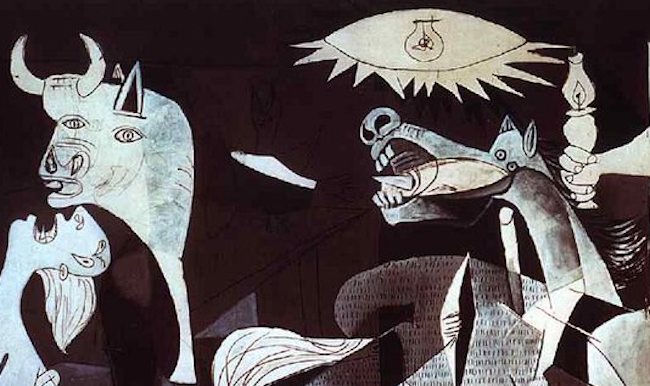
.
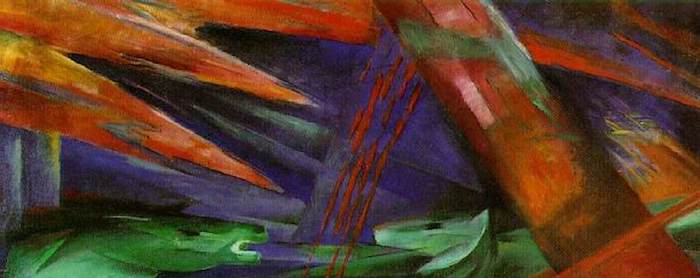
→Part 2→

.

.

.