.
.
for my brother — nowhere in these pages
.
.
.
I hate to repeat myself.
—Jackson Pollock
.
.
.
Christmas 2001
.

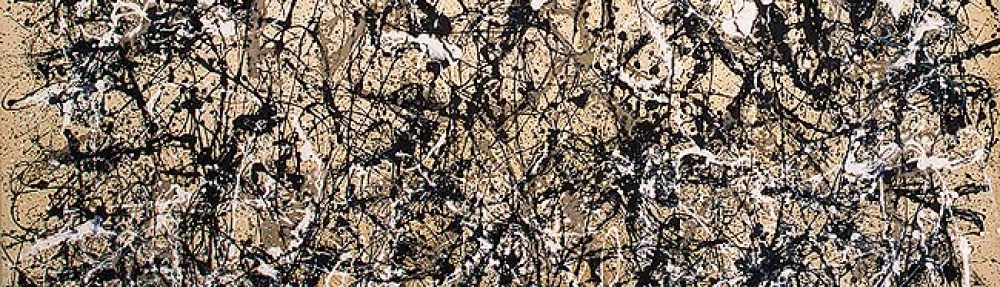
It’s Sunday, late afternoon, early winter; I’m with my brother and we’re at the Metropolitan, standing in front of the Pollock, the painting made more of whatever it is by our hangovers, Autumn Rhythm, one of his allover jobs, some twenty feet of swirling lines, streaks, and blotches of black and white paint, slaps of khaki, a few punches of some kind of gray on unprimed canvas, the canvas itself browning with age, as if expounding the painting’s mortality.
If you stand too close, you only see disconnected lines, the splatters, the idiosyncratic blots, Rorschachs of indeterminate personality.
If you stand too far, you just see a mass of paint squared on the wall among more masses of paint, more abstract paintings in this gallery after all the other galleries at the museum, all the other centuries of other paintings representing whatever other artists thought worth representing—fruit, flowers, skulls, and machines; landscapes, cities, interiors, and battlefields and ruins; peasants and rustics set in genres and allegories; royalty, nobles, statesmen, and generals, their outer lives, epic scenes of their triumphs and defeats; the inner strain, the quiet joys, the vague room of unknown people; soft, fleshy nudes and hard-edged gilded saints; gods and demons and monsters and heroes of varying alignments, from around the world, from above and beyond and beneath it; and Christ, his followers, their trials and blood, his unscathed mother, sitting; and Socrates, also sitting, taking the drink, pointing the finger up; and Buddha, squatting, taking the break: the faces, the places, the objects of longing and despair; nature, the culture contained in perspective boxes or turned loose in stabs at infinity or flattened on the picture plane, space disrupted, perspective collapsed—as if the modern Americans ran out of things to paint.
But if you stand just far enough away from the Pollock, the lines move, the painting engulfs and absorbs you in its patterns, in its rhythms, so that there isn’t anything else but the paint, the lines, the motion. One moment it flies apart, you are scattered in an exploding universe; the next it contracts, falling back into itself, you shrink, back into yourself, nowhere, you are lost. When you close your eyes, an afterimage of confusion. Open them again, when you’re hungover, the painting is frightening—
Illusions, the depth, the motion, the fear.
Actually, I think I only had a few the night before, but we were out late. Add to that where I am, New York, and to that whatever is going on with my brother, where those leave me, and the effect is still the same. Because there is some kind of problem, a big problem, and I’m supposed to be here in New York to help. But I haven’t done anything yet. I tried to get him to open up Friday, the night I flew in, but didn’t get very far, and yesterday was a wash. Nor was going out last night in the plan. So it was my idea to go to the museum this Sunday, a place where we might yet talk. We’re not the kind who go to church. Yet as I look at the painting, I still debate what to say.
I don’t want to say the wrong thing.
I don’t know what the right thing is.
It’s hard to think of anything to say when you’re staring at a Pollock
Hungover, then, is only how the painting makes you feel, wherever you are, whatever has happened, whatever you’ve done, scattered, ragged, at loose ends—
Another illusion, maybe.
And actually my brother is sober, or looks it, as I recall. He may have held off as well. Or maybe not. Seven years older, with more times around the block, he’s had a lot more practice.
But I’m the one who is afraid. Afraid because New York has always scared me. The first time I went to see him, a kid in high school, a hot summer, there were fifty-one murders that week, a record at the time, and all the while I was there I was calculating my odds. This Sunday, afraid because of what is happening to my brother, or what I think is happening, of whatever made him call a few days before, shout and cry in wordless rage, and then hang up, whatever caused him to do what I found when I got there, smash every mirror in his apartment.
It’s what the painting can make you feel, stupid and weak.
It’s what the painting reminds you of, the exhilaration of violence—
More illusions?
Because my brother, before the Pollock, looks focused, composed, together—all there. And this is the only painting in the museum that interests him, the one that makes him stop and look. And it’s the image I have of him, looking at the Pollock, the only one that comes back to me and stays. The rest of the weekend is hard to remember because all this happened over twenty years ago, because there was too much from that weekend, from what came before and followed, that was too strange and upsetting, too much that is too hard to see again, to live again, too much I’ve wanted to forget. Since then, in memory, a twenty-plus year blackout. Only now have I begun to try to put the pieces together of a brother I thought was falling apart, who still falls apart as I try to remember him, but who before the Pollock looks as if he is in touch, in communion with something I am not.
Somewhere else, some other time, there is Pollock who paints the canvas, and I have seen pictures of him in action, the Namuth photographs of Pollock painting, Pollock, his arms, his face, the paint a blur of motion over an expanse of canvas unrolled across the floor. Here, at the Metropolitan, is my brother, looking at the painting, motionless but moved. And here I am, some twenty years removed, remembering my brother before the Pollock, seeing an image of the painter. I think that there may be some connection, some identity between the two, for reasons I have yet to sort out. That if I’m ever to know anything worth knowing about my brother, maybe myself, I need to figure it out, this moment, present in memory, present in whatever there is that a moment might contain yet which doesn’t exist just in time or memory yet touches both, and touches us all, yet survives us, and survives the past and will not be corrupted by the future—
Or so, in which, we would all like to believe.
And between them, my brother, Pollock, there is the painting, Autumn Rhythm, its present, its presence, and the image that will remain after it has fallen from sight, after the actual paint has fallen from rotted threads, the image and whatever it suggests, whatever else there might be, an understanding—
Of what?
I studied art, even gave it a stab myself, and I know that interpretation is a tough knot. That Pollock’s paintings don’t look like anything isn’t the problem. That they so largely and emphatically don’t look like anything must be what has moved us all to thought. So we try to give them meaning, put them in some context, place them in a world of recognizable signs. A picture of apocalypse, of twentieth century self-destruction. A Pollock has been paired with an atomic cloud: See, look, this is where we are. Or of modern dislocation, the tangle from our loss of purpose, our alienation: See, look, this is where we are not.
We are assuming here that art has something to do with life.
My brother, though, before the Pollock, does not look like he is worried that the world will blow up, at least any time soon. He does, however, show the wear—his hairline, the lines on his face—the result of pushing himself and/or being pushed too hard. And maybe his eyes reflect this strain, as they struggle to comprehend the painting, or see through it, or past it. But maybe it is just the look of engagement, because looking at the Pollock, he seems to know just where he is. And Pollock obviously has been put through the ringer as well—also tonsured, also worn in the Namuth photographs, the lines in his face clenched in a pained scowl as he paints—yet he doesn’t look lost but full of purpose and he moves about the canvas in angular yet dance-like grace.
Which doesn’t mean, of course, the world won’t blow up sooner or later.
Or that anyone in modern times knows where he is, ever has, or ever will.
—It’s a big painting, my brother says.
I look at him, looking at the Pollock, then look at the Pollock. I am struck more not by how the painting doesn’t look like anything, but by how it continually doesn’t look like anything and doesn’t look like anything in different ways, and looking at it makes me wonder what all the other paintings in the museum that do look like something can mean.
If you can relax and stop thinking about yourself and meanings, you see a kind of dignity and fluency in the swirling lines, an ecstasy of muted colors. Still an illusion, but it occurs to me, now settled in a settled life, that the worst illusions may be the ones we don’t see as illusions but take as solid and real, then burden with our beliefs.
Then again, Pollock and my brother may not have seen what was coming.
But there have to be meanings, and they have to mean something.
I still had time to talk, or thought I did, yet I left Monday morning without saying anything and never got another chance. I never even found out what the problem was. And I haven’t yet learned what I should have said, or decided what there is to say. It doesn’t matter, however, what I told him that Sunday before the Pollock, because the following spring he was dead.
.
Friday night, just in from the airport. My brother sits on the sofa, holding a water glass full of unwatered scotch.
He’s talking about—
.
Not scotch—
.
When I am in my painting, I’m not aware of what I’m doing. It is only after a sort of “get acquainted” period that I see what I have been about. I have no fears about making changes, destroying the image, etc., because the painting has a life of its own. I try to let it come through. It is only when I lose contact with the painting that the result is a mess. Otherwise there is pure harmony, an easy give and take, and the painting comes out well.
Pollock, on his work.
The focus on profit margins is encouraging, but it is not clear to us that the environment will necessarily offer the volume opportunities at above-current marginal spreads to afford both higher margins and better earnings growth. Return on assets can be improved by reducing low margin assets but perhaps also shrinking absolute earnings dollars. Our modeling suggests . . . .
My brother, from one of his reports.
.
My brother, Jackson Pollock—differences:
| Pollock | My brother |
| Last of five. Came out black, strangled by the cord. Born into a poor family that moved around a lot, out West. | First of two, a poster baby, eight pounds of health. Born into in a boring middle class family that stayed put, down South. |
| No clear read on his father, but not quite with it. Some sympathies for people on the bottom of the heap, though not far above it himself. Encouraged Pollock vaguely. Once took Pollock, when a kid, to a work camp and let the other guys get him drunk, watch him dance. Eventually split. | Conservative father. Middle of the heap. With it well enough. Encouraged brother to succeed, discouraged excess. Didn’t split. |
| Came of age in the Depression. | Grew up in the golden years, 50s and early 60s. |
| Thrown out of high school a couple of times. Later dropped out. Studied off and on at the Art Students League, NYC. | A model student, valedictorian in high school. Got full scholarship for college, double major in English and economics. Grad work at Harvard, MBA. |
| Studied under Thomas Hart Benton, a regionalist painter whom he admired for a while then rejected. Some affinities for Surrealists, others. | Didn’t admire anyone I know of. Once, however, had favorable things to say about Volcker; later changed his mind. |
| Brief affair with politics, on the left. | Stayed away from politics. His job, other suggestions move him towards the right. |
| Survived on WPA checks, sponged off family and friends. | Paid his way, all the way. |
| Grown up, wore T-shirts and jeans, went out to a barn and splattered paint on unstretched canvas. | Wore Brooks Brothers suits, took the subway to work, investment banking. |
| Was broke most of his career. | Made a hefty salary. |
| Left behind all those paintings. | Didn’t leave anything behind. |
When I am in my painting . . . have no fears—
The focus on profit margins—
Pollock’s words seem to match better my brother’s life and my brother’s sound more like those of someone who made convoluted paintings, as if their lives and words got mixed up.
Or maybe Pollock and my brother were mixed up.
Or maybe lives and words don’t fit the way we think they should.
Pollock was a boozer, but that bit about his father letting him get drunk as a kid sounds more like legend. I’ve read a few books about his life, and it’s difficult to read what others have made of him without wondering what they are making up. Like his paintings, he is hard to take or leave. There are those who wish to elevate the artist, others to put him in his place. But perhaps both have to have a kid get drunk and dance before the eyes of men before they let him hurl paint at a canvas.
Our desire to destroy myths is as strong as the urge to create them.
Still, there’s something that sets Pollock apart from others. I have seen early photos: on his face, the look of a kid who thinks he’s going to be someone. And something that sets my brother apart as well. It’s not fair to call my parents boring, because they are good people, and it’s not fair to call them that, either, but from the family the sense he came from nowhere, or at least did not come from us. You can see it even in pictures of him on Mom’s lap, the beam, the possession, his look beyond the frame. Though they deny it, it’s hard to believe that after having him my parents didn’t decide to break the mold, the reason I trail him by seven years.
And sometimes great differences can mask greater similarities.
Similarities:
- Both hit their stride in the postwar boom, Pollock in the lead.
- Both made their splash in New York.
- Both were intense.
- Both drank a lot.
- Both had a way of holding a cigarette, as if defining a point around which the world might gather.
- Both wanted to turn the world on end.
- Neither believed in anything specific, but both seemed to have a general sense of something Out There that absorbed them.
- And both acted in such a way that their own lives didn’t matter. I don’t know if this is faith or self-destruction.
- Both went out early, Pollock 44, a car crash while cruising with a girlfriend and her friend, the friend crushed, Pollock and girlfriend thrown clear, but Pollock into a tree; my brother 34, cancer.
- Both their deaths caused, it has been speculated, by the way they both lived.
- Both their mothers adored them.
What is essential here, what is dumb?
OK, my brother wasn’t an artist and didn’t make it into all the art books. Then again, I’m not sure what distinction can be made about someone’s being an artist, or, if there is one, which way it goes. Besides, my brother had a reputation himself—the Wall Street Journal often called for inside dope. And I suppose he did leave behind those reports. But fame is not the point here. And output can’t be the point either.
What is the point?
Those reports—their careful yet twisted strings of numbers and terms, the cautious, torturous progress to predictions. I’ve started reading through them again and still find them impenetrable.
Those reports—he worked at the firm half the Ivy League graduates would have given their souls to work for in the 80s, if souls are what we have, the 80s when you didn’t have to be smart to make a ton, only shrewd and relentless. But he started there in the early 70s, the years of debt, before the splurge, before the money came pouring back in from around the world, before the lights went up in the dark places of Times Square, before the towers fell, before whatever happens next, whatever pours in next or falls. He wasn’t in it for the big bucks. He couldn’t have been. He could have made much more doing something else. Because his head was somewhere else, because his head mattered to him, because he was an analyst, because he did what the others hadn’t done before starting work, he read.
First it was science fiction, then it was science, he was going to be an inventor though never said what he was going to invent. And he got into MIT yet went elsewhere, because then it was literature and sex. He read the ego boys, Hemingway, Mailer, and Roth; also he got laid a lot. But he read other lit, Proust, Musil, Beckett, and Joyce, books I could only stumble through, Ulysses, even Finnegans Wake—who knows how much of it he understood? And he read the other stuff, Marx and Sartre and Freud; also the Kamasutra. He read everything, read books I never had the nerve to crack open, big books of big schemes, of manias and myths, of larger meanings posited and meanings largely displaced, he must have read them as much for what they held as what they left out, whatever else was left to figure out, they must not have said enough because he kept on reading. And with the lit and other stuff he read economics, because then it was business and whatever business meant, whatever business held, whatever business left out, so an MBA, Harvard, he got into Harvard, then right off the bat landed a job with a firm on Wall Street, then soon left it for the better pace, the one with a Park Avenue address, with an office with a view. And still he dated around and still read lit, Heller, Barth, Pynchon, and Gaddis—he read JR, and wasn’t fazed—and other stuff I never heard of as he worked his way up the ladder.
He analyzed bank stocks, his angle on the market. You have to see the big picture, he’d say, you have to know how the world works, how to play the good breaks against the bad, and it was the bad that were good for playing the market. Because it wasn’t just his head, it was intelligence and the risk. Because, he said, it’s a crapshoot, predicting the economy and the market, and this must have been what drove him, pitting his head against the odds. Intelligence, the risk, and something else, there had to be more to it than that—
Or maybe it got to him, the speculation, the doubt.
I don’t know, because then we were apart and I’d lost touch. Because then my last years in college, where I learned something but never learned what to do with it, then a period that is hard to account for, those years when I couldn’t decide what to do with myself. A year abroad, Paris, it was somewhere to go, and when I returned I was supposed to be sorting my life out, making plans. Law school, maybe, it’s what everyone else was doing, I had to do something, and maybe I thought I could do something with it, the law.
Except for brief phone calls and a couple of days together with the parents at Christmas, I hadn’t talked with him much in several years. Then all I got were a few complaints about work, the hours, but nothing he couldn’t handle. From the parents, parent worries. Some concern about his drinking, but we never did have to do that much to get the parents going.
Then Wednesday he calls, he shouts, he cries, he screams. He’s only drunk, I think, no big deal. But after he hangs up it occurs to me he’s really drunk. And no crier, no shouter, my brother, so I call back, only to hear his answering machine:
I’m not in right now. If you’re opportunity, knock once. If you’re a friend or relative, leave your name and number, and I’ll get back to you as soon as I can. If you’re an insurance salesman, forget it.
A sense of humor, my brother, I haven’t heard this one before, but I don’t laugh, I’m worried, so I leave a message. Yet he doesn’t call back and he doesn’t return the calls I make all day Thursday, and now I’m scared. So I make plane reservations and call once more, telling the machine my flight plans.
And then it’s Friday night, I’m in the back of a cab, sitting on this fear as I stare at Manhattan lights across the water, as the driver—impassively manic, a thyroid case with bulging eyes and a twitching neck, who’s got on his hack license a consonant loaded name I can’t pronounce much less place—tears through lanes of traffic on the Triborough Bridge in a run of near misses. He isn’t even looking at the road, he isn’t looking at anything, he’s showing that look, the look of not looking, the look that says I can take this, this is nothing kid, you haven’t seen anything yet. It’s the look you’re supposed to have in New York, it’s the look that makes you feel like a kid, it’s what New York makes you feel like, a kid wide-eyed and afraid, but you aren’t supposed to show that in New York, the fear. Yet I look, I can’t help looking at all those lights, and only then do I think that it could be something big, what’s happening to my brother, that he might be flipping out. And I didn’t see it coming.
But I couldn’t think about that back then, why I didn’t see it coming, for reasons I couldn’t think about, either. Maybe because I was too wrapped up in my own life. Maybe because I hadn’t seen enough, didn’t know how to think about what it meant to flip out. College hadn’t prepared me for that. Or maybe for other reasons I couldn’t then and still can’t touch, but may yet need to.
Scared for him, scared, too, for myself, again for reasons still unknown. But scared maybe because he took me under his wing and I always followed him, and though he had a seven-year head start and I knew I’d never catch up, still I followed and had never been closer to anyone else, and if something happened to him, who would there be left to follow? Because he’s the one who passed down books and got me to read, who taught me the ontological urgency of love, the point of drinking, the art of making a point, he’s the one who got me started looking.
But you aren’t supposed to look in New York and you’re not supposed to show fear because what you should be afraid of is what you haven’t seen yet, a largeness not contained by city streets, the possibilities of unseen violence, you’re not supposed to look because this is nothing, what you see now, you haven’t seen anything yet, and if you look and show fear you won’t be prepared for it when it happens, you won’t even know what it is, you’ll only be caught by what there is now, nothing, nothing yet.
Yet still I look, can’t help looking, speeding down FDR, seeing a stutter in the skyline, the crescendo of buildings, the pattern of lights, the grid of streets and skyscrapers, the structures, the structure of New York held together by structured debt—but all of this still nothing. And then we turn off and get stuck in traffic, creep through the night crowd, the night business, the ashy, electric smell, the garbage, the junk floating in the air, the bottled frenzy, the noise of things being built or torn apart—the faces, the places, the things of my fear of New York, the faces and places and things of the New York, the city that Ford told to drop dead—but still the things of nothing yet but when I look at the driver frozen in his seat he looks like he’s about to jump out of his skin and I get really scared, my fear swelling as large as New York, which is as large as fear can swell.
Only now, twenty years later, do I see it’s what I should have been waiting for all along, my brother going on a bender and flipping out, and given what I know now, flipping out and more. Because what else is there to do in New York? Because this is the place where fifty-one people can get murdered in a week, a record that has probably been broken many times since, if anyone’s keeping score. Because this is the place where people with too many consonants in their names end up, fleeing whatever has chased them from those unknown lands, the place where they go out in a guttural explosion of unseen violence and nameless noise. Because this is the place where Pollock cracked up, ran from shrink to shrink, went on binges, staged drunken rages in the streets, the place where he started painting those paintings that didn’t look like anything, or like anything anyone had seen yet. And he kept painting those large sprawling canvases that assault our sense of what is what, which don’t leave us with easy answers, which don’t leave us with any answers at all.
And Friday night, just in from the airport, I see him open the door, but I don’t see him, what I see is what I don’t see, myself, in the cardboard backing of the mirror in the hallway. Then I see my brother on the sofa, holding a water glass full of—
Gin, it is a water glass filled with straight gin.
And he talks about—
Debt.
It is debt he talks about as he sits there plastered, passive, and ponderous, yet looking like he’s about to erupt—
.
Autumn Rhythm:
Still, art has to tell us something. Just because the painting doesn’t look like anything doesn’t mean it doesn’t mean anything. It’s hard to believe there isn’t something driving those swirls, the blots, the splatters. The painting challenges you with its restlessness, the thrusts that seem to grope for expression, like the urge to speak—
Or come from an insanity that can’t find words.
But there’s nothing easy in doing a Pollock. I tried one in college and all I got was a muddy mess. Look at the painting and it directs your gaze across, away, up, down, and back in complex and unpredictable ways. Get lost and it picks you up, then leads you somewhere else. It takes skill to know how to move the eye, maybe more.
Besides, insanity—that’s what everyone said when they first saw Pollock’s work. Or thought him an impostor, his work a hoax. Jack the Dripper, they called him, and put him on the cover of Life for all of us to see and mock. But which is crazier, throwing paint on a canvas, creating art we don’t understand, or getting rabid because the art is beyond us? And which is the hoax, the worse pose, making paintings that don’t look like anything, or giving us what we recognize, what we already know, what we want to see, and see again and again?
But after he died we took to him, and now, of course, when we see a big canvas with all those splatters, we don’t even get a rise. We say, Oh, that’s a Pollock, and the thing looks rather tame. We’ve gotten used to Pollock, or found a way to put him behind us. There must be an insanity in complacency as well.
There were those who saw the large Pollocks and got it, or said they did, but thought they didn’t go far enough, even said they looked too pretty. Also those who thought they went too far, made too much about too little. Or that they weren’t going in the right direction, weren’t going anywhere we needed to go.
Maybe a complacency, an insanity, too, in thinking we know what we need to know and where to go from there, even how far we can go once we start. Maybe in thinking we know what should look pretty and what should not.
If it is a picture of madness, we may all need to decide on which side of the canvas the madness lies.
If it isn’t a picture of madness, we may need to think about what madness and sanity look like, and learn to tell the difference.
At any rate, Pollock, painting in the Namuth photographs, seems to know what he is doing, though he doesn’t look like he knows all he wants or needs to know.
And my brother, that Sunday at the Metropolitan, sober before the Pollock, does not look perplexed or insane, or anything close to omniscient.
And more seems to be involved in my brother’s soberness than just being sober.
Which doesn’t mean either was sane.
Which doesn’t mean either wasn’t.
Or that the world won’t blow up sooner or later.
But there’s nothing complacent about the way one paints, the way the other looks.
.
Not gin—
Not drunk—
Not erupt—
Maybe I was too close to my brother.
Maybe I wasn’t close enough.
But I don’t think I was that worked up or scared.
Or maybe I was too scared to be worked up.
Maybe I am not close enough to myself . . . .
.
Memory cannot be trusted . . . .
.
Memory is all I have.
.
—Debt is an interesting concept.
He sits on the sofa, nursing a water glass full of—
Water.
—On the wagon, he says, pointing to the glass.
But I didn’t pay much attention. That week wasn’t the first time. Every now and then he’d take a break. Still, out of respect for his resolution of the moment—who doesn’t make these?—I probably drank the same.
Friday, just in from the airport. We must have talked about something, and we probably talked about his work.
—Conventional wisdom tells us to keep debt down and pay it off, but the conventionally wise are fools. The trick has always been to know how to massage it. Yet now we seem to have found a way to leverage debt, make it rise, then run out from under it.
—What happens when it falls? I ask.
I must have asked questions.
—Who knows? Maybe it won’t. We live in mysterious times.
But it was hard to keep the ball rolling.
He lights his first cigarette, draws deep, holds, then releases the smoke, watching it spread with a look that approaches satisfaction but disappears when the mist dissolves. Then he stares with vacant curiosity at the cigarette in his cupped hand, as if he doesn’t know what it is or how it got there.
A detail I’m probably adding, not the smoke but his reaction. However, the night went like that, his saying random things that drifted and vanished before they came together and made sense. I think we both killed a couple of packs.
Then silence. There was a lot of silence that night. I remember the silence more than words.
—You look good, I tell him.
He doesn’t. Puffy and blue, he looks beat up. Also too much older. Also too sober. And also like he doesn’t want to talk. So I hold back, I am patient. He must have been upset and I don’t want to push him—
Or maybe I was scared to hear what he had to say. I remember spending a lot of time staring about the room.
Not much in the living room, basic living room stuff, small living room things not arranged but put down, a few concessions to decoration. Not much that was different from the last time, except an oriental rug that must have cost a wad, which was all he had for show.
Nothing to be afraid of here.
Black against the picture window, his angle of New York.
Over the bookcase another glassless mirror, all the shards removed. Neat work—a perfectionist, my brother. It matches the one in the hall. I pretend not to notice, but remember why else I should be patient.
By the sofa, a dead fern.
—Getting domestic. Where’d that come from?
—Girlfriend.
—How’s that going?
He makes a flourish that ends at the plant.
—Why don’t you throw it away?
—I guess you could say I’m a sentimental kind of guy.
—That’s what I’ve always thought. This isn’t the one who didn’t like you because she thought you were Jewish?
—She thought I looked Jewish.
—What’s the difference?
He shrugs.
—Besides, he says, that was another one.
More silence.
Also on the floor, which maybe I only just then notice because it is partly hidden by the bookcase, a grossly fat junk store Buddha sitting in the position, painted red head to toe. It was the kind of red that makes you think of anger or fire trucks, but on his face, a blissful, moronic smile.
—Girlfriend.
He anticipates my question.
—Another one, he says.
The one who ran personnel at the firm, who got him to try coke.
—Where’d she get it?
—It’s everywhere.
—No, I mean the Buddha.
He shrugs.
—Did she paint it?
He shrugs.
I don’t want to ask why he hasn’t tossed that out as well.
Then still more silence. And his silences got longer as the night went on. But I waited, I’m sure I was patient—
—About the mirrors, Bub.
Or maybe I tried to get him on track.
—They seem to be broken.
—That’s what I thought.
Again, silence, but this time he seems to be considering what to say, though what he is thinking about doesn’t look like it can come out easily. But he opens up, somewhat.
—I didn’t go into work this week.
—You could use a break.
—I didn’t go in last week either.
—Two weeks is standard.
—Not in my racket. Besides, I didn’t set it up. I didn’t even call.
Heavy business this, and I don’t know how to reply.
—They tried to get me. The phone rang off the hook.
—And?
—I didn’t answer.
He tells me he finally did phone in a few days ago, and the brass decided to call it a vacation. He isn’t sure, however, exactly what that means.
—They’re behind you, all the way. Up to a point.
—What about next week?
He shrugs.
Then slowly he starts to talk about the job. About the office, a loose-run ship without a clear chain of command but where power makes itself felt and where power can quickly change. About the eighty hour weeks. About the time spent on the road with the institutional accounts, fronting for the firm.
—Sales, he says, with distaste.
While the boys in M&A are getting the attention, bringing in the bucks.
I look at him.
—Mergers and Acquisitions, he says, with an expression that is hard to read.
But I still don’t know what he is talking about. I think the merger craze was only just then cranking up and this may have been the first time I heard the term. He doesn’t explain further, however, but goes back talking about his work. About the time spent on research, keeping up with banks and bank managers, with the money coming in, going out. With all the things that can be done with money, with all the forces that control what money does.
—Miss a factor and everything is thrown out of whack. There’s a connectedness in things.
Maybe he becomes animated here, maybe we are at last getting somewhere, because his face lightens and he lifts his head and begins to move his hands before him in quick but careful articulation, his fingers grasping, shuffling small, invisible pieces, as if finding and placing the terms of the idea he is building.
Keeping up with inflation, with interest rates, with the money supply. With the Feds. With business, or what anyone can figure out business is doing.
—Everything is rising and falling now. It can be hard to tell what is doing what.
His hands turn palms up, his fingers open with proposal.
—Patterns are easy to find. The patterns most find, however, aren’t worth much.
Then he waves and spreads his hands apart, in a sweep at larger meanings. Then he joins them in imperfect closure, then moves them again as before, finding more details to add to his construction.
With oil prices, with Arabs and Israel, with Europe and the Russians. With developing technologies, developing nations, with collapsing nations and failing technologies.
—Sometimes it’s the small factor that can make a big difference, if you run it through the loop enough times.
With trends, with fads, with shifts in mood and taste.
—Sometimes it’s hard to tell what is small and what is big.
With anything that touches money or influences the way money is touched.
—Where you start is everything, but you can never start in the same place twice.
And I try to follow all this, waiting for him to get to the point, yet he keeps going, keeps building, because there’s more to keep up with, but his hands start moving faster, faster than what he’s saying, out of sync. And maybe he gets anxious, lost in the complexity of what he’s trying to do, yet still his hands keep moving, keep adding and placing details, still faster—
Too many details to remember now. But I couldn’t see what they had to do with whether or not bank stocks were worth sticking in someone’s portfolio, much less with whatever was wrong with him.
Or with anything else.
—If all the factors could be worked out, he says at some point, but doesn’t finish.
—Then what?
He shrugs.
His hands stop, close into fists, and drop on his lap. Then his face returns to that raw, beaten look.
Then more silence.
We didn’t get anywhere that night. All I saw was that he had dumped his life into a job that returned nothing more than a half-empty room with scattered things and some casual observations on debt.
I stare at the red Buddha. The Buddha smiles the smile, his eyes pushed closed by bulging cheeks.
A detail I know I’m adding, not the Buddha or his cheeks or the smile, but the timing. Yet I’m certain I listened and was patient—
—Why don’t you get out?
Did I ask that? I must have, because he rears, glaring back at me with contempt, and I see the brother who can smash mirrors and scream—
.
More differences:
| When drunk, out of control. | In control, sober or drunk. |
| Reticent, sullen, withdrawn. Didn’t even have much to say about his art. | Voluble, charming, and quick. Had something to say about everything. |
| Let his health go to hell. Ran around shouting at people. Peed on things. Started fights, usually got beat up. Some arrests. | Played tennis; later lifted weights, tried to keep in shape. Didn’t start fights, etc. No arrests. |
| Diagnosed as schizophrenic by a pro, and just about everything else by just about everyone else. | Never went to a shrink. Universally assumed to be sane. |
| Dependent on, abusive with friends, strangers, wife. | Not dependent on anyone. Reserved, civil to everyone, related or not. |
| Dysfunctional, destructive marriage. | Never got married. |
But the last is a similarity because it’s difficult to imagine either one settling down into marriage or anything else, if there is any virtue in settling down. And both fooled around, though the jury today is out as to how we should take this one.
There are plenty of accounts about Pollock getting into fights, smashing things, peeing on them. The evidence here is strong. My brother—but then there’s the way he bolted at my question, along with the business with the mirrors and the phone call Wednesday. And as I recall, things got out of hand Saturday night. Still, not much here.
The view from some, however, that Pollock was only putting on an act. More than anything he did, it was what he held back, stronger, whatever it was, maybe more frightening than anything he actually let loose. And the same went for my brother. Pollock, who would shut himself up for days of impenetrable silence and could not paint. My brother, his vacation, and even before the call Wednesday he got harder to talk to on the phone, who that Friday night seemed to move further into himself, not in quiet, inward gathering, but as if contracting into some black hole of thought.
Also, his last year my brother stopped exercising and put on weight, probably hit the sauce too much, and wasn’t seeing anyone. And while Pollock fooled around, there is some question about how well he fooled around.
Silence/noise—either way, we’re talking pathology.
.
Autumn Rhythm:
But just because the painting doesn’t look like anything doesn’t mean that nothing is pictured for us to see. While it obviously isn’t a direct imitation of an object in the physical world, it could be a representation of something the artist felt without, which he abstracted from his experience, something too large, too complex for simple, direct expression.
It could be a picture of the turbulence that underlies the seeming order, the seeming calmness of the appearance of things.
Or it could be a picture of the apparent noise of things moving to a silence.
Or it could be a picture of the disorder beneath calm perception, beneath the veneer that covers what we see, the way we see, an image unmovable yet moving yet strepitous of something deep inside the artist—
Something deep inside us all—
Yet Pollock painting, my brother at the Metropolitan looking—
Nothing complacent about the way Pollock paints, the way my brother looks, but no large disturbance on their faces either. Nor does it look like any greater one lies within.
Which still doesn’t mean both were sane, because there’s a kind of calm that comes from looking madness in the eye, one’s own or any other.
But which still doesn’t mean both weren’t.
.
Wednesday night he calls, he screams—
Thursday he doesn’t return my calls—
Or maybe he called Thursday night. I don’t remember calling back that much.
Friday night, the cab ride, I get there, we talk—
About what?
—Why don’t you get out?
Maybe I asked something else. But I said something that ticked him off.
Or maybe he said something that ticked me off. It didn’t take that much to get me started, back then.
Maybe he only glares at me . . . .
.
He glares, but then composes himself, then his look softens into the look of the tolerant older brother. Then this look fades into a look that doesn’t look like anything.
Still sitting on the sofa, still drinking a glass of water.
—On the wagon, he says again.
Sober as a deacon, or more.
He shifts the glass in his hand, as if uncertain how to hold it, then looks down the mouth, imagining, perhaps, what is not inside. Then he puts it down and lights another cigarette. Again he sucks and blows, again the mist appears, and once again it’s gone.
—Going to AA, he says.
I’ve forgotten about this.
—Not what you think, he says, looking at me.
Maybe I reacted again. If I did, he didn’t notice.
They tone it down, he explains, lay off the religious schmaltz, go easy on the Twelve Step mumbo jumbo. It’s at an upscale church downtown, Episcopal, run by guys who know their clientele, a pinstripe crowd, all professionals, all first-rate. Lots of guys in his trade. They listen, they tell their stories. After a session, the exchange of business cards—phone numbers in case they fall, but also contacts. Good business, AA.
—And if you’re lucky, a good date. In this town, you find company where you can.
He looks up again, and his face brightens once more.
—Also trendy. Maybe a trend.
As if, he says, some train of events has brought them together at the same time to the same place. There’s something here he feels is worth some thought.
I listened but probably didn’t pay attention. Hokey stuff, AA. If he had a problem with drinking, he would have found another way to deal with it. He couldn’t have been serious—yet it occurs to me that AA may have been where he started, not debt, and that he wasn’t that quiet or scattered, at least here. His job, those factors, and all the silences must have come later.
They meet in the basement, chugging coffee and smoking their lungs out while they listen to the stories. And sitting on metal folding chairs, keeping their cool, their poise, the pose, they position themselves to get up.
He lights up another cigarette, off the first one’s butt.
And I may have realized that this one wasn’t going to be short. It also occurs to me now I was the one who was silent. There wasn’t anything I wanted to hear. Yet I was patient, I know I was patient, and let him get off his chest what needed getting off. Whatever this routine was, I listened and let it go, perhaps the reason I have forgotten about AA. He couldn’t have been serious. We still had plenty of time, I must have thought. The real talk could come later. Now, however, was probably when I started lighting up myself. I may have also wished I was holding something other than water.
—We’ve spent our entire lives positioning ourselves.
He continues, yet this is new and they aren’t sure how to do it, or know where they’re trying to put themselves except someplace where they’ll be in some way different, maybe even better. But they don’t know what they’ll be like, who they’ll be when they get there.
—It’s what makes the positioning hard.
He forces a grin.
—Kind of funny, too.
Because as they sit on those creaking metal chairs—guys with status, power, and bucks, trying to keep their cool, working for the position—little girls going to choir practice peep in the back door and giggle.
—What better place than the basement of a church?
The grin turns into a broad smile, which on his worn face looks grotesque. If I wasn’t scared before, I was now, because I realized there was a good chance he was serious. And if I was silent then, it was because there wasn’t anything I could say back.
They do get up, he says, because telling stories is what AA is all about. The chronicling of the habit, the naming of places and events. Tales of taking account, setting the record straight, of coming to terms with oneself, of wrestling with the beast. Of the drowning, the wallowing, the falling.
—No one hates himself or loves hating himself more than an alcoholic.
So many stories, he says, so many variations on the basic plot, but they all lead to the same conclusion, seeing the light, the whatever. Maybe they fake it, maybe make parts up, maybe not. It really doesn’t matter. Telling the stories is not an art of accuracy, but of precision, of framing, of getting the feeling right and trying it on for size. Of setting yourself in the right spot on the scale between ecstasy and agony, from which you can make your leap.
—Listening, you get to know them. There’s something you feel with the guys at AA that comes from what brings us all there, not togetherness but some other kind of closeness.
Then a pause that was hard to bear. He lifts, then stares through a transparent glass of equally transparent water, then puts the glass down and lights up again, then gathers and composes himself, and all humor goes from his face, leaving a pained mask that sends me close to horror. Because I realize he did get down to business with whatever was wrong with him, or tried to, which may have had something to do with booze and AA. Because now he’s positioning himself for his story. And as I looked at his face, and as I remember it now, it looks like he looks dead serious. No wonder I have forgotten about AA.
First, the details, a catalog of the amounts, the types, their subtleties, their strengths—maybe here is where he began moving his hands before him, grabbing, placing invisible things in the air, as if moving props to set the stage, with the cigarette he holds leaving swirling traces. And now, recalling those details, I can’t stop the rest from coming.
The clock that booze sets, the business lunch drinks, the after work drinks, and the before and during and after dinner drinks. The late night drinks to get him through the work he brings home, the later night drinks to help him unwind, the drink in the morning to ease the burn on waking—maybe here is where he talked about the job, the hours and office politics and pressures, and M&A.
The drinks to break time, to make time; drinks for special occasions, drinks to make up for the lack of anything special to celebrate. The drinks for nothing special. The drinks to set or find a mood. The drinks to loosen up, the drinks to get sharp, the drinks to loosen up again when he gets too sharp.
—It’s incredible, he says.
Though I couldn’t tell how his belief was stretched, whether he was shamed by the nature of his excess or was simply dumbfounded by its variety and size. Against the severity in his face, somewhere in memory, a suppressed titter. While I didn’t hear the laughter of little girls, it did feel like someone was peeping in and giggling. Still, I was patient, I tried to be patient, I know I was patient—
Yet there are still more details. He gives a guided tour of local bars, telling legends of fellow travelers, still moving his hands, wider out, and the living room becomes crowded with stumbling drunks and smoke. Then his hands stop grabbing and moving but start to wander and drift away, still further out, as the faces and places become faceless and uncertain. Then his hands start to come back, and the faces and places recede until he is down to his apartment and the guy at the liquor store across the street, who makes late night deliveries and knows his name.
And then there’s only smoke.
—At last, he says, hands up but quiet and together.
Maybe they were folded.
At last the feeling, the place where drinking has brought him—
Or hasn’t. Nothing, nowhere, he says, he’s become nothing, gone nowhere. It’s as if he has been stripped to bare sensation, as if he’s become a giant eye exposed, floating above a fading world.
—It’s not that booze makes you fuzzy. It’s that everything else is fuzzy. Booze is what makes this clear.
He could soar for days in perfect serenity above the haze. Next would come the crash, the plunge into vision of infinite, painful brilliance.
—You don’t know what life really looks like until you’ve seen it from the bottom.
Then finally—
—Finally, he says.
The moment, the realization that makes him decide to go in, which wasn’t so much a revelation—
—What is there to know you don’t know already?
As a blossoming, a release.
Then he looks not at me but nowhere, and his face—
That face—
I can still see the blue depressions, the veins, the swollen flesh—
Yet that face—
Somehow loosens into seraphic bliss.
—It’s incredible, he says.
And my brother turns to the Buddha and smiles some kind of smile.
And the Buddha smiles his smile.
And I turn and stare at the mirror so I won’t have to look at either one.
—Not what you think.
What did I think?
It was hard not to be moved at least by the intensity of his performance, nor could I easily dismiss his look, which had to be sincere. And it hurt to see the pain on his beat-up face. But what did I think?
Crap, I thought, sheer crap. Because the thing I least expected, the thing that scared me most was this AA bit. He’d copped out, swallowed the line whole, and turned into one of their saints. I didn’t fly up to New York to find out he was a lush, or worse a lush who had been saved. What I now remember is worrying not that my brother was flipping, but rather flaking out.
—When did you become an alcoholic? I ask.
Maybe I was loud.
He shrugs.
.
Attempts at spiritualism and cures:
| Early on, a tour with a Theosophist. Later, visits to a White Russian exile, a Jungian and other therapists of varying stripes. Also to medical specialists and GPs, a homeopath and a quack. Several pilgrimages to Bellevue. | AA. |
.
Friday night—
His hands—
His face—
—Not what you think.
I suspect the jury has come back too soon with a verdict on substances and their abuse. OK, heavy drinking isn’t a good idea and won’t make us heroes, but not drinking won’t make us different, either. There’s more to our lives than what we do or do not put into our bodies, or less.
Still, I may have to concede what wouldn’t have bothered me then and may not even have noticed the other times I saw him, that my brother hit the sauce too hard. I was still young enough to believe that nothing I did to myself could harm me, at least nothing I put inside. Nor could I accept that anything that went wrong inside one’s head could ever be so simple. But I know now how it happens, and can happen easily, and how much easier it happened back then. To booze add the job. He’d worked his butt off, didn’t have much to show for it, and maybe was seeing his position slip away. Against the push of work, the pull of booze. But then the problem of booze, so he lays off, which gives the illusion of solution. Yet all he really has now is work, so back to work and then back to booze. Going on the wagon was just a way of resting up to give the wheel another spin. What I didn’t know then is how we can kid ourselves, how easy it is draw a blank.
If there’s anything I have learned since, it is that we all have to jump in somewhere, then flounder the best we can and not expect too much. And there’s a perspective here, where my brother, those details fit, not one that pulls them together, but the kind that makes everything fly apart.
Still, that face—
Yet it could have been a boozer’s face.
Still, AA—
But we find comfort where we can.
Still, the mirrors—
Or let it out when we have to.
Hard to believe Pollock didn’t fall into the same trap.
And that once both started falling, they couldn’t stop.
.
Autumn Rhythm:
It may be a painting of something simple, but there’s nothing simple or easy about it.
Pollock painting . . . .
My brother looking . . . .
But word is that Pollock painted the big ones sober—
.
—and my brother handled booze well enough before. I think we all handled it better back then than we think now. Also if he had gone off the ledge, I would have gotten some signal, if not from him, then from the parents. Nor was it like him to do anything without a more deliberate plan and better method. He would have found another way to pull himself up, if, in fact, he was down. Besides, if he was serious about AA, and he seemed to be, then he had to have been on the wagon when he ducked out of work, as well as Thursday when he called and screamed.
Does this mean he laid off Saturday night as well?
Which means—
I have take this one step at a time, resolve Friday before I can make it to Saturday. This much seems clear so far, however, that he was still avoiding the problem, whatever his problem was, which must have been the cause for my reaction as well as the reason I have forgotten about AA. Yet if he hadn’t fallen, what should be made of AA?
—It’s incredible.
A temporary lapse, a misreading?
—It’s incredible.
Or was he flaking out?
—It’s incredible.
Yet I’m not sure which he found more incredible, his drinking or AA bliss.
—It’s incredible.
And seeing him now, telling his story, it doesn’t look like he is astonished by anything he has done.
—It’s incredible.
Or even is talking about himself or his habits.
—It’s incredible.
Or even about booze.
—It’s incredible.
Or at least about booze the way you’re supposed to. If there’s a method here, it seems designed for something else. And the more I think about his words, those details, the less they add up to the confession of someone trying to go straight.
Or up.
That smile—
I wonder now if he didn’t fake his own story.
But if he wasn’t telling his story, whose was he telling? What was it about?
And if he wasn’t kidding himself, who was being kidded? What’s the joke?
That smile—
I don’t think he dropped it when he started talking about—
.
Junk.
I have forgotten about junk.
.
—You don’t have to be a rocket scientist to do what the boys in M&A do.
He says without missing a beat.
—They act the middleman, bringing companies and buyers together, and all they do is broker the deals.
Still on the sofa, still holding a glass of water, still smoking up a storm. And still he keeps talking, ever with a smile that flits with angels and hovers over faceless demons and smashed mirrors. I can’t remember where I was then, unless, having just heard his AA story and bought it wholesale, I was scrambling for somewhere in between.
Just find a corporation that’s ripe, he explains, then get on the horn and call around until you find someone who wants to buy. For this they get their whopping fees. But the buyers are happy to pay.
—And why not pay? It’s not their money.
I didn’t bother to ask what had happened to AA.
—Whose is it?
He stares at me, incredulous.
But I must have kept on asking questions. Maybe I was trying to recoup from my outrage, if I showed it a moment before. Maybe I was still trying to be patient.
—Where do buyers get the money?
—Junk.
—Junk?
I know I hadn’t heard about junk before.
—Junk bonds. They float junk bonds to leverage the deals, putting up the target’s assets as collateral.
—How can they put up what they don’t have?
He stares at me again.
—Why do they call it junk?
—Low grade, high risk.
—Why would anyone buy junk?
—High yield. Besides, junk is sexy, so everyone wants it, or soon will.
Then again, maybe I only put on the face of patience and was humoring him. Not only was he avoiding his problem, he wasn’t coming close.
—There are other ways the game can be played.
M&A can help the clout go private and buy the corporation for themselves.
Or M&A can side with the target and help its clout from being taken over.
And if other companies want the target, the game gets hot, more M&A is called in, and junk begins to fly.
—They’ll figure out yet other ways. Only the limits of their imagination hold them back.
But I don’t know how long I could have kept it up, my patience real or phony. His AA story had displaced my concern to one distance; in a quantum leap, M&A had displaced my displacement to yet another.
—What is the purpose? I ask.
I was probably loud again, maybe louder.
He stares at me in mock exasperation and, grinning grossly, throws his hands in the air.
—Why does there have to be a purpose?
Or maybe his exasperation was real. Or maybe he had a real reason to fake it. Or maybe the reason and his look were both fake, for reasons real or phony. Wherever he was coming from, however tight his grip, it now looked like he was the one who was trying to humor, as if I were the one who was screwed up and needed help. Which must have displaced my displaced displacement to some place infinitely distant and scary.
—Junk and the deals aren’t as bad as they sound, or don’t have to be.
He says, toning it down, and working back into that smile. Most corporations, he explains, are undervalued, and the conglomerates can stand some shaking up. Junk, played right, can pay off.
—Value, however, is not the issue here.
Yet before I can ask what the issue is, he starts going into the details of mergers, returning to his hands, extending his fingers between us yet more carefully, more precisely, pushing the details of AA out of the way to make room for M&A.
Details of assets and financing and taxes, of stock prices and good reads on the market. Of deferring payment and contingency plans. Of playing the SEC, who sometimes looks this way, sometimes that, but usually looks the other way.
—And timing.
Which is everything, he says.
I don’t know how he knew all this since M&A wasn’t his line. Nor am I sure whether he was describing what was going on then or was projecting scenarios down the line. My brother, though, was someone who kept his ear to the ground as well as looked ahead. And I am certain that as he talked and moved his hands I was having trouble seeing straight in any direction.
—I suppose if a deal goes bad, they can dump employees and sell off assets.
I also realize my brother wasn’t quiet at all, but spent the whole night talking. If it feels now like he was silent, it was because he wasn’t making sense, or any sense that made sense to me. And if I was silent that night, it is because I couldn’t find any place to jump in.
But junk may have been where he started, not debt or AA. And if anything was flaky, it was those deals. It sounded like business was on a mammoth binge itself, which made his own, if he had gone on one, seem inconsequential. Maybe AA came later only as a side trip, because it occurs to me that junk was what he most talked about, the focal point around which his other words turned. His wings, however, if he had them on, weren’t lifting him above the clouds but swooping both of us down somewhere well below. If I felt anything strongly that night, it wasn’t queasiness from some church basement confession, but a more pervasive and heavier disgust. The deals stank of corruption, and even though he didn’t have anything to do with them, a lot of the smell was coming from him.
Still, I was patient, I know I was patient, and kept my feelings to myself. He was hurting, and this wasn’t the time for scruples or cross-examination. Maybe I kept them too well, maybe that is why I have forgotten about junk.
Yet still he goes on, now getting into the finer points of contracts, and these are not so simple. Defining the conditions, setting the terms. Pricing the target, representing the facts. Making promises and protecting the players from liabilities unforeseen.
But arcane and slangy, I didn’t recognize the terms he used, nor did they suggest anything I could picture then much less remember now. And while whatever he was talking about had a real place in the world and a plan and some kind of order, the reasoning behind it seemed to defy reason.
And still he goes on, and as he talks his smile lowers, drawn by the motion of his words and the discourse of his hands, until at last it yields to the look that looks dead serious—here must have been where that look came. Because now I see that face, the hollows that look like bruises, the blotches that don’t look like flesh. Around his eyes, the lines of pain, though I don’t know if these were caused by the perversity of what he was saying or by the difficulty in explaining it.
—Minds and paper, that’s all there is.
Maybe he invested business with the same stupid wonder we all have at whatever business conjures up. Maybe he had kidded himself into the simple, quiet illusion that covers a brawl. Even insiders can get sucked in. And M&A may have been what launched him into AA. Booze was the sacrament he drank at the altar of the Invisible Hand, AA his penance so he wouldn’t feel so bad about being so faithful. Maybe he had been through the rinse and spin-dry cycle of this belief so many times that it washed him out. This one happens, too.
—Except, of course, for all this amazing debt.
Or maybe junk took him to debt instead, then to the economy, all those factors, and out into the world. Maybe he wasn’t kidding himself at all, but had reached, in fatalistic absorption, the sober recognition of how screwed up what he and everyone else had been doing was. Which sets us all up for AA, or worse.
But whatever the source of his obsession, however great his recognition, the smell was still the same. And either way, he was only going further from whatever was wrong with him. As I listened and tried to follow, I also tried to keep track of the reason why I was there, but this, too, went off on some unchartable course. At some point exhaustion had to have taken over. After the worry I had carried at least a day, after a night of seeing that face and its pain, after hours of stifling a disgust that was burrowing itself deeper, of getting lost in the endless twists and turns of junk, I began to lose my sense of what was what and started to go under. From the cloud of confusion, a headache. From all that smoke in the room, his and mine, burning eyes that felt like they had detached themselves from their sockets. It was getting hard just to see.
As I sink, however, my brother gains momentum. Because there are still more details. Strategy, he talks next about strategy, which seems more important to him than the deals themselves. Defensive maneuvers and offensive strikes, depending upon who hires you, which side you’re on. Knowing the players, their strengths and weaknesses, how to play one against the other. Focusing, keeping clear on objectives, but also finding the best way to distort these for the press and keep shareholders quiet and content. Establishing credibility, respecting sensitivities, maintaining civility. Being firm, staying in control. But also knowing when to chuck the niceties, when to let go and play confusion and anger to advantage.
Strategy was even harder to follow because it got awfully abstract. He didn’t even use numbers I could grasp. Yet he went on another hour, or seemed to, still moving his hands faster, with even greater precision. I don’t think he ever lost control of what he was doing, whatever it was; rather his control shaped it more precisely into something I recognized less. But at this point all I can remember is dizziness, which maybe is what felt like little girls peeping in and giggling.
Or were they singing?
Because with the dizziness came a kind of awe. It was hard not to be impressed by the deals, by their size and complexity, their airy splendor.
—Finally—
And somehow sometime later, with a stillness and closing of hands, a conclusion emerges from the haze, a revelation which may not have been a revelation—what had he said that anyone knew about, much less could understand?—but has the shape and lightness of one, when at last that smile returns and he looks at the Buddha and says—
But he may have started and ended yet somewhere else, because in memory the smoke still rises and drifts. Because I remember there are still more details about other things he talked about that night, with centers that pull away from junk, but these are too distant and scattered to place. So it might have been somewhere else again that his gravity turned to lightness, when he smiled that smile and said—
Or maybe I have the order right as I have remembered it, but there’s no order to what he said. Because how could I have expected him to put his words in any kind of order, given what he had just gone through, whatever it was, wherever it took him? He had to have been too upset for coherence. And his was a world of squander and excess. It couldn’t have prepared him well for what he was trying to do. Or maybe it prepared him too well. So at some point, regarding nothing, he took a flying leap and said—
Just as much, however, how can I accept now anything I registered then or trust any order I give it? I was upset myself, and not just at seeing him hurt. I was hurt myself, because all his bewildering talk left me feeling isolated and strange. He wasn’t even giving me a handle to grab and help him in whatever way I could. But which couldn’t have been much, because what did I know about anything? I was still just a kid who hadn’t seen much, had only seen nothing, nothing yet.
Yet finally he says—
—Finally—
Finally?
—Finally—
That smile—
I couldn’t even tell where he stood on those deals.
.
Memory . . . .
.
It’s Friday night, and my brother sits on the sofa, holding a glass of something, talking about God knows what.
This much is certain.
Somewhere there are smashed mirrors.
This is too close to certain not to be.
Also somewhere there is a problem to explain and a brother who needs help.
This may need some work.
And at some point, he gets serious about something—or doesn’t but looks serious, or seriously doesn’t look serious—moving his hands as he talks, placing and removing things until everything is in the place he wants, when his hands stop and he looks up and smiles a smile that levitates in the ether or elsewhere and says about junk or debt or booze or AA or the world or something else or nothing at all—
—It’s incredible.
And almost as certain, not knowing what anything had to do with anything else, definitely exhausted, definitely confused and giddy, probably worried, probably hurt, probably quiet, possibly angry, possibly sick with disgust, possibly wallowing in self-pity and youthful obtuseness, I wanted to pin him down somewhere and asked, referring to I don’t know what—
—Incredible in what sense? Incredible in the sense that it’s so absurd that it’s beneath our understanding, or in the sense that it’s in some way marvelous, beyond belief?
He stares at me.
I may have shouted.
Maybe he looks at the Buddha.
Or maybe I do.
Or maybe the Buddha looks at us with those closed eyes and neither of us looks back.
Or maybe we all stare at the mirror over the bookcase.
But it occurs to me my brother and the Buddha weren’t smiling but had an expression that looked like a smile, yet wasn’t.
—Both, he says.
.
Still, it could have been something simple, and it could have something simpler yet. There remains the obvious thing that stares me in the face. If he wasn’t going anywhere in his talk, it could be where he wasn’t going that mattered most. Junk is also hard to remember because, aside from how much it took off after he died, I still don’t know much more than what I’ve since read in the paper. Yet there can’t be anything mysterious about junk: behind all the hocus-pocus are hustlers finding ways to cash in.
Maybe this is all there is to it, because there’s a point around which booze and junk can orbit, and maybe the rest is just cosmic fluff. Maybe his problem, maybe what upset him and made it difficult for him to talk clearly was also what was hardest for him to admit because he cared too much about it, thus had to exalt in some baffling way, was what I have forgotten because it was and still is hard to accept, what now most hurts to remember, but what, once remembered, cannot be forgotten—
Is that maybe he was on the take himself.
And this may have been what took him out.
Or not on the take, but wanted to be. He was too bummed out because he had missed out on deals. Because now I remember what he says next or first or somewhere, but it doesn’t matter when:
.
—I got a lousy bonus.
.
This must have been where I reacted
He stares at me.
—Not the money, he says. It’s the firm, it’s their way of sizing you up.
Maybe I reacted again.
—Not the firm, but what you’re worth.
Maybe here is where he got serious.
—Not the money, not the firm, not what you’re worth, but what money means.
Maybe this is what was incredible.
—Not what it means.
He looks at me as if what he wants to say is beyond me.
—You’re in six figures as it is. What do you care about money?
I may have shouted.
—Not what you think.
I think I screamed.
And he struggles to explain, heated, pained, as if it is even beyond himself—
.
Autumn Rhythm:
It could be a depiction of enlightenment.
Or it could be the picture that hides it.
Because there are things about ourselves we cannot face but bury, yet still cannot let go—or they cannot let go of us—so they emerge in some unrecognizable form we can accept.
Because there’s a satisfaction in rendering the obvious unintelligible.
But also a price to pay, which can come sooner as well as later.
Pollock, my brother, painting, looking—
.
Mothers:
| Independent; doting yet hard and distant. When she visited Pollock, grown up, he’d go on a bender. | Soft, yielding, affectionate; follower of social codes. When my brother went home he played the Southern gent.. |
But in both their eyes, neither son could do any wrong.
Maybe they were too much their mamas’ boys.
Maybe it was the money.
Hard to tell where the jury is on this one.
.
Ambitions in life:
| Said he wanted to be the world’s greatest painter. | The money— The money— The money— The money— |
.
Or was he still smiling the smile that was not a smile yet still looked like a smile just the same?
—Not the money.
—Not the money.
—Not the money.
—Not the money.
—Not the money.
—Not the money
Why are those damn little girls still giggling?
.
—Money is everything, he says.
The sofa, words, hands, smoke; somewhere in space and time. A glass of something that for all I know is poison, the glass either half-empty or half-full or both or neither.
—But money doesn’t mean anything.
My brother is trying to explain money.
—To a middle class schlepp it means a pension and thirty-year mortgage, a life nestled securely in a balance of assets and debt.
—To a working stiff, it means a paycheck and a life in hock.
—To a wino on the street, it means a pint of blood and a bottle of port.
—To a guy on Wall Street, it means a chance to make more money.
—Money is only a medium of exchange, a symbol for other symbols. It’s because money can mean anything that money is everything. And because money is everything, money doesn’t mean anything.
—You know that picture in the introduction to the Samuelson text, the one that looks like birds if you look at it one way and goats or something if you look another way?
It’s not some kind of trick, he explains. We have as much cause to see one as the other; it depends on our mental cast. The point is that the theory we use to interpret an event determines what we see, how we define a problem and solve it.
I think he uses the Depression for an example.
He pauses.
—At any rate, if you look at the picture long enough they don’t look like either.
He looks at me to see if I am with him before he continues.
I am not.
Then he stares at me with something that looks like pity.
Or maybe it is only patience.
.
I have no idea when he said this or why, or where he went from there.
I have no idea when he said anything or why. Or what look came where, faked or not, or how well it matched what he felt or didn’t feel, if he felt anything about it. Or what he was doing with his hands, whether he was replacing one thing with another, or adding things together, or wasn’t placing but removing them all, clearing everything out of the way.
It occurs to me, however, the Buddha wasn’t painted red but blue.
Memory . . . is chaos.
.
Autumn Rhythm:
There could be a mistake in looking at art to figure out the artist, for reasons we all might want to consider. Or in looking that way at what anyone says and does. As if one doesn’t know what one is about, as if his only purpose in making art, or in saying or in doing, is to hide himself so the rest of us can flush him out.
And a picture of madness, even one’s own, is not necessarily the same thing as madness itself, if madness is what is being pictured. There’s a difference between a thing and a thing when it is presented. A transformation of some sort occurs. This subject becomes isolated from the rush of one’s life and put on display so we can look at it and think about what it is. We are given a picture of one thing we can set against other things we’ve seen.
.
Other things my brother talked about Friday night I can now recall, but not in the order they came:
1. Rollo May’s Love and Will and Norman Brown’s Life Against Death. Books interpreting our cultural plight through psychoanalytic theory. One, in his view, a bit soft; the other not so soft. Have forgotten whom or who he thought was right about anything, if either was.
2. Camaraderie, his perception of, at Salomon Brothers vs. absence of where he worked.
3. Economics as a soft discipline.
4. Economics as a hard discipline.
5. Aggregate major league batting averages vs. ERAs for that year. Used to illustrate some point about measurement in economics.
6. Classical economic theory and forms in classical music. One suffered from the comparison.
7. Schumpeter, who either did or did not have his head up a dark place.
8. Post-post-Keynesianism.
9. Incremental value. A term that had something to do with his trade.
10. Diminishing vs. increasing returns. Terms used in his trade, too, but also had other uses.
11. Elastic and inelastic demand. Used to make a point not related to his trade.
12. Identity vs. difference. Used to make a point not related to his trade or to whatever point he made using elastic and inelastic demand.
13. It may not have been Big Mac and the refinancing of NYC debt.
14. “The nation that controls magnetism controls the universe.” Diet Smith, Dick Tracy. Said so backward it might have been forward.
15. “Corruption is the cement that keeps the Army from breaking apart.” General Cummings, Mailer. Said so forward it might have been backward.
16. A quotation in German. Not translated. Have forgotten the source.
17. It wasn’t Nietzsche.
18. Or Freud.
19. A paean to Byron the Bulb.
20. Achebe’s novel. Mentioned only in passing. No idea from where to where.
21. A classification of various stimulants and depressants, cocaine at the bottom. Don’t remember the basis of the classification or whether it was of ascending or descending value.
22. Socialism as marriage without sex.
23. Capitalism as sex without marriage.
24. Marriage as desirable.
25. Marriage as bondage.
26. Bondage as desirable.
27. Bondage as undesirable.
28. Sex.
29. Greed, pros and cons.
30. Free lunches, lack of.
31. Microscopic and macroscopic morphogenesis. Surprised I can remember these terms. From Chance and Necessity, Monod, some Frenchman I’d never heard of. No idea how used, what related or not related to.
32. Chance vs. necessity. Uncertain which had the upper hand.
Uncertain how he felt about any of the above, or where he stood.
.
Twenty years since, and once again this stuff floats inside my head. . . .
I think there was some kind of progression—a construction of words, a fine-tuning with hands, a refining of mood, a carrying and release of weight—that led to some kind of conclusion, which might have had something to do with him.
But just as much, even though each word had to have followed one after the other in some kind of order, I have a sense of everything coming all at once, then circling without ever landing.
Yet even if he wasn’t going anywhere, he wasn’t going there in a big way. And something is suggested in these details beyond casual randomness, a largeness not of correspondences, but of correspondences caressed and missed. Hard not to be impressed as much by what he didn’t grasp as by what he did, or might have.
And there seem to be similarities and repetitions, echoes in what he said, even patterns that might be traced. Maybe he wasn’t talking about junk or debt or booze or AA or the rest, or not directly, but about things analogous to these, and about something that contained the analogies, so that with each detail, each spot he moved with his hands there in the living room, he posited a point in another place, beyond the room, invisible, yet swarming—
.
33. Ms. Mascara.
.
—There was one woman who got up.
It feels late and smoky, and we’re back at AA, in the basement of that church, if we ever left it. Ms. Mascara—my name, because I don’t think he gave her one—has risen to tell her story. A blond, about his age, a finance officer in some megacorp. Nicely built, sharp, almost pretty but for wrinkles and a booze torn face.
—No, pretty with the wrinkles.
Soap opera stuff, so bad it was probably true, he says. Pushy Mummy, busy Daddy, a traipse through Vassar, Wharton, and Manhattan, through marriage and divorce. Sleeps around looking for her White Knight, then sleeps around to get ahead, then just sleeps around, drinks everything in sight. The kind of stuff they’d heard a hundred times before.
—We could have sung along.
A host of ex-husbands and ex-lovers, she calls the role and reviews the disintegration of each relationship in turn, along with the binges that help ease her in and out, as if each has some particular and special importance.
—But all she was doing was saying the same damn thing.
As she talks her eyes well up, then pour. Tear-smeared mascara runs down her face in streaks, turning it into a blackened mask that makes her look like a sloppy clown of horror.
—It was perfect.
She recounts each failure with a plot that unwinds into snarls, until tied in a knot, she reaches a paroxysm of silence beyond which she can go no further, then reloads and goes on to the next.
—We could have finished for her.
And they wanted to, because she had them. They were moved, they were racked. Because it wasn’t what she said, but the way she said it.
Her chest heaves, her breasts soar, her body shakes as she spills her guts, yet her voice comes out strong and pure.
—It was that silence that kept us in our seats.
With each tale, she shakes harder, cries more, smears more, blackens more, yet her voice gets stronger and clearer, her silences longer and more dense.
Then halfway through a recent disaster—
—A bellhop, a gym teacher, a CEO at Pan Am. Who knows, who cares? Take your pick.
She stops altogether and just stands there and looks at them.
—Then she started laughing.
And they laughed.
—She roared.
And they roared.
—We laughed until the tears came.
Maybe I stared at him, if I was still able to keep my head up.
—Not what you think.
I have no idea what I thought, if I still could think.
Not attraction, not sex, he says.
—But Jesus, she was gorgeous!
He finishes with a look that shows the joy of pain, like that of a saint getting shot through with arrows.
And now I see her face, the one he created for me twenty years ago, the tears, the streaks, the blackened eyes and cheeks. And now I see his face, which may have been the only one he showed that night. On it a kind of passion, with the passion a kind of pain. But maybe it isn’t the pain of injury but of deliberation and the desire to get everything right, the pain of desire itself. And maybe his look is the look that tries to move away from pain and passion, the look that is searching for the look that doesn’t look like a look. And maybe he finds it, the smileless smile, the expression without expression, late, in the deep black of early Saturday morning, when he finally says before turning in, or at any rate says the last words I can remember his saying,
—There’s no end to the things we can leverage.
.
Autumn Rhythm:
It could be a kind of discovery, an uncovering not of things within, without, but of forms, and a structure that might contain them and allow them to appear.
Then again, I suppose it should be decided whether or not there’s anything In There or Out There to contain, and if there is, that it can be contained, and if it can be, that it’s worth containing and can contain us.
.
Autumn Rhythm:
Or maybe what Pollock saw or felt within, without could not be pictured. He could only react, speak in tongues, or not speak at all but gasp. But utterance would not be important; what matters is the action, the throwing of self and paint. What finds itself on the canvas is a record of this behavior. The painting then becomes a symptom—
Which still takes us back to madness—
.
Autumn Rhythm:
Or to affirmation, which could lead to some sort of belief and wherever else that goes, if there’s anywhere it can go.
.
Autumn Rhythm:
Transcendence. Not a putting or ordering of things, but a sudden break away toward what there might be beyond things and their order, a revelation—
Of what?
Where?
How?
Why?
.
Autumn Rhythm:
Or it may not be an act of putting things or ordering them or moving beyond them or moving anywhere, but simply a matter of throwing pigment, a random spilling of paint, pure chaos on the canvas.
Why would anyone do that?
Why not?
.
Autumn Rhythm:
Or maybe Pollock didn’t try to do anything other than make a painting. If he reacted to anything, it was to the paint itself, the forms it took on the canvas, forms which refer to nothing other than themselves.
But what can be said about something that only talks to itself?
Maybe this is craziness.
Or maybe it is sanity, saintly sanity.
.
None of which, however, means the world won’t blow up.
.
—Not what you think.
.
Thursday, night he calls—
.
Even if there is a mistake in looking at paintings to figure out the artist, still we can’t say a Pollock is not a Pollock, whatever being a Pollock means. Even if it is a picture of chaos, it is still Pollock’s chaos, different from any other. There has to be a person named Pollock who was moved to paint what he painted. Not Pollock, or all of him, not the guy who drank like a fish and cracked up and peed on things and got into fights and withdrew into a shell—or maybe these, yet only the parts of them he needed—these parts, but also the part of Pollock who was moved to paint, the parts that found their way into a painting, a personal presence. And looking we are moved and present, not all of us, but the parts of us that can look at a painting and be moved, wherever it is we’re moved.
But the ability to paint a part of oneself, the ability for part of one to look, takes oneself out of oneself and puts one into a world. And even if it is a world unto itself, self-contained and self-referring, it is a large, full world Pollock painted and that we see, or at least a large, full world for a painting. With the presence of persons painting and looking, the possibility of a self and its possibilities. With the largeness and the fullness, the possibilities of largeness and fullness. With the largeness and the fullness, the possibilities of a world. With a world and the self and the largeness and the fullness, the possibilities of a self in the large and teaming World. Or if chaos, at least the possibilities of a self in Chaos. And with these possibilities, the possibilities of whatever helps us make the jump—
Pollock painting, my brother looking:
Pollock doesn’t seem to see anything other than the paint he throws.
My brother, looking, only sees the thrown paint.
Hard to tell whether Pollock, from the look on his face, is contained, and is uncontaining what he has contained.
My brother looking, ditto.
But whatever Pollock is doing, my brother seems to follow.
.
Personal philosophies:
| Hans Hoffman once got in an argument with Pollock about the need to paint from nature.Pollock’s reply: I am nature. | My brother, on life: It’s like riding a bicycle. If you don’t pedal fast enough you fall. |
Similarity or difference?
Either way, at the end, both were on the edge of something and both were falling off.
But how will we ever know what’s on the other side until we give ourselves a push?
.
Thursday night, he calls—
But maybe he didn’t shout that loud or cry.
Friday, a day of endless worry—
Whose?
Friday night, the living room, the smoke, the fear—
Which?
Maybe it is only memory who screams.
But where is certain, as well as when and how I got there—
.
—Friday night, in a cab, going to see my brother, going to see what is wrong, thinking about what I can do, what I can say, riding further into New York, into the grid of streets, into the smoke, the smells, further into the city of all cities, into the capital of our contempt of cities, the city a president tells to drop dead, into the capital of our obsession with cities, the place of what contempt and obsession can bring, the avenues, the streets, the grids, the networks, the plans, the endless schemes, the structures, the structures of structures rising, falling, the dropping dead, the dead dropping—
Friday night, in a cab, going to my brother in New York, and all I can do is sit and look at nothing, nothing yet. What do I think I’m going to say or do? Because New York knows what it is about, more than I’ll ever know, and he’s always known what he’s about, my brother, just as much—
In a cab, going to see my brother, now stuck in traffic, stuck in the grid of city streets, waiting for the driver to flip out, thinking my brother may be flipping out, too, and I don’t even know what it is, what has happened to him, what is wrong, I only know when I see it I will only be able to stand back in awe and feel small and giddy at the sight of whatever it is, and this makes me feel like a kid too, yet still a kid who can stare in fright at the world and be blown away in a fit of gaping wonder—
But you aren’t supposed to show that in New York, either.
.
Autumn Rhythm:
A case might be made that painting is not chaotic, but rather manages as much control as possible of its subject, if there is one.
And maybe Pollock is not out of control, but given his subject, if there is one, has shown restraint.
And my brother’s restraint, as he looks, could be his way of marking off what he hasn’t restrained, what can’t be restrained, but which he still keeps before his eye and manages with his seeing.
And just because my brother didn’t paint pictures or Pollock painted pictures that don’t look like anything, just because they didn’t hang around too long, doesn’t mean they both didn’t have a vision—
.
—Not what you think.
I remember being outraged, but it was a rage of sort I’d never known before.
—Not what you think.
Yet what did I think?
I thought he was crazy, in some way simple or complex.
I thought he was in trouble, that his time was running out.
But I also simply thought he was complexly inspired, and that he was going to live forever.
What do I think now?
How would I know what to think? I have stayed on this side of sanity.
Maybe all are true.
Maybe none.
But Jesus, he was gorgeous himself!
.
Monday morning, an early flight back—
No time to talk.
Sunday, we both slept late, the Met, the Pollock—
Nothing said.
Saturday night—
A mess. And I think someone else was involved.
Saturday afternoon and morning—
A blank.
Friday night—
Maybe we didn’t say anything, but spent the whole night staring at each other like morons.
AA is certain. The church sent the family a letter after he died. The smashed mirrors I’m sure about, too, although when we flew up spring to clean out his apartment, the mirrors had all been fixed. Yet walking to the bathroom, Friday night, after he had gone to bed, I cut my big toe on a sliver in the hall and still have the scar.
But maybe it was the stinging pain that felt like the laughter of little girls.
This I have to take on faith in memory: when I went to the can, his bedroom light was still on. And his window was open, because with the light a cold draft came through the crack beneath the door. And when I knocked, he didn’t answer.
This does not require faith: when I woke up Saturday, he was gone.
But I realize he got rid of the Buddha years before. He chucked it when he and that girlfriend broke up. The only time I saw the Buddha was back in high school, the first time I went to see him, that hot summer when everyone in New York was murdering everyone or else was getting murdered.
Also Ms. Mascara—I’m not sure where I got her. She may have come from another time or I may be confusing her with someone else.
Or I may have made her up.
Memory . . . is incredible.
.
The painting Pollock paints in the Namuth photographs is Autumn Rhythm.
.
I think Pollock edged my brother out on the booze.
My brother, however, beat Pollock on the chemo, hands down.
.

.
.
.
.
.