.
When I am in my painting, I’m not aware of what I am doing. It is only after a sort of “get acquainted” period that I see what I have been about. I have no fears about making changes, destroying the image, etc., because the painting has a life of its own. I try to let it come through. It is only when I lose contact with the painting that the result is a mess. Otherwise there is pure harmony, an easy give and take, and the painting comes out well.
The focus on profit margins is encouraging, but it is not clear to us that the environment will necessarily offer the volume opportunities at above-current marginal spreads to afford both higher margins and better earnings growth. Return on assets can be improved by reducing low margin assets but perhaps also shrinking absolute earnings dollars. Our modeling suggests . . . .
Such ease in the words of the freak who flung paint, such torture in those of the straight who studied the easy flow of money. As if Pollock had discovered what my brother was still struggling to find in whatever they both had before them. Then again, I don’t know what price Pollock paid to get there or how it paid off when he arrived, if he did. And maybe there’s a joy in wrenched syntax and forced diction, and agony in the harmony of give and take.
I suppose it depends on how the words are read.
When I am in my painting—what kind of emphasis on “in”?
The focus on profit margins—where, if anywhere, to put a stress?
But however you read them, where is the painter or my brother, much less a person, in what he said about his work?
Then again, maybe discovery is not the point.
No fears about making changes, destroying the image, etc.—what then is the purpose of the image?
What is left when that is gone?
What else is he not afraid of doing?
The focus on profit margins—what is the picture here?
What image has been destroyed?.
What is one aware of when one is not aware of what he’s doing?
.
The focus on profit margins—it was about the only thing I could find in the apartment that had his name on it, a rough draft of his last report. But when the reports got printed, the name of the guy who ran his group went to the top of the cover page and my brother’s fell to the bottom. So it goes, he once told me, but it was something else that bugged him about the job.
It’s Saturday, my brother’s gone, and in the flat, sober light of a gray winter day, I’m going through his things. And twenty years later, in the gray light of a dead brother, I’m going through his things once again, using whatever I have picked up along the way. Then I thought I was trying to help. Now I’m just trying to figure out whatever needs figuring out.
Also, it hasn’t been easy living without a brother.
The place felt empty when I first woke up, late, after a night of dreams that left no trace. Nor was anything left from the dizziness of Friday night, the leveraging of debt and its incomprehensible correlates, other than a dull ache that felt like a hangover. I had to think what I was doing lying on a sofa bed in the middle of a living room where nothing looked incredible. Then I saw the glassless mirror over the bookcase, then I looked outside.
Out the living room window, when I raised the blinds, the scratch of random street noise, an overcast sky without texture that looked cold but didn’t look like it would do anything. Below, a courtyard, also empty. Weeds, dirt, and scabs of grass; concrete and scattered trash. Rising from the center, a single tree, tall, with wide spreading limbs, its branches not just leafless but black, making me think it might be dead or dying instead of resting up. Still rising, enclosing the court and tree, the wings of his building, a symmetry of hundreds of identical windows. In the windows with opened blinds, no one and not much I could see. Across from me, a different symmetry, a different identity of different windows on the featureless back of another apartment building. Further off, not seen but what could be imagined, more buildings, more windows, more identities and symmetries, more structures of glass and steel and stone and concrete not holding anything I could tell yet defined by the lines of street maps and blueprints and diminishing designs and purposes, receding in the narrowing plan of sight—
More New York.
Somewhere in the grid, my brother.
He must have gone to work, I decided, and then found the proof. In his bedroom, a dresser drawer opened to stiff, white shirts; on his bed, above a moil of sheets, a light blue shirt and a dark suit, crumpled, like corpses—the clothes that lost the fight. In the bathroom, the signs of the labor of preparation. In the sink, scattered hairs and stubble that didn’t get rinsed away. On the mirror—this one survived—a few flecks of foam and dried spots of water, body oils, and other fluids. In the air, the sweet, sick smell of toothpaste and aftershave.
For all I knew, he told me he was going in last night. Still, it upset me he’d leave me alone after just flying up, not for my sake but his. This suggested blindness, and something else as bad. Nor had he gotten much sleep, or may not have slept at all, which, along with whatever put the pain I saw on his face, or even the bliss if bliss is what it was, couldn’t have left him in any kind of shape to do what he thought he had to do.
Maybe all that talk had led to some revelation, some resolve, maybe he was still on a roll and riding it out. Or maybe it set off a shock and he realized that ducking out two weeks was all he could get away with, so he went in on a Saturday to make a start before he had to face the brass. The most probable explanations, however, also seemed the least likely, and the only conclusion that made sense to me that morning was that by going to work he was either further avoiding his problem or plunging deeper in it, either way making it worse.
But maybe he was only doing what I hadn’t yet learned that we all do and do for no good reason, whenever, however we have to, getting on with his life. What also didn’t occur to me is that I might have been a cause. Someone got heated about something Friday night.
I started to call to make sure, but saw in the hall, above the table and phone, another glassless mirror and decided against it. Better to leave him alone. Besides, we still had time to talk later, I thought. But without any idea of what was going on, I wouldn’t know what to say. And the day would wear hard on him. No telling how he would be when he returned, or where he’d go from there. Before we talked again I wanted something concrete and coherent, the evidence of things and their patterns, so I began my search.
Whatever caused him to smash mirrors made me dread what I might uncover, yet persuaded me all the more of the necessity to find it. Because there had to be a problem. If not, why had he called me, why was I there?
Because I believed there had to be good reasons.
With the dread and necessity, and more compelling than either, still the wonder, a fascination at what it might be, the problem, which, after the dizziness of Friday night, had to be strange and deep, the fascination itself, however, not weighted or obscured by the morbid or even strange, but suspended in the transparent, unafflicted lightness of the reason behind reasons, self-evident and self-contained.
Because I wanted to believe something.
What do I want to believe now?
His things:
In the bedroom, which I thought the best place to start, the bed, the clothes again, and a dresser, the dresser an old piece with ornamental pulls, given by the parents years before to help him get set up. On top of the dresser, an alarm clock, loose change and subway tokens, and a hand-carved box filled with more change and tokens, a few stray bills.
In one corner by the window, weights and an exercise bench, dusty. On the wall facing his bed, his office—a filing cabinet and a large desk, modernish, not cheap, but nondescript; not dusty. On the desk, his computer—he was the first person I knew to buy one. In the desk drawer, supplies and a scientific calculator with a multitude of functions. On the floor and desk, notepads, print-outs, computer manuals, business journals, and memos from the firm, in stacks. On top on one stack:
The focus on profit margins—
That report.
Not far from the desk, a chess table. On the chess table, chess pieces, a game that look half played.
Hanging in the closet, enough dark suits for a boardroom, pinstriped, plaid, and plain; a sweat suit, not much casual. On the closet floor, the dark glow of dress shoes, most black; one pair of tennis. On the shelves, sweaters and boxes of things of marginal use that defied classification but looked innocuous.
Inside the closet door, an empty full-length frame.
In the living room, the living room furniture, pieces too basic to even be called modern. The TV on top of a cabinet holding his stereo and records. On the floor, the oriental rug, an arabesque of tiny patterns floating over a field of deep red. On the wall across from the window, the bookcase; in the bookcase, books. Above the bookcase, the living room broken mirror, cherry framed, twin to the one in the hall—also the parents. Next to the sofa, the dead fern, if a fern is what it was.
Not seen in the living room corner next to the bookcase, not seen because not looked for, not looked for because not thought about, not thought about because not thought any longer to be there—the Buddha.
I’m beginning to doubt the fern was there as well.
No booze in the kitchen, though everywhere the emblems and paraphernalia. In one cabinet, a cocktail shaker, an earthenware sake set, and crystal glasses, shot to wine; on the counter, a small wine rack without wine; in one drawer, a strainer, stirrers, and other apparatus, some plated—or sterling for all I knew—and cardboard coasters advertising beers from around the world.
Also in the kitchen, an incomplete set of plain dishes, silverware not made of silver, a few pots and pans, kitchen gizmos, and a complete set of German knives, razor sharp. A Cuisinart, in the box. On the refrigerator door, a calendar without any days marked. Inside the refrigerator and cabinets, several bags of coffee and a carton of cigarettes, not much food. On top of the refrigerator, a Glenfiddich can, heavy with more subway tokens and quarters.
In the hall, a mahogany dining room table resting on literal feet and actual claws, its leaves folded, with two ladder-back chairs tucked in—as ever, the parents. Below it, a foot of New York phone books; on it, the phone, an address book, and Friday’s Times. And again, above the phone, looking at the front door—or not—the hall broken mirror, the one that made me decide earlier not to call.
None of which told me much except that he worked a lot, lived a bachelor’s life eating out, though may once have given cooking a few abortive shots, was not that concerned about the things around him, and though he had let his exercise regimen slide, he otherwise kept his life in order. Which together seemed odd to me then, yet only odd. And several years later his lifestyle didn’t seem odd to me at all. It fits into a familiar pattern.
Also that he was, in fact, on the wagon, which didn’t tell me anything. That he kept the booze equipment suggested he wouldn’t stay on it long, as if it were waiting there for his fall. What disturbed me more was that he had so much—but I was living on a beer income at the time and didn’t know he just owned the basics. Besides, it was among the best stuff he had and he wasn’t one who threw things out without cause—
No booze.
This did seem extreme and still does, his getting rid of it all, as if he had pushed the spring too far and it was only a matter of time before it snapped back. Then again, there was the AA pledge, if he had made one. But the absence of alcohol revealed nothing about how much he drank before or whether or not it had gotten the upper hand. Or how far he might fall if he stepped off.
Saturday night—
I’m still not ready for that. Yet now I’m not sure he fell that hard or even fell at all, or if he did, that he didn’t fall some other way. Drinking soon became a moot point anyway, because it wasn’t long before he had to quit. I still don’t know where to put him in relationship to substances or on which side he belongs, the league of those who abuse them vs. those who don’t.
The AA business from Friday night, whatever it was, still haunts me—but I didn’t find anything from them, either. Then as now, whatever his habit or conversion, I could only believe that his drinking or not drinking, whatever drinking or not drinking meant, if they meant anything, may not have meant anything in themselves but were symptomatic of something else I hadn’t found, what had driven him to drink in the first place and away from it in the second, if he had been driven either way.
Yet I hadn’t found any evidence he had gone overboard anywhere. The mirrors—but there were no other signs of distress or breakage. I did see a faint trail of blood leading into the bathroom, but it was mine, left over from cutting my toe the night before. I immediately cleaned it up. More evidence, however, that the mirrors had in fact been smashed.
So I went back through the rooms again, this time looking more closely, digging deeper. I did want to respect his privacy and not pry too far into those small, dirty recesses of life we all have, which are disturbing only when brought to light. But I needed to find something definite, and I think my hope was to find quickly just enough to work from for our talk when he returned. Not finding anything convinced me all the more that what I was looking for was there, as well as wonder what obsession had buried it. But as I rummaged through drawers, flushed out corners, and looked underneath anything that could be lifted, I felt a mounting dread and awe, both chased by the guilt of violation.
Now, just the guilt.
The filing cabinet, which I avoided on the first go-around because I thought it would be too private, had only business business and personal business, none of the latter very personal, none of either accounting for anything beyond what I knew and had already seen. Employee material and his yearend reviews, positive yet formal. Warranties, receipts, and credit card and bank statements, a huge line on the card, not put to the test. His savings not as healthy as I thought it would be, but then I saw his lease and taxes. Still, healthy enough, and never tapped. A fat life insurance policy, probably gratis from the firm; a will without drama, probably written only for an unlikely event. Letters from the family, college friends, old girlfriends, even a few letters I wrote from Paris—people asking, telling people how people are doing, all the questions and answers as pro forma as the rest.
If I looked and she existed and there was a follow-up, no letters from Ms. Mascara.
In the stacks on, by his desk, still just business business. I tried to read the computer manual to figure out how to open his disks, but soon got lost in the instructions. The titles on the floppies, however, only referred to what had been printed out. I punched a few buttons on the calculator and hit a function, which returned an irrational number.
On the bedroom side of the bedroom, I looked at the box on top of the dresser again. Its simple yet rough, deeply cut design didn’t suggest anything except that it hadn’t come from the parents.
Inside the top drawer of the dresser, pens and cufflinks and other accessories; a pool of more change and tokens, and many floating bills. Clothes in the other drawers. Under the clothes, more clothes.
In the closet, a few small things that had slipped through to the floor, all of marginal utility or ambiguous worth, none remarkable or personal, probably forgotten.
The game on the chess table: No one had the advantage, as best as I could tell.
In living room, in the stereo cabinet, the stereo and records with frayed jackets. Monk, Miles Davis, Coltrane, etc., the less commercial Getz; the Beatles, the Stones, not much other rock; a smattering of classical touching the major periods—leftovers from college days.
On the bookshelves, mostly books on business, weighty volumes with factual titles and stark covers. Several feet of thick binders with reports from Standard and Poor’s, Barron’s, and Moody’s, a few inches of his own that had been bound. Samuelson, then other economics texts more specific and more difficult, thousands of pages of dense, small print and graphs and tables, but no metaphors or illustrations. Making some kind of transition from business, maybe, calculus and statistics texts. Next, however, mystery from the East, The Art of War and the I Ching, which seemed out of place and made me question what followed: games—studies of bridge, chess, and poker; the Rollo May and Norman Brown and Monod, and a few other science and psychology books trying to put it all together, maybe not enough; self-help books on exercising and controlling one’s weight, on how to quit smoking and drinking, the latter not from AA but factual and matter of fact, and dated and unread; a couple of guidebooks to Manhattan, with places where one can smoke and drink and eat. No lit, however. Only detectives—the classics, Chandler, Cain, Hammett, and even Himes, and a long run of a series by some new guy whose work, from the covers, didn’t look so classy.
I went through the titles twice, top to bottom then bottom to top, trying to distill something from their arrangement, each time getting stuck on the Sun Tsu and the I Ching, and had to leave the shelves.
The fern by the sofa, if it was a fern and was still there, was still dead.
If it wasn’t there, however, it still was dead.
In the address book on the table in the hall, a perfect correspondence with the names I found in the files, names added over the years, their addresses and numbers revised, written with different inks and in a similar and familiar hand only slightly different in time without any decline in legibility.
In the bathroom, in the medicine cabinet, the usual stuff for aches and strains. Over the bathroom mirror, a fluorescent light that buzzed loudly, which I hadn’t noticed before.
In the coat closet, coats.
In the linen closet, linens.
In the kitchen, a few more booze items in out-of-the-way places. In the cabinet under the sink, a trash can without much trash, a few household tools, and a cockroach trap. A few cockroaches, not dead.
Here and there, more loose change.
All of which told me a lot without telling me anything more or different. I still hadn’t found what I knew had to be somewhere, though I was running out of guesses as to what it might be. Instead I found more of what I couldn’t find because it wasn’t there.
Lots more booze not there, an amount that now seemed inordinate.
No statements or annual reports from his own investments, I assumed because he didn’t have any—like booze, another absence. This surprised me, but again struck me as nothing more than odd. Given what I know now about the market then, it could have been a sign of sanity.
Both gifts from girlfriends, the fern and the Buddha, there or not, either way marked what also wasn’t there. Nor did I see any other gift, evidence of any softening or disruption in the apparent order of his things, any point where his emotions might have welled one way or the other—a vase, a silk shirt, a framed print of an Impressionist painting or of something expressionist, sharp and sour yet still tied to some affection or other binding passion, no object of any sort, whether painted red or blue or not—except maybe the box on his dresser, but it looked too removed from anything that might have come from the heart. No one was in his life; my brother was alone—this was the thought that sank in that day, sank in and kept sinking, yet which, like the absence of booze, led me nowhere. But again I could only conclude that this absence, like the booze, might not have meant anything in itself but still was symptomatic.
Yet he could have been between relationships, taking a break. As hard is it is for me now to imagine his ever settling down, I wasn’t close to ready myself then, or at his age, or even several years later. He still had time, or would have. Perhaps, as might have been the case with investing, he was simply saving up for something good. If anyone was lonely that day it was me. I couldn’t fit myself into his life, or at least the one I saw in the apartment, which may have kept him company well enough in a meantime. What I remember more is wishing he had saved a few beers.
At least I didn’t find numbers in his address book to call just in case, a relief. But as much as I didn’t want to see them, it also bothered me that I couldn’t find any texts from the liturgists at AA, and for these I looked the hardest. His spiel, those convulsive tales of drinking the night before should have materialized into something. Whether he hit the sauce too hard or not, AA meant something I am still loathe to consider but has to be explored. Yet what I most needed to find was what I couldn’t find most, tangible evidence that he had moved from reason, much less flitted somewhere above it. The only result of my second search was that I felt worse about what I was doing, though not as bad as now.
Those books—but Sun Tzu I know now was a fad on Wall Street, the I Ching everywhere else, though I think he got to both early while they still were fresh.
The mirrors—yet they no longer looked strange and I began to take them for granted. What grew to clinical proportions, however, was that which had been preserved and stared me in the face almost everywhere I went, yet also, like the mirrors, returned nothing—the evidence of his work. The tools on his desk, the uniforms in the closet, the tokens that got him there and back. It was as if work had taken over his life, was even crowding him out of his bedroom, even away from sleep—
But I know now, as do we all, that bringing work home is not something that can easily be avoided.
Still:
The focus on profit margins is encouraging—
and all the notes and memos and letters, and the thousands of pages of journals and reports and books, all those words and numbers. The writing was so foreign to me that if he had added anything with his own words to what already been said, I wouldn’t have understood it—and probably couldn’t now. Yet the language of his texts didn’t look different from the firm’s or that in all the other texts, not different from words of the world of business. Not only did he not have much of a life outside the job, he didn’t seem to have one in it.
But I know better now. Following the forms and filling them out is simply a matter of survival, as much a way of preserving an identity as losing it. Still, there should have been something somewhere that showed his hand, or at least a dent where it had been removed.
The mirrors—
Then, back in his office, I stumbled upon these notes in one of the legal pads by his desk. On the first page:

On the next:

On the third, before blank pages:

I spent about an hour trying to decide what should be made of these.
The first page—what themes? The # of what? With all the abstract terms and abbreviations, it didn’t make much sense. Obviously, though, it was a flow chart of how he fit in the firm and connected to a world outside it. The next page seemed clear enough and potentially alarming, a stern critique of his habits and motivation, his conditional relationship with the others, the push to forge ahead nonetheless. The third was all too clear, a list of internal doubts, short and incisive. Beneath the structure of his work, insecurity and fear?
Yet after all he was an analyst and studying balance sheets is what he did. It is not surprising that he would apply the same scrutiny to his own account. Besides, we came from good middle-class people. We’re supposed to be conscientious—and self-doubting. My list would be longer.
And what I now see in the notes is too familiar. The posturing, the planning, the strategies, the hedges; the creation of fronts to mark off territory, the maneuvering towards openings for attack—evidence of the battles that have to be fought to make it through another day at the office. It’s easy to see how Sun Tzu fit in with the other books. Maybe this is what wore him down, the constant struggle. I have only seen skirmishes; where he worked he must have seen war.
But when I read the notes in reverse order, the opposite seemed to be true, that he had full confidence in what he was doing and the few doubts then looked like throwaway gestures at reservations, his critique casual and offhand. Nothing more than damage control. Maybe instead the fight pumped him up—too much?
Again, my experience is limited.
Which was the case? Had he smashed the mirrors because he could not look at himself, or because what he saw was not enough?
But whatever order I read them, there was nothing equivocal about the first page. If he had any doubts about his performance, it only said that he did his work and apparently knew what he was doing, which told me nothing. Unless he took issue with what he got for his efforts—
The money—
All that cash all over the place—only small change, but it spilled everywhere, as if leaking out the seams.
That cash—we had to bag and take it to a bank to be counted and rolled. Later, however, several years of apartment living taught me the need for change, the hassle of getting rid of it. Money is a pain in the butt.
Then, putting the notes down, I noticed the trashcan by the desk. In it, a balled up letter outlining the reasons why he deserved a larger bonus and how much. The figure looked huge.
That letter—I have forgotten about it, too. But I have since learned that in his line salary is nothing. The bonus is where they get paid. Also, thinking big is part of the routine. Guys with small egos aren’t hired, much less kept. As to the amount, I still don’t know what to make of it but I do know that during the splurge they asked for ten times more and got it.
—Not the money.
But if money mattered to him, he hadn’t spent anything on himself. No investments—he wasn’t even trying to make it grow, and what first didn’t bother me seemed perverse. The only real money he had was in his savings, not earning squat.
No investments—but at least whatever was going on in the world of leveraged debt, my brother was in the black. Or maybe he was overcapitalized, if there is a problem in that. Yet what looked perverse then now seems perversely sane. He should at least have been tempted.
And with all his money just sitting around, it was as easy to believe that he was indifferent to money, or for that matter held it in contempt, but I couldn’t think where that might put him and still can’t. Unless—
—Not the money. It’s the firm, it’s their way of sizing you up.
Yet I reread the yearend reviews in his files, and he sized up well. His evaluations in fact were glowing, though largely mentioning him only to the extent he contributed to the corporate product. I doubted these could be taken at face value because there had to be more that would not get said, movements beneath the surface, the M&A shuffle, maybe, and whatever lay beneath that. But M&A wasn’t mentioned in his notes, nor was there any indication of discontent in the less formal correspondence from the firm.
The firm—I know how deep these currents can run.
—Not the firm, but what you’re worth.
But outside of money and performance, nothing in the apartment showed he was worth anything.
—Not the money, not the firm, not what you’re worth, but what money means.
What did money mean to him? Aside from the cash and his savings account, I only saw the words and numbers representing money, along with his heavy-duty tools to wield it, but not the thing itself.
The focus on profit margins is encouraging, but it is not clear to us that the environment will necessarily offer—
Yet his representations had to have taken him into a world of other representations of money, of estimates and sizing up and calculations of risk, of the games of playing these out. Into this world and the world it represented, a tangible world of money and what money moved, into this world and whatever moved it, whatever moved money to move. Which had to have moved him somewhere.
And not just into that world, because he did have other texts—the calculus, the statistics, the bridge and chess and poker, and the I Ching, with the coins that got tossed in that, and the science and psychology, what got tossed in those—into that world and another, parallel or on its own course, a rarefied world beyond the apparent world, a world in the mind and beyond it, a world of the pure motion of the play of numbers and chance and things, its calculus and its games, into that world and whatever moved it, which had to have moved him somewhere else.
Yet however much he had or how much he saw or how many numbers he crunched representing it, no matter how far his work took him into its world, or how far the other words took him beyond that, the evidence in his apartment, abstract and concrete, didn’t tell me anything about what money meant to him—or what it meant to anyone—but only that it moved. No words of sanctification or anguish, none that might take him outside for some relief. Not only were there no texts from the liturgists at AA, there were no words anywhere of promise and salvation or sacrifice and torment, no words of conversion or of some other flight, not even any words of guilt assuaging complacency or self-satisfied indulgence from the think-and-grow-rich saviors, no aspirin from the Dale Carnegies or drug from the other Carnegie, no words, no sacred texts, no shrines, no altars, no evidence of anything sacrificed or preserved, except some booze thrown out and cash and tokens kept. I didn’t even find anything that might explain what got him started on money in the first place.
This was the absence that perplexed me most, of the words that might explain the words. Maybe, like the absence of booze, a void that was waiting to be filled in some torrential binge. Or like love, an absence of what was no longer there and might never return, a void that could only grow wider. But like the others, this absence still told me nothing and had to be symptomatic of what I hadn’t yet found.
Or may not have been symptomatic of anything. Maybe, as with love and investment, he was only holding back, saving up. But as I know now, money does not have to be explained, except when it takes over. One grows up and learns not to be a sap. Also not to invest the world of work with too much meaning, maybe not even any other. Looking at his things again now, juggling the numbers, I can see the pattern I missed because I didn’t know it, the one that took years to become familiar. Given who he was, what he did, and where he worked, and especially given New York, he had to have been too sophisticated to fall for such sentimentality.
But maybe this was his problem, that he was too sophisticated, too far removed by the chase that dispels illusions, instead was so preoccupied not with substitutes, because there was nothing posited for substitution, but with things and their motion regardless of what moved them, so far removed that he lost his place. Add to this a bald ambition that had nowhere to fix itself except in the world of money, a world that never rested, and set this motion against the routine, the maneuvering, the stress and drinking, until at last inertia claimed its toll.
And maybe it was enough for him, the rush of watching money move, the charge in his head as he made his estimates and calculations, letting it run through his veins like a drug—until he overdosed.
What I was looking for could have been all around me, I just didn’t know what it was. If anyone was suspect that weekend, it was me, who saw strangeness in the obvious and familiar. AA—but maybe by backing away so hard he landed on the other side. Or maybe AA was another campy transaction, one that could never be cashed in. Or maybe it was just another drug.
Then again, I don’t know why what is familiar doesn’t look strange to me now. But maybe he did, maybe there was recognition, maybe he finally realized the madness, the futility in what he was doing, which is what sent him spinning Friday night.
But I had no evidence he had been moved anywhere. I had nothing then to account for his call—
Or enough now to account for where he finally moved. People last a lot longer doing what he did, the way he did it.
Still, those mirrors—
Yet so clean, so perfect they were in what they didn’t show. His violence had made them inviolable. They seemed a part of everything else he had, all of which refused to tell me anything about him.
Or else had nothing to say. Maybe he just got tired of looking at himself every time he turned a corner. Thinking about them now, I wonder why he hadn’t smashed the one in the bathroom as well.
—Not what it means.
What was left?
By mid-afternoon I had scoured the place and hadn’t found anything incredible in either sense. The later it got, the more I worried about what he was doing at work and what work might be doing to him. Also the more unsure I became about who would come through the door, much less what I could tell him. I waited for him to phone, but he didn’t. Wondering why he didn’t made me think I shouldn’t, yet contemplating that reason worried me more. I finally looked up the number of his firm in the phone book and called, but only heard a recorded message—get back to them on Monday. I couldn’t think of anything else but wait for him to return.
Everywhere, hovering above the surface of things, a guilt from having disturbed it, a dread that could not land, and a fascination that had soured into the pervasive ethereality of a rotten smell, the things, however, not looking disturbed or fearful or special or rank, not looking to be anything more or less than what they were. Fluttering above, the wings of the angel of manic doubt.
I thought about the balance in his savings, then about the bonus he asked for in the letter, trying to get a fix on the two numbers, then on him. Both amounts and his image at first seemed big. Then they got too big. Then they seemed small. Then they got too small. Then the money vanished, taking my brother with it.
Either what I was looking for was buried in a place too dark, too deep beneath the surface to manifest itself into a sign.
Or was utterly beyond me, and beyond the sense of things and their order.
Still, those mirrors—
Yet from the evidence of things, it was if he didn’t exist, and the mirrors reinforced the point.
I started reading one of the detectives, by that new guy, forgetting what I was trying to do, but got dizzy with its racing plot and had to give it up.
I can’t remember what I did rest of the day.
.
—Not what it means.
What is left?
The memories of things, however, should at least be reliable as I had to go through them again that spring when I returned with the parents—the last time I saw New York. Also, there is hard evidence. I took several books then, just to have something from him. To these I have recently added his notes and a few reports, along with his work ID. I found them in one of my father’s files last year when I helped get his estate in order, which now sit in my own file of miscellaneous personal stuff I don’t know where else to put or how to name.
But this evidence, hard and soft, is almost all I have. We slept in Sunday, and after the Pollock kept to ourselves the rest of the day. Monday, I left early, and our calls after that were brief and unrevealing, until I got the one about the deep pain in his side.
That ID—it’s the only picture I have of him taken in New York, and the last anywhere. As ever, the wear, the hairline, the puffed jowls—but no bruises. Some slight carelessness—or is it casualness?— his head and glasses slanted a few degrees in opposing angles, a few hairs out of place, one lapel from a starched collar slightly up, though a full Windsor knot pulled tight to his throat. But his eyes look you straight on. Confidence, sheer confidence, if confidence is what it is. And a smile—that smile. Here, almost a smirk. The Mona Bub of Wall Street.
His books—what didn’t bother me then upsets me now. He got rid of all the lit. Worse, the detectives that took their place, especially all those by that new guy with their flashy, lurid covers, which were the closest things I saw that approached obsession. Maybe he could no longer grasp the subtleties in stories about people who look for meaning in their lives. Or got tired of stories about people who fool themselves when they look. Maybe that new guy cut to the chase and gave the bottom line.
I can account well enough for everything else. Except those letters from Paris—I can’t remember what I wrote. And everything still accounts for everything without accounting for anything.
Twenty odd years later, and still the surface.
Still a sense of something missed.
No anxiety now, however, about his return.
But the fascination behind the reason behind reasons has turned to dust.
There is still the evidence of Saturday night.
There is only the evidence of Saturday night.
One will need some help.
.
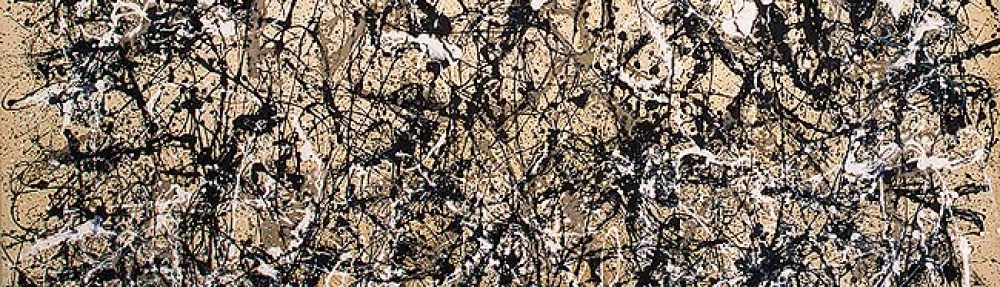
Autumn Rhythm:
There is a wholeness and inclusion, or at least the impression of these, but it is difficult to say the painting has a set order, that it couldn’t be put together in some other way, or any other way, or even that it is together. Or that any one spot, blot, line, or splatter is essential. Or that all of them are. Yet there is a necessity of placement at stake. Move or erase too many, maybe just one, and the painting is destroyed.
It is a big painting, but is it painting of something small enlarged in minute detail, or something enormous that has been shrunk?
How far can you go when you enter, if you can enter? If you can, where can you stay? If you can’t, what keeps you out? Where are you pushed?
The thing jumps out at you even as it retreats.
.
What is needed is a chart, a plan, a set of rules. Or at least a dance chart to tell you where to put one foot after the other . . . .
Perspective:

A horizon is set towards which lines that define objects converge, theoretically at infinity. A central point on the horizon, the eye point, determines the overall cast. It’s a device for creating the illusion of depth in two dimensional pictures that look like something, a way of establishing relationships, consistent and proportional, between up and down, here and there, anywhere in the frame. Also a way of orienting viewers, both the ones who look at the picture from outside it as well as those who look within.

But more than an illusion, a metaphor. There’s a figure in the figure. Not just a way of relating parts, of ordering space consistently and proportionally, but also a vehicle for the notions of consistency and proportion and relation. Not just an orderly picture, but a picture of order itself. Since the eye point lies at an infinite distance, we are given a container for the World. And since we can see that point and all it determines, we have the means to comprehend It.
Perspective implies perspective, an angle on the world we see, a world where we see each other and are seen, where we have a place, where everything fits, a world governed by whatever it is that exists between and beyond us and holds all things together:

The place we have in the order of things, however, maybe not be the place we want:

It may be difficult to stare down the throat of infinity very long.
.
Concerns:
There are no absolutes.
Corot, Cezanne, Picasso, etc.
.
Old hat, I know, perspective. Also, there are problems. A sleight of hand, a wrenching of geometry, a Western imposition. Perspective has helped foist on us the delusion that we know where we are going, that we are going someplace. But there has to be some basis to compare one thing to another, or we couldn’t say anything about anything, much less tear it apart. Even a criticism of perspective requires some kind of perspective. And it’s hard to believe there isn’t something Out There to guide us, though you’d think we would have nailed this down by now.
.
Questions:
What is infinity?
It is everything.
What isn’t infinity?
It is anything that isn’t everything, or:
It is everything that isn’t anything.
What isn’t anything?
.
Preliminary Considerations:
Postwar affluence, the Cold War; the anxiety that comes with lots of money and lots of bombs.
The middle class.
The South, old/new.
Childhood . . . .
Love and Will:
Both artist and neurotic speak and live from the subconscious and unconscious depths of their society. The artist does this positively, communicating what he experiences to his fellow men. The neurotic does this negatively. Experiencing the same underlying meanings and contradictions of his culture, he is unable to form his experiences into communicable meaning for himself and his fellows.
The Art of War:
Now the elements of the art of war are first, measurement of space; second, estimation of quantities; third, calculations; fourth, comparisons; and fifth, chances of victory.
The Art of War:
By terrain I mean distances, whether the ground is traversed with ease of difficulty, whether it is open or constricted, and the chances of life and death.
Life Against Death:
The desire for money takes the place of all genuinely human needs. Thus the apparent accumulation of wealth is really the impoverishment of human nature, and its appropriate morality is the renunciation of human nature and desires—asceticism . . . . In this dehumanized human nature man loses contact with his own body, more specifically with his senses, with sensuality and with the pleasure principle.
Chance and Necessity:
The initial elementary events which open the way to evolution in the intensely conservative systems called living beings are microscopic, fortuitous, and utterly without relation to whatever may be their effects upon teleonomic functioning. But once incorporated in the DNA structure, the accident—essentially unpredictable because always singular—will be mechanically and faithfully replicated and translated: that is to say, both multiplied and transposed into millions or billions of copies. Drawn out of the realm of pure chance, the accident enters into that of necessity, of the most implacable certainties.
Samuelson:
The law of diminishing returns: An increase in some inputs relative to other fixed inputs will, in a given state of technology, cause total output to increase; but after a point the extra output resulting from the same additions of extra inputs is likely to become less and less. This falling off of extra returns is a consequence of the fact that the new “doses” of the varying resources have less and less of the fixed resources to work with.
Steps:
The heart of the suggested program of personal recovery is contained in Twelve Steps describing the experience of the earliest members of the Society:
1. We admitted we were powerless over alcohol—that our lives had become unmanageable.
2. Came to believe that a Power greater than ourselves could restore us to sanity.
3. Made a decision to turn our will and our lives over to the care of God as we understood Him.
4. Made a searching and fearless moral inventory of ourselves . . . .
Thunder:

Thunder—success! Thunder comes with a terrible noise, laughing and shouting in awesome glees and frightening people for a hundred miles around. The sacrificial wine is not spilt.
The middle class:
Suburbs, frisky dogs, and ruddy cheeks; stories that always turn out well, or at least turn out the same way . . . .
Love and Will:
The neurotic and the artist—since both live out the unconscious of the race—reveal to us what is going to emerge endemically in the society later on.
Money, my brother (1):
Money is everything.
Money, my brother (2):
Money doesn’t mean anything.
Issuance of Class B bonds or lower, $millions (junk):

Dow Jones:

Gross Domestic Product (GDP):

Income distribution, %:

Alcohol consumption, gallons:

Cancer rate, per 100,000 male population:

Murders reported in NYC:

Prices paid for a Pollock (Blue Poles):

Abundance:

Abundance—success! The King inspires them. Do not be sad; it is fitting to be like the sun at its zenith.
Excess:

Excess! The ridgepole sags. It is favorable to have some goal in view. Success!
Dizziness:
Dizziness is a psycho-physiological state tied to confusion and the mental processes of understanding, with a possible ontological component. There are many variations. You have just come to grasp a basic principle, a unity that breaks down barriers between the disparate things before you, and can see it, in the totality of its relevance, racing endlessly to comprehend them. Or you see the unity, but it careens off the walls of all the things it does not comprehend and scatters everywhere beyond them, while the things it does pervade begin to dissolve into endless nothing. Or you only see the principle but sense no walls at all, only the outlines of what you think is there, the boundless extension of their empty possibilities. Or see the mesh of possibilities in things, but not the principle that might align them, only the chance of a principle, ever endless in its evasion. Or see neither the principle nor possible connections, only endless endlessness.
In each there is the same feeling, similar to that of physical dizziness, like an irritation in the ears, a tickling of equilibrium, and it is difficult to tell whether the sensation is one of rising or falling. In each also come feelings of doubt and confidence, of anxiety and elation, but it is not clear whether the dread belongs to confidence, the transport to the doubt. With these feelings, another emotion impossible to name, diffuse yet more intense; with its movement, a stillness, a white mist spreading in a blinding sun . . . .
The Abyss:

Abyss upon abyss—grave danger! All will be well if confidence is maintained and a sharp hold kept upon the mind; activities so conducted will win esteem.
The Art of War:
Apparent confusion is a product of good order; apparent cowardice, of courage; apparent weakness, of strength.
.
—but I miss it, the Cold War. At least we knew who to hate, and in knowing who to hate, knew where we stood. If we didn’t hate the communists, we hated the communist haters. Both hatreds were strengthened either by the chance of getting blown up or the confidence we could blow the communists up, though it is hard to say which haters were made more secure by which threat. With our hatred, we could even manage reverence, an awe at the possibility we might all disappear in clouds.
Now, however, not much cause to look up. There’s little chance anything will fall. And with the collapse of the Soviets, we were turned back on ourselves and now only have each other to hate, but it’s hard to think of good reasons and make them stick . . . .
.
The South—same deal, really, yet how easily we shed our hatred and our guilt. Now we have consciences we can live with, and can really be pleasant people.
Also we are getting rich . . . .
.
—Hey, Vito.
.
He sits propped up in a hospital bed, his voice weak and hoarse, yet steady. It is the effort that he expends in talking that makes him sound loud.
When he first called about the pain, said something was wrong with his liver, I was upset but not surprised. But then the word came later, cancer, which had spread into his colon. So he flew down to North Carolina to be with the family and the oncologists at Duke, and for the past month I have been driving back and forth.
—Sheeesh, Vito, this operation. It makes ya’ sound like a gangstah.
The oncologists at Duke, however, say it is the other way around, that the cancer started in his colon, and yesterday, even though the odds weren’t good, they cut half of his bowel away. The liver they couldn’t touch.
A plastic bag is stuck to his side, weighted, half full.
—Hey, Vito. I got a job for you.
Also, he has been on chemo, over a month. His hospital gown, that gown that looks like a garment designed for a destitute, wayward child, hangs limp. Sixty pounds gone. The poison takes the good cells with the bad.
—Hey, Vito. Come here and kiss my hand.
His hair has thinned to baldness, his cheeks, what’s left of them, droop casually, their flesh yellow and blotched. A new outline defines his face, his bones showing their contours, his depressions sinking deeper, his lips stretching across his teeth in another kind of smile—
He looks like death.
—Hey, Vito. I’m talkin’ to ya.
His eyes still look straight on, however, deep from within their sockets, though now with the piercing gaze of laughter as it skirts terror.
Or maybe it was the other way around here as well . . . .
.
Saturday afternoon—
I think I spent the rest of the day staring out the window . . . .
.
.
.
.
.