.
—Jesus, you look like hell.
He says when he comes in and sees me.
I probably did. A day of worrying about him and making bad guesses had unnerved me, which has to be the reason why it is so hard to remember what followed. I was too strung out from chasing dead ends for anything he said or did to make an impression substantial enough to count on now. I can’t even recall how he looked when I looked up, other than tired, any mark on his face revealing what had occupied me all day.
Yet I don’t think the look exists that matches the one I expected. I may have been shocked to see him.
Now some of it starts to fall in place . . . .
.
It is Saturday night, and has been dark for several hours. He walks across the oriental rug then stops in the middle of its red, anxious field, mulling over something that brings him pain. He’s wearing jeans, a sport jacket, and a white shirt, the collar open. No tie. Over these a full-length formal coat that makes his casual dress look imposing, his pain monstrous. In one hand, his briefcase; tucked in the other arm, almost as monstrous, the early edition of the Sunday Times.
He looks at me again, then surveys the room, then looks at me once more, still pained. Then his pain disappears and his face brightens with release: my brother has made a decision. He puts the briefcase down, lifts the paper, takes the entertainment section out, drops the rest, and opens to the listings.
—Sonny Harrison!
He says.
—Nine trombones!
—Village Vanguard!
—Let’s blow!
The voice of exclamation I may have added. At any rate, the next thing I know, I’m on the curb and he’s in the street, poised at the edge of traffic, raising a finger with restrained menace. Then we’re in a cab, and he names a street and a place that sounded foreign—I didn’t know what it was, I still can’t remember it now—but we are first going someplace else.
In a cab, in the back seat of a cab again, this one’s driver a bullet-headed Charon sunk deep in his seat, his hands welded to the wheel, his mouth shut, his eyes dulled in catatonic stupor, in a cab with my brother, in a stampede of all those yellow cabs, charging down the Manhattan digit in another run of near misses, and I didn’t even know where I was going.
What was I thinking, why hadn’t I resisted? Because whatever we were doing must have been still more avoidance, or yet another plunge into the problem. But I wasn’t in any shape to resist or even think, could only follow him, whatever he had in mind. All I remember for certain is being glad to get out of his apartment, then all I remember is looking out the window of the cab.
But what should you think about, what is there to think about, how can you think about anything when you’re in a cab in New York, what else can you do but look? And I look, I know I looked, even though you’re not supposed to look, I couldn’t help looking, couldn’t stop looking at the faces, the places, the things of New York night, couldn’t stop looking at all those lights, shaken by the looking but still couldn’t stop looking, and shaken the looking itself by the motion, the noise of the cab, by the noise of all those cabs, by sliding, banging metal, by worn shocks on pitted streets, the pinch of sudden stops, shaken by the noise of cabs and by other noise in the streets, the noise of things being built or torn apart, by its reverberation between the walls of what stood still and still stood, this noise made more distinct yet more scattered by its recoil so you can’t tell the noise of construction from the other, by this noise and the noise of the loud strains of music that seem to come from nowhere, like the strain of sudden decisions—
Looking, shaken by looking, the looking shaken, shaking, looking at all the containers, all those buildings, at what is contained by stone and steel and glass and thick, glassless doors, by metal bars and mesh and blinds, by columns of deadbolt locks, looking at the enclosures, the courts, the lots, the yards, contained by chain-link fence capped with razor wire, the looking shaken and shaken themselves the buildings by the noise of their facings, their echoes of other places, other times, or their abstractions of those places, of those times, or their glass and steel denials of other times and other places, shaken itself the moorings, any suggestion, any notion of any place or time, and covered, the facings, with the gray film of exhaust and dirt, the black in joints and cracks, in the intricacies of cornicework and stone carvings and poured concrete figures, in the filigree of wrought iron flourish—
The looking shaken, the buildings shaken by what uncontains them, the ladders and stairs of escape climbing up the walls, shaken by what they cannot contain, the light from all the windows and by what escapes them in the streets, the smoke, the burning smells, the exhaust, the steam, the fumes of food and vomit and excrement, the gases from subways and sewers through manholes and sidewalk grates, the clouds of breath, the breath from faces, from the people on the streets escaping, uncontained, whose night business is being out, who want out, can’t help wanting out, can’t help being out, the people who do not look and the people at night who do look, who look with the hard edge of commerce and desire, of possession, of release, of avoidance, of sudden decisions and plunges, the people who do not look not looking because they know the others are looking, because if you look, they got you, the lookers, you get dead because looks can kill, because looking can get you killed in New York by the lookers, who kill because killing seems to be the only way or because killing is their business, because you don’t do what they say when they got you, or don’t say the right thing, or who kill you when you do, or kill because you look like somebody or just because you look, and if you look and get caught looking, you know that no one will look when you get killed, nor is there any comfort in knowing that most people get killed by people they know because in New York the small percentage can work into big numbers, and even if not murder, there’s the slow death in the other night transactions, the selling, the possessing, the taking, the shell games and the luring and the exhibitions, the looks to catch you looking, the looks to get you to look and make a sound, because once you look you get seen, you speak, you yell, you get exposed, you get trapped, you buy, and a part of you gets taken and sold, and even if you’re in a cab, only looking but not looked at, the same part still gets taken and destroyed though not as much or more—
Yet still I look, couldn’t help looking, couldn’t stop looking not just at faces I could see but also for the faces I could not, because the faces you see may not matter, whether they look or not, because you can never know why someone is looking, can never make sense of a shout here then there, know whether some flash in dress, a wild stare, a sudden plunge isn’t a slip from innocence or even a thrust to assert it or know whether a careful pace, averted eyes, and sober clothes mask a hidden murder or conceal one that is planned or hold the lid on some checked abandon waiting for release, it’s the faces of the people you don’t see but know are there who matter, or might be there and might matter and because of the big numbers will be there, the people you only read about in books and the paper or hear from rumors, the people turned out by debt, set loose by New York courts and psych wards, the people beyond the grasp of courts and wards, the Mob, the mobs, the gangs, the flocks of hookers and pimps and junkies and thieves cloaked in the darkness of their purpose, the hoards of soloists, hidden in the black filigree of their obscure designs, faces you only see in movies or in the film of your worst dreams or who hover at its fringes, but you know they are there, on the streets, somewhere, there not because the reports are true, less because movies and rumors and dreams are true in the way fictions might be true, not that their numbers and analyses are inaccurate or that the spectral hauntings or giant figures on screens, the clear, sudden terror of their acts, the fake wash of blood aren’t real one way or another, but that they aren’t accurate or clear or real or fake or loud enough because they only reveal what you can count and see or dimly sense or are only what the fiction makers and you can conceive and hold, because these only catch the surface and can’t tell you anything about those who never make it into the papers or appear in dreams, and since they are all only weak approximations of what is there, because they all fall short, they only hit the surface so they have to be there as well, the people you cannot see, because what is true is more than what you see, thus anything less has to be true as well, because the odds of big numbers make them more than probable, they are true, the fictions, the reports, the bad dreams, because they aren’t true and what isn’t true is because even if it isn’t true it wouldn’t matter because its falseness would pale before the largeness of what isn’t false, making the lies, the misconceptions insignificant, and even if you, insignificant, in a cab only looking, watching the lights streak by your window, feel safe even when that part of you gets taken or destroyed, that’s all, you think, you can give that up you kid yourself, then you think how safe you’ll be when it stops, and when you get out you will realize there is no safety in numbers or assurance or even illumination in all the lights, the flashing lights, the moving lights, the headlights, taillights, streetlights, stoplights, the noise of lighted windows littered against the sky, the smear of their halos, the haze of their blurring in your eyes, because they still fall short because they still only reveal what you can see but not what you can’t—
And there is no safety or even a word in the words of the neon signs loud with the names of faces, of places, of things, no safety in the small words and emblems and logos and signs in shop and restaurant and bar and corporation windows or in the huge words on monumental boards, no safety in their statements to locate, to direct, to indicate, to sell, to make you look because they do not place or direct you anywhere or offer or show you anything because what they represent is trivial, their smallness only marks the largeness of what they don’t represent, their largeness points to the size of their triviality, the triviality made large because it falls so short, the huge and the small words only show how much more there is to show of that whose scale cannot be plotted, of what dies when it is lit or consumed, what drives the lookers and non-lookers out and keeps everyone else in, what makes you look even though you’re not supposed to look, what drives you to the sweet stench of movies and feeds the worst dreams you’ve haven’t had but wait for, what is a kind of certainty in their eyes, the eyes of the lookers, the non-lookers you can and cannot see, a knowledge constructed by the lines of sight of all the gazes that do not intersect—
Not that the faces, the places, the things of New York are different from those anywhere else, or even that there are more of them, because there’s a gestalt here where the whole is more than the sum of the parts, or greatly less, it is a gestalt of brightness, or darkness, of what can’t be seen because it is too bright or dark, what can’t be contained by walls or locks or revealed in lights or words yet is defined by not being lit or contained, what is measured by the scale of the edge of what razor wire or a switchblade or a spray of bullets cannot slice and spill on the pavement, what a mist cannot pervade, what a nightmare cannot conceive, what cannot be devoured or thrown up, what screaming cannot touch, what you won’t be prepared for when it hits you, you won’t even know what it is because what you see now is nothing—
Nothing yet.
And at some point, looking, not thinking, not knowing where I was going, lost, not anywhere, and not even knowing that—I must have looked at my brother, who is not looking.
He sits with his head on the back of the seat, cheeks bouncing loosely with the jolts, his face moving through shifting shadows. Though his eyes are open, gazing upward, they are not fixed, and he breathes thinly through his mouth, as if asleep. Also he is silent, I know he was silent, and there was something final and unapproachable about this silence. Not impenetrable, however, because it wasn’t the silence of blockage or removal, but rather of opening and contact, which, like his breathing, allowed easy passage within, without.
And not unintelligible, either, or it shouldn’t have been, because it wasn’t the silence from losing or avoiding thought but one that had the look of engaging it. Because with his breathing, the creases of fatigue on his face slacken and his eyes continue to lose their focus yet become more alert, moving closer to some awareness, one that lies beyond the nervous exchange of words and light.
Not impenetrable, not unintelligible, because there wasn’t anything left to penetrate, anything else to know. It is the silence that must exist after all the walls have come down.
And with each breath, each loosening of his gaze, each continued moment of silence, it seemed he eased himself deeper into what I must have found repulsive yet which at same time filled me with the awe that bangs its head against transcendence, that he was going further into the darkness of the streets, the noise in all our hearts—
.
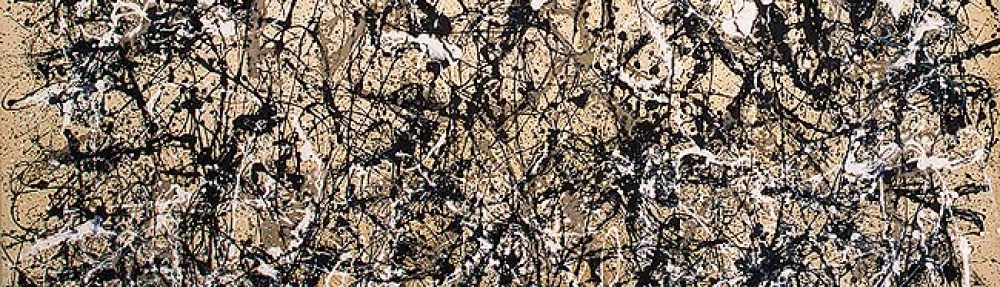
Autumn Rhythm . . . .
.
—but now I remember where we first stopped. Where we stopped was in front of a Spanish restaurant he said he’d heard about at the office, somewhere in SoHo. What we were going to do at this restaurant somewhere in SoHo was have supper before going to the Vanguard, even though food and music were the last things on my mind, and had to have been on his as well.
Inside, closeness and distraction. Long slab tables not far apart, cane bottomed chairs that hit the ones behind them when pushed back, and the place half-filled and filling, the waiters negotiating the lanes, brushing the shoulders of us sitting. Candles on the tables for lighting, which cast shadows on rough textured stucco walls. Some sort of music played too soft to be heard, or maybe there wasn’t any. The waiter comes, my brother orders—paella and sangria, neither of which I’ve had before. Then memories of a flowing, rising disquiet, fed by an atmosphere that felt dirty and oppressive. The dimness, the warmth that soon turned to stuffiness, the buzz of the talk of the crowd, ebbing but returning louder, their reserve loosening into irritations imperfectly shaped, joys shot at and missed—faint reflections of what we had left outside, disturbing in their faintness.
But still my brother sits there, ever silent, still not looking, yet still maintaining the easy passage within, without. He doesn’t look irritated or happy about anything, or like he is thinking about happiness or irritations, but rather remains somewhere beyond them. He doesn’t even look like he is waiting for the food. What it looks like he is doing is sitting, and I think this is what unsettled me more, that he could sit when there was so much that made it hard to sit. Yet he seems to be the only one in the restaurant who knows what he is doing.
Then the sangria comes in a stoneware pitcher, thin bloodiness where float ice cubes and sliced oranges and lemons and limes, pale colored in the light. Without ceremony, he pours first for me, then himself. I taste, and realize sangria has wine.
Then what?
I must have stared at him in shock.
But where was I here, if I was any condition to think about where I was? I had to have been upset, because wine meant he had lost his will and broken a commitment, which meant, in doing so, however fickle this one was, that others could fall as well and take him with them. Upset more because of what else the wine might mean, that what I didn’t think a problem was a problem, because of where taking a drink after laying off could go hard and fast. But I had to have been relieved as well because it also meant he didn’t take seriously the AA mumbo jumbo of the night before.
Or was I both upset and relieved?
Or neither?
Where am I now?
But wine means at least this much, that he didn’t hold off from drinking that night.
Which means—
He looks at me and solemnly says,
—I know, it’s sweet. But sangria is what you drink with paella.
Then he takes a sip and puts his glass down, not showing how he has received the wine or what receiving wine might mean, what he may have started. He doesn’t look like he has begun anything other than a glass a wine, as if he has forgotten about AA, or sees no contradiction in what he is doing.
How could something that meant so little yet might mean so much not have seemed to mean anything to him at all?
Then what did I do? After Friday, after that day, after what I’d seen, I must have eyed the glass with special urgency. But wondering what drinking after not drinking meant, I didn’t know what to do—
I didn’t touch my glass.
Not because I was trying to set an example or stay some course. I must have decided to stick with what I had had all day—nothing—too undone and unsure of myself to make a switch. Or maybe I decided staying sober was only way I could handle what we were doing, whatever it was that we were doing.
And my brother did not react to my not drinking, either. Throughout the meal, when his glass was empty, he first looked at mine, and after seeing that it remained full, filled his, which left me wondering what filled glasses meant, what the difference was between his and mine.
Next, more stoneware, a large covered pot. When my brother lifts the lid, paella. Paella: on a bed of yellowed rice, scallops, shrimp, lobster tails, mussels in the shell, and other meats not from the sea; green and red peppers and other vegetables I could only guess at; and more things I recognized less and had no idea where to place—all arranged in a spiraling composition, looking like, in miniature, some cosmic event waiting to turn itself loose. If we had to eat that night, we had to eat something, and while I don’t know what we should have had, paella wasn’t it. Circumstances called for food more basic and direct. Yet with even less ceremony, he spoons it out on the plates, again first for me. Then he picks up his fork and eats.
Maybe I held back here as well. More likely I went through the meal quickly because I couldn’t have eaten much that day. Either way, no memory of how it tasted. My brother couldn’t have eaten much before himself, but when I finish and look at him, I see that what he is doing now is still eating, pulling legs off shrimp, cracking lobsters, prying out mussels, cutting the other meat, forking all this in with the rice and vegetables and other stuff while piling up hard and soft shells and tiny limbs on one side of his plate, as the other diners around us pile up lifeless shells on theirs, my brother forking then chewing, interspersing the shelling and cutting and piling and lifting and chewing with sips from his glass, finishing the whole bottle as he did, doing all this methodically but without deliberation, not evincing pleasure, but not frowning in resignation from having to yield to necessity, or in distress from giving in to temptation, not even smiling furtively in the pleasurable guilt of yielding, not looking like he is doing anything but eating and drinking.
When he finishes, he puts down his fork with a finality that shows he is done.
When he pulls out a cigarette, he lights and smokes it.
When the tab comes, he pays it.
And I watch all this, reeling in conundrums of the obvious.
It had to have been late enough for the first set at the Vanguard, but he proposes that we walk. The fresh air, he says, will do us good. So we walk, I ever following, wondering what it means to walk.
Whatever he was doing, whatever happened later that night, he took his time getting there.
Outside, cold air not fresh, against the warmth and disquiet I carried from the restaurant. Some concerns, too, about what crustaceans and filter feeders and unknown life were doing down in my stomach. Then the return of New York fear, at the intersections, off to the right, the darkness of Lower East Side—what I’d heard, what I imagined if I were in a place where I could imagine, but even if not, what, given the greater odds, was going on there, skid row nightmares, planned mauling and random deaths, and greater nothing yet. Against the fear, in SoHo among the lofts and cast-irons and brownstones, blossoming gentrification—I had only seen the buds before. A fern bar, upscale restaurants, boutiques and shops selling clothes and interior things, casual, campy, and expensive, all closed but their windows lit, beacons of toniness against the night. Against the fear and shops, galleries, more of them than I remembered from the last time I was there.
My brother, who wanted to walk, keeps walking, not looking left or right. And I follow, not knowing what else to do but follow, first feeling safe with him, then wondering about that. Then before I know it, I’ve lost him—
Now I find him. He has turned into one of the galleries, an opening, a two man show by artists whose names escape me. Lots of food and booze on tables, which he passes by. Or maybe not the booze. A modest crowd, more of what I saw in the restaurant, the gentry, the casually rich with their self-possessed and possessing looks, not looking at the paintings, but rather ignoring them with casual disinterest, who also do not catch his glance. Where he goes is to the paintings. What he does with the paintings is look at them, with or without a drink in his hand.
Again I follow him, wondering what has driven him to want to look at art.
On one side of the gallery, brushless, geometric starkness: large, simple hard-edge figures, slightly skewed, painted with fluorescent colors loud yet subtly jarring in the closeness of their hues. Hard to tell if the work is a send-up on abstraction or an effort to push it another notch. On the other side, representation. Enormous heads with gaping mouths and wide, staring eyes, the heads either laughing or shouting or crying in pain, or laughing at their crying, shouting because there isn’t enough pain. Mostly blacks and unearthly browns, with blues and greens that stream like blood, and bright reds that do not come from facial cuts; everywhere, pushed beyond apparentness of technique, the evidence of brushes and palette knives, gobs of impasto worked up and slashed, like squeezed, lacerated flesh. Impossible to tell what the heads are reacting to, other than being forced to be represented on a canvas. Or maybe it is the paintings themselves that react against having to endure the representation of big heads.
My brother gives the paintings of both artists the same expression, if it is an expression, that only shows he has seen them, and when he has seen them all he walks out.
Still I follow, now with a grimace in my gut.
Finally we work our way to the Village, or I assumed that’s what we were doing, because he didn’t stop until we got there. But he takes a winding route across the island, east to west, with side trips that send us almost as far north and south, walking a good two miles in the kind of cold that penetrates joints. Yet still he walks at an unhurried pace with a smooth billowing of his opened overcoat that keeps time with his step, still maintaining the same unruffled silence, the same easy exchange within, without, now revealed in his visible breath. With the breath, the return on his face of the look that is not looking.
I look, however, still couldn’t stop, still couldn’t help looking, looking but not seeing, not knowing. Maybe I was too tired and overwhelmed to see, maybe there was too much to see, too much that could not be grasped. And maybe I was still a kid, out of it, who hadn’t seen anything yet, but this is what I remember now:
There was once a part of me that wanted to believe some place existed where all the things I made concessions to were not conceded, where what I wanted most in life but so far had failed to envision might find a form, where purpose could get beaten into shape, where right and wrong were realigned into a schema that could be felt and made some sense, where staleness was a sin, a place where one could cut loose but cut loose to look and think and create and live, a place that was not heaven. The circumstances of my life, a fault of talent may have kept me from getting to that place, but it was enough for me to think that it was there, somewhere, and I tried at least to find it to confirm my belief and know that somebody upheld what I hadn’t managed for myself. One can be sustained by contact and approximations.
Paris, maybe, where I went the year before, but I didn’t know French well enough to see if that place was there. Language didn’t matter though, because the city was overrun by American tourists.
And the Village, where I’d go when I visited him the years before. But the Village was a place that lived only in my mind yet actually lay elsewhere, because I only knew it from the pieces I’d stumble upon that I couldn’t put together, some I never found again. The first time, by accident, taking the wrong subway and coming up at Village Cigars, where I bought one, a cigar, a five dollar wonder, rich and harsh, then smoking it and wandering several blocks, charged by a heavy pulse and finely textured rush, by the rush of people on sidewalks not crowded but full, by the look on their faces, the cast of store signs, street signs, the wear on brick in the streets, on buildings that held onto a few stories in a city that fled in heights—all seeming just as richly cured and harshly charged by the possibilities in blood that had been pushed but kept. Then a few more blocks left me in a neighborhood that looked only raw but threatening, and I couldn’t retrace my steps.
Later, neighborhoods with improbable trees lining the walks. Old town and row houses, classical revivals unstudied, clean, and intact; apartments showing not the signs of neglect but priorities—not homes but platforms, where you had to prove yourself to stay. Stores that sold books and records that couldn’t be bought anywhere else. Galleries that couldn’t survive uptown, thriving in converted storefronts and urban caves. Cafes where diners stared at notes. Theatres off and off-off, and thus closer, where the expense went not into the sets or lobbies, but into emotion and the emotion of restraint. Chess out in the open, motionless players locked in the struggle of placement and position, commanding movement in some immeasurable space. Basketball wars waged in a chain-link cage, a choreography of thrusts and feints, a collage of bruises. And nightclubs where the same bruises turned into jazz.
Not much, not anything, really, yet enough to get me started. The rest I tried to flesh out with what I read, what came out of the Village before me during those decades that straddled wars, back when everyone thought they knew what was what, which the Village knew wasn’t it. The pieces I couldn’t assemble on my visits, the Village would stitch together for me.
That night, however, following my brother, looking, while I recognized the names of streets and landmarks, what was alive in the streets looked spilled, what I thought was the Village and lived in me looked dead. Hardcore homeless, softcore nighthawks, panhandlers aggressive as traders on the floor. A couple of offers for dates, a fire in Washington Square. Spectacles on the sidewalks, the overflow from bars running off both ends of the scale. Graffiti overwriting graffiti in manic bombing, hopeless scrawl; vomit trailing into stairwells. A fight, someone thrown into the street. But mostly empty streets and still more nothing, nothing yet, yet everywhere, on the apartment buildings and restaurants and shops, the face of money, moving and cashing in.
Maybe my brother was feeling his way, or maybe he just got lost. I don’t think it mattered to him, however, where he went or how, or what he might be walking into. Getting somewhere or avoiding anywhere else was not important in his plan, if he had one, if there was a plan to have. And even if this was not his intent, and I doubt he had one, the effect was the same, to strip me of my illusion or show that whatever might once have held it up had been destroyed. Because by the time we reach the canopy of the Vanguard, my legs are stiff, my head is numb, and my heart is in my stomach.
Then down the steps, into the club, only to find the Vanguard in retreat—the place is packed, rotten with tourists and more gentry. It takes us forever to find a table, and there my brother, sitting once more, as the crowd, whites and off-whites dressed too well, ever casually possessed and casually distant in their disinterest, fake listening to the music or talk stiffly, sharply over it, voicing their distracted conceptions of themselves, of their conceptions, as subway trains rumble below, as the band, twelve blacks jammed and spotlit on the small stage, drums, a piano, a bass, and nine of those absurdly long instruments that require a stretch to produce nothing better than brass mellowness, play only to themselves, pumping out big band mush that must have sounded contrived even when it first came out, pleasantness created to appease those who don’t want to be moved but jostled, if they can let themselves go that far—there, sitting, my brother begins to fall.
Because when the waiter comes, he orders—
A round of—
Whiskey.
When the drinks came, however, I said nothing, and probably didn’t even stare. I still didn’t touch mine. I know I held back the rest of the night. But if I stayed sober, it had to have been because that was the only way I could manage what it was that he was doing.
Not the booze, less a simple fall from grace or will, because it wasn’t a fall as easy as those. Because where he was going, it doesn’t matter whether you drink or not. AA was at best a stall, more likely just another side trip.
I don’t know why he picked this place, that music. What you hear, where you go, however, don’t matter. One place is as good as another for a fall. What happens next or where we end up can’t matter either, because where he was falling there was no place to land. Nor does it matter that I was at the end of whatever reserve I had left after the past two days, after the walk through the Village, does not matter that I could look but could not see, because what made seeing hard was what I needed to see. I must at least have seen and known this much. And it doesn’t matter that I couldn’t see or know enough to remember well now, because I remember all I need, and have since learned at least enough about it to know how to steer clear. But memory doesn’t matter and understanding doesn’t matter because there isn’t anything to remember or understand.
This is what my brother understands as he sits there in the club with the crowd, before that music. And I understand now this much, what I must have seen then but faintly comprehended, that what surrounded us, what was there, inside the Vanguard cellar and out, was a vital part of who he was, what was happening in his life. And to some extent he was part of it himself, or at least was on the surface, as you could not tell what distinguished him from the crowd or even those who walked the streets when you consider his job, the way he dressed, and the way looked, the way he didn’t. Still, he stood apart from them all because he knew who he was, where he was, and what he was really doing. And knew his part in the world, whatever it was, didn’t matter because it could only be small, approaching, by some operation of fractional multiplication the infinitesimally insignificant, nothing compared to what he saw beyond himself endlessly opening up the other way.
I still don’t know his relationship to the world, but ties must be a moot point, because to know the world is to concede its power, from which, once recognized, there may be no escape. And it takes getting out of the stale walks of your life and going to New York and seeing a brother fall to know what New York knows better than the rest of us, that the world is a place of endless distraction and wanton violence, which may be two aspects of the same thing, a place inhabited by shapeless creatures with too many feelers and feeble appendages, protected by their shells, groping, crapping, colliding in the ooze, pushing each other out, evolving from their collisions into creatures with better feelers and harder, more expensive shells that allow them to collide and crap and grope some more, a place where the best projection of yourself doesn’t stand a chance, where the next act of violence is a matter of odds, of someone finally figuring it out, where a brother can flip out for whatever reason or no reason at all one week and continue the way he did before the next, only to fall again until there isn’t anything left of him to fall.
It doesn’t matter that he took his time, because where he was going there was no rush.
It doesn’t matter that I didn’t do anything that weekend but follow him, because there was nothing else to do.
It doesn’t matter what was going on with him.
He must have known this, too.
Yet still, as ever, he sits at the table with a look on his face of sublime indifference, sipping whiskey, not struggling against but easing into his fall, silent and unafraid, and it doesn’t look like there is anything else that could happen next but then he speaks—
.
—Lighten up.
.
I have forgotten this.
.
Then he starts tapping his finger.
.
I have forgotten this, too.
.
Then what happens next is he does what was hardest to fathom, what I have also forgotten perhaps because I may not have recognized what it was. What he does next is listen to the music. What he seems to be doing with the music is getting into it.
Either he was loosening up for the fall that followed with a tune and a buzz in his head—
Or he was going somewhere else some other way.
.
I may have some reconstruction to do.
.
I suppose I could ease up a bit.
.
Saturday night, the Vanguard: darkness, the crowd, their tittering egos. Before us, the flash of spotlights on brass bells, on slides moving back and forth from otherwise quiet bodies, tilted heads, and pressed black cheeks.
My brother sits back in his chair, relaxed but focused, sipping whiskey, listening, and tapping his finger. Like the band, the rest of him is still. Relaxed maybe because of the whiskey. Or maybe relaxed because he is focused. And maybe focused because he is relaxed. Whatever the case, what he seems to be doing is following within what is being played out on the stage.
There was so much from that night, from all his years, that worked against this moment and nothing to hold it up. Yet I realize now that this could have been the moment the last few hours had led up to, maybe more. I can’t think how he managed it, this moment, or why, but I may now need to rethink the rest of the ones that followed.
Maybe this moment was just the eye of a storm passing through. Yet he doesn’t look like he is unaware of what he has left behind, nor like he doesn’t see what is coming. Wherever he is, he is the only person on the floor who is wholly present, or looks it, at least this moment.
At any rate, it is the point where I am stuck. While I’m still not sure what happens next, and while what happens next still may not matter, I can’t go anywhere until I come to terms with it, this moment that he listens. Maybe I can then try to see what I can put on top.
Which must have been what I did then, as always, follow him, though I may not have known where I was going or why, but follow him nonetheless, into this moment, and let the other moments go, at least for a while. Maybe I even managed to loosen up, just enough—though without the aid of whiskey because I still didn’t know what drinking or not drinking meant and didn’t want to lose what control I had left—loosen up to see where the music might take me.
Or loosen up just to listen, because there was a time when I could listen to jazz and be moved, loosen up and listen to the band, which may have been what seemed like falling.
That music—
Maybe it was—that music, simple, sentimental fluff that tripped its way into oblivion.
Still, it beat the other options.
That music—Ellington maybe, it hasn’t left much of an impression and I never could listen to the old stuff, so it’s hard to conjure up anything now from what I imperfectly remember, but A Train is what plays now in my head, pulling into its stations with a rolling, facile bounce.
Or not just Ellington, or maybe not Ellington at all, but what they do with Ellington, carrying the tune along on the hydraulics of their well-oiled slides, the players not striking the slots of harmony but slurring into, coaxing the notes and making the harmony swell with genial, brassy warmth. I don’t know what else there is to recall or add. Once you’re onboard the thing, you get all you need in a few bars to see what it is and where it is going.
Still, it finds a way to move itself and keep moving, and now that it’s gotten started in memory, it doesn’t want to stop. Yet now that it is moving, it begins to pull away and I have to race to catch up with what I already know and have, in memory. Then when I think I’ve got it back, I see it now behind me, coming down the tracks, ever at its unhurried pace. So I wait, tapping notes on the mental keyboard until I have it right, then get onboard again.
But now it is a more forceful ride than I remember yet no less simple or easy, as the nine slides, working the different parts, taking different positions, pursue lines away from the tune faster or slower than the beat set by the bass and drums, than the rippling of the piano, making rhythms within the rhythm. Even though I still know what it is and where it’s going, I’m less sure where I am or am going now, in memory.
No grime on white tiles or bolted beams under concrete ceilings, nor dark tunnels beneath which city walls soar and glare and crumble. No sparks or smell of ozone in the air, nor subway cars hit by aerosol spray slamming, rattling on hard, uneven rails, though every now and then a syncopated hit from the snares, a blaring from the bells.
It doesn’t take me out to Brooklyn or even uptown to Harlem, nor anyplace in between where I could get mugged or propositioned, yet doesn’t move outside these either, or beneath or above them, does not descend into the Catacombs or come anywhere close to Elysian Fields. Where it takes me is where I was then is where I am now, even though I’m not sure where I am when I was there at the Vanguard, before the stage—takes me to the music, going back into itself even as it pulls away once more.
Now I have to catch up again, and again overrun it, and again have to wait, but when I get on it this time instead of trying to ride it, I let it ride me, let myself ride with its currents, still knowing where it is taking me, but now getting there propelled by the tightness in nine black faces released in the fluent action of nine levering slides, a motion that is powerful and loose and free.
Not sentimental—
Yet just when I think I am moving with them, they split into small groups and pass the tune around, dividing it up, taking it apart and putting it back together in different ways that still aren’t different from what it is or where it is going, taking me apart and passing me all over the place without making me any different or taking me anywhere else.
Then at some essential moment, conclusive yet without finality or resolution, they each go up the steps of an arpeggio in turn, then play the chord together, the sound surging into a single yet involved sound, a chorus of the currents in the current, mellow, maybe, but also rich and deep.
Not sentimental—
Then when I think I have captured the chord and pulled myself back together, they all fall silent; then one takes off on a solo, his sliding, freed from the constraints of a group, now more varied and energetic, exploring yet more possibilities in the tune, going yet further away from what it is, touching everything there is to touch within his reach and still going past that, yet not running from it or from what the rest of the band has established. And I ride yet further out, knowing even less where I am going even though I still am who I am where I am where I was and am not going anywhere else, but now am going there by myself but not alone, in memory.
Somewhere Ellington, his presence—where he came from, what moved him, the way he moved it, and what I may have missed; somewhere, the presence of Harrison, where he came from, what moved him, what he took from Ellington and moved along with his orchestration, his planning, and his touch. Somewhere beyond Ellington and Harrison, what moved them to play music on a stage. On the stage, what was not planned, what the band took from Ellington and Harrison and now improvise and recreate afresh. And on the stage, Harrison himself. Maybe the music doesn’t raise me very high, but at least, now remembering, now seeing Harrison’s face, his easy acceptance, the slight, tight smile he holds behind the mouthpiece as he plays, I know I won’t be dropped.
Not sentimental—
Maybe the tune is simple but the music is not. The tune is only where they start; the music is what they do with it, driving, pushing, making it move, but move with their own momentum, shaping their sentiment without losing its size or motion.
Not sentimental—
Yet still the tune, the fixed point from which they stretch the tether of their playing, of their emotion, an emotion that seems to know itself, which might be called joy yet won’t rest with what it is.
Not playing to themselves, but playing. And what they are playing is jazz, but jazz without the bruises.
Not pleasantness, not appeasement, but pleasure, whether anyone is pleased or not.
The stage, the slides; my brother, his presence—I don’t know if I made it there that night, really doubt it, but I may have moved in that direction. And even though grasping this moment now, or coming close, still doesn’t take me anywhere, at least it is somewhere to be.
Not falling—
Or at least not falling yet.
Because whatever was going on in my brother’s life, he still could listen—and is listening, moved and moving with the band, tapping his finger slightly, softly, but firmly on the table, now swaying his head in small, tight arcs, his movement in sync with theirs, as if replaying within himself what comes from the stage, his listening a kind of music itself.
—Of course, he says.
I didn’t know, however, what he was of coursing. But there could be a point here. There has to be something to be said in favor of complexity and co-ordination.
.
Formalist considerations:
Not just a study of shapes and colors and how they are spread out on a canvas, but a stance. The artist discards the pretence of making paintings that look like something and pays attention only to what paint can do. His paintings assert what can asserted in a painting, shapes and colors, and the relationships they create from, within themselves.
Autumn Rhythm: Whatever the turbulence in his life and the world, Pollock could still make a painting. Not a painting that doesn’t look like anything, but a painting that doesn’t try to look like anything other than a painting, a play of streaks and blots and splatters. What it does is what these do, make the eye move around the canvas. Not chaos, however, because it is not without calculation. There is balance in the muted colors, and control in the movement of the shapes and patterns they suggest, the way they refer to themselves within the world of the canvas. Not ugliness, either, because its does have its own kind of attraction. But not pat order or mere decoration. What makes the painting work is the way shapes move in and out of patterns without stopping there, yet staying within the whole, but still not being constricted by any sense of wholeness.
—I like it. But it doesn’t say anything about life.
But there isn’t anything to be said.
—There’s a lot of stuff out there.
Or says all that is worth saying. Clement Greenberg:
Hence it was developed that the true and most important function of the avant-garde was not to “experiment,” but to find a path along which it would be possible to keep culture moving in the midst of ideological confusion and violence. Retiring from public altogether, the avant-garde poet or artist sought to maintain the high level of his art by both narrowing and raising it to the expression of an absolute in which all relativities and contradictions would be either resolved or beside the point.
—Who’s Clement Greenberg?
He’s an art critic. He liked Pollock.
—Why do we need to call in an art critic?
Critics can help us understand things that we can’t see for ourselves.
—Suit yourself. But it sounds like his point is telling us what we’re not supposed to see.
The point here is that life outside the artist is not denied, because it still is there and is what gets him started. But the only way to maintain his integrity is to distance himself from the glut. The only way to have a life in the world worth living is to shape his own. There’s an honesty here that doesn’t fall into traps.
As for art, as for ourselves. What matters isn’t so much who we are or what happens to us, but what we create from where we are and what we have.
Because which moment counts when you try to assess a brother? The moment he smashes things or gets smashed by them, or the one where he steps back and puts his life together and makes it sing?
Because it could be just this, that whatever was going on in his work or outside it, whatever he had done in New York and whatever New York had done to him, whatever caused him to smash mirrors, whatever made him call and scream, whatever any of these had to do with what happened to him five months later, at least he could have this moment of composure. Seen in this light, the flak is only raw material; that night, the weekend, all the years before could have been an ongoing improvisation where, unmoved, he still could move and be moved—
But how long can anyone keep this act up?
—Who knows?
Where’d you come from, anyway?
—Guess.
.
. . . the flash of spots on brass, moving slides; big band tunes and crowd noise, my brother.
On the table, two drinks: one full, one empty.
He still looks relaxed and focused, no more or less than before. I’m still sitting there, listening, or trying to, maybe getting into Ellington myself, maybe not, because not that loose, not loose enough—
And not much looser now.
But then the band moves into more familiar territory, to the jazz I cut my teeth on and thought was what jazz was, to music individual and driven, Monk and Coltrane.
Or goes to something that feels like Monk and Coltrane, or rather to what Monk and Coltrane did to the old stuff, or rather to what the band does to what Monk and Coltrane did, still sliding into or away from the notes with the same ease, the same force, the surge, the swell, the currents, still playing out the emotion that comes from what they do with what Monk and Coltrane did—
Yet I don’t think I was with them at all. Their warm, brassy translation, now troubling in its brass, its warmth, takes what has been taken out of one place then puts it into another that is not familiar and seems misplaced as the slides dive further with Monk in some melody that seems memorable but not easy to remember but once remembered hard to forget but I can’t recall it, the band plunging through the chords only to turn them inside out into harmonies that seem off but there, or elsewhere, then stalling in the middle of nowhere, then taking off in runs up and down the scale, missing notes not missed, moving in syncopations that come suddenly or take forever, making the regular beat seem off—
And then pull further away from the beat with Coltrane into something else just as memorable, and less, forgotten too, accelerating, turning loose in smoother rhythm, building dissonant chords that leave the key stranded, the chords seeming to belong still elsewhere or sound unfinished and have no place to return but still are there returning, making me think I knew less where Monk and Contrane were going than Ellington, even less what might have moved them all.
And everything that listening, or remembering listening has put aside—the night, my brother, the nothing, the nothing yet—now comes rushing back in. Yet still the band, with Monk and Coltrane, still somehow keeping the tune somewhere, though it only seems to be there for the stalls, the acceleration, the convolutions, the dissonance. And while their ease remains it seems beside the point, and the emotion created is not one I can name much less know how it moved me, except I must have felt lost.
Yet still Harrison keeps his smile tight, and my brother, though his head is still, still listens and keeps listening and still taps his fingers, though in a way without apparent method that is disturbing even though he doesn’t look disturbed, tapping his fingers, firmly, precisely, and tightly, too, both hands now on the table, his fingers spread apart, rising and falling at different rhythms, singly or in pairs, different fingers making each pair, fingers descending from different places on his hands, returning, yet rising and falling with a beat that still keeps up with the band with Monk and Coltrane, wherever the band and Monk and Coltrane are, if such a place exists.
—Copacetic, he says.
I had no idea what was OK with him.
It is possible, however, that listening was only incidental to where he was going.
And that the only way to deal with the world is to leave it.
.
Existential considerations:
Harold Rosenberg—
—Who’s Harold Rosenberg?
Another art critic. Rosenberg:
Art as action rests on the enormous assumption that the artist accepts as real only that which he is in the process of creating. “Except the soul has divested itself of the love of created things . . .” The artist works in a condition of open possibility, risking, to follow Kierkegaard, the anguish of the esthetic, which accompanies possibility lacking in reality. To maintain the force to refrain from settling anything, he must exercise in himself a constant No.
Autumn Rhythm: The painting resists coherence even as it suggests it, and its attraction also repels. There’s an erraticness to the suggested patterns that makes one wonder if they are patterns, that as much denies as asserts the possibility of any whole. Forms and their relationships may be what Pollock is trying to avoid. Or the patterns, if they are there, may only be accidents to what Pollock is really doing, tracing the thread of his life, spilling himself on the canvas however it happens, whatever way he can.
So it might be this instead, that if there isn’t anything to be said about the glut, it doesn’t matter where we stand or what we look at or what we paint or do, much less how we shape our stance or create our art, because there is nowhere to stand, nothing to see, no form for us to paint that might make sense. What matters is that we act, that we stand and look and paint. We still have to engage ourselves in a world that can’t engage us, but only so we can disengage, because only by disengaging can we stand and look and paint and know that we exist, the only possibility worth the risk of standing.
Yet how long can anyone keep this act up?
—Who knows? But what difference does that make?
However scary the world is, it has to be scarier to stand outside it. One should be able to last awhile with one’s choices.
—No free lunches. Still, I like it. But it doesn’t say anything about art.
Why, in the face of overwhelming angst, should we care about art?
—There’s a lot of art out there.
Why can’t you give a definite answer?
—
.
. . . the crowd, my brother, the spots, the stage, the slides, Monk and Coltrane; a full glass on the table before me.
And then bop, then Gillespie, or something that now sounds like Gillespie and bop, or what they do with Gillespie and bop, but still is bop, straight up bop played straight, the slides starting slowly and together, like locomotive shafts fluidly, forcefully lurching forward, moving into the tune, a simple tune, or barely that, only a handful of notes, though with some surprises, that says all it has to say in a few bars and seems to expire as the band works through it, only to be resurrected in the next bar as they work it once again.
And now my brother—
Or were there two glasses full?
.
What are the rules here?
—I can’t tell you anything you don’t already know or don’t want to know.
I suppose I’m really talking to myself, then.
—Yes and no.
Yes, I’m talking to myself because even though your voice speaks from what I remember about you and about what you knew, these memories have been filtered through the way I see things and what I know, and thus the voice is mine?
—Sure, why not.
No, I’m not talking to myself because my experience with you has shaped the way I remember you and what you knew, thus the voice is to some extent you, or someone very much like you?
—Sure, why not.
But then it would be difficult to know when I’m talking to whom.
—
Who is talking to whom right now?
—
What wouldn’t I want to know, and why?
—
.
Bop, Gillespie . . . .
The waiter comes again, an order made. When he returns, he leaves my first, so now I’m staring at two full glasses.
Or three?
Yet my brother—
Relaxed and focused, still no more, no less.
And now his hands and head are still, but, almost imperceptibly, his body moves in a pulse that starts with his feet and moves up to his shoulders. And each time the slides rework the material, they pick up speed, and my brother’s movement becomes slighter and slower, but more noticeable in its slightness, yet still staying with them, making a beat behind the beat.
And as they pick up speed and slowness, it seems like both brother and band are getting where they have wanted to be all night, separately or together.
—Yas, yas, yas, he says.
And I must have tried again to follow—
But there has to be something behind the things we leave behind.
.
Representation:
However obliquely, however subtly we glance from the world, or how high or hard we bounce off it, there is still the point of contact, and where we hit and what we hit has to bear some relationship with where we end up and how we get there. Something has to move us to stand and look and paint and make forms or tear them up. We can never completely leave the world, its shapes and colors.
Also there is still some troubling behavior to account for, as well as what shape they were in towards the end and how they both went out.
Autumn Rhythm: Just because the painting doesn’t look like anything, whether it comes together in patterns or not, doesn’t mean that nothing is represented. We reveal ourselves as much in what we flee in panic or sensibly avoid as in what we faithfully copy. And trying to duplicate what we see may not bring us any closer to ourselves or to the world, much less restore our faith.
Pollock himself never liked the term nonrepresentational to describe his art. He said that he was a little representational all of the time, that he had an image in mind when he started his allover jobs, but for some reason chose to veil it. Sometimes a figure might appear by accident while he painted, and he’d go back and cover it up with those splats and swirls. But was he trying to hide figures from the world—or from himself—or subdue them so he could come to terms with what he saw, even put it in some larger context?
His early paintings, at any rate, do look like something. One of his first, a self-portrait painted in blood and mud colors and white flashes that look like they have been scratched in the oils: a plagued youth, frightened and possessed, his large eyes peering out even as they seem to retreat, the right eye distorted, that whole side of his face starting to dissolve into the dark field.

And figures return disfigured as well in his last work, painted after the big allover jobs. One, a diptych of sorts, with a black Pollock sprawl on one side. On the other, roughly but clearly a head, outlined in black and partly filled with grays and a flush of yellows and reds. Coming from and covering the right side of the face, a huge tumor-like mass, swelling towards the sprawl. Self-portrait, maybe, or at least an image of what Pollock thought it was like to be a person.
Portrait and a Dream (detail):

My brother, in the face he gave to the world, from childhood shots to the last picture, that work ID, the same self-assurance without reserve or qualification, the same smile, if a smile is what it was.
—Hey, Vito. Look at me while you’re talking.
Your ID—even the balding, the puffiness, and the lines of wear seem minor accidents to what you see and can send out. Your carefully careless look, the confidence in your eyes, if it is confidence, your guise that doesn’t negotiate certainties but brackets them, that looks like it can take as much as it deflects. The face of Wall Street, maybe—or is it the face you gave to Wall Street, to the world?
Difference or similarity? It depends on what is represented and how it is read, and which direction these images were going.
Several years before he started painting the big ones, Pollock took some drawings to an analyst, some of them scribbles which may have prefigured the later work. Expressions of inner conflict, a fractured ego, the analyst’s interpretation. Possibly a mother thing—and others here concur. While there wasn’t anything Stella wouldn’t do for her boys, especially Jackson, her favorite, she was also domineering, and rigid in her kindness. Perhaps she could only make the promise of what she was not able to deliver, or did not want to give at the expense of her maternal control. Her words of approval, then, must have come as strictures, and her every sacrifice put him on the block. Also no dad to bounce off mom, to guide him or turn him loose. Another early painting done in earth tones and ghastly whites shows a monstrous naked woman of frenzied flesh, surrounded by six vaguely formed, diminutive ghosts. Earth mother maybe, or maybe a family portrait. Before such a presence, ever the haunted little kid.

You—
You’re not going to jump in here, are you?
—How can I?
The studio portrait of you on Mom’s lap, the fond embrace, your centering in the picture—the unselfconscious selfness, the ethereal, imbued possession that only the Italians once understood. And while the glow around your head is not a halo but the trick of lighting we now use to replace one, you’re the only kid I’ve seen who could wear it as if it were and wear it well. Against the unconditional affection, Dad’s words must have struck like feathers. Not that they came, because you found that fitting into Dad’s plan was a way to keep them both, and keep the fondness and the center. And fondly, forever in the center, its embrace, the kid who never saw the need to see a pro.
—You’re doing a psychoanalytical kind of thing, aren’t you?
I suppose, though I have reservations and besides am not well equipped. But some kind of framework might be useful.
—
One has to make use of what is out there.
—
One has to maintain some level of control if he’s ever to get anywhere.
—
.
. . . three full glasses on the table—
The band, my brother—
Still the bop—
The bop keeps running itself out and going on—
And after several reworkings of the tune, both band and brother are moving faster, and if not together, still going at the same pace, the band picking up the tempo, my brother accelerating into his slow movement head to toe, yet both not moving with more force but moving with an intenseness that moves away from intensity to greater ease, still getting closer to wherever it is they’re going. From the reworkings, from the speed, the sound of slides that isn’t mellow but still is brassy and rich but isn’t resonant or if it is, the resonance doesn’t come from making notes fit together, yet still they come together and make the sound, whatever kind of sound it is, the sound that gets them where they are going, if they are going anywhere.
I have no idea, however, where this is.
Or where I was.
—Go, go, go! my brother says.
But now some in the crowd have stirred and are listening too, or at least are looking at what is happening on the stage.
.
One is going to give his psychoanalytical kind of thing a ride.
—You’re not going to talk about my penis, are you?
No, I don’t think they talk about body parts anymore. Besides, we don’t have to get down to that level of details.
—Details are everything.
How can something that is everything be a detail?
—
One is pushing on. Beyond the family, growing up, one son who matched the model of sons and fit into the plan of moms and dads, enmeshed in the fabric of world; the other who didn’t.
—You’re adding a social dimension.
I suppose it would be a psychosocial dimension.
—Everything is psychosocial.
I thought everything is details.
—Psychosocial is a detail.
How can—
—
One will give his psychosocial thing a ride. Pollock only saw the eye of disapproval, especially with his art, so whatever happened in the home, his self-doubt would have been doubled back by the acceptance the world withheld. And how everyone loved hating him once he came into own and Time and Life picked up the beast who contradicted the plan, parading him around until everyone got bored with Pollock and Pollocks. Against the world, then, the rebellious self, which, in the fight—his painting—could only grow larger. But as the growing self distanced itself from the world, another was created, this one shrinking from the largeness of what it rejected, a largeness which could only grow larger from rejection. No room in this self for the voice that says I am Jackson Pollock, and too much room for the other, which couldn’t find anything to say.
—You’re also doing a temporal-spatial kind of thing here, aren’t you?
One should start at the beginning and go to the end.
—
One has to start somewhere and see where it takes him.
—
Onward. You, the prize of parents, teachers, and business, the golden boy who could do no wrong, who basked in the light of the world and could return its love with a smile. Yet that ID—the smile might not be a smile but a wince as the look from your eyes tears at the flesh, pulling away. Because it had to be a strain on you as well. Unbridled acceptance could have created the soaring self that had to grow larger to meet acceptance, but also another one that had to shrink from the endless love of the world, the smother of its embrace.
However different the circumstances, the results would still be the same. Either way, you’re both in the eye.

Presupposed here, however, is that world itself has a plan, or that its plan, if it has one, can love, or that its love, if it has it, is worth having. Not the case.
—Big assumption.
The evidence to the contrary is not so good. More likely, what Mom gave, the world denied, so you tried to find her love in whatever you had before you but which it never could return. For Pollock, endless denial, inside and out. So either way, soaring or shriveling, you both had no bearings, no way to get a fix on yourself, no way to see who you were. What’s left but to smash mirrors or make paintings that don’t look like anything? Any peace, any presence, any composure you found could not have lasted long. Booze, if we have to consider it, may have fed the shrinking self and bolstered the exploding. But booze would only have been a catalyst. You both would have gone out sooner or later.
Autumn Rhythm: large, necessarily large, lovingly or violently large, or lovingly violently large, but largely off the mark and violently incoherent.
— Nice picture, though a bit tidy for my taste.
.
. . . bop, crowd, brother, whiskey, bop—
.
I’m not making a picture, I’m trying to interpret a picture.
—Why would you want to do that?
There has to be a way to see a picture in order to understand it.
—An interpretation is a picture.
How can an interpretation be a picture?
—An interpretation is a picture of a picture.
Then what’s the difference between a picture and an interpretation?
—One is more boring than the other.
What difference does that make?
—Who wants to look at boring pictures?
Are all interpretations boring?
—Some interpretations are more boring than others. Besides, you’re missing the big picture here and no one’s getting much credit.
I have more.
.
Representation:
There’s another way this could be worked. Because assumed is that moms and dads have plans, or if they do that their love informs them and that their love is enough, or, for that matter, isn’t too much. You could have only received the illusion of a plan and of getting what you needed, or if you got too much, the illusion too much is enough. It might have been easier on Pollock to have done without and bask in denial.
—You never were comfortable with Mom, were you?
Who is?
Then again, while the early portrait melts in anxious fretting, it isn’t pain on that last Pollock face, but a look of composure, even a closed-lipped satisfaction. To have love denied is still to assert the chance it exists somewhere, so there is the desire, at least, to try to give it an image. Which still would be an illusion but one in which there is room to move around. In which case it may not matter what the world returns. The mass that swells from the face may not be a disturbance but desire, moving towards the sprawl which is not the world but a wish, the dream.
And maybe it is a smile on your ID, not reaching out to meet the world but projecting one within. I suppose that to have any amount of attention is to be given scope and a fondness. What was given to you fed this love, or at least its illusion; what was denied to Pollock may have been denied by him in turn or not even seen, at any rate could have been made up by what was created in the world within.
But how long can one last loving loveless endless love? Because however you work it this way, you both could only chase illusions, swollen and swelling with what they did not and could not have, yet still kept you coming back for more. You were written a blank check, but a check that could not be cashed. All you had was still the sprawl that destroyed.
—Nice picture, but how is it different from the other?
I suppose they are the same, with the small difference that in this one you went out grinning.
—Sounds like a big difference to me.
.
. . . bop, still bop, ever bop, and brother and band still moving faster and slower, still together even if they are not together, still getting closer, not the band arriving, though, because they still haven’t left what they began with but are only taking it further, but not departing either because where they are going is back into what they are doing, whatever they are doing to the tune, if there is a tune, because it’s hard to tell if the tune is there only to be taken apart and revived or if the rebirth and destruction aren’t themselves the tune and all they have to work with, nor my brother arriving or departing, because he doesn’t seem to be coming or going himself, and even if listening is not essential to what he’s doing when he moves, still he moves so wholly in his slow, quiet quickness, moves in a way so differently similar that whether or not he’s connected to what the band is doing and what they’re connected to may be beside the point, the slides now dividing up this tune among themselves, what there is of it, and passing it around and reworking it back into what my brother either absorbs and replays inside or makes on his own in separate but simultaneous creation, what I listen to but don’t hear because if I was moving anywhere it was running to keep up. Yet still I am moved in my moving because I am not hearing and not understanding what they are doing faster as I try to catch them, moving in yet another rhythm, a rhythm of accelerating confusion, moving with my brother, with the band reworking the tune faster back into the sound, into the emotion that comes from the sound that can’t be called joy, or terror, either, but has the velocity of both though I can’t tell whether its speed comes from the destruction or remaking, if anyone cares, if anyone knows which is happening, whether, listening, moved, and moving, we’re being taken apart or put back together, or know if this distinction can be made, or if it can, that it matters to the band or my brother or even me, listening or at least moving to what still picks up speed as it moves faster away and back into what it is or isn’t or isn’t and is—
Bop.
And now more of the crowd is moving too, their hands, their faces in still another rhythm.
.
Representation:
—Bigger pictures!
—More credit!
—More details!
.
Representation:
Maybe too much is made of our early childhood muck, but there had to have been some kind of sensitivity to that bump that says I, its swelling and contractions, along with something that caused it to swell and contract. And maybe you both had more of this, the sensitivity, along with the difficulties it causes that the rest of us do not endure and may not even be aware of. With the sensitivity, factor in the world, its muck, which the rest of us may not see as well.
Yet it’s hard to put Pollock’s life together with his work and there’s little that explains the kinds of paintings he made or the splash he made in art. His mother did encourage art, but it was only arts and crafts, and while three of his brothers were artists, they largely did commercial and conventional stuff. Outside the home, as the family kept moving west to make a living, falling farm prices and small town pieties and small town meanness, a layover in provincial LA.
Other early Pollocks also look like something, his landscapes. He first studied under the Regionalist Thomas Hart Benton, glorifier of frontier legend, of our heartland, its simplicities, its folk heroes, its places, its bright colors, its rhythms.
Benton, Arts of the West:

—You’re adding a cultural dimension.
If sentimental trash can be called that.
—I detect an aversion here. Besides, everything is culture.
I thought—
—Another detail.
I’m not even sure culture is what we should call it. I don’t know what is accomplished by elevating rubes or embellishing a life that isn’t there. One should consider what lies behind such an urge. Still, Pollock was an ardent pupil, but in these works Benton exuberance becomes Ryderesque brooding, isolated figures in sterile western landscapes painted in somber colors, their rhythms spiraling in, not out, their space claustrophobic. Pictures, maybe, of the mood beneath the mood.
Pollock, Going West:

You, however, had what Pollock lacked, the stability, the support, the encouragement, and some early breaks. It’s just as difficult, though, to account for what you did and where you ended up. Dad was only a modest success in his work, who weighed prudence against ambition and preached the kind of faith in business no serious businessman would ever get suckered into. Outside the home, suburban platitudes and whatever was left of the Southern scheme of things, that displaced heaven, its hierarchies, its deities, its angels, its sweetness—its trash.
—You never were comfortable with the South, were you?
Who is?
Somewhere, lingering whiffs of something, which could only turn into bad smells. Against the whiffs, the messages. For Pollock, keep moving when there wasn’t any place to go. For you, don’t reach, find your place and stay put. Really the same message.
Maybe this is what drove you both out—
And up—
And over.
Autumn Rhythm: explosion/implosion.
—More credit!
.
. . . bop, bop, whiskey, but not the whiskey, but still bop and more bop, as if whatever they’re doing can go on being torn apart and resurrected forever and now there’s bop all over the place because the slides have broken up into solos, each separately taking the tune and reworking it in freewheeling improvisation then passing it on to the next, the soloists still not leaving what the group established because the group hasn’t established anything, not leaving because what the group has established is not establishing anything, not leaving yet still reworking what isn’t being established and passing it on, moving yet faster yet not arriving, and then they dish it to the drummer who slices and fans it out in a tuneless, melodic clash and thump and spray who passes it to the pianist who fingers it in even more percussive scintillation who gives it to the bass who walks it all over the place and then Harrison takes it himself and his smile gets tighter, drier, yet his acceptance still easier and you still don’t feel like you will be dropped but you feel like you are falling or taking off or both and now the whole crowd is watching and some have started cheering and my brother is still with them or somewhere else yet still quieter, his eyes almost closed as the locomotive starts to fly off the tracks—
.
Representation:
But maybe something from Benton and the territory stuck with Pollock, at least the desire, its rhythms. And maybe in the hierarchies of the South you found the steps to move into the clear.
Anything horizontal suggests land, anything that big, lots of it. And there are earth tones, and something atmospheric is suggested in the blank spaces, and extension posited in the outward moving swirls. A landscape, then, but stripped of phony sentiment: space, an openness of horizons vanishing into horizons that cannot be fixed, the space of movement, of the motion of possibilities untilled, untapped, a place where the slate gets wiped clean and selves have room to remake themselves into selves that are worth having.
Autumn Rhythm: freedom.
—Better and worse! You’re not saying anything about anything!
.
. . . bop, bop, bop, the flash of spots on slides, on the sweat on black faces, maybe flashes behind the eyes, and the band has everyone with them somewhere or everywhere or nowhere, the crowd whistling and hooting, me sitting there in a daze or stupor, and my brother sitting there or somewhere else in a motionless quiver, pre-ecstatic—
—Hi-ho, Silver! he says.
I think he shouted.
The crowd roars.
.
But how long—
.
. . . bop, bop, bop, bop, bop, bop, bop—and then somehow the bop doesn’t die but just stops—
.
Autumn Rhythm:
.
. . . and now the stage is empty. Set over, the band has taken a break. My brother just sits there, vacant and exhausted. Yet not empty, not emptied of anything, but not full, or if full, full in the emptying. And full and empty, he ever looks focused and relaxed.
I think I felt like I had been slammed to the mat and was having trouble getting up.
If not then, I am now.
I can’t remember what happens next . . . .
.
.
—If I might add a few observations and ask some questions.
Will we know who will be talking to whom?
—I doubt it.
Will I get to ask questions?
—You know the rules.
Keep going anyway.
—Your pictures tend to be rather abstract.
I’m trying to learn something.
—You have a tendency to push your conclusions to cataclysmic finality.
There are some details at the end I am not making up.
—How you get there is the issue. Also, I note you tend to treat the painter and me as if we were passive agents, helpless in the play of internal and external forces.
They’re pretty big forces.
—We’re pretty big guys. Yet at the same time you tend to discount the validity and value of those forces.
How can they be taken seriously?
—They’re pretty big forces.
I still have more to consider, though I’m not looking forward to what will turn up. The night isn’t over yet. But I suppose we could take your behavior and the painting not as symptoms of the malaise within, without, but as signs of recognition. Even if you couldn’t change the world, you could have reached the understanding that leads to readjustment. After all, the first step in solving a problem is to understand it, and maybe you were able to go this far but time ran out before you could effect a solution. Then again, I’m not sure any readjustment, no matter how well informed, could have stood long by itself.
—I’m sensing a fixation here.
There is nothing obsessive in concerns about survival.
—Suit yourself.
I suppose at least you may have had the solace that comes from knowing what was going on. Maybe with recognition, some balance, some order to what could have been worse.
—This is not at all certain.
What? That there was a malaise within, without, that, if there was, it could be understood and represented, that, if there was and it could be understood, that you understood it, or that, if it could be understood and you understood it, you were moving towards readjustment, maybe some kind of solution, or that at least you got some strength and satisfaction from the seeing and from the effort?
—Take your pick. I further note that you seem to be comfortable with the notion of a self.
Who said I was comfortable? But we need some kind of placeholder here.
—I also sense some ambivalence on matters relating to physical desire and psychological, possibly social and/or metaphysical release.
This isn’t necessarily my problem.
—Who said it was a problem? In your gallery of possible representations that might offer some explanation of the course of our lives and subsequent demise as well as help you learn something about life and the world, are you excluding the esthetic value of formal relationships in your pictures?
I am not in a position to exclude anything, but it is difficult to see what formal relationships have to do with anything outside themselves other than making coherent art and maybe offering one some kind of emotional integrity, perhaps even a measure of relief. But if representations give answers, what difference would the esthetic quality of their formal relationships make and why should we care how they make us feel?
—I think you’ve got that turned around. On the other hand, have you denied the existential position that the world is meaningless and one has nothing inside or out to attach oneself to? That the only way for one to define one’s life is by disengaging from the world then acting in whatever way one can figure out that affirms one does in fact exist, say, by making paintings that don’t look like anything or behaving in decisive ways that do not have anything to do with anything?
It is difficult to see what conclusions might be reached about bald acts in an absurd world. A picture has to make some kind of statement.
—A statement has to make some kind of art.
You’re going in circles.
—I didn’t start this. How is the freedom in your last picture different from that offered by your formalist picture or that in the existential picture?
It would still refer to a positive value in the world, which formalism ignores and existentialism does not accept.
—What are you talking about?
Freedom is both an ideal and an internal state where one has gained enough control—
—I’m struggling with ideal. I’m struggling with control.
Some kind of value, some kind of something worth having, and some kind ability to maintain distance from whatever has determined one’s life, inside and out, so that one can entertain options and make choices. One would also like to think there is an environment that allows this to occur.
—Yet you question the intelligence and sensibility of our cultural ways. Why wouldn’t it be more sentimental schlock as well?
One would like to think there is something real and vital about this place.
—How can freedom be tied down to any place, say, this one?
One would like to think there is something real and vital about some place.
—Besides once one makes a choice, whatever its merits, won’t one be determined by this commitment, and thus no longer be free?
One has to choose somewhere. How long can one live without committing oneself to something?
—You haven’t asked the other questions.
How long can one last not standing apart from the world, not creating some internal world coherent in its self-reference, or not making some incoherent stab at asserting one’s existence, or last not enjoying some kind of love, real or imagined, immeasurably given and/or denied, or last not recognizing the world, or last not seeking and not living in some conception of freedom if freedom in some real sense can be said to exist and can be pursued, or last not committing oneself to anything that may or may not be worth the commitment?
—Who knows? At any rate in spite of your ambivalence, aversions, uncertainties, and discomforts, or maybe because of these, I sense you want to put the self and the world together into some intelligible and desirable form, and then consider how well the artist and I and you and anyone else fit within this form or don’t, then make conclusions about our lives and about life in general, based on this fit or lack thereof.
Why not?
—You don’t seem to be getting anywhere.
.
.
.
.
.