.
What happens next is that my brother sits there, hands on table, vacant and exhausted, yet full, yet not full, waiting for the next set, loading up for his next run, blithe to what was going on in his life and what was yet to come—
.
What happens next is that, sobered by exhaustion, my brother sinks into one of his black holes of thought, from which he never again emerged—
.
What happens next is that my brother sinks into that black hole, loading up and waiting there for the next run—
.
What happens next is that my brother keeps sitting, there at the Pit, his hands flat on the table, his fingers spread out and still, his eyes open, looking but not looking, focused but not focusing on anything around him, ever apart from the crowd, the noise, yet seeing, yet knowing, and yet ever sublimely indifferent, unconcerned about what might happen next—
.
What happens next is that I keep sitting, back with a vengeance where I started, worrying about my brother, my worry made worse by the depression I saw him sinking into that I couldn’t then and still can’t touch—
.
What happens next is that I sit there without any idea where my brother is, then and ever depressed about that—
.
What happens next is that we both sit there depleted, though depleted for different reasons, to think about what might happen next—
.
Yet even if I am talking to you or someone like you, I may only be talking not to you but to another self you projected to me, or a self very much like the one you projected, based on the way you saw yourself and the way you wanted me to see you. And even if I’m talking to myself, I still may not be talking to myself, but rather talking to my projected self, which not only shapes the way I remember you but also the way I see myself as it tries to see you or your projected self yet doesn’t because it can only see its own projections. Either way makes knowing who I am talking to hard.
But we also have to consider that I could be talking not to you or someone like you or even a self like the one you projected but to an alter ego, or an alter ego very much like your alter ego, different from the one or ones you had and the other you intended, for whatever reason within one has an alter ego. Or alter egos, because there could be several taking turns without distinguishing themselves, thus appearing to speak as one voice. Or if to myself, I could be talking not to myself but to my alter ego which shapes the way I see myself that remembers you or your other selves—or to my alter egos, if I am dealing with more than one. And not just or not even to you or me, because both of us may have appropriated—
—Appropriated. That’s a nice word. Where’d you get that?
One hears things—have appropriated yet another ego or egos from other egos outside ourselves, the egos in the world, or they have appropriated us and speak through us without our knowing it. And if they don’t speak through us, don’t speak because we see and know and reject them, if we can do this, we still have to create another self or selves to face them. So if I really want to know who I am talking to, I would have to sort out all the selves by deciding what separates them and what they have in common, and to do this I would have to figure out not only how and why we replace our self with other selves or why we unknowingly assume them, but also learn where the other selves come from and what lies behind them, then consider how they have determined the way you seem and the way I see you.
But there have to be parts of those other selves, whatever determines them, that nonetheless are essential to who you are in some way, and thus are still worth a look. Also there have to be parts of you not fully absorbed by your projected self or alter ego or egos or the other selves that are not your selves, parts of you that remain intact in all those selves that also in some other essential way define you, parts that I still remember but have not fully comprehended, thus might yield fresh input. And for that matter, whatever self or selves that I see when I look at myself, there have to be parts of me that have not been digested yet that are still essential, so it is still worth talking to myself or other self or selves or to those selves beyond me, if that is all I am doing, no matter how they might appear. This isn’t a closed loop, is it?
—Absolutely not.
One has taken courage. And I feel I have only scratched the surface.
—I like surfaces.
—I like scratches.
.
—I gotta pee!
My brother says.
I think he was loud, but maybe he really had to go.
What happens next is we go to the men’s room, where we stand in line. When we get to the urinals, what we do is pee, my brother in a long and noisy stream, though not with urgency yet not without a measure of what might have been delight.
Only a trickle from me.
Then what happens next is that we return to the table. What went in has come out, leaving my brother no different than before, because what he does is sit again with that look I could not read, ever distant, ever silent, ever unperturbed, waiting—
Actually, he looked relieved.
Then what happens is that the band begins the next set, playing what didn’t seem possible after the Monk and Coltrane and all that bop, a romantic ballad, seriously unsentimental yet soft and slow, borne gently by the slides. They still don’t leave what they start with, yet still aren’t going anywhere, yet still seem to be where they want to be, and are just as close there now as they were with bop.
But the crowd is loose and now seem together, at least with themselves, everyone listening quietly or smiling and talking easily in whispers that do not grate, as if the bop has taken off their edge and the ballad smoothes it out.
And I look at my brother, who must have found his second wind. Because again he listens, again gets into the music, again is with the band, now with more apparent motion, a fluid swaying of his head, a soundless tapping on the table.
He looks content.
Actually, he looked happy.
Because he is smiling too, or if he wasn’t, he had a look that must have come from some place that gave pleasure, or something very much like it.
And I must have tried to pick myself up and follow him once more, try to get into the music myself and see where it might take me. Yet remembering, listening now, I have no more idea where I was going then or am going now than before, except that now I feel and feel I felt then I was going somewhere else, even though I’m not and wasn’t.
I don’t think the ride was smooth at all.
—Hi-ho, Silver! I think he says again, this time softly.
Another round appears.
.
—Hey, Vito. You haven’t said anything about sex.
I thought I did.
—No, I mean sex.
I thought I wasn’t supposed to talk about body parts.
—Talking about body parts is not talking about sex.
What is one supposed to talk about?
—Sex.
Where does sex fit in?
—Everywhere. Everything is sex.
I thought everything was culture.
—Everything is sex.
Another detail?
—Sex is not a detail.
If sex is not a detail, what is it?
—Sex.
How can something that is not a detail be represented?
—
.
. . . on the stage, flashes of moving brass, all those trombones, their sensual, silent sliding. A slowness that isn’t languorous or even slow but muscular and free, a fullness of sound, of the sounds within the sound, not seducing but inviting gently in—
The crowd behind my back—
.
Sex:
We could take this down a level.
—Where are we going?
The unconscious.
—What the hell is the unconscious?
It is that part of the mind where the urge lies, but can remain trapped and unexpressed.
—Why would the urge get trapped?
We can’t always let it out the way we want to.
—Then how do we know what’s down there?
What’s down there gets distorted by the clash with what’s above it and emerges cloaked in behavior that we and the world can accept but do not recognize, though this behavior still may not always do us any good.
—Either something gets expressed or it doesn’t.
But we can’t always assume what we see on the surface means what it appears to be, that it isn’t determined by what stirs beneath it.
—For that matter, we have no reason to think anything that appears on the surface means what it appears to be, assuming it can mean anything, that it isn’t distorted by your restless murky deep.
It’s not my murky deep. I suppose I’m doing a Freudian kind of thing, who seems to have cornered this market. I do have reservations. I don’t think the Viennese plumber ran water through all the pipes. Also his tastes run a little too baroque for my liking.
—Go for baroque.
Also, the temptation is to treat his constructs of the id, etc. as if they referred to things that actually existed instead of hypothetical constructs, contingent and provisional. And once I started reifying suspicions, I don’t know where I’d stop.
—Reify some suspicions.
I’m not sure I wouldn’t be better off reading bumps.
—Read some bumps.
You’re not helping.
—Who said anything about helping?
One may need to find someone else to talk to.
—Do you know who you’re talking to now?
.
. . . ballad, the band unwinding its wordless story with gentle motion and soft flashes on their slides, but not winding down themselves, or the story—
My brother—
Still listening, still with it, still into it, his fingers tapping in regular rhythm, with the time, soft and slow, almost to the point of hearing—
I am staring at four glasses, whiskey in each to the mark.
.
One is going to continue to pretend it’s you.
—Suit yourself.
Still, there has to be some way to hold discourse on desire and consider what happens when it doesn’t come out the way it wants. Mother business again—
—You never were comfortable with Mom, were you?
Don’t even think about it. But that, and maybe the way the genetic cards are stacked.
Pollock, Naked Man, another early painting that looks like something:

—You are talking about body parts.
I don’t know this can be avoided. Against the legends, there is question about how well Pollock performed.
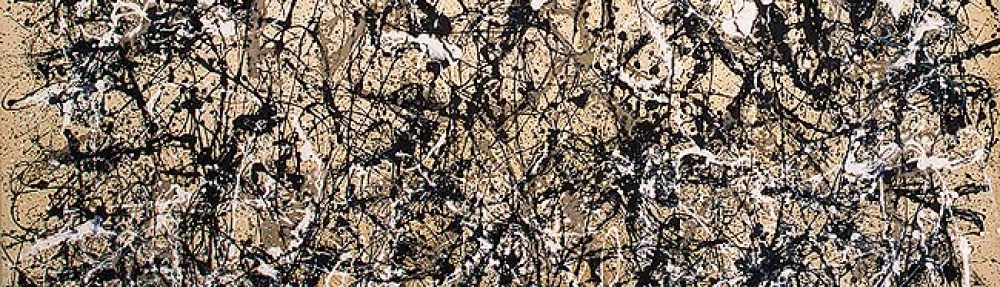
Autumn Rhythm: Impotence in disguise, deceiving itself into largeness when what’s at stake is very small, nothing more than swirling frenzy, powerless and empty.
—Yow! You used the “i” word. This is getting unsavory.
From you, I only heard the tales of your exploits.
—All true!
We’re not in a locker room.
—Suit yourself.
One should have some place to consider the basic issues of life where one does not have to conceal one’s insecurities or cover them up with juvenile boasting.
—Suit yourself.
One should have some place where one can consider all possibilities in turn, eliminate the unlikely, and then come to terms with the most probable.
—Suit yourself.
One is losing patience, but I’ll provisionally let your claims stand. The other possibility:
Autumn Rhythm: Potency, the largeness, the fullness, the power of desire itself, whose only deception is that it can present itself when all that can be shown is the scattered traces left in its release.
—Worse and better.
Then again it may not make much difference how much you both got, or even if you got any. Who’s to say that desire, once turned loose, can ever find what it needs?
—Not me.
Especially if the urge is strong.
Autumn Rhythm: The traces of the motion of desire, of desire trying to get enough when there isn’t an enough, yet deceiving itself that there is and coming back for more, which still won’t be enough, so still coming back, exhausting itself in its charge because enough is not enough, and furious with its exhaustion, still driving in a frenzy just as powerless, just as empty.
Autumn Rhythm: And the desire not realized but still projected by impotence, however self-deceiving, could be just as great, its emptiness just as full, the frenzy just as powerful in the rage against what can’t and doesn’t happen.
Either way a frustration of desire blocked, from which can only come the futile projection of the pictures we make or of the figures living our life returns us, images desperately incomplete. Either way, an obsession that feeds itself into the chaos of unfulfillment.
—I’m not enjoying this at all. How can you talk about sex without having a good time?
The point is to get closer to the truth, not have a good time. Besides, not everything related to sex is necessarily pleasing.
—Suit yourself. But what are you saying? That sex did us in?
There seems to have been a large buildup of some kind that led to some sort of large disturbance.
—More credit, dammit.
But Pollock said he painted from the unconscious.
—Maybe he meant something else. What it sounds like you’re saying is that he didn’t know what he was doing.
Yet there’s only so much the conscious mind can handle.
—What the hell is a conscious mind?
It is the part of the head that tells us what is what.
—It sounds like what you’re saying is that the conscious mind doesn’t know what it is doing.
There’s only so much we can handle, whatever there is that allows us to handle.
—Suit yourself!
.
What happens next . . . .
.
What happens next is my brother keeps getting into the music, fingers tapping, his head now swaying broadly.
He still looks happy.
And the crowd—still talking, but talking less and listening more, some rocking their heads, too, but in motions off the beat yet just as soft and slow—look happy, too.
And I’m still listening, or trying to. I don’t know how I looked. I doubt, however, I looked happy yet.
Still the ballad, the story, its regard ever moving towards a threshold without ever stepping in. And there, Harrison as ever, his smile, his presence, what came before him, what he held within himself, what he released into the music but did not let go, what he let hover and play itself over us all in the darkened pit.
—Hi-ho, Silver! he may have said a third time, so softly I could barely hear it.
.
Sex:
Or maybe not the getting or the doing or even the power to get or do, not even any picture that is made or contemplated, but the making, the having, or not even that—
Autumn Rhythm: Not desire, but the desire that precedes desire and moves it, the desire that returns when desire has run its course and is gone, or even is there if the other never starts Not hidden because it is not hiding. Not pictured because its figure is its formlessness, its quickness, the lightness of its ever-changing image, of its shifting, ephemeral suggestions. Not complete because it never ends because it has no end, because in completion it destroys itself—
The desire for desire itself, which keeps desire alive?
—I’m feeling a tingle here.
Yet how long—
—Don’t spoil it!
.
What happens next is—
.
—Tell me about Paris.
What happens next is that my brother turns and starts talking to me.
—Bub, I say.
Maybe he was loud, maybe to make himself heard over the music.
—I want to hear about Paris, he says.
I didn’t know where this came from.
—Bub, the music, I say.
And knew less where it was going.
—I’ve spent all my life in the trenches. You’ve been to Paris. I’ve always wanted to go to Paris. Tell me about Paris.
But he was getting off the course.
—There’s nothing to tell. I bummed around in Paris for a year.
—We’re talking Paris here.
—Paris is no big deal.
—No big deal? Wine! Art! Sartre! Pigalle! Ou-la-la baby dolls! Gooey cheese and forty-foot long sticks of bread! You’re one cool cucumber.
—Stop.
—You know what you are? You’re a gypsy savage. A real gypsy savage.
—A what?
—Gypsy savage.
—Listen to the music, I say.
Trying to get him back on course, maybe.
And that is what he does, turns and goes back to listening, picking up where he left off, swaying, tapping, getting into it, looking happy.
And now the band puts more into the ballad, or seems to, pulling from within without reaching and pouring what they draw there into what they play, what they tell, yet the music no less fast or slow, the story fuller, but not filling up or spilling.
And the crowd responds, or seems to, almost all listening now, and a swell seems to spread across the floor of murmuring, nodding, and touching, a liquid agitation of hands and heads and tongues, still off yet nonetheless moving. They still look happy, too.
And maybe that is what I was tried to do, still listen, still try to get into it myself—but I don’t think supper was going down well. Shrimp and scallops and the remains of unknown life from land and sea were dancing somewhere down below in a marinade of stomach acid.
I don’t think I was getting happy at all.
.
Sex:
Still, against the self and its desire, against whatever you had and got, even against our mothers, factor in the world. Look not at desire, but at desire in the world, the ways the world way clamps down the lid, its rules—the Code—and see what results from how well they fit together or, more likely, how much they don’t, what happens when the urge doesn’t come out the way it should.
Pollock, Man with Knife:

—Why would the world clamp down the lid?
I suppose it keeps us together as the urge can get out of hand. It may not be a good idea to make love with our sisters, or to do it in the streets.
—Is this Code a cultural thing?
There has to be something in the muck worth preserving.
Autumn Rhythm: Impotence—
—You’re not going to give this up are you?
How can I?
—It’s easy.
There is too much at stake to give this one up.
—There is too much at stake not to give that one up.
One still has to look at pictures.
Autumn Rhythm: Impotence acknowledging the Code but resisting, yet not able to do anything about it, yielding, channeling projected desire into the horror of love, into the love of guilt and doubt, then deceiving itself that there is something in its flustering prostration.
Autumn Rhythm: Potency acknowledging the Code but resisting with a fight, yet not powerful enough to overcome it, deflecting back into itself, doubling up into a tangled mess, deceiving itself there is something in what is only impotence, just impotence with a charge.
—I’m getting grossed out here.
I didn’t make the rules.
—Getting grossed out is OK if it’s done right. What’s the difference, anyway?
Either way, a consuming of the self that desires or tries to, a masochistic roil. The only difference would be whether you go out with a whimper or a bang.
—Big difference.
Or:
Autumn Rhythm: Impotence of either sort, not acknowledging but rejecting the Code and trying to destroy or replace it with the exploding images of its protest.
Autumn Rhythm: Potency of any kind, rejecting the Code and taking on the world itself, but, twisted by passing through the restraints, coming out in anger and seeking revenge, leaving behind the traces of its rampage.
Here, either way, sadistic fury, with the deception there’s some justification behind it and that revolt might take the desiring self somewhere that is right when instead, sooner or later, it would only take it out. The difference here would be how much damage is done.
—Sounds like—
This would be a big difference.
—Look at all these pictures! Man, you’re really not getting anywhere.
There are probably a lot more ways to work it out, but I have to admit I’m having trouble with this one myself.
—Also I’m still not having a good time. What happened to freedom?
I guess I’m a modest guy.
—Not you, buster. It’s the quiet people you have to watch out for.
.
Paris—all I can remember is packed metros, the smell of wine and garlic on Parisian breath, and all those American tourists . . . .
.
The slides—
The flash of spots on brass—
And now the glint of beads on black faces. The band has again worked up another sweat, ever apart from the crowd even as they play, yet in and within what they are playing not to themselves or for anyone but still are playing, the music, its emotion, their emotion, their motion and still the slowness that is not slow, the filling, the holding, the containing, the release, but still the not-spilling—
The crowd, their smiles, their murmur, their touching, the dark motion in the darkened room of white emotion of whites and off-whites, still building, still swelling—
They looked too happy.
They looked like they were in a mood to take their clothes off.
I think I was trying to cover up.
Yet still my brother, still there, still present, still with the music, still getting into it, still smiling, still full and still filling, still focused, still relaxed—
Not falling—
.
Sex:
I suppose it should be considered whether the Code is worth having. The world may have its own agenda that doesn’t suit us well. Still, I suspect anything we replace it with would bring the same results.
—You’re no fun at all.
.
Sex:
Then again, we may need to consider what would happen if the world tosses the Code and lifts the lid itself, if this hasn’t happened already.
—Go, go, go!
.
—Did you get laid?
My brother turns to me again.
—Did I what?
—You went to Paris and didn’t get laid?
—I didn’t say I didn’t get laid.
—What was she like?
—What was who like? I didn’t say I got laid.
—Make up your mind. Is it true what they say?
—What who says?
—Gypsy savage.
—Bub—
He stares at me in mock offense and rolls his eyes. Then he turns to the stage and gets back into the music, ever happy, and even happier yet—
Yet now he’s tapping the table with closed hands, quietly, but faster than the beat and out of sync—
Yet still relaxed, still focused—
Not drunk—
But it was getting hard to see what separated him from the crowd.
.
Sex:
Yet whatever you got or didn’t get, whatever you could or could not do in the world or outside it, we can’t make love all the time and the urge has to go somewhere, so where else can it go?
—Money!
Money? We’re in the seat of our deepest emotion here. What the hell does money have to do with anything?
—Money is everything.
I thought—but you said money doesn’t mean anything. How can money be everything?
—What else can it be?
This is hopeless—
.
—and now he’s banging the table with his fists and staring around the room looking for who knows what.
—What are you doing?
I ask him.
—I’m having a good time.
—You’re making a scene.
—Sipsy javage.
—Get off it.
—Hipsy mavage.
—There’s nothing to tell.
—Pipsy cravage.
—Listen to the goddam music, I say.
I know I was trying to stay on some course, or at least find one—
But memory starts to unravel, taking the whole night with it. I had been pulled in different directions the past two days, by why I was there, what I was trying to do, what I’d seen and heard against what I hadn’t seen and heard and done without getting anywhere, then was pulled again by what I was doing at the Pit against what I still wasn’t doing, only to be pulled somewhere else once more, and pulled there rudely.
OK, he’d had a few, and there was still that AA business floating somewhere or nowhere. But he hadn’t had that much, or nothing he couldn’t handle. Besides, even sober, I wasn’t in good shape myself. And after what he had been through, I shouldn’t have been surprised that he’d get rough around the edges.
Yet this is the sense, that whatever sustained him that night and might have sustained him before was slipping away. Also he had broken the silence that contained him, and with the breaking, the sense that he was sinking into the noise, the darkness of that night. I don’t know where else I could have been but strung out, holding fast to soberness, preparing myself for what happens next.
Not drunk—
Not that drunk—
I may have shouted.
—What music? he says.
Not falling—
Or not falling the way I thought.
.
Behavior at bars:
| A regular at Cedar Tavern, no-frills bar in Village, hangout for other painters who made paintings that didn’t look like anything, de Kooning, Kline, etc. While living in Long Island, came back to Cedar after gallery openings, visits to NY shrink. Restored contact with art scene; asked people what they did, what they were into; returned to his NY self . . . | What happens next . . . . |
.
What happens next is—
.
What happens next is—
.
Jane.
.
I’m fairly sure her name was Jane, and almost as certain Jane was blond. I know there was a blonde somewhere in New York who had something to do with my brother.
I’m not sure, though, how we found our way to her, or exactly why. Our waiter, now taxed by the too happy crowd, was slow getting back to us, maybe the reason he was looking around the room and finally got up and left the table for the bar, working his way through the mob with a determination that didn’t look like resolve, or impulse, either, but nonetheless got him there, where she sat.
—Flipsy cleavage, my brother whispers in my ear as we draw near.
Or maybe he saw her first, and used the bar as an excuse for Jane. Or maybe both were factors. Or maybe he just wandered up, turned around, and there she was. A memory, maybe, of others clearing a path and staring. However he did it, whatever his motives, there wasn’t any stopping him and I didn’t know what else to do but tag along.
It’s possible, however, that Jane came up to him and took a seat.
At any rate, we’re standing there, my brother and I, holding fresh drinks, still whiskey, though holding them with different intents, standing there before Jane, Jane perched on a barstool, holding something else, Jane whose age was probably squarely between ours, putting her at a distance from either of us that would have given pause, Jane wearing a full-length cashmere sweater dress, either bright red or a deep blue—there was something about the dress and the way she wore it that gave pause, too, which, like whatever it was about that Buddha no longer there in the apartment, makes memory flash on and off—the three of us there, Jane, my brother, and I, looking at each other, waiting for someone to say the first word.
Behind the bar, the harried coolness of bartenders and the gleam from all those bottles, the mellow colors of transparent refined spirits. In front, glasses rising, falling, emptying, filling; the stance, the transparent talk of drinkers drinking, not distilled.
What Jane looks like is trouble, though it’s hard to say what kind it was or where it lay. Because there was also something plain, universal, and almost honest about the way she looked, which, like mall architecture, was as easy to take as leave.
Tall and broad-shouldered, she didn’t stoop to hide her size. Rather, she sat up straight without being rigid, bending where she had to, giving her a suppleness, one from which she might pounce. And her eyes had a directness that focused at some point beyond you, penetrating with what could have been a confidence that was either erotic or predatory, or both. In them, a look that squashed any smile from her, or looked to erase the one in you.
Then again, there was a calmness in her not-smiling and an openness about those eyes that invited looking back, along with a softness almost sensual that clung to her, like her dress. Still, none seemed to belong to her, the calm or the openness, if that is what they were, or the softness, or even the dress. And the softness covered a firmness, and some force that could have been menace, either warning you not to linger too long, or not to stop.
But these didn’t seem hers, either. Nor did the menace quite emerge into anything as definite as meanness, and even when it came close, the thrust didn’t seem to come from her, but from some random agent outside her, passing through. The firmness just as easily could have only been health, and the force of menace a hardcore innocence. Which didn’t seem objects of her reflection as well. In fact she didn’t seem self-conscious about anything. Or maybe, what is improbable yet seemed the case, she simply wasn’t aware. And when she stared past you, she may not have been looking anywhere at all, yet she looked like someone who knew what she was about, and for all I know she did.
Still, you looked back and kept looking, even though it was difficult to decide on the parts that were essential to what was Jane and leave behind those that were not, much less know what to look out for. There didn’t seem to be any there there, though Jane was better looking than Oakland. Because whatever her relationship to them, the goods, or enough of them, were there.
And there.
And there.
And her lips, large and red, their full, yet subtle curves that would require some impossibly complex equation to graph, if not sensual, were seriously something better. And her long blond hair was of the color that made you want to say blond and lose yourself in the conception, at once Platonic and American, of blondness. Even if she wasn’t a blonde, you knew she should have been.
My brother, I fear, is smitten.
—Your eyes, my brother says, looking straight into them.
Yet he stands resolutely relaxed, or seems to, as if his earlier restlessness has quieted or found relief, as if the drinks before have worn off, or haven’t but possibly are what have gotten him there, stands there with the impressive look of someone who knows he doesn’t have to impress—the look on that ID. And he speaks with a offhand frankness that sounds like sincerity, and even though it couldn’t have been, there was a candor in his offhandedness that took my breath, and maybe Jane’s.
There’s still a chance that he was not falling at all, but working on something subtle.
—What about my eyes? Jane asks, looking back at him or through, or nowhere.
—Windows, my brother says.
—Windows? Jane asks.
—Windows, my brother says.
—Windows, Jane says.
—Your eyes, windows, my brother says.
—My eyes, windows? Jane asks.
—Windows, eyes, my brother says.
—Windows, eyes, Jane says.
Then he looks at Jane and Jane looks back, each without expression—yet another expression without expression, or was it the same but without the arrows? And both of their expressions without expression are different yet the same, the expression that holds back an expression, the expression waiting to make an expression, the expression that depends on what happens next, Jane waiting for my brother to finish, my brother waiting for Jane to put the two together.
Or maybe she already has and has reached the conclusion, and my brother knows this, so the expression without expression is the expression of understanding, of not showing anything because what there is to show has already been grasped and does not need demonstration, the expression of not waiting but being there, of not waiting for what happens next because they already know what it will be, and even if there’s no way of knowing if they had reached the same conclusion, whether they had the same thing in mind or stood opposed, they still seemed to be on the same plane. And even though I’m sure they weren’t contemplating souls, what souls were and did or even the possibility of having them, there was something sublime and maybe spiritual in how much they weren’t. All I know for certain is that I could only stand aside and watch.
Jane uncrosses her legs, then crosses them the other way.
A memory of the sound of silken static and of realignment, of being turned at a small but precise angle that leaves you miles from where you were.
—So what brings you to our little burg? she asks.
—Speculation and romance.
This one does take her back, however, briefly.
—No, I mean your line of work.
—That is my work. In my off-time I’m just a steady guy.
Jane snorts softly.
My brother doesn’t flinch.
—What’s yours? he asks.
—Buyer. Bloomingdale’s.
—Sounds like we’re in the same business.
—You make interesting comparisons, Jane says.
—All in a day’s work, my brother says.
This one puts her legs back where they were before.
More realignment but not back to where you were but still elsewhere.
And again a moment of looking, their expressions easing back a precise slightness.
—Eyes, he says.
—Eyes, she says.
—Sight.
—Sight.
—Dark.
—Dark.
—Unseen.
—Unseen.
—Seeing.
—Seeing.
—Brightness.
—Brightness.
—Sightless.
—Oh, oh, oh, Jane says.
And yet another moment of looking at each other that seemed to last forever but probably lasted only a second or never even happened but could and should have, and once started could never end, of Jane looking at my brother and my brother looking back, and of me, outside the looking, looking at my brother look at Jane and looking at Jane look at my brother, probably still holding my breath, as I do now, looking back at myself then looking at them, looking at them looking, I see what Jane must have seen—
.
Behavior at bars:
| . . . wore jeans, boots, put on cowboy act; got stinking drunk; proposi–tioned every woman in sight . . . |
.
Inventory:
- However much wine is in a pitcher of sangria.
- The possibility of something at the gallery, hard or soft.
- Four shots of whiskey at the table, during the sets.
- Yet a brisk walk in the cold and whatever the music had burned off.
- But also the hard desire to get wherever the drinks would get him, and get there fast.
- And a fifth at the bar, disappearing quickly.
- Or sixth or seventh—I think I missed a few.
.
Behavior at bars:
| . . . got turned down by every woman in sight . . . |
.
—see what Jane saw but my brother didn’t, see what I didn’t see then, or did but just then realized and have suppressed all these years—jeans beneath a jacket rumpled from a good fifteen hours of wear, the stubble on his face that had sprouted over that stretch along with what his open, wilted collar revealed, his glasses more than slightly crooked, and a stance that, looking at it now through the haze of forgetting, is not steady but straight only enough to hold back staggering—see that he looks like a parody of easy probity or shrewdness or any other look he may have tried to affect in his hours on or off, that the expression on his face could only have looked moronic, see and realize what Jane had to have seen and concluded from the start, that the guy trying to hit up on her wasn’t making sense, was only a sloppy, harmless drunk.
No wonder I stayed sober.
No wonder I have forgotten.
But everything comes back clearly now—too clearly. I must have caught here my second wind, gaining the kind of soberness that doesn’t come from laying off. And I realize now that the night had only just begun, because Jane still looks at him, something subtle in mind herself.
—Tell me more about my eyes, she says at last.
—Your eyes—
He says, then stops and fumbles in exasperation with gestures too contrived to be real, but too awkward to be faked.
—I’m not doing this right.
He grabs me.
—You tell her. Say it in French.
—Who’s this?
—This is my brother. He went to France. He’s a gypsy savage.
—Bub, I say.
—Who’s Bub? Jane asks.
—I’m Bub. Short for Bubba. It’s what my little brother—
He points to me.
—called me when he was a baby because he couldn’t say brother.
—How cute.
The way she said “cute” could have pierced an armored truck.
—Also in the South everyone is called Bubba.
—That explains your accent.
—Yes ma’am. Ah’m a Southern boy.
I don’t know what this was—he got rid of his accent back in college—but at some point he cranked one up and began to lay it on thick.
—What is yours? he asks.
— I’m from Ohio. I don’t have an accent.
—That explains it.
—Explains what?
My brother doesn’t answer, but Jane doesn’t give this one a second’s thought. Instead, she turns to me.
—Then you must be Bubbette.
I must have turned several shades of red or blue.
—Go on, tell her! Tell her in French!
—Merde, I may have mumbled.
Jane may have snickered.
My brother looks at me in a gross show of betrayal, then quickly drops it and turns to Jane. Her eyes open wider as she waits, getting ready.
—Miz Jane, evuhry day will be night when ah don’t see you.
He says.
And then Jane—
But then Dick cuts in—
Dick.
Hair short, his face round but firm, his body strong and tight from working out, though I doubt for any sport, Dick had not a clean-cut look but what looked like a take-off on clean-cuttedness, yet still a look that looked clean. I couldn’t tell which side of Jane’s age Dick’s was on, but it was close. Like Jane, he was open-eyed and seemed open; unlike Jane, he smiled all the time. Like Jane’s not-smiling, however, his smiling looked like it had the same mission, to search and destroy. Unlike Jane, it didn’t look like it would take much to set him off and make him lose his cool, if cool is what Jane kept. Yet Dick, too, looked like he knew what he was about, or at least that he knew all he needed to and that anything else was not worth knowing. That if anything could surprise him, it would be that he could be surprised, which gave him the look of endless—not wonder, but whatever the opposite of wonder is yet keeps its lightness and knows no bounds. He could have passed for a Marine.
Or maybe he was just another healthy innocent because his smile seemed to bring him peace. He may even have been a nice guy. Given my brother’s behavior, it’s hard to say how he should have looked or acted.
I’m fairly sure, however, his name wasn’t Dick. Or maybe his name was Dick and Jane’s name wasn’t Jane. Memory can be prone to allegory, but the two had something in common, whatever it was, and there was something about the two of them together that that suggested a lesson from some primer that may need to be dredged up once again.
Dick, of course, had been standing behind my bother’s shoulder all this time, looking on—I realize this now as well, that I saw him from the start and watched to see how he might react, Dick at first holding back his anger, but soon moving into that smile, probably because he had reached the same conclusion about my brother as Jane. So if he cut in at last, it was because he was getting bored and wanted to join the game himself.
Or maybe just to set straight whatever needed setting straight, once he found it.
But it’s just as possible that he was simply coming to Jane’s rescue, to save her from the lush.
What occurs to me only now, though, is that my brother knew Dick was behind him, in fact was one of the guys he shoved aside to get to Jane and the bar, which makes his game more complicated, or more absurd, assuming it was a game and he knew what he was doing. Dick could have easily ripped him to shreds.
Whatever the case, here is Dick with us, standing there too.
—This is a Bub, Jane says.
Dick looks at my brother, still smiling.
My brother smiles back, now past the point of standing straight .
—And this is a Bubbette.
Dick doesn’t seem to see me, which was just as well.
My brother smiles back, offers his hand, and Dick takes it, probably squeezing hard.
—This is an uncommon pleasure, my brother says, probably hiding pain, if he felt it.
When he gets his hand back, he points to Dick, then to Jane, then back to Dick, a question on his face, then looks shocked and embarrassed, as if he didn’t realize they might be some kind of an item.
Dick keeps smiling.
My brother puts on an earnest show of profuse apology that doesn’t take anybody in.
—Dick, let me buy you a drink.
Dick looks at the one he has and waves my brother off. My brother ignores him, however, and leans over the counter and shouts,
—Barkeep!
Warily he comes.
—Jacque Daniels! he says in Southern drawl, but leaving off the ess.
—Monsieur Jacque Daniels for the gentleman!
—Monsieur Jacque Daniels for the lady!
—Monsieur Jacque Daniels for toot le monde! he says, looking at me.
Now we’re all holding two drinks, looking for room to put the spares on the crowded bar, except my brother, who keeps both barrels loaded.
And I did hold one of them, but left it full as ever so I could put up a front to justify my place there, a drinker among drinkers. I needed this position so I could see exactly where this was going, though I had probably already seen enough.
Dick drops his smile a moment, shaking his drinks with irritation, and it wasn’t until he had one hand free again that he regains his smile and continues.
—What’s your line, Bub? he asks.
—Iron and steel, my brother says.
—Oh?
—My wife irons and I steal from her.
A lame joke, which gets a lame ha-ha from Dick.
Actually, he looked offended.
—Just kidding, Dick.
—We seem to be having trouble deciding what Bub does for a living, Jane says.
Dick makes a backhanded swipe that suggests it couldn’t have been much, while his face opens with indulgence, as if whatever my brother did were OK with him.
—Besides, Dick, I’m not married, but you—
Again he points back and forth between the two.
It was obvious there was some kind of closeness between Dick and Jane that had worn in with time, but one that had also put them at a familiar distance from the things they no longer touched, making the nature of their relationship hard to pin down. The possibility can’t be excluded that they may have been brother and sister. Maybe both were blond.
Dick, however, doesn’t reply but keeps on smiling.
—You must be from Ohio, too, my brother says.
Dick stares at him.
—You don’t have an accent, Jane says.
Dick stares at Jane. Jane looks at my brother. My brother looks at Jane, not following. This puzzles Jane, who takes a moment to reflect, while Dick perseveres.
—Well, Bub, what brought you here?
—His-tuh-ree.
I think this is where my brother’s accent really kicked in, made worse by drunken slurring. His reply puts more strain on Dick’s smile.
—Fate.
This one draws it tighter.
—Chiv-ul-ree.
And tighter.
—Hot blondes.
And tighter.
—Cold cash.
The last one makes it disappear.
—You’re putting me on, aren’t you?
—No suh.
—You’re full of crap, aren’t you?
—Dick’s a broker, Bub, Jane says.
My brother does not look impressed.
—Stockbroker, Dick says.
My brother is beside himself in admiration. Dick looks close to anger.
—And Bub’s a Southerner, Jane says, putting a hand on his shoulder.
Which cracks a smile on everyone’s face but mine.
Now the ice has been broken, and the three are at ease and perversely friendly, exchanging free glances and grasping hands. And this is where he falls through, because Dick and Jane have come together to home in on Bub, my brother. If they were doing anything with their hands, it was holding him up to prolong their gentle, gentile slaughter.
—New York is what it is, Bub, says Dick with metaphysical weightiness.
—New York is all there is, Bub, says Jane with pragmatic resolve.
My brother stops to contemplate both propositions.
—This is a tough town, Bub, says Dick, with staged affection.
—You have to know what you’re doing, Bub, says Jane, with acid politeness.
My brother looks surprised, as if he hadn’t yet found either out.
—There are things you can do here you can’t do anywhere else, says Jane with pointed kindness.
—But there are things we do not accept, says Dick, putting a nice cap on the point.
My brother doesn’t seem to understand.
—I mean—
Dick starts, with a look of righteous concern that actually looked serious, as if he were revealing the basic principle that lay behind his attack. Then he gestures towards some unmentionable that he holds before of my brother’s face.
—Oh.
My brother’s face clears, as if he got Dick’s meaning.
—No offense, Bub.
—None taken.
My brother doesn’t seem affected.
—What I’m saying, Bub, is that it must have been difficult to leave the plantation.
And then Dick smiles.
—But—
My brother looks confused.
—But—
He seems astonished.
—But theah will ahwl-ways be the vuh-tue of our women to protect, he protests, putting his arm around Jane’s waist. I can’t remember if he still had both hands full.
Jane snorts loudly.
Dick slaps him on the back.
—Bub, let me get this round, he says.
It went downhill fast from here.
.
Behavior at bars:
| . . . argued with the painters; insulted, picked fights with them, everyone else; swept food off tables, pulled a toilet door off its hinges, broke glasses, swung mops, threw things . . . |
.
There’s more, too much more, my brother putting on his gross Beauregard while Dick and Jane plied him with whiskey, held him up, and closed in. But where was I all this time? I was sorry, I was wrecked. It hurt to see this happening to him. But also I was trapped. He was too far gone and there was nothing I could do to save him. I could only watch, first with pity, then pity fell to some emotion below that. I doubt I can descend now to the depths that he fell. Because this has to be the real reason I can’t remember that night, that he got stinking drunk and made a fool of himself in the hands of Dick and Jane. And their grip was too strong for me to pull him out. The only course of action I could think of was to keep staying sober so I could handle whatever happened next, even if it was only to pick up the pieces.
Not that he was drunk, or maybe that’s all I saw then, but what being drunk had to mean, that he had lost what most defined him for me, his control over who he was. What I don’t know is if he knew what he was doing, or whether this distinction matters.
What I still can’t figure out, though, is just what he was doing, or rather what he thought he was doing, if, in fact he gave it any thought. Maybe he was making a play for Jane, and when that failed he turned to Dick to redeem himself in some perverse way, and he covered his failure here with whiskey and Southern schlock, one feeding the other in downward spiral. Or maybe Dick was the target, and Jane his means of approach. But either way, it still works out the same, as it would if they came up to him and he was the target, because he didn’t try to stop them. The question is why he wasted time with either.
There was, I suppose, a sharpness to both of them, but it never cut anything hard. And brokers are a dime a dozen, nor did Dick show himself to be worth much more. The same assessment could be made for somewhat attractive blondes and Jane. Yet they seemed to hold some fascination for him, one he could not let go.
More likely, he was playing some kind of game, or rather trying to, because he was too far gone to do anything well. Yet it wasn’t one that he could have won, as he played it on their terms. And even if it was a game and he played it the way he meant to, his only purpose in doing so could only have been to allow what happened to him happen. The Southern bit was only his way of seeing how far down he could sink.
.
Behavior at bars:
| . . . got beat up, thrown out of the Cedar. Sometimes tolerated by artists, others; often not. Or some–times they’d stoke him up and stand back and watch the show, see Pollock self-destruct . . . |
.
Most likely, my brother wasn’t trying to do anything. Rather, he simply lost it, assuming he ever had it.
—Sing Dixie for us, Bub, Jane may well have asked.
—Oh-h-h, ah wish I wuz in the land of . . . .
I’m fairly sure he did.
—Dance for us, Bub, Dick asked sometime later.
Or Jane asked.
Or they both asked.
Or if they didn’t, it is something they could have asked, and would have had they thought of it, and if they did, my brother probably obliged them.
A memory of feet slapping the floor, and of laughter, and of stumbling.
And it went on for hours, or seemed to, until they finally had him where they wanted and zeroed in for the kill, Jane with her arm now fully around him, her other hand fingering his lapel, Dick with one of his hands caressing my brother’s neck, both of them unloading on him, taking turns.
—Think bonds, Bub, says Dick.
—Think suede, Bub, says Jane.
—Think utilities, Bub.
—Think tweed, Bub.
—Think money market mutual funds, Bub.
—Think natural fibers, Bub.
—Think growth stocks, Bub.
—Think basic black, Bub.
—Think glamour stocks, Bub.
—Think silk, Bub.
—Think gold, Bub.
—Think gold lamé, Bub.
—Think Milton Friedman, Bub.
—Think Bill Blass, Bub.
—Think Ginnie Mae, Bub.
—Think Saint Laurent, Bub.
—Think bottom line, Bub.
—Think hemlines, Bub.
—Think franchises, Bub.
—Think brand names, Bub.
—Think high-tech, Bub.
—Think spandex, Bub.
—Think oil, Bub.
—Think petro-dollar chic, Bub.
—Train to be assertive, Bub.
—Learn to show your sensitivity, Bub.
—Discover your potential, Bub.
—Show it if you got it, Bub.
—Don’t take any wooden nickels, Bub.
—Pad your shoulders, Bub.
—Promote yourself, Bub.
—Create an image, Bub.
—Win, Bub.
—Dress for success, Bub.
—Think performance, Bub.
—Think performance, Bub.
—Think the masses, Bub.
—Think spaghetti straps, Bub.
—Think perceptions, Bub.
—Think strapless, Bub.
—Keep your options open, Bub.
—Take a plunge, Bub.
—Think primal scream, Bub.
—Think spiked heels, Bub.
—Think suckers, Bub.
—Think black leather and chains, Bub.
—Think Jaws, Bub.
—Think Deep Throat, Bub
—Think quick kill, Bub.
—Think slow, painful death, Bub.
There may be a few items I have added to the list, but I know there are more I have forgotten. Whatever they said, the result was still the same: they pounded my brother into a helpless blob. He made some kind of reply to each, still keeping the drawl, but became more slurred and incoherent. What was odd—or maybe not—was that Dick and Jane not only seemed dead serious, but got excited more about what they were saying than what they were doing with looks that looked like awe. And my brother looked like he took in all they said with a look of ever widening open-eyed amazement.
But what is most perverse is that as he replied, his accent went from white to black.
—Lawd have muhcy, he says when they finish.
I was in agony. I know I was in agony—
But Jesus, he was pathetic. Beauregard had turned into Stepin Fetchit.
.
Money:
Not the booze, or not just the booze, or not booze at all, but another kind of inebriation.
Maybe it was the money.
—Finally.
I’m surprised you’re still around.
—Will wonders never cease?
Because whatever drove both of you out of the hinterlands, where you ended up was New York. Pollock down to cold-water flats and walk-ups around the Village, subsisting on odd jobs, WPA checks, and handouts from friends and family, making art most galleries wouldn’t take, those that did, couldn’t sell, when they did, didn’t sell for much, or didn’t until he was almost dead; you to the apartment in Upper East Side, working your way up the ladder, up from the firm in Wall Street to the one with the Park Avenue address, the one half the Ivy League grads would sell their soul to work for if souls are what we have, up the floors to the office with a window and a view. There, and hitching rides back and forth from California, what Pollock saw in the 30s was the bust that somehow turned into the 40s and 50s boom that suckled Dicks and Janes. There, on your trip up and up, what you saw was the boom taking off into the splurge that turned them into ogres. And more similarity than difference here, because going up or down, you both saw two sides of the same thing, its intoxication and hangovers.
—You’re getting excited.
I’m only being rational and cutting to the chase.
—I’m smelling red.
Marx couldn’t have been wrong about everything.
—Marx could have been right about everything.
I’m getting mixed signals here.
—I like red.
I think you still are drunk. But no wonder Regionalism didn’t stay with Pollock, those folk tales which suckered us into believing our down-home goodness and the rightness of our place while the country was going broke.
—Are we back to culture?
If you want to call it that. Though really it’s a matter of class, of who gets what.
—Everything is class.
Just as much it would be politics, not just who gets what but how this is done.
—Everything is class and politics.
But really it’s economics, because in this place politics is economics.
—Everything is class and politics and economics.
But what we most care about is business.
—Everything is class and politics and economics and business.
And what is business but the play for cash?
—You see? But what has happened to the Code?
Its agenda has been revealed. So against the Regionalist Benton, the Social Realists Pollock studied for a while, Orozco, Rivera, and Siqueiros, outsiders who saw what we couldn’t see, the rhythms of the machine.
Rivera:

But maybe their statements were too tame for Pollock. Maybe they missed the size, the violence of its rhythms.
As for us, we were taught to keep our noses clean, our hands to ourselves, never to expect too much. Also to be careful with our money, the measure and the substance of our worth. No wonder those middle class nostrums didn’t stick with you, the dope that has lulled us into contentment and our sense of place, setting us up for the next bust.
—This is not at all certain.
I suppose we will outlast it, if it comes, or enough of us, because it is our money that makes the machine go and our survival that fuels it and gives it the measure and substance of its worth. But even if the next bust doesn’t come, we still get taken for a ride in a life determined by what we do or do not have. Because what you saw in New York was the machine behind the machine, its rhythms, its violence, the violence of money chasing money.
—Big picture!
Everything is money.
—Money is everything.
Not money per se, because money doesn’t mean anything, but what it buys, yet more than that, what it stands for and takes the place of.
—You’re getting it.
Or rather what it doesn’t stand for and doesn’t take the place of. And since money doesn’t mean anything, our lives are nothing in its world.
—You’re not getting it.
But what you left behind offered only the emptiness behind its promise. And how careful with our money those of us in the sticks are, yet how we love those who are free with it, who glorify our placid selves and let the greed that we repress run wild. And how much we love those who hold out their promise of what we cannot find for ourselves but mask in myths of place and rightness, myths that cover what we really care about, what drove us West until we ran out of room, what, in the commerce of flesh, made the South the South, then made it bust, and what is now pumping it back up again. It doesn’t matter how much either of you had, or even if you had any. What you both found in New York was nothing that was everything or everything that was nothing, that which was projected from nothing doubling back into itself and returning what doesn’t return anything, returning it in a flurry of sterile exchange, returning what empties the self as it fills it, what strangles or bloats us even as we cling to it. And the self that tried to understand itself and its world could only fail, and in the failure collapse into a self that mocked the self and ruined it, the phony cowboy or Southern fraud. What else was left for you but to go out with a bang in the brawl for money?
—More credit!
I didn’t say you gave in consciously.
—You’re not going to give this unconscious business up, are you?
Given what you were up against, I don’t see how you could have avoided it. But if not breakdown, resistance maybe, perhaps a kind of statement.
Autumn Rhythm: Protest, the violence that counters violence.
Pollock did a stint in Siqueiros’ workshop and helped build a float for a May Day parade. And you voted Democrat in the 60s.
—Who didn’t? I’m really struggling here.
OK, you ended up in investment banking. And it’s unlikely that Pollock painted paintings that didn’t look like anything to change anyone’s mind about much. I’m really struggling here myself. But I don’t see how it matters, because even if you attempted protest, it couldn’t have lasted long. Any kind of statement or pose, existential or formalist or any other, wouldn’t have stood up either. Worse, they would only have hidden the real world from you and made you more susceptible to its blows.
—MORE CREDIT!
But maybe you saw the world, and, sensitive, saw it too well. Perhaps this is the problem. You saw what I could not see back then, what I have only begun to come to terms with now. But even if you recognized the world for what it was, I can’t see what difference that would make since any kind of understanding would still have left you without a place to stand. The charge of your ambition, of your love, of your aspirations, of your knowledge could only have bounced back with destructive force from what you saw—
Autumn Rhythm: The eye of money, seen. Its plan, its love, the splats, the swirls, the wanton, cancerous growth, the smile that is a scream.
—If you’re not going to give us any credit, at least let us have a good time.
But money can’t even bring happiness.
—Lots of guys I worked with looked happy.
How can anyone can find happiness is a world that measures itself in money?
—I dunno. We need some kind of jism to make us go.
But money and the things it buys can’t take the place of what matters in our life.
—You’re being greedy.
Greedy! How am I being greedy? Money is only a substitute for the real thing.
—What the hell are you taking about?
Do I have to explain everything?
—Who said anything about explaining? Also, you haven’t said anything about sex.
What has sex got to do with anything?
—Everything is sex.
But everything is—there are times when we have to put the urge aside.
—Suit yourself!
Still, even desire itself gets drained and subverted by the substitution. Those guys you worked with probably even had trouble getting it up.
—You’re talking about body parts again. But again, those guys . . . .
It couldn’t have been good.
—It could have been fantastic.
It couldn’t have been worthwhile.
—Tell them that.
There are other kinds of death.
—Suit yourself.
Besides, you weren’t happy.
—Who said I wasn’t happy?
You weren’t fulfilled.
—Who said I wasn’t fulfilled?
You’re dead.
—Let’s not get personal here. When did you become socially aware, anyway?
One concedes he has been late coming around, but one has not been unmindful. Sooner or later one should try to understand something beyond himself before one becomes too feebleminded to understand anything or care.
—Suit yourself!
One’s doubts run deeper yet . . . .
.
.
.
.
.