.
—Good outfit! Good outfit!
.
Who said that?
.
—Good outfit! Good outfit!
My brother says.
Dick has just told him where he worked.
I think this happened early on.
I can’t remember the name of Dick’s firm, however, though doubt my brother thought much of it. His reply came rather quick. Then Dick asks my brother where he works.
Dick is staring at his drink . . . .
.
I’ve left out a few things.
.
—Miz Jane, evuhry day will be night when ah don’t see you . . . .
Actually, his accent was pretty good. In fact it may have gotten better as the night wore on.
And I think she actually blushed.
Also Dick and Jane may have put down the Daniels as fast as my brother, or tried to.
I may have the scene at the bar all wrong.
.
—Good outfit! Good outfit!
Just after asking my brother if he is full of crap, Dick names his firm. Then he asks my brother again where he works, and this time gets a reply.
Dick stares at his drink, not smiling, looking cowed.
—Barkeep!
Now my brother orders the next round.
And now Dick is staring at two.
Then he leaves Dick here, hands full, and turns to Jane, there, to continue his pitch if a pitch is what it was. If he wasn’t making time, he took a long time making something and made it awfully well, because he had her every moment.
—Jane, every day will be night for me when I don’t see you.
He says at last, looking straight into her eyes, and while he still was laying it on, he was awfully damned convincing.
—But I know my nights will be bright with day when I see you in my dreams.
And Jane may have blushed hard, or as hard as she was capable of blushing, but not because she was embarrassed, because she lifts her leg and touches his thigh with the toe of her red or blue high heel.
Dick was by himself all this while, still not smiling, still staring, still brooding, but not paying attention to either one. And it was still a long while after Jane’s heel was raised that his face lights up and he cuts in with urgent questions.
—Federated? he asks.
My brother turns his back to Jane.
—Underrated! he says, not missing a beat, looking at him the same way he looked at Jane, but now she was no longer there.
—RJR?
—Smoking!
—Seagrams?
—Smashing!
—Paramount?
—Paramount!
—RCA?
—Triple A!
—Chase Manhattan?
—Big apple!
—Marathon?
—Goes the distance!
—TWA?
—Soaring!
—Bausch and Lombe.
—Out of sight!
—Marvel?
—Marvelous!
—Playtex?
—Double D cups!
—Beatrice?
—Divine!
Again I’m sure I’ve added, but also know I have forgotten, as this exchange went on at least as long as the other, maybe long enough for another round. I don’t know, however, what those stocks had in common, because flops were sprinkled in with the stars. Maybe my brother’s predictions were simply off. Then again, I doubt giving hot tips was what he was really doing. But Dick bought everything he said, working himself into a fervor while they went down the list, until Jane, not there, not smiling in a way that really wasn’t smiling, at last steps in, puts an arm around his waist and fingers his lapel.
Then Dick comes closer, too.
—Think bonds, Bub, he says.
—Think suede, Bub, she says.
Then this litany starts and goes on for who knows how long. But they weren’t trying to pound him to the ground but raise themselves to reach him, each trying to outdo the other as they went down the list.
—Think quick kill, Bub.
—Think slow, painful death, Bub.
All of which my brother absorbed with something that approached the look of rapture.
—Lawd have muhcy!
He says at last, but then the blackface turns back to white.
—To hell with the dividend discount model! he says.
—To hell with the dividend discount model, Bub! one replies.
No—they said it in unison, the only time I’ve heard this actually done.
—To hell with basic value!
—To hell with basic value, Bub!
—To hell with earnings growth!
—To hell with earnings growth, Bub!
—To hell with debt-to-equity ratios.
—To hell with debt-to-equity ratios, Bub!
—To hell with price-earnings ratios!
—To hell with price-earnings ratios, Bub!
—To hell with return on assets!
—To hell with return on assets, Bub!
—To hell with size!
—To hell with size, Bub!
—To hell with scale!
—To hell with scale, Bub!
—To hell with simplicity!
—To hell with simplicity, Bub!
—The days of glory are gone but not forgotten!
Dick and Jane may have cheered themselves into that place beside themselves.
—Because, after all, what is New York but the boudoir for the South?
He concludes.
It may have been Jane who sang Dixie, and she may have sung it sweetly.
It may have been Dick who shuffled on the floor.
And while I’m certain someone staggered, even fell, it may not have been my brother.
The drunk routine was just his lure to suck them in. Or if he was drunk, the booze helped him do it better. If anyone was on a string, it was Dick and Jane, because what I first thought they were trying to do to him, he instead did to them.
—Say something in French, dammit!
And also tried to do to me.
I pull him aside.
—You’re being an ass, I say.
—Tipsy ravage.
I didn’t feel pity at all that night. What happened was I got pissed off. Only now, however, does it occur to me that whatever the Friday night AA bit was, what he was doing now was not a break but a continuation of it.
And the drinks still kept coming.
And the night was still far from over.
But I still could only stand aside and watch, more sober than I could stand.
.
Behavior at bars:
| They flocked from far and wide to the Cedar to see the famous man who made paintings that didn’t look like anything, just to get a glimpse. And Pollock might come out on the sidewalk to greet the throng and ask: |
—Who’s the greatest painter in the world?
—You are! their reply.
.
Money:
Maybe I have been ignoring the obvious. Maybe because it is too obvious, maybe because it is so loud that I haven’t heard it. Or there may be some other reason I haven’t yet touched. But I can’t see what difference reasons make. At any rate it is the thing that speaks loud and clear now.
Not the money itself, because he never had much, but what he substituted for money, and what that stood for, or rather what stood behind it. Pollock, cast out by the world, fighting to reclaim his place but on his own terms, making paintings where size is more important than any image they might have. If the world hated him at first, we loved hating him, and it didn’t take long for this hatred to turn to pure love, really for the same reason, this love based on the same thing that stirred our hatred. No wonder those large paintings that don’t look like anything go for big bucks now. They give us license to believe anything we want about ourselves and let our worst desires run wild. Pollock could have had us licking out of his hands, but just didn’t last long enough to cash in.
—Better watch your blood pressure.
As hard as it is to consider, I don’t know how much longer I can hold this one back. It has to be looked at now, no matter what the cost. Because this, finally, has to be the real reason why I was so upset then and can’t remember much now, why I have blocked you out all these years—
Maybe it was still the money.
—Money is everything.
But money doesn’t mean anything.
—Money doesn’t mean anything.
And it’s because money doesn’t mean anything that money means too much and money is everything.
—You’re still not getting it.
Maybe in your eyes you didn’t have enough. More likely, however, you had too much. Just as likely, however, it wasn’t what you had but what you saw run endlessly through your calculations and sifted in your hands. Not avarice per se, though this might be a large part of it, but more what had been extracted from greed and refined, the gas that fuels the machine. It doesn’t matter what you had or saw, because considering what moved you, you could never get or see enough money to pump yourself up as big as you wanted to be.
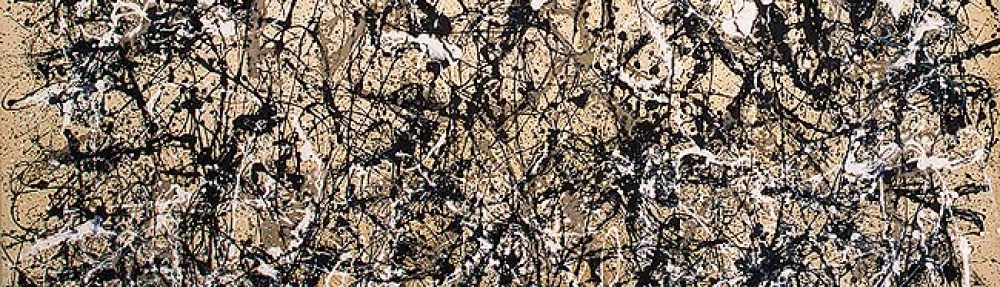
Autumn Rhythm: Narcissism unbridled, the self asserting itself in a measure that only recognize its selfness. In the inflation, the crowding out of anything else or any other selves. And in the crowding out, sooner or later, the swelling until the self explodes.
—I’m starting to feel bad here.
How one feels here is not important.
—Suit yourself. But also it’s not a very big picture.
It is big in what it leaves out and in the price others have to pay for the omission. Because this one can go further since you were not alone but lived in a world where bigness counts.
—Are we back to body parts?
I think we’re back to class and money.
—Everything is class and money.
But it could also be a matter of gender, when self-love shows its head.
—Everything is class and gender and money.
Autumn Rhythm: Priapic fury, whether turned back on itself in impotent rage or unleashed, exploding in a burst of sense and senseless figures. In its assertion or in its denial, in the unleashing, the blotting out, the destruction of the desire of others, of any other desire, and finally, when the damage is done, of itself.
And just as easily it could also be race when big boy sees his color. West, South, either way, the push comes from the same conception, the same desire, and the results are still the same.
—Everything is class and gender and race and money.
Of course this self is too shrewd, too arrogant to be so blatant, so hides itself in some other guise with phony claims to something neutral, something basic, something higher, when what it covers is low and base. Any claim of self to the selfless is just pretence that lets the real message slip in.
Autumn Rhythm: Selfishly selfless self-promotion, to the exclusion, at the expense of other colors. And still, sooner or later, of its own.
—Bigger pictures! But how are they different from the last big picture you made?
I see where you fit in. Also I’m giving you credit.
—It smells like something else.
I didn’t say I was enjoying this.
—Suit yourself. Still, I like the intensity.
One’s convictions should be matched by one’s intensity.
—I would think the opposite, whatever your convictions are. At any rate, I’m not sure the two should be confused. Besides, I’m lost. Where do you see all this in the picture?
It’s more in what you don’t see but has been masked. Because in its size, in its pretense to show something large and important, the picture preempts any other claim. In its diffuseness, in its obscurity, it allows what it hides to thrive and spoil. And we can extend this one all the way to our culture, if we want to call it that, or rather to your culture, to the spending, the buying, the manic exchange, to the wizards who stood behind the machine and ran the show, who planted corporations around the globe that we defended with our big bombs. No wonder in the late 50s we sent Pollock’s big paintings that didn’t look like anything around the world. Look, see how free we are. Give up and let our corporations in. It was another way of trying to nuke the world into submission.
—Wow! Your biggest picture yet! But are you saying we were cover boys for the Cold War? I’m having cart and horse problems.
It may not matter which came first, but where the cart and horse were together. What joined both, once turned loose, eventually ran its course and ran rampant.
—Man, I’m really feeling bad now.
What we’re looking at is really bad.
—What are you trying to do here, Vito, figure out why we’re dead or why you find us embarrassing?
There’s a chance they are related.
—If the forces you describe are as large and strong as you say, it wouldn’t have made any difference what we did.
The issue here is attitude, and the effect it can have on the self.
—Are you saying bad political karma killed us? That would be a first. Besides I haven’t seen you do anything.
OK, you’ve got me. But at least I don’t accept the ideas. At least I haven’t tried to promote them.
—Seems to me by not doing anything you actually might be helping.
OK, I’m not happy here.
—Also you haven’t done that badly yourself, jackwise.
I don’t enjoy it.
—Well, it must at least make you feel good to think that you might be right about all this.
I don’t feel good at all. But at least I can face the world and see it for what it is.
—I don’t see what good that does.
OK, I feel guilty. I feel really guilty.
—As long as that makes you happy. Besides, ease up. I think you’re talking to yourself now.
When did I stop talking to you?
—Hard to tell, Vito, but I think you left me behind a long time ago. But as long as you’re talking to yourself, I’m still confused and have a few more questions. Is it true Siqueiros was involved in Trotsky’s assassination?
This isn’t clear. Do you have a point?
—Just curious. What race are you?
I don’t like to think about myself in terms of race.
—Either you take race seriously or you don’t.
OK, I’m white, but I’m not proud of it.
—What about class?
I don’t like to think about class either.
—Don’t tell me you don’t have a gender. What are we supposed to do with the body part anyway?
What we shouldn’t do with it is the issue
—That wasn’t my question.
There are distinctions to be made here. Ultimately, it may be a matter of intent, of deliberation, of conscious choice.
—I’m still lost with this unconscious/conscious business. Since, as was decided earlier, everything is class and gender and race and money, how could we have acted otherwise?
You’re being devious.
—No, I swear! I swear! I’m trying to figure this one out.
Who am I talking to now?
—Guess.
It’s starting to sound like you again.
—Suit yourself. On the other hand, since everything is class and gender and race and money, if we acted through deliberate choice, assuming there is such a thing and that it can be done, we would have been fools to have acted otherwise. Besides, if our real motives were freely accepted, our decisions freely made, why wouldn’t the picture, as you see it, be an expression of freedom?
—It would only be an illusion of freedom.
—Wouldn’t an illusion of freedom still be freedom?
Some kinds of freedom are better than others, illusory or not.
—I’m struggling with better.
Freedom is a matter of pursuing vital options, of making essential choices whether they are realized or not.
—Money is essential. Money is vital. Money is an option.
Some choices are better than others.
—I’m still struggling with better.
There is a difference between running wild and sanely being free.
—I’m struggling with sane. I’m struggling with free.
What else is there?
—Everything.
What is everything without freedom and sanity?
—What are freedom and sanity without everything?
There are proportions to consider, a balancing out to be made, the need for the creation of a level playing field.
—What would be the basis that determines the proportions and the angle of the field?
We may need to factor in morality.
—What the hell is morality?
It is an awareness of a system of values, as well as a way of behaving and adhering to those terms.
—But if everything is class and gender and race and money, what would be the basis for those terms, other than class and gender and race and money?
Can we not take anything for granted? We could appeal to basic humanity, or just to simple common sense.
—What is basic?
—What is humanity?
—What is simple?
—What is common?
—What is sense?
—What the hell is common sense?
It is what one is starting to lose.
—Lose it!
There has to be something else beyond money.
—More money! You’re not getting it at all.
I’m not sure that I want to.
—Suit yourself.
One’s doubts have bottomed out. There has to be some objection that can be made. Something is wrong in the world and with what you did and what happened to you, and there has to be a way to describe these and put them together. Something has to be wrong with the big picture I have just described.
—Yes, it’s boring.
WHO CARES IF IT’S BORING? BORINGNESS IS ONLY A NICETY OF ESTHETICS. WHAT DOES ESTHETICS HAVE TO DO WITH ANYTHING?
—Everything is art.
HOW CAN CLASS AND GENDER AND RACE AND MONEY BE ART?
—What else can they be?
One is beyond exasperation.
—I like beyond exasperation.
WHO IS TALKING TO WHOM NOW?
—
WHO DIDN’T ANSWER THEN?
—To the White Horse!
WHO SAID THAT?
—So what brings you to our little burg, Bubbette?
WHO SAID THAT?
—I think Jane said it.
—Yesssssss.
WHAT ARE YOU DOING HERE?
—
.
.
One may have to finish this one alone.
.
.
One has been doing this one alone.
.
.
One has lost control . . . .
.
.
To go any further, one will have to hold fast to one’s sanity, or at least to something that looks like sanity.
.
.
Details. One will have to hold fast to one’s sanity and the details . . . .
.
.
—So what brings you to our little burg, Bubbette?
Jane asks.
And I say—
It occurs to me that I was doing more than just watching from the sidelines. This had to have been a critical moment for me, when I needed to define my position and defend it. Anything I said would be put on the table for all three to hear, so I had to consider all the ways it would play. And what I said would have depended on when she asked me and what I knew.
This much is certain, that tired and confused as I was, I know I laid off the sauce. I had to keep my wits.
If she asked early, during the onset of their attack, I couldn’t give her the real reason why I was there, my brother’s problem, or show sympathy for him, because those would only have put more blood in the water. So I had to disguise the reason in some way that would give me a defensible position as well as shore up his as best I could. Even though I probably thought he was already a lost cause, I still had to try to keep his slide from getting worse, or at least make a place from which I could jump and save him when he fell.
Assuming they staged an attack. But there was aggression in the air from the start.
Yet any defense I made of him would not have stood up against his behavior. Similarly, if I showed myself too well, my brother would have suffered from the comparison, weakening whatever position he had left. More, if I made too strong of a defense, that would have really put me on the offensive, making me the target, setting up a counterattack from Dick and Jane, and I don’t know how long I could have held out there. So my answer had to be definite, or at least appear definite, yet at the same time be evasive, putting both of us, my brother and me, in the realm of people-who-know-what-they-are-about-even-though-it-doesn’t-seem-that-way, though obviously do so in different ways for each of us, without tipping my hand anywhere. But I couldn’t be too evasive, as that would have egged them on to pin me down. And I certainly couldn’t give them what they wanted. My brother was doing more than enough of that already.
Then again, I didn’t recognize my brother’s backwards attack or see what was coming, so if I gave the real reason I might deflect his maneuver, perhaps giving Dick and Jane a reprieve that would let them recharge for their next assault, again assuming this is what they were doing. They were trying awfully hard to do something that had a bite. But the way he was playing the game, he would have worked his problem to his advantage, as well as made me a participant in his conquest. Yet disguising the reason wouldn’t have worked either, as he would only have twisted what I said further, still weakening my position with Dick and Jane. Either approach, then, honesty or subterfuge, would have played me unknowingly into their hands—and his. Because what I really had to do, though I didn’t know it, was find a way to protect myself from all three and not get caught up in the crossfire.
So if she asked early, it didn’t matter what I said. But not saying anything would have played worse, leaving me without any position at all, so I still had to say something.
If she asked later, however, when it was clear what he was doing, I might have been tempted to give the reason, just to cut him down to size. I don’t know how long I could have contained the anger I must have felt. He still, however, would have used that to his advantage. And there certainly wasn’t any way I could defend him, given what he was doing. So my only choice would have been to give some answer that defended me, not against Dick and Jane, who were losing, but against my brother, and do so in some way that was neither defensive nor evasive, but assertive yet not sappy—he would have torn into that as he had everything else—placing me in some realm beyond the corruption that infected them all. Still, I had to put myself somewhere close enough to save him, because even though he was winning, he was still falling, just not the way I thought, not going under but out the other way. He was, after all, my brother.
So I still had to say something.
Or were Dick and Jane only trying to defend themselves all along?
Or do something else that bit?
But nothing they did would have made any difference.
And if Jane asked sometime later in the time of I-still-don’t-know-what-happens-next, when everyone was past hope—and I remember at least this much, that this is where we were headed—I don’t know how I could have answered, but still had to carve out some position to save whomever I could, even if it was only me.
So much is clear to me now, if I didn’t see it then, that the only way to stand in the world is to align yourself with something that matters, whatever its size, shape, or color, whatever the nature of its organ, no matter how much it doesn’t matter to anyone else.
Or: In the absence of the above, pretend it is there and that it does matter.
And/or: No one looks out for you if don’t look out for yourself.
One cannot let go of reason.
But most of all, when she asked, I needed to think fast before the moment passed, my chance was gone.
She sits on the stool, or sits somewhere—red, blue, soft, hard, looking at, through, nowhere, not smiling, not not-smiling, legs crossing, legs uncrossing, sits there, the goods there—
And there—
And there—
Reaching back now, I see myself reaching then, there, my head racing for the right words, and I say—
I can’t remember when she asked or what I said.
.
—To the White Horse!
.
My brother says.
.
Still at the Vanguard, still at the bar.
Still my brother, still beaming perversely from his conquest.
Still Dick and Jane, both agog in empty-headed awe.
And I’m still there, still holding back my anger, which must have been at the point of rage, but still holding onto soberness and my position, if I had one yet, or still poising myself to stake one, waiting—
—To the White Horse!
But the night was taking another turn.
Behind us, music I can no longer hear or place, the room formless in a darkness that seems to be spreading. An unearthly light from spots on brass and sweating black faces, black players still indifferent to the off-white crowd, the noise, the dark, but still easing into and away but not away, pumping slides, still playing. In the dark, pale apparitions of the gesturing hands and faces of the crowd, tangled like dense undergrowth, their combined murmur loud and simple and repetitive, like an incantation, yet wordless and without purpose, and arrhythmic, like the beat of a troubled heart.
And the darkness spreads in memory from that moment into the rest of the night, and past it, out into the twenty some years since, into now, when I look back and try to see through that darkness, and in it, and try to chase its pulse, a pulse that seems close and everywhere around me yet still escapes, leaving behind only still more dark.
It had to be well on the other side of midnight. I couldn’t have maintained my vigilance forever. There was too much that was too clear, yet also too much that was too unsettled and too upsetting. All I can see now are brief flashes, fleeing—
I will only be able to proceed from here in fragments.
.
—To the White Horse! Jane says.
—What’s the White Horse? Dick asks.
Jane stares at Dick.
The sense of descent from the sublime past bathos, down to whatever gropes beneath that.
But these had to be the last words said at the Vanguard, because the next thing I know we’re putting on our coats and stepping out once more into the streets . . . .
.
A short walk, but colder, too cold, my brother in the lead at a brisk pace and walking straight—his staggering earlier must have only been an act, if he staggered.
Jane and Dick following harrowed, hurrying, trying to keep up—
.
The walk, Jane on my brother’s arm, not harrowed; Dick hurrying behind them—
.
The walk, all three together, Jane an arm on both, none harrowed or hurrying but everyone strolling—
.
Or was everyone staggering?
.
Singing—a solo or duet or trio, and maybe a harrowing chorus from the streets . . . .
.
The walk, me somewhere behind, following all three with sober dread . . . .
.
The White Horse—
.
Inside, stuffiness, smoke, dark wood, and more darkness. And more noise—more crowd, more of the same, more of what we had just left behind, had been leaving behind all night. My brother scans the room, looking over the heads, his face troubled as if by something lost or out of place. Then it lights with discovery when he sees a couple vacating a table at the back. He goes there with dispatch, making a path through a welter of bodies who stare and show indignation—or approval? Hands, at any rate, reach out to touch him. Then he quickly takes a seat to claim the table and waits for us, who follow less surely.
—This is the table where Dylan Thomas drank himself to death, he says, after we have all sat down.
I don’t what he was doing with DT, unless he was still trying to throw us off. Literature, not patriotism, has to be the last refuge of a scoundrel. And drunks and despots as well.
—Who’s Dylan Thomas? Dick asks.
Jane stares at Dick again.
Dick looks at Jane with a look that looks like he’s wondering why she’s looking at him.
Jane looks at my brother, who doesn’t look at anyone.
Drinks are ordered, drinks arrive, and cigarettes are lit; drinks are drained and ordered again and keep on coming, the French Tennessee gentleman, as ever. But now they are quiet, and the mood has changed. Maybe the walk sobered them up. More likely they have passed the euphoric phase of drinking and are drinking now to recapture the mood, but instead have passed into the next phase, where you gaze in silence at those opaque things that move slowly before you and seem large and profound but aren’t yet look it, or Dick and Jane have, and look really drunk.
My brother, however, seems in possession of himself and everything around him. The conqueror on his throne, maybe, lording over his spoils. I don’t see how he managed it, given all that he had drunk. Yet he was the one who kept ordering the drinks, and half empty glasses were scattered on the table with the full. Hard to tell, though, which glass was whose, or who was keeping up with whom, or trying.
But I know mine was one of the full. Soberness was the only protection I had. So close to them now, at the table, so exposed, I may have worried they might see I wasn’t touching it, though really I doubt they noticed. More unnerving was their silence, which left me without a field of action. All I could do was sit there, holding my anger, guarding my position—or still waiting to establish it—so I could make my move when the time was right.
The worry then, however, it was too late . . . .
.
—This town is falling apart, Dick says solemnly.
Out of nowhere, because I can’t think of anything that might have led up to it. From the way he blurted it out, though, he sounded as if he was finally letting something out he had been working on some time.
Actually, it looked more like he was trying solemnness on for size. It didn’t fit well.
He looks at my brother for his approval.
My brother does not show it.
—The infrastructure is crap. We’re sitting on iron water mains over fifty years old, waiting for them to break.
My brother does not look alarmed.
—ConEd is crap. The subways are crap. The sewers are crap. The streets are crap. The bridges are crap. Someone found a bridge with a support beam rusted out. It had a hole you could put your hand through.
My brother looks even less alarmed.
—The mayor is crap. City Hall is crap. The police are crap. The fire department is crap. The schools are crap. Even the crap is crap.
My brother does not look sullied.
—The problem with this town seems to be that there isn’t enough toilet paper to go around, Jane says.
Dick stares at Jane.
Jane stares back at Dick.
Dick takes a moment to decide how he is supposed to look at Jane. He settles on irritation, or tries irritation on for size. Then he turns to my brother and puts on another solemn face, jacking this one up with his brows. It fits worse.
—Koch’s puny tax breaks aren’t doing any good. Corporations are still moving out. Raw economic power is what this town is all about.
Then he looks at Jane, who still is staring.
—New York will never get out of its hole until the city planners get off the developers’ backs and turn them loose.
Then he looks back at my brother.
My brother looks inward and slightly, gently nods his head, as if adding up all that Dick has said.
—Why, he asks, would you want to put your hand through a bridge?
Jane makes a raucous giggle.
Dick looks at Jane.
Jane looks at Dick.
Dick looks at my brother, who doesn’t look back. I’m not sure where he was, but he must have decided to keep Dick out of his territory.
Dick then turns to Jane, putting irritation back on.
—I don’t know why anyone would want to do business here.
—We’re still here, Dicky.
—I don’t know how we’ll ever build enough decent housing when rent control strangles landlords.
—We have rent control, Dicky.
—I don’t know how much longer this town can live on debt.
—We’re in debt, Dicky.
—The problem with this town is drugs.
—We do drugs, Dicky.
—The problem with this town is crime.
Jane answers with a stare.
—The problem with this town, Jane, is that it is filthy.
—The problem with this town, Dicky, is that it has lost its nerve.
Then Jane and Dick look at each other flatly, not smiling, though not smiling in different ways, yet both not smiling with force. Then they drop their emotion and turn to my brother, both with the look of innocent appeal.
My brother looks back at them—but I don’t know how to describe how he looked, except that he didn’t look like anything could reach him from above or from below.
—This isn’t it, he says.
Before anyone can ask what isn’t what, he rises and moves to a table at the front that has just opened up. Jane, then Dick, and then I get up and follow.
—This is the table where Dylan Thomas drank himself to death.
He says when we all have sat down.
Dick and Jane look at each other, not flatly but flattened, then sink back into silence.
I still could only sit and wait, protecting myself, not knowing how to look. But I think I see now how he was playing his game.
My brother smiles again . . . .
.
Waiting . . . .
.
Sober—
Too sober. I had reached that phase of soberness where you see things so precisely that they seem less than real—an enlarged vein in a boozed eye, a smear of lipstick, twists in mouths that are not meant to be there, expressions on faces that miss expression but look like grotesque masks of those expressions—the things that drunks do not see.
But too sober you also see the things that are obvious but look too real, that you don’t know how to explain, or explain the way you need to—a spill on the table that can’t wholly be wiped up with a napkin, a glass that moves in the spill even though you take your hand away, a spark of light on the rim of the glass that stays in the same place no matter how you turn it, a curl of smoke unwinding and branching into nothing . . . .
.
Voices . . . .
.
You hear voices . . . .
.
Voices over other voices over the ghosts of still other voices of those who once got drunk at the White Horse, discordant voices, crowding each other out—
Or mingling?
.
—The problem with New York, Dick, is that it is too sensitive.
Jane speaks first, warmly cool.
—The problem with New York, Jane, is that it is incapable of feeling.
Dick replies, coolly warm.
Neither looks at my brother, who sits there, ever smiling.
—The problem with New York, Dick, is that it has lost its style.
—The problem with New York, Jane, is that it lacks conviction.
—The problem with New York, Dick, is that it is tacky.
—The problem with New York, Jane, is that it has no sense of loyalty.
—The problem with New York, Dick, is that it does whatever anyone tells it to do.
—The problem with New York, Jane, is that it has let down its guard.
—The problem with New York, Dick, is that it has dropped its pants.
—The problem with New York, Jane, is that it is not a team player.
—The problem with New York, Dick, is that it is a loser.
They stare at each other a moment, recharging their heat and coolness.
—This town is too superficial, Jane.
—This town is too insecure, Dick.
—This town is too self-absorbed, Jane.
—This town is too superficial, Dick.
—This town is too insecure, Jane.
—This town is too self-absorbed, Dick.
They pause again.
—Too passive, Jane.
—Too aggressive, Dick.
—Too aggressive, Jane.
—Too passive, Dick.
—New York is passive aggressive, Jane.
—New York is obsessive compulsive, Dick.
—New York is schizophrenic, Jane.
—New York is paranoid, Dick.
And then Jane’s coolness turns to heat and Dick’s heat turns to cold.
—The problem with New York, Jane, is that it is an idiot.
—The problem with New York, Dick, is that it is a friggin bore.
—The problem with New York, Jane, is that it is a callous bitch.
—The problem with New York, Dick, is that it is a prick.
—The problem with New York, Janey, is that it can’t get enough.
—The problem with New York, Richard, is that it can’t get it up.
Then they both turn to my brother, the cold burning, the heat freezing, turn to my brother who has been watching them all along and look at him desperately, waiting for the word from him that might put the other on the floor.
Yet still he does not speak but smiles cruelly, or maybe smiles with a cruelty so cruel it won’t show itself. On the table, fresh drinks and freshly spilled guts.
What more could he have wanted?
Actually, though, there was something sincere in their entreaty, as if they really were looking for him to tell them if anything they said was right.
It is possible they actually were talking about New York.
They also may have looked aroused.
Nor is it certain my brother listened to anything they said.
But his face changes suddenly, as if struck.
—This isn’t it, he says.
Dick and Jane pick up their drinks . . . .
.
Waiting . . . .
.
Too sober—
And the things that you cannot see yourself, too sober, seem to sustain the drunks even as they continue in their slurred talk, their sloppy gestures, their fumbling with opaque deceptions, as their words take on a logic you cannot follow yet continues to spell itself out for them, as time seems to stop for you while they still keep its stumbling beat . . . .
.
—This is the table where Dylan Thomas drank himself to death.
My brother has found another table and another smile.
—The real problem with this town is unions, Jane.
—No, the real problem with this town is sweatshops, Dick.
And Dick and Jane pick up where they left off.
—We need the sweatshops, Jane. How else will the work get done?
—Without unions we wouldn’t have sweatshops, Dick.
—Without sweatshops we wouldn’t have unions, Jane.
—Then the real problem with this town is services.
—No, the real problem with this town is welfare.
—Dick, welfare is a service.
—Services are welfare, Jane.
—Then welfare is a real problem, Dick, but the real, real problem with this town is that there are too many freaks.
Their temperature still ran hot and cold, the pitch of their emotion raised an octave higher. But they were now singing the same song, yet kept fighting to see who could outdo the other.
—No, the real, real problem is that there are too many fags, Jane.
—Fags are freaks, Dick.
—Not all freaks are fags, Jane.
—Then the real, real problem is that there are too many fags.
—Fags are a real, real problem but the real, real real problem with this town is that there are too many Italians.
—Careful, Dick.
—Careful, Jane.
—The real, real real problem with this town is that there are too many Puerto Ricans.
—The real, real real problem with this town is that there are too many blacks.
—The real, real real problem is that there are too many Orientals.
—We need the Orientals, Jane. How else would the work get done? The real, real real problem with this town is that there are too many Arabs.
—Oil, Dick.
—Not all oil has Arabs, Jane.
—Not all Arabs have oil, Dick.
—Then some Arabs are a real, real real problem, but the real, real real real problem with this town is that there are too many Jooooooooz.
And burning hotter and colder yet, aroused to the verge of violence, they turn to my brother and look and wait for a word from him, a nod.
What more could he have wanted now? He had them both at his feet. And had me as well, because he made me watch.
Yet still he sits there, commanding, at the center of the grid, playing the game behind all games, smiling so slightly a smile so horribly slight, sits there with only this difference from the other two, that he is in command.
But more than command, what he knew. Because while they didn’t know what they were doing, he did, and knew what it was doing to them. And it’s not that he had done much with it himself, or anything, really, but what he could have done with it, what it could do, the potential that lay in what he saw and kept, made worse by his keeping it and letting it burn inside him, that which lay beneath appearances, beneath power and possession, the primitive hatred and unworldly love that he knew with an intelligence not other but a-worldly, yet still he sits there letting it burn even as it consumes him, knowing this, too, but letting it burn brighter until at last he speaks—
Actually, they looked angelic.
Actually, he looked archangelic.
I’m still not sure he listened to them.
—This isn’t it, he says.
My brother disappears into the crowd . . . .
Waiting . . . .
Too sober—
And it is as if the drunks are the ones who swim in the natural course of things, or have even found a way to move outside it, leaving you behind, sinking . . . .
.
Horse heads—
Fixtures in the bar—
Or figures memory has put there?
.
New table, somewhere in the heart of the White Horse, Dick and Jane and I there waiting for where he will take us next even though there wasn’t anywhere else to go but still waiting for him to say at last the final word—
.
New table, waiting for him to say—
.
New table, waiting—
.
—The nation that controls magnetism controls the universe.
My brother says.
Dick and Jane look stunned.
—I predict:
Dick and Jane freeze in openmouthed hush and listen.
—With magnetism we will build towers that cover the earth and soar beyond the clouds. Above them will fly satellites that shoot magnetic beams to protect us from our foes. We will live and work in the towers, and never have to leave. They will be large enough to hold everything we need, and more. Or we can live as far away as we want from our work and from each other, because magnetic coupes will whisk us from place to place at the speed of light, yet which, with magnetism, will never collide or emit unseemly gas. And all the towers will have magnetic toilets, solving the problem of elimination, so our sewers will run clean.
I think I dropped my jaw.
—With magnetism supply and demand will always meet and the tap will never run dry. Magnetic means of production will provide an endless flow of goods and services. The magnetic coupes will take goods anywhere and everywhere in a flash. A magnetic system of information exchange, which we all will connect to with cheap magnetic devices on our wrists, will open up endless markets and create endless demand. Investment and finance will merge and be absorbed into the system to offer ready capital and instant, endless credit. And in the magnetic system corporations will be consolidated, or broken up into smaller, specialized firms, or endless mom and pops, overlapping and redundant. But since the system will bring the business straight to us, the middleman will be cut out.
—Magnetic gizmos will make our work easier, giving us more time to be ourselves, or someone else. Magnetic transportation will take us out into the world, or bring the world to us. Magnetic transmissions will bring us everything we want to see and know, and will tell us what we need to know when we’ve seen too much. With magnetism we will simulate adventure and give ourselves a thrill. Or magnetism will sedate us when adventure works us up too much and control the acids in our stomachs. Magnetism will remove hair from our noses and our armpits as well as grow it on our heads. Magnetic implants will give us larger breasts and bigger penises, while magnetic pills will bring instant erections and multiple orgasms. And, if we can’t think of anything else to do, magnetic treatments will boost our spirits to enable us all to work longer hours.
—Magnetism will help us have kids, or prevent them when we don’t want any. Magnetism will bring us together when we want to be together and ease the pain of separation when we don’t. Magnetism will give us charisma and charm, and cleanse us of our guilt. Magnetism will lift our mood and divide it into endless, shining facets. With magnetism we will be able to change the color of our skin to any color and shade we please. Or we can all be moved by the same magnetic buzz and show each other, on our faces, the same magnetic glow.
Did he say all that? Any of it? Have I remembered right? Yet it comes to me so quickly, so clearly, and I know I couldn’t have made it up myself. And I think there was still more.
Much of what he said is familiar now, too familiar, though I doubt he was looking ahead, or if he was, it was to wrench the future back and reduce it to his own terms for his present purpose. Nor do I believe I could ever separate the parts that were absurd, or even know what to make of those that weren’t, much less know where he stood with either pile. He spoke with a look so deadpan that it was impossible to tell he made any distinction between the two, if he did.
No help from Dick and Jane. The effect of his words on both of was different—Dick, sitting up, rigid in his clean-cuttedness, Jane, sitting back, with her suppleness wound taut—yet was also the same, each still trying to rise above the other in apprehension, but both of them at a pitch so high that I couldn’t tell who was on top, or tell whether what they showed was elation in being taken to the threshold of rapture, spiritual and/or erotic, or holy terror from being torn away.
What was he trying to do? Pull our legs or feel them up? Or pull them off, landing the final blow that would confound us into total, abject dumbness?
What was his game? Was it the game where you keep making up the rules as you go so no one knows what the game is? Or was it the game behind the game behind all games that only he knew how to play?
But, finished, still he sits there, showing only the deadpan mask, dead and deadly in what it faces, in the slightness of its smile.
And then he takes it off—
Revealing what I couldn’t look at then and still dread to look at now, what I’ve buried all these years—
Another deadpan mask.
But then that one comes off—
Only to reveal another—
And another—
And another—
They come off in an infinite regression of slapstick horror—
Revealing—
But now the lights of memory flicker and spit.
I can’t remember how he finally looked, or where things went from here.
A sense of endings, of going home and sleeping one off.
Stronger still, worse than worse, the fear the night was still not over yet . . . .
.
Monsters on the horizon . . . .
.
There is, however, an easier way to look at his behavior.
.
Insanity:
At some point interpretation becomes moot. Maybe Pollock and my brother were both so far gone from where they started, so entangled in where they ended up, that causes can never be rooted out.
Autumn Rhythm—
.
Art:
—Let me try this again. Money is only a medium of exchange, a symbol for other symbols. It’s because money can mean anything that money is everything. And because money is everything, money doesn’t mean anything.
.
Insanity:
Then again, an even simpler explanation may suffice.
Maybe they lost their marbles.
Autumn Rhythm—
.
—Mistah Kurtz—he dead.
.
Now what?
Who said that?
To whom?
Where?
Why?
.
—Mistah Kurtz—he dead.
My brother says, putting blackface on again, but no irony in his voice. God knows where Kurtz came from or why he said it. It’s not hard now, however, to see a possible connection.
—Sorry to hear it, man.
The cabdriver says—
We’re sitting in the back seat of yet another cab, but I don’t know where we’re going. It seems, though, we were in it a long time and we didn’t fall into the river, so we must have been heading uptown.
—Your sympathy won’t get you anywhere with me, brother, my brother says, taking the blackface off.
—Calling me brother won’t get you where you want to go, says the driver, illumined by dashboard lights.
Black but light, short but thick and strong, with a circle of a beard and a round face deeply lined in the expression of a fierce, fixed scowl that did not look like it could be taken in by anything, he looked like Charles Mingus. Also like he was on an edge himself, and was getting pushed.
—Bub, I say.
The night was taking yet another turn.
A press of bodies, crowded in the back seat—
Dick and Jane.
Though I don’t know why they’re there. But both are subdued or just out-of-it drunk, Jane squeezed in between my brother and me, flopped back in languorous dissolution, her rear, firm but relaxed, pressing ours and rising over; Dick beside me, slumped against the door, brooding over wins and losses—maybe. Or maybe they were just resting up so they could slouch back to the altar once more. I couldn’t see their faces well. I don’t know where I could have been myself after being baited and jerked around all night then getting blasted flat by his magnetic barrage, other than where I am now, not incredulous but without faith in the credible, yet sober, ever sober, staring down the maw of what happens next.
So it was down to my brother and the driver, and what he was doing with him and where that would lead. And me, because I still had to watch. Wherever he was going, he didn’t waste words getting there.
—Surliness is hardly appropriate behavior in these difficult times, if you catch my drift.
—Nossuh, I do not catch your drift. Maybe I should take you where I live.
—What can you expect? What can you expect? my brother muses idly, to no one, then returns to the driver.
—All I’m saying is that one should inspect one’s attitude and consider how it fits in the general scheme.
—Things falling apart, man.
—Nothing we haven’t seen before.
—Too much been going on too long.
—Patience is as much a virtue as it is a vice.
—Some guys I know had their heads up their butts so long they don’t know what the world look like.
—The view would not be different if they took them out.
—Shit, man. Shoes should be put on the other feet.
—I fear mine would slip around.
The lines in the driver’s face deepen, clenching into a grimace that makes his cheeks seem to smile.
—Bub.
If I had my position, now was the time to act. But what kind of position could I have had? Following my brother’s maneuvers—anticipating and reacting to his moves, resetting myself for the next—would only have left me scattered at the dead ends I had been running into all that day, without anyplace from which to jump. So the best I could have done would be to hold fast to the notion of a position, but not the thing itself, and go from there. But that place wouldn’t have been any different from where I would have been if I hadn’t established my position yet. I might have been better off not having any position at all. But this much was certain, the need to raise soberness to the next plane.
—All the talk about what been called justice ain’t nothing but a sham.
—You haven’t been listening carefully.
—The people will stay quiet no more, man.
—The people have always been rather noisy.
—The people gonna take to the streets again, man.
—The fresh air will do them good.
—Man, the kids gonna carry guns.
—The children have always been well armed.
—We’re talking anarchy.
—The laws have always been rather fickle.
—System’s rotten and will collapse.
—It is the rot that holds it up.
—The old boys can’t last forever.
—The old order has been around a long time.
—The old mothas been around too long. Time for new.
—Order is an illusion.
—Who you think gonna be there when they fall?
—This is the point, my brother says.
The lines in the driver’s face still deepen further, constraining a mounting anger—or constructing a platform from which it can be released.
—Bub.
But at last I knew what his game was, or rather saw that he had finally quit kidding around and wasn’t playing games anymore. And much as he had had to drink, he wasn’t so much drunk as had pushed through drunkenness to the other end, finding now the shortest distance between who he was and what he wanted to do. Because now he finally spoke in his true voice, the one that drove his posturing and games, a voice whose irony was so dry and brittle it was about to snap, a voice without accent or inflection, direct and cool—and lethal. With his voice came the true voice of the other voices that had filtered through. Bleeding through all the voices, a consuming, deadly joy.
And while I doubt I have the words right, in fact it’s unlikely that I could, I’m certain of their shape and motive. Because this is the effect of soberness taken to its limit, that it strips all the accidents and distractions to strike the core. Because what I must have seen then and know I see now is that when he took the blackface off this time, his true color was revealed. That my brother had picked up where Kurtz left off, had taken a step out of that misplaced novel, out of fictions, out, down into a darker region that had no stairs.
—What you seen so far in the city is nothing compared to what you’re gonna see, the driver says.
—Never underestimate one’s capacity for wonder.
—Buildings gonna burn.
—Buildings can be rebuilt.
—Those buildings gonna burn too.
—Buildings are not important
—The city gonna crumble into zilch, man.
—Another will take its place.
—You never gonna replace what get destroyed.
—There will always be the city.
—Innocents gonna get hurt.
—Innocence is a tricky concept.
—Lion gonna eat the lamb.
—There are plenty of lambs for all.
—We’re talking wholesale slaughter, man.
—The butcher shops will thrive.
—Corpses gonna pile up on the sidewalks.
—The rats will clear them off.
—Smell gonna be awful.
—It is a taste that can be acquired.
—Blood gonna run into the sewers.
—The wash will purify our spirits and fortify resolve.
The driver falls silent, but hits the pedals hard, lurching forward and slamming us into stops.
My brother eases himself back further into his lethal calm.
I scale the heights of soberness.
And then the driver says,
—From the gore and rubble gonna come a power stronger, more horrible, more gorgeous than anything you ever seen.
—Never overestimate one’s capacity for wonder.
—You mothas gonna be standing around dazed and stupid, clinging to your mamas’ white skirts.
—There is a certain utility in the labeling of certain dispositions as values and designating vehicles that might carry them.
—Shit, what your mamas been carrying ain’t nothing but the junk that drip from all their festering sores.
More than ever heated.
—This is still the point.
Ever calm.
—Besides—
And my brother takes a long and horribly calm moment before he continues, letting the driver steep in his anger, priming him for what he says next.
—Bub.
Yet even sober, whether I had a position or not, what could I have done? I hadn’t been able to turn the tide all night and what he had been doing before was nothing compared to what he was doing now. And I realize that more than ever he knew what he was doing and had absolute control, but also realize this, that control doesn’t matter because what he was doing could not be controlled but only seen, that control was only a matter of seeing clearly and following carefully what he saw, and realize that it doesn’t matter what he saw or what he knew because sight and knowledge were only a doubling of what he was doing, a kind of clarity but nothing more, see that there wasn’t anything I could have done because he was beyond the point of being stopped, much less saved, see that he had gone from silence, was passing through words, and now moving into action—
Which is where the driver is going, his face in the dashboard lights a reflection of hysteric rage, as he speeds up still faster and freely spins the steering wheel, crossing lanes and making turns with a recklessness that looks like ease while New York crashes by and Dick and Jane bounce around the back seat like dummies—
While I can still only watch and listen and wait with visions of getting mauled or shot or ending up in a twisted heap in Harlem, but still staying sober, without anything else to do but stay sober, trying to ratchet soberness one last notch, the soberness charged by adrenal fear—
And still I can only watch and listen now, twenty years later, now as then ever sober as the fear rushes me once again, and even though I know we got out of it, escaped what he was doing and where it ended, I still know what happened five months later and where that put him yet still have to discover how one led to the other, to find the Kurtz connection and find out what is left after the connection is made and what that means, what it has to do with my brother, with what followed all the months after five, has to do with anything and everything, rushes me now as I try to remember what happens next, when my brother says—
.
Says—
.
—Mistah Kurtz—he dead.
.
No—
Kurtz came first. I’m fairly certain Kurtz came first.
.
Sober—
Fearing—
Waiting—
Ever waiting for my brother who says at last,
—It is interesting you should talk about mothers, because I can guarantee you won’t catch me holding your mother’s skirt. I won’t bother to comment on its color.
—Bub!
The driver looks like he will explode.
—Shit, man. At least she honest about what she do. Your mama have to sneak in the back door of every apartment house on Park Ave-a-noo to do her business. I don’t even want to think about what come out the front.
Again another deadly pause.
—Your mother is so honest about what she does that she has put all the pros in Bed-Stuy out of work. Nor do we have far to look for the product of her enterprise.
—Bub!
—Bub!
Now it is the driver who waits in fearful silence, the silence that falls just before what I dreaded most happens, what I still dread remembering now, what happened so quickly I scarcely knew what it was, much less could keep up with it, yet what doesn’t merit comment, whose atrocity was too large, too base for indignation and was even beyond outrage, what could only be endured, and once endured, had to be forgotten as quickly as possible, if only to stay sane—
But before that, the driver says—
.
—Mistah Kurtz—he dead.
.
The driver said that, not my brother.
I know Kurtz came first, yet it was the driver who raised him. And if the driver spoke first, he was simply talking black. God knows yet again where he got Kurtz. But if the driver started off, it had to be my brother who said,
—Sorry to hear it, man.
Putting on blackface over white in response to the driver’s black. Yet the driver had to be the one who placed our mother in the slums, and when he said it, he was putting whiteface over black. And if the driver did that, it had to be my brother who said next,
—Shit, we never see your mama in public because she spend all her time backstage with the crew at the Lincoln Center op’ra house, and we know what kind of music they make.
Still keeping blackface.
Which means—
I don’t want to think about what that means.
—Bub!
But it had to be my brother who made the driver think of Kurtz. And maybe the driver went to whiteface in retaliation to my brother’s blackface when he says,
—Well, everyone gets to see your mother. And she shows more leg than all of the lovely dancers at Radio City put together. Try to keep in step with that.
—Shit, your mama do anything with anybody anytime.
—Bub!
—Discrimination of taste has never been your mother’s strong suit.
—Yo mama, George Steinbrenna, and Billy and all the bat boys, too. See if you can win a pennant with what come outta that.
—Bub!
—Your mother, the Mets infield. Add them up, what’s the score? But we know the answer, don’t we.
—Yo mama and the cast o’ Oklahoma!
—Bub!
—Your mother and the talent behind Oh! Calcutta!
—Yo mama and King Kong.
—Bub!
—Your mother and Al Smith in his grave.
—Yo mama and Andy Warhol.
—Bub!
—Your mother and Rex Reed.
Says the driver so coolly that it burns—
But it was the driver who stayed calm, so it had to be my brother who got so worked up. Was the driver the one who began the assault and had been goading my brother all along? Yet what difference does that make?
—Shit, man. The higher up your mama go only tell us more how big a slut she is.
—Bub!
But my brother did know what he was doing, so he had to have been playing the blackface perversely straight, his hysterics a hamming up in cruel and careful calculation. He only let the driver get on top so he could better knock him down. And maybe the driver didn’t have a wild look on his face, rather it only seemed that way. But the driver’s coolness only marked the extremity of where my brother had pushed his rage, his whiteface an indication of how much his anger had been blanched. His manic driving showed where he really was, the driver, who, even though he did not look like he could be taken in, still couldn’t hold out much longer.
—Your mother has been down on her back so long she doesn’t even know the enormity of the distance she has to look up.
Cold enough to make hell freeze over—but the driver hasn’t lost it yet.
—Yo mama and Bob Moses. And she the reason he built them ’spressways, just to handle all her traffic.
—Bub!
—Your mother and the Sanitation Department. We know why they really go on strike.
—Yo mama, Mayor Ed, Po-leece Commissionah R. McGuire, and the entire NY Pee-Dee, all them boys in blue.
—Bub!
—Your mother, the Gambino, Genovese, Colombo, Bonanno, and Luchese families, top to bottom, don down to the last soldier, and every consigliere and lieutenant in between.
—Yo mama, Card’nal Cooke and all those saints who keep on marching in.
—Bub!
—Your mother and 42nd Street at two o’clock a.m.
—Shit, shit, shee-it. Not only do yo mama not care how high she have to climb to get what she want, she don’t even know when enuff is enuff. Too much is not enuff for yo mama, and when she gets it, she still come back for mo’.
—Bub!
Bub?
No—it was my brother who raised Kurtz, but maybe he didn’t start with blackface but blackface putting on blackface in another backwards twist to what propelled him forward, then switched not to white but blackface doing whiteface?
Which means—
I don’t want to think about what that means, either.
—Not only is there no end to her bounty, there exists no word the might define the extent of her appetites, and if we had to give it some appellation, we would have to call it your mother.
—Bub!
—Yo mama and the houn’ dog in the Macy parade.
So the driver been speaking black the whole time.
—Your mother and the Goodyear blimp.
—Bub!
—Yo mama and the Chrysl’r Building.
Or was the driver putting blackface over black, backing up from my brother’s backward attack in backwards retaliation?
Which means—
—Your mother and the Empire State.
—Bub!
—Yo mama and the World Trade, both towers at the same time.
Or had my brother forced him into the position of putting blackface over whiteface doing black?
Which means—
I know less and care even less what any of these might mean, because the driver was still about to lose it and my brother showed no signs of letting up.
—Your mother and the entire island of Manhattan, from Battery Park to the Cloisters, and all the avenues east and west. Throw in twenty bucks of beads and she’ll stay for the night.
—BUB!
Bub?
No—it wasn’t my brother who teamed up with Kurtz, though that still doesn’t matter because it was still Kurtz he traveled with and then left behind. But he had to have been doing blackface all this time.
Which means—
Or was he putting blackface over whiteface doing blackface over white?
Or black?
—BUB!
No—it was my brother who brought in Kurtz. So was he putting—
But it is absurd to try to sort this out because doing so, given his perverse intent, can only lead to madness. More importantly, it doesn’t matter who said what or how because what matters is where he had been all night and where he was going with it. What mattered then and what matters now is what happens next, and even if what happens next is not worth remembering and can only be forgotten, it still has to be remembered so it can be forgotten, and even if it could only be seen and felt and is beyond comment now and can’t mean anything, or mean anything worth meaning, still it has to mean something in what it doesn’t mean, and the only thing I could have done then to prepare myself for what happens next, the only way now to see and feel and know this meaning is to stretch soberness as far as it can go—
—BUB!
—BUB!
—BUB!
—Curb your dog, man.
The driver says.
—YEAH, CURB YOUR DOG, BUB! I say.
—I think he’s talking to you, Bubbette.
A hand slips down between my legs and grabs a thigh.
Maybe grabs higher.
There may also have been a long and difficult pause.
—Don’t let your dog curb you.
The driver?
—Without vision, the people perish.
Still the driver?
My brother?
.
The world is everything that is the case.
The world is not everything that is the case.
The world is everything that is not the case.
The world is not everything that is not the case . . . .
.
Revelation:
.
But then my brother and the driver load up yet again, charging themselves to the point of breaking hell loose, and then there is motion, some kind of contact, and then—
.
Dizziness . . . .
.
And then—
.
What happens next?
.
.
.
.
.