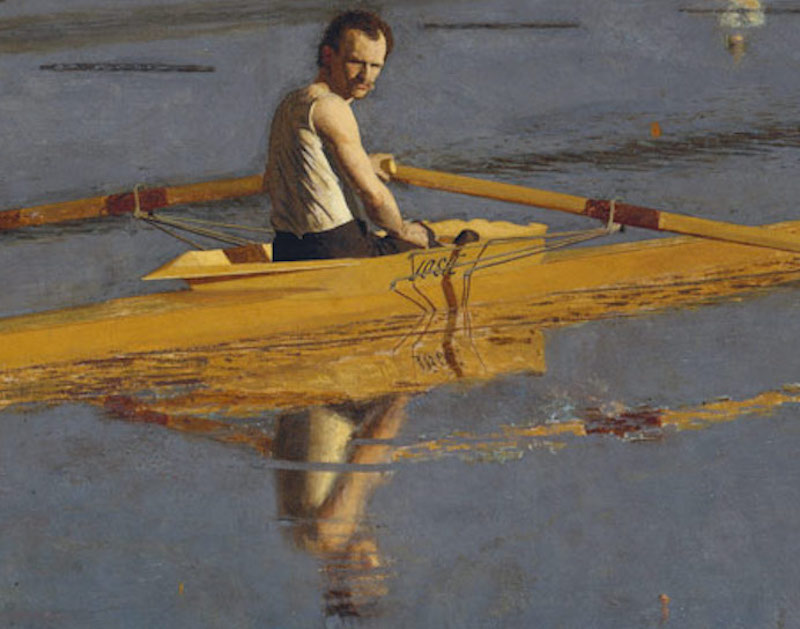
Max Schmitt in a Single Scull, Recent Thoughts

November 2016

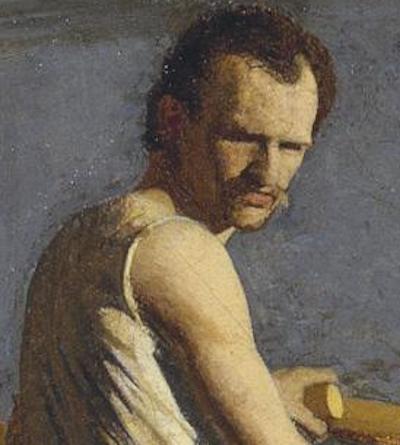
Max Schmitt and his reflection have been with me some sixty years, almost my entire life. I first saw him as a child, browsing through the only art book we had on the shelves, Modern American Painting, by Peyton Boswell, Jr., published in 1939. My mother’s influence, but perhaps my father’s. Schmitt gazed towards but not directly at me, with a look that wasn’t recognition or identification yet which made contact and left an opening I haven’t yet closed. With the opening, a proposition that I couldn’t understand then but may have felt, or maybe just a simple statement I still don’t wish to refute. I bought a print some fifteen years ago and he has been on a wall as I’ve moved around the last years, a protracted season of dislocation.

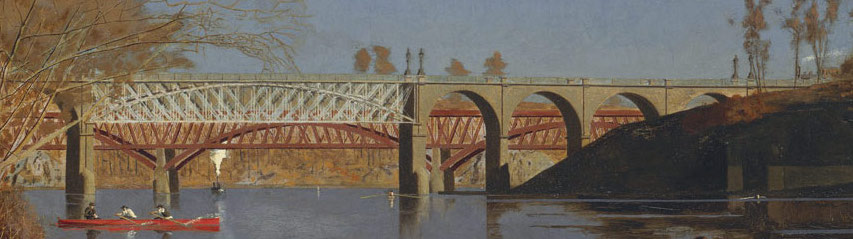
The painting is Thomas Eakins’s The Champion Single Sculls, also known as Max Schmitt in a Single Scull, completed in 1871. Click the image above for full enlargement. Schmitt, a friend of the painter, was Philadelphia’s single-scull champion several years. Rowing was popular then, and he was a well-known and well-loved figure in amateur sports across the nation, forgotten now. But I did not know that until much later, nor does Eakins show crowds teeming on the shores cheering him on at the height of victory as he crosses the finish line. He doesn’t even show him demonstrating his strength and skill executing a hard pull on the oars in tense, charged exertion. Rather he presents him dressed in casual gear during a practice session on a crisp autumn day, by himself, in a nearly deserted scene made luminous by a clarifying late-afternoon sun. Schmitt has just made a turn on the Schuylkill River and now relaxes, the wakes from his scull and oars leaving broad trailing curves that take us into the painting and set its composition, giving it its energy. To me, for so many years, he was only a man named Schmitt and he was just there, resting above the still water, looking out, balancing the oars in one hand, which more and more I realize is a marvelous feat.

The bridges are rendered in sharp, accurate perspective—Eakins was a master of the technique—but other painters had already begun to flatten space and dismantle it, taking art in rapid acceleration on an unknown path. And we see on the horizon the developing technology of the time, the train about to cross one bridge, a steam boat to pass under, this when our technology was taking off, with it, our mounting wonder.

Nor does Eakins show influence of the Impressionists, who had already begun exploring the transience of light and stating the primacy of paint, of colors. Above, Claude Monet’s Bathers at La Grenouillère, painted in 1869.

There is no evidence Eakins even visited the Salon des Refusés, and he had his chance. He was in Paris at the time, studying under Jean-Léon Gérôme, an academic painter who enjoyed considerable popular and critical success, for example with his Ave Caesar! Morituri te salutant (Hail Caesar! We Who Are about to Die Salute You).

Eakins has done nothing to alter the esthetic course of art or change our perceptions. He presents the world as solid, and academic rigor anchors his work. Yet the painting is alive, in the shimmering blur of brush along the shore, the erratic reach of the trees, the brisk scrape of clouds above. It succeeds at what makes any work endure, working within a form and giving it life and expression. I have never tired of looking. Each time it is fresh and vital.

He does make a break, however, and it comes from his subject matter, which was rejected by the official salons of Paris and shocked established Philadelphia. He has given us a common man not posing but relaxing in informal clothes, performing an everyday behavior without ceremony, without appropriation of past claims and pretense, in an ordinary place without hierarchy of space or institution. We have begun to look at ourselves and it is liberating.

Perhaps Schmitt is looking at someone on the shore, perhaps he is taken in a thought, or perhaps he is deflecting one. There’s a severity in his face and he seems to scowl, but he’s only frowning in the glare of the sun. His look did not put me off as a boy and must have instilled this note back then, that whoever, wherever we are, whatever we hope to be, we need to maintain vigilance, skepticism, and a measure of reserve.

Really, Eakins doesn’t give us much to identify him as an individual, but his portrait is made in the whole landscape, of which he is a part but where he keeps his separation. There is light. And there is transcendence, but where it takes us is back to exactly what we see, the clouds, the trees, the brush, the trailing curves in the river, and Max Schmitt resting above still water, looking out, balancing oars in one hand.

I have looked at the painting several times this past week, the week of election, for confirmation, or reassurance, or to restore a definition, and I realize how the painting has always stood for me, that it shows me what it means to be American, vigorous and assertive yet relaxed and open, and free of historical encumbrance; self-assured but not self-possessed and not afraid.

Failing that, it is a picture of what it means to be alive, to be oneself by oneself, and not be alone.

There’s a kind of idealism in realism, or can be, a belief that the simple fact of our existence is worth stating and preserving.

.

.

To St. Johns Bridge

And Thee, across the harbor, silver-paced
As though the sun took step of thee, yet left
Some motion ever unspent in thy stride,—
Implicitly thy freedom staying thee!

from Hart Crane, “To Brooklyn Bridge”

A routine is a repetition that both breaks the day and places us in it, giving our lives the appearance of structure, of order. A bridge is a repetition of structural elements that orders a way beyond our routines, to thoughts of other things, or that appearance.

I have a routine where after the morning’s work I walk to the St. Johns Bridge and down to the Willamette River. If I miss a day my life feels incomplete. I live across the street from the playground of an elementary school and leave late morning to avoid the shouts and shrieks of the kids at recess, an inseparable mix of joy and chaos, though sometimes I take their noise with me. By that time I’m fatigued anyway, and bogged down in some unresolved disorder. I leave thinking the walk will provide inspiration, that I will return with fresh insight and rejuvenated resolve.

From the east entrance

I descend a side street

down to Cathedral Park, beneath the bridge, where north Portlanders run their dogs, fly drones, and get married.

Then, after following a long viaduct of approach,

I reach a small floating pier, beneath the span, and walk to its end, my terminus,

where I take a break—I have a bit of a climb back.

And I stand and look out on the river, and free my mind, and wait to see what comes, from without, from within.

Designed by David Steinman, an engineer of considerable reputation, the bridge was the result of local initiative and remains a source of civic pride and identity. Boosters staged vaudeville acts throughout Multnomah County to promote funding; images have since multiplied across St. Johns, on the banner of the neighborhood newspaper, on storefronts, on posted bills and t-shirts. Construction started a month before the Crash of ’29.

Yet while it set several records when built, the St. Johns Bridge is not well known and pales before more recent structures that move us to greater awe. Really, there was no compelling need to build it and it serves no large purpose now. The plan then was to connect the small industrial communities of Linnton and St. Johns, some five miles north of downtown Portland. Today it joins no major freeways on either side. But that is what I like about it, a modesty that encourages intimacy, that it is not especially useful, that it is largely there for itself, that it is distant from the noise of our wonder.

The east anchorage expresses its mass in a squat concrete structure, the energy of its function in steeply curved posts and buttresses, this function formalized in a compressed stance embellished with abstract emblems and stabilized and capped with cornice work,

the energy released in the ascent of the cables to the towers, the cables carrying a tension hard to imagine,

the tension easing into the sweeping curves of the cables that hold the deck. The suspense of anchorage discharges in the process of suspension. The bridge entire, in the arcade of concrete piers, the latticework of trusses supporting the road deck, the network of thin cables holding the deck from above, scarcely visible, in the division of bracing within the towers—is a complex orchestration of compression and tension brought together into a whole that is graceful, effortless, seemingly weightless, almost ethereal. To me, with my limited knowledge of engineering, such a feat isn’t possible and the bridge is simply marvelous. My spirits lift every time I see it.

The bridge was built at a time when the ruling esthetic demanded an honesty of structure, a welding of form to function, and Steinman spoke to the integrity of his design. But another desire, another wish, competed with utility, the American technological sublime, which complemented then supplanted the natural sublime once found in the American landscape. John Roebling’s Brooklyn Bridge carried the spirit, and Steinman, like Hart Crane, grew up in proximity and professed his close attachment, its influence.

Then there is the other spirit. The gothic arch, once used to elevate belief and bring in light, provides the motif played throughout, in the concrete piers and components of the towers, arches of varying width, height, and pitch. According to Steinman the pointed arch added contrapuntal tension to the rhythm of the suspending cables, but the structure he called “a prayer in steel” also brought past associations and higher thoughts. Today, maybe only nostalgia, and fading questions.

I’ve had a touch of vertigo the times I have walked across, however. That used not to bother me. Yet it’s two hundred feet down, and when I look out from the deck I feel the downward temptation. There is this about bridges as well, that they move us to the edge, to another launching point. In the movie Pay It Forward a woman climbs on its railing to make the leap but is saved by a recovering drug addict who walks by and talks her down.

Still, the bridge is always there, a point of continuity and stability, an anchor of connection and communication with, yet also of structural separation from, with, from nature that surrounds, its variations through the seasons, with, from the ambiguous, overcast moods of Portland weather that call for some kind of brightness, with my shifting thoughts, from the fog of my moods.

But only this is certain one day to the next: our structures are just structures, our function is undefined.

I wait at the end of the pier until I realize I am waiting. Nothing ever comes, in fact I put my work aside and let it drift. But I always get this release, this revelation: I am free and I am alive, and I don’t have answers to anything.

.

.

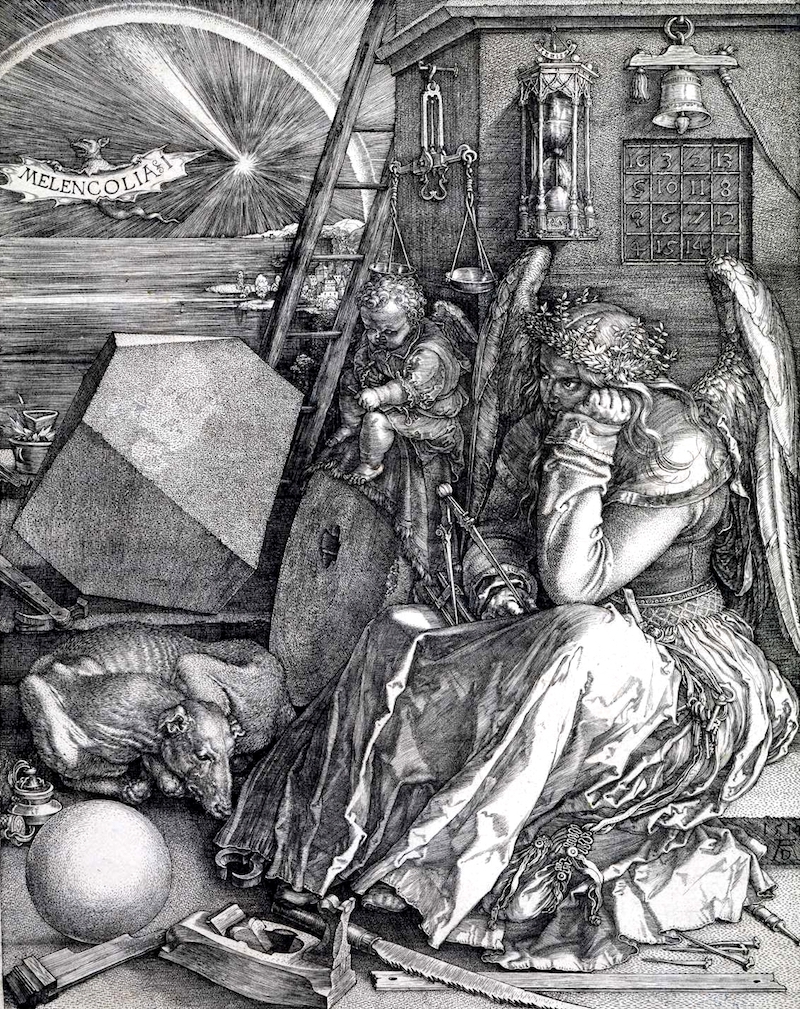
Melancholia

We…advocate that melancholia be positioned as a distinct, identifiable and specifically treatable affective syndrome in the DSM-5 classification.

Melancholic patients respond better to broad-action tricyclic anti­depressants than to narrow-action antidepressants (e.g., serotonin uptake inhibitors). They respond well to ECT. In comparison to those with nonmelancholic mood disorders, melancholic patients rarely respond to placebos, psychotherapies, or social interventions.

from “Issues for DSM-5: Whither Melancholia?”
The American Journal of Psychiatry

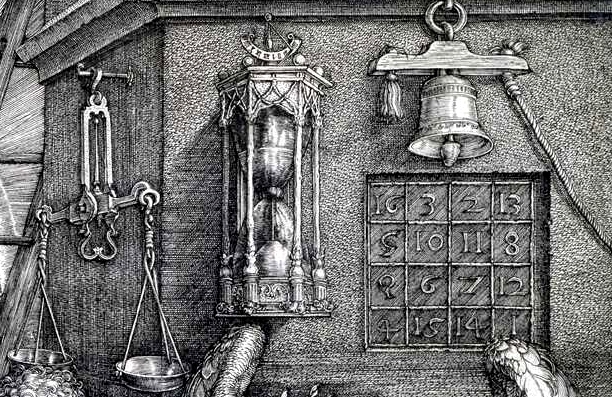
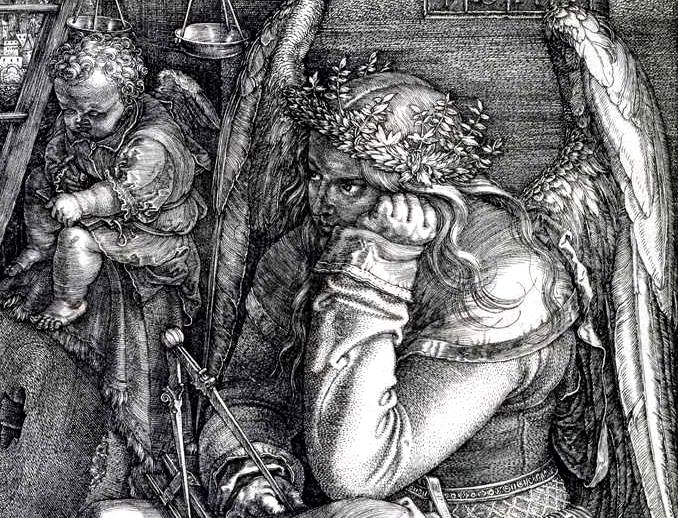
Dürer’s engraving Melencolia I draws from the theory of humors that goes back to classical times, where states of body and mind were determined by four essential fluids. It once was the basis of medical practice and found widespread cultural representation. Balance of the four brought health, but that was an ideal that we could not always maintain, or that not all of us could not find, or, in Christian times, a perfection none of us could reach at all since and because of the Fall of Man. A predominance of one in excess led to pathology, but in lesser amounts set phases we all went through or determined different personality types among us. I regret loss of this system, as it gave us variety and cut us some slack. Moody was something we could be. Today our vast catalog of mental aberration depends solely upon the empty term “normal” that is defined only by what it is not, that denotes a state that is a balance of nothing. Yet we stray from it at our peril.

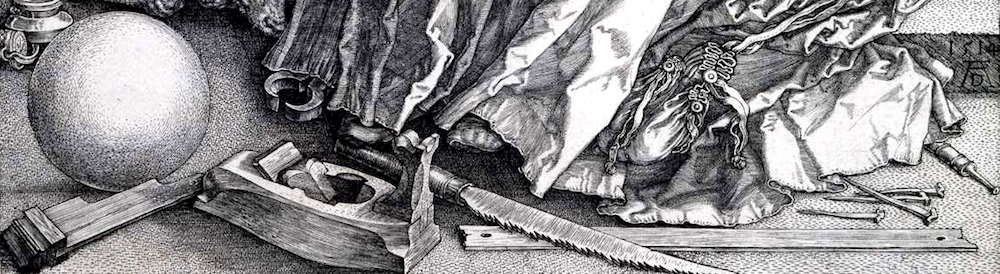
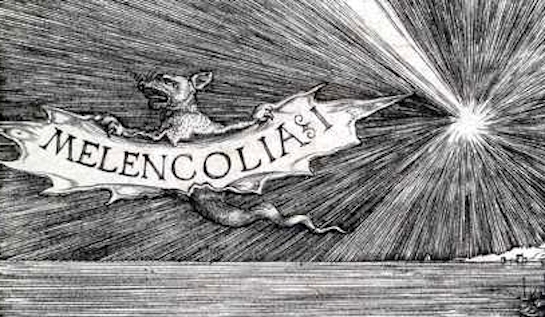
Black bile was the fluid of melancholy, which brought lethargy and stinginess. The melancholic was the most dreaded of the four personality types, as surfeit could lead to insanity and even death. Its representations, a grim miser clenching his purse, an indolent woman asleep at her spinning wheel, were sedative expressions that suppressed that fear. And intrigue—madness and death have always had that pull on us. Dürer’s figure, however, is not a common person but a winged angel, intensely alert and deep in thought, surrounded by the elements and tools of creation. Dürer has given us a picture of the artist, and in her face we see the power of her potential. But the tools lie scattered at her feet, untouched. She is grounded, locked in thought, does not fly, does not create, while in the background a comet flares and a bat cries terror. The dread has been released in a scene of darkness and disorder. I’ve had a print on a wall for decades, and every now and then I look at her for inspiration. She does not look back. This is as it should be.

Perhaps her block and the disarray show the broil and fruitless mulling that precede creation. But according to Erwin Panofsky, in The Life and Art of Albrecht Dürer, from which I take my material, that work will never come:

Hers is the inertia of a being which renounces what it could reach because it cannot reach for what it longs.

The artist is limited to the visible, what can be shown, what can be represented, and is removed from higher thought that might transcend, from the light of divine understanding, always beyond us.

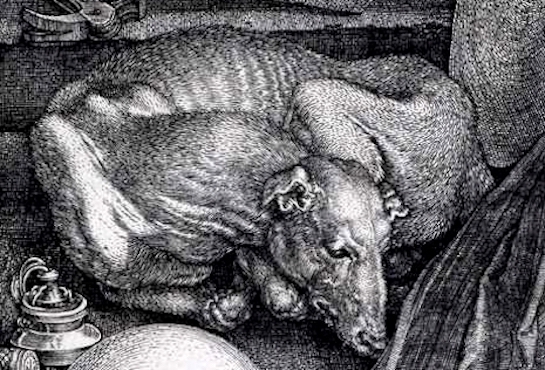
But Dürer’s stalled angel also gives us one of the most compelling images of the artist we have. A picture that shows failure to create is a complete creation itself, consummate and marvelous in its workmanship, its expression. The midnight figure is bright in contrasts, the whites of her eyes against her somber face, the luminous folds of her robe against a darkened space. A scene of inactivity is charged with dynamic, in the energy of her arched wings, the push from the outlines of the many shapes, in the spiraling line of composition that runs from the eyes of the bat through the eyes of the putto, of the angel, of the sullen dog.

There is no contradiction in any of this, as there are no contradictions in art. Nor is there irony, as we see exactly what we should expect. We are shaped by our conflicts and contradictions, our reaches, our misses, and our doubts: these give us life. And the failure to represent the divine visibly points all the more to its invisible presence. It is our balanced, symmetrical representations and our clear resolutions into action that are ironic because they always fall short of our desires, of our projections, and they touch a different kind of madness.

The engraving is built on a correspondence of symbols based on theology, philosophy, and common understanding that connected the universe from the material to the celestial, that ran deep in Dürer’s culture. The four humors “were supposed to be coessential with the four elements, the four winds (or directions of space), the four seasons, the four times of day, and the four phases of life.” His angel, holding a compass, beneath instruments of measurement, echoes a prior woodcut “Typus Geometriae,” a woman representing geometry, the study that in the Renaissance was the foundation for creating art and understanding the structure of the world. Saturn, the original creator, inspired geometry as well as fueled imagination with furor melancholicus. The dog and bat were his. I won’t develop all the sources and connections, however, because I’d only repeat what Panofsky has so thoroughly and beautifully written. Also we know today none of the assumptions and correspondences are true.

But what we know is false now wasn’t true then, yet still we have Melencolia I, who still holds us captive. There’s a paradox here that needs to be sounded. If we reject the divine, and we have, we need to replace it with something else. Our lives, like our art, depend upon how much we can draw from within and reach without.

I will leave the magic square and the devices for measuring weight, time, and space hanging on the wall and ignore them. Mathematics, like our logic, we now know talks only to itself. They will also serve as reminders to deflect a world that cannot tolerate imprecision or imperfection, or indulges them too much.

I will keep the tools on the floor because I still have dreams of constructing and peopling homes and cities and worlds. But I will add a jackhammer and wrecking ball to test their strength, or demolish the facile abstractions that now surround us or any I might create.

The bat stays where he is, soaring above a leaden sea, who will scream my every waking minute to help me maintain vigilance, see terror overlooked, or induce it when I fall complacent.

I will get a dog, lean, clenched, and perpetually morose, and have him lie at my feet to anchor my flights.

And I will ponder my next project, moved by what is not there, what might be, what always never will be. Or let my amanuensis putto scribble away idly while I brood in dark brilliance and do nothing.

.

.

Riding to Apocalypse

And I saw, and behold, a pale horse, and its rider’s name was Death, and Hades followed him; and they were given power over a fourth of the earth, to kill with sword and with famine and with pestilence and by wild beasts of the earth.

Revelation 6:8

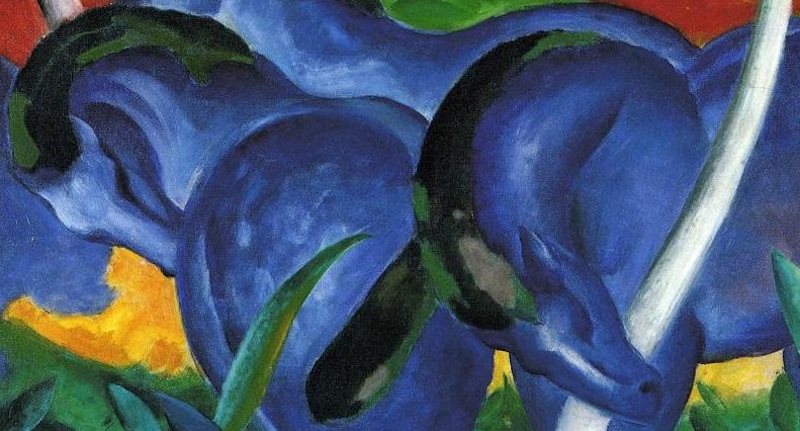
Franz Marc’s The Large Blue Horses—another work of art that has been with me almost my entire life, a print of which also has hung on a wall for some fifteen years, and I can’t remember when or where I first saw it. My best guess is in the library of elementary school, high up in childhood memory, among other paintings on the walls surrounding the low shelves that held books within reach of our hands and hearts and minds, appropriate for the course our lives were supposed to follow.

The blueness of the horses did not strike me as strange but rather was a given supported by the mass of their collective surge and the energy of the overall composition, their motion made significant by their self-possession, the color itself part of some larger motion I did not question and wouldn’t have grasped if explained. But what I took from it then, I think, is that there could be power in reflection and composure.

And the painting has survived the process of school, its ideas of itself, its upward gradations; and the rising flood of images that followed on screens and in popular print; and, when I studied art in college, the outline taught that put art on an ascending conveyor belt of movements. There is no such thing as progress in art or any permanence in our ideas and distractions.

Events from the last years and changes in my life and recent reading, however, have unsettled the painting and made me question its place now over my hearth.

Marc painted The Large Blue Horses in 1911, for many a time of alienation from and revolt against rapid industrial growth in Germany and the materialist Wilhelmine society it brought, when Nietzsche’s appeals for a return to Dionysian passions flourished, when crisis in the Balkans increased in pitch and European instabilities made global war seem inevitable, a war which many others found attractive, a world whose vast web of motives and intrigues most of us have forgotten, if we ever learned it.

What I’m supposed to say is that Marc was a German Expressionist, who looked not at the facts and impressions of people and nature and society but at subjective realities beneath the surface, at undercurrents of self and culture, and, hopefully, at something beyond and higher. The animals he painted represented human states and a desire to return to uncorrupted nature, nature expressed in ideal landscape. Marc created his own color symbolism, and blue stood for the male principle, serious and spiritual.

All these terms are as intriguing as they are slippery, ultimately meaningless.

Of course the painting is sexual, but that slant obscures as much as it makes clear.

But there is no escaping the sensuous, sinuous, swelling flesh of the horses or the suggestive pull of their movement or the tension of the contrasting colors. The rhythm of their bodies continues into and complements that of the hills and sky, positing larger context. The horses’ blue, a color that optically recedes, is placed in front, while the distant hills are painted the forward red, this atmospheric reversal closing foreground and background and increasing the break from expectations, moving us from the nature we think we know.

Horses themselves give pause—such large animals that are not predators, that possess great strength yet are graceful and reserved. A horse without a rider lifts the burden of possession and use, opening up possibilities and raising questions. With their bowed heads Marc’s blue horses submit to the rhythm and yet push against, parting the distended white trees that divide the canvas.

In 1913, the world closer to war, Marc painted The Tower of Blue Horses, where there are four blue horses now, vertical and rising, open-eyed and agitated, their flesh taking on the angles of Cubism.

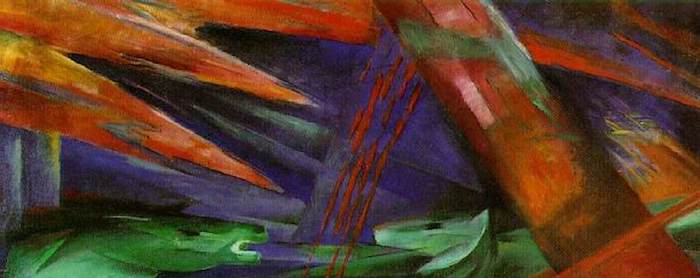
A few months later, war still closer, in Fate of the Animals the horses, frenzied and in peril, turn green, blue mixed with yellow, which, Marc tells us, “cannot still the brutality of red,”

in a picture that takes animals and landscape to the point of annihilation by the slashing diagonal lines, red flames, that dominate the canvas and set the fractured composition. An irony here—the painting was actually damaged in a fire and Paul Klee only partially restored the area on the right.

Fate of the Animals recalls Picasso’s Guernica, another painting of wholesale destruction and disruptive composition, his response to Franco’s request to bomb the town, Germany’s tuneup for the next world war. Both have since stood as pictures of the horrors of war in general, of civilization on the brink.

Marc also shows the influence of the dynamism of Futurism, though with inverted intent; Picasso continues his cubist experiments in his synthetic phase, with clearer representation in his angled shapes. These maneuvers are not advances, however, but adjustments to match the subject. But the breakup and rearrangement of parts does not create chaos but rather gives coherence to disorder, and with coherence, the terror of beauty.

Most have taken the bull as the source of the massacre, representing fascist brutality, and the horse stands for the slain innocents, their agony and death. The bull alone is passive, however, with a stilled face that is hard to read, and Picasso used the figure for other representations, including of himself. Guernica is direct in its images and but ambiguous in its meanings, leaving unanswered questions. The bull also leads us to the Minotaur and the labyrinth of mythical meaning. Still, there is the overpowering sense of revulsion at something we have done to ourselves.

But in Fate of the Animals the source of destruction is external, coming from some unseen force above, beyond our agency, entering the canvas in the flames at the upper left and rebounding and continuing their destructive course across the picture plane. It is, in fact, a picture of apocalypse. Frederick Levine, in The Apocalyptic Vision, makes a convincing case, explaining how Marc drew cataclysm from Wagner, from Nordic myth. The long column that slants left against the flames is Yggdrasil, the eternal ash, which shelters the four willowy deer on the right, who alone will survive to start a new race. Apocalypse is not just inevitable, it is desired.

We know that everything can be destroyed if the germination of a spiritual race does not endure the test of the greed and impurity of the masses. We struggle for pure ideas, for a world in which pure ideas can be thought and can be expressed without becoming impure.

Marc saw the war as the coming apocalypse and volunteered early, before conscription. It was something he had to witness and endure. But the imagined glory of the past that others wanted restored was what he wished to see destroyed. Like them, he had no idea what was to follow.

The combat of the infantrymen which I witnessed yesterday was incredibly hideous, more horrifying than anything I have ever seen. I was totally shaken last night. The courage with which they advance, and the indifference, indeed, the enthusiasm for death and for wounds has something mystical about it. Naturally, it is a mood of reconciliation, the clarification of something that was previously uncertain.

Purity is a trap, a dead end, and this is pathology. Marc, who was given to bouts of depression, has surrendered to his mood and in self-immolation projected it into unnamed abstraction. Spiritual shell shock here as well, as the pathology of the self meets the pathology of the world in a landscape of death and shattered mirrors.

And the apocalypse of Fate is what The Large Blue Horses leads up to, what stirs the trio in their lowered gaze above my mantle. Reading Levine forced reexamination of the painting and led me in downward spiral. My living room deadened in its plane and turned into a no man’s land, a grayness spreading to lifeless winter trees outside my windows, to lifeless streets, and lifelessness beyond, endlessly. Everywhere I went I saw entrenched lives and, on faces, in reports from around the world, the signs of dissolution and breakage. I avoided looking at the painting, then started avoiding the room. I long debated taking it down, not finding resolve.

Nietzsche’s descent into madness, legend goes, began with the sight of a beaten horse.

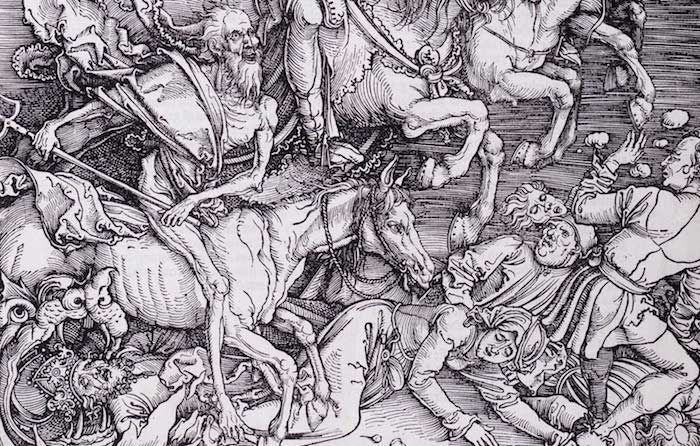
But psychology is sterile reduction. And to reject myth as superstition is to deny its power and persistence. Some notion of apocalypse has been with us a long time. It may be one of our earliest formations. In Dürer’s gorgeous woodcut the four horses unleashed in Revelation take the riders who scourge the land, necessary preparation for a new heaven and new earth. Destruction precedes renewal—or is it merely the underside of our highest, purist aspirations?

It is impossible to recreate the confusion of thought and emotion of Marc’s time and get a fix, but it is just as impossible to gain footing now in a world certain only of itself, not going anywhere at breakneck speed, where wars are fought by others and victims most often are others and apocalypse has become a casual diversion in movies and video games.

Too often when we read biography into art we only read ourselves. What I most became aware of looking at the Blue Horses was myself, a depression that came from within and radiated out. The signs of breakage were still there outside my windows, however. They are still there. They have always been there. If I hadn’t noticed them before it was because I wasn’t looking.

And I don’t know if a glance towards apocalypse isn’t what drew me to the painting over fifty years ago.

Only by risking everything do we know what anything is worth.

Or:

We risk everything because we do not know what else to do.

I have no idea which is true, if either.

I only know the old man will always be with us.

And that if I take the Blue Horses down I will be lost.

Slowly, cautiously, I have returned to their coiling, inward gaze. Color has returned to the room, slowly, cautiously, and leaves have returned to trees, and grasses return to barren fields and softly fill furrows and cover mounds though from which chunks of old concrete still protrude, though a grayish mist lingers over all.

March 4, 1916, near Verdun, Lieutenant Franz Marc rode a chestnut bay out on a reconnaissance mission and did not return. He was killed by shrapnel, French or German, no one knew. Another irony. The world is littered with ironies.

.

.

Above the Roofs of Paris, A Non-Memoir

Tout pays où je ne m’ennuie pas est un pays qui ne m’apprend rien.
Any country where I am not bored is a county that teaches me nothing.

Camus, “Death in the Soul”/“La mort dans l’âme”

I’m not sure bored is the right translation—s’ennuyer touches on several different moods and I wonder if English handles well the reflexive verbs. But I think boredom means something else to the French, certainly to Camus, different from what it means to us.

I arrived in Paris the summer of ’73, late morning to a cloudless sky, with little money and almost no French, not knowing where I was going to sleep that night. I had no strong reason for being there. I was 20, and like the rest of the U.S. I was full of anticipation not based on much anything substantial.

Why look back at that time now?

I had finished my junior year in college and felt I should learn another language, thinking I might learn it better in place. French because several works engaged me, Camus’ The Fall, for example, for its absolute irony, what that pointed to, for its introspection, an inward cast that threw the outside world into a different light, unrelenting.

The last thing I want to do is write a memoir. I am not a remarkable person and I do not want to be in that position. Nor am I interested in being interesting, least of all to myself. Besides, it’s impossible to get anyone’s attention now. And if I’m supposed to make a confession, what am I supposed to confess, to whom, and why?

The Alliance Française was my first stop from the airport, the state school that teaches its language to the world. I enrolled for classes and at its bulletin boards ran into another student who told me about a hostel across the Seine where I was able to stay a week, having to change rooms twice. My plan was to remain for the summer. I had about enough cash to fund myself if I were careful. I started classes and kept looking for another place to live, beginning my branching out into the streets of Paris, hobbled by my lack of French and knowing little about the city. The first days were charged with uncertainty and possibilities beyond imagining.

Really those days were a static nothing. Only now do I realize what I felt was exposed. Nothing remarkable happened in the months after. I have nothing exciting to report, nothing that might entice, that might set me off from the crowd who preceded me. But plot works on the assumption that we have power to act in the world and effect some kind of difference, that action matters, that change is always possible, always worth the while. I gain nothing by trumping up the superficial, and it may be the expectation of plot that I most want to defuse.

At the Alliance Française I ran into a Cuban woman from Michigan who told me about her room that she was soon leaving in a house in Arcueil, a commune just south of Paris. I met her there to check it out. It was close to a Métro station and I could afford it. We talked for some time, opening up—travel does that to you. She had just returned from Italy where she said standing before Michelangelo’s David gave her an orgasm—

If you need sex, watch René Clair’s movie. Better yet, read Henry Miller’s Under the Roofs of Paris. None of us can top that.

By the end of the summer I hadn’t learned much French and felt I had accomplished nothing, so I decided to stay. I did find some work that stretched my funds, again at the school bulletin boards, small jobs getting paid to hold conversations in English with French students and employees learning our language, for which there was demand. English had established itself as the international language, or at least the language of international business. Later I got a part-time job teaching English to bank employees that allowed me to stay another ten months, giving me more time for whatever I hoped to happen that hadn’t happened yet.

I am not going to add judgments of the French, unless I let a few slip. I hadn’t developed much perspective on anything that might have led to insight. Also a year is nothing and my exposure was slight. I wouldn’t trust anything I might have to say now, either, based on what the next forty years have brought, in fact would trust it less. I do want to note, however, that once I broke the crust of their exterior, the urban reserve, the formal skepticism, I didn’t encounter any Parisians who were not kind.

More, I don’t see the point in piling up details, interesting or not, as if accumulating them means anything, as if recording my experience somehow puts me in the world and makes that place significant, gives my life some sharp cast, makes it “real.” Authenticity is an illusion, a trap. Still, I will need to try to locate myself, and there are places, and moments, and people whose existence I want to preserve.

Really I didn’t go to Paris because I wanted to learn French. I only wanted to get away—somewhere. I didn’t want to return not because I had something to stay for but because I had no idea what to do with myself when I returned. At 20, I was already stalled in my life. I had every reason to believe I could pursue a life of material comfort with some kind of status, but I couldn’t see myself in any profession, lacked confidence, and had no conviction, much less desire. I had no special talents, had developed no craft or set of skills, no body of experience or knowledge about anything to make any kind of judgment or decision.

The received notion—idée reçue—is that I hadn’t yet learned how to live, that Paris opened me up and helped me find myself. There are serious problems with all the terms, though in a way that is true. But Paris wouldn’t change my lack of resolve, rather, though I didn’t know it then and couldn’t have, made me acutely aware.

Yet really that is what I most want to recapture, the uncertainty, the exposure, the stripping of the self, to see what might be left, or maybe just the stripping. I don’t gain anything by moving from A to B with climax C in between or by going back to see where I am now and making some kind of comparison. What I want to do is find again that point, a place not for starting over or revision or regret, but for resetting, or better just rest there, discover once more what might have been overlooked had there been remarkable events, what it might mean to be bored.

.

There is a time for action, however. There is always a time for action.

.

“Death in the Soul” is an early literary attempt about a week Camus spent alone in Prague. He was only a few years older than I and like me had little cash and didn’t know the language. His days were spent wandering the streets, and he recounts largely mundane events and simple, meaningless contacts, feeling trapped by aging Europe, the walls of the past. He experiences an intense despair that appears gratuitous, though with Camus we know that is not the case, his despair relieved only by his journey further south, to open, warmer climes, a warmer spirit.

Man is face to face with himself: I defy him to be happy. . . And yet this is how travel enlightens him. A great discord occurs between him and the things he sees. The music of the world finds its way more easily into this heart grown less secure.

Yet he qualifies himself, as he does in his remark about the lesson of boredom. It was a thought, he says, that helped him get to sleep. The Prague he visited returned a bitter smell and anguish, not enlightenment, noise instead of harmony, a dead man instead of life. Camus will not rest in his debate between the individual spirit and the world, will not rest with anything, and if his despair appears gratuitous it is because in the face of uncertainty—uncertainty in the larger, or, really, its immeasurable sense—everything we might conclude is tentative, any action without anchor. Absurdity for him is not a stance for a pose. And “Death in the Soul” is not a memoir but a literary staging for youthful mood and later thought.

So much of my time was spent wandering the streets of Paris as well, getting lost in the labyrinth of the narrow, old alleys only to be released into wide boulevards, the plan of Baron Haussmann, its argument between the state and its people—the suspicion has been leveled that Napoléon III wanted to broaden the streets to make it easier to bring in troops. Read a history of Paris and the streets fill with the shouts of protest and run with centuries of blood. There were other arguments, other expressions, other architectural containers and releases, the accents and structural reasoning that gave them face, the flying buttresses that held them up. And there were other places where one could get lost, dark containers of hidden life. Paris is a public encyclopedia of a millennium of the debates between order and chaos, between the passion for order and the order of desire, so many unfamiliar. I didn’t feel trapped but overwhelmed and uninvolved. Yet Paris is a horizontal city, closer to a human scale, seldom rising above seven or so stories. When you look up, you see only the sky.

Language connects us to the world; not having it cuts all ties. Simple but essential day-to-day transactions—buying food, finding a place to live, knowing the laws so as to follow them or steer clear—were a strain, and I often failed. Not knowing the names of the multitude of routine things that define daily life made them hard to get. Even when I developed a functional control, Parisians often pretended not to understand me, probably because of how I butchered the words. They are proud of their language in ways we are not. I lacked sensitivity for the sounds of vowels, which carry sense, and was stuck in my thick, Southern ar, unable to make the French (Crachez!—spit!—one instructor told me). Nor did I ever learn to deliver their formalities of address, which I found excessive, with any confidence or grace. Informalities, the words that breach walls and initiate closeness, I missed at every turn. False steps in both led to injury, offense, or pity. As for slang, forget it. Slang is for the adept. I was always on guard and almost never felt at ease when I spoke. Most, it is irony and intonation that give language meaning, the art of slanting words to put them in their place or take them to heart. I could manage neither, and the sentence Je suis seul was only a sterile formula that had no impact whatsoever.

As for my own language, my English words were seldom returned. I steered clear of the hordes of American tourists, the tourist spots. My faith in talking to myself in my own tongue, my means of self-reflection and self-definition, began to slide. My patron saint, I suppose, was Denis, who, decapitated by Roman pagans in the early years, picked up his head and wandered Paris, legend goes. Saint Denis, however, preached all the way he walked. Where he stopped and died, a shrine was built, later a church, a burial place for kings, the church later enlarged and opened up by Abbot Suger to allow entry of the light of the Word, its union with royal power. I could only mumble and never stopped wandering. Built on top, all the lines of construction around and above me where I found no intersection.

.

While Camus knew unrest and oppression at home in Algeria and was sympathetic, neither “Death in the Soul” nor the other early lyrical essays, written in the mid-1930s, anticipate our soul’s greatest crisis, the massive disruption of reason and wholesale death of the coming war that charged his later writing. Maybe in his despair, the deadness, a hint, but the next years may have beyond the imagination of most of us then. Then again, it was from our imagination that the beasts stirred.

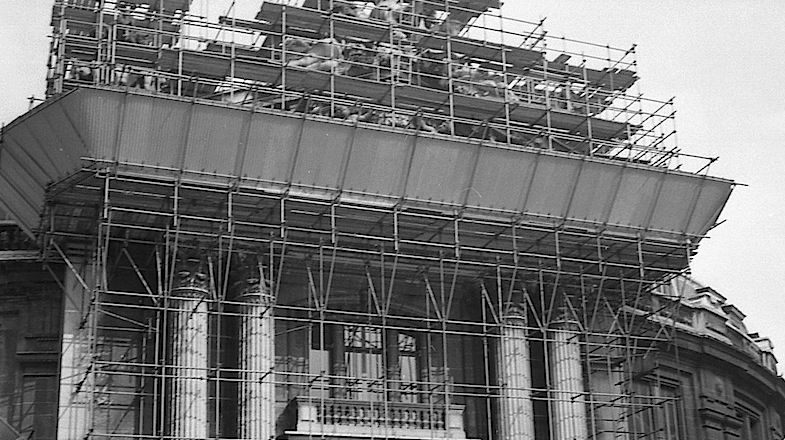
When I arrived, the defining events of WWII had long passed, but with what resolution or understanding? Paris was in the last stages of the Malraux plan to clean its buildings—there was still scaffolding up throughout—while France was adjusting to its declining influence. Restoration gave the buildings a fresh face on the present but lost the impact of the past, surface without the wear of turmoil, display without visible reference. Like the rest of the western world, France was in recession, and the foreign workers welcomed in better times were gathering in slums on the city’s borders. Demolition of Les Halles, the ancient central market made stately in the 1850s with elaborate iron and glass framing, was nearly complete, leaving a huge pit the city debated how to fill. That pit was also the setting for the climatic scene of Touche pas à la femme blanche—I saw it when it opened—a rather glib movie that appropriated Custer’s last stand to represent France’s capitulation to the influence of power and money, notably ours, the waning of native ideologies.

There were student demonstrations in the streets, though none that approached the fervor of May 1968, protests against what they thought the CIA, and by extension the U.S., had wrought in the postwar world and in fact had, still tremors against the overthrow of Allende in Chile, the persistence of our Shah of Iran, and whatever else they thought we might be doing elsewhere in the world and probably were. More generally, resentment lingered over the recently completed Tour Montparnasse, an utterly bland sixty-story skyscraper that broke the horizontal line of the city, blamed on a corrupting American influence. I simply took the tower as a given, what I had learned to accept as a symbol of progress, or maybe better an idée reçue, which I began to question. At six-foot-three I was a tower myself among the French, often brought to my attention—I was dubbed le grand Américain. Bland yet imposing, like Montparnasse, I began to doubt my own construction, what I showed the world, what I contained.

Meanwhile at home—I’d read the Herald Tribune on occasion—with the signing of the Paris Peace Accords we were quickly putting Vietnam behind us. The Watergate hearings gathered momentum; long lines appeared at gas pumps.

I don’t think anyone knew what would happen next or what was supposed to happen or had solid plans or substantial purpose. Like me, the western world was in a stall, that world left with what it had brought within its borders, what it had left unresolved without.

.

There is a time for action. There is always a time for action. But the times when we have moved ourselves to act the time for action has long passed.

.

I think it was early morning I saw him, daylight even, a faint, grayish sky not promising, not anything, but that still cleared shadows from the buildings. Maybe I was returning from seeing F—. A street cleaner, he was standing bent over his broom, looking but not looking at the street or beyond him, at the receding prospect of his work, the endless web of streets, the broom an impossible device with a long handle and narrow, conical head, long bristled, like a witch’s. African, most likely from one of France’s former colonies, his face was beaded with tribal scars and he was wearing the official thin, pale blue smock given by the city and on his head a flopping knit cap, rainbow colored, his own touch, his culture’s, but the bright colors not illuminating but withdrawing from the grayness, his face showing not an expression but its removal, and in his eyes a burning look that still burns in memory, of pain, of complete isolation, and still of something else and nothing, a stark nothing. . . .

.

I was not alone.

I was not alone, only distant. And my life in Paris was not idle but full of contact. Yet while Paris is supposed to be the city of style and lavish emotion, most I encountered, even as I went up the scale, lived closely to their means and practiced a material reserve I hadn’t known. Clothes were put into service for long stretches; appliances were not a given. My landlord took his bike to work, and the doctor who came late one night when I had an attack of appendicitis rode a motor scooter. I felt a superiority that embarrasses me now, if it didn’t then. But I had to adjust myself as I was living on only about two hundred a month. Of course that was not hard to do and my condition was only temporary. I did learn a leanness, however, that has since served me well. My poverty in language meant I also had to practice another kind of reserve, guarding my emotions since I did not have the means to purchase them. At least what I could not accomplish in spirit did not get poured into costly substitutes.

The house in Arcueil was in a working class neighborhood of other small houses abutting, where many were communist by circumstance and tradition, not intellectual choice. My landlord once showed me a slideshow of his vacation in Moscow; we were both impressed by the subway stations. It was a simple stucco two-story with a tiled roof and little ornament. The family lived on the first floor, my landlord and his wife and two daughters, and they rented out the second, three bedrooms, a small bath, and kitchen. My room had just a single bed, a simple desk and chair I think, some kind of armoire, and one lamp, all the furniture needed, though, for philosophy or a revolution. My window opened south, looking out on Paris but not showing much. Jacques had the other front room with his girlfriend, largely accounted for by its double bed. A couple from Martinique had the back. The kitchen was our common room, where complex arrangements had to be made for cooking, along with others in the bathroom.

One or both of the Martiniquais worked for a ministry, as did Jacques, Youth and Sports. The Martinique couple were quiet and forcibly polite, the brief moments I saw them in the kitchen. When their bedroom door was closed they fought incessantly, shouting at each other in rapid fire. One morning I found blood in the bathroom. I won’t even hazard a guess as to causes. The source of their tension was hermetically sealed from the rest of us, maybe from themselves as well.

Jacques, however, was open, befriended me, and became an unofficial ambassador of culture, high and low, formal and counter. He winced at what I ate, and one Sunday took me to the nearby outdoor market to shop, then prepared a full course meal, inexpensive but distinctive, the hallmark of French cuisine, a kindness that was probably also meant for my instruction. He taught me the slang and standard jokes, none of which I dared try, and corrected me when I attempted standard French and passed on his copy of Grammaire Larousse, along with his little red book, L’indispensable Paris par arrondissement, the collection of maps of streets, both of which I still have. He mentioned in passing literature recent and past, encouraging me to read Bouvard et Péchuchet, Flaubert’s novel about two bonhommes who try their hand at just about everything and fail—for the vocabulary, he said, but I did identify with them. I also received brief lessons on French history as well as current events, along with opinions on the newspapers that covered them. Le Monde had his respect, as did Charlie Hebdo, with a sideways laugh. In case I had missed it, I got the standard criticism of the U.S., but also of France—corruption, alcoholism, the oppression of institutions, including his, his concerns for the future of his, its youth. And I got tips on shoplifting, minor, of course, and only at the large stores, for the principle, a way of getting back. Not tried.

Some of his knowledge came from school, but I suspect he picked up most of it on his own, not for diversion, however, or appearances, but for survival. He had it rough growing up and had to fend for himself early on, so he needed to build an identity based on something that would hold him up, that he could live with, one that pitted knowledge against what he saw in life, that could not afford to indulge itself in affected stance. Liberté, égalité, fraternité, the French three-part motto, often came from his lips with pride as much with skepticism and even derision because of their absence, a questioning of those who said them, their motives, as well as of the qualities themselves. Freedom does not come cheap.

We had to speak in English, though, where he struggled, as I couldn’t hold my own in French, and this is my great regret, that I put him in an inferior position that did not allow him to speak full voice. I know it was a strain.

My first work, holding English conversation, took me across the social spectrum and into many quarters I would otherwise have overlooked, inside the personal interiors of apartments, up to attic rooms, and out to sidewalk cafes, their mix of local traffic. The employment bulletin board at the Alliance Française was always covered and served as much as an informal portal for interchange, exploration, and ritual connection, one, I’m sure, of many in Paris. I talked with university students from whom I heard the student rant and banter. It was how I met F—, who was studying for her maîtrise. Also a spirited secretary, a virtuoso at gossip, and I had a chance at an artist, who interviewed me in his studio but turned me down. A young ministry employee, lower level, learning English to advance, whom I met at a café, was soon joined by friends in his or other ministries, who grew to a crowd, ministers themselves to political positions across the board—a cheery communist, a Peronist, socialists of varying degrees, a few who were apolitical, one seriously, another seriously not, still others, and even a sullen National Socialist—yes, a Nazi. Politics got debated in lively crossfire, along with just about everything else under the sun. And in one of the better quarters I tutored a ten year old boy, J.P., whose parents were quite well off and well connected. His mother, Mme S— traced her ancestry down to a Roman solider passing through southern France. However much I might have resented what they stood for, I did not recognize the signs of their status, foreign to me. But they did not force those on me, in fact, after the lesson, I sat at their table for the lengthy family déjeuner, formally casual, and was treated as a guest, where cultural debate took other turns, though largely was politely avoided.

All the talk was in English, since that was my job, so it varied in completeness and perfection. As with Jacques, I was putting them at disadvantage. But I was the one who held back, not knowing what to say before lives similar in some ways but in many others different, ever uncertain of what I represented, ever distant, distant from any self I could name.

.

J.P. soon wearied of his lesson, and I sometimes filled out the rest of the time sitting with Mme S— in baroquely curved chairs at the dining room table, chatting idly, a fleeting intimacy beneath the glints from the crystal chandelier overhead, feeling, maybe, but only slightly, I had stumbled into a Henry James novel. She was an open, gracious woman, and it was one of the few times I felt comfortable speaking French.

One day, while I was at the café waiting for my ministers to arrive, I noticed a woman sitting at another table, striking in several regards, lâche in others, her posture, her pose worth a Manet study, her hair the same color as the Irish setter who lay at her feet, striking himself. Two men came up to compliment her on her dog. The one with the mustache began petting him with increasing vigor.

Doucement, she said.

When Jacques took me to the open market to shop for the dinner, he stopped at a stall to buy grapes and asked for a smaller bunch.

Je peux vous les couperI can cut them for you—the woman behind, provincial, young but worn, said with acid. Jacques recoiled with a smile.

It was a common joke, a rallying cry of sorts. What could be cut, he explained later, were the male parts. A pair of severed testicles once appeared on the front page of Charlie Hebdo with the headline Ne coupez pas!

Desire, of course, was everywhere on the surface, and its obverse edge.

.

Culture, learning the language, did not cost much at all.

The Alliance Française, on Boulevard Raspail, was close to the Latin Quarter, near the Luxemburg Gardens, the universities, the sidewalk book stalls. Tuition was modest, and classes ran in units lasting a few weeks, a constant rotation of instructors and students from around the world with varying needs to learn the language.

A random few students:

A black Algerian worker out of work, who battled his version of the language against the state’s.

Nuns from New York, preparing for parochial school, probably. How flat their voices, how little music, the Irish woman next to me once said, whose husband had relocated to Paris for business.

A Cambodian who saw no problems with the Khmer Rouge back home and was planning to return.

Two instructors, memories of whom have most survived:

Mme Veulter, a handsome older woman with a long face that showed dignity and ironic reserve prevailing over the lines of wear, who was well versed in many fields, stately, magisterial even, but also forgiving, who endured our stumbling without disdain.

Mme Beaurain, young, short, with a straight posture not rigid and a strong, attractive Gallic face, her head always up, her hair in a tail that hung to her waist, her poise, like her voice, a springboard of energy and intelligence, her tail keeping the beat with her vibrance. And she’d look at us and listen as if we were spirited and intelligent, too. She was working on her doctorate, in political science, I think, or comparative literature, or maybe both.

For both women, speaking French, as well as teaching it, was a way of being, and their bearing as much as anything they said or did encouraged us to persevere and believe in our study. Both, too, I’m sure, had higher ambitions. I doubt they were paid much.

I went to every art museum I could find as well as some plays and movies, all inexpensive, though with the latter I had to rely largely on faces and gestures. I did develop an ability to listen to formal speech and sat in on lectures at the Sorbonne and other university branches. If I knew the subject I could follow fairly well. I doubt, however, knowing the language better would have helped me with the poststructuralist F— recommended, where I discovered new ways to get lost. I also learned to read French and read its literature for myself, without plan or guides. I crawled through Balzac’s Le Père Goriot on my hands and knees, looking up words about every other sentence, struggling with the student Rastignac to escape the squalor of Mme Vauquer’s boarding house, richly detailed by Balzac, and make my way through the novel and up, out into its world, powered by his moral engine. But I persisted, and words began to return familiar and take on the emotional cast that give a novel’s world coherence, or at least this appearance. I also read Zola’s Germinal, descending into the bowels of France, the coal mines, emerging with the strike, and Stendhal, and Flaubert, and later Proust. I found it easier to live in the 19th century works, steered by the authors’ direct passions, or Flaubert’s passionate distance, their clearer sense of motive, of failing, of conflict within the self, within the world, between the two, or those appearances. I could even rise to Proust’s meditative reflections, the quiet, subtle mysteries of ordinary things and common sensation, to the possibility of transcendent connection, of climbing his enchanted ladder, yet another appearance.

All of which fell apart in Camus’ simple Stranger, which I did not find simple at all. Informal speech in life is difficult, clipped as it is by what we assume is understood by our listeners, what we cut off from them and even from ourselves that is not. In a first person narrative the cutting extends several levels more to what the writer, the world, clip from themselves, the gaps between the words compounded to orders beyond sortable complexity. Aujourd’hui, maman est morte—the first sentence took me nowhere, not even to Meursault’s disaffection. I had to keep the English translation close by to enter the novel’s mood and distance, and still may have missed.

The simple things in life are always hard.

The first effect of all this exposure is destructive. Learning a language from the start is to trap yourself in the basic yet unfamiliar structure of its grammar and be left with the filling in of slots with words without creating meaning or connection. Sitting at desks and writing the dictées, speaking the other drills, is to be reduced to a child in grade school again, sitting lost at your desk, hands folded, straining to keep up, to pay attention. Répétez, s’il vous plaît—the words often repeated themselves by our instructors—still echo in my head. Going to museums and standing for hours is to endure sore feet and tired eyes and an aching head while you try to come to terms once more with the basic language of space, the possibilities, the possible meanings of perspective, from the flat, gilt, ritual space of saints and Christ to the vast stages set, deeply reasoned, for rulers, other superior persons, their conquests and trials, the figurative display of the ideas of state and religion, of belief and social order, then to be thrown back to the close, ambiguous spaces of ordinary people and common scenes, transient impressions and interior moods, unreasoned yet sensual, yet expressive, only to see space exploded, perspective challenged and thrown out. Art forces you to question how and what you see, your ability to stand in the world, the terms of stance.

As much, however, to look at art is to be exposed not just to the world’s projections, but also to its own uncertainties and doubts, its disarray, its turmoil, its explosions and collapses, winged Nike of Samothrace celebrating victory armless and headless, flying above the starved, maddened wreck of humanity left stranded on the raft of the Medusa.

And to read for yourself is to cut yourself adrift.

Culture, like freedom, does not come cheap either. I don’t know how we got the idea that art is supposed to divert us.

I also was exposed to something else quite common, not of culture but its depletion, or its antithesis, or its failure, yet which at twenty I had not yet experienced, the grind of routine, the questioning, pervasive and unresolved, from the wear of life day to day. On a tip from another American at the Alliance Française I discovered an agency that brokered English teachers, and after a cursory interview was given an address off the Champs Élysées, where I taught from scratch beginning English to bank employees, who stayed after work several nights a week and bolstered themselves after a long day to learn our language and meet the challenge of the growing influence of the world’s business. While roles were reversed—I was now the teacher—I was still constrained to converse on a basic level. I also found I didn’t know our language as well as I thought—our verbs, for example, while irregular in construction, give a complex dissection of time—and had to relearn it. Then, after the lesson, it was on the ride home I learned the meaning of another three-part expression Jacques taught me and often repeated, what I’d see on his face when he returned from the ministry, then saw on all the faces, métro, bureau, dodosubway, work, sleep, though he gave dodo another interpretation he explained with a gesture—that countered liberté, égalité, fraternité, or left it hanging in air, that dissolved distinctions one might make in time.

I took the southern perimeter line, Ligne 6, that ran from Charles de Gaulle/Étoile to Nation, that had not yet been modernized, that still had the old metal cars with wood seats, that still ran on steel rails, ran slowly, seemingly endlessly with its many stops, home, the next day, distant thoughts, put on hold, a timeless stalling, and all the cars were always crowded to capacity and most of us had to stand, standing close to but not looking at each other, or at anything, not even at the distant view of Paris opened up where Ligne 6 ascended on elevated tracks and crossed the Seine, that tower, the parks, the monuments, the boulevards of Haussmann, and we were always silent, our weary faces without expression, our suits and dresses rumpled, our painted faces smeared, our hairstyling unraveling as the train lurched and screeched and the mass of us absorbed the jolts and readjusted and returned to our weariness, our massing, our not looking, the burnt, electric smell of the train, the ozone of its sparking mixing with our stale breath, the stale wine on our breath, the faded perfume, the unsortable mix of smells of perpetual mass human wear and use, vaguely foul and uncertainly human, and as the train moved away from the Elysian Fields, the more affluent got off, leaving the less, their dress, their unraveling, other smells of mass the same or slightly different or greatly so but no more or less sortable, and then the train descended once more underground, taking us, the apparitions of our faces fading, wilted petals, down to a blackness. . . .

.

As I told you, it’s a matter of dodging judgment. Since it is hard to dodge it, tricky to get one’s nature simultaneously admired and excused, they all strive to be rich. Why? Did you ever ask yourself? For power, of course. But especially because wealth shields from immediate judgment. . . . Wealth, cher ami, is not quite acquittal, but reprieve, and that’s always worth the taking.

Jean-Baptiste Clamence, Camus’ judge-penitent, tells us in The Fall, speaking from the heart of Amsterdam, a city he likens to an inferno peopled with bad dreams.

What have we accomplished in the last forty years other than build more tall, bland towers and wage senseless wars and run ourselves into debt?

And write memoirs. James Atlas, in “Confessing for Voyeurs,” which came out some years back, reviews the deluge of memoirs from writers and academics, who detail their sex lives, their obsessions and their other oddities, in a rush of words embracing the urge to confess and be seen. The masses have joined in with similar. Another writer for the Times found at Amazon from 40,000 to 160,00 books of memoirs, depending on the search. Personal blogs now number in the millions. I wonder, though, if it is a matter of confessing—do we really care what anyone else thinks?—but rather we are deflecting judgment with another kind of reprieve.

Clamence speaks to us directly and on every page strips the mask, peeling the onion of the self. The successful lawyer in Paris, held in high esteem, richly rewarded in bed, charitable, even kind, reveals the motive behind his every action, the protection and preservation of the self against all. But, as he tells us at the end, he is not confessing his life but holding up a mirror. There are no holes in his argument. The logic of the self is airtight. He has moved himself to a plane beyond judgment, perhaps discovering what we have been putting off, that judgment doesn’t have a place to stand.

It might be as simple as this, that we have finally learned to stop fooling ourselves with the illusions of beliefs and the perspectives that might contain them. There is nothing to base them on; there are no forms that touch on anything beyond us that might give them shape. Even progress, the false word I grew up with yet still believed, seems to have been discarded or has lost its sense, if it ever had one. I suppose it takes some kind of perspective to reject perspective. Then again, we may have learned to move beyond framing comparisons. So our only guiding theme is the endless projection of ourselves, the only form that matters is the one that tracks one detail after the next in a present moment that doesn’t look past itself or forward, an accelerating plot that shoots straight into the void. It is a way to avoid extinction. Debt, after all, can be postponed or passed off on others. These are skills we have perfected. The same may be true for the reprieve we grant ourselves with memoirs, which may well last a lifetime.

The greater temptation, however, is not to write a single word or even say one, to think of nothing, hope for nothing, except, perhaps, self-annihilation.

And yet—

I didn’t see them at first because of the crowd, then caught glimpses of their hands and faces through the shifting mass but couldn’t tell what they were doing. I was returning from my stint with the bank employees, Ligne 6 again, back in the Métro, the timeless stall, the jolts, the smells, the weary faces, the not looking. But they kept maneuvering for openings, and I’d see their faces appear with looks of frustration but also eagerness as they reached and found gaps for the gestures from their hands and caught each other’s eye. They were two deaf men in common dress holding a conversation, the only two people in the car talking. As the train moved further around the circle, and descended, and the crowd thinned, they found seats close together, freeing them to unobstructed exchange, their hands moving quicker with what they were passing, their faces brightening with what had been received and what they had yet to say, with where their conversation might be going, unknown but drawing them in quickening anticipation. I had left Arcueil and moved to another room further west, thus stayed on the train longer, and as I approach my stop the car is nearly empty and the timeless stalling longer, seemingly interminable now, the darkness of the tunnel darker and the figurative comparison to hell becomes more literal, the silence now seemingly absolute but for the deaf men’s conversation, yet still they talk, faster, with greater animation, and on their faces a building joy that doesn’t seem it will ever find a stopping place, a rest.

The Fall is not a confession, but an examination of confession taken to extreme, its utmost limits. However careful Clamence’s investigation, how deep his sounding, how great his reach, how unassailable his argument, what we realize most is what he has left out, what he has not captured, what he cannot capture, what escapes him, what penetrates the fortress of the self, yet that which wordlessly illuminates his darkest thoughts and releases another kind of joy. Our best arguments fall apart before what we do not and cannot understand, yet which stubbornly persists.

Where Ligne 6 takes me now, however, is back to the house in Arcueil, once or several times, late afternoon, after so many months of self dissolution brought by the language and the culture and the streets of Paris, by my distant, failed connection with its people. I am sitting at the kitchen window with a bottle of wine, looking out. The small yards behind the houses on my street and the houses on the next street are enclosed by a grid of rough block fences, squaring the backyards and joining them. Each yard has something that distinguishes it, and the rural influence remains here, just outside Paris—a vegetable garden, pens and sheds for animals. Someone has chickens, someone else a goat. Also sheds for storage or some personal labor, hidden. In my yard, a swing set the girls no longer use, a rusting memory of childhood. There is nothing else to see, other than a high-rise apartment building in the distance, modernish and sterile, not even the setting sun, off to the side and behind several houses. There is no streaking light, no dramatic break of clouds, no place for saints or angels to sit or a chariot to descend, nor the lurid glare from war or revolution, just a pale blue diminishing into grayness. The world is silent, save for an occasional ratcheting cry from the goat, the flutter and coo and cluck from the hens. As the sky darkens, cats come out and negotiate the grid of walls and climb the roofs of the houses in their liquid, feline stealth.

I have no thoughts of leaving the window. I feel I have found a place, feel myself in place, but it is not a place I can name. I think about nothing, don’t even think to think, have no thoughts of that day or of the past months or the coming, of who I am or what I am supposed to do. I do not feel depressed. I do not feel anything. I only feel alive, and all I am aware of is the quiet hum of existence in the lingering light.

I was not alone. I am not alone. I will never be alone.

To put yourself in this moment is not an act of humility, or contrition, or the backward arrogance of denial. It isn’t anything, and being there is doing nothing. To try to locate it is to get lost, as it isn’t anywhere and everywhere at the same time, perhaps to realize the error of trying to find, of location.

We could use what this moment reveals to build a philosophy, even a religion, but could just as easily use it to tear apart all thought and faith. It is only by tearing the self apart and seeing what is left, however, that we can start again and rebuild.

Trying to create a psychology would be a waste of time.

Clamence, at the end of The Fall, lies in his bed, feverish—dying?—staring at The Just Judges, a stolen painting rescued from a bar at the center of his infernal Amsterdam, a side panel from the van Eyck altarpiece, the judges riding on horseback to adore the sacred Lamb. . .

I want to believe it was my exposure to art, its tearing down and all its divergent and conflicting paths for reconstruction, that brought me to this moment. I also want to believe that the moment at the window is the source for the creative act. I don’t know if either is true, however, and have no way of proving them. I will make this leap of faith, that the creative act is our best shot at staying alive. What I know for certain is that all creative expressions and forms are necessary, and necessarily incomplete. We always have to start over. And we always need a place to return.

Quelles jolies fleurs!

And sometimes, once dismantled, we are taken by surprise. I am holding them, the flowers—a large bouquet of gladiolas, a clumsy mistake in floral language I didn’t know, and I later learned she did not like them, gladiolas—and am horribly self-conscious about them and feel wholly exposed but I have no way to hide them as I leave the flower shop and a little girl ahead of me on the sidewalk turns and looks at them and makes that remark. I am walking to Rue Serpente, a narrow, winding street in the heart of Paris, off boulevard Saint-Michel, and I am on the threshold of a declaration, exhilarated and torn apart by fear and doubt and anticipation, afraid of failure, of success, anticipating results that could end quickly or last I did not think about how long or where they might take me, and I try not to look at the people and hope they will not look at me, at the flowers, fearing their judgments, but they are not looking or judging, I was, thinking what I was about to do was beneath me, was beyond me, I was not worth it, I didn’t know what I was worth, I didn’t think I was worth anything, and the faces on the street blur and I question my direction and the familiar streets look strange and begin to blur themselves and their intersections seem to rise and disperse and the flowers loom larger, weightless, and then there is only the smell, a fragrance subtle and immaterial that overwhelms the smells of the street and I can’t think about anything else, but I find it, Rue Serpente, and begin the slow climb on the narrow stairs four flights up to F—’s small room in the attic where one wall angles with the roof and has a window that looks out—

.

.

Notes

“Paris in Black and White/1973-74” shows more of my photographs from this time along with further reflection. The photographs are quite rough—and remain my favorite images of the city.

James Atlas, “Confessing for Voyeurs: The Age of the Literary Memoir Is Now.” The New York Times Magazine, May 12 1996. 

Neil Genzlinger, “The Problem with Memoirs.” The New York Times, January 28, 2011.

Six Persimmons


Summer 2021

Some stray event, a random thought touched a memory the other day, an image. I can’t recall where or when I first saw it. I found a copy online, put it on my desktop, and just gazed. It touched me lightly, deeply, taking me outside myself, back within in ways I have yet to define or explain. I keep looking at it but the picture deflects all reason, focused sight, insight, returning me only to what it is, a picture of six persimmons.

Still, I keep looking.

It is early summer, after fifteen months of isolation, disbelief, despondency. The virus, they say, is passing, but another variant has appeared and now spreads.

During those months, mass demonstrations and disruption—we got out for these, with masks, without masks, gathering in collective passion or scattered disarray, voicing our dissent, our convictions, asserting our identities, assailing the identities of those not ourselves, aligning ourselves with the belief that our lives matter, that our freedom should be protected at all costs. Banners were raised, symbols flew, hollow symbols, symbols with larger meanings, with meanings too familiar, meanings beyond meaning.

Meanwhile the movement to prove the last election was stolen persists in its efforts to return to office the man who has been diagnosed, convincingly, a malignant narcissist. It is hard to tell whether the movement, like the virus, is in decline or might yet gather fresh momentum. It is impossible to know if their efforts are serious or whether that makes a difference.

And last week the temperature rose to 112 one day, 115 the next, this in Portland. Once more, cause to isolate myself, stay inside.

Six Persimmons, ink brushed on paper, is the work of Muqi Fachang, a Chan Buddhist monk, 13th century, Song dynasty, China, who also painted a crane, a gibbon, tigers and dragons, the enlightened, and landscapes, mists, clouds. Little is known about Muqi. While Six Persimmons is similar to other work of the period in its openness and free brush, other work later, elsewhere, nothing is known about it when made, why it was made, how it was used, what Muqi intended, if he intended anything. Chan—the Chinese transliteration of Sanskrit dhyana, profound meditation, of which the Japanese pronunciation is Zen. But for centuries nothing was written about the six persimmons that has survived until it was recorded as a gift early 17th century to a Zen temple complex in Japan, little written centuries after. It remains in the complex, is seldom shown.

The persimmons rest together, slightly separated, towards the bottom, off-center, yet stand poised and balanced in a vacant field. It is what impresses me about the painting, its sense of itself, of what it is.

For well over a year the virus has kept us distant. Outside, we step away from strangers. When we meet those we know, we smile behind our masks, project our spirits, our public sense of ourselves, our belief that all is as well, as well as might be expected, still at a distance. But back home, after we remove our masks, a reserve returns, questions we cannot answer.

I have kept busy and done well enough, I suppose, but when idle, often, I see no point in anything. I avoid looking in a mirror.

The heat outside was invisible and still, yet palpable, oppressive, like a mass that would absorb you if you stepped in. Indoors, the cooler air was outlined with the edges of its presence. For days the heat blocked all thoughts other than the one that it is hot. When the heat passed, fatigue set in, an emptiness that took me with it.

The virus is invisible, passed on in mists of breath and germs, even from those who have no symptoms. It manifests itself in incessant, dry coughs and shades of orange on a map, pale to violent. While the odds of serious effect are not great, we live with the suspicion, submerged, kept at bay, that all humanity is diseased. We exaggerate small things—a sniffle, a dryness of the throat—and numbly accept large numbers, 600 thousand dead here and counting, in the world, millions.

Like a mutation, the variation of the movement that centers itself on the man whose guiding mantras were hate the bitch, drain the swamp, build the wall. Like the new virus strain, this one appears more malicious, more easily spread. Restricting voting rights, freeing guns, fighting masks and vaccines—all in the name of invisible freedom.

There are other voices, but it is not certain they are heard, that they can listen, that they can speak as one.

The six persimmons do not sink, do not float in emptiness. They just are there. But as I keep staring at them and try to concentrate, they separate and scatter, vision breaks apart. When I back away, clear my mind, return, they reappear.

Likely I saw them decades ago in a popular book about Zen—I had passing interest—but I can’t find it. Modern interpreters took the painting as an apt expression of Zen thought, Zen belief, Zen practice, and the persimmons have since been cast widely in that light. The general idea of Zen is that we learn to see behind illusions, past pain, through doubts, to deny the self to find our inner self, to look out into to the essential nature that is everything and nothing, breaking the split, removing the barrier that separates us from the world. This way we find balance, true perception, enlightenment that transforms us, which can be perceived in anything, in everything, in ordinary things such as six persimmons that Muqi depicts suspended in an open field.

I/not I, not this/not that, everything/nothing—the words are attractive, suspect, possibly, likely meaningless, meaningless at least to me. They are just words without reference, that deny reference. As for the six persimmons, they do not, cannot speak for themselves.

Words—I stare at mine and see nothing in them, in the empty space in which they appear. As I write, every sentence feels like my last. Revising, I want to remove them all.

Words—the Chan monks maneuvered words into perplexing sentences to guide disciples, public statements, koans in Japanese. The sound of one hand clapping, our face before we were born—their purpose is to spring traps and break down the barriers of the intellect to free the mind to enlightenment, awakening, satori.

Words—Trump made public statements in his tweets, thousands and thousands, quick, direct incantations, a handful of simple words juggled, recombined, repeated, repeated, repeated incessantly, a daily onslaught of denial, ridicule, debasement, accusation, falsity, unreality, of attacks on individuals, any who set themselves apart, on whole parts of the US, whole groups, whole nations, statements whose most common term of affirmation was his simple name, a term that had no reference beyond itself, himself, whose gathering mass wore us down to moral stupor.

Or freed us to belief.

Malignant narcissist—Erich Fromm introduced the term to analyze totalitarian personalities of his time. Self-love becomes destructive when it loses its center, tears down borders and replaces them with its own. When malignant narcissists feel threatened, and they will always feel threatened, fear turns to rage. Their only recourse is to expand their borders, deny, destroy anyone, anything that is not I, enlarging the self, widening the range of projected opposition, increasing the fear, the rage, the destruction in widening spiral as long as they, the world exist, turning everything into nothing.

But how bold, how confident they appear in public, the malignant narcissists, how much they displace our insecurities, our hardships, our doubts, how much they feed our base suspicions, such a simple, direct message they give us, easily recognized, easily absorbed, reducing our confusion to a single word, channeling our emotions, offering a simple, direct course of action. We believe, we act, we destroy. We get caught up in the cycle, we feed it.

The virus is indifferent to the self, or rather promotes itself through us at our expense, with this difference: it doesn’t matter to it what we believe. We are everything to the virus, we are nothing.

The heat was supremely distant to all life, bringing with it a hint of annihilation. It was caused by a heat dome, an interchange of a high pressure system with the dry, warming ground, a rare event, exacerbated by global warming. We had a hand in this.

As for myself, in my worst moments, I am timid, anxious, afraid or irritable, indignant. What I once thought was solid now appears ephemeral. What I once believed I now doubt as little seems to support it. I do not know what to think, but I find myself hating half the country.

I—

I—

I—

I know better.

There is more I have not tapped, more from the past that has been buried and will resurrect, more to come beyond vision. Still, life could be worse, as we have seen past centuries. But plagues passed, madness came to some kind of order.

I keep up with the news, watching fresh news cover old, washing it into oblivion. Persisting only this, our desire to believe we are OK people and all is OK.

I have no confidence we are prepared to meet the challenges of whatever happens next.

I myself am ill equipped.

Muqi must have spent a lifetime with his beliefs, with his art, with the life around him: looking, observing, sensing; meditating, forgoing, letting go; putting brush to paper, feeling the oblong shape of its handle, its hardness in his hand, the flexing and gliding of its bristles against, across paper, watching the strokes move with his brush, with his hand, seeing the image emerge, the screen fill. Each, his beliefs, his art, his perception of the world, must have influenced the other two, all he did in his life. All three must have taken years of practice, of discipline. What amazes me is how fresh, how spontaneous, how sure his work still appears after all the centuries, through the aging, darkening paper, beyond the incidental marks and wear over time.

Discipline, practice, and, most of all, the experience are what define Zen, I am told. Perhaps if I meditated long hours, days, years, I would think differently, see clearly, be different, become someone else, become myself. But it is hard for me to sit still, and even if I did put the time in I am skeptical I would accomplish anything beyond moving myself into a wordless state.

But we think when we give something a name we have somehow captured, explained it. We do not have words to identify what most matters in life.

So I keep looking at a painting of six persimmons.


They have different sizes, one small, the others larger, not the same but close to each other, and different degrees of roundness, none wholly round, each varying in irregular curve. And they have different stances, leaning at varying degrees, not leaning, swelling against, relaxing within their edges, the edges in places indistinct, and different composures, from squat to upright. All are rendered on a monotone scale, tones black to not quite white. We do not see the bright orange colors of persimmons or sense their tart, sweet taste. Then again, this absence makes us all the more aware of how much they are not there, the taste, the color. Nothing is denied.

The six do not sit on a table with an edge, a plane receding into depths. No focal point defines them or diminishes them into projected space. There is no horizon, a line marking the distance from here to there. Five do almost align themselves on a straight line but sit slightly off, calling into doubt where that line might be. They are not quite centered, left and right, but are framed within borders. Two pairs touch, or come close to touching. One is overlapped, one overlaps, one stands forward, or below, suggesting space, though depth is questioned by the frontal character of each.

Above, below, everywhere, an open field, not the sky, not a wall, but another presence, substantial, not substantial, like a cloud, like a mist. This field is not empty but textured with quiet variations that do not repeat themselves in patterns, asserting itself but not commanding, resting back but not receding. Again, the persimmons do not float, do not sink within, inside, before the field. They have weight and mass, or something mass-like, once more in varying degrees, degrees not related to their size, but the force involved is not gravity keeping them in check, pulling them down, but their variously weighted presence. They are there, in the field. That is the focus.

The temptation is to say their different shadings present different degrees of ripeness, but the contrasts among them are too great for natural gradation. Spherical depth by shading is only lightly suggested in three. Whether the flanking persimmons, both having thick but faint outlines without shading within, reflect light or contain the field are questions that cannot be answered, or if answered may not have a point. There are other temptations that likely would have the same result. What they do is contain the group and establish the group’s relationship with the field, while at the same time opening out to it. That all are positioned towards the bottom calls attention to the large field, while their darker tones and solid shapes offset that field, its largeness, resulting in a measure of counterpoise, a kind of communication.

Opened up, freely, loosely expressed but not dismissed, the sense that they are a group together, a group of persimmons.

The small persimmon turns from the two on the left and looks to the largest, the black, and to the faint one on the right, overlapped, which has a similar rightward, upward bulge. But it also has a tone close to that of the second, bringing back the left two. And it rests beneath the open space between the other five, making us aware of the field, existing in a different relationship to it, qualifying our sense of the field.

The black persimmon, scarcely shaded, stands upright and provides the greatest contrast among the six, is the most insistent. Its blackness anchors the group and counters the lightness, the openness all around. It is not a culmination of some sort, however, but a pause that provides release back into the field.

The other three fall off in shading and degree of light, of darkness, leading in tone to the open two, a quick progression that keeps them all together.

The stems and sprays of leaves on each are black, too, the stems mostly upright, their tops together archly pointing right and up, towards the open field above, and left and down. Each stem and spray is different, abrupt and precise in its expression, in fact together the stems and sprays suggest some kind of expression. Just as much they are individual, idiosyncratic, separately, collectively in their arrangement, statements made apart from characters, expression. Together they charge the field.

The brush strokes throughout, from their soft suggestion, their modest blush, their curving grace, their emphatic strikes, look quick, effortless, certain, at complete ease.

There is more to see, more to say, more, different ways to say what I have said, more relationships to establish and question. Doing so would reinforce the sureness, the ambiguity of the composition. Yet however sure this composition, you realize the six persimmons could have been arranged in other ways, perhaps countless, no less ambiguous, no less sure.

Close your eyes, abstract the composition, imagine the varying axes of the persimmons, of the stems. Draw diagonals from the corners of the frame intersecting on the black persimmon, below, off-center, away from stasis, and project the other lines within, and watch them engage, move from engagement. Let the lines go and engage the field, its openness, its textures. Stay there as long as you can.

Open your eyes, and you see what you expect to see, six persimmons, and what you might have missed, the picture’s quiet energy, its composure, the shimmering tonal contrasts.


1

I’m getting on in years, and what I most have come to realize is how much I don’t understand, how much I’ll never understand. It is liberating.

2

Everything is what it appears to be, if we let it to appear to be what it is.

3

Vigilance, always vigilance, quick, light, unassuming.

4

We are alone, separately, collectively, together.

5

There are always options.

6

I am alive in the world, and the world has life.


A Visit to Étienne-Louis Boullée’s Cenotaph for Sir Isaac Newton

The scale of Étienne-Louis Boullée’s cenotaph for Sir Isaac Newton is enormous. The sphere alone has a diameter of 500 feet. Cypress trees, symbols of mourning, circle the monument on three levels, tightly spaced. A cenotaph is a monument honoring a person whose remains lie elsewhere.

Boullée was the son of an architect, a brilliant student who went on to teach and become a first-class member of Royal Academy of Architecture in Paris. It is late eighteenth century. Neoclassicism was in full bloom and ideas of the Enlightenment were in the air.

Holes are cut in the exterior to simulate inside the points of light of stars in the universe, the interior otherwise black:

At night a central hanging light illumines:

O Newton! With the range of your intelligence and the sublime nature of your Genius, you have defined the shape of the earth; I have conceived the idea of enveloping you with your discovery. That is as it were to envelop you in your own self.

Boullée says about his monument in a treatise.

The cenotaph rests on a solid foundation, a belief in reason and basic truths and the truth of basic forms, in an orderly fitting together of parts, the power of architecture to reform. It was never built, however, because practically it was unfeasible. Boullée was a visionary.

The French Revolution was around the corner.

Postmodernists took a liking, for a while.

Almost no one was there the day we went, so we had it to ourselves. We climbed the broad stairs and entered through a round opening, large yet still dwarfed by the sphere. Then we walked through a long tunnel that took us to the interior, to the center, where rested the empty sarcophagus. We glanced at the sarcophagus, then looked up at the stars.

Newtonian physics still works well enough for us, day to day. Of course the universe is expanding, of course it is made of stuff we only somewhat understand, but we were content to see it fixed on the ceiling and we spent the rest of the day enveloping ourselves in ourselves and each other, reaching out into a space that seemed endless.

Night, when the light went on, we were blinded.

.

.

Winter, 2017

It should be possible to build a pagoda of crispbread, to think of nothing, to hear no thunder, no rain, no splashing from the gutter, no gurgling around the house. Perhaps no pagoda will emerge, but the night will pass.

Max Frisch, Man in the Holocene

.

January, well over a year ago, while I was descending the first flight of stairs of my condo to go out for a walk, my left foot slipped forward, landing hard on the next step, that leg straight, then my knees collapsed and folded and I landed on them full weight. I’m not infirm. I was taking the steps with pace, as I had been for some sixty years. I simply missed my stride a little bit, likely less than an inch. Only weeks later did I learn I fractured my left fibula and ripped the quad tendons in both legs.

Surgery was still weeks more off, after which I had to strap both legs in braces without bend for two months so the repairs could take hold. I spent another few weeks in convalescence then was sent home, where I managed walking straight-legged and stiffly, with a walker, only when necessary. I sat at my desk a few hours a day in a wheelchair with my legs straight out on supports and made limited excursions to the kitchen downstairs, third to second floor, with difficulty, with caution, with pain and no small fear. Bend was gradually added to the braces and they eventually came off, but I could only perform light exercise and it was easy to overdo it. Muscles, especially at my age, atrophy from disuse at a rate so fast I immediately forgot it after a PA told me. Simple tasks taxed and wore me out; constant pain kept me up at night. Even now I have to restrict myself and get out little. I am run down and dispirited.

There were people. I had just moved to Portland, but neighbors I scarcely knew helped out, showing kindness I had no reason to expect, and the first months I had frequent visits from the Kaiser home therapists. But otherwise I was alone, and my only physical exposure with the external world came from partial views from windows—in my bedroom, the condo unit next door; in my office, trees and the playground of an elementary school across the street above which opened a thin slice of skies above. Most of my time was spent in the bedroom, sparsely furnished, in need of repair. I still had much to do to settle in, now put on hold. In all windows appeared the weather—snow, drifting, swirling, piling down, the heaviest in over a decade; a summer in the sun, the hottest in as long. In between, perpetual Portland rain and grayness. With my body weak and inactive my mind dulled, I read fitfully, couldn’t write. I also followed the news on my computer or, while in bed, on my pad—I don’t have cable tv hookup because I can no longer handle the glut of our culture that window lets in.

I also built a house, or a model of one.

The news, of course, was not good. I saw what was a few months before believed impossible, the inauguration of a man who in behavior, thought, and appearance grossly exceeded the worst caricature of his kind, and every day brought yet another onslaught of abuse. Global warming moved more solidly from theory to fact with the fresh evidence, severe hurricanes in Texas, Florida, and Puerto Rico, and I saw pictures of their devastation, their swallowing up. That summer, wildfires in Oregon. Later California burned, more pictures of widespread devastation. I learned about the opioid epidemic throughout our heartland, sex monsters were exposed, swastikas appeared in public, statues came down, security ruptured at online databases exposing, spilling our identities, and a man in Las Vegas opened fire from the 32nd floor of a hotel on an open-air concert, killing 58 and wounding hundreds more and his motives were never found.

But most I just dozed off or floated, keeping at bay doubts and an unease I couldn’t do anything about, though not forgetting where floating might lead. I tried to maintain a framework of a self, bare yet functional, and keep a thread of contact with some belief, or an outline of one, or its ghost. Now I want to see what I can add, what I might strengthen, what might need revision, what I might take forward in the years to come.

Worse can happen, much worse. I’m not looking for sympathy, which doesn’t do me or anyone else any good. Nor do I want to dwell on the details, which no one wants to hear, though I will have to visit a few and work my way through them. Besides, I will recover in some fashion and get back out into the world. But I do want to recall that first night, which felt like a dream about someone else, or a vision in which I was an outsider observing, or was transformed into a generic character in some universal fiction. There were fifteen inches of snow on the ground, the streets were frozen, and Portland, ill-equipped, was paralyzed, the hospitals were packed, there wasn’t a free bed. I had spent some eight hours in the emergency room, where my PA kept trying to stand me up—I shouted the first time—then gave me Valium and oxycodone, which eased my ascent and I finally succeeded. He decided I could leave for follow-up later, gave me a walker, and called a cab. It was around 1:00 am, and the streets were empty as I rode alongside the Willamette under a clearing sky, the moon, quiet and serene, illuminating the white ground everywhere with a light that dissolved all discord. I felt euphoric from adrenalin, from the drugs angelic. When I arrived at the complex I had to negotiate by myself, on the walker, some thirty feet from the cab to my front door, the corridor between my unit and the next. Snow was crusted and runoff from the roofs had frozen solid on the walks and stoops. I was walking on ice.

And I made it, and once inside I got up the stairs with the walker, somehow, and stood for a moment by the kitchen, pausing, surveying my living space, glad at last to be back home after a day in emergency, thinking this is not so bad, I can manage this, this will pass.

Then my legs collapsed and I fell flat on the floor.

.

What difference does it make what the motives are for someone who kills 58?

.

An essay is a type of construction in which an author enters the world and gathers its facts, its ideas of itself, from which he or she builds. It should have a guiding structure that leads to discovery, to illumination, to a point towards which everything aligns in revelation.

Architecture gives actual construction, with thought behind. Making a model of a building offers a way to experience its physical presence close hand, over time, to examine its structure, the relationship of its parts, to think about one’s possible place in it and its place in the world, about its meanings, as well as engage in the practice and ritual of construction. A model also provides a platform to contemplate structures and relationships in general, what might be suggested analogically, what might be applied elsewhere.

Laid up, I wanted to do something with my hands, a way to counter my seclusion and immobility. Construction sets were a childhood passion I revived some time ago, and I’ve long had an interest in architecture. I don’t know why I settled on Peter Eisenman’s House II. I’m not even sure how I knew it. Likely I saw in a general architecture history a diagram of a complex lozenge that engaged but baffled, only given scant explanation in the text, a memory of which resurrected. I got curious and ordered books and tracked down all the drawings and pictures I could find online.

House II is the second of eleven experimental houses, of which only it and three others were built. In the design process Eisenman started with a grid of nine squares and a two-level cube determined by 4 x 4 posts, evenly spaced.

The grid and basic shape go through a series of transformations—shifts, extrusions, displacements, and omissions—which generate the design.

There’s a point to all this, or a deflection of one.

But it must have been pictures of the house when first built that most struck me—the bare, white structure on a snow-covered hill beneath a stark, gray sky, looking out on empty, seemingly endless space yet withdrawn in inward questioning—where I sensed a recognition, a proposition that propelled me forward.

.

Imagine:

We live deep underground in a cave, sitting before screens, chained in such a way that the screens are all we can see. The screens have cameras that record our faces looking at the screens and capture what we say. Behind us, unseen, unknown, more of us behind screens that play what is recorded by the cameras in the front, which they edit and send back to the screens in front, and so on in endless loop. There is no opening to the cave, or if there is it has not been found. It has not been found because no one is looking for it. No one knows what is outside. When the screens turn off, there is darkness.

.

I have been months staring at a screen where words have piled up without coherence or direction. Some days there are blizzards of loose thoughts and stray details I list as fast as I can, scarcely keeping up. Other days there are droughts when nothing comes. I have attempted outlines several times, but these trail off inconclusively and lose themselves in dissipation. Still, I keep everything and the file is quite long, but when I scroll down and scan it I see I have repeated myself many times, the same details, the same inconsequential thoughts, similar aborted outlines. There are days I just sit, waiting for inspiration to move forward, am fatigued when it comes hours later and have to stop, only to find the next morning it has disappeared.

The election was a shock, a piercing injury. I was not alone. That night, leaving the bar where I watched the returns, I saw fallen faces, and saw more days later on the sidewalks, elsewhere, everywhere. I won’t slip into the pathetic fallacy of saying the world fell into dissolution, but I did begin to see what escaped notice before, cracks in the pavement, shooting weeds, mud beneath thinning grass, stagnant pools, peeling paint, scattered trash. Only now does it occur to me that my—our—depression was always there, pooling beneath.

Torture absolutely works, the president has told us. He can feel it. We elected a man whose basic tropes are cruelty and fear. His purpose, however, conscious or not—can that distinction be made?—is not to end terrorism but keep it alive. He needs it. Torture intensifies its target, gets our attention and aligns it, projecting our insecurities, our unknown fears, our hidden terrors, our failing conscience onto a different face we can attack, all the while fixing the president at the center. The more severe the methods the better. We are being waterboarded into rage and submission. As with terrorism, so with the rest of the nation, the world, all those he has exiled or targeted, all those he wants to wall off, their circle widening. Alongside torture and related, obstacles have been removed from the conduits of money, whose surging transmission to the top exceeds basis or purpose and looks to have no limits. All this in the name of freedom. Actually, we haven’t been given a name, other than his. Any other naming, all ideals, ideology itself are dead—or their illusion has finally lifted. In their place, the architecture of golden towers, bearing hugely the five letters. Capitalism, or his—our—brand of it, ultimately is personal.

From the inauguration on, my months confined in recovery were a time of lingering pain and spreading disbelief as the world slipped into unreality. Or rather the world became too real when abstract fears from November were given concrete manifestation each morning when I checked the news. Each day launched fresh assaults that stretched credibility yet which, accumulating, defined the expected and set the ground for what topped it the next. The details stayed with me the rest of the day in uneasy contemplation that spread like a plague. Isolated, without the mediation of employment and social communion, was I indulging myself and exaggerating the grossness? Or, alone, without distractions, with time to think, was I seeing it more clearly and letting it sink in? I could not stop checking the news because without it I would lose my only contact with the outside world. Yet how could I keep myself intact within it? What gives continuity one day to the next, or at least keeps one from going under?

But those months were also a time of memory, of reflection. I realized how much the election was not a freak aberration but rather a continuation of the last decades, inevitable, necessary. All the threads were in place, the hollow calculations of past elections, the closed loop between media and campaigners, the lowest common denominator of their appeal. The ascendance of self-interest masked by self-righteousness, the vacuum exposed by the fall of towers, the senseless wars. The noise of self-abandon and self-absorption. We delight in personal chaos yet deflect complexity of any kind, giving ourselves instead to the most direct, the simplest expression, which speaks loudest. No wonder many of us promote the purist color and want to build protective walls and throw others out.

I could build a wall around myself—the Chinese built one, long ago—mine fortified with indignation, to protect me from all that assails and threatens to destroy. But that would cut me off, isolate conscience, and leave me alone with a moral stance difficult to maintain without ever increasing reinforcement that would lock me in all the more and, inversely, sap resolve.

Or I could tear down the walls others have put up, but then what? What do I carry over the breach? What would contain the resulting flood?

Conscience built on what? On reflection what I realized was that I had retreated the previous decades into a haven of denial and forgetting, had not supported myself with anything solid, had simply put the world aside because it depressed and disgusted me, and thus, in a sense, was complicit. There were days when, after a night sleepless from soreness, I lay in bed drifting, losing focus, when the pain in my legs, like the news, felt outside me and seemed to come from the same source, were the same thing, both contained by the four walls of my room, as if the world had been reduced to a closed, aching box I had somehow created.

Then there were days when I lost track altogether. Each news report of abuse, factual, verbatim, too obviously damning, came and went without consequence, as if the gears of the machine of our society had been stripped, as if we had moved beyond outrage or had been consumed by it. I also discovered the other sources I had ignored all these years. While in the convalescent home I did watch cable news, nonstop, and discovered the other networks, and back home scanned the alternative voices online, clarifying in their collective furor, separately chaotic in their denials, distortions, and frank biases, each voice feeding the other endlessly, the pages online seemingly infinite, like Piranesi carceri receding into depths I could never sound.

Beneath the fury, a deathly torpor. I also discovered in reports, in pictures what had been hidden or ignored, the opioid epidemic in our hills, in our heartland, throughout the country—the numbers, the listless faces, the despair, the drugged stupor, the deaths piling up in homes, on the streets.

Still they kept coming without reprieve, our president’s abbreviated assaults, self-expanding and self-serving, brutal, rash, and shameless, horribly embarrassing. They brought to the surface my own faults, and I questioned whether a self was something I wanted to have. What I didn’t ask myself was whether I was moved by much more than my hatred of that man. Only recently have I realized it was my anger that stirred me all those months in bed and helped keep me going. There will only be emptiness when that man leaves, or is removed.

I did try to take the longer view and maintain perspective. I read history and streamed series on my pad. I had the time, and spent much time there. History’s walls, their breaches, the shifting borders, the massive dislocations, the holocausts, the wholesale wars—it was impossible to find a center. Many parallels, none promising. Throughout, talk of progress, an endless stutter.

Last summer wildfires in nearby reserves spread, out of control. Portland darkened with the smoke, ashes drifted in air and settled on my sills and stuck to my screens, filling my room for weeks with unseen particles and an acrid smell that burned my eyes and turned my stomach. More sleepless nights, and in a doubtful moment in a darkened room I thought, or perhaps didn’t voice inside but breathed it, this is the smell of the world now, this is the beginning, the beginning of the way the world will end.

I could build a tower of silence—the Zoroastrians had one—a circular stone pit atop a mountain where bodies are gathered, the sun bleaches corrupting flesh, vultures pick my bones.

There is no reason to write an essay.

.

Whoever thou art, if thou seekest to extol the glory of these doors,
Marvel not at the gold and the expense but at the craftsmanship of the work.
Bright is the noble work; but, being nobly bright, the work
Should brighten the minds, so that they may travel, through the true lights,
To the True Light where Christ is the true door.
In what manner it be inherent in this world the golden door defines:
The dull mind rises to truth through that which is material
And, in seeing this light, is resurrected from its former submersion.

One can build for salvation here and in a life hereafter. Above, the gilded verse on the main doors of Abbot Suger’s renovation of St. Denis. His addition of the arched choir was inspired by Neoplatonist thought, an architectural solution to the problem as to how the physical world might be reconciled with the ideal, the temporal with the eternal, us with our maker. The pointed arch, vault rib, and buttress, elements of the coming Gothic style, distribute load to allow maximum space for the stained glass windows, through which the light of the spirit passes, where glow the patterns and messages of their figures.

There are problems with all the terms, even among believers, and a reduction of mystery, of sacrifice. Still, one has been here before, and one returns, and stands and pauses beneath the distant vaults, looking up, not without contrition, recalling in the cool, gray silence echoes of past upward yearning, waiting for the Word.

It is not the stained glass, however, but the buttresses outside, flying in English, thrusting in French, gathered in their parallel support, that still hold me and shadow my thoughts, solid, stone heavy, yet light and lifting, spreading stress and containing it in complex coordination all these centuries, endlessly, eternally, or never.

But self-reformation, like charity, begins at home.

.

Much of House II is devoted to openness. Architecturally it is negative space. Philosophically it is the void.

For weeks I was wholly engaged in the process of understanding, planning, and building, and making mistakes and getting lost and tearing down and revisiting and revising and rebuilding, and with the construction and destruction and reconstruction came a host of thoughts that hovered but landed nowhere, returning me only to House II, its structure, the relationship of its parts, which sent me flying into thought once again.

The actual house, completed 1970, is situated on top of a once treeless hill in Vermont and looks out on the surrounding countryside, isolated, without recognition. Its nonobjective forms and stark white and glass surfaces mark its separation from the land, from nature, from any kind of connection. The second floor is broken up into three levels containing what could be three bedrooms, with some room left over, and the whole interior is defined by openness and circulation throughout, especially the first floor, which has scant partition. Frank Lloyd Wright, who introduced architecture to the open plan, offers contrast. Against his integrated and comprehensive flowing space, that space guided by natural metaphors and a program for living, we see in House II the opposite, detailed and intricate openness without program or allusion.

Eisenman’s essential intent is formal, and House II belongs to a dialogue architecture has had with itself the last century and that century’s debates with the centuries before. A construction built of forms, however, still raises, in its exclusion of reference, the specter of other kinds of forms, thus, in their absence, still leaves open matters of whether they exist, what they may or may not mean. We are aware of their presence by their absence. If nothing else, we think why they are not there, how much they are not there, and have to decide where that takes us. With forms come analogies of values, and systems of values, their possibilities, or the fact of their absence.

And it is still a house, however problematic, a place to enter and live, and we have to figure out how to live there, or wonder why the life we lead doesn’t fit.

And it exists in a context of history, its constructions and destructions: of the twentieth century, its massive thrusts and disruptions, its innovations and retreats, its confidences and absences, and of the past centuries the twentieth turned its back on. And of a present, uncertain, and of a future, still uncertain in spite of our certainties, our hopeful projections, our illusions, our absences.

With history, centuries of thought, to which Eisenman makes a nod, the twentieth, where ideas past are taken apart or inverted or doubted and dispelled or left up for grabs.

Then there is my context, lying on my bed, diminished and incomplete, trying to assemble myself, maintain myself, attempting to position myself in my world, our present, in time itself, place myself in its continuum at a time when the world and I had gone off track.

House II is alive with how much it makes us think about and all it does not show, like a mind itself, as if a model of consciousness, at least or if only a consciousness of itself.

A grid suggests order and regularity and enclosure, perhaps a Cartesian scheme reaching out into space and comprehending it. What the house most shows is a basic shape, the cube, that has been extensively modified. A physical cube might bring associations of the cube in abstract—a unit for construction, a building block, a starting point. It is one of the Platonic solids and has had associations throughout the history of our culture of solidity, of some truth, and with truth, some virtue, some value.

All such associations are quickly dismantled. Constructing a building—and constructing a model of a building—is usually is a matter of expectations and repetition. Walls and floors align, doors and windows follow consistent patterns related to their uses and their relationship to the whole. That almost never happened in my model. Even traditional architectural markers of openings are not clear. Throughout my construction scale drifted in and out, in my hands, before my eyes. It was hard to find the human scale. Often the building seemed quite large, when in fact it is a modest house, about 45 x 45 feet.

Even, or especially, structure is ambiguous. The structural function of the initial grid is disguised or undercut. Some elements are stranded, posts don’t rise to support what we think they should support or support nothing. We are left with the question as to what exactly is holding the house up and don’t have a definite answer. The modernist dictum that form follows function has been subverted.

Then the house as built is not, Eisenman tells us, the real architecture, but rather is a model, or is made to look like a model, and exists as but one part of the flow of his efforts—his own models and over 2,000 drawings—an artifact of the overall concept, his conception. That ambiguity makes us aware of the process of design and construction, of process itself, of possibilities suggested, not yet realized, of possibilities absent, leaving us with questions that can be answered in several ways—or can’t be answered at all. And I was building a model of a model, disturbing another current in the stream, raising more questions.

I first built a flat, green base, the ground, on which I raised the 4 x 4 grid of white posts, pristine and terse, perfect, and contemplated it for days while I studied the floor plans and drawings and pictures. Then I started filling in, though lacking confidence of how to proceed, my understanding of the house imperfect.

Alterations were made to the house over the years by its owners, and I tried to correct those and restore it to the original form I saw in the first photographs. But there was much in those pictures I couldn’t see and I had to make my best guesses. The drawings were of limited help, as there were variations among them and between them and the final construction. Then, because of the limitations of my model parts, I had to make compromises, omissions and simplifications where I could go one way or the other, or distort proportions I couldn’t quite capture, whose basis I didn’t understand.

I kept checking the pictures and drawings throughout, only to realize several times I had made a mistake early in construction. Or I changed my mind about a compromise, which had rippling effects throughout the structure. Walls, sections, the entire second floor were demolished, and I had to pick up the trail and start over, disheartened. Yet I woke early and worked late, without fatigue, my mind alive, the time engaged, until I finally made all the decisions I thought I could make and realized I was done, or rather had taken it as far as I could. With the finished model, I assembled in my head a catalog of necessary compromises along with the uncertain ones, an uneasy cross referencing of them, and a nexus of uncertainties about the drawings and the final built house; with those a host of thoughts, voiced and unvoiced, or their spirits, the catalog full and alive with uncertain possibilities, possibly pointless.

House II is complete in its provisionality and has a kind of structural honesty, one that allows questions and doubt, that thinks beyond function, or within, or outside it. It shows complexity and carefulness, precision and proportion, which, even if only formal, have value in themselves yet which might be applied elsewhere.

And it shows intelligence, a mind working out problems in space, perhaps a way of seeing and fixing problems. Eisenman was influenced by Chomsky’s theory of deep structure that opens up thought in language. Analogously, the regular grid, with its simple logic, its certainty of solution, has been shifted into complex relationships where extension and solutions are possible but outcomes are as yet unknown. We are given a model of a process to reach beyond what we see, what we think we know, what exceeds our simple assumptions. The imperfect cube suggests a structure that could be extended with variety, with complexity perhaps endlessly.

Or we come to realize any final form is elusive, or illusory.

Or House II is merely an idle formal exercise, of value only in itself, to itself, and whatever it tells architecture, and nothing else, merely an esthetic retreat. There is, however, some virtue in that.

Or in its open structure and its branching into vast, empty space, we are aware of the immensity of nothing, and nothing else.

Or only discover uncertain, complex ways of dealing with uncertainty that lead us nowhere.

When I consider it in the context of my disrepair and attempts to assemble myself, of the time of that winter, its barrage of bad news, and in the context of the past, its barrages, and set it against millennia of constructed architectures, their colonnaded processions, their symmetry and composure, their expansion and projections and enclosures, while it may not have been Eisenman’s intent, the house looks like a fragment of a house, inwardly conflicted, a carefully constructed ruin, a complex rendering of our own incompleteness, our breaking down in a world that has broken down itself, where there is nothing we can do, save despair.

But none of those thoughts settled, rather returned me where I started, the same person with a model of a house rising from a board on my lap while in bed, alone in the empty box of my bedroom, its four walls in need of patching and repainting, bare save for a window in one that saw nothing.

It was the closest I came to ecstasy.

.

These long chains of reasonings, quite simple and easy, which geometers are accustomed to using to teach their most difficult demonstrations, had given me cause to imagine that everything which can be encompassed by man’s knowledge is linked in the same way, and that, provided only that one abstains from accepting any for true which is not true, and that one always keeps the right order for one thing to be deduced from that which precedes it, there can be nothing so distant that one does not reach it eventually, or so hidden that one cannot discover it.

Alone with our thoughts we have all we need to get started. Descartes, as he tells us in his Discourse, secluded himself to discover essential truth, beginning with the fact of his existence, which he claimed to prove by the act of his thinking. From there he created a perfect God and, riding the back of geometry, mapped out an orderly universe that takes our breath and leaves us breathless.

Putting ourselves in the world has always been an obstacle in philosophy that requires a leap. Self itself is a term that dissolves the more we try to define it. Eventually we realized truth was a word, that finding it was a matter of language, a problem of its cracks and closures. Ultimately we are left with metaphors, have to take one over the other, see how it fits. Metaphors are always true, metaphors are always false.

Descartes isolated the mind because he believed the evidence of the senses could not be trusted. But the mind is the body, the body is the mind. Also too often the things that we are most certain about cannot be trusted and it is the uncertain things that cannot be trusted that most need attention.

For me alone in my room, during the day drowsy and fading off, or at night barely conscious, the basic truth that proved my existence was pain. My legs hurt, therefore I must still be alive. There were days in the early going when the pain around my knees radiated out into the skies with clarifying passion, resonant with the music of the spheres, glorious and tormented. Other days I felt only spreading dullness spiked with stray flashes, as if I were only a frayed being disconnected from anything beyond me in a pained, dull world itself disconnected and spread out and scattered across the grid. I have no way of disproving either.

We avoid thinking about pain because it is distasteful, as if it is unreal. There is common sense here, however. Most times we can put pain aside and push through it, it goes away. Focusing on it makes it worse and can interfere with healing. Obsessing about it is an indulgence that unchecked can lead to paralysis. But pain, after all, is our body’s way of telling us something is not right, and my only route to recovery, to reentry into the world depended on listening to its messages, beginning with the chorus of screams above both knees the first day when I tried to get up, which still echoes in the chambers of memory every time I attempt to rise.

My first revelation came in the convalescent home when the braces were removed to change the dressings: six-inch scars down my knees, not quite parallel, red, and, surprisingly, bloodless—the incisions had been glued shut, not sutured. They held a fascination for some of the nurses; I could barely look. Above my knees, large, irregular mounds of swelling above the places of repair, some small swelling elsewhere, unexplained. Beyond that, all muscles were attenuated, limp, and feeble from the waist down. Movement was hard to conceive. Within my legs, invisible and unknown, a lapsed structure of alignment of joints and ligaments and tendons and muscles, fallen from interconnection and function. Also invisible, an imperfect memory, atrophying itself, of the structure my legs had before, what they then could do. Before me, still invisible, still unknown, then and still now, the time of its knowing also unknown, the future structure that might be created in recovery and where that will take me. The only way to build that structure was to take what I had and get up and move, which began the second day after surgery, and push against the pain that rebounded with every effort.

Along with checks of my temperature, blood pressure, pulse, and blood oxygen, the therapists and nurses asked me to rate my pain according to a scale:

0 No Pain
I am pain-free.

1–3 Functional
I have pain.
It does not affect my daily activities or my life.

4–6 Uncomfortable
It is hard to move.
I cannot concentrate.
Pain is impacting my abilities.
The pain affects my daily activities and my life.

7–9 Severe
I am not able to leave my home.
I am unable to do anything—I am in bed.
The pain has a significant effect on my daily activities and my life.

10 Unbearable
I feel out of control and overwhelmed.
I cannot tolerate the pain sensation.
I need urgent or emergency care.

Such a scale was instituted some decades ago by the profession, an attempt to add reason and quantitative measurement to our state of being. Pain is now considered a vital sign. My replies were recorded and I assume put in my record, although nothing of came of them. The ritual only served to keep pain in mind and remind me of my limitations, my place on a scale of existence ranging from contentment to utter helplessness and terror. I always downplayed my responses.

Exercise was slight at first and seemingly ineffectual, yet still exacted its toll in pain. With each repetition the tendons and ligaments and muscles strained, slipped, and pulled against each other and tugged at the parts swollen. I couldn’t really begin effective recovery until I got some bend in the braces or exercise in earnest until the braces came off. At first I could only bend my knees about 50 degrees, and the only way to increase the angle was to try to pull my legs shut and stretch, which never felt like stretching and sent tremors throughout my recalcitrant legs, not yielding.

I had to live within a limited range of motions and develop strict mental restraints not to exceed it as well as fight habits, all I before took for granted without a thought. Start a squat and I might not be able to stop my weight on weakened joints. Getting down on my hands and knees is still not something I think about. Once, while I was hobbling sideways down the stairs, the doorbell rang and I turned and almost rushed straight down to answer, which would have been disastrous had I not checked myself. Sitting, standing, rising and descending; getting into my car, pushing the brake, knowing I could slam it hard—the full specific list is long, and I had to break each action down into details and gradations. With increased motion, I went further out into the world, but largely short walks or drives for necessities—trips to Kaiser, the grocery store, later visits to the gym. Now, still not much else.

Everything had to be carefully tested, and my essential feedback was pain. But it was impossible to know what it meant, what relationship it bore to the nascent structure of recovery. My knees could ache in complex, coordinated points of stress, reflecting the contacts and interconnection of their many parts. Or I felt random stabs that didn’t add up to anything. My basic problem was to know when to push and when to back off, to distinguish helping myself from harming, but I didn’t get clear answers. I had sharp, loud twinges in small spots, likely structurally insignificant, whose noise was out of proportion to actual stress, that could bring me to the point of collapse but abated once I walked a bit, others that persisted. Throbbing pains appeared in odd places, away from joints and damage, that might have been referred from elsewhere. Muscle soreness lessened as I warmed up in exercise or got progressively worse, and I couldn’t find correlation with my cautious efforts. Developing muscles, as they grew larger and worked into alignment, sent the same message as the swollen. What I didn’t feel was the pleasurable burn of exertion. I was always working against some soreness. I came to mistrust the rare days that I had little pain and felt resilience throughout, which would only be undermined the next with overall malaise. Once, a year out, when I felt I had made steady progress and was feeling better, I woke up to a stiff, nearly immobile right leg whose pain made it unstable. I had strained a ligament or tendon but had no idea how I did it. I had to retreat for two weeks, favoring that leg, only to have the same thing happen to my left and lost another two, with both a month of recovery gone.

With the limited range of motion and weakened body, a weakened mind that strained to reach, to conclude, to make connections in a cloud of pain.

With the weakened mind, a self pushing and pulling back its sense of itself, of its structure, projecting, retreating, doubting its possibilities.

What I could not afford to do was hope or torture myself with a picture of perfect health. I would always fall short of some projected ideal I never achieved in the past and wouldn’t capture in the future, and it was impossible to remain upbeat and sustain functional hope on a daily basis a year and more when the evidence day to day was uncertain and too often dismaying. I didn’t even have concrete proof the repairs were successful or that they might not come undone. It was highly likely they were and would hold, but my physical therapist couldn’t give a definite answer. Too much within was invisible and unknown, and answers wouldn’t be certain until some indefinite time in the future when movement was firm and sure. With those doubts came others—if a slight slip could lead to my present state what else might happen, would I be struck down again in some circumstance more perilous, even slightly so, whether the other twinges and aches I felt elsewhere, and I felt them all the time, were symptomatic of a cancer or some other disease, of impending organ failure, of total system collapse—and I fell into a despair total and without limits.

I think I had to let despair run its course. At any rate I couldn’t stop. But it cleared the air and set the ground for the only option I had, to persevere.

And what I was constructing in my knees I needed to build inside my head.

The nurses kept offering oxycodone, and here is where the pain scale comes into play. Report high enough, you get the drug. The nation roared and the medical profession and pharmaceutical industry responded, leading to the epidemic from which we all now suffer. I didn’t like it and went off a few days after surgery. It put me to sleep and didn’t alleviate pain that much when conscious, rather put it in a place where I was aware of it but just didn’t care. So many in our country literally must be in the same state, figuratively too many more.

There’s a metaphor in all of this, of course. The nation is a limp, swollen joint, strained and ripped out of alignment, screaming in conflict and retreating in avoidance. If I want to come to terms with it I will have to feel its pains and try to understand them, or look for ways past and around, and build from them a self in the world that can take care of itself and is worth having and find a structure to hold it. The nation would do well to follow suit.

From here, extension is invited. A general principle of ethics comes quickly to mind: one should not pass pain on to others. But that should be self-evident and we were told long ago.

nothing so distant that one does not reach it eventually—the temptation is to go further, not stop, make connections out into the void. I have made a few forays, as well as taken other efforts apart and tried to reconstruct them. Here, however, is where we get into trouble and I have no confidence anyway. We will always bump our heads. Credit has to be given to the marvels of healing, the body’s vastly intricate ability to close its wounds. But we cannot posit a focal point, a terminus, some vision of nature or a perfect God, both of which, whom, from the evidence, are indifferent.

Besides, such an effort misses the point. Living, and thinking about living, is a complex process that requires constant self-examination and exploration and excavation and reconstruction, whose main result and essential purpose is to live and think about living.

.

I walked down to the Willamette the other day, first time since, a mile or two down a hill from my condo, with a cane, sore and a little wobbly all the way. At river’s edge I passed the pollution warnings and walked out beneath the St. Johns bridge onto a floating pier that swayed with the silent currents, where I could see the other bridges, further out the modest skyline of downtown Portland, rising. Beyond Portland, the rest of the nation. Beyond the rest of the nation, the rest of world.

There is still time, time to repair ourselves. There is always time.

Time has run out, in which case we need to find the best way to manage ourselves in the meantime.

.

In the future glass towers, clean and fresh, with hanging gardens, monuments to our irrepressible spirits, will rise weightless from the ground, self-assured, transparent, and transcendent, and soar into the heavens and disappear.

In the future, x years from now, I will hold the matrix of some important thought aching in my head that I won’t be able to unpack and will constantly forget.

.

An essay should:

Start in one place and end in another.

Reach within itself—

Beyond itself—

And come up short.

Structure itself any way it can, then pull out all supports and see what still stands.

There is no reason to write an essay.

.

.

.

.

.

——————————————————————————–

Drawings of Peter Eisenman, House II, 1969–70, courtesy Eisenman Architects.

St. Denis verse translated by Erwin Panosky, from Abbot Suger

Autumn Rhythm

.

It’s the image that often returns and holds me, of standing next to my brother at the Metropolitan before the Pollock, Autumn Rhythm, seventeen feet of swirling black lines and streaks of white, black and white blotches, slaps of muted colors, all on unprimed canvas, the canvas itself browning with age, as if expounding the painting’s mortality, the memory, like the Pollock, a forceful dispersion where nothing settles.

If you stand too close you only see disconnected lines, the splatters, the idiosyncratic blots, Rorschachs of indeterminate personality.

If you stand too far you just see a mass of paint squared on the wall among other masses of paint from the other paintings in the gallery.

But if you stand just far enough away the lines move, the painting engulfs and absorbs you in its patterns, in its rhythms, so that there isn’t anything else but the paint, the lines, the motion. One moment it flies apart, you are scattered in an exploding universe; the next it contracts, falling back into itself, you shrink, back into yourself, nowhere, into nothing, you are lost. When you close your eyes, an afterimage of chaos.

Madness.

Yet the large painting has presence and looks to point to something still larger, as if it stands at the threshold of some kind of meaning within us, without, within and without and beyond.

Assumed is that art has anything to do with life.

And it’s the painting that most engages my brother among the other abstract paintings, after all the other galleries, after all the centuries when painters painted pictures that looked like something, that represented whatever they thought worth representing—fruit, flowers, and skulls; landscapes and cities and interiors, and battlefields and ruins; peasants and rural folk set in genres and allegories; royalty, nobles, statesmen, and generals, their outer lives, epic scenes of their triumphs and defeats; the inner strain, the quiet joys, the vague room of unknown people; soft, fleshy nudes and hard-edged gilded saints; gods and demons and monsters and heroes of varying alignments, from around the world, from above and beyond and beneath it; and Christ and his followers, their trials and blood, and his unscathed mother, sitting; and Socrates, also sitting, taking the drink, pointing the finger up; and Buddha, not pointing, squatting, taking the break: the faces, the places, the objects of longing and despair; people, nature, the culture contained in perspective boxes or turned loose in flights into infinity or flattened on the picture plane, space disrupted, perspective collapsed—it’s the Pollock that makes him stop and look.

With the image of his standing there, a possible connection, an identification of my brother with the painter: my brother looking, motionless and absorbed; Pollock moving when he paints, absorbed—I have seen the Namuth footage and photographs—Pollock stepping over and around and in and on the canvas he spreads on the floor before he nails it on a stretcher, dancing with a halting yet certain grace.

—Hey Vito.

Seven years later I am looking at my brother propped up in a hospital bed in the oncology ward at Duke, his voice weak and hoarse.

—Sheesh, all this stuff they do to youse here, he says. It makes you sound like a gangstah.

Forty pounds gone, his hair thinned to baldness, his cheeks limp, their flesh yellow and blotched, his hollowed face nearly a skull.

—Hey Vito. Come and kiss my hand.

A sense of humor, my brother.

A few months later he was dead.

That was thirty-five years ago. I have never been closer to anyone else since or yet closed the breach.

I think I might yet discover a way to join the moments and trace a plot, gain a perspective that aligns and explains, that I might reach some understanding, might yet discover my place in the world, make a connection of life past with life present and whatever lies ahead—

Or at least, at last, find a way to put the last memory behind me.

But fear I will fall into another descent from which there may be no escape.

Every glance, every essay, risks a small death that flits above the greater.

In the thirty-five years since I only know I do not know how I fit in a world I do not understand or where I belong in a country I no longer recognize, a country that eternally renews itself in unrecognizable ways.

But my brother, before the Pollock, looks composed and engaged, all there.

Maybe from the depths, de profundis, release, a revelation—

Of what?

.

What is needed is a chart, a plan, a set of rules. Or at least a dance chart to tell us where to put one foot after the other …

.

Plot:

We all want to believe that a light shines on us individually and makes us each protagonists in life’s contests. Plot restores our faith in action and makes our lives seem real. It is a way to order events and give them direction in the stories we tell about ourselves, to take us from beginnings to endings, to chart our paths in the world. A mistake, a flaw, a motive separates us from the baseline of the world, causing tension that rises over time and propels the plot and increases our distance from the world until a point is reached beyond which the strain can go no further, the climax, which is followed by an unwinding that returns us to the world, a falling into one kind of resolution or another.

Plot depends not just on our understanding of who we are and what makes us tick, but also on the way the world works, or the way we think it works, and what moves it. But more than that. Plot can also be built on an idea, an understanding, a projection of who we can be, should be, what matters, how our lives should begin and end, what is beyond us. Plot implies perspective.

.

Perspective:

A horizon is set towards which lines that define space converge, theoretically at infinity. A central point on the horizon, the eye point, marks the spot and determines the overall cast. It’s a device for creating the appearance of depth in two-dimensional pictures that look like something, a way of establishing relationships, consistent and proportional, between up and down, here and there, anywhere in the frame.

But more than an appearance, a metaphor. There’s a figure in the figure. Not just a way of relating parts, of ordering space consistently and proportionally, but also a vehicle for notions of consistency and proportion. Not just an orderly picture, but a picture of order. Not just deep space, but a schema for the concept of depth. Since the eye point lies at an infinite distance, we are given a container for all the world. And since we can see that point and all it determines, we have the means to comprehend it. Perspective implies perspective, a framework that holds the world we see, a world where we see each other and are seen, where we have a place, where everything fits, a world governed by whatever it is that exists between and beyond us and holds all things together.

In his fresco The School of Athens, Raphael set the Greek philosophers in a volume of Renaissance architecture. At the center stand Plato and Aristotle, representatives of ideal forms beyond and their particular manifestations here on earth, these two surrounded by the others in animated talk and gestures, their disputation contained by and aligned within the receding vaults determined by lines of perspective, those lines leading in the distance to soft clouds and open blue sky, their focal point placed behind the two commanding figures. In Leonardo’s The Last Supper, the vanishing point, God’s eye, is directly behind Christ’s head, which sets the perspective that frames the chamber and aligns what he lays before his agitated disciples. In the distance, mysterious blue hills and the fading light. In both a box is constructed that proposes, contains, and opens up, each holding and balancing turmoil and reason, spirit and the body, each setting a trajectory that tells a story about disorder and resolution, fall and redemption, each plotting a course for our life on earth and a life everlasting.

.

Supply and demand:

A graph that tells a story and paints a picture, where desire and assertion find happy intersection in the world.

.

On the face of things, they could not have been more different. Pollock came out black, strangled by the cord, and grew up in a poor family, out West. His father split. His education was spotty, and he only had brief, fragmented training in his field. Rough in manner and reticent to the point of pain, he was given to periods of total withdrawal and sporadic bursts of violence, usually harmless but senseless, or could break into tears over nothing. Professionals and amateurs alike diagnosed him with a bouquet of psychological disorders. We never would have heard of him had he not become an artist. Friends and family, however, remained closely attached. And he did become an artist, the leading figure of the Abstract Expressionist movement. Left behind all those paintings.

A poster baby, my brother grew up in a stable middle-class family down South, and his life was a straight line to success. Valedictorian in high school, he received a full scholarship through college, Chapel Hill, and went to Harvard for his MBA. After graduating he worked in investment banking, first with a small outfit in New York, followed by a few years with American General in Houston—his exile, he called it—then back in New York with First Boston, in its day the firm where Ivy Leaguers would have sold their soul to land a job, if souls are what we have. Articulate and charming, even courtly, he had a strong, flexible mind and a quick wit. He could put on the mask of sobriety and order one moment, then, with a quick grin, a sudden wide-eyed glance, and an open-handed gesture, throw everything up for grabs. Perhaps that is not a difference, but he stayed in control and by all current standards was considered sane. Didn’t leave anything behind.

He did write reports for First Boston, though the exec above him put his name on top, a sore point. I still have them, but, as they are impenetrable in dense, arcane financial language, I don’t know what to make of them or how they might relate to anything outside the world of finance. Also the Wall Street Journal called for his opinion. He analyzed banks, his angle on the economy, and created a computer model for doing so that the firm praised.

Reputation cannot be the point, however, as it doesn’t matter, or doesn’t matter to me now. What matters is who they were, how they lived, a way of being, a way to keep oneself whole—

Or keep oneself from going under—

What matters most is finding out what matters.

Surface differences, however, can cover essential similarities. Both were ambitious and driven, both made their splash in New York, and both hit their stride in the postwar boom, Pollock in the lead. Both drank a lot. Both had a way of holding a cigarette as if defining a point around which the world might gather. Neither was political or believed in anything specific, though both had a sense of something Out There towards which they directed their gaze. Both acted in such a way that their own lives didn’t matter. I don’t know if that is faith or self-destruction. And both went out early, Pollock at forty-four, a car crash while drunk with two others on board; my brother, thirty-four, from an illness for which his doctors could not pin down a cause. But both showed signs of strain well before, prematurely receding hairlines and loss of definition in their faces. Pollock’s death was preceded by years of inactivity and depression, while my brother was starting to lose control. A year before he died I got an urgent phone call, incoherent and desperate. I flew over to try to help and saw he had smashed every mirror in his apartment.

What is essential here, what is noise?

But a plot is suggested, a familiar story with a point. Insecurity can propel leaps as much as certainty and drive ambition. Pollock broke the rules of convention and flung paint, projecting himself as the artist in the act of painting, leaving the traces on huge canvases to distinguish himself from the crowd and become the great painter. My brother, ever sure of himself, took the route of money, endless in how much it can inflate. Pollock increased his output for the annual shows, fifty paintings one year, making paintings that didn’t look like anything, that didn’t look like anything in different ways, ever pushing the ceiling of what we thought we were supposed to see. My brother put in eighty-hour weeks, looking to extend his grip on the upward flow of cash. Either way, both followed a course that returned nothing but the demand to keep pushing and provided no image of themselves other than the face of what they sought, the demand feeding the image in endless reflection.

We have often been told such stories before, though do not hear them much now. Their purpose, I suppose, is to restore balance in the world, though it is not always clear what is being weighed or what value there is in balance. Not considered in those stories, however, is the world in which they tried to find a place, above which they tried to soar.

Pollock came of age between the wars that leveled assumptions western civilization rested on, during the Depression, which leveled still more. He lived off scant WPA checks for artists at a time when there was not much support or interest in the visual arts other than the regional mannerisms of Thomas Hart Benton, under whom he briefly studied, Grant Wood, John Steuart Curry, and others, who painted pictures of basic folk in fabled rural settings at a time when the Dust Bowl and farm foreclosures forced mass migrations, when Hoovervilles spread in urban fields and bread lines stretched for blocks and factories lay empty, even though Americans had the desire and ability to make and buy and plow and reap. As Pollock’s work developed there still was little recognition outside Manhattan of much art that strayed from the familiar. When his reputation took hold, the early 1950s, he was a few years from his death, my brother grew up, and I was born, a time of fabled materialism, conformity, and suspicion, when faith in the invisible hand was ascendent. Really, though, it was a era of its own wildness and excess. Joe McCarthy after all, a hard drinking and freewheeling player, was a beat in his own way, who cut loose in the hearings, staging happenings that gave us a spectacle we could not find elsewhere.

In my brother’s time, when I was growing up, before the lights went back up in Times Square, New York’s extravagant palaces of spectacle had been sectioned off into small screening rooms and portaled cubicles that smelled of Lysol, Times Square now both the locus and symbol of urban pathology, represented in many films. The city was in debt and talked of default, its infrastructure was in disrepair, and the murder rate soared, over fifty one week. Off the streets, dark recesses not entered; on them, the habit of keeping to oneself and avoiding glances. As for the nation, riots and assassinations and another war that divided us down the middle, while on the horizon, beyond and above us, the vanishing point of nuclear annihilation. Then, as I went out into the world, a period of economic stagnation and decades without focus that I have trouble accounting for. Yet still we we kept our faith in the market and our native ways.

How can our course be plotted when the ground beneath is slipping? Or pathologies of the self be separated from those in the world? Or a complete picture made when our ways of looking are narrow and insubstantial?

.

Perspective, concerns:

The place we have in the order of things may not be the place we want. Perspective space was also used to sound the depths of hell or, in the works of Piranesi, set ruins of antiquity in deserted landscapes or create vast, dark prisons, intricate and seemingly endless.

It is hard to stare down the throat of infinity very long.

There are no absolutes.

Corot, Cézanne, cubism, etc.

.

Dizziness …

.

I suppose there is indulgence in analyzing bank stocks and making paintings that don’t look like anything. Then again we have to do something with ourselves and express it and give it some kind of value. But Pollock’s sales and recognition came late, not long before his death, and his larger exposure in the country stirred only curiosity and derision. My brother invested little and didn’t do much with what he had. Neither had much of a life outside their work. Both, however, were once engaged by much that lay beyond.

Banks represent the agency that manages value and negotiates the possibilities that underwrite the world, which must have been the attraction. Lately I have gone through my files of the papers he left to see what I can glean. His model to assess banks, adopted by the firm and passed on to the industry, looks, as he states, beyond the volatility of surface transactions to an understanding of how bank management and bank functions work together and translate into performance, using levels of assumptions built in to assess the data, assumptions that could be adjusted to meet changes in the financial world, at the time uncertain. I have also given his First Boston reports another shot, one on refinancing New York’s debt with some hope for the short term but doubts about long-term financing, others on Morgan Stanley, J. P. Morgan, Chase, and Citicorp, where he looks ahead critically and cautiously. Between the lines the light of hope—or is the glare of recognition?

Pollock was a serious artist, for which he was later mocked. Formal and expressive demands mattered to him, and he insisted he always had an image in mind, but that he veiled it. He was sensitive to the motions of nature, within, without. The vast, open spaces of the West and its subdued colors left an impression. While his exposure to art was not extensive, he held close the artists who moved him, past and present, touching in them the essential. As a boy he was taken by Orozco’s Prometheus, Prometheus the Titan who gave us fire and inspiration, whose muscular figure pushes up and strains against the gothic arch that frames the mural while surrounded by bowed or lifted heads of us around him, troubled and diminished. Under Benton, at the Art Students League, he copied Rubens, Michelangelo, Rembrandt, and El Greco, from whom he learned the possibilities of size and the energy of rhythms and the subtleties of tonal contrasts. Along with Orozco, the other Mexican muralists Siqueiros and Rivera, who projected size and message into the world. From Europe, the surrealists Miró and Masson, what they turned loose from from what they thought lay within, the cryptic messages of desire, but also Mondrian, his strict forms of geometry, his precise compositions. At home he was moved by the dark, brooding landscapes of Ryder as well as Native American masks and totems, faces of tribal identity, emblems of collective restraint, that externalized common fears and contained communal desires and displaced the desire for violence. And, like the other artists of his time, by Picasso, who changed the landscape.

Everything my brother touched came to life, and looking at what he discovered as I grew up opened up the world. It wasn’t so much the things themselves but what he invested in them and what they returned, a quickness of the spirit, a fullness of understanding, precise and robust, those and still something else. First it was science and science fiction, their possibilities. He read Asimov and Scientific American, experimented and made things—a simple computer, a model of the moon circling the earth—and excelled in math, broaching its more abstruse operations. He was also accepted at MIT undergrad, though I don’t know what his plan was. Then he branched out into the stuff of life and its contradictions, reaching for other insights and the larger view. At UNC he double-majored in English and economics, complements perhaps in his thinking or a division to maintain a complex self in a complex world. He also took courses in political science and psychology, while extramurally his study was sex. And he kept reading by himself, for himself, outside the classroom and after he left school. The standard works from the past, and Hemingway and Roth, models of the male stance and of edge and detachment, but also Joyce, Beckett, Barth, and Pynchon, their long, difficult novels of systems and meanings, or nonmeanings, of large schemes and larger doubts, of assertion and comic undercutting. There wasn’t anything he closed out or would not entertain.

Reading means nothing unless you become absorbed in the details, unless it charges the blood, breaks thought, expands it, and takes you someplace else. It was seeing that in my brother that got me started reading myself, and he encouraged me and passed on recommendations. I still have his copies of Moby-Dick, books by and on Marx and Freud, and Norman O. Brown’s Life against Death, extensively underlined. These became part of a growing conversation between us that went on for years. While in college I studied art, literature, and philosophy, moving further out on my own and adding to our exploration. When I visited him in New York I found the museums and galleries and theaters off and off-off-Broadway—Long Day’s Journey into NightBuried ChildAmerican Buffalo—those visits followed by more talk in bars or back at his apartment or months later over the phone, where we spent hours deep into the night, finding threads or cutting them, extending the conversation, further out, further in, getting lost yet still returning.

To be engaged, however, is not the same as being located or whole. Guernica was the Picasso that most struck Pollock, the monumental tableau of twentieth-century slaughter and mutilation under the light of a single, naked bulb, painted at a time when tribal violence had been unleashed throughout the world. My brother also read closely Mailer’s The Naked and the Dead and Heller’s Catch-22, novels looking at that war to view present corruption, and Gaddis’s JR, his dissection of capitalism and the American dream.

Pollock went to a Jungian therapist to treat his mental disorder and was asked to bring sketches to the sessions, the therapist’s idea being that by tapping universal images of the cycles of life and death he could find balance and restoration within. Really he was working out images he took from Picasso—a wounded horse, painfully involuted, a mesmeric bull in heavy outline—and other figures that found their way into his work—monsters impacted and convoluted, impossible to identify, groups of them compressed into inseparable mass—and frenetic linear drawings without clear suggested image—angular or sinuous, dense and taut or openly released across the paper—that anticipated the allover paintings. What part of Picasso’s world, still his, did Pollock try to tap, what did he internalize to express what was going on inside his head? How can it be decided if the images moved towards resolution or away from it, exacerbating his conflicts? Or that he didn’t find balance in compromises with what could not be taken head on or resolved?

What is flight, what is garbling, what is obsession, what is vision, what is seeing closely what most of us manage to avoid? The critical interpretations are no help. His work invites as much as it deflects.

The time of our talk also marked the beginning of a period of deepening stress and isolation for us both. I got an ulcer at twenty-five; my brother could not sleep. Still we talked, but found no causes or solutions, or too many, and our conversations often collapsed into silence.

I have another file of notes on legal pads my brother made in his last years, where in lists and charts he reviews his performance, his place, his role in the firm, and First Boston’s performance, its position in the financial world, his objective being to set for himself one-, five-, and ten-to-fifteen-year plans—not completed. On other pages he reviews himself as a person in more lists, critical, introspective, and comprehensive, with bullet points of his strengths and doubts and fears and uncertainties—inconclusive.

Many saw the Pollock drip paintings as the high point of his work, a culmination, as progress and an influence on later artists. Progress towards what, with what influence? Missed is the variety and formal invention and expressive power and originality in all his work, start to end, how much he looked back at what he had done before, how much he did not follow trends or match expectations, how much he left unresolved. Direct figuration reappeared in his late work, which caused a stir. In one of his last paintings, Portrait and a Dream, another large, wide canvas, he painted on the right a face—self-portrait, he tells us—drawn in heavy outline and partly filled in with black forms and colored shadings. On the right side of the face there is a large bulge that covers the eye and cheek, that swells towards and looks at the other side of the canvas, at a large, black linear mass of disturbingly suggestive but unidentifiable shapes—the dream. Between the portrait and the dream and surrounding them, a field of blank space.

.

Perspective, concerns:

Modern artists rejected perspective space as a trick, an illusion, that could not capture fleeting light, the transience of surfaces. Or its balance and hierarchy of scale could not express the disproportions artists felt within and saw without. Or it forced design and constrained the possibilities of composition. Or it violated the integrity of the picture plane, of the materiality of paint, of the point of art itself.

Our spiritual aspirations, we have realized, can oppress, and our orderly schemes can mask cultural imposition or project inverted desires and disorders into the appearance of depth and resolution. Those discoveries were a source of marvel for a while, though they fizzle now.

Nor have we found a way to connect a subject with an object or even make sense of those terms. Our logical propositions we now concede cannot see outside themselves.

We flounder with ethics because we cannot anchor such thought. We don’t tell stories with a moral because we have suspicions about that term as well, or do not understand it, or have replaced it with others.

We have information that we accumulate in prodigious amounts, ever increasing prodigiously, its size and the process of accumulation themselves sources of wonder, yet we have nothing to bring facts together other than the terms we input to guide the gathering, those determined by our shifting whims and needs.

The world, we have discovered, is flat after all.

What is sober realization, what is our own exalted deflation?

.

It would take long catalogs to plot the movements in painting after Pollock, and this has been done. If a chart were made of them, it would show dispersion. If a demographic survey taken, diaspora. The argument between form and content was taken to its limits, by some in disjunctive juxtaposition, or to the realization there were never grounds for the debate. Artists reduced forms to their simplest expression in hard-edge shapes or diaphanous fields of color, or sharpened them for optical effect. They sounded the quiet mysteries of chance and subtle patterns, or turned themselves loose in formal chaos. Words appeared, and concepts without words or image. Or they denied the rectangular canvas was a window on anything, and they reshaped or attacked or abandoned it; brush strokes were erased or reemerged in excrescent globs. Or they returned to representation in paintings that reproduced the world exactly, without comment, or, one step removed, represented photographs of the world, revealing it to be nothing other than what it was. Or they attacked the world in sharp social comment, or they embraced all the world threw at it, its detritus and camp and kitsch and guileless self-promotion, breaking down the distinction between high and low, taking the world straight or giving it a comic side glance or setting themselves apart at a distance too rarefied to be called irony. Distinctions were made, the divisions of gender and orientation and skin color asserted. The body and its parts were reproduced in lassitude or brought to the point of excitation. Faces and questions of identity fractured into states of self-consciousness, self-absorption, self-denial, self-anesthetization, and self-annihilation.

Taken together, all the work provides a complete, accurate picture of the world and how we stand in it. There is a point that defines the dispersion and sets the tension that sustains our engagement with this art, but if you blink it is gone, you are left nowhere. I have followed a parallel course on my own in my thoughts and readings and work, and have been influenced by art’s reflections, deflections, and retreats, by its moods and arguments, becoming maddened, exhilarated, and critically refracted by turns. The temptation is to say we exhausted all the possibilities. Then again I don’t know that exhaustion wasn’t the goal. I don’t know where we are now or why we exist or what is left to create.

First Boston, in my brother’s last years, made its mark handling mergers and acquisitions, for which it received hefty fees, part of a trend at the time, the leveraging of debt with junk bonds to consolidate and restructure the corporate scene or feed corporate predatory instincts. After my brother died the rules loosened and the financial landscape changed, creating a world where neither I nor anything I have done has any value, that world moved by a spirit Alan Greenspan called irrational exuberance. There have been four major market corrections since, notably the dot-com bust, its bubble fed both by the power of and our wonder in our devices and systems. Money and art even met in mutual exchange as the rich bought art to make themselves inviolable and hip or use it as a precious tangible for speculation, of which the world is running short, and there was a boom and bust in the modern-art market as well.

First Boston also took the lead in securitizing home mortgages, and it is the housing bubble years later that most takes one’s breath for its size and complexity and rarefied thought, a creation that topped anything artists showed us. Huge pools of subprime—doubtful—home loans were bundled by the investment houses and sliced into layers, then sold off in bonds whose returns varied according to their quality and risks. Complex mathematical formulas were brought into play, but at at the core lay the assumption that housing prices would never fall. Then the loans in the lowest tranches were bundled and sliced and sold again in CDOs, collateralized debt obligations. Both passed through the rating firms with triple-A grades, those firms caught themselves in the euphoria and the pressure to show growth and profit. An instrument was also created for investors to hedge their bets, CDSs, credit-default swaps, and these were bundled too, into synthetic CDOs, bonds comprised of CDSs layered and rated like the others. The language of the terms refers to nothing any of us can recognize; trillions were invested in the devices whose value, by one casual guess, was a hundred times over the value of the loans beneath them. No one knew what lay at the bottom—all the bad loans—because there were so many and they had become obscured in the vast construction no one understood.

Dominance, the gambler’s urge, an opening for corruption—the standard accusations don’t fully explain. The creators did follow a logic of risk in their devices, which, after all, were derivatives of competition and the free spirit. But also Wall Street invested heavily itself. Major firms were leveraged out thirty times and more. My brother, in his notes, talked about the need for positioning in the financial world, and this is a powerful motive that can lead to substitutes and diversions. Maybe, as with the artists, there was the desire to see how far things could be pushed. Or maybe, like the artists, they got pushed by the world they saw before them, which they helped make, where they got caught in an endless loop. Yet there was a faith and sacrifice invested in their architecture that resembled the sacred as they built a towering glass cathedral to debt beyond imagination.

The bubble burst and the stock market collapsed, taking the economy with it. The banking system reeled. AIG, who absorbed American General, my brother’s second firm, was badly exposed to the subprime market and had to be bailed out by our government, as were the banks he studied, or the corporations who absorbed them, one to the point of insolvency, who had to be bailed out as well. Millions lost their homes.

Everything we once thought solid melted into air.

We elected a congenial man who made us feel good about ourselves and promised us a shining city on a hill, who preached the gospel of the supply side and defeated the Evil Empire.

Yet new faces have emerged with fresh menace, and wars continue to be fought on shifting sands. The market has rebounded; vast wealth remains, anxious to move again.

.

Perspective, concerns:

The Lord commanded us not to make unto ourselves graven images.

Andy Warhol told us we would all be world famous for fifteen minutes.

Martin Luther saw the hand of Satan, prince of the world, God of his age, in the rise of capitalism.

Gordon Gekko thrilled us when he told us greed was good.

Marx believed capitalism contained within itself the seeds of its own destruction.

Schumpeter, taking his cues from Marx, found that destruction creative, part of the cycle of economic regeneration.

Norman O. Brown, taking his cues from Freud, saw in capitalism neurosis, the indefinite deferral of our essential desires.

Freud, however, late in his career, had doubts we were going to make it anyway. Our instinct to assert ourselves—and self-destruct—he feared was greater than any reactions we might form to divert the urge, than any concessions civilization might toss us in its desperate attempts to keep us all together.

But we no longer create pictures and tell stories about what we think lies inside our individual and collective minds. Instead we make chemical adjustments, using marvelous and complex pills to enhance performance and restore balance.

For what?

.

Dizziness …

.

Perspective:

Still there is a desire for the spirit, though it comes out in odd places, out of any proportion.

Still there is the dream of political communion, though, like the City of God, it has vanished from visible form on earth.

And desire has taken wing, on its own.

Maybe we are uneasy and sense we have indulged ourselves, but just as much we have lost ourselves in the things that absorb us.

Everywhere the sense our lives are wonderful and wonderfully moving forward; everywhere our delight we are on the threshold of collapse.

.

Dizziness:

Dizziness is a psychophysiological state tied to confusion and the mental processes of understanding, with a possible ontological component, if it makes sense to talk about ontology. There are many variations. You have just come to grasp a basic principle, a unity that breaks down barriers between the disparate things before you, and can see it, in the totality of its relevance, racing endlessly to comprehend them. Or you see the unity, but it careens off the walls of all the things it does not comprehend and scatters everywhere beyond them, while the things it does pervade dissolve into endless nothing. Or you only see the principle but sense no walls at all, only the outlines of what you think is there, the boundless extension of their empty possibilities. Or see the mesh of possibilities in things, but not the principle that might align them, only the chance of a principle, ever endless in its evasion. Or see neither the principle nor possible connections, only endless endlessness.

In each there is the same feeling, similar to that of physical dizziness, like an irritation in the ears, a tickling of equilibrium, and it is difficult to tell whether the sensation is one of rising or falling. In each also come feelings of doubt and confidence, of anxiety and elation, but it is not clear that the dread doesn’t belong to the confidence, the transport to the doubt. With these feelings, another emotion impossible to name, diffuse yet more intense, and with its movement, a stillness, a white mist spreading in a blinding sun—

.

Revelation:

And lo, in heaven an open door!

Before an iridescent sky a celestial-like Being appears who is half man and half woman, whose face is kindly and open and accepting, in whose look all discord disappears. And around the Being there are seven screens, and each screen shows the Being and the seven screens, and the seven screens on the seven screens show the Being and the seven screens, and the reproduction continues as far as the eye can see, endlessly. And the face is a voice and the voice is a face, and the voice says come hither and I will show you what must take place after this.

And the Being holds in her/his left hand a scroll sealed with seven seals, and asks in a loud voice who is worthy to break the seals. A large beast who is half lion and half man, greatly maned, steps forward and roars the seven encrypted words that no one can recognize, and the scroll opens but then disappears and the screens go blank. The Lion roars again, and seven angels, young and sharp and clear, each with seven eyes and seven corporate bodies, appear and are given seven horns, and each in turn sounds her or his horn in wrathful scorn, and the screens turn on again. One shows darkness in the skies above the earth. In the next fire and cosmic rays ravage the land. In the next leaves fall from trees, in the next the land is torn by tornadoes, in the next the land is scraped clean by hurricanes. In the next social diseases infect our bodies, in the last diseases infect our systems.

Then the seven angels blow their horns together in blaring judgment and the screens dissolve into the iridescent sky, and the sky then fills with final battle. Legions of demons and the stressed and the foul in spirit, with strange faces and strange tongues, take the field, the wastelands of the world from wars past and present, to do battle against legions of angels called to duty, bright and clean, whose words are pure, and both turn loose the machines of war against the other. Great is the battle, and great is the loss of life and limb, and the field turns red with blood. And there is great respawning at points across the field as the angels and demons and foul in spirit reappear, larger, more powerful, and stranger, wielding stranger, more marvelous machines, and the two sides start to resemble each other in their fury, and they come now from beneath the world and beyond it. And the battle lasts a thousand times a thousand years, and the respawning multiplies a thousand times that, and the pile of carnage a thousand times that, and the noise of battle rises louder a thousand times that, and the two sides cannot be told apart and no words can be distinguished.

And then the sky turns to gray static and nothing can be heard.

Then the Lion appears again, standing on a rock, and proclaims the circle of life has been restored. And behind him, behind the rock, the New City appears in which glass towers in fantastic, angelic shapes soar, and beneath them there are golden arches, and the Sacred Ghost of the Brothers L, and the Virgin, and the Toys That Will Be Us. And through the city runs a river of light, an endless flow of changing colors and images and faces and words and numbers and signs. And great is the rejoicing from the multitude who have passed judgment and been saved, and their rejoicing becomes the river. And alongside the river strolls the Cowboy Who Is Naked, playing a guitar trimmed in red and white and blue, singing hakuna matata, don’t worry, be happy—

.

My brother spent many of his long hours fronting for First Boston with the institutional accounts, traveling widely, a source of frustration and wear. He made yearly swings out to San Francisco, and while I was at Berkeley I caught him for a few hours after the meetings, each time seeing his building exhaustion. On his last trip it seemed total, so I talked him into taking a break and driving down to Big Sur just to get away, which I needed to do myself. We went on a hike, exercise we often took in the Appalachians before he started his career, a ritual of retreat, challenge, and renewal, of ascent and a view from the top. The trail we took was fairly steep but not that long, yet, with both of us at odds with life, it taxed us. We rose from the shade of redwoods and balm of ferns alongside a creek up into hills shadeless, but for a scattering of forest oaks, and hot and windless and brown and dry, months past the renewal of winter rains. We didn’t take water. When we reached the top we were spent and sweated out, still without breeze to cool us, the smell of dried grass and scrub scratching our noses, the heat parching our dry skin and resolve. We could see for miles, but only saw the Pacific, extending out and diminishing into a glare at the horizon beneath an indifferently colored sky, that and a seemingly endless expanse of rolling hills without contrast or momentum. It is the image of California that often returns to me when its mist lifts.

The hike and view comprise another memory I want to keep now, alongside the one of our trip to the Metropolitan, both of which sustain me and remind me who and where I am. To use my brother’s death as a focus, a point of theme and exploration, would only leave me with varied stories about angles on health and life that would not tell me anything about who he was or what he would have had to have given up to survive and where that would have left him, or even if survival were possible. There is never an otherwise in such stories and they never tell me what I need to understand. Nor can I think of any stories told now where I can or want to place him. A great many of all stories told end with death. It is a way to heighten tension and give direction towards a pinnacle, the climax, but as much it is a concession that we don’t know what we are doing and can’t think of another end.

Death, of course, is an abstraction. About the thing itself we know nothing.

It is not possible to explain the void in my life left when he died and there is no point in trying. I can only attempt to get some sense of its size and maintain it. What I also remember now and want to preserve are memories of the late nights we’d spend talking about all we had seen and read, drinking, smoking, filling his apartment with a haze, adding to and trying to see through it. There are few times in my life I have felt more alive.

.

Autumn Rhythm:

It is not quite a web that the mesh of lines suggests, as the lines don’t always cross or connect and in places trail off by themselves. Nor a mass, though there is massing. Inasmuch as it is a web, it is not one that is attached to anything but exists in a state of suspension, by itself, separated from the edges of the painting by a rough but fairly even border of empty space, canvas without paint or primer. Inasmuch as it is a mass, if one can speak of gravity in a painting it might be said that the mass defies it. Then again, it could as easily be said that the webbing itself generates the force that gives the massing its weight and presence.

The massing, or webbing, is squarish, having about the same proportions as the rectangular frame that holds and defines the painting. Within the massing, three large areas of activity might be discerned, left, right, and center, almost equal, as if the painting is laid out in triptych form, though there is no sense of clear moments or purpose or progression among the three and none is distinct enough to imply it belongs to the large massing, or webbing, nor is the large massing definite or discrete enough itself that it might be divided, that it might posit a sense of wholeness and parts related. Within the three areas, perhaps a dozen or so smaller clusters, which, once seen, pull away from them and do not seem parts of anything but which, together, comprise the largest part of the massing, or the webbing.

Against the predominant mesh of black lines, over, sometimes under, a pattern of white lines. Thicker than the black, they contribute to the massing, but because there are fewer of them and they are spread apart and scarcely connect, they contradict the sense of webbing and clustering. Or they suggest another webbing countering the black but less complete, which, because white, seems at the front, as if caught in and trying to escape it. But it is the black that appears foremost to the eye, as if frontality is not a matter determined by light and dark. Neither mesh, however, appears to come forward or recede very far: Distance has been denied, or held in check. Yet the space seems endless.

Against the black and white lines, still contradicting the webbing but not the massing, again frontal yet receding and too close to the shade of brown of the unprimed canvas to allow an independence of hue, a scattering of thick, tan shapes like checks, largely separate from each other and in places isolated from the black and white, in others buried in them. Much fainter, fewer still, and again isolated and scattered or embedded in the white and black, a few runs, a few patches, a few specks of a grayish blue, which as much hint at color in the painting as they accentuate its monochromatic cast.

Each color—black, white, tan, gray—might suggest four different webbings, each less massive, each less complete according to the degree of its presence. Then again, the four might all be part of a larger mesh, or mass, that comprises them all and lies beyond them, if the painting encourages us to look elsewhere. But it would be difficult to decide whether that larger mesh itself moves towards some larger whole or away to a larger incompleteness. Either way, distance is still denied, or held, yet still seems endless. Depth remains suspended in endless debate.

The black lines, and to a lesser extent the white, cross the painting in broad, subtle sweeps that might be described as graceful and even approach beauty, if grace is a state than can be broad and is what a sweep of lines might carry. But they also make quick turns, coming sharply back on themselves in circular reversals that anxiously disturb the grace and the beauty. And the lines themselves sometimes lose the sense of lines, trailing off into a splay of streaks or a spray of points of accident or indecision. Or they congeal into odd-shaped blots, like nodes of swelling, which could move one to thoughts of ugliness and despair, if there is an issue of beauty and grace at stake for contrast. Which prevails, grace or anxiety, changes with every glance. Then again, grace or beauty, or both together if the two are related, may be what the painting—in its reversals, in its indecision, in its streaking, in its splattering, in its blotching—attempts most to avoid, and in doing so has been decisive. Or there may be another state involved, which has nothing to do with grace and beauty, or anxiety and despair, and the appearance of ugliness—or beauty—is only an illusion projected by the eye, unsupported.

There is a sense of movement, urgent and quick, yet light, a racing, a swirling into, through, and across largeness. But also there is congestion and collision. And to the extent each turn and each thrust counteract, there is just as much a sense of stasis, or of canceling out, or decay.

There is a sense of presence and of containment, but it’s difficult to say which contains which, the mass of the lines and shapes, the empty space of the raw canvas, and impossible to know what presence is revealed.

There is distribution and some evenness, and with the evenness and distribution a sense of patterns and patterning, of order. Yet if the patterning has any regularity, it is in the constant difference, the constant irregularity of the parts—of the length and bend of each curve and of the curving within a curve, of the size of the blots and their varied contours, of the various angles of the checks, of the varying density of each spray of dots—and in the consistently different ways the parts come together and disperse.

And there is almost a sense, in the definite existence of lines and shapes and in their definition, of figuration and of types, and of variation within types, a comprehensiveness, a comprehension. But, as with the patterning, their overall differences and total irregularity defy any figure or understanding.

The closer one looks at the whole massing, or webbing, the more one sees three areas of activity. The closer one looks at those three areas, the more one sees the clusters. The closer one looks at the clusters, the more one sees the splats, the lines, the sprays, the spots, the more one becomes aware of an unrelated gathering of unattached parts, each of which speaks with a separate, individual insistence.

The painting as much gives rise to hope—or despair—as removes the props that might support either.

.

We destroy ourselves when we reach beyond ourselves. We languish if we do not try.

.

.

.

.
Hamlet

The National Theater on Elm, our main street, opened in 1921 and for several years was Greensboro’s premier showcase. Vaudeville and silents played there, I understand, maybe live stage, later followed by sound and color. While its exterior was modest, inside the National displayed the complexity and splash of theater as well as its decorum, an embellishment of its spaces. It had side and rear balconies, a mezzanine, a proscenium, a raised stage with rows of curtains and back rooms, and damask carpeting throughout; the Robert Morton organ featured a full percussion set—drums, cymbals, chimes, Chinese blocks, a tambourine, maybe a klaxon. When fully lit for cleaning, the interior looked exposed, unsure of itself, the plaster flourishes frail, the gilt trim garish, but when the lights went down, the chamber expanded into deep, glowing involvement. Aside from our churches, there were few other establishments in town that sustained such a mood or gave us a way to escape our lives, to see past them.

When I knew the theater in the ’60s, however, it was the kind of place you’d expect to find condoms and switchblades, not that I ever did because I seldom went there. Urban decline had slid a block past, putting the National in the somewhat—nothing in Greensboro was that extreme—bad part of town. Or maybe our small downtown never had that much going for it. At any rate the second runs and B movies it then showed didn’t interest me. For several years, however, my father had his office on the second floor and I’d visit on occasion. I was only attacked once. He was district manager of a chain of theaters in the South, and there he negotiated entertainment, propriety, and profit, more and more an iffy proposition. The mezzanine and balconies had been closed, so he had the whole upper levels to himself. In the foyer behind the mezzanine the stuff of his business spread, ledgers, stacks of posters of varying sizes, ad copy, offset blankets, and I don’t know what else, dust dulling the gloss of promotion.

Beyond the foyer, other rooms, including his office proper. While the rest of the South was racing to catch up with modern times, his office held back, its decor reminiscent of an office scene from a ’40s movie, It’s a Wonderful Life, even, with its row of wood filing cabinets, an ancient Underwood that later became mine, and the bulky, dark-stained desk where my father sat wearing a business suit and rimless gold-framed glasses that may well have come from that time. At least one of its walls had a large glass window through which he could look out on his domain, the fading possibilities from the past. I believe he was happiest there. Maybe he took his jacket off.

I think I have the details right. The National was demolished in the late ’60s, so I have to rely on recollection from boyhood. Yet my time spent wandering the theater made a strong impression not because of what it was but because of what it projected. I never thought about acting. I wasn’t even that interested in movies. Instead it offered a mental space to strut and fret, to put myself into some kind of darkness and think of higher things, as it still does, in memory.

So we went to the Carolina, which opened in 1927, also in the chain, larger and finer, touted in fact as the finest theater between Washington and Atlanta, and two blocks away from decline. While the facade was appropriated from a Greek temple, still it was a nod to classical times and the Greeks weren’t beyond some gaudy showmanship themselves. For many years the Carolina got the major runs in town, box office that didn’t offend. Then the only nude you saw there was a plaster statue of armless Venus, standing in a niche. It was a place to take the family, especially to watch Disney, Disney packaging of our culture, of our past, Disney reading of our fate, Disney conventional wisdom, Disney smiles and frowns: Disney setting us in our place in the Disney scheme of things—getting us to accept the yellow puppy for the dead rabid dog and other Disney sops. I couldn’t. I shouldn’t complain, however. Disney put food on the table and helped get me through college.

At least once, though, I stood on the marquee of the National, up among its lights, to watch our Christmas parade. North Carolinians are reserved people who do not think too highly of themselves—there is virtue here—but also then were uncertain, so the parades were tentative affairs of tempered civic pride and fragile display, city officials waving shyly from convertibles, indifferent high school bands, a few forgettable floats.

Then came the Shriners Oriental Band, some thirty turbaned men dressed in billowing, bright-colored silks, the front line swashing fake scimitars grandly, without menace, the band behind them playing odd flutes that made a tweedling noise, their music reflecting Occidental not Eastern weirdness. I didn’t know any Shriners then and still don’t know who they are or why they wear fezzes. But the old guy who led them was something else, and he kept leading the band for decades, even after a heart operation or two. He raced from curb to curb, zigzagging, flinging himself with abandon, kicking his feet high above his head, performing some exotic dance that transcended or at least flew from place and definition but kept us all there, and I can tell you he had south Greensboro’s approval.

Then down South Elm you’d hear approaching a muted, syncopated roll of snares counterpointed by pulsing basses, by fifty or more players in step—the A&T college marching band, bringing up the rear, cautiously exuberant and proud. When they reached the main street stage they’d break out in Christmas standards with precision but also with art, with a bounce, reinvigorating the songs we’d heard so many times before, the drums rolling, thumping with unexpected emphasis in rhythm that was kept, their full-throated brass sounding in single voice, warm not blaring. When they played “The First Noël” the angels did sing.

I hope I have these details right.

But I know the band was good. They were invited to the Macy’s parade in the ’70s and I understand are going back again. They moved us where we stood, moved us in spite of ourselves, in spite of where we had been standing for so many years. Woolworth’s 5 & 10 was only a few blocks down from the National, where in 1960 four A&T students walked up to the lunch counter and asked to be served. Blacks could buy goods at the store but not sit down and eat. In just a few months the sit-in movement spread throughout the South and beyond, beginning a long period of other marches, other staging of civil demonstration, and of slow change and mounting tensions—including mass protests at the National and Carolina.

And here the parade stops. I do remember “Colored” entrances to the theaters and darkened faces up, behind me—blacks sat in the balconies. Both were integrated about three years after the sit-in. My father would have been involved—and probably resisted. Yet I don’t remember anything at all about that change or the demonstrations. I didn’t have a concrete sense of what they were protesting until after college, when I got a job with Social Services and finally saw the rest of town.

Not just blacks and whites, their separation, the tensions, not just colorful displays. There is so much else that slips away now, in memory.

I am standing on an empty stage.

.

O, what a rogue and peasant slave am I!
Is it not monstrous that this player here,
But in a fiction, in a dream of passion,
Could force his soul so to his own conceit

The players have come to Elsinore and one has just rehearsed extemporaneously at Hamlet’s request Aeneas’ recounting of Priam’s slaughter. Here Hamlet is building resolve for his own action, the settling of his father’s murder, and the players have given him an idea. Yet as much he is putting on a show himself, doubting himself and reveling in that doubt, and, quite frankly, hamming it up. Hamlet is one of the best known characters in all of literature: the sublime, noble youth standing up against so much obvious wrong is universally seductive. But he also gives us a mask for our own indulgences, an excuse to cut loose with our own madness.

That from her working all his visage wanned,
Tears in his eyes, distraction in his aspect,
A broken voice, and his whole function suiting
With forms to his conceit? And all for nothing!

And he pulls the rug from under everything.

I am sure I saw Richard Burton’s Hamlet at the National. It was a filming of the Broadway production directed by John Gielgud, simultaneously released for short runs throughout the nation in 1964. I was 12. The movie was probably shown at the National instead of the Carolina because my father didn’t think they could make any money from it, and they didn’t. I can’t remember why I went—my interests in culture then were pretty thin—and it wasn’t the kind of thing my parents would have pushed. I don’t remember anything at all about the play at all except that it was three hours of torture without the relief of action, in black and white yet. The actors largely only talked and gestured, and I couldn’t follow Shakespeare’s packed language or make sense of so much emotional overflow that I didn’t hear at home. By the time the cast finally got down to business at the end, I was too exhausted to care. I only remember clearly the ghost of Hamlet’s father, just a black shadow projected on a wall, and his voice—Gielgud’s—when he shouts the words:

Remember me

Which hit me hard without my knowing why. Twelve year olds carry a lot of baggage about facing their fathers and keeping promises.

I have seen the film version on DVD several times since, however, and it has become my favorite Hamlet. The actors wear rehearsal dress—casual street—removing the trappings of what we no longer care about or believe, cosmic underpinnings of our station. Royalty in Shakespeare now just gives us a way to take ourselves seriously, a metaphor for a realm in the mind, at least, where we don’t have to worry about being thrown off the stage. Hamlet is an individual play, or, if it wasn’t in Shakespeare’s time, it is now. The set itself is bare, imitating back stage—a brick wall, a few common props, rough platforms, some steps—minimally modern, or, as I prefer to think of it, not timeless but without time. Palatial adornment, all the tracery where an individual might get distracted has been stripped. This abstraction allows us to fill in ourselves what we want to add and close out all the things that now need closing out. Or consider what we have put in the place of royalty and where that has left us.

I’m not a Richard Burton fan, yet I most like his Hamlet. He’s not some simple youthful hero racked by injury, defined by a noble stance and given to heroic postures. Rather he shows a range of moods that run the gamut, a complexity of character that cannot be unraveled. His voice breaks, he gives himself to a conceit; the ideals he promotes hang in precarious balance. He is a Hamlet who questions Hamlet even as he asserts him, pumping up the moody Dane only to deflate him the next turn. Every line he delivers reflects this ambiguity, and when Burton’s Hamlet goes mad, it’s hard to tell if he’s feigning madness or really has lost it. An artificial distinction has been removed.

And it’s seeing Hamlet at the National, seeing it as I remember it now—the film’s sparse staging unmoored from fading ghosts, played itself in the nearly empty theatre with its sticky floors and creaking lumpy seats and peeling paint and threadbare carpet and fading patterns, its ghosts—that gives me a diminishing perspective to look down, a place to stand alone and reflect, to brood on boyhood indignation and all that was rotten in the state of Greensboro, on youthful indecision and errancy as well as on present uncertainty, if not a Burton, at least a bughouse Hamlet.

.

To be or not to be—

To be a Southerner is to live with contradictions that endured divide and corrupt you, but which opposed leave you without a self, without a kingdom to inherit. To leave the South, however, is to be set adrift with complexes no one cares about or even understands.

I grew up in a world that cared about and supported me, a world built on an understanding of place and order, governed by genuine values and terms for acceptance, which, followed, promised belonging. Within that scheme, racial prejudice and segregation, these with their own well-mannered refinements and gradations, which as a boy, of course, I did not question. How could I separate from that world what our parents could not remove themselves?

You can adopt a critical stance, condemn and reject, as I did, but to reject puts you on an ethereal plane, the place of the critic, where you are defined by the terms of rejection without anything to assert positively for yourself other than your rejection. And it is a lofty place where it is easy to make a misstep and fall, with nothing to catch you when you do.

Race remains an awkward subject for whites to talk about, potentially volatile. Most avoid it. We are asked to take seriously in others what we can’t take seriously ourselves, or shouldn’t—our race. In effect we assume that race is something others have. White still means privilege and position, which materially is everything, but nothing else, nothing that might give us meaningful footing in the world, a vital self. We can condemn ourselves as racists because we are white and share that past, but that doesn’t tell us what we are, only what is wrong with us, which can result in an endless loop of self-reprisal against which, sooner or later, we will react. But to keep quiet is to bury self-doubts and ignore what still is a problem in this country—race.

Yet rejection dovetailed nicely with youthful outrage and raised those my age above the meddling of parents who held us back. It also set us against the gentle people who cared. Like Hamlet I was left talking to myself or was given to moods that had everyone wondering what was wrong. Or I’d break out in paroxysms of protest, most often with my father because of what he represented and because he stood his ground, also because he was closest. Not shouting matches—raised voices and extended argument were serious breaches of family ethic—so a few pointed words were enough to disturb the order and represent where the argument might go and what it meant, what it threatened. But also I didn’t have the exhibits to arm myself that the nation saw elsewhere in the South, the tear gas, the hosing, the dogs turned loose. Overt racism, like anything extreme, was not tolerated where I lived. We prided ourselves as being civil and progressive, and had that reputation.

This civility, however, was the problem. Protest violated the spirit of getting along, the fabric that held us together, and thus could not be considered valid recourse. Because we did not think highly of ourselves, we did not want to make exceptions or create special rules. It was a formula for maintaining the status quo.

For years the demonstrations, while insistent, increasingly so, stayed within the bounds, incredibly, of civility and the law. Doing so was a necessity—blacks lacked the inside power to force the issue—but also civility and character were traits they cared about themselves. Many civic models from the other side of town came to the fore, informed, patient, and forbearing people who most of us did not know—and largely dismissed. So they could work only so much influence and were not heard. Each proposal was resisted at every step, and the changes after the Woolworth’s sit-in were superficial. Signs were taken down, outer doors were opened but not inner, the openings that gave access to opportunity and advancement. The school board dragged its feet on integration, then finally moved to a voluntary plan that made slight progress and had HEW on its back. Freedom was defined in favor of owners, their right to do as they saw fit. Hiring practices did not move.

Tensions mounted on both sides, fed by what was reported in the rest of the nation, the toll of stalling—riots, the murders of King and Malcolm X. With the tensions came questioning of method and a shift to charged rhetoric. Stokely Carmichael spoke to the A&T campus and the Black Panthers offered alternative models; the city looked more to the police and National Guard. Then, in 1969, after a series of protests at the school and elsewhere in town, clashes escalated into open confrontation. The police and Guard stormed the campus, shots were fired from both sides, then the Guard proceeded to clear out the campus, smashing in dorm doors. One student was killed.

But all indications are that the city grossly overreacted and may have been responsible for the death. The city had been listening to radicals, not the black civic leaders, and must have been seeing Watts and Newark rather than Greensboro. And they looked at the present moment, not the past, decades of neglect and denial. What they also weren’t looking at were their own suspicions, heightened to the pitch of conspiracy, bordering on paranoia.

Yet while A&T was only a few miles away, it might as well have been a thousand, so great was the separation white from black. Our desire to avoid the offensive blinded us to offense. Our distance, the enforced alienation, kept us from discourse with the others and left us only to ourselves and all that had gone unsaid. However civil we tried to be—and were—the assumptions beneath our civility and our interpretation of civil rights, politely unexamined, were monstrous. We had created a breeding ground for perversion with no checks to stop its growth. It is a terrifying spectacle to watch kindness turn to cruelty.

Even my own revolt was abstract, uninformed and self-serving, because I was just as removed as everyone else. I don’t remember anything at all about the Woolworth’s sit-in or the events that followed because I did not witness them nor know much about them other than what I might have caught in the news, itself cautious, polite, still distant—and civil in its disapproval. My parents would have protected me, but we seldom went downtown anyway. All I was exposed to directly was the forced silence in my world, tense but ever civil, but from which might slip a few words of violation over what was being argued by blacks, with that, generalized concerns about the fate of the rest of the world, fears of its collapse. With those, what their silence kept. The near wordless battles with my father grew more personal and increased in pitch, made all the more intense because there was no prospect of release or resolution. It was a time when we thought our fathers were not our fathers but some corrupt version who had stepped in to take their place. Virtual stepfathers can be just as pernicious as real ones and are harder to deal with.

But when alone I found myself uncertain and ineffectual, haunted by my own monsters.

Thus conscience does make cowards of us all

Hamlet again, later in that soliloquy. The note in my text interprets “conscience” as “self-consciousness, introspection,” but given the context the moral sense of the word cannot be excluded. And can there be a self without a conscience to be conscious of?

Hamlet sees no options to his dilemma, no means in his world to take action, so contemplates suicide as the solution to his woes. It is thought of the afterlife, however, what it represents, that slows him, its word on crimes against life, even one’s own. The ghost of his good father should be in mind here, who in the first act revealed he burns in the fires of purgatory, penance for his own youthful sins. It is conscience in the sense we know that is the other ghost in the play, that never appears in person but which tugs at Hamlet’s motive, stalls the plot, and tortures us for three hours without release or resolution, denying us what his father wants, what Hamlet wants, what we all want—

Does Hamlet recognize the irony in what he says?

Do we?

There can’t even be a whisper of justification for the cause, but I should be grateful to blacks for their years of speaking up, and I am. I was given what should be the foundation of any education, a push to step outside my world and question it rather than follow the course of its contradictions. I had the chance to exercise all meanings of conscience and try to put them together. It was also a time we thought about the meanings of other words—civil rights, for example. But it wasn’t just an exercise in abstractions. Conscience was grounded in reality, one prerequisite for sanity. We did go to integrated schools and at last saw the others, several of them the sons and daughters of faculty and administrators, again, at A&T. What we found were students like us, eager to get along and get ahead, though they were better prepared for handling the past.

What we learned is that we didn’t want it.

Not just those my age. In the late ’60s and early ’70s much of the town opened up and talked, in city councils and civic groups, in the churches and the schools and at home. Perhaps the talk was slow and grudging, but there was serious reexamination and I don’t think there were many who didn’t reconsider, even if only a moment. I haven’t heard such engaged public discussion since.

What Hamlet does not consider is a world without conscience in any sense. Then again it may not matter. Whom of the other characters, exactly, do we admire for his character, her loyalty, her strength of mind, his taste, his wisdom, his vision, their channeling of passion? What supports them? What do they hold up themselves? Royalty in Elsinore, like Southern segregationists, think themselves Christians.

I’m not sure how well it served me either when, after college, I took the job at Social Services and finally saw the neighborhoods across town, not all of them black. Not race, that isn’t what I saw, not even poverty, which the state managed to a level, but housing projects that did not project, a structure, or a structured lack of structure, pervasive and closed, closed to change and hope and meanings, and seemingly unbreakable.

Nor could I exercise conscience well in my own world. It’s a mistake to think that race wholly shaped our lives, and there was more to my life growing up, but so much slips away in its abstractions as I try to look back now. School was defined by standards and procedures, process without much purpose. We were encouraged to be good citizens but weren’t taught how to exercise that power or question the powers that existed. Life was the way it was; our task was to learn and repeat and follow. And the suburbs were the suburbs, a world unto itself but that looked only at itself. It was hard to believe anyone lived differently, but just as hard to know how we were supposed to live ourselves. We weren’t just separated by race, but also from just about everything else, from the larger world, from any kind of center. The decay of downtown Greensboro was blamed on integration, but really we gave ourselves to the suburbs and continued to move commerce and culture further out. The Carolina followed the National in decline, and my father moved his office to the Terrace, a new theater miles away in a shopping center, modernish and nondescript.

Then add the hours, the possible memories sucked away by TV shows and advertising, the poison they poured into the porches of our ears, their world of promotion and sensation, where we were encouraged to believe anything and nothing, and learned not to trust anyone or anything we heard.

There were suburban releases. For my sixth or seventh birthday, my father paid a projectionist one afternoon to show The Blob at the Carolina to a dozen or so of my friends, Steve McQueen in an early role, our guide to coolness in the face of adversity. It’s a movie about an alien thing that falls from outer space, escapes from its shell, and proceeds to devour everyone in Anytown, U.S.A., growing larger with every meal. We had the theater to ourselves, and when the blob, now huge, invades the Anytown theater, we ran up and down the aisles of the Carolina ourselves, screaming for our lives. The Blob fit into a pattern that has grown larger itself and continues to devour us with its formula for our distraction: alien entity utterly unlike us—though strangely familiar—maybe from outer space, maybe from other distant places, distant times, appears out of the blue and mounts a threat not related to anything recognizable in our world, presenting no moral complexity or dilemma. We unite to destroy it and in the process close out any worldly concern we might have. The aliens are finally destroyed, though not always, purging us for a while but increasing our appetite for the next invasion.

As for my father, the proposition of entertainment, propriety, and profit got further pulled apart. At the Terrace he resorted to the latest Disney or by reaching back to old standbys and giving them long runs, a month or more, Disney’s Mary Poppins, The Sound of Music, Gone with the Wind, and Doctor ZhivagoZhivago still baffles me. Meanwhile I went to the rival Janus, an art theater, where I saw Woodstock, Easy Rider, and if. . . . I did watch Little Big Man at the Carolina, however. Also Bullitt—Steve McQueen again—where I saw my first car chase and real blood, both of which jolted me, also staples since of Hollywood reality. It is also a movie that asks questions about constant exposure to violence. How tame Bullitt looks now. Curiously, the Billy Jack movies, low-rent counterculture, played well at his drive-ins, and my father got behind them.

Yet it was, after all, a business, and more and more I suspect that was all it was to him then, a maneuvering of abstract numbers. But also the company changed owners and was absorbed by larger firms, and where once he had influence and freedom to make decisions, he now had to answer to higher ups, their abstractions. More and more Greensboro itself—like the South, like the nation—gave itself to business, much of which remained downtown, at our center. There was talk of tearing down the Carolina to make room for more office parking.

But take all those movies, map their settings real and manufactured, diagram the plots, outline the themes, and overlap these pictures. Now try to put yourself in time and place, then build a world, a future. It is a blueprint for cultural chaos.

To be or not to be. . . .

.
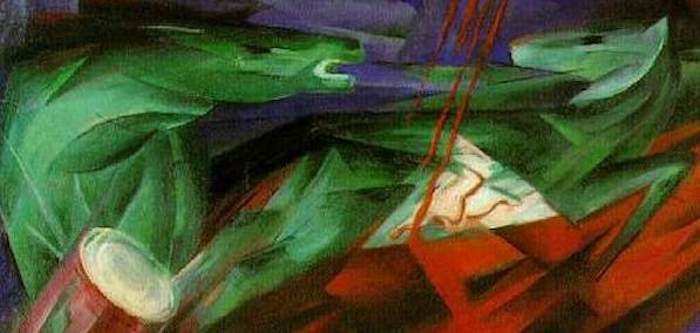
Claudius kept Hamlet from returning to the university at Wittenberg so he could keep an eye on him. I, however, left the South for grad school, Berkeley. Friends of mine who went to northeastern colleges in the ’70s told me Southerners got put on the stand, as had been happening elsewhere in the nation, though often it was a matter of de factos accusing de jures, whose method of dealing with race was to castigate the South. I went to California planning to drop my accent and keep a low profile, but also arm myself with arguments defending the place where, after all, I was born. You don’t understand, I was going to say—but how could I defend what I had criticized myself and couldn’t explain anyway? With those debates, the weighing of responsibility for a past I had rejected but still was part of me and had only imperfectly engaged, guilt lingering like a spectral mist. But really I argued with myself as my background seldom came up in the ’80s or later. For most Californians the South is a foreign place.

Berkeley did have its own refinements on race and culture couched in language that required an apprenticeship to understand, arguments that were intense and impersonal and unforgiving, abstract and self-reflexive, whose light left no shadows. What my years at Berkeley sheltered me from was how much the nation had changed in the way it saw itself and what it looked it, its ways of talking about itself. Reagan’s landslide victory over Carter, one of our own and a man of conscience, came as a shock. The presidential debate sets the date for me when public discussion lost traction. It is also the date I assign for our collective loss of memory.

With what ease he joined contradictions and deflected our anxieties, how much he put our minds at rest by ignoring matters like race and encouraging us to look elsewhere, how much he fed our need to feel good about ourselves, what a supernal shine he put on self-interest. He was the president of the fathers who were not our fathers.

And how easily the next thirty years slide away. I moved to Silicon Valley to teach, where the wonder of our devices fed itself with the belief they were transforming our lives, proof of which came from stellar advancements in their ability to process, to remake the process into new process. More self-reflection and self-referral, a looking forward without looking back. There I continued to drift in irresolution, carrying conflicts and anxieties that seemed necessary but had nowhere to ground themselves, feeling more and more out of place in California, the land of the laid back, where the people are relaxed and friendly—and coolly uncivil.

In the rest of the nation, the continued ratcheting of our distractions on our screens, a repackaging of the same stale ideas in our public discussion, the continual burying and forgetting. Now the impasse over Obama’s budget, that discussion, the leeching of the weal, another market slide. When I was in high school, one debate topic was whether 4% unemployment was acceptable. With the discussion, our faith in our markets, the push to feed them in spite of their collapses, the graphs that give no sense of a baseline, of economic reality, of material sanity, or of a bottom.

We are an OK people in an OK nation and everything is OK. We must protect our OKness at all costs, and when it is threatened we need to do all we can to prop it up. Then we realized we didn’t feel OK but didn’t know why, our discomfort compounded by what we had been told and believed, that we were supposed to feel OK about ourselves. Beneath our OKness and our doubts about it, what we had not looked at, assumptions unexamined, what was left unsaid, what had been allowed to grow.

The horror of 9/11 wasn’t that it came from beyond, unexpected, but rather that it gave us a spectacle of what we most feared at home ourselves and had been waiting for but could not admit, how easily our world could collapse. But we got the alien threat we needed, whose strange desert lands displaced us into a place we could act, whose strange people with their strange passions, familiar but not recognized, opposed and matched our own. The Afghan war was too quick, too easy, however, so we still looked elsewhere. We needed Iraq 2 to pump us up. And since we could not find Bin Laden, we especially needed that other face so hostile, so strange, yet so direct, so clear, so familiar though not familiar, a face to assault personally what had been too abstract and impersonal for us and too messy and too uncertain, that face inflated by our suspicions, by what had grown monstrous inside us, a face against whom we could fulfill what gnawed at us and remained unfulfilled, against whom we could finally exact our deepest desire—

As I felt myself, withdrawn and angry and conflicted and alienated from everything and myself, the need to strike out if not abroad then elsewhere, anywhere, really, everywhere, not just against virtual fathers who were not our fathers, but others, anyone, really, the need to get—

What is galling about turning the other cheek is that it exposes us, leaving us uncertain, freezing us in inaction.

What else is revenge but a way to prove we still exist?

.

This quarry cries on havoc. O proud Death,
What feast is toward in thine eternal cell
That thou so many princes at a shot
So bloodily hast struck?

Fortinbras of Norway has just returned and surveys the carnage at the end. The court of Elsinore has effectively been wiped out.

Who wasn’t relieved when the statue of Saddam Hussein came down?

Who was prepared for what followed the next eight years?

How many of us know the extent of the destruction, there, here, the number of dead, or cares?

But now the credits run and the lights come on at the National. I blink, we adjust our eyes, watching emerge faintly the faded patterns and tarnished glitter on the walls, thinking about returning home.

What Hamlet was to Shakespeare’s world I can only guess and never feel. Did it show the widespread effects when those on high were corrupt and threatened the natural order? Or was order the illusion Shakespeare created to reveal by contrast the contradictions, the possibilities of disorder and desperation, of corruption, there at the Danish court, anywhere, to which princes and queens and kings were not immune?

If not then, the latter has to be the case for Hamlet now. We cannot project a world and hand it off to those above us. Our Hamlet throws us back on ourselves. But it had to be exhilarating then as it is now to have the scaffolding collapse and see the world so thoroughly shaken. The power of the play is not in what it resolves but how much it contains without resolving, how much it raises and takes away, how much it makes us doubt.

Enough, at least, to give us pause.

It is also a play that exercises our conscience without letting us rest with easy—or any—answers. Hamlet is not a fiction about revenge, but a fiction about our fictions of revenge, which it teases us with and frustrates interminably, and however strong the personal urge, the felt rightness, we see what happens when those fictions get played out on a larger stage.

Moments earlier, the stage littered with corpses, the Burton Hamlet, himself at the point of death, stares at Claudius, whom he has just dispatched, and laughs, in fact chuckles. I suppose it is an expression of contempt for the pathetic king, but the escape of humor opens up something else suppressed throughout the play, the laughter of absurdity. Revenge, like the play, is darkly comic. Because Burton next delivers his last line with the thought that terrifies us all with its laugh, that the rest is silence.

We admire Hamlet for his ideals and noble character, his aspiration for something higher, or its illusion, still attractive, but what draws us is that he can act and does—eventually—while we have to hold back. It’s his humanity, however, with its passions, imperfect and unruly, that binds us to him, humanity in all its contradictions, most in its resistance to our definitions. Yet if we have been paying attention, we have to confess he has been rather sloppy. Directly or indirectly he has left a trail of dead. He unhinges Ophelia with his madness, and his slaying of her father, unintentional but rash, finishes her off. He is especially cavalier with his sentence on Rosencrantz and Guildenstern. To say he gets caught up in circumstances beyond his control, that he, too, is a victim of the corruption, makes him a mere agent, a thing.

I have been careless myself.

Only now, after thirty years in California, do I miss the Carolina accent that embarrassed me for so long, its modulating vowels that take two beats, its flattened consonants, its lingering, guttural ars—sounds unstudied but cultivated with fondness, a voice that takes the edges off, that does not try to assert with plosives or separate or distinguish, but join. I cannot recall meeting a cruel or indifferent person there, black or white.

My father was not a king or a bad king, but he was a good man. I condemned his reserve because I knew what it held back. What I did not consider was what his reserve kept him from thinking, from doing—or what else it kept alive. Finally I have come to understand in my life its necessity—reserve is another requirement for sanity—and even its virtue. When he was a boy growing up in a small town in South Carolina in the ’20s, the Klan marched in the holiday parades, as they did in Washington and throughout the nation, not in anger but as an open display of civic pride. That was his world, and ours. Maybe the Klan even gave the town what it lacked, some mystery, a twist of the exotic, a flash of spectacle.

His parents did not have much money, but somehow his mother saw him through college in Spartanburg, where they then lived. To help make ends meet, he got a job at the local theater, taking, tearing tickets, which is where he made his start. After the war he was offered a position in the chain and was glad to get the job. He stayed with them for forty years. Only late in his life did he tell me when young he wanted to go to New York to do what he didn’t say.

A few year after my father died, my mother sent me a stack of letters from lawyers in New York, dense with legal language. Lowes Cineplex, the corporation that then owned his company, was going bankrupt, the term set so it could be absorbed by another. She was worried about her retirement check. It wasn’t much, but it was all that remained of his years of loyal service, so I spent weeks trying to sort it out, phone calls that shuttled me from one office to another without getting any answer. I finally found out from one of my father’s former managers that that her plan was vested.

We lost interest, the palaces and temples decayed, their balconies and back stages and prosceniums and niches and trim and flourishes were razed, their theater organs sold or trashed, making way for the suburban boxes that spread further out, in malls, out by highways, out nowhere, worlds unto worlds unto worlds unto themselves, like cells their screens splitting, where play the revenge of our abstractions, our abstractions of ourselves. I searched the bankruptcy notice to look for my father and couldn’t find him. I later learned that Wilby-Kincey, who first hired him—he always spoke highly of Mr. Kincey and knew him well, in fact was in line for succession—had merged and changed names again, then was absorbed by Plitt Southern, whose name I saw in tiny print in the list of companies Lowes was turning over, some 250 of them, corporate containers representing all those boxes, tens of thousands. . . .

.

.

.
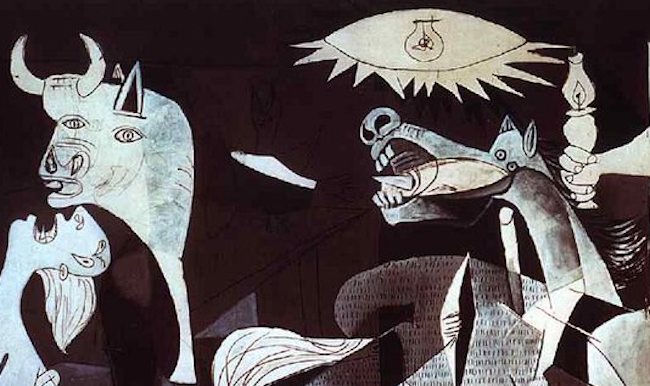
Under the rainbow: capitalism/the subprime mortgage crash

One Sunday afternoon some years ago, run down with life, I fell asleep watching a football game, the game itself a low-scoring grind in which I had little interest. When I woke the game was over and I was looking instead at two gentleman, not tall at all, both gracious and reassuring, showing me their yacht and cars and palatial home, which dwarfed them, telling me how easily I, too, could have these things. They had to have been the Rice twins, John and Greg, and what I was watching was an infomercial hawking the Cash Flow Generator, a scheme to cash in on the housing boom, though specifics were never mentioned I suppose because that would have dispelled the magic. I was still groggy and in a mood, like all of us then, to be entranced. I thought I had awakened on the other side of the rainbow. I have a very modest income from teaching and live in a rental in Silicon Valley, one of the most expensive places in the country. Obviously I had done something wrong to be in such a position, but watching the twins I felt the problem wasn’t that I didn’t work hard enough or hadn’t made the right decisions in life, but that I was just being obtuse. There were real opportunities out there and all I had to do was make a simple call. For it was the time of our other national pastime, flipping houses, and seeing the twins was one more piece of evidence confirming my suspicion we weren’t in Kansas anymore.
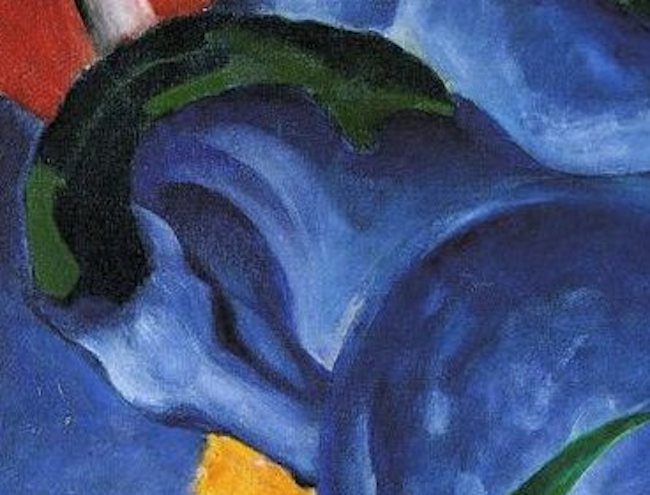
A few years later, we were all looking at the other side of this curve:

The Dow Jones.

Continue reading