Max Schmitt in a Single Scull, Recent Thoughts

November 2016

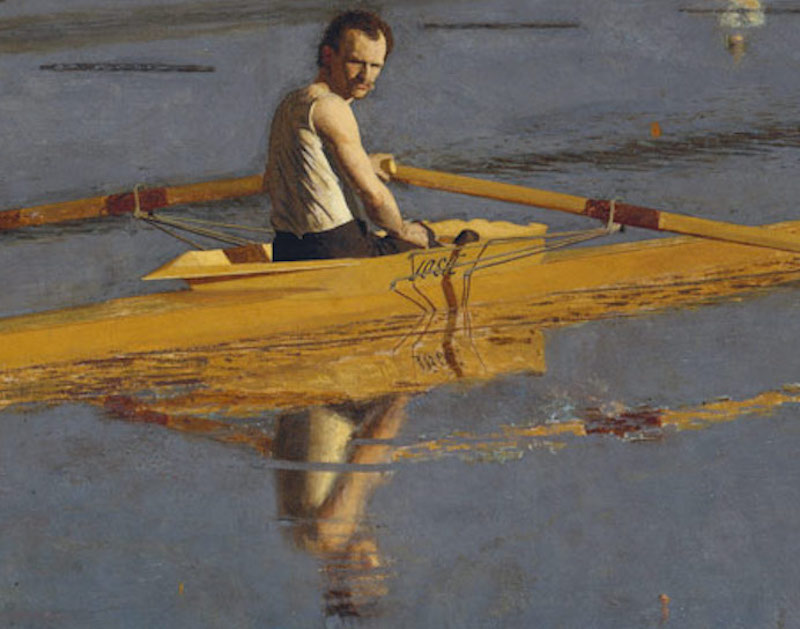
Max Schmitt and his reflection have been with me some sixty years, almost my entire life. I first saw him as a child, browsing through the only art book we had on the shelves, Modern American Painting, by Peyton Boswell, Jr., published in 1939. My mother’s influence, but perhaps my father’s. Schmitt gazed towards but not directly at me, with a look that wasn’t recognition or identification yet which made contact and left an opening I haven’t yet closed. With the opening, a proposition that I couldn’t understand then but may have felt, or maybe just a simple statement I still don’t wish to refute. I bought a print some fifteen years ago and he has been on a wall as I’ve moved around the last years, a protracted season of dislocation.

The painting is Thomas Eakins’s The Champion Single Sculls, also known as Max Schmitt in a Single Scull, completed in 1871. Click the image above for full enlargement. Schmitt, a friend of the painter, was Philadelphia’s single-scull champion several years. Rowing was popular then, and he was a well-known and well-loved figure in amateur sports across the nation, forgotten now. But I did not know that until much later, nor does Eakins show crowds teeming on the shores cheering him on at the height of victory as he crosses the finish line. He doesn’t even show him demonstrating his strength and skill executing a hard pull on the oars in tense, charged exertion. Rather he presents him dressed in casual gear during a practice session on a crisp autumn day, by himself, in a nearly deserted scene made luminous by a clarifying late-afternoon sun. Schmitt has just made a turn on the Schuylkill River and now relaxes, the wakes from his scull and oars leaving broad trailing curves that take us into the painting and set its composition, giving it its energy. To me, for so many years, he was only a man named Schmitt and he was just there, resting above the still water, looking out, balancing the oars in one hand, which more and more I realize is a marvelous feat.
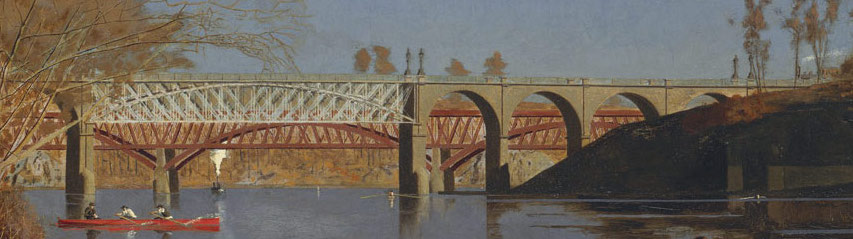
The bridges are rendered in sharp, accurate perspective—Eakins was a master of the technique—but other painters had already begun to flatten space and dismantle it, taking art in rapid acceleration on an unknown path. And we see on the horizon the developing technology of the time, the train about to cross one bridge, a steam boat to pass under, this when our technology was taking off, with it, our mounting wonder.

Nor does Eakins show influence of the Impressionists, who had already begun exploring the transience of light and stating the primacy of paint, of colors. Above, Claude Monet’s Bathers at La Grenouillère, painted in 1869.

There is no evidence Eakins even visited the Salon des Refusés, and he had his chance. He was in Paris at the time, studying under Jean-Léon Gérôme, an academic painter who enjoyed considerable popular and critical success, for example with his Ave Caesar! Morituri te salutant (Hail Caesar! We Who Are about to Die Salute You).

Eakins has done nothing to alter the esthetic course of art or change our perceptions. He presents the world as solid, and academic rigor anchors his work. Yet the painting is alive, in the shimmering blur of brush along the shore, the erratic reach of the trees, the brisk scrape of clouds above. It succeeds at what makes any work endure, working within a form and giving it life and expression. I have never tired of looking. Each time it is fresh and vital.

He does make a break, however, and it comes from his subject matter, which was rejected by the official salons of Paris and shocked established Philadelphia. He has given us a common man not posing but relaxing in informal clothes, performing an everyday behavior without ceremony, without appropriation of past claims and pretense, in an ordinary place without hierarchy of space or institution. We have begun to look at ourselves and it is liberating.
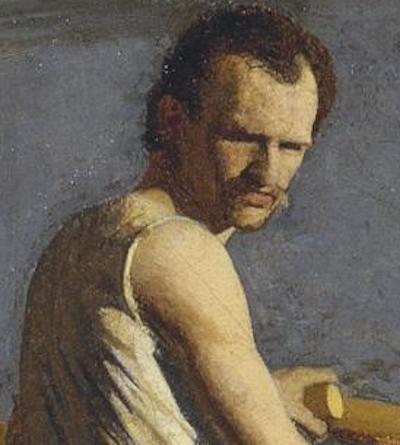
Perhaps Schmitt is looking at someone on the shore, perhaps he is taken in a thought, or perhaps he is deflecting one. There’s a severity in his face and he seems to scowl, but he’s only frowning in the glare of the sun. His look did not put me off as a boy and must have instilled this note back then, that whoever, wherever we are, whatever we hope to be, we need to maintain vigilance, skepticism, and a measure of reserve.

Really, Eakins doesn’t give us much to identify him as an individual, but his portrait is made in the whole landscape, of which he is a part but where he keeps his separation. There is light. And there is transcendence, but where it takes us is back to exactly what we see, the clouds, the trees, the brush, the trailing curves in the river, and Max Schmitt resting above still water, looking out, balancing oars in one hand.

I have looked at the painting several times this past week, the week of election, for confirmation, or reassurance, or to restore a definition, and I realize how the painting has always stood for me, that it shows me what it means to be American, vigorous and assertive yet relaxed and open, and free of historical encumbrance; self-assured but not self-possessed and not afraid.

Failing that, it is a picture of what it means to be alive, to be oneself by oneself, and not be alone.

There’s a kind of idealism in realism, or can be, a belief that the simple fact of our existence is worth stating and preserving.

.

.
Melancholia

We…advocate that melancholia be positioned as a distinct, identifiable and specifically treatable affective syndrome in the DSM-5 classification.

Melancholic patients respond better to broad-action tricyclic anti­depressants than to narrow-action antidepressants (e.g., serotonin uptake inhibitors). They respond well to ECT. In comparison to those with nonmelancholic mood disorders, melancholic patients rarely respond to placebos, psychotherapies, or social interventions.

from “Issues for DSM-5: Whither Melancholia?”
The American Journal of Psychiatry

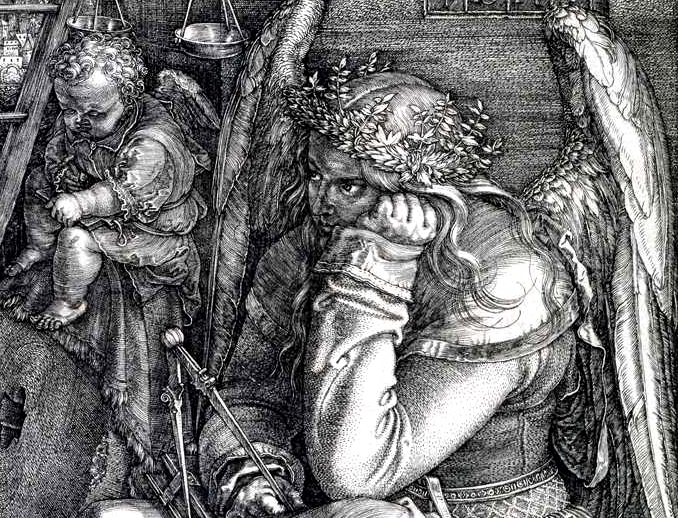
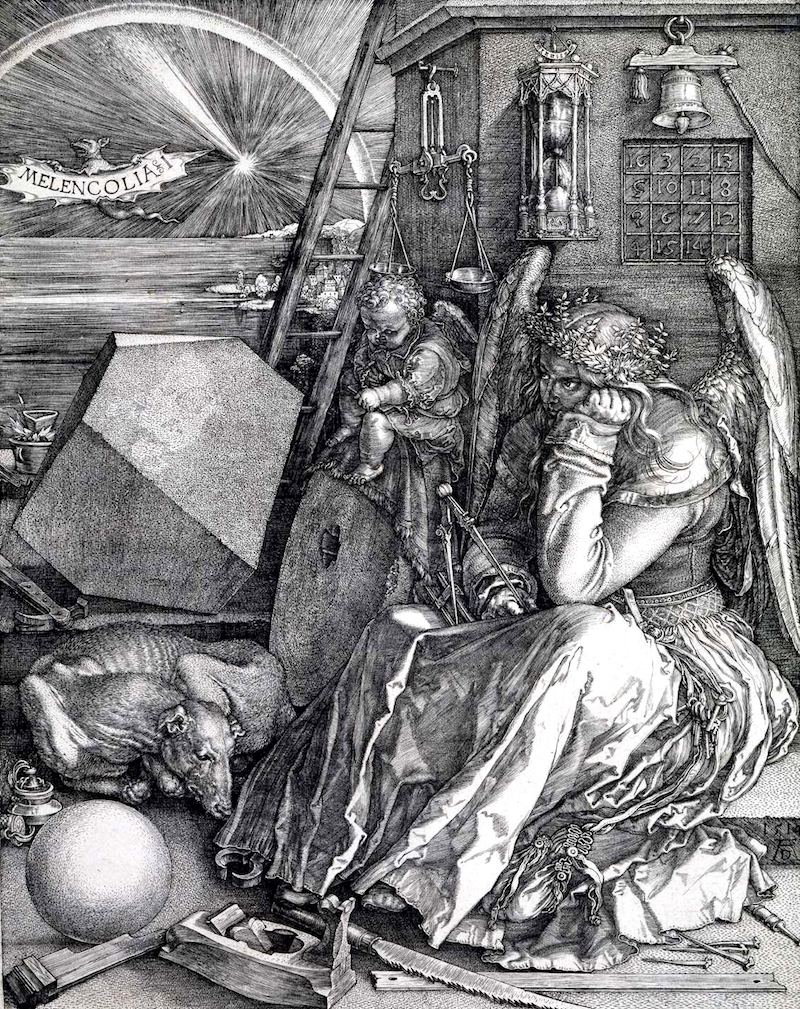
Dürer’s engraving Melencolia I draws from the theory of humors that goes back to classical times, where states of body and mind were determined by four essential fluids. It once was the basis of medical practice and found widespread cultural representation. Balance of the four brought health, but that was an ideal that we could not always maintain, or that not all of us could not find, or, in Christian times, a perfection none of us could reach at all since and because of the Fall of Man. A predominance of one in excess led to pathology, but in lesser amounts set phases we all went through or determined different personality types among us. I regret loss of this system, as it gave us variety and cut us some slack. Moody was something we could be. Today our vast catalog of mental aberration depends solely upon the empty term “normal” that is defined only by what it is not, that denotes a state that is a balance of nothing. Yet we stray from it at our peril.

Black bile was the fluid of melancholy, which brought lethargy and stinginess. The melancholic was the most dreaded of the four personality types, as surfeit could lead to insanity and even death. Its representations, a grim miser clenching his purse, an indolent woman asleep at her spinning wheel, were sedative expressions that suppressed that fear. And intrigue—madness and death have always had that pull on us. Dürer’s figure, however, is not a common person but a winged angel, intensely alert and deep in thought, surrounded by the elements and tools of creation. Dürer has given us a picture of the artist, and in her face we see the power of her potential. But the tools lie scattered at her feet, untouched. She is grounded, locked in thought, does not fly, does not create, while in the background a comet flares and a bat cries terror. The dread has been released in a scene of darkness and disorder. I’ve had a print on a wall for decades, and every now and then I look at her for inspiration. She does not look back. This is as it should be.

Perhaps her block and the disarray show the broil and fruitless mulling that precede creation. But according to Erwin Panofsky, in The Life and Art of Albrecht Dürer, from which I take my material, that work will never come:

Hers is the inertia of a being which renounces what it could reach because it cannot reach for what it longs.

The artist is limited to the visible, what can be shown, what can be represented, and is removed from higher thought that might transcend, from the light of divine understanding, always beyond us.

But Dürer’s stalled angel also gives us one of the most compelling images of the artist we have. A picture that shows failure to create is a complete creation itself, consummate and marvelous in its workmanship, its expression. The midnight figure is bright in contrasts, the whites of her eyes against her somber face, the luminous folds of her robe against a darkened space. A scene of inactivity is charged with dynamic, in the energy of her arched wings, the push from the outlines of the many shapes, in the spiraling line of composition that runs from the eyes of the bat through the eyes of the putto, of the angel, of the sullen dog.

There is no contradiction in any of this, as there are no contradictions in art. Nor is there irony, as we see exactly what we should expect. We are shaped by our conflicts and contradictions, our reaches, our misses, and our doubts: these give us life. And the failure to represent the divine visibly points all the more to its invisible presence. It is our balanced, symmetrical representations and our clear resolutions into action that are ironic because they always fall short of our desires, of our projections, and they touch a different kind of madness.

The engraving is built on a correspondence of symbols based on theology, philosophy, and common understanding that connected the universe from the material to the celestial, that ran deep in Dürer’s culture. The four humors “were supposed to be coessential with the four elements, the four winds (or directions of space), the four seasons, the four times of day, and the four phases of life.” His angel, holding a compass, beneath instruments of measurement, echoes a prior woodcut “Typus Geometriae,” a woman representing geometry, the study that in the Renaissance was the foundation for creating art and understanding the structure of the world. Saturn, the original creator, inspired geometry as well as fueled imagination with furor melancholicus. The dog and bat were his. I won’t develop all the sources and connections, however, because I’d only repeat what Panofsky has so thoroughly and beautifully written. Also we know today none of the assumptions and correspondences are true.

But what we know is false now wasn’t true then, yet still we have Melencolia I, who still holds us captive. There’s a paradox here that needs to be sounded. If we reject the divine, and we have, we need to replace it with something else. Our lives, like our art, depend upon how much we can draw from within and reach without.

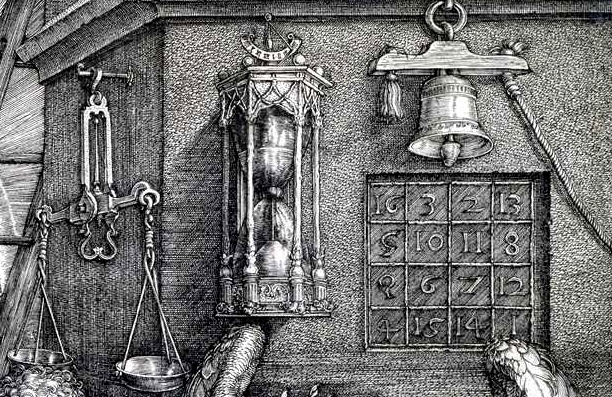
I will leave the magic square and the devices for measuring weight, time, and space hanging on the wall and ignore them. Mathematics, like our logic, we now know talks only to itself. They will also serve as reminders to deflect a world that cannot tolerate imprecision or imperfection, or indulges them too much.

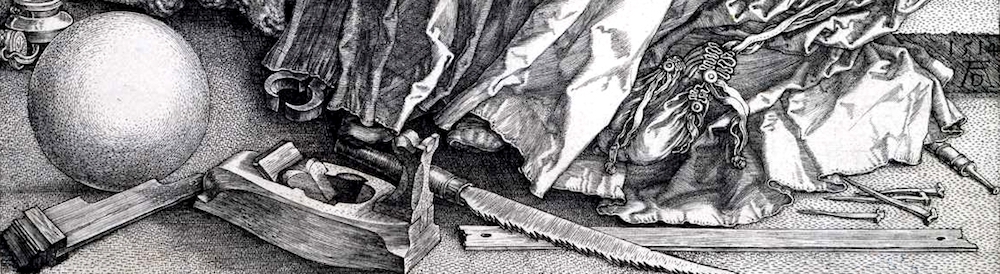
I will keep the tools on the floor because I still have dreams of constructing and peopling homes and cities and worlds. But I will add a jackhammer and wrecking ball to test their strength, or demolish the facile abstractions that now surround us or any I might create.

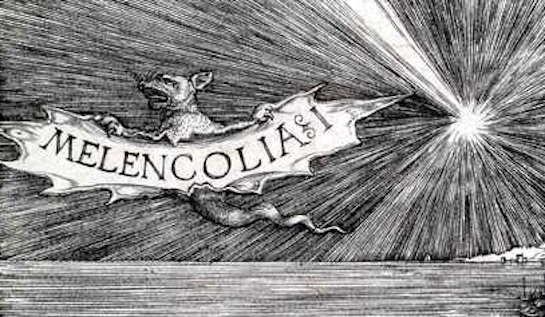
The bat stays where he is, soaring above a leaden sea, who will scream my every waking minute to help me maintain vigilance, see terror overlooked, or induce it when I fall complacent.

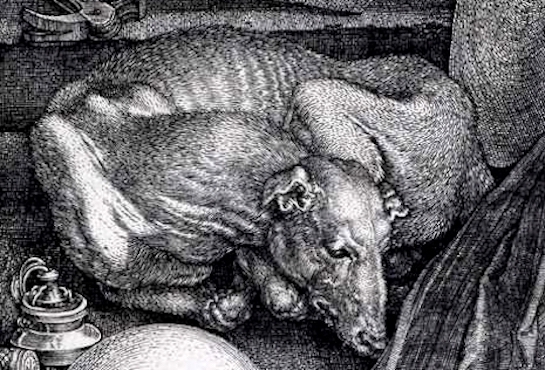
I will get a dog, lean, clenched, and perpetually morose, and have him lie at my feet to anchor my flights.

And I will ponder my next project, moved by what is not there, what might be, what always never will be. Or let my amanuensis putto scribble away idly while I brood in dark brilliance and do nothing.

.

.