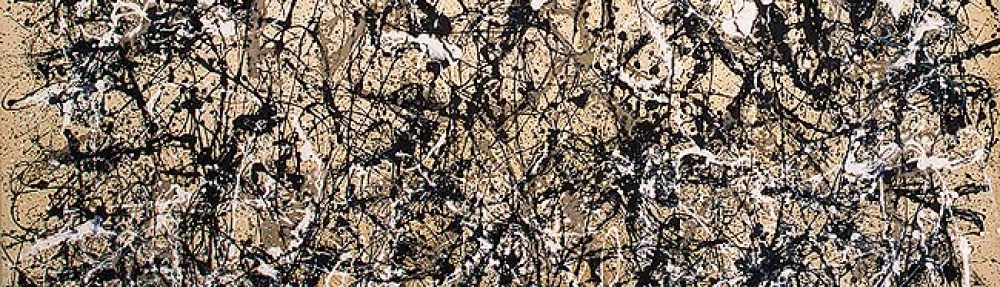
Autumn Rhythm / 2

.

When I am in my painting, I’m not aware of what I am doing. It is only after a sort of “get acquainted” period that I see what I have been about. I have no fears about making changes, destroying the image, etc., because the painting has a life of its own. I try to let it come through. It is only when I lose contact with the painting that the result is a mess. Otherwise there is pure harmony, an easy give and take, and the painting comes out well.

The focus on profit margins is encouraging, but it is not clear to us that the environment will necessarily offer the volume opportunities at above-current marginal spreads to afford both higher margins and bet­ter earnings growth. Return on assets can be improved by reducing low margin assets but perhaps also shrinking absolute earnings dollars. Our modeling suggests . . . .

Such ease in the words of the freak who flung paint, such torture in those of the straight who studied the easy flow of money. As if Pollock had discovered what my brother was still struggling to find in whatever they both had before them. Then again, I don’t know what price Pollock paid to get there or how it paid off when he arrived, if he did. And maybe there’s a joy in wrenched syntax and forced diction, and agony in the harmony of give and take.

I suppose it depends on how the words are read.

When I am in my painting—what kind of emphasis on “in”?

The focus on profit margins—where, if anywhere, to put a stress?

But however you read them, where is the painter or my brother, much less a person, in what he said about his work?

Then again, maybe discovery is not the point.

No fears about making changes, destroying the image, etc.—what then is the purpose of the image?

What is left when that is gone?

What else is he not afraid of doing?

The focus on profit margins—what is the picture here?

What image has been destroyed?.

What is one aware of when one is not aware of what he’s doing?

.

The focus on profit margins—it was about the only thing I could find in the apartment that had his name on it, a rough draft of his last report. But when the reports got printed, the name of the guy who ran his group went to the top of the cover page and my brother’s fell to the bottom. So it goes, he once told me, but it was something else that bugged him about the job.

It’s Saturday, my brother’s gone, and in the flat, sober light of a gray winter day, I’m going through his things. And twenty years later, in the gray light of a dead brother, I’m going through his things once again, using whatever I have picked up along the way. Then I thought I was trying to help. Now I’m just try­ing to figure out whatever needs figuring out.

Also, it hasn’t been easy living without a brother.

The place felt empty when I first woke up, late, after a night of dreams that left no trace. Nor was anything left from the dizziness of Friday night, the lever­aging of debt and its incomprehensible correlates, other than a dull ache that felt like a hangover. I had to think what I was doing lying on a sofa bed in the middle of a living room where nothing looked incredible. Then I saw the glassless mirror over the bookcase, then I looked outside.

Out the living room window, when I raised the blinds, the scratch of random street noise, an overcast sky without texture that looked cold but didn’t look like it would do anything. Below, a courtyard, also empty. Weeds, dirt, and scabs of grass; concrete and scattered trash. Rising from the center, a single tree, tall, with wide spreading limbs, its branches not just leafless but black, making me think it might be dead or dying instead of resting up. Still rising, enclosing the court and tree, the wings of his building, a symmetry of hundreds of identi­cal windows. In the windows with opened blinds, no one and not much I could see. Across from me, a different symmetry, a different identity of different win­dows on the featureless back of another apartment building. Further off, not seen but what could be imagined, more buildings, more windows, more identi­ties and symmetries, more structures of glass and steel and stone and concrete not holding anything I could tell yet defined by the lines of street maps and blueprints and diminishing designs and purposes, receding in the narrowing plan of sight—

More New York.

Somewhere in the grid, my brother.

He must have gone to work, I decided, and then found the proof. In his bed­room, a dresser drawer opened to stiff, white shirts; on his bed, above a moil of sheets, a light blue shirt and a dark suit, crumpled, like corpses—the clothes that lost the fight. In the bathroom, the signs of the labor of preparation. In the sink, scattered hairs and stubble that didn’t get rinsed away. On the mirror—this one survived—a few flecks of foam and dried spots of water, body oils, and other fluids. In the air, the sweet, sick smell of toothpaste and aftershave.

For all I knew, he told me he was going in last night. Still, it upset me he’d leave me alone after just flying up, not for my sake but his. This suggested blindness, and something else as bad. Nor had he gotten much sleep, or may not have slept at all, which, along with whatever put the pain I saw on his face, or even the bliss if bliss is what it was, couldn’t have left him in any kind of shape to do what he thought he had to do.

Maybe all that talk had led to some revelation, some resolve, maybe he was still on a roll and riding it out. Or maybe it set off a shock and he realized that ducking out two weeks was all he could get away with, so he went in on a Satur­day to make a start before he had to face the brass. The most probable explana­tions, however, also seemed the least likely, and the only conclusion that made sense to me that morning was that by going to work he was either further avoiding his problem or plunging deeper in it, either way making it worse.

But maybe he was only doing what I hadn’t yet learned that we all do and do for no good reason, whenever, however we have to, getting on with his life. What also didn’t occur to me is that I might have been a cause. Someone got heated about something Friday night.

I started to call to make sure, but saw in the hall, above the table and phone, another glassless mirror and decided against it. Better to leave him alone. Besides, we still had time to talk later, I thought. But without any idea of what was going on, I wouldn’t know what to say. And the day would wear hard on him. No telling how he would be when he returned, or where he’d go from there. Before we talked again I wanted something concrete and coherent, the evidence of things and their patterns, so I began my search.

Whatever caused him to smash mirrors made me dread what I might uncover, yet persuaded me all the more of the necessity to find it. Because there had to be a problem. If not, why had he called me, why was I there?

Because I believed there had to be good reasons.

With the dread and necessity, and more compelling than either, still the wonder, a fascination at what it might be, the problem, which, after the dizziness of Friday night, had to be strange and deep, the fascination itself, however, not weighted or obscured by the morbid or even strange, but suspended in the transparent, unafflicted lightness of the reason behind reasons, self-evident and self-contained.

Because I wanted to believe something.

What do I want to believe now?

His things:

In the bedroom, which I thought the best place to start, the bed, the clothes again, and a dresser, the dresser an old piece with ornamental pulls, given by the parents years before to help him get set up. On top of the dresser, an alarm clock, loose change and subway tokens, and a hand-carved box filled with more change and tokens, a few stray bills.

In one corner by the window, weights and an exercise bench, dusty. On the wall facing his bed, his office—a filing cabinet and a large desk, modernish, not cheap, but nondescript; not dusty. On the desk, his computer—he was the first person I knew to buy one. In the desk drawer, supplies and a scientific calcula­tor with a multitude of functions. On the floor and desk, notepads, print-outs, computer manuals, business journals, and memos from the firm, in stacks. On top on one stack:

The focus on profit margins—

That report.

Not far from the desk, a chess table. On the chess table, chess pieces, a game that look half played.

Hanging in the closet, enough dark suits for a boardroom, pinstriped, plaid, and plain; a sweat suit, not much casual. On the closet floor, the dark glow of dress shoes, most black; one pair of tennis. On the shelves, sweaters and boxes of things of marginal use that defied classification but looked innocuous.

Inside the closet door, an empty full-length frame.

In the living room, the living room furniture, pieces too basic to even be called modern. The TV on top of a cabinet holding his stereo and records. On the floor, the oriental rug, an arabesque of tiny patterns floating over a field of deep red. On the wall across from the window, the bookcase; in the bookcase, books. Above the bookcase, the living room broken mirror, cherry framed, twin to the one in the hall—also the parents. Next to the sofa, the dead fern, if a fern is what it was.

Not seen in the living room corner next to the bookcase, not seen because not looked for, not looked for because not thought about, not thought about because not thought any longer to be there—the Buddha.

I’m beginning to doubt the fern was there as well.

No booze in the kitchen, though everywhere the emblems and parapher­nalia. In one cabinet, a cocktail shaker, an earthenware sake set, and crystal glasses, shot to wine; on the counter, a small wine rack without wine; in one drawer, a strainer, stirrers, and other apparatus, some plated—or sterling for all I knew—and cardboard coasters advertising beers from around the world.

Also in the kitchen, an incomplete set of plain dishes, silverware not made of silver, a few pots and pans, kitchen gizmos, and a complete set of German knives, razor sharp. A Cuisinart, in the box. On the refrigerator door, a calen­dar without any days marked. Inside the refrigerator and cabinets, several bags of coffee and a carton of cigarettes, not much food. On top of the refrigerator, a Glenfiddich can, heavy with more subway tokens and quarters.

In the hall, a mahogany dining room table resting on literal feet and actual claws, its leaves folded, with two ladder-back chairs tucked in—as ever, the parents. Below it, a foot of New York phone books; on it, the phone, an address book, and Fri­day’s Times. And again, above the phone, looking at the front door—or not—the hall broken mirror, the one that made me decide earlier not to call.

None of which told me much except that he worked a lot, lived a bachelor’s life eating out, though may once have given cooking a few abortive shots, was not that concerned about the things around him, and though he had let his exercise regimen slide, he otherwise kept his life in order. Which together seemed odd to me then, yet only odd. And several years later his lifestyle didn’t seem odd to me at all. It fits into a familiar pattern.

Also that he was, in fact, on the wagon, which didn’t tell me anything. That he kept the booze equipment suggested he wouldn’t stay on it long, as if it were waiting there for his fall. What disturbed me more was that he had so much—but I was living on a beer income at the time and didn’t know he just owned the basics. Besides, it was among the best stuff he had and he wasn’t one who threw things out without cause—

No booze.

This did seem extreme and still does, his getting rid of it all, as if he had pushed the spring too far and it was only a matter of time before it snapped back. Then again, there was the AA pledge, if he had made one. But the absence of alcohol revealed nothing about how much he drank before or whether or not it had gotten the upper hand. Or how far he might fall if he stepped off.

Saturday night—

I’m still not ready for that. Yet now I’m not sure he fell that hard or even fell at all, or if he did, that he didn’t fall some other way. Drinking soon became a moot point anyway, because it wasn’t long before he had to quit. I still don’t know where to put him in relationship to substances or on which side he belongs, the league of those who abuse them vs. those who don’t.

The AA business from Friday night, whatever it was, still haunts me—but I didn’t find anything from them, either. Then as now, whatever his habit or conversion, I could only believe that his drinking or not drinking, whatever drinking or not drinking meant, if they meant anything, may not have meant anything in themselves but were symptomatic of something else I hadn’t found, what had driven him to drink in the first place and away from it in the second, if he had been driven either way.

Yet I hadn’t found any evidence he had gone overboard anywhere. The mirrors—but there were no other signs of distress or breakage. I did see a faint trail of blood leading into the bathroom, but it was mine, left over from cutting my toe the night before. I immediately cleaned it up. More evidence, however, that the mirrors had in fact been smashed.

So I went back through the rooms again, this time looking more closely, dig­ging deeper. I did want to respect his privacy and not pry too far into those small, dirty recesses of life we all have, which are disturbing only when brought to light. But I needed to find something definite, and I think my hope was to find quickly just enough to work from for our talk when he returned. Not find­ing anything convinced me all the more that what I was looking for was there, as well as won­der what obsession had buried it. But as I rummaged through draw­ers, flushed out corners, and looked underneath anything that could be lifted, I felt a mounting dread and awe, both chased by the guilt of violation.

Now, just the guilt.

The filing cabinet, which I avoided on the first go-around because I thought it would be too private, had only business business and personal business, none of the latter very personal, none of either accounting for anything beyond what I knew and had already seen. Employee material and his yearend reviews, positive yet formal. Warranties, receipts, and credit card and bank statements, a huge line on the card, not put to the test. His savings not as healthy as I thought it would be, but then I saw his lease and taxes. Still, healthy enough, and never tapped. A fat life insurance policy, probably gratis from the firm; a will without drama, probably written only for an unlikely event. Letters from the family, col­lege friends, old girlfriends, even a few letters I wrote from Paris—people asking, telling people how people are doing, all the questions and answers as pro forma as the rest.

If I looked and she existed and there was a follow-up, no letters from Ms. Mascara.

In the stacks on, by his desk, still just business business. I tried to read the computer manual to figure out how to open his disks, but soon got lost in the instructions. The titles on the floppies, however, only referred to what had been printed out. I punched a few buttons on the calculator and hit a function, which returned an irrational number.

On the bedroom side of the bedroom, I looked at the box on top of the dresser again. Its simple yet rough, deeply cut design didn’t suggest anything except that it hadn’t come from the parents.

Inside the top drawer of the dresser, pens and cufflinks and other accesso­ries; a pool of more change and tokens, and many floating bills. Clothes in the other drawers. Under the clothes, more clothes.

In the closet, a few small things that had slipped through to the floor, all of marginal utility or ambiguous worth, none remarkable or personal, probably forgotten.

The game on the chess table: No one had the advantage, as best as I could tell.

In living room, in the stereo cabinet, the stereo and records with frayed jack­ets. Monk, Miles Davis, Coltrane, etc., the less commercial Getz; the Beatles, the Stones, not much other rock; a smattering of classical touching the major periods—leftovers from college days.

On the bookshelves, mostly books on business, weighty volumes with fac­tual titles and stark covers. Several feet of thick binders with reports from Standard and Poor’s, Barron’s, and Moody’s, a few inches of his own that had been bound. Samuelson, then other economics texts more specific and more difficult, thousands of pages of dense, small print and graphs and tables, but no metaphors or illustrations. Making some kind of transition from business, maybe, calculus and statistics texts. Next, however, mystery from the East, The Art of War and the I Ching, which seemed out of place and made me question what followed: games—studies of bridge, chess, and poker; the Rollo May and Norman Brown and Monod, and a few other science and psychology books trying to put it all together, maybe not enough; self-help books on exercising and controlling one’s weight, on how to quit smoking and drinking, the latter not from AA but factual and matter of fact, and dated and unread; a couple of guidebooks to Manhattan, with places where one can smoke and drink and eat. No lit, however. Only detectives—the classics, Chandler, Cain, Hammett, and even Himes, and a long run of a series by some new guy whose work, from the covers, didn’t look so classy.

I went through the titles twice, top to bottom then bottom to top, trying to distill something from their arrangement, each time getting stuck on the Sun Tsu and the I Ching, and had to leave the shelves.

The fern by the sofa, if it was a fern and was still there, was still dead.

If it wasn’t there, however, it still was dead.

In the address book on the table in the hall, a perfect correspondence with the names I found in the files, names added over the years, their addresses and numbers revised, written with different inks and in a similar and familiar hand only slightly different in time without any decline in legibility.

In the bathroom, in the medicine cabinet, the usual stuff for aches and strains. Over the bathroom mirror, a fluorescent light that buzzed loudly, which I hadn’t noticed before.

In the coat closet, coats.

In the linen closet, linens.

In the kitchen, a few more booze items in out-of-the-way places. In the cabinet under the sink, a trash can without much trash, a few household tools, and a cockroach trap. A few cockroaches, not dead.

Here and there, more loose change.

All of which told me a lot without telling me anything more or different. I still hadn’t found what I knew had to be somewhere, though I was running out of guesses as to what it might be. Instead I found more of what I couldn’t find because it wasn’t there.

Lots more booze not there, an amount that now seemed inordinate.

No statements or annual reports from his own investments, I assumed because he didn’t have any—like booze, another absence. This surprised me, but again struck me as nothing more than odd. Given what I know now about the market then, it could have been a sign of sanity.

Both gifts from girlfriends, the fern and the Buddha, there or not, either way marked what also wasn’t there. Nor did I see any other gift, evidence of any sof­tening or disruption in the apparent order of his things, any point where his emotions might have welled one way or the other—a vase, a silk shirt, a framed print of an Impressionist painting or of something expressionist, sharp and sour yet still tied to some affection or other binding passion, no object of any sort, whether painted red or blue or not—except maybe the box on his dresser, but it looked too removed from anything that might have come from the heart. No one was in his life; my brother was alone—this was the thought that sank in that day, sank in and kept sinking, yet which, like the absence of booze, led me nowhere. But again I could only conclude that this absence, like the booze, might not have meant anything in itself but still was symptomatic.

Yet he could have been between relationships, taking a break. As hard is it is for me now to imagine his ever settling down, I wasn’t close to ready myself then, or at his age, or even several years later. He still had time, or would have. Perhaps, as might have been the case with investing, he was simply saving up for something good. If anyone was lonely that day it was me. I couldn’t fit myself into his life, or at least the one I saw in the apartment, which may have kept him com­pany well enough in a meantime. What I remember more is wishing he had saved a few beers.

At least I didn’t find numbers in his address book to call just in case, a relief. But as much as I didn’t want to see them, it also bothered me that I couldn’t find any texts from the liturgists at AA, and for these I looked the hardest. His spiel, those convulsive tales of drinking the night before should have materialized into something. Whether he hit the sauce too hard or not, AA meant something I am still loathe to consider but has to be explored. Yet what I most needed to find was what I couldn’t find most, tangible evidence that he had moved from reason, much less flitted somewhere above it. The only result of my second search was that I felt worse about what I was doing, though not as bad as now.

Those books—but Sun Tzu I know now was a fad on Wall Street, the I Ching everywhere else, though I think he got to both early while they still were fresh.

The mirrors—yet they no longer looked strange and I began to take them for granted. What grew to clinical proportions, however, was that which had been preserved and stared me in the face almost everywhere I went, yet also, like the mirrors, returned nothing—the evidence of his work. The tools on his desk, the uniforms in the closet, the tokens that got him there and back. It was as if work had taken over his life, was even crowding him out of his bedroom, even away from sleep—

But I know now, as do we all, that bringing work home is not something that can easily be avoided.

Still:

The focus on profit margins is encouraging—

and all the notes and memos and letters, and the thousands of pages of journals and reports and books, all those words and numbers. The writing was so foreign to me that if he had added anything with his own words to what already been said, I wouldn’t have understood it—and probably couldn’t now. Yet the language of his texts didn’t look different from the firm’s or that in all the other texts, not different from words of the world of business. Not only did he not have much of a life outside the job, he didn’t seem to have one in it.

But I know better now. Following the forms and filling them out is simply a matter of survival, as much a way of preserving an identity as losing it. Still, there should have been something somewhere that showed his hand, or at least a dent where it had been removed.

The mirrors—

Then, back in his office, I stumbled upon these notes in one of the legal pads by his desk. On the first page:

On the next:

On the third, before blank pages:

I spent about an hour trying to decide what should be made of these.

The first page—what themes? The # of what? With all the abstract terms and abbreviations, it didn’t make much sense. Obviously, though, it was a flow chart of how he fit in the firm and connected to a world outside it. The next page seemed clear enough and potentially alarming, a stern critique of his habits and motivation, his conditional relationship with the others, the push to forge ahead nonetheless. The third was all too clear, a list of internal doubts, short and incisive. Beneath the structure of his work, insecurity and fear?

Yet after all he was an analyst and studying balance sheets is what he did. It is not surprising that he would apply the same scrutiny to his own account. Besides, we came from good middle-class people. We’re supposed to be consci­entious—and self-doubting. My list would be longer.

And what I now see in the notes is too familiar. The posturing, the planning, the strategies, the hedges; the creation of fronts to mark off territory, the maneuvering towards openings for attack—evidence of the battles that have to be fought to make it through another day at the office. It’s easy to see how Sun Tzu fit in with the other books. Maybe this is what wore him down, the constant struggle. I have only seen skirmishes; where he worked he must have seen war.

But when I read the notes in reverse order, the opposite seemed to be true, that he had full confidence in what he was doing and the few doubts then looked like throwaway gestures at reservations, his critique casual and offhand. Noth­ing more than damage control. Maybe instead the fight pumped him up—too much?

Again, my experience is limited.

Which was the case? Had he smashed the mirrors because he could not look at himself, or because what he saw was not enough?

But whatever order I read them, there was nothing equivocal about the first page. If he had any doubts about his performance, it only said that he did his work and apparently knew what he was doing, which told me nothing. Unless he took issue with what he got for his efforts—

The money—

All that cash all over the place—only small change, but it spilled everywhere, as if leaking out the seams.

That cash—we had to bag and take it to a bank to be counted and rolled. Later, however, several years of apartment living taught me the need for change, the hassle of getting rid of it. Money is a pain in the butt.

Then, putting the notes down, I noticed the trashcan by the desk. In it, a balled up letter outlining the reasons why he deserved a larger bonus and how much. The figure looked huge.

That letter—I have forgotten about it, too. But I have since learned that in his line salary is nothing. The bonus is where they get paid. Also, thinking big is part of the routine. Guys with small egos aren’t hired, much less kept. As to the amount, I still don’t know what to make of it but I do know that during the splurge they asked for ten times more and got it.

—Not the money.

But if money mattered to him, he hadn’t spent anything on himself. No investments—he wasn’t even trying to make it grow, and what first didn’t bother me seemed perverse. The only real money he had was in his savings, not earning squat.

No investments—but at least whatever was going on in the world of lever­aged debt, my brother was in the black. Or maybe he was overcapitalized, if there is a problem in that. Yet what looked perverse then now seems perversely sane. He should at least have been tempted.

And with all his money just sitting around, it was as easy to believe that he was indifferent to money, or for that matter held it in contempt, but I couldn’t think where that might put him and still can’t. Unless—

—Not the money. It’s the firm, it’s their way of sizing you up.

Yet I reread the yearend reviews in his files, and he sized up well. His evaluations in fact were glowing, though largely mentioning him only to the extent he contributed to the corporate product. I doubted these could be taken at face value because there had to be more that would not get said, movements beneath the surface, the M&A shuffle, maybe, and whatever lay beneath that. But M&A wasn’t mentioned in his notes, nor was there any indication of dis­content in the less formal correspondence from the firm.

The firm—I know how deep these currents can run.

—Not the firm, but what you’re worth.

But outside of money and performance, nothing in the apartment showed he was worth anything.

—Not the money, not the firm, not what you’re worth, but what money means.

What did money mean to him? Aside from the cash and his savings account, I only saw the words and numbers representing money, along with his heavy-duty tools to wield it, but not the thing itself.

The focus on profit margins is encouraging, but it is not clear to us that the environment will necessarily offer—

Yet his representations had to have taken him into a world of other repre­sentations of money, of estimates and sizing up and calculations of risk, of the games of playing these out. Into this world and the world it represented, a tangi­ble world of money and what money moved, into this world and whatever moved it, whatever moved money to move. Which had to have moved him somewhere.

And not just into that world, because he did have other texts—the calculus, the statistics, the bridge and chess and poker, and the I Ching, with the coins that got tossed in that, and the science and psychology, what got tossed in those—into that world and another, parallel or on its own course, a rarefied world beyond the apparent world, a world in the mind and beyond it, a world of the pure motion of the play of numbers and chance and things, its calculus and its games, into that world and whatever moved it, which had to have moved him somewhere else.

Yet however much he had or how much he saw or how many numbers he crunched representing it, no matter how far his work took him into its world, or how far the other words took him beyond that, the evidence in his apartment, abstract and concrete, didn’t tell me anything about what money meant to him—or what it meant to anyone—but only that it moved. No words of sancti­fication or anguish, none that might take him outside for some relief. Not only were there no texts from the liturgists at AA, there were no words anywhere of promise and salvation or sacrifice and torment, no words of con­ver­sion or of some other flight, not even any words of guilt assuaging compla­cency or self-satisfied indulgence from the think-and-grow-rich saviors, no aspirin from the Dale Carnegies or drug from the other Carnegie, no words, no sacred texts, no shrines, no altars, no evidence of anything sacrificed or pre­served, except some booze thrown out and cash and tokens kept. I didn’t even find anything that might explain what got him started on money in the first place.

This was the absence that perplexed me most, of the words that might explain the words. Maybe, like the absence of booze, a void that was waiting to be filled in some torrential binge. Or like love, an absence of what was no longer there and might never return, a void that could only grow wider. But like the others, this absence still told me nothing and had to be symptomatic of what I hadn’t yet found.

Or may not have been symptomatic of anything. Maybe, as with love and investment, he was only holding back, saving up. But as I know now, money does not have to be explained, except when it takes over. One grows up and learns not to be a sap. Also not to invest the world of work with too much meaning, maybe not even any other. Looking at his things again now, juggling the numbers, I can see the pattern I missed because I didn’t know it, the one that took years to become familiar. Given who he was, what he did, and where he worked, and especially given New York, he had to have been too sophisticated to fall for such sentimentality.

But maybe this was his problem, that he was too sophisticated, too far removed by the chase that dispels illusions, instead was so preoccupied not with substitutes, because there was nothing posited for substitution, but with things and their motion regardless of what moved them, so far removed that he lost his place. Add to this a bald ambition that had nowhere to fix itself except in the world of money, a world that never rested, and set this motion against the routine, the maneu­vering, the stress and drinking, until at last inertia claimed its toll.

And maybe it was enough for him, the rush of watching money move, the charge in his head as he made his estimates and calculations, letting it run through his veins like a drug—until he overdosed.

What I was looking for could have been all around me, I just didn’t know what it was. If anyone was suspect that weekend, it was me, who saw strangeness in the obvi­ous and familiar. AA—but maybe by backing away so hard he landed on the other side. Or maybe AA was another campy transaction, one that could never be cashed in. Or maybe it was just another drug.

Then again, I don’t know why what is familiar doesn’t look strange to me now. But maybe he did, maybe there was recognition, maybe he finally realized the madness, the futility in what he was doing, which is what sent him spinning Friday night.

But I had no evidence he had been moved anywhere. I had nothing then to account for his call—

Or enough now to account for where he finally moved. People last a lot longer doing what he did, the way he did it.

Still, those mirrors—

Yet so clean, so perfect they were in what they didn’t show. His violence had made them inviolable. They seemed a part of everything else he had, all of which refused to tell me anything about him.

Or else had nothing to say. Maybe he just got tired of looking at himself every time he turned a corner. Thinking about them now, I wonder why he hadn’t smashed the one in the bathroom as well.

—Not what it means.

What was left?

By mid-afternoon I had scoured the place and hadn’t found anything incredible in either sense. The later it got, the more I worried about what he was doing at work and what work might be doing to him. Also the more unsure I became about who would come through the door, much less what I could tell him. I waited for him to phone, but he didn’t. Wondering why he didn’t made me think I shouldn’t, yet contemplating that reason worried me more. I finally looked up the number of his firm in the phone book and called, but only heard a recorded message—get back to them on Monday. I couldn’t think of anything else but wait for him to return.

Everywhere, hovering above the surface of things, a guilt from having dis­turbed it, a dread that could not land, and a fascination that had soured into the pervasive ethereality of a rotten smell, the things, however, not looking dis­turbed or fearful or special or rank, not looking to be anything more or less than what they were. Fluttering above, the wings of the angel of manic doubt.

I thought about the balance in his savings, then about the bonus he asked for in the letter, trying to get a fix on the two numbers, then on him. Both amounts and his image at first seemed big. Then they got too big. Then they seemed small. Then they got too small. Then the money vanished, taking my brother with it.

Either what I was looking for was buried in a place too dark, too deep beneath the surface to manifest itself into a sign.

Or was utterly beyond me, and beyond the sense of things and their order.

Still, those mirrors—

Yet from the evidence of things, it was if he didn’t exist, and the mirrors reinforced the point.

I started reading one of the detectives, by that new guy, forgetting what I was trying to do, but got dizzy with its racing plot and had to give it up.

I can’t remember what I did rest of the day.

.

—Not what it means.

What is left?

The memories of things, however, should at least be reliable as I had to go through them again that spring when I returned with the parents—the last time I saw New York. Also, there is hard evidence. I took several books then, just to have something from him. To these I have recently added his notes and a few reports, along with his work ID. I found them in one of my father’s files last year when I helped get his estate in order, which now sit in my own file of miscel­laneous personal stuff I don’t know where else to put or how to name.

But this evidence, hard and soft, is almost all I have. We slept in Sunday, and after the Pollock kept to ourselves the rest of the day. Monday, I left early, and our calls after that were brief and unrevealing, until I got the one about the deep pain in his side.

That ID—it’s the only picture I have of him taken in New York, and the last anywhere. As ever, the wear, the hairline, the puffed jowls—but no bruises. Some slight carelessness—or is it casualness?— his head and glasses slanted a few degrees in opposing angles, a few hairs out of place, one lapel from a starched collar slightly up, though a full Windsor knot pulled tight to his throat. But his eyes look you straight on. Confidence, sheer confidence, if confidence is what it is. And a smile—that smile. Here, almost a smirk. The Mona Bub of Wall Street.

His books—what didn’t bother me then upsets me now. He got rid of all the lit. Worse, the detectives that took their place, especially all those by that new guy with their flashy, lurid covers, which were the closest things I saw that approached obsession. Maybe he could no longer grasp the subtleties in stories about people who look for meaning in their lives. Or got tired of stories about people who fool themselves when they look. Maybe that new guy cut to the chase and gave the bottom line.

I can account well enough for everything else. Except those letters from Paris—I can’t remember what I wrote. And everything still accounts for every­thing without accounting for anything.

Twenty odd years later, and still the surface.

Still a sense of something missed.

No anxiety now, however, about his return.

But the fascination behind the reason behind reasons has turned to dust.

There is still the evidence of Saturday night.

There is only the evidence of Saturday night.

One will need some help.

.

Autumn Rhythm:

There is a wholeness and inclusion, or at least the impression of these, but it is difficult to say the painting has a set order, that it couldn’t be put together in some other way, or any other way, or even that it is together. Or that any one spot, blot, line, or splatter is essential. Or that all of them are. Yet there is a necessity of placement at stake. Move or erase too many, maybe just one, and the painting is destroyed.

It is a big painting, but is it painting of something small enlarged in minute detail, or something enormous that has been shrunk?

How far can you go when you enter, if you can enter? If you can, where can you stay? If you can’t, what keeps you out? Where are you pushed?

The thing jumps out at you even as it retreats.

.

What is needed is a chart, a plan, a set of rules. Or at least a dance chart to tell you where to put one foot after the other . . . .

Perspective:

A horizon is set towards which lines that define objects converge, theoretically at infinity. A central point on the horizon, the eye point, determines the overall cast. It’s a device for creating the illusion of depth in two dimensional pictures that look like something, a way of establishing relationships, consistent and proportional, between up and down, here and there, anywhere in the frame. Also a way of orienting viewers, both the ones who look at the picture from out­side it as well as those who look within.

But more than an illusion, a metaphor. There’s a figure in the figure. Not just a way of relating parts, of ordering space consistently and proportionally, but also a vehicle for the notions of consistency and proportion and relation. Not just an orderly picture, but a picture of order itself. Since the eye point lies at an infinite distance, we are given a container for the World. And since we can see that point and all it determines, we have the means to comprehend It.

Perspective implies perspective, an angle on the world we see, a world where we see each other and are seen, where we have a place, where everything fits, a world governed by whatever it is that exists between and beyond us and holds all things together:

The place we have in the order of things, however, maybe not be the place we want:

It may be difficult to stare down the throat of infinity very long.

.

Concerns:

There are no absolutes.

Corot, Cezanne, Picasso, etc.

.

Old hat, I know, perspective. Also, there are problems. A sleight of hand, a wrenching of geometry, a Western imposition. Perspective has helped foist on us the delusion that we know where we are going, that we are going someplace. But there has to be some basis to compare one thing to another, or we couldn’t say anything about anything, much less tear it apart. Even a criticism of per­spective requires some kind of perspective. And it’s hard to believe there isn’t something Out There to guide us, though you’d think we would have nailed this down by now.

.

Questions:

What is infinity?

It is everything.

What isn’t infinity?

It is anything that isn’t everything, or:

It is everything that isn’t anything.

What isn’t anything?

.

Preliminary Considerations:

Postwar affluence, the Cold War; the anxiety that comes with lots of money and lots of bombs.

The middle class.

The South, old/new.

Childhood . . . .

Love and Will:

Both artist and neurotic speak and live from the subconscious and unconscious depths of their society. The artist does this positively, communicating what he experiences to his fellow men. The neurotic does this negatively. Experiencing the same underlying meanings and contradictions of his culture, he is unable to form his experiences into communicable meaning for himself and his fellows.

The Art of War:

Now the elements of the art of war are first, measurement of space; sec­ond, estimation of quantities; third, calculations; fourth, comparisons; and fifth, chances of victory.

The Art of War:

By terrain I mean distances, whether the ground is traversed with ease of difficulty, whether it is open or constricted, and the chances of life and death.

Life Against Death:

The desire for money takes the place of all genuinely human needs. Thus the apparent accumulation of wealth is really the impoverishment of human nature, and its appropriate morality is the renunciation of human nature and desires—asceticism . . . . In this dehumanized human nature man loses contact with his own body, more specifically with his senses, with sensuality and with the pleasure principle.

Chance and Necessity:

The initial elementary events which open the way to evolution in the intensely conservative systems called living beings are microscopic, for­tuitous, and utterly without relation to whatever may be their effects upon teleonomic functioning. But once incorporated in the DNA structure, the accident—essentially unpredictable because always sin­gular—will be mechanically and faithfully replicated and translated: that is to say, both multiplied and transposed into millions or billions of copies. Drawn out of the realm of pure chance, the accident enters into that of necessity, of the most implacable certainties.

Samuelson:

The law of diminishing returns: An increase in some inputs relative to other fixed inputs will, in a given state of technology, cause total output to increase; but after a point the extra output resulting from the same additions of extra inputs is likely to become less and less. This falling off of extra returns is a consequence of the fact that the new “doses” of the varying resources have less and less of the fixed resources to work with.

Steps:

The heart of the suggested program of personal recovery is contained in Twelve Steps describing the experience of the earliest members of the Society:

1. We admitted we were powerless over alcohol—that our lives had become unmanageable.

2. Came to believe that a Power greater than ourselves could restore us to sanity.

3. Made a decision to turn our will and our lives over to the care of God as we understood Him.

4. Made a searching and fearless moral inventory of ourselves . . . .

Thunder:

Thunder—success! Thunder comes with a terrible noise, laughing and shouting in awesome glees and frightening people for a hundred miles around. The sacrificial wine is not spilt.

The middle class:

Suburbs, frisky dogs, and ruddy cheeks; stories that always turn out well, or at least turn out the same way . . . .

Love and Will:

The neurotic and the artist—since both live out the unconscious of the race—reveal to us what is going to emerge endemically in the society later on.

Money, my brother (1):

Money is everything.

Money, my brother (2):

Money doesn’t mean anything.

Issuance of Class B bonds or lower, $millions (junk):

Dow Jones:

Gross Domestic Product (GDP):

Income distribution, %:

Alcohol consumption, gallons:

Cancer rate, per 100,000 male population:

Murders reported in NYC:

Prices paid for a Pollock (Blue Poles):

Abundance:

Abundance—success! The King inspires them. Do not be sad; it is fitting to be like the sun at its zenith.

Excess:

Excess! The ridgepole sags. It is favorable to have some goal in view. Success!

Dizziness:

Dizziness is a psycho-physiological state tied to confusion and the mental proc­esses of under­standing, with a possible ontological component. There are many variations. You have just come to grasp a basic principle, a unity that breaks down barriers between the disparate things before you, and can see it, in the totality of its relevance, racing endlessly to comprehend them. Or you see the unity, but it careens off the walls of all the things it does not comprehend and scatters everywhere beyond them, while the things it does pervade begin to dis­solve into endless nothing. Or you only see the principle but sense no walls at all, only the outlines of what you think is there, the boundless extension of their empty possibilities. Or see the mesh of possibilities in things, but not the princi­ple that might align them, only the chance of a principle, ever endless in its evasion. Or see neither the principle nor possible connections, only endless endlessness.

In each there is the same feeling, similar to that of physical dizziness, like an irritation in the ears, a tickling of equilibrium, and it is difficult to tell whether the sensation is one of rising or falling. In each also come feelings of doubt and confidence, of anxiety and elation, but it is not clear whether the dread belongs to confidence, the transport to the doubt. With these feelings, another emotion impossible to name, diffuse yet more intense; with its movement, a stillness, a white mist spreading in a blinding sun . . . .

The Abyss:

Abyss upon abyss—grave danger! All will be well if confidence is main­tained and a sharp hold kept upon the mind; activities so conducted will win esteem.

The Art of War:

Apparent confusion is a product of good order; apparent cowardice, of courage; apparent weakness, of strength.

.

—but I miss it, the Cold War. At least we knew who to hate, and in knowing who to hate, knew where we stood. If we didn’t hate the communists, we hated the communist haters. Both hatreds were strengthened either by the chance of getting blown up or the confidence we could blow the communists up, though it is hard to say which haters were made more secure by which threat. With our hatred, we could even manage reverence, an awe at the possibility we might all disappear in clouds.

Now, however, not much cause to look up. There’s little chance anything will fall. And with the collapse of the Soviets, we were turned back on ourselves and now only have each other to hate, but it’s hard to think of good reasons and make them stick . . . .

.

The South—same deal, really, yet how easily we shed our hatred and our guilt. Now we have consciences we can live with, and can really be pleasant people.

Also we are getting rich . . . .

.

—Hey, Vito.

.

He sits propped up in a hospital bed, his voice weak and hoarse, yet steady. It is the effort that he expends in talking that makes him sound loud.

When he first called about the pain, said something was wrong with his liver, I was upset but not surprised. But then the word came later, cancer, which had spread into his colon. So he flew down to North Carolina to be with the family and the oncologists at Duke, and for the past month I have been driving back and forth.

—Sheeesh, Vito, this operation. It makes ya’ sound like a gangstah.

The oncologists at Duke, however, say it is the other way around, that the cancer started in his colon, and yesterday, even though the odds weren’t good, they cut half of his bowel away. The liver they couldn’t touch.

A plastic bag is stuck to his side, weighted, half full.

—Hey, Vito. I got a job for you.

Also, he has been on chemo, over a month. His hospital gown, that gown that looks like a garment designed for a destitute, wayward child, hangs limp. Sixty pounds gone. The poison takes the good cells with the bad.

—Hey, Vito. Come here and kiss my hand.

His hair has thinned to baldness, his cheeks, what’s left of them, droop casu­ally, their flesh yellow and blotched. A new outline defines his face, his bones showing their contours, his depressions sinking deeper, his lips stretching across his teeth in another kind of smile—

He looks like death.

—Hey, Vito. I’m talkin’ to ya.

His eyes still look straight on, however, deep from within their sockets, though now with the piercing gaze of laughter as it skirts terror.

Or maybe it was the other way around here as well . . . .

.

Saturday afternoon—

I think I spent the rest of the day staring out the window . . . .

.

.

.

→Part 3a→

.

.

.

Autumn Rhythm / 3a

.

—Jesus, you look like hell.

He says when he comes in and sees me.

I probably did. A day of worrying about him and making bad guesses had unnerved me, which has to be the reason why it is so hard to remember what followed. I was too strung out from chasing dead ends for anything he said or did to make an impression substantial enough to count on now. I can’t even recall how he looked when I looked up, other than tired, any mark on his face revealing what had occupied me all day.

Yet I don’t think the look exists that matches the one I expected. I may have been shocked to see him.

Now some of it starts to fall in place . . . .

.

It is Saturday night, and has been dark for several hours. He walks across the oriental rug then stops in the middle of its red, anxious field, mulling over something that brings him pain. He’s wearing jeans, a sport jacket, and a white shirt, the collar open. No tie. Over these a full-length formal coat that makes his casual dress look imposing, his pain monstrous. In one hand, his briefcase; tucked in the other arm, almost as monstrous, the early edition of the Sunday Times.

He looks at me again, then surveys the room, then looks at me once more, still pained. Then his pain disappears and his face brightens with release: my brother has made a decision. He puts the briefcase down, lifts the paper, takes the entertainment section out, drops the rest, and opens to the listings.

—Sonny Harrison!

He says.

—Nine trombones!

—Village Vanguard!

—Let’s blow!

The voice of exclamation I may have added. At any rate, the next thing I know, I’m on the curb and he’s in the street, poised at the edge of traffic, raising a finger with restrained menace. Then we’re in a cab, and he names a street and a place that sounded foreign—I didn’t know what it was, I still can’t remember it now—but we are first going someplace else.

In a cab, in the back seat of a cab again, this one’s driver a bullet-headed Charon sunk deep in his seat, his hands welded to the wheel, his mouth shut, his eyes dulled in catatonic stupor, in a cab with my brother, in a stampede of all those yellow cabs, charging down the Manhattan digit in another run of near misses, and I didn’t even know where I was going.

What was I thinking, why hadn’t I resisted? Because whatever we were doing must have been still more avoidance, or yet another plunge into the problem. But I wasn’t in any shape to resist or even think, could only follow him, what­ever he had in mind. All I remember for certain is being glad to get out of his apartment, then all I remember is looking out the window of the cab.

But what should you think about, what is there to think about, how can you think about anything when you’re in a cab in New York, what else can you do but look? And I look, I know I looked, even though you’re not supposed to look, I couldn’t help looking, couldn’t stop looking at the faces, the places, the things of New York night, couldn’t stop looking at all those lights, shaken by the look­ing but still couldn’t stop looking, and shaken the looking itself by the motion, the noise of the cab, by the noise of all those cabs, by sliding, banging metal, by worn shocks on pitted streets, the pinch of sudden stops, shaken by the noise of cabs and by other noise in the streets, the noise of things being built or torn apart, by its reverberation between the walls of what stood still and still stood, this noise made more distinct yet more scattered by its recoil so you can’t tell the noise of construction from the other, by this noise and the noise of the loud strains of music that seem to come from nowhere, like the strain of sudden decisions—

Looking, shaken by looking, the looking shaken, shaking, looking at all the containers, all those buildings, at what is contained by stone and steel and glass and thick, glassless doors, by metal bars and mesh and blinds, by columns of deadbolt locks, looking at the enclo­sures, the courts, the lots, the yards, con­tained by chain-link fence capped with razor wire, the looking shaken and shaken themselves the buildings by the noise of their facings, their echoes of other places, other times, or their abstractions of those places, of those times, or their glass and steel denials of other times and other places, shaken itself the moorings, any suggestion, any notion of any place or time, and covered, the facings, with the gray film of exhaust and dirt, the black in joints and cracks, in the intricacies of cornicework and stone carvings and poured concrete figures, in the filigree of wrought iron flourish—

The looking shaken, the buildings shaken by what uncontains them, the ladders and stairs of escape climbing up the walls, shaken by what they cannot contain, the light from all the windows and by what escapes them in the streets, the smoke, the burning smells, the exhaust, the steam, the fumes of food and vomit and excrement, the gases from subways and sewers through man­holes and sidewalk grates, the clouds of breath, the breath from faces, from the people on the streets escaping, uncontained, whose night business is being out, who want out, can’t help wanting out, can’t help being out, the people who do not look and the people at night who do look, who look with the hard edge of com­merce and desire, of possession, of release, of avoidance, of sudden decisions and plunges, the people who do not look not looking because they know the others are looking, because if you look, they got you, the lookers, you get dead because looks can kill, because looking can get you killed in New York by the lookers, who kill because killing seems to be the only way or because killing is their business, because you don’t do what they say when they got you, or don’t say the right thing, or who kill you when you do, or kill because you look like somebody or just because you look, and if you look and get caught looking, you know that no one will look when you get killed, nor is there any comfort in knowing that most people get killed by people they know because in New York the small percentage can work into big numbers, and even if not murder, there’s the slow death in the other night transactions, the selling, the possessing, the taking, the shell games and the luring and the exhibitions, the looks to catch you looking, the looks to get you to look and make a sound, because once you look you get seen, you speak, you yell, you get exposed, you get trapped, you buy, and a part of you gets taken and sold, and even if you’re in a cab, only looking but not looked at, the same part still gets taken and destroyed though not as much or more—

Yet still I look, couldn’t help looking, couldn’t stop looking not just at faces I could see but also for the faces I could not, because the faces you see may not matter, whether they look or not, because you can never know why someone is looking, can never make sense of a shout here then there, know whether some flash in dress, a wild stare, a sudden plunge isn’t a slip from innocence or even a thrust to assert it or know whether a careful pace, averted eyes, and sober clothes mask a hidden murder or conceal one that is planned or hold the lid on some checked abandon waiting for release, it’s the faces of the people you don’t see but know are there who matter, or might be there and might matter and because of the big numbers will be there, the peo­ple you only read about in books and the paper or hear from rumors, the people turned out by debt, set loose by New York courts and psych wards, the people beyond the grasp of courts and wards, the Mob, the mobs, the gangs, the flocks of hookers and pimps and junkies and thieves cloaked in the darkness of their purpose, the hoards of soloists, hidden in the black filigree of their obscure designs, faces you only see in movies or in the film of your worst dreams or who hover at its fringes, but you know they are there, on the streets, somewhere, there not because the reports are true, less because movies and rumors and dreams are true in the way fictions might be true, not that their numbers and analyses are inaccurate or that the spectral hauntings or giant figures on screens, the clear, sudden terror of their acts, the fake wash of blood aren’t real one way or another, but that they aren’t accurate or clear or real or fake or loud enough because they only reveal what you can count and see or dimly sense or are only what the fiction makers and you can conceive and hold, because these only catch the surface and can’t tell you anything about those who never make it into the papers or appear in dreams, and since they are all only weak approximations of what is there, because they all fall short, they only hit the surface so they have to be there as well, the people you cannot see, because what is true is more than what you see, thus anything less has to be true as well, because the odds of big numbers make them more than probable, they are true, the fictions, the reports, the bad dreams, because they aren’t true and what isn’t true is because even if it isn’t true it wouldn’t matter because its falseness would pale before the largeness of what isn’t false, making the lies, the misconceptions insignificant, and even if you, insignificant, in a cab only looking, watching the lights streak by your win­dow, feel safe even when that part of you gets taken or destroyed, that’s all, you think, you can give that up you kid yourself, then you think how safe you’ll be when it stops, and when you get out you will realize there is no safety in num­bers or assurance or even illumination in all the lights, the flashing lights, the moving lights, the headlights, taillights, streetlights, stoplights, the noise of lighted windows littered against the sky, the smear of their halos, the haze of their blurring in your eyes, because they still fall short because they still only reveal what you can see but not what you can’t—

And there is no safety or even a word in the words of the neon signs loud with the names of faces, of places, of things, no safety in the small words and emblems and logos and signs in shop and restaurant and bar and corporation windows or in the huge words on monumental boards, no safety in their state­ments to locate, to direct, to indi­cate, to sell, to make you look because they do not place or direct you anywhere or offer or show you anything because what they represent is trivial, their small­ness only marks the largeness of what they don’t represent, their largeness points to the size of their triviality, the triviality made large because it falls so short, the huge and the small words only show how much more there is to show of that whose scale cannot be plotted, of what dies when it is lit or consumed, what drives the lookers and non-lookers out and keeps everyone else in, what makes you look even though you’re not supposed to look, what drives you to the sweet stench of movies and feeds the worst dreams you’ve haven’t had but wait for, what is a kind of certainty in their eyes, the eyes of the lookers, the non-lookers you can and cannot see, a knowledge constructed by the lines of sight of all the gazes that do not intersect—

Not that the faces, the places, the things of New York are different from those anywhere else, or even that there are more of them, because there’s a gestalt here where the whole is more than the sum of the parts, or greatly less, it is a gestalt of brightness, or darkness, of what can’t be seen because it is too bright or dark, what can’t be contained by walls or locks or revealed in lights or words yet is defined by not being lit or contained, what is measured by the scale of the edge of what razor wire or a switchblade or a spray of bullets cannot slice and spill on the pavement, what a mist cannot pervade, what a nightmare can­not conceive, what cannot be devoured or thrown up, what screaming can­not touch, what you won’t be prepared for when it hits you, you won’t even know what it is because what you see now is nothing—

Nothing yet.

And at some point, looking, not thinking, not knowing where I was going, lost, not anywhere, and not even knowing that—I must have looked at my brother, who is not looking.

He sits with his head on the back of the seat, cheeks bouncing loosely with the jolts, his face moving through shifting shadows. Though his eyes are open, gazing upward, they are not fixed, and he breathes thinly through his mouth, as if asleep. Also he is silent, I know he was silent, and there was something final and unapproachable about this silence. Not impenetrable, however, because it wasn’t the silence of blockage or removal, but rather of opening and contact, which, like his breathing, allowed easy passage within, without.

And not unintelligible, either, or it shouldn’t have been, because it wasn’t the silence from losing or avoiding thought but one that had the look of engag­ing it. Because with his breathing, the creases of fatigue on his face slacken and his eyes continue to lose their focus yet become more alert, moving closer to some awareness, one that lies beyond the nervous exchange of words and light.

Not impenetrable, not unintelligible, because there wasn’t anything left to penetrate, anything else to know. It is the silence that must exist after all the walls have come down.

And with each breath, each loosening of his gaze, each continued moment of silence, it seemed he eased himself deeper into what I must have found repulsive yet which at same time filled me with the awe that bangs its head against tran­scendence, that he was going further into the darkness of the streets, the noise in all our hearts—

.

Autumn Rhythm . . . .

.

—but now I remember where we first stopped. Where we stopped was in front of a Spanish restaurant he said he’d heard about at the office, somewhere in SoHo. What we were going to do at this restaurant somewhere in SoHo was have supper before going to the Vanguard, even though food and music were the last things on my mind, and had to have been on his as well.

Inside, closeness and distraction. Long slab tables not far apart, cane bot­tomed chairs that hit the ones behind them when pushed back, and the place half-filled and filling, the waiters negotiating the lanes, brushing the shoulders of us sitting. Candles on the tables for lighting, which cast shadows on rough tex­tured stucco walls. Some sort of music played too soft to be heard, or maybe there wasn’t any. The waiter comes, my brother orders—paella and sangria, neither of which I’ve had before. Then memories of a flowing, rising disquiet, fed by an atmosphere that felt dirty and oppressive. The dimness, the warmth that soon turned to stuffiness, the buzz of the talk of the crowd, ebbing but returning louder, their reserve loosening into irritations imperfectly shaped, joys shot at and missed—faint reflections of what we had left outside, disturbing in their faintness.

But still my brother sits there, ever silent, still not looking, yet still main­taining the easy passage within, without. He doesn’t look irritated or happy about anything, or like he is thinking about happiness or irritations, but rather remains somewhere beyond them. He doesn’t even look like he is waiting for the food. What it looks like he is doing is sitting, and I think this is what unsettled me more, that he could sit when there was so much that made it hard to sit. Yet he seems to be the only one in the restaurant who knows what he is doing.

Then the sangria comes in a stoneware pitcher, thin bloodiness where float ice cubes and sliced oranges and lemons and limes, pale colored in the light. Without ceremony, he pours first for me, then himself. I taste, and realize sangria has wine.

Then what?

I must have stared at him in shock.

But where was I here, if I was any condition to think about where I was? I had to have been upset, because wine meant he had lost his will and broken a commitment, which meant, in doing so, however fickle this one was, that others could fall as well and take him with them. Upset more because of what else the wine might mean, that what I didn’t think a problem was a problem, because of where taking a drink after laying off could go hard and fast. But I had to have been relieved as well because it also meant he didn’t take seriously the AA mumbo jumbo of the night before.

Or was I both upset and relieved?

Or neither?

Where am I now?

But wine means at least this much, that he didn’t hold off from drinking that night.

Which means—

He looks at me and solemnly says,

—I know, it’s sweet. But sangria is what you drink with paella.

Then he takes a sip and puts his glass down, not showing how he has received the wine or what receiving wine might mean, what he may have started. He doesn’t look like he has begun anything other than a glass a wine, as if he has forgotten about AA, or sees no contradiction in what he is doing.

How could something that meant so little yet might mean so much not have seemed to mean anything to him at all?

Then what did I do? After Friday, after that day, after what I’d seen, I must have eyed the glass with special urgency. But wondering what drinking after not drinking meant, I didn’t know what to do—

I didn’t touch my glass.

Not because I was trying to set an example or stay some course. I must have decided to stick with what I had had all day—nothing—too undone and unsure of myself to make a switch. Or maybe I decided staying sober was only way I could handle what we were doing, whatever it was that we were doing.

And my brother did not react to my not drinking, either. Throughout the meal, when his glass was empty, he first looked at mine, and after seeing that it remained full, filled his, which left me wondering what filled glasses meant, what the difference was between his and mine.

Next, more stoneware, a large covered pot. When my brother lifts the lid, paella. Paella: on a bed of yellowed rice, scallops, shrimp, lobster tails, mussels in the shell, and other meats not from the sea; green and red peppers and other vegetables I could only guess at; and more things I recognized less and had no idea where to place—all arranged in a spiraling composition, looking like, in miniature, some cosmic event waiting to turn itself loose. If we had to eat that night, we had to eat something, and while I don’t know what we should have had, paella wasn’t it. Circumstances called for food more basic and direct. Yet with even less ceremony, he spoons it out on the plates, again first for me. Then he picks up his fork and eats.

Maybe I held back here as well. More likely I went through the meal quickly because I couldn’t have eaten much that day. Either way, no memory of how it tasted. My brother couldn’t have eaten much before himself, but when I finish and look at him, I see that what he is doing now is still eating, pulling legs off shrimp, cracking lobsters, prying out mussels, cutting the other meat, forking all this in with the rice and vegetables and other stuff while piling up hard and soft shells and tiny limbs on one side of his plate, as the other diners around us pile up lifeless shells on theirs, my brother forking then chewing, interspersing the shelling and cutting and piling and lifting and chewing with sips from his glass, finishing the whole bottle as he did, doing all this methodically but without deliberation, not evincing pleasure, but not frowning in resignation from having to yield to necessity, or in distress from giving in to temptation, not even smiling fur­tively in the pleasurable guilt of yielding, not looking like he is doing any­thing but eating and drinking.

When he finishes, he puts down his fork with a finality that shows he is done.

When he pulls out a cigarette, he lights and smokes it.

When the tab comes, he pays it.

And I watch all this, reeling in conundrums of the obvious.

It had to have been late enough for the first set at the Vanguard, but he pro­poses that we walk. The fresh air, he says, will do us good. So we walk, I ever following, wondering what it means to walk.

Whatever he was doing, whatever happened later that night, he took his time getting there.

Outside, cold air not fresh, against the warmth and disquiet I carried from the restaurant. Some concerns, too, about what crustaceans and filter feeders and unknown life were doing down in my stomach. Then the return of New York fear, at the intersections, off to the right, the darkness of Lower East Side—what I’d heard, what I imagined if I were in a place where I could imagine, but even if not, what, given the greater odds, was going on there, skid row nightmares, planned mauling and random deaths, and greater nothing yet. Against the fear, in SoHo among the lofts and cast-irons and brownstones, blos­soming gentrification—I had only seen the buds before. A fern bar, upscale restaurants, boutiques and shops selling clothes and interior things, casual, campy, and expensive, all closed but their windows lit, beacons of toniness against the night. Against the fear and shops, galleries, more of them than I remembered from the last time I was there.

My brother, who wanted to walk, keeps walking, not looking left or right. And I follow, not knowing what else to do but follow, first feeling safe with him, then wondering about that. Then before I know it, I’ve lost him—

Now I find him. He has turned into one of the galleries, an opening, a two man show by artists whose names escape me. Lots of food and booze on tables, which he passes by. Or maybe not the booze. A modest crowd, more of what I saw in the restaurant, the gentry, the casually rich with their self-possessed and possessing looks, not looking at the paintings, but rather ignoring them with casual disinterest, who also do not catch his glance. Where he goes is to the paintings. What he does with the paintings is look at them, with or without a drink in his hand.

Again I follow him, wondering what has driven him to want to look at art.

On one side of the gallery, brushless, geometric starkness: large, simple hard-edge figures, slightly skewed, painted with fluorescent colors loud yet sub­tly jarring in the closeness of their hues. Hard to tell if the work is a send-up on abstraction or an effort to push it another notch. On the other side, represen­tation. Enormous heads with gaping mouths and wide, staring eyes, the heads either laughing or shouting or crying in pain, or laughing at their crying, shout­ing because there isn’t enough pain. Mostly blacks and unearthly browns, with blues and greens that stream like blood, and bright reds that do not come from facial cuts; everywhere, pushed beyond apparentness of technique, the evidence of brushes and palette knives, gobs of impasto worked up and slashed, like squeezed, lacerated flesh. Impossible to tell what the heads are reacting to, other than being forced to be represented on a canvas. Or maybe it is the paintings themselves that react against having to endure the representation of big heads.

My brother gives the paintings of both artists the same expression, if it is an expression, that only shows he has seen them, and when he has seen them all he walks out.

Still I follow, now with a grimace in my gut.

Finally we work our way to the Village, or I assumed that’s what we were doing, because he didn’t stop until we got there. But he takes a winding route across the island, east to west, with side trips that send us almost as far north and south, walking a good two miles in the kind of cold that penetrates joints. Yet still he walks at an unhurried pace with a smooth billowing of his opened over­coat that keeps time with his step, still maintaining the same unruffled silence, the same easy exchange within, without, now revealed in his visible breath. With the breath, the return on his face of the look that is not looking.

I look, however, still couldn’t stop, still couldn’t help looking, looking but not seeing, not knowing. Maybe I was too tired and overwhelmed to see, maybe there was too much to see, too much that could not be grasped. And maybe I was still a kid, out of it, who hadn’t seen anything yet, but this is what I remem­ber now:

There was once a part of me that wanted to believe some place existed where all the things I made concessions to were not conceded, where what I wanted most in life but so far had failed to envision might find a form, where purpose could get beaten into shape, where right and wrong were realigned into a schema that could be felt and made some sense, where staleness was a sin, a place where one could cut loose but cut loose to look and think and create and live, a place that was not heaven. The circumstances of my life, a fault of talent may have kept me from getting to that place, but it was enough for me to think that it was there, somewhere, and I tried at least to find it to confirm my belief and know that somebody upheld what I hadn’t managed for myself. One can be sustained by contact and approximations.

Paris, maybe, where I went the year before, but I didn’t know French well enough to see if that place was there. Language didn’t matter though, because the city was overrun by American tourists.

And the Village, where I’d go when I visited him the years before. But the Village was a place that lived only in my mind yet actually lay elsewhere, because I only knew it from the pieces I’d stumble upon that I couldn’t put together, some I never found again. The first time, by accident, taking the wrong subway and coming up at Village Cigars, where I bought one, a cigar, a five dollar won­der, rich and harsh, then smoking it and wandering several blocks, charged by a heavy pulse and finely textured rush, by the rush of people on sidewalks not crowded but full, by the look on their faces, the cast of store signs, street signs, the wear on brick in the streets, on buildings that held onto a few stories in a city that fled in heights—all seeming just as richly cured and harshly charged by the possibilities in blood that had been pushed but kept. Then a few more blocks left me in a neighborhood that looked only raw but threatening, and I couldn’t retrace my steps.

Later, neighborhoods with improbable trees lining the walks. Old town and row houses, classical revivals unstudied, clean, and intact; apartments showing not the signs of neglect but priorities—not homes but platforms, where you had to prove yourself to stay. Stores that sold books and records that couldn’t be bought anywhere else. Galleries that couldn’t survive uptown, thriving in con­verted storefronts and urban caves. Cafes where diners stared at notes. Theatres off and off-off, and thus closer, where the expense went not into the sets or lob­bies, but into emotion and the emotion of restraint. Chess out in the open, motionless players locked in the struggle of placement and position, com­manding movement in some immeasurable space. Basketball wars waged in a chain-link cage, a choreography of thrusts and feints, a collage of bruises. And nightclubs where the same bruises turned into jazz.

Not much, not anything, really, yet enough to get me started. The rest I tried to flesh out with what I read, what came out of the Village before me during those decades that straddled wars, back when everyone thought they knew what was what, which the Village knew wasn’t it. The pieces I couldn’t assemble on my visits, the Village would stitch together for me.

That night, however, following my brother, looking, while I recognized the names of streets and landmarks, what was alive in the streets looked spilled, what I thought was the Village and lived in me looked dead. Hardcore homeless, soft­core nighthawks, panhandlers aggressive as traders on the floor. A couple of offers for dates, a fire in Washington Square. Spectacles on the sidewalks, the overflow from bars running off both ends of the scale. Graffiti overwriting graf­fiti in manic bombing, hopeless scrawl; vomit trailing into stairwells. A fight, someone thrown into the street. But mostly empty streets and still more noth­ing, nothing yet, yet everywhere, on the apartment buildings and restaurants and shops, the face of money, moving and cashing in.

Maybe my brother was feeling his way, or maybe he just got lost. I don’t think it mattered to him, however, where he went or how, or what he might be walking into. Getting somewhere or avoiding anywhere else was not important in his plan, if he had one, if there was a plan to have. And even if this was not his intent, and I doubt he had one, the effect was the same, to strip me of my illu­sion or show that whatever might once have held it up had been destroyed. Because by the time we reach the canopy of the Vanguard, my legs are stiff, my head is numb, and my heart is in my stomach.

Then down the steps, into the club, only to find the Vanguard in retreat—the place is packed, rotten with tourists and more gentry. It takes us forever to find a table, and there my brother, sitting once more, as the crowd, whites and off-whites dressed too well, ever casually possessed and casually dis­tant in their disinterest, fake listening to the music or talk stiffly, sharply over it, voicing their distracted conceptions of themselves, of their conceptions, as sub­way trains rumble below, as the band, twelve blacks jammed and spotlit on the small stage, drums, a piano, a bass, and nine of those absurdly long instruments that require a stretch to produce nothing better than brass mellowness, play only to themselves, pumping out big band mush that must have sounded con­trived even when it first came out, pleasantness created to appease those who don’t want to be moved but jostled, if they can let themselves go that far—there, sitting, my brother begins to fall.

Because when the waiter comes, he orders—

A round of—

Whiskey.

When the drinks came, however, I said nothing, and probably didn’t even stare. I still didn’t touch mine. I know I held back the rest of the night. But if I stayed sober, it had to have been because that was the only way I could manage what it was that he was doing.

Not the booze, less a simple fall from grace or will, because it wasn’t a fall as easy as those. Because where he was going, it doesn’t matter whether you drink or not. AA was at best a stall, more likely just another side trip.

I don’t know why he picked this place, that music. What you hear, where you go, however, don’t matter. One place is as good as another for a fall. What happens next or where we end up can’t matter either, because where he was falling there was no place to land. Nor does it matter that I was at the end of whatever reserve I had left after the past two days, after the walk through the Village, does not matter that I could look but could not see, because what made seeing hard was what I needed to see. I must at least have seen and known this much. And it doesn’t matter that I couldn’t see or know enough to remember well now, because I remember all I need, and have since learned at least enough about it to know how to steer clear. But memory doesn’t matter and under­standing doesn’t matter because there isn’t anything to remember or understand.

This is what my brother understands as he sits there in the club with the crowd, before that music. And I understand now this much, what I must have seen then but faintly comprehended, that what surrounded us, what was there, inside the Vanguard cellar and out, was a vital part of who he was, what was happening in his life. And to some extent he was part of it himself, or at least was on the surface, as you could not tell what distinguished him from the crowd or even those who walked the streets when you consider his job, the way he dressed, and the way looked, the way he didn’t. Still, he stood apart from them all because he knew who he was, where he was, and what he was really doing. And knew his part in the world, whatever it was, didn’t matter because it could only be small, approaching, by some operation of frac­tional multiplication the infinitesimally insignificant, nothing compared to what he saw beyond himself endlessly opening up the other way.

I still don’t know his relationship to the world, but ties must be a moot point, because to know the world is to concede its power, from which, once rec­ognized, there may be no escape. And it takes getting out of the stale walks of your life and going to New York and seeing a brother fall to know what New York knows better than the rest of us, that the world is a place of endless dis­traction and wanton violence, which may be two aspects of the same thing, a place inhabited by shapeless creatures with too many feelers and feeble append­ages, protected by their shells, groping, crapping, colliding in the ooze, pushing each other out, evolving from their collisions into creatures with better feelers and harder, more expensive shells that allow them to collide and crap and grope some more, a place where the best projection of yourself doesn’t stand a chance, where the next act of violence is a matter of odds, of someone finally figuring it out, where a brother can flip out for whatever reason or no reason at all one week and continue the way he did before the next, only to fall again until there isn’t anything left of him to fall.

It doesn’t matter that he took his time, because where he was going there was no rush.

It doesn’t matter that I didn’t do anything that weekend but follow him, because there was nothing else to do.

It doesn’t matter what was going on with him.

He must have known this, too.

Yet still, as ever, he sits at the table with a look on his face of sublime indif­ference, sipping whiskey, not struggling against but easing into his fall, silent and unafraid, and it doesn’t look like there is anything else that could happen next but then he speaks—

.

—Lighten up.

.

I have forgotten this.

.

Then he starts tapping his finger.

.

I have forgotten this, too.

.

Then what happens next is he does what was hardest to fathom, what I have also forgotten perhaps because I may not have recognized what it was. What he does next is listen to the music. What he seems to be doing with the music is getting into it.

Either he was loosening up for the fall that followed with a tune and a buzz in his head—

Or he was going somewhere else some other way.

.

I may have some reconstruction to do.

.

I suppose I could ease up a bit.

.

Saturday night, the Vanguard: darkness, the crowd, their tittering egos. Before us, the flash of spotlights on brass bells, on slides moving back and forth from otherwise quiet bodies, tilted heads, and pressed black cheeks.

My brother sits back in his chair, relaxed but focused, sipping whiskey, lis­tening, and tapping his finger. Like the band, the rest of him is still. Relaxed maybe because of the whiskey. Or maybe relaxed because he is focused. And maybe focused because he is relaxed. Whatever the case, what he seems to be doing is following within what is being played out on the stage.

There was so much from that night, from all his years, that worked against this moment and nothing to hold it up. Yet I realize now that this could have been the moment the last few hours had led up to, maybe more. I can’t think how he managed it, this moment, or why, but I may now need to rethink the rest of the ones that followed.

Maybe this moment was just the eye of a storm passing through. Yet he doesn’t look like he is unaware of what he has left behind, nor like he doesn’t see what is coming. Wherever he is, he is the only person on the floor who is wholly present, or looks it, at least this moment.

At any rate, it is the point where I am stuck. While I’m still not sure what happens next, and while what happens next still may not matter, I can’t go any­where until I come to terms with it, this moment that he listens. Maybe I can then try to see what I can put on top.

Which must have been what I did then, as always, follow him, though I may not have known where I was going or why, but follow him nonetheless, into this moment, and let the other moments go, at least for a while. Maybe I even man­aged to loosen up, just enough—though without the aid of whiskey because I still didn’t know what drinking or not drinking meant and didn’t want to lose what control I had left—loosen up to see where the music might take me.

Or loosen up just to listen, because there was a time when I could listen to jazz and be moved, loosen up and listen to the band, which may have been what seemed like falling.

That music—

Maybe it was—that music, simple, sentimental fluff that tripped its way into oblivion.

Still, it beat the other options.

That music—Ellington maybe, it hasn’t left much of an impression and I never could listen to the old stuff, so it’s hard to conjure up anything now from what I imperfectly remember, but A Train is what plays now in my head, pulling into its stations with a rolling, facile bounce.

Or not just Ellington, or maybe not Ellington at all, but what they do with Ellington, carrying the tune along on the hydraulics of their well-oiled slides, the players not striking the slots of harmony but slurring into, coaxing the notes and making the harmony swell with genial, brassy warmth. I don’t know what else there is to recall or add. Once you’re onboard the thing, you get all you need in a few bars to see what it is and where it is going.

Still, it finds a way to move itself and keep moving, and now that it’s gotten started in memory, it doesn’t want to stop. Yet now that it is moving, it begins to pull away and I have to race to catch up with what I already know and have, in memory. Then when I think I’ve got it back, I see it now behind me, coming down the tracks, ever at its unhurried pace. So I wait, tapping notes on the mental keyboard until I have it right, then get onboard again.

But now it is a more forceful ride than I remember yet no less simple or easy, as the nine slides, working the different parts, taking different positions, pursue lines away from the tune faster or slower than the beat set by the bass and drums, than the rippling of the piano, making rhythms within the rhythm. Even though I still know what it is and where it’s going, I’m less sure where I am or am going now, in memory.

No grime on white tiles or bolted beams under concrete ceilings, nor dark tunnels beneath which city walls soar and glare and crumble. No sparks or smell of ozone in the air, nor subway cars hit by aerosol spray slamming, rattling on hard, uneven rails, though every now and then a syncopated hit from the snares, a blaring from the bells.

It doesn’t take me out to Brooklyn or even uptown to Harlem, nor anyplace in between where I could get mugged or propositioned, yet doesn’t move out­side these either, or beneath or above them, does not descend into the Catacombs or come anywhere close to Elysian Fields. Where it takes me is where I was then is where I am now, even though I’m not sure where I am when I was there at the Vanguard, before the stage—takes me to the music, going back into itself even as it pulls away once more.

Now I have to catch up again, and again overrun it, and again have to wait, but when I get on it this time instead of trying to ride it, I let it ride me, let myself ride with its currents, still knowing where it is taking me, but now getting there propelled by the tightness in nine black faces released in the fluent action of nine levering slides, a motion that is powerful and loose and free.

Not sentimental—

Yet just when I think I am moving with them, they split into small groups and pass the tune around, dividing it up, taking it apart and putting it back together in different ways that still aren’t different from what it is or where it is going, taking me apart and passing me all over the place without making me any different or taking me anywhere else.

Then at some essential moment, conclusive yet without finality or resolu­tion, they each go up the steps of an arpeggio in turn, then play the chord together, the sound surging into a single yet involved sound, a chorus of the cur­rents in the current, mellow, maybe, but also rich and deep.

Not sentimental—

Then when I think I have captured the chord and pulled myself back together, they all fall silent; then one takes off on a solo, his sliding, freed from the constraints of a group, now more varied and energetic, exploring yet more possibilities in the tune, going yet further away from what it is, touching every­thing there is to touch within his reach and still going past that, yet not running from it or from what the rest of the band has established. And I ride yet further out, knowing even less where I am going even though I still am who I am where I am where I was and am not going anywhere else, but now am going there by myself but not alone, in memory.

Somewhere Ellington, his presence—where he came from, what moved him, the way he moved it, and what I may have missed; somewhere, the presence of Harrison, where he came from, what moved him, what he took from Ellington and moved along with his orchestration, his planning, and his touch. Some­where beyond Ellington and Harrison, what moved them to play music on a stage. On the stage, what was not planned, what the band took from Ellington and Harrison and now improvise and recreate afresh. And on the stage, Harrison himself. Maybe the music doesn’t raise me very high, but at least, now remembering, now seeing Harrison’s face, his easy acceptance, the slight, tight smile he holds behind the mouthpiece as he plays, I know I won’t be dropped.

Not sentimental—

Maybe the tune is simple but the music is not. The tune is only where they start; the music is what they do with it, driving, pushing, making it move, but move with their own momentum, shaping their sentiment without losing its size or motion.

Not sentimental—

Yet still the tune, the fixed point from which they stretch the tether of their playing, of their emotion, an emotion that seems to know itself, which might be called joy yet won’t rest with what it is.

Not playing to themselves, but playing. And what they are playing is jazz, but jazz without the bruises.

Not pleasantness, not appeasement, but pleasure, whether anyone is pleased or not.

The stage, the slides; my brother, his presence—I don’t know if I made it there that night, really doubt it, but I may have moved in that direction. And even though grasping this moment now, or coming close, still doesn’t take me anywhere, at least it is somewhere to be.

Not falling—

Or at least not falling yet.

Because whatever was going on in my brother’s life, he still could listen—and is listening, moved and moving with the band, tapping his finger slightly, softly, but firmly on the table, now swaying his head in small, tight arcs, his movement in sync with theirs, as if replaying within himself what comes from the stage, his listening a kind of music itself.

—Of course, he says.

I didn’t know, however, what he was of coursing. But there could be a point here. There has to be something to be said in favor of complexity and co-ordi­nation.

.

Formalist considerations:

Not just a study of shapes and colors and how they are spread out on a canvas, but a stance. The artist discards the pretence of making paintings that look like something and pays attention only to what paint can do. His paintings assert what can asserted in a painting, shapes and colors, and the relationships they create from, within themselves.

Autumn Rhythm: Whatever the turbulence in his life and the world, Pollock could still make a painting. Not a painting that doesn’t look like anything, but a painting that doesn’t try to look like anything other than a painting, a play of streaks and blots and splatters. What it does is what these do, make the eye move around the canvas. Not chaos, however, because it is not without calcula­tion. There is balance in the muted colors, and control in the movement of the shapes and patterns they suggest, the way they refer to them­selves within the world of the canvas. Not ugliness, either, because its does have its own kind of attraction. But not pat order or mere decoration. What makes the painting work is the way shapes move in and out of patterns without stop­ping there, yet stay­ing within the whole, but still not being constricted by any sense of wholeness.

—I like it. But it doesn’t say anything about life.

But there isn’t anything to be said.

—There’s a lot of stuff out there.

Or says all that is worth saying. Clement Greenberg:

Hence it was developed that the true and most important function of the avant-garde was not to “experiment,” but to find a path along which it would be possible to keep culture moving in the midst of ideological confusion and violence. Retiring from public altogether, the avant-garde poet or artist sought to maintain the high level of his art by both nar­rowing and raising it to the expression of an absolute in which all relativities and contradictions would be either resolved or beside the point.

—Who’s Clement Greenberg?

He’s an art critic. He liked Pollock.

—Why do we need to call in an art critic?

Critics can help us understand things that we can’t see for ourselves.

—Suit yourself. But it sounds like his point is telling us what we’re not sup­posed to see.

The point here is that life outside the artist is not denied, because it still is there and is what gets him started. But the only way to maintain his integrity is to distance himself from the glut. The only way to have a life in the world worth living is to shape his own. There’s an honesty here that doesn’t fall into traps.

As for art, as for ourselves. What matters isn’t so much who we are or what happens to us, but what we create from where we are and what we have.

Because which moment counts when you try to assess a brother? The moment he smashes things or gets smashed by them, or the one where he steps back and puts his life together and makes it sing?

Because it could be just this, that whatever was going on in his work or out­side it, whatever he had done in New York and whatever New York had done to him, whatever caused him to smash mirrors, whatever made him call and scream, whatever any of these had to do with what happened to him five months later, at least he could have this moment of composure. Seen in this light, the flak is only raw material; that night, the weekend, all the years before could have been an ongoing improvisation where, unmoved, he still could move and be moved—

But how long can anyone keep this act up?

—Who knows?

Where’d you come from, anyway?

—Guess.

.

. . . the flash of spots on brass, moving slides; big band tunes and crowd noise, my brother.

On the table, two drinks: one full, one empty.

He still looks relaxed and focused, no more or less than before. I’m still sit­ting there, listening, or trying to, maybe getting into Ellington myself, maybe not, because not that loose, not loose enough—

And not much looser now.

But then the band moves into more familiar territory, to the jazz I cut my teeth on and thought was what jazz was, to music individual and driven, Monk and Coltrane.

Or goes to something that feels like Monk and Coltrane, or rather to what Monk and Coltrane did to the old stuff, or rather to what the band does to what Monk and Coltrane did, still sliding into or away from the notes with the same ease, the same force, the surge, the swell, the currents, still playing out the emo­tion that comes from what they do with what Monk and Coltrane did—

Yet I don’t think I was with them at all. Their warm, brassy translation, now troubling in its brass, its warmth, takes what has been taken out of one place then puts it into another that is not familiar and seems misplaced as the slides dive further with Monk in some melody that seems memorable but not easy to remember but once remembered hard to forget but I can’t recall it, the band plunging through the chords only to turn them inside out into harmonies that seem off but there, or elsewhere, then stalling in the middle of nowhere, then taking off in runs up and down the scale, missing notes not missed, moving in syncopations that come suddenly or take forever, making the regular beat seem off—

And then pull further away from the beat with Coltrane into something else just as memo­rable, and less, forgotten too, accelerating, turning loose in smoother rhythm, building dissonant chords that leave the key stranded, the chords seeming to belong still elsewhere or sound unfinished and have no place to return but still are there returning, making me think I knew less where Monk and Contrane were going than Ellington, even less what might have moved them all.

And everything that listening, or remembering listening has put aside—the night, my brother, the nothing, the nothing yet—now comes rushing back in. Yet still the band, with Monk and Coltrane, still somehow keeping the tune somewhere, though it only seems to be there for the stalls, the acceleration, the convolutions, the dissonance. And while their ease remains it seems beside the point, and the emotion created is not one I can name much less know how it moved me, except I must have felt lost.

Yet still Harrison keeps his smile tight, and my brother, though his head is still, still listens and keeps listening and still taps his fingers, though in a way without apparent method that is disturbing even though he doesn’t look dis­turbed, tapping his fingers, firmly, precisely, and tightly, too, both hands now on the table, his fingers spread apart, rising and falling at different rhythms, singly or in pairs, different fingers making each pair, fingers descending from different places on his hands, returning, yet rising and falling with a beat that still keeps up with the band with Monk and Coltrane, wherever the band and Monk and Coltrane are, if such a place exists.

—Copacetic, he says.

I had no idea what was OK with him.

It is possible, however, that listening was only incidental to where he was going.

And that the only way to deal with the world is to leave it.

.

Existential considerations:

Harold Rosenberg—

—Who’s Harold Rosenberg?

Another art critic. Rosenberg:

Art as action rests on the enormous assumption that the artist accepts as real only that which he is in the process of creating. “Except the soul has divested itself of the love of created things . . .” The artist works in a con­dition of open possibility, risking, to follow Kierkegaard, the anguish of the esthetic, which accompanies possibility lacking in reality. To main­tain the force to refrain from settling anything, he must exercise in himself a constant No.

Autumn Rhythm: The painting resists coherence even as it suggests it, and its attraction also repels. There’s an erraticness to the suggested patterns that makes one wonder if they are patterns, that as much denies as asserts the possi­bility of any whole. Forms and their relationships may be what Pollock is trying to avoid. Or the patterns, if they are there, may only be accidents to what Pollock is really doing, tracing the thread of his life, spilling himself on the canvas however it happens, whatever way he can.

So it might be this instead, that if there isn’t anything to be said about the glut, it doesn’t matter where we stand or what we look at or what we paint or do, much less how we shape our stance or create our art, because there is nowhere to stand, nothing to see, no form for us to paint that might make sense. What matters is that we act, that we stand and look and paint. We still have to engage ourselves in a world that can’t engage us, but only so we can disengage, because only by disengaging can we stand and look and paint and know that we exist, the only possibility worth the risk of standing.

Yet how long can anyone keep this act up?

—Who knows? But what difference does that make?

However scary the world is, it has to be scarier to stand outside it. One should be able to last awhile with one’s choices.

—No free lunches. Still, I like it. But it doesn’t say anything about art.

Why, in the face of overwhelming angst, should we care about art?

—There’s a lot of art out there.

Why can’t you give a definite answer?

.

. . . the crowd, my brother, the spots, the stage, the slides, Monk and Coltrane; a full glass on the table before me.

And then bop, then Gillespie, or something that now sounds like Gillespie and bop, or what they do with Gillespie and bop, but still is bop, straight up bop played straight, the slides starting slowly and together, like locomotive shafts fluidly, forcefully lurching forward, moving into the tune, a simple tune, or barely that, only a handful of notes, though with some surprises, that says all it has to say in a few bars and seems to expire as the band works through it, only to be resurrected in the next bar as they work it once again.

And now my brother—

Or were there two glasses full?

.

What are the rules here?

—I can’t tell you anything you don’t already know or don’t want to know.

I suppose I’m really talking to myself, then.

—Yes and no.

Yes, I’m talking to myself because even though your voice speaks from what I remember about you and about what you knew, these memories have been filtered through the way I see things and what I know, and thus the voice is mine?

—Sure, why not.

No, I’m not talking to myself because my experience with you has shaped the way I remember you and what you knew, thus the voice is to some extent you, or someone very much like you?

—Sure, why not.

But then it would be difficult to know when I’m talking to whom.

Who is talking to whom right now?

What wouldn’t I want to know, and why?

.

Bop, Gillespie . . . .

The waiter comes again, an order made. When he returns, he leaves my first, so now I’m staring at two full glasses.

Or three?

Yet my brother—

Relaxed and focused, still no more, no less.

And now his hands and head are still, but, almost imperceptibly, his body moves in a pulse that starts with his feet and moves up to his shoulders. And each time the slides rework the material, they pick up speed, and my brother’s movement becomes slighter and slower, but more noticeable in its slightness, yet still staying with them, making a beat behind the beat.

And as they pick up speed and slowness, it seems like both brother and band are getting where they have wanted to be all night, separately or together.

—Yas, yas, yas, he says.

And I must have tried again to follow—

But there has to be something behind the things we leave behind.

.

Representation:

However obliquely, however subtly we glance from the world, or how high or hard we bounce off it, there is still the point of contact, and where we hit and what we hit has to bear some relationship with where we end up and how we get there. Something has to move us to stand and look and paint and make forms or tear them up. We can never completely leave the world, its shapes and colors.

Also there is still some troubling behavior to account for, as well as what shape they were in towards the end and how they both went out.

Autumn Rhythm: Just because the painting doesn’t look like anything, whether it comes together in patterns or not, doesn’t mean that nothing is rep­resented. We reveal ourselves as much in what we flee in panic or sensibly avoid as in what we faithfully copy. And trying to duplicate what we see may not bring us any closer to ourselves or to the world, much less restore our faith.

Pollock himself never liked the term nonrepresentational to describe his art. He said that he was a little representational all of the time, that he had an image in mind when he started his allover jobs, but for some reason chose to veil it. Sometimes a figure might appear by accident while he painted, and he’d go back and cover it up with those splats and swirls. But was he trying to hide figures from the world—or from himself—or subdue them so he could come to terms with what he saw, even put it in some larger context?

His early paintings, at any rate, do look like something. One of his first, a self-portrait painted in blood and mud colors and white flashes that look like they have been scratched in the oils: a plagued youth, frightened and possessed, his large eyes peering out even as they seem to retreat, the right eye distorted, that whole side of his face starting to dissolve into the dark field.

And figures return disfigured as well in his last work, painted after the big allover jobs. One, a diptych of sorts, with a black Pollock sprawl on one side. On the other, roughly but clearly a head, outlined in black and partly filled with grays and a flush of yellows and reds. Coming from and covering the right side of the face, a huge tumor-like mass, swelling towards the sprawl. Self-portrait, maybe, or at least an image of what Pollock thought it was like to be a person.

Portrait and a Dream (detail):

My brother, in the face he gave to the world, from childhood shots to the last picture, that work ID, the same self-assurance without reserve or qualification, the same smile, if a smile is what it was.

—Hey, Vito. Look at me while you’re talking.

Your ID—even the balding, the puffiness, and the lines of wear seem minor accidents to what you see and can send out. Your carefully careless look, the confidence in your eyes, if it is confidence, your guise that doesn’t negotiate certainties but brackets them, that looks like it can take as much as it deflects. The face of Wall Street, maybe—or is it the face you gave to Wall Street, to the world?

Difference or similarity? It depends on what is represented and how it is read, and which direction these images were going.

Several years before he started painting the big ones, Pollock took some drawings to an analyst, some of them scribbles which may have prefigured the later work. Expressions of inner conflict, a fractured ego, the analyst’s interpre­tation. Possibly a mother thing—and others here concur. While there wasn’t anything Stella wouldn’t do for her boys, especially Jackson, her favorite, she was also domineering, and rigid in her kindness. Perhaps she could only make the promise of what she was not able to deliver, or did not want to give at the expense of her maternal control. Her words of approval, then, must have come as strictures, and her every sacrifice put him on the block. Also no dad to bounce off mom, to guide him or turn him loose. Another early painting done in earth tones and ghastly whites shows a monstrous naked woman of frenzied flesh, surrounded by six vaguely formed, diminutive ghosts. Earth mother maybe, or maybe a family portrait. Before such a presence, ever the haunted little kid.

You—

You’re not going to jump in here, are you?

—How can I?

The studio portrait of you on Mom’s lap, the fond embrace, your centering in the picture—the unselfconscious selfness, the ethereal, imbued possession that only the Italians once understood. And while the glow around your head is not a halo but the trick of lighting we now use to replace one, you’re the only kid I’ve seen who could wear it as if it were and wear it well. Against the uncondi­tional affection, Dad’s words must have struck like feathers. Not that they came, because you found that fitting into Dad’s plan was a way to keep them both, and keep the fondness and the center. And fondly, forever in the center, its embrace, the kid who never saw the need to see a pro.

—You’re doing a psychoanalytical kind of thing, aren’t you?

I suppose, though I have reservations and besides am not well equipped. But some kind of framework might be useful.

One has to make use of what is out there.

One has to maintain some level of control if he’s ever to get anywhere.

.

. . . three full glasses on the table—

The band, my brother—

Still the bop—

The bop keeps running itself out and going on—

And after several reworkings of the tune, both band and brother are moving faster, and if not together, still going at the same pace, the band picking up the tempo, my brother accelerating into his slow movement head to toe, yet both not moving with more force but moving with an intenseness that moves away from intensity to greater ease, still getting closer to wherever it is they’re going. From the reworkings, from the speed, the sound of slides that isn’t mellow but still is brassy and rich but isn’t resonant or if it is, the resonance doesn’t come from making notes fit together, yet still they come together and make the sound, whatever kind of sound it is, the sound that gets them where they are going, if they are going anywhere.

I have no idea, however, where this is.

Or where I was.

—Go, go, go! my brother says.

But now some in the crowd have stirred and are listening too, or at least are looking at what is happening on the stage.

.

One is going to give his psychoanalytical kind of thing a ride.

—You’re not going to talk about my penis, are you?

No, I don’t think they talk about body parts anymore. Besides, we don’t have to get down to that level of details.

—Details are everything.

How can something that is everything be a detail?

One is pushing on. Beyond the family, growing up, one son who matched the model of sons and fit into the plan of moms and dads, enmeshed in the fab­ric of world; the other who didn’t.

—You’re adding a social dimension.

I suppose it would be a psychosocial dimension.

—Everything is psychosocial.

I thought everything is details.

—Psychosocial is a detail.

How can—

One will give his psychosocial thing a ride. Pollock only saw the eye of dis­approval, especially with his art, so whatever happened in the home, his self-doubt would have been doubled back by the acceptance the world withheld. And how everyone loved hating him once he came into own and Time and Life picked up the beast who contradicted the plan, parading him around until everyone got bored with Pollock and Pollocks. Against the world, then, the rebellious self, which, in the fight—his painting—could only grow larger. But as the growing self distanced itself from the world, another was created, this one shrinking from the largeness of what it rejected, a largeness which could only grow larger from rejection. No room in this self for the voice that says I am Jack­son Pollock, and too much room for the other, which couldn’t find anything to say.

—You’re also doing a temporal-spatial kind of thing here, aren’t you?

One should start at the beginning and go to the end.

One has to start somewhere and see where it takes him.

Onward. You, the prize of parents, teachers, and business, the golden boy who could do no wrong, who basked in the light of the world and could return its love with a smile. Yet that ID—the smile might not be a smile but a wince as the look from your eyes tears at the flesh, pulling away. Because it had to be a strain on you as well. Unbridled acceptance could have created the soaring self that had to grow larger to meet acceptance, but also another one that had to shrink from the endless love of the world, the smother of its embrace.

However different the circumstances, the results would still be the same. Either way, you’re both in the eye.

Presupposed here, however, is that world itself has a plan, or that its plan, if it has one, can love, or that its love, if it has it, is worth having. Not the case.

—Big assumption.

The evidence to the contrary is not so good. More likely, what Mom gave, the world denied, so you tried to find her love in whatever you had before you but which it never could return. For Pollock, endless denial, inside and out. So either way, soaring or shriveling, you both had no bearings, no way to get a fix on yourself, no way to see who you were. What’s left but to smash mirrors or make paintings that don’t look like anything? Any peace, any presence, any composure you found could not have lasted long. Booze, if we have to consider it, may have fed the shrinking self and bolstered the exploding. But booze would only have been a catalyst. You both would have gone out sooner or later.

Autumn Rhythm: large, necessarily large, lovingly or violently large, or lov­ingly violently large, but largely off the mark and violently incoherent.

— Nice picture, though a bit tidy for my taste.

.

. . . bop, crowd, brother, whiskey, bop—

.

I’m not making a picture, I’m trying to interpret a picture.

—Why would you want to do that?

There has to be a way to see a picture in order to understand it.

—An interpretation is a picture.

How can an interpretation be a picture?

—An interpretation is a picture of a picture.

Then what’s the difference between a picture and an interpretation?

—One is more boring than the other.

What difference does that make?

—Who wants to look at boring pictures?

Are all interpretations boring?

—Some interpretations are more boring than others. Besides, you’re miss­ing the big picture here and no one’s getting much credit.

I have more.

.

Representation:

There’s another way this could be worked. Because assumed is that moms and dads have plans, or if they do that their love informs them and that their love is enough, or, for that matter, isn’t too much. You could have only received the illusion of a plan and of getting what you needed, or if you got too much, the illusion too much is enough. It might have been easier on Pollock to have done without and bask in denial.

—You never were comfortable with Mom, were you?

Who is?

Then again, while the early portrait melts in anxious fretting, it isn’t pain on that last Pollock face, but a look of composure, even a closed-lipped satisfaction. To have love denied is still to assert the chance it exists somewhere, so there is the desire, at least, to try to give it an image. Which still would be an illusion but one in which there is room to move around. In which case it may not matter what the world returns. The mass that swells from the face may not be a distur­bance but desire, moving towards the sprawl which is not the world but a wish, the dream.

And maybe it is a smile on your ID, not reaching out to meet the world but projecting one within. I suppose that to have any amount of attention is to be given scope and a fondness. What was given to you fed this love, or at least its illusion; what was denied to Pollock may have been denied by him in turn or not even seen, at any rate could have been made up by what was created in the world within.

But how long can one last loving loveless endless love? Because however you work it this way, you both could only chase illusions, swollen and swelling with what they did not and could not have, yet still kept you coming back for more. You were written a blank check, but a check that could not be cashed. All you had was still the sprawl that destroyed.

—Nice picture, but how is it different from the other?

I suppose they are the same, with the small difference that in this one you went out grinning.

—Sounds like a big difference to me.

.

. . . bop, still bop, ever bop, and brother and band still moving faster and slower, still together even if they are not together, still getting closer, not the band arriving, though, because they still haven’t left what they began with but are only taking it further, but not departing either because where they are going is back into what they are doing, whatever they are doing to the tune, if there is a tune, because it’s hard to tell if the tune is there only to be taken apart and revived or if the rebirth and destruction aren’t themselves the tune and all they have to work with, nor my brother arriving or departing, because he doesn’t seem to be coming or going himself, and even if listening is not essential to what he’s doing when he moves, still he moves so wholly in his slow, quiet quickness, moves in a way so differently similar that whether or not he’s connected to what the band is doing and what they’re connected to may be beside the point, the slides now dividing up this tune among themselves, what there is of it, and passing it around and reworking it back into what my brother either absorbs and replays inside or makes on his own in separate but simultaneous creation, what I listen to but don’t hear because if I was moving anywhere it was running to keep up. Yet still I am moved in my moving because I am not hearing and not under­standing what they are doing faster as I try to catch them, moving in yet another rhythm, a rhythm of accelerating confusion, moving with my brother, with the band reworking the tune faster back into the sound, into the emotion that comes from the sound that can’t be called joy, or terror, either, but has the velocity of both though I can’t tell whether its speed comes from the destruction or remaking, if anyone cares, if anyone knows which is happening, whether, listening, moved, and moving, we’re being taken apart or put back together, or know if this distinction can be made, or if it can, that it matters to the band or my brother or even me, listening or at least moving to what still picks up speed as it moves faster away and back into what it is or isn’t or isn’t and is—

Bop.

And now more of the crowd is moving too, their hands, their faces in still another rhythm.

.

Representation:

—Bigger pictures!

—More credit!

—More details!

.

Representation:

Maybe too much is made of our early childhood muck, but there had to have been some kind of sensitivity to that bump that says I, its swelling and contrac­tions, along with something that caused it to swell and contract. And maybe you both had more of this, the sensitivity, along with the difficulties it causes that the rest of us do not endure and may not even be aware of. With the sensitivity, factor in the world, its muck, which the rest of us may not see as well.

Yet it’s hard to put Pollock’s life together with his work and there’s little that explains the kinds of paintings he made or the splash he made in art. His mother did encourage art, but it was only arts and crafts, and while three of his brothers were artists, they largely did commercial and conventional stuff. Out­side the home, as the family kept moving west to make a living, falling farm prices and small town pieties and small town meanness, a layover in provincial LA.

Other early Pollocks also look like something, his landscapes. He first stud­ied under the Regionalist Thomas Hart Benton, glorifier of frontier legend, of our heartland, its simplicities, its folk heroes, its places, its bright colors, its rhythms.

Benton, Arts of the West:

—You’re adding a cultural dimension.

If sentimental trash can be called that.

—I detect an aversion here. Besides, everything is culture.

I thought—

—Another detail.

I’m not even sure culture is what we should call it. I don’t know what is accomplished by elevating rubes or embellishing a life that isn’t there. One should consider what lies behind such an urge. Still, Pollock was an ardent pupil, but in these works Benton exuberance becomes Ryderesque brooding, isolated figures in sterile western landscapes painted in somber colors, their rhythms spiraling in, not out, their space claustrophobic. Pictures, maybe, of the mood beneath the mood.

Pollock, Going West:

You, however, had what Pollock lacked, the stability, the support, the encouragement, and some early breaks. It’s just as difficult, though, to account for what you did and where you ended up. Dad was only a modest success in his work, who weighed prudence against ambition and preached the kind of faith in business no serious businessman would ever get suckered into. Outside the home, suburban platitudes and whatever was left of the Southern scheme of things, that displaced heaven, its hierarchies, its deities, its angels, its sweet­ness—its trash.

—You never were comfortable with the South, were you?

Who is?

Somewhere, lingering whiffs of something, which could only turn into bad smells. Against the whiffs, the messages. For Pollock, keep moving when there wasn’t any place to go. For you, don’t reach, find your place and stay put. Really the same message.

Maybe this is what drove you both out—

And up—

And over.

Autumn Rhythm: explosion/implosion.

—More credit!

.

. . . bop, bop, whiskey, but not the whiskey, but still bop and more bop, as if whatever they’re doing can go on being torn apart and resurrected forever and now there’s bop all over the place because the slides have broken up into solos, each separately taking the tune and reworking it in freewheeling improvisation then passing it on to the next, the soloists still not leaving what the group estab­lished because the group hasn’t established anything, not leaving because what the group has established is not establishing anything, not leaving yet still reworking what isn’t being established and passing it on, moving yet faster yet not arriving, and then they dish it to the drummer who slices and fans it out in a tuneless, melodic clash and thump and spray who passes it to the pianist who fingers it in even more percussive scintillation who gives it to the bass who walks it all over the place and then Harrison takes it himself and his smile gets tighter, drier, yet his acceptance still easier and you still don’t feel like you will be dropped but you feel like you are falling or taking off or both and now the whole crowd is watching and some have started cheering and my brother is still with them or somewhere else yet still quieter, his eyes almost closed as the loco­m­otive starts to fly off the tracks—

.

Representation:

But maybe something from Benton and the territory stuck with Pollock, at least the desire, its rhythms. And maybe in the hierarchies of the South you found the steps to move into the clear.

Anything horizontal suggests land, anything that big, lots of it. And there are earth tones, and something atmospheric is suggested in the blank spaces, and extension posited in the outward moving swirls. A landscape, then, but stripped of phony sentiment: space, an openness of horizons vanishing into horizons that cannot be fixed, the space of movement, of the motion of possibilities untilled, untapped, a place where the slate gets wiped clean and selves have room to remake themselves into selves that are worth having.

Autumn Rhythm: freedom.

—Better and worse! You’re not saying anything about anything!

.

. . . bop, bop, bop, the flash of spots on slides, on the sweat on black faces, maybe flashes behind the eyes, and the band has everyone with them some­where or everywhere or nowhere, the crowd whistling and hooting, me sitting there in a daze or stupor, and my brother sitting there or somewhere else in a motionless quiver, pre-ecstatic—

—Hi-ho, Silver! he says.

I think he shouted.

The crowd roars.

.

But how long—

.

. . . bop, bop, bop, bop, bop, bop, bop—and then somehow the bop doesn’t die but just stops—

.

Autumn Rhythm:

.

. . . and now the stage is empty. Set over, the band has taken a break. My brother just sits there, vacant and exhausted. Yet not empty, not emptied of anything, but not full, or if full, full in the emptying. And full and empty, he ever looks focused and relaxed.

I think I felt like I had been slammed to the mat and was having trouble getting up.

If not then, I am now.

I can’t remember what happens next . . . .

.

.

—If I might add a few observations and ask some questions.

Will we know who will be talking to whom?

—I doubt it.

Will I get to ask questions?

—You know the rules.

Keep going anyway.

—Your pictures tend to be rather abstract.

I’m trying to learn something.

—You have a tendency to push your conclusions to cataclysmic finality.

There are some details at the end I am not making up.

—How you get there is the issue. Also, I note you tend to treat the painter and me as if we were passive agents, helpless in the play of internal and external forces.

They’re pretty big forces.

—We’re pretty big guys. Yet at the same time you tend to discount the validity and value of those forces.

How can they be taken seriously?

—They’re pretty big forces.

I still have more to consider, though I’m not looking forward to what will turn up. The night isn’t over yet. But I suppose we could take your behavior and the painting not as symptoms of the malaise within, without, but as signs of rec­ognition. Even if you couldn’t change the world, you could have reached the understanding that leads to readjustment. After all, the first step in solving a problem is to understand it, and maybe you were able to go this far but time ran out before you could effect a solution. Then again, I’m not sure any readjust­ment, no matter how well informed, could have stood long by itself.

—I’m sensing a fixation here.

There is nothing obsessive in concerns about survival.

—Suit yourself.

I suppose at least you may have had the solace that comes from knowing what was going on. Maybe with recognition, some balance, some order to what could have been worse.

—This is not at all certain.

What? That there was a malaise within, without, that, if there was, it could be understood and represented, that, if there was and it could be understood, that you understood it, or that, if it could be understood and you understood it, you were moving towards readjustment, maybe some kind of solution, or that at least you got some strength and satisfaction from the seeing and from the effort?

—Take your pick. I further note that you seem to be comfortable with the notion of a self.

Who said I was comfortable? But we need some kind of placeholder here.

—I also sense some ambivalence on matters relating to physical desire and psychological, possibly social and/or metaphysical release.

This isn’t necessarily my problem.

—Who said it was a problem? In your gallery of possible representations that might offer some explanation of the course of our lives and subsequent demise as well as help you learn something about life and the world, are you excluding the esthetic value of formal relationships in your pictures?

I am not in a position to exclude anything, but it is difficult to see what for­mal relationships have to do with anything outside themselves other than making coherent art and maybe offering one some kind of emotional integrity, perhaps even a measure of relief. But if representations give answers, what dif­ference would the esthetic quality of their formal relationships make and why should we care how they make us feel?

—I think you’ve got that turned around. On the other hand, have you denied the existential position that the world is meaningless and one has noth­ing inside or out to attach oneself to? That the only way for one to define one’s life is by disengaging from the world then acting in whatever way one can figure out that affirms one does in fact exist, say, by making paintings that don’t look like anything or behaving in decisive ways that do not have anything to do with anything?

It is difficult to see what conclusions might be reached about bald acts in an absurd world. A picture has to make some kind of statement.

—A statement has to make some kind of art.

You’re going in circles.

—I didn’t start this. How is the freedom in your last picture different from that offered by your formalist picture or that in the existential picture?

It would still refer to a positive value in the world, which formalism ignores and existentialism does not accept.

—What are you talking about?

Freedom is both an ideal and an internal state where one has gained enough control—

—I’m struggling with ideal. I’m struggling with control.

Some kind of value, some kind of something worth having, and some kind ability to maintain distance from whatever has determined one’s life, inside and out, so that one can entertain options and make choices. One would also like to think there is an environment that allows this to occur.

—Yet you question the intelligence and sensibility of our cultural ways. Why wouldn’t it be more sentimental schlock as well?

One would like to think there is something real and vital about this place.

—How can freedom be tied down to any place, say, this one?

One would like to think there is something real and vital about some place.

—Besides once one makes a choice, whatever its merits, won’t one be determined by this commitment, and thus no longer be free?

One has to choose somewhere. How long can one live without committing oneself to something?

—You haven’t asked the other questions.

How long can one last not standing apart from the world, not creating some internal world coherent in its self-reference, or not making some incoherent stab at asserting one’s existence, or last not enjoying some kind of love, real or imagined, immeasurably given and/or denied, or last not recognizing the world, or last not seeking and not living in some conception of freedom if freedom in some real sense can be said to exist and can be pursued, or last not committing oneself to anything that may or may not be worth the commitment?

—Who knows? At any rate in spite of your ambivalence, aversions, uncer­tain­ties, and discomforts, or maybe because of these, I sense you want to put the self and the world together into some intelligible and desirable form, and then con­sider how well the artist and I and you and anyone else fit within this form or don’t, then make conclusions about our lives and about life in general, based on this fit or lack thereof.

Why not?

—You don’t seem to be getting anywhere.

.

.

.

→Part 3b→

.

.

.

Autumn Rhythm / 3b

.

What happens next is that my brother sits there, hands on table, vacant and exhausted, yet full, yet not full, waiting for the next set, loading up for his next run, blithe to what was going on in his life and what was yet to come—

.

What happens next is that, sobered by exhaustion, my brother sinks into one of his black holes of thought, from which he never again emerged—

.

What happens next is that my brother sinks into that black hole, loading up and waiting there for the next run—

.

What happens next is that my brother keeps sitting, there at the Pit, his hands flat on the table, his fingers spread out and still, his eyes open, looking but not looking, focused but not focusing on anything around him, ever apart from the crowd, the noise, yet seeing, yet knowing, and yet ever sublimely indifferent, unconcerned about what might happen next—

.

What happens next is that I keep sitting, back with a vengeance where I started, worrying about my brother, my worry made worse by the depression I saw him sinking into that I couldn’t then and still can’t touch—

.

What happens next is that I sit there without any idea where my brother is, then and ever depressed about that—

.

What happens next is that we both sit there depleted, though depleted for different reasons, to think about what might happen next—

.

Yet even if I am talking to you or someone like you, I may only be talking not to you but to another self you projected to me, or a self very much like the one you projected, based on the way you saw yourself and the way you wanted me to see you. And even if I’m talking to myself, I still may not be talking to myself, but rather talking to my projected self, which not only shapes the way I remember you but also the way I see myself as it tries to see you or your pro­jected self yet doesn’t because it can only see its own projections. Either way makes knowing who I am talking to hard.

But we also have to consider that I could be talking not to you or someone like you or even a self like the one you projected but to an alter ego, or an alter ego very much like your alter ego, different from the one or ones you had and the other you intended, for whatever reason within one has an alter ego. Or alter egos, because there could be several taking turns without distinguishing them­selves, thus appearing to speak as one voice. Or if to myself, I could be talking not to myself but to my alter ego which shapes the way I see myself that remem­bers you or your other selves—or to my alter egos, if I am dealing with more than one. And not just or not even to you or me, because both of us may have appropriated—

—Appropriated. That’s a nice word. Where’d you get that?

One hears things—have appropriated yet another ego or egos from other egos outside ourselves, the egos in the world, or they have appropriated us and speak through us without our knowing it. And if they don’t speak through us, don’t speak because we see and know and reject them, if we can do this, we still have to create another self or selves to face them. So if I really want to know who I am talking to, I would have to sort out all the selves by deciding what separates them and what they have in common, and to do this I would have to figure out not only how and why we replace our self with other selves or why we unknow­ingly assume them, but also learn where the other selves come from and what lies behind them, then consider how they have determined the way you seem and the way I see you.

But there have to be parts of those other selves, whatever determines them, that nonetheless are essential to who you are in some way, and thus are still worth a look. Also there have to be parts of you not fully absorbed by your pro­jected self or alter ego or egos or the other selves that are not your selves, parts of you that remain intact in all those selves that also in some other essential way define you, parts that I still remember but have not fully comprehended, thus might yield fresh input. And for that matter, whatever self or selves that I see when I look at myself, there have to be parts of me that have not been digested yet that are still essential, so it is still worth talking to myself or other self or selves or to those selves beyond me, if that is all I am doing, no matter how they might appear. This isn’t a closed loop, is it?

—Absolutely not.

One has taken courage. And I feel I have only scratched the surface.

—I like surfaces.

—I like scratches.

.

—I gotta pee!

My brother says.

I think he was loud, but maybe he really had to go.

What happens next is we go to the men’s room, where we stand in line. When we get to the urinals, what we do is pee, my brother in a long and noisy stream, though not with urgency yet not without a measure of what might have been delight.

Only a trickle from me.

Then what happens next is that we return to the table. What went in has come out, leaving my brother no different than before, because what he does is sit again with that look I could not read, ever distant, ever silent, ever unper­turbed, waiting—

Actually, he looked relieved.

Then what happens is that the band begins the next set, playing what didn’t seem possible after the Monk and Coltrane and all that bop, a romantic ballad, seriously unsentimental yet soft and slow, borne gently by the slides. They still don’t leave what they start with, yet still aren’t going anywhere, yet still seem to be where they want to be, and are just as close there now as they were with bop.

But the crowd is loose and now seem together, at least with themselves, everyone listening quietly or smiling and talking easily in whispers that do not grate, as if the bop has taken off their edge and the ballad smoothes it out.

And I look at my brother, who must have found his second wind. Because again he listens, again gets into the music, again is with the band, now with more apparent motion, a fluid swaying of his head, a soundless tapping on the table.

He looks content.

Actually, he looked happy.

Because he is smiling too, or if he wasn’t, he had a look that must have come from some place that gave pleasure, or something very much like it.

And I must have tried to pick myself up and follow him once more, try to get into the music myself and see where it might take me. Yet remembering, listening now, I have no more idea where I was going then or am going now than before, except that now I feel and feel I felt then I was going somewhere else, even though I’m not and wasn’t.

I don’t think the ride was smooth at all.

—Hi-ho, Silver! I think he says again, this time softly.

Another round appears.

.

—Hey, Vito. You haven’t said anything about sex.

I thought I did.

—No, I mean sex.

I thought I wasn’t supposed to talk about body parts.

—Talking about body parts is not talking about sex.

What is one supposed to talk about?

—Sex.

Where does sex fit in?

—Everywhere. Everything is sex.

I thought everything was culture.

—Everything is sex.

Another detail?

—Sex is not a detail.

If sex is not a detail, what is it?

—Sex.

How can something that is not a detail be represented?

.

. . . on the stage, flashes of moving brass, all those trombones, their sensual, silent sliding. A slowness that isn’t languorous or even slow but muscular and free, a fullness of sound, of the sounds within the sound, not seducing but inviting gently in—

The crowd behind my back—

.

Sex:

We could take this down a level.

—Where are we going?

The unconscious.

—What the hell is the unconscious?

It is that part of the mind where the urge lies, but can remain trapped and unexpressed.

—Why would the urge get trapped?

We can’t always let it out the way we want to.

—Then how do we know what’s down there?

What’s down there gets distorted by the clash with what’s above it and emerges cloaked in behavior that we and the world can accept but do not recog­nize, though this behavior still may not always do us any good.

—Either something gets expressed or it doesn’t.

But we can’t always assume what we see on the surface means what it appears to be, that it isn’t determined by what stirs beneath it.

—For that matter, we have no reason to think anything that appears on the surface means what it appears to be, assuming it can mean anything, that it isn’t distorted by your restless murky deep.

It’s not my murky deep. I suppose I’m doing a Freudian kind of thing, who seems to have cornered this market. I do have reservations. I don’t think the Viennese plumber ran water through all the pipes. Also his tastes run a little too baroque for my liking.

—Go for baroque.

Also, the temptation is to treat his constructs of the id, etc. as if they referred to things that actually existed instead of hypothetical constructs, contingent and provisional. And once I started reifying suspicions, I don’t know where I’d stop.

—Reify some suspicions.

I’m not sure I wouldn’t be better off reading bumps.

—Read some bumps.

You’re not helping.

—Who said anything about helping?

One may need to find someone else to talk to.

—Do you know who you’re talking to now?

.

. . . ballad, the band unwinding its wordless story with gentle motion and soft flashes on their slides, but not winding down themselves, or the story—

My brother—

Still listening, still with it, still into it, his fingers tapping in regular rhythm, with the time, soft and slow, almost to the point of hearing—

I am staring at four glasses, whiskey in each to the mark.

.

One is going to continue to pretend it’s you.

—Suit yourself.

Still, there has to be some way to hold discourse on desire and consider what happens when it doesn’t come out the way it wants. Mother business again—

—You never were comfortable with Mom, were you?

Don’t even think about it. But that, and maybe the way the genetic cards are stacked.

Pollock, Naked Man, another early painting that looks like something:

—You are talking about body parts.

I don’t know this can be avoided. Against the legends, there is question about how well Pollock performed.

Autumn Rhythm: Impotence in disguise, deceiving itself into largeness when what’s at stake is very small, nothing more than swirling frenzy, powerless and empty.

—Yow! You used the “i” word. This is getting unsavory.

From you, I only heard the tales of your exploits.

—All true!

We’re not in a locker room.

—Suit yourself.

One should have some place to consider the basic issues of life where one does not have to conceal one’s insecurities or cover them up with juvenile boasting.

—Suit yourself.

One should have some place where one can consider all possibilities in turn, eliminate the unlikely, and then come to terms with the most probable.

—Suit yourself.

One is losing patience, but I’ll provisionally let your claims stand. The other possibility:

Autumn Rhythm: Potency, the largeness, the fullness, the power of desire itself, whose only deception is that it can present itself when all that can be shown is the scattered traces left in its release.

—Worse and better.

Then again it may not make much difference how much you both got, or even if you got any. Who’s to say that desire, once turned loose, can ever find what it needs?

—Not me.

Especially if the urge is strong.

Autumn Rhythm: The traces of the motion of desire, of desire trying to get enough when there isn’t an enough, yet deceiving itself that there is and coming back for more, which still won’t be enough, so still coming back, exhausting itself in its charge because enough is not enough, and furious with its exhaus­tion, still driving in a frenzy just as powerless, just as empty.

Autumn Rhythm: And the desire not realized but still projected by impo­tence, however self-deceiving, could be just as great, its emptiness just as full, the frenzy just as powerful in the rage against what can’t and doesn’t happen.

Either way a frustration of desire blocked, from which can only come the futile projection of the pictures we make or of the figures living our life returns us, images desperately incomplete. Either way, an obsession that feeds itself into the chaos of unfulfillment.

—I’m not enjoying this at all. How can you talk about sex without having a good time?

The point is to get closer to the truth, not have a good time. Besides, not everything related to sex is necessarily pleasing.

—Suit yourself. But what are you saying? That sex did us in?

There seems to have been a large buildup of some kind that led to some sort of large disturbance.

—More credit, dammit.

But Pollock said he painted from the unconscious.

—Maybe he meant something else. What it sounds like you’re saying is that he didn’t know what he was doing.

Yet there’s only so much the conscious mind can handle.

—What the hell is a conscious mind?

It is the part of the head that tells us what is what.

—It sounds like what you’re saying is that the conscious mind doesn’t know what it is doing.

There’s only so much we can handle, whatever there is that allows us to handle.

—Suit yourself!

.

What happens next . . . .

.

What happens next is my brother keeps getting into the music, fingers tap­ping, his head now swaying broadly.

He still looks happy.

And the crowd—still talking, but talking less and listening more, some rocking their heads, too, but in motions off the beat yet just as soft and slow—look happy, too.

And I’m still listening, or trying to. I don’t know how I looked. I doubt, however, I looked happy yet.

Still the ballad, the story, its regard ever moving towards a threshold without ever stepping in. And there, Harrison as ever, his smile, his presence, what came before him, what he held within himself, what he released into the music but did not let go, what he let hover and play itself over us all in the darkened pit.

—Hi-ho, Silver! he may have said a third time, so softly I could barely hear it.

.

Sex:

Or maybe not the getting or the doing or even the power to get or do, not even any picture that is made or contemplated, but the making, the having, or not even that—

Autumn Rhythm: Not desire, but the desire that precedes desire and moves it, the desire that returns when desire has run its course and is gone, or even is there if the other never starts Not hidden because it is not hiding. Not pictured because its figure is its formlessness, its quickness, the lightness of its ever-changing image, of its shifting, ephemeral suggestions. Not complete because it never ends because it has no end, because in completion it destroys itself—

The desire for desire itself, which keeps desire alive?

—I’m feeling a tingle here.

Yet how long—

—Don’t spoil it!

.

What happens next is—

.

—Tell me about Paris.

What happens next is that my brother turns and starts talking to me.

—Bub, I say.

Maybe he was loud, maybe to make himself heard over the music.

—I want to hear about Paris, he says.

I didn’t know where this came from.

—Bub, the music, I say.

And knew less where it was going.

—I’ve spent all my life in the trenches. You’ve been to Paris. I’ve always wanted to go to Paris. Tell me about Paris.

But he was getting off the course.

—There’s nothing to tell. I bummed around in Paris for a year.

—We’re talking Paris here.

—Paris is no big deal.

—No big deal? Wine! Art! Sartre! Pigalle! Ou-la-la baby dolls! Gooey cheese and forty-foot long sticks of bread! You’re one cool cucumber.

—Stop.

—You know what you are? You’re a gypsy savage. A real gypsy savage.

—A what?

—Gypsy savage.

—Listen to the music, I say.

Trying to get him back on course, maybe.

And that is what he does, turns and goes back to listening, picking up where he left off, swaying, tapping, getting into it, looking happy.

And now the band puts more into the ballad, or seems to, pulling from within without reaching and pouring what they draw there into what they play, what they tell, yet the music no less fast or slow, the story fuller, but not filling up or spilling.

And the crowd responds, or seems to, almost all listening now, and a swell seems to spread across the floor of murmuring, nodding, and touching, a liquid agitation of hands and heads and tongues, still off yet nonetheless moving. They still look happy, too.

And maybe that is what I was tried to do, still listen, still try to get into it myself—but I don’t think supper was going down well. Shrimp and scallops and the remains of unknown life from land and sea were dancing somewhere down below in a marinade of stomach acid.

I don’t think I was getting happy at all.

.

Sex:

Still, against the self and its desire, against whatever you had and got, even against our mothers, factor in the world. Look not at desire, but at desire in the world, the ways the world way clamps down the lid, its rules—the Code—and see what results from how well they fit together or, more likely, how much they don’t, what happens when the urge doesn’t come out the way it should.

Pollock, Man with Knife:

—Why would the world clamp down the lid?

I suppose it keeps us together as the urge can get out of hand. It may not be a good idea to make love with our sisters, or to do it in the streets.

—Is this Code a cultural thing?

There has to be something in the muck worth preserving.

Autumn Rhythm: Impotence—

—You’re not going to give this up are you?

How can I?

—It’s easy.

There is too much at stake to give this one up.

—There is too much at stake not to give that one up.

One still has to look at pictures.

Autumn Rhythm: Impotence acknowledging the Code but resisting, yet not able to do anything about it, yielding, channeling projected desire into the hor­ror of love, into the love of guilt and doubt, then deceiving itself that there is something in its flustering prostration.

Autumn Rhythm: Potency acknowledging the Code but resisting with a fight, yet not powerful enough to overcome it, deflecting back into itself, doubling up into a tangled mess, deceiving itself there is something in what is only impotence, just impotence with a charge.

—I’m getting grossed out here.

I didn’t make the rules.

—Getting grossed out is OK if it’s done right. What’s the difference, anyway?

Either way, a consuming of the self that desires or tries to, a masochistic roil. The only difference would be whether you go out with a whimper or a bang.

—Big difference.

Or:

Autumn Rhythm: Impotence of either sort, not acknowledging but rejecting the Code and trying to destroy or replace it with the exploding images of its protest.

Autumn Rhythm: Potency of any kind, rejecting the Code and taking on the world itself, but, twisted by passing through the restraints, coming out in anger and seeking revenge, leaving behind the traces of its rampage.

Here, either way, sadistic fury, with the deception there’s some justification behind it and that revolt might take the desiring self somewhere that is right when instead, sooner or later, it would only take it out. The difference here would be how much damage is done.

—Sounds like—

This would be a big difference.

—Look at all these pictures! Man, you’re really not getting anywhere.

There are probably a lot more ways to work it out, but I have to admit I’m having trouble with this one myself.

—Also I’m still not having a good time. What happened to freedom?

I guess I’m a modest guy.

—Not you, buster. It’s the quiet people you have to watch out for.

.

Paris—all I can remember is packed metros, the smell of wine and garlic on Parisian breath, and all those American tourists . . . .

.

The slides—

The flash of spots on brass—

And now the glint of beads on black faces. The band has again worked up another sweat, ever apart from the crowd even as they play, yet in and within what they are playing not to themselves or for anyone but still are playing, the music, its emotion, their emotion, their motion and still the slowness that is not slow, the filling, the holding, the containing, the release, but still the not-spilling—

The crowd, their smiles, their murmur, their touching, the dark motion in the darkened room of white emotion of whites and off-whites, still building, still swelling—

They looked too happy.

They looked like they were in a mood to take their clothes off.

I think I was trying to cover up.

Yet still my brother, still there, still present, still with the music, still getting into it, still smiling, still full and still filling, still focused, still relaxed—

Not falling—

.

Sex:

I suppose it should be considered whether the Code is worth having. The world may have its own agenda that doesn’t suit us well. Still, I suspect anything we replace it with would bring the same results.

—You’re no fun at all.

.

Sex:

Then again, we may need to consider what would happen if the world tosses the Code and lifts the lid itself, if this hasn’t happened already.

—Go, go, go!

.

—Did you get laid?

My brother turns to me again.

—Did I what?

—You went to Paris and didn’t get laid?

—I didn’t say I didn’t get laid.

—What was she like?

—What was who like? I didn’t say I got laid.

—Make up your mind. Is it true what they say?

—What who says?

—Gypsy savage.

—Bub—

He stares at me in mock offense and rolls his eyes. Then he turns to the stage and gets back into the music, ever happy, and even happier yet—

Yet now he’s tapping the table with closed hands, quietly, but faster than the beat and out of sync—

Yet still relaxed, still focused—

Not drunk—

But it was getting hard to see what separated him from the crowd.

.

Sex:

Yet whatever you got or didn’t get, whatever you could or could not do in the world or outside it, we can’t make love all the time and the urge has to go some­where, so where else can it go?

—Money!

Money? We’re in the seat of our deepest emotion here. What the hell does money have to do with anything?

—Money is everything.

I thought—but you said money doesn’t mean anything. How can money be everything?

—What else can it be?

This is hopeless—

.

—and now he’s banging the table with his fists and staring around the room looking for who knows what.

—What are you doing?

I ask him.

—I’m having a good time.

—You’re making a scene.

—Sipsy javage.

—Get off it.

—Hipsy mavage.

—There’s nothing to tell.

—Pipsy cravage.

—Listen to the goddam music, I say.

I know I was trying to stay on some course, or at least find one—

But memory starts to unravel, taking the whole night with it. I had been pulled in different directions the past two days, by why I was there, what I was trying to do, what I’d seen and heard against what I hadn’t seen and heard and done without getting anywhere, then was pulled again by what I was doing at the Pit against what I still wasn’t doing, only to be pulled somewhere else once more, and pulled there rudely.

OK, he’d had a few, and there was still that AA business floating somewhere or nowhere. But he hadn’t had that much, or nothing he couldn’t handle. Besides, even sober, I wasn’t in good shape myself. And after what he had been through, I shouldn’t have been surprised that he’d get rough around the edges.

Yet this is the sense, that whatever sustained him that night and might have sustained him before was slipping away. Also he had broken the silence that contained him, and with the breaking, the sense that he was sinking into the noise, the darkness of that night. I don’t know where else I could have been but strung out, holding fast to soberness, preparing myself for what happens next.

Not drunk—

Not that drunk—

I may have shouted.

—What music? he says.

Not falling—

Or not falling the way I thought.

.

Behavior at bars:

A regular at Cedar Tavern, no-frills bar in Village, hangout for other painters who made paintings that didn’t look like anything, de Kooning, Kline, etc. While living in Long Island, came back to Cedar after gallery openings, visits to NY shrink. Restored contact with art scene; asked people what they did, what they were into; returned to his NY self . . . What happens next . . . .

.

What happens next is—

.

What happens next is—

.

Jane.

.

I’m fairly sure her name was Jane, and almost as certain Jane was blond. I know there was a blonde somewhere in New York who had something to do with my brother.

I’m not sure, though, how we found our way to her, or exactly why. Our waiter, now taxed by the too happy crowd, was slow getting back to us, maybe the reason he was looking around the room and finally got up and left the table for the bar, work­ing his way through the mob with a determination that didn’t look like resolve, or impulse, either, but nonetheless got him there, where she sat.

—Flipsy cleavage, my brother whispers in my ear as we draw near.

Or maybe he saw her first, and used the bar as an excuse for Jane. Or maybe both were factors. Or maybe he just wandered up, turned around, and there she was. A memory, maybe, of others clearing a path and staring. However he did it, whatever his motives, there wasn’t any stopping him and I didn’t know what else to do but tag along.

It’s possible, however, that Jane came up to him and took a seat.

At any rate, we’re standing there, my brother and I, holding fresh drinks, still whiskey, though holding them with different intents, standing there before Jane, Jane perched on a barstool, holding something else, Jane whose age was probably squarely between ours, putting her at a distance from either of us that would have given pause, Jane wearing a full-length cashmere sweater dress, either bright red or a deep blue—there was something about the dress and the way she wore it that gave pause, too, which, like whatever it was about that Bud­dha no longer there in the apartment, makes memory flash on and off—the three of us there, Jane, my brother, and I, looking at each other, waiting for someone to say the first word.

Behind the bar, the harried coolness of bartenders and the gleam from all those bottles, the mellow colors of transparent refined spirits. In front, glasses rising, falling, emptying, filling; the stance, the transparent talk of drinkers drinking, not distilled.

What Jane looks like is trouble, though it’s hard to say what kind it was or where it lay. Because there was also something plain, universal, and almost hon­est about the way she looked, which, like mall architecture, was as easy to take as leave.

Tall and broad-shouldered, she didn’t stoop to hide her size. Rather, she sat up straight without being rigid, bending where she had to, giving her a supple­ness, one from which she might pounce. And her eyes had a directness that focused at some point beyond you, penetrating with what could have been a confidence that was either erotic or predatory, or both. In them, a look that squashed any smile from her, or looked to erase the one in you.

Then again, there was a calmness in her not-smiling and an openness about those eyes that invited looking back, along with a softness almost sensual that clung to her, like her dress. Still, none seemed to belong to her, the calm or the openness, if that is what they were, or the softness, or even the dress. And the softness covered a firmness, and some force that could have been menace, either warning you not to linger too long, or not to stop.

But these didn’t seem hers, either. Nor did the menace quite emerge into anything as definite as meanness, and even when it came close, the thrust didn’t seem to come from her, but from some random agent outside her, passing through. The firmness just as easily could have only been health, and the force of menace a hardcore innocence. Which didn’t seem objects of her reflection as well. In fact she didn’t seem self-conscious about anything. Or maybe, what is improbable yet seemed the case, she simply wasn’t aware. And when she stared past you, she may not have been looking anywhere at all, yet she looked like someone who knew what she was about, and for all I know she did.

Still, you looked back and kept looking, even though it was difficult to decide on the parts that were essential to what was Jane and leave behind those that were not, much less know what to look out for. There didn’t seem to be any there there, though Jane was better looking than Oakland. Because whatever her relationship to them, the goods, or enough of them, were there.

And there.

And there.

And her lips, large and red, their full, yet subtle curves that would require some impossibly complex equation to graph, if not sensual, were seriously something better. And her long blond hair was of the color that made you want to say blond and lose yourself in the conception, at once Platonic and American, of blondness. Even if she wasn’t a blonde, you knew she should have been.

My brother, I fear, is smitten.

—Your eyes, my brother says, looking straight into them.

Yet he stands resolutely relaxed, or seems to, as if his earlier restlessness has quieted or found relief, as if the drinks before have worn off, or haven’t but pos­si­bly are what have gotten him there, stands there with the impressive look of someone who knows he doesn’t have to impress—the look on that ID. And he speaks with a offhand frankness that sounds like sincerity, and even though it couldn’t have been, there was a candor in his offhandedness that took my breath, and maybe Jane’s.

There’s still a chance that he was not falling at all, but working on something subtle.

—What about my eyes? Jane asks, looking back at him or through, or nowhere.

—Windows, my brother says.

—Windows? Jane asks.

—Windows, my brother says.

—Windows, Jane says.

—Your eyes, windows, my brother says.

—My eyes, windows? Jane asks.

—Windows, eyes, my brother says.

—Windows, eyes, Jane says.

Then he looks at Jane and Jane looks back, each without expression—yet another expression without expression, or was it the same but without the arrows? And both of their expressions without expression are different yet the same, the expression that holds back an expression, the expression waiting to make an expression, the expression that depends on what happens next, Jane waiting for my brother to finish, my brother waiting for Jane to put the two together.

Or maybe she already has and has reached the conclusion, and my brother knows this, so the expression without expression is the expression of under­standing, of not showing anything because what there is to show has already been grasped and does not need demonstration, the expression of not waiting but being there, of not waiting for what happens next because they already know what it will be, and even if there’s no way of knowing if they had reached the same conclusion, whether they had the same thing in mind or stood opposed, they still seemed to be on the same plane. And even though I’m sure they weren’t contemplating souls, what souls were and did or even the possibility of having them, there was something sublime and maybe spiritual in how much they weren’t. All I know for certain is that I could only stand aside and watch.

Jane uncrosses her legs, then crosses them the other way.

A memory of the sound of silken static and of realignment, of being turned at a small but precise angle that leaves you miles from where you were.

—So what brings you to our little burg? she asks.

—Speculation and romance.

This one does take her back, however, briefly.

—No, I mean your line of work.

—That is my work. In my off-time I’m just a steady guy.

Jane snorts softly.

My brother doesn’t flinch.

—What’s yours? he asks.

—Buyer. Bloomingdale’s.

—Sounds like we’re in the same business.

—You make interesting comparisons, Jane says.

—All in a day’s work, my brother says.

This one puts her legs back where they were before.

More realignment but not back to where you were but still elsewhere.

And again a moment of looking, their expressions easing back a precise slightness.

—Eyes, he says.

—Eyes, she says.

—Sight.

—Sight.

—Dark.

—Dark.

—Unseen.

—Unseen.

—Seeing.

—Seeing.

—Brightness.

—Brightness.

—Sightless.

—Oh, oh, oh, Jane says.

And yet another moment of looking at each other that seemed to last forever but probably lasted only a second or never even happened but could and should have, and once started could never end, of Jane looking at my brother and my brother looking back, and of me, outside the looking, looking at my brother look at Jane and looking at Jane look at my brother, probably still holding my breath, as I do now, looking back at myself then looking at them, looking at them looking, I see what Jane must have seen—

.

Behavior at bars:

. . . wore jeans, boots, put on cowboy act; got stinking drunk; proposi–tioned every woman in sight . . .

.

Inventory:

  • However much wine is in a pitcher of sangria.
  • The possibility of something at the gallery, hard or soft.
  • Four shots of whiskey at the table, during the sets.
  • Yet a brisk walk in the cold and whatever the music had burned off.
  • But also the hard desire to get wherever the drinks would get him, and get there fast.
  • And a fifth at the bar, disappearing quickly.
  • Or sixth or seventh—I think I missed a few.

.

Behavior at bars:

. . . got turned down by every woman in sight . . .

.

—see what Jane saw but my brother didn’t, see what I didn’t see then, or did but just then realized and have suppressed all these years—jeans beneath a jacket rumpled from a good fifteen hours of wear, the stubble on his face that had sprouted over that stretch along with what his open, wilted collar revealed, his glasses more than slightly crooked, and a stance that, looking at it now through the haze of forgetting, is not steady but straight only enough to hold back stag­ger­ing—see that he looks like a parody of easy probity or shrewdness or any other look he may have tried to affect in his hours on or off, that the expression on his face could only have looked moronic, see and realize what Jane had to have seen and concluded from the start, that the guy trying to hit up on her wasn’t making sense, was only a sloppy, harmless drunk.

No wonder I stayed sober.

No wonder I have forgotten.

But everything comes back clearly now—too clearly. I must have caught here my second wind, gaining the kind of soberness that doesn’t come from laying off. And I realize now that the night had only just begun, because Jane still looks at him, something subtle in mind herself.

—Tell me more about my eyes, she says at last.

—Your eyes—

He says, then stops and fumbles in exasperation with gestures too contrived to be real, but too awkward to be faked.

—I’m not doing this right.

He grabs me.

—You tell her. Say it in French.

—Who’s this?

—This is my brother. He went to France. He’s a gypsy savage.

—Bub, I say.

—Who’s Bub? Jane asks.

—I’m Bub. Short for Bubba. It’s what my little brother—

He points to me.

—called me when he was a baby because he couldn’t say brother.

—How cute.

The way she said “cute” could have pierced an armored truck.

—Also in the South everyone is called Bubba.

—That explains your accent.

—Yes ma’am. Ah’m a Southern boy.

I don’t know what this was—he got rid of his accent back in college—but at some point he cranked one up and began to lay it on thick.

—What is yours? he asks.

— I’m from Ohio. I don’t have an accent.

—That explains it.

—Explains what?

My brother doesn’t answer, but Jane doesn’t give this one a second’s thought. Instead, she turns to me.

—Then you must be Bubbette.

I must have turned several shades of red or blue.

—Go on, tell her! Tell her in French!

—Merde, I may have mumbled.

Jane may have snickered.

My brother looks at me in a gross show of betrayal, then quickly drops it and turns to Jane. Her eyes open wider as she waits, getting ready.

—Miz Jane, evuhry day will be night when ah don’t see you.

He says.

And then Jane—

But then Dick cuts in—

Dick.

Hair short, his face round but firm, his body strong and tight from working out, though I doubt for any sport, Dick had not a clean-cut look but what looked like a take-off on clean-cuttedness, yet still a look that looked clean. I couldn’t tell which side of Jane’s age Dick’s was on, but it was close. Like Jane, he was open-eyed and seemed open; unlike Jane, he smiled all the time. Like Jane’s not-smiling, however, his smiling looked like it had the same mission, to search and destroy. Unlike Jane, it didn’t look like it would take much to set him off and make him lose his cool, if cool is what Jane kept. Yet Dick, too, looked like he knew what he was about, or at least that he knew all he needed to and that anything else was not worth knowing. That if anything could surprise him, it would be that he could be surprised, which gave him the look of endless—not wonder, but whatever the opposite of wonder is yet keeps its lightness and knows no bounds. He could have passed for a Marine.

Or maybe he was just another healthy innocent because his smile seemed to bring him peace. He may even have been a nice guy. Given my brother’s behav­ior, it’s hard to say how he should have looked or acted.

I’m fairly sure, however, his name wasn’t Dick. Or maybe his name was Dick and Jane’s name wasn’t Jane. Memory can be prone to allegory, but the two had something in common, whatever it was, and there was something about the two of them together that that suggested a lesson from some primer that may need to be dredged up once again.

Dick, of course, had been standing behind my bother’s shoulder all this time, looking on—I realize this now as well, that I saw him from the start and watched to see how he might react, Dick at first holding back his anger, but soon moving into that smile, probably because he had reached the same conclusion about my brother as Jane. So if he cut in at last, it was because he was getting bored and wanted to join the game himself.

Or maybe just to set straight whatever needed setting straight, once he found it.

But it’s just as possible that he was simply coming to Jane’s rescue, to save her from the lush.

What occurs to me only now, though, is that my brother knew Dick was behind him, in fact was one of the guys he shoved aside to get to Jane and the bar, which makes his game more complicated, or more absurd, assuming it was a game and he knew what he was doing. Dick could have easily ripped him to shreds.

Whatever the case, here is Dick with us, standing there too.

—This is a Bub, Jane says.

Dick looks at my brother, still smiling.

My brother smiles back, now past the point of standing straight .

—And this is a Bubbette.

Dick doesn’t seem to see me, which was just as well.

My brother smiles back, offers his hand, and Dick takes it, probably squeezing hard.

—This is an uncommon pleasure, my brother says, probably hiding pain, if he felt it.

When he gets his hand back, he points to Dick, then to Jane, then back to Dick, a question on his face, then looks shocked and embarrassed, as if he didn’t realize they might be some kind of an item.

Dick keeps smiling.

My brother puts on an earnest show of profuse apology that doesn’t take anybody in.

—Dick, let me buy you a drink.

Dick looks at the one he has and waves my brother off. My brother ignores him, however, and leans over the counter and shouts,

—Barkeep!

Warily he comes.

—Jacque Daniels! he says in Southern drawl, but leaving off the ess.

—Monsieur Jacque Daniels for the gentleman!

—Monsieur Jacque Daniels for the lady!

—Monsieur Jacque Daniels for toot le monde! he says, looking at me.

Now we’re all holding two drinks, looking for room to put the spares on the crowded bar, except my brother, who keeps both barrels loaded.

And I did hold one of them, but left it full as ever so I could put up a front to justify my place there, a drinker among drinkers. I needed this position so I could see exactly where this was going, though I had probably already seen enough.

Dick drops his smile a moment, shaking his drinks with irritation, and it wasn’t until he had one hand free again that he regains his smile and continues.

—What’s your line, Bub? he asks.

—Iron and steel, my brother says.

—Oh?

—My wife irons and I steal from her.

A lame joke, which gets a lame ha-ha from Dick.

Actually, he looked offended.

—Just kidding, Dick.

—We seem to be having trouble deciding what Bub does for a living, Jane says.

Dick makes a backhanded swipe that suggests it couldn’t have been much, while his face opens with indulgence, as if whatever my brother did were OK with him.

—Besides, Dick, I’m not married, but you—

Again he points back and forth between the two.

It was obvious there was some kind of closeness between Dick and Jane that had worn in with time, but one that had also put them at a familiar distance from the things they no longer touched, making the nature of their relationship hard to pin down. The possibility can’t be excluded that they may have been brother and sister. Maybe both were blond.

Dick, however, doesn’t reply but keeps on smiling.

—You must be from Ohio, too, my brother says.

Dick stares at him.

—You don’t have an accent, Jane says.

Dick stares at Jane. Jane looks at my brother. My brother looks at Jane, not following. This puzzles Jane, who takes a moment to reflect, while Dick perse­veres.

—Well, Bub, what brought you here?

—His-tuh-ree.

I think this is where my brother’s accent really kicked in, made worse by drunken slurring. His reply puts more strain on Dick’s smile.

—Fate.

This one draws it tighter.

—Chiv-ul-ree.

And tighter.

—Hot blondes.

And tighter.

—Cold cash.

The last one makes it disappear.

—You’re putting me on, aren’t you?

—No suh.

—You’re full of crap, aren’t you?

—Dick’s a broker, Bub, Jane says.

My brother does not look impressed.

—Stockbroker, Dick says.

My brother is beside himself in admiration. Dick looks close to anger.

—And Bub’s a Southerner, Jane says, putting a hand on his shoulder.

Which cracks a smile on everyone’s face but mine.

Now the ice has been broken, and the three are at ease and perversely friendly, exchanging free glances and grasping hands. And this is where he falls through, because Dick and Jane have come together to home in on Bub, my brother. If they were doing anything with their hands, it was holding him up to prolong their gentle, gentile slaughter.

—New York is what it is, Bub, says Dick with metaphysical weightiness.

—New York is all there is, Bub, says Jane with pragmatic resolve.

My brother stops to contemplate both propositions.

—This is a tough town, Bub, says Dick, with staged affection.

—You have to know what you’re doing, Bub, says Jane, with acid politeness.

My brother looks surprised, as if he hadn’t yet found either out.

—There are things you can do here you can’t do anywhere else, says Jane with pointed kindness.

—But there are things we do not accept, says Dick, putting a nice cap on the point.

My brother doesn’t seem to understand.

—I mean—

Dick starts, with a look of righteous concern that actually looked serious, as if he were revealing the basic principle that lay behind his attack. Then he ges­tures towards some unmentionable that he holds before of my brother’s face.

—Oh.

My brother’s face clears, as if he got Dick’s meaning.

—No offense, Bub.

—None taken.

My brother doesn’t seem affected.

—What I’m saying, Bub, is that it must have been difficult to leave the plantation.

And then Dick smiles.

—But—

My brother looks confused.

—But—

He seems astonished.

—But theah will ahwl-ways be the vuh-tue of our women to protect, he protests, putting his arm around Jane’s waist. I can’t remember if he still had both hands full.

Jane snorts loudly.

Dick slaps him on the back.

—Bub, let me get this round, he says.

It went downhill fast from here.

.

Behavior at bars:

. . . argued with the painters; insulted, picked fights with them, everyone else; swept food off tables, pulled a toilet door off its hinges, broke glasses, swung mops, threw things . . .

.

There’s more, too much more, my brother putting on his gross Beauregard while Dick and Jane plied him with whiskey, held him up, and closed in. But where was I all this time? I was sorry, I was wrecked. It hurt to see this happen­ing to him. But also I was trapped. He was too far gone and there was nothing I could do to save him. I could only watch, first with pity, then pity fell to some emotion below that. I doubt I can descend now to the depths that he fell. Because this has to be the real reason I can’t remember that night, that he got stinking drunk and made a fool of himself in the hands of Dick and Jane. And their grip was too strong for me to pull him out. The only course of action I could think of was to keep staying sober so I could handle whatever happened next, even if it was only to pick up the pieces.

Not that he was drunk, or maybe that’s all I saw then, but what being drunk had to mean, that he had lost what most defined him for me, his control over who he was. What I don’t know is if he knew what he was doing, or whether this distinction matters.

What I still can’t figure out, though, is just what he was doing, or rather what he thought he was doing, if, in fact he gave it any thought. Maybe he was making a play for Jane, and when that failed he turned to Dick to redeem himself in some perverse way, and he covered his failure here with whiskey and Southern schlock, one feeding the other in downward spiral. Or maybe Dick was the tar­get, and Jane his means of approach. But either way, it still works out the same, as it would if they came up to him and he was the target, because he didn’t try to stop them. The question is why he wasted time with either.

There was, I suppose, a sharpness to both of them, but it never cut anything hard. And brokers are a dime a dozen, nor did Dick show himself to be worth much more. The same assessment could be made for somewhat attractive blondes and Jane. Yet they seemed to hold some fascination for him, one he could not let go.

More likely, he was playing some kind of game, or rather trying to, because he was too far gone to do anything well. Yet it wasn’t one that he could have won, as he played it on their terms. And even if it was a game and he played it the way he meant to, his only purpose in doing so could only have been to allow what happened to him happen. The Southern bit was only his way of seeing how far down he could sink.

.

Behavior at bars:

. . . got beat up, thrown out of the Cedar. Sometimes tolerated by artists, others; often not. Or some–times they’d stoke him up and stand back and watch the show, see Pollock self-destruct . . .

.

Most likely, my brother wasn’t trying to do anything. Rather, he simply lost it, assuming he ever had it.

—Sing Dixie for us, Bub, Jane may well have asked.

—Oh-h-h, ah wish I wuz in the land of . . . .

I’m fairly sure he did.

—Dance for us, Bub, Dick asked sometime later.

Or Jane asked.

Or they both asked.

Or if they didn’t, it is something they could have asked, and would have had they thought of it, and if they did, my brother probably obliged them.

A memory of feet slapping the floor, and of laughter, and of stumbling.

And it went on for hours, or seemed to, until they finally had him where they wanted and zeroed in for the kill, Jane with her arm now fully around him, her other hand fingering his lapel, Dick with one of his hands caressing my brother’s neck, both of them unloading on him, taking turns.

—Think bonds, Bub, says Dick.

—Think suede, Bub, says Jane.

—Think utilities, Bub.

—Think tweed, Bub.

—Think money market mutual funds, Bub.

—Think natural fibers, Bub.

—Think growth stocks, Bub.

—Think basic black, Bub.

—Think glamour stocks, Bub.

—Think silk, Bub.

—Think gold, Bub.

—Think gold lamé, Bub.

—Think Milton Friedman, Bub.

—Think Bill Blass, Bub.

—Think Ginnie Mae, Bub.

—Think Saint Laurent, Bub.

—Think bottom line, Bub.

—Think hemlines, Bub.

—Think franchises, Bub.

—Think brand names, Bub.

—Think high-tech, Bub.

—Think spandex, Bub.

—Think oil, Bub.

—Think petro-dollar chic, Bub.

—Train to be assertive, Bub.

—Learn to show your sensitivity, Bub.

—Discover your potential, Bub.

—Show it if you got it, Bub.

—Don’t take any wooden nickels, Bub.

—Pad your shoulders, Bub.

—Promote yourself, Bub.

—Create an image, Bub.

—Win, Bub.

—Dress for success, Bub.

—Think performance, Bub.

—Think performance, Bub.

—Think the masses, Bub.

—Think spaghetti straps, Bub.

—Think perceptions, Bub.

—Think strapless, Bub.

—Keep your options open, Bub.

—Take a plunge, Bub.

—Think primal scream, Bub.

—Think spiked heels, Bub.

—Think suckers, Bub.

—Think black leather and chains, Bub.

—Think Jaws, Bub.

—Think Deep Throat, Bub

—Think quick kill, Bub.

—Think slow, painful death, Bub.

There may be a few items I have added to the list, but I know there are more I have forgotten. Whatever they said, the result was still the same: they pounded my brother into a helpless blob. He made some kind of reply to each, still keep­ing the drawl, but became more slurred and incoherent. What was odd—or maybe not—was that Dick and Jane not only seemed dead serious, but got excited more about what they were saying than what they were doing with looks that looked like awe. And my brother looked like he took in all they said with a look of ever widening open-eyed amazement.

But what is most perverse is that as he replied, his accent went from white to black.

—Lawd have muhcy, he says when they finish.

I was in agony. I know I was in agony—

But Jesus, he was pathetic. Beauregard had turned into Stepin Fetchit.

.

Money:

Not the booze, or not just the booze, or not booze at all, but another kind of inebriation.

Maybe it was the money.

—Finally.

I’m surprised you’re still around.

—Will wonders never cease?

Because whatever drove both of you out of the hinterlands, where you ended up was New York. Pollock down to cold-water flats and walk-ups around the Village, subsist­ing on odd jobs, WPA checks, and handouts from friends and family, making art most galleries wouldn’t take, those that did, couldn’t sell, when they did, didn’t sell for much, or didn’t until he was almost dead; you to the apartment in Upper East Side, working your way up the ladder, up from the firm in Wall Street to the one with the Park Avenue address, the one half the Ivy League grads would sell their soul to work for if souls are what we have, up the floors to the office with a window and a view. There, and hitching rides back and forth from California, what Pollock saw in the 30s was the bust that somehow turned into the 40s and 50s boom that suckled Dicks and Janes. There, on your trip up and up, what you saw was the boom taking off into the splurge that turned them into ogres. And more similarity than difference here, because going up or down, you both saw two sides of the same thing, its intoxication and hangovers.

—You’re getting excited.

I’m only being rational and cutting to the chase.

—I’m smelling red.

Marx couldn’t have been wrong about everything.

—Marx could have been right about everything.

I’m getting mixed signals here.

—I like red.

I think you still are drunk. But no wonder Regionalism didn’t stay with Pol­lock, those folk tales which suckered us into believing our down-home goodness and the rightness of our place while the country was going broke.

—Are we back to culture?

If you want to call it that. Though really it’s a matter of class, of who gets what.

—Everything is class.

Just as much it would be politics, not just who gets what but how this is done.

—Everything is class and politics.

But really it’s economics, because in this place politics is economics.

—Everything is class and politics and economics.

But what we most care about is business.

—Everything is class and politics and economics and business.

And what is business but the play for cash?

—You see? But what has happened to the Code?

Its agenda has been revealed. So against the Regionalist Benton, the Social Realists Pollock studied for a while, Orozco, Rivera, and Siqueiros, outsiders who saw what we couldn’t see, the rhythms of the machine.

Rivera:

But maybe their statements were too tame for Pollock. Maybe they missed the size, the violence of its rhythms.

As for us, we were taught to keep our noses clean, our hands to ourselves, never to expect too much. Also to be careful with our money, the measure and the substance of our worth. No wonder those middle class nostrums didn’t stick with you, the dope that has lulled us into contentment and our sense of place, setting us up for the next bust.

—This is not at all certain.

I suppose we will outlast it, if it comes, or enough of us, because it is our money that makes the machine go and our survival that fuels it and gives it the measure and substance of its worth. But even if the next bust doesn’t come, we still get taken for a ride in a life determined by what we do or do not have. Because what you saw in New York was the machine behind the machine, its rhythms, its violence, the violence of money chasing money.

—Big picture!

Everything is money.

—Money is everything.

Not money per se, because money doesn’t mean anything, but what it buys, yet more than that, what it stands for and takes the place of.

—You’re getting it.

Or rather what it doesn’t stand for and doesn’t take the place of. And since money doesn’t mean anything, our lives are nothing in its world.

—You’re not getting it.

But what you left behind offered only the emptiness behind its promise. And how careful with our money those of us in the sticks are, yet how we love those who are free with it, who glorify our placid selves and let the greed that we repress run wild. And how much we love those who hold out their promise of what we cannot find for ourselves but mask in myths of place and rightness, myths that cover what we really care about, what drove us West until we ran out of room, what, in the commerce of flesh, made the South the South, then made it bust, and what is now pumping it back up again. It doesn’t matter how much either of you had, or even if you had any. What you both found in New York was nothing that was everything or everything that was nothing, that which was projected from nothing doubling back into itself and returning what doesn’t return anything, returning it in a flurry of sterile exchange, returning what emp­ties the self as it fills it, what strangles or bloats us even as we cling to it. And the self that tried to understand itself and its world could only fail, and in the failure collapse into a self that mocked the self and ruined it, the phony cowboy or Southern fraud. What else was left for you but to go out with a bang in the brawl for money?

—More credit!

I didn’t say you gave in consciously.

—You’re not going to give this unconscious business up, are you?

Given what you were up against, I don’t see how you could have avoided it. But if not breakdown, resistance maybe, perhaps a kind of statement.

Autumn Rhythm: Protest, the violence that counters violence.

Pollock did a stint in Siqueiros’ workshop and helped build a float for a May Day parade. And you voted Democrat in the 60s.

—Who didn’t? I’m really struggling here.

OK, you ended up in investment banking. And it’s unlikely that Pollock painted paintings that didn’t look like anything to change anyone’s mind about much. I’m really struggling here myself. But I don’t see how it matters, because even if you attempted protest, it couldn’t have lasted long. Any kind of state­ment or pose, existential or formalist or any other, wouldn’t have stood up either. Worse, they would only have hidden the real world from you and made you more susceptible to its blows.

—MORE CREDIT!

But maybe you saw the world, and, sensitive, saw it too well. Perhaps this is the problem. You saw what I could not see back then, what I have only begun to come to terms with now. But even if you recognized the world for what it was, I can’t see what difference that would make since any kind of understanding would still have left you without a place to stand. The charge of your ambition, of your love, of your aspirations, of your knowledge could only have bounced back with destructive force from what you saw—

Autumn Rhythm: The eye of money, seen. Its plan, its love, the splats, the swirls, the wanton, cancerous growth, the smile that is a scream.

—If you’re not going to give us any credit, at least let us have a good time.

But money can’t even bring happiness.

—Lots of guys I worked with looked happy.

How can anyone can find happiness is a world that measures itself in money?

—I dunno. We need some kind of jism to make us go.

But money and the things it buys can’t take the place of what matters in our life.

—You’re being greedy.

Greedy! How am I being greedy? Money is only a substitute for the real thing.

—What the hell are you taking about?

Do I have to explain everything?

—Who said anything about explaining? Also, you haven’t said anything about sex.

What has sex got to do with anything?

—Everything is sex.

But everything is—there are times when we have to put the urge aside.

—Suit yourself!

Still, even desire itself gets drained and subverted by the substitution. Those guys you worked with probably even had trouble getting it up.

—You’re talking about body parts again. But again, those guys . . . .

It couldn’t have been good.

—It could have been fantastic.

It couldn’t have been worthwhile.

—Tell them that.

There are other kinds of death.

—Suit yourself.

Besides, you weren’t happy.

—Who said I wasn’t happy?

You weren’t fulfilled.

—Who said I wasn’t fulfilled?

You’re dead.

—Let’s not get personal here. When did you become socially aware, anyway?

One concedes he has been late coming around, but one has not been unmindful. Sooner or later one should try to understand something beyond himself before one becomes too feebleminded to understand anything or care.

—Suit yourself!

One’s doubts run deeper yet . . . .

.

.

.

→Part 3c→

.

.

.

Autumn Rhythm / 3c

.

—Good outfit! Good outfit!

.

Who said that?

.

—Good outfit! Good outfit!

My brother says.

Dick has just told him where he worked.

I think this happened early on.

I can’t remember the name of Dick’s firm, however, though doubt my brother thought much of it. His reply came rather quick. Then Dick asks my brother where he works.

Dick is staring at his drink . . . .

.

I’ve left out a few things.

.

—Miz Jane, evuhry day will be night when ah don’t see you . . . .

Actually, his accent was pretty good. In fact it may have gotten better as the night wore on.

And I think she actually blushed.

Also Dick and Jane may have put down the Daniels as fast as my brother, or tried to.

I may have the scene at the bar all wrong.

.

—Good outfit! Good outfit!

Just after asking my brother if he is full of crap, Dick names his firm. Then he asks my brother again where he works, and this time gets a reply.

Dick stares at his drink, not smiling, looking cowed.

—Barkeep!

Now my brother orders the next round.

And now Dick is staring at two.

Then he leaves Dick here, hands full, and turns to Jane, there, to continue his pitch if a pitch is what it was. If he wasn’t making time, he took a long time making something and made it awfully well, because he had her every moment.

—Jane, every day will be night for me when I don’t see you.

He says at last, looking straight into her eyes, and while he still was laying it on, he was awfully damned convincing.

—But I know my nights will be bright with day when I see you in my dreams.

And Jane may have blushed hard, or as hard as she was capable of blushing, but not because she was embarrassed, because she lifts her leg and touches his thigh with the toe of her red or blue high heel.

Dick was by himself all this while, still not smil­ing, still staring, still brood­ing, but not paying attention to either one. And it was still a long while after Jane’s heel was raised that his face lights up and he cuts in with urgent questions.

—Federated? he asks.

My brother turns his back to Jane.

—Underrated! he says, not missing a beat, looking at him the same way he looked at Jane, but now she was no longer there.

—RJR?

—Smoking!

—Seagrams?

—Smashing!

—Paramount?

—Paramount!

—RCA?

—Triple A!

—Chase Manhattan?

—Big apple!

—Marathon?

—Goes the distance!

—TWA?

—Soaring!

—Bausch and Lombe.

—Out of sight!

—Marvel?

—Marvelous!

—Playtex?

—Double D cups!

—Beatrice?

—Divine!

Again I’m sure I’ve added, but also know I have forgotten, as this exchange went on at least as long as the other, maybe long enough for another round. I don’t know, however, what those stocks had in common, because flops were sprinkled in with the stars. Maybe my brother’s predictions were simply off. Then again, I doubt giving hot tips was what he was really doing. But Dick bought everything he said, working himself into a fervor while they went down the list, until Jane, not there, not smiling in a way that really wasn’t smil­ing, at last steps in, puts an arm around his waist and fingers his lapel.

Then Dick comes closer, too.

—Think bonds, Bub, he says.

—Think suede, Bub, she says.

Then this litany starts and goes on for who knows how long. But they weren’t trying to pound him to the ground but raise themselves to reach him, each trying to outdo the other as they went down the list.

—Think quick kill, Bub.

—Think slow, painful death, Bub.

All of which my brother absorbed with something that approached the look of rapture.

—Lawd have muhcy!

He says at last, but then the blackface turns back to white.

—To hell with the dividend discount model! he says.

—To hell with the dividend discount model, Bub! one replies.

No—they said it in unison, the only time I’ve heard this actually done.

—To hell with basic value!

—To hell with basic value, Bub!

—To hell with earnings growth!

—To hell with earnings growth, Bub!

—To hell with debt-to-equity ratios.

—To hell with debt-to-equity ratios, Bub!

—To hell with price-earnings ratios!

—To hell with price-earnings ratios, Bub!

—To hell with return on assets!

—To hell with return on assets, Bub!

—To hell with size!

—To hell with size, Bub!

—To hell with scale!

—To hell with scale, Bub!

—To hell with simplicity!

—To hell with simplicity, Bub!

—The days of glory are gone but not forgotten!

Dick and Jane may have cheered themselves into that place beside themselves.

—Because, after all, what is New York but the boudoir for the South?

He concludes.

It may have been Jane who sang Dixie, and she may have sung it sweetly.

It may have been Dick who shuffled on the floor.

And while I’m certain someone staggered, even fell, it may not have been my brother.

The drunk routine was just his lure to suck them in. Or if he was drunk, the booze helped him do it better. If anyone was on a string, it was Dick and Jane, because what I first thought they were trying to do to him, he instead did to them.

—Say something in French, dammit!

And also tried to do to me.

I pull him aside.

—You’re being an ass, I say.

—Tipsy ravage.

I didn’t feel pity at all that night. What happened was I got pissed off. Only now, however, does it occur to me that whatever the Friday night AA bit was, what he was doing now was not a break but a continuation of it.

And the drinks still kept coming.

And the night was still far from over.

But I still could only stand aside and watch, more sober than I could stand.

.

Behavior at bars:

They flocked from far and wide to the Cedar to see the famous man who made paintings that didn’t look like anything, just to get a glimpse. And Pollock might come out on the sidewalk to greet the throng and ask:

—Who’s the greatest painter in the world?

—You are! their reply.

.

Money:

Maybe I have been ignoring the obvious. Maybe because it is too obvious, maybe because it is so loud that I haven’t heard it. Or there may be some other reason I haven’t yet touched. But I can’t see what difference reasons make. At any rate it is the thing that speaks loud and clear now.

Not the money itself, because he never had much, but what he substituted for money, and what that stood for, or rather what stood behind it. Pollock, cast out by the world, fighting to reclaim his place but on his own terms, making paintings where size is more important than any image they might have. If the world hated him at first, we loved hating him, and it didn’t take long for this hatred to turn to pure love, really for the same reason, this love based on the same thing that stirred our hatred. No wonder those large paintings that don’t look like anything go for big bucks now. They give us license to believe anything we want about ourselves and let our worst desires run wild. Pollock could have had us licking out of his hands, but just didn’t last long enough to cash in.

—Better watch your blood pressure.

As hard as it is to consider, I don’t know how much longer I can hold this one back. It has to be looked at now, no matter what the cost. Because this, finally, has to be the real reason why I was so upset then and can’t remember much now, why I have blocked you out all these years—

Maybe it was still the money.

—Money is everything.

But money doesn’t mean anything.

—Money doesn’t mean anything.

And it’s because money doesn’t mean anything that money means too much and money is everything.

—You’re still not getting it.

Maybe in your eyes you didn’t have enough. More likely, however, you had too much. Just as likely, however, it wasn’t what you had but what you saw run endlessly through your calculations and sifted in your hands. Not avarice per se, though this might be a large part of it, but more what had been extracted from greed and refined, the gas that fuels the machine. It doesn’t matter what you had or saw, because considering what moved you, you could never get or see enough money to pump yourself up as big as you wanted to be.

Autumn Rhythm: Narcissism unbridled, the self asserting itself in a measure that only recognize its selfness. In the inflation, the crowding out of anything else or any other selves. And in the crowding out, sooner or later, the swelling until the self explodes.

—I’m starting to feel bad here.

How one feels here is not important.

—Suit yourself. But also it’s not a very big picture.

It is big in what it leaves out and in the price others have to pay for the omis­sion. Because this one can go further since you were not alone but lived in a world where bigness counts.

—Are we back to body parts?

I think we’re back to class and money.

—Everything is class and money.

But it could also be a matter of gender, when self-love shows its head.

—Everything is class and gender and money.

Autumn Rhythm: Priapic fury, whether turned back on itself in impotent rage or unleashed, exploding in a burst of sense and senseless figures. In its assertion or in its denial, in the unleashing, the blotting out, the destruction of the desire of others, of any other desire, and finally, when the damage is done, of itself.

And just as easily it could also be race when big boy sees his color. West, South, either way, the push comes from the same conception, the same desire, and the results are still the same.

—Everything is class and gender and race and money.

Of course this self is too shrewd, too arrogant to be so blatant, so hides itself in some other guise with phony claims to something neutral, something basic, something higher, when what it covers is low and base. Any claim of self to the selfless is just pretence that lets the real message slip in.

Autumn Rhythm: Selfishly selfless self-promotion, to the exclusion, at the expense of other colors. And still, sooner or later, of its own.

—Bigger pictures! But how are they different from the last big picture you made?

I see where you fit in. Also I’m giving you credit.

—It smells like something else.

I didn’t say I was enjoying this.

—Suit yourself. Still, I like the intensity.

One’s convictions should be matched by one’s intensity.

—I would think the opposite, whatever your convictions are. At any rate, I’m not sure the two should be confused. Besides, I’m lost. Where do you see all this in the picture?

It’s more in what you don’t see but has been masked. Because in its size, in its pretense to show something large and important, the picture preempts any other claim. In its diffuseness, in its obscurity, it allows what it hides to thrive and spoil. And we can extend this one all the way to our culture, if we want to call it that, or rather to your culture, to the spending, the buying, the manic exchange, to the wizards who stood behind the machine and ran the show, who planted corporations around the globe that we defended with our big bombs. No wonder in the late 50s we sent Pollock’s big paintings that didn’t look like anything around the world. Look, see how free we are. Give up and let our cor­porations in. It was another way of trying to nuke the world into submission.

—Wow! Your biggest picture yet! But are you saying we were cover boys for the Cold War? I’m having cart and horse problems.

It may not matter which came first, but where the cart and horse were together. What joined both, once turned loose, eventually ran its course and ran rampant.

—Man, I’m really feeling bad now.

What we’re looking at is really bad.

—What are you trying to do here, Vito, figure out why we’re dead or why you find us embarrassing?

There’s a chance they are related.

—If the forces you describe are as large and strong as you say, it wouldn’t have made any difference what we did.

The issue here is attitude, and the effect it can have on the self.

—Are you saying bad political karma killed us? That would be a first. Besides I haven’t seen you do anything.

OK, you’ve got me. But at least I don’t accept the ideas. At least I haven’t tried to promote them.

—Seems to me by not doing anything you actually might be helping.

OK, I’m not happy here.

—Also you haven’t done that badly yourself, jackwise.

I don’t enjoy it.

—Well, it must at least make you feel good to think that you might be right about all this.

I don’t feel good at all. But at least I can face the world and see it for what it is.

—I don’t see what good that does.

OK, I feel guilty. I feel really guilty.

—As long as that makes you happy. Besides, ease up. I think you’re talking to yourself now.

When did I stop talking to you?

—Hard to tell, Vito, but I think you left me behind a long time ago. But as long as you’re talking to yourself, I’m still confused and have a few more ques­tions. Is it true Siqueiros was involved in Trotsky’s assassination?

This isn’t clear. Do you have a point?

—Just curious. What race are you?

I don’t like to think about myself in terms of race.

—Either you take race seriously or you don’t.

OK, I’m white, but I’m not proud of it.

—What about class?

I don’t like to think about class either.

—Don’t tell me you don’t have a gender. What are we supposed to do with the body part anyway?

What we shouldn’t do with it is the issue

—That wasn’t my question.

There are distinctions to be made here. Ultimately, it may be a matter of intent, of deliberation, of conscious choice.

—I’m still lost with this unconscious/conscious business. Since, as was decided earlier, everything is class and gender and race and money, how could we have acted otherwise?

You’re being devious.

—No, I swear! I swear! I’m trying to figure this one out.

Who am I talking to now?

—Guess.

It’s starting to sound like you again.

—Suit yourself. On the other hand, since everything is class and gender and race and money, if we acted through deliberate choice, assuming there is such a thing and that it can be done, we would have been fools to have acted otherwise. Besides, if our real motives were freely accepted, our decisions freely made, why wouldn’t the picture, as you see it, be an expression of freedom?

—It would only be an illusion of freedom.

—Wouldn’t an illusion of freedom still be freedom?

Some kinds of freedom are better than others, illusory or not.

—I’m struggling with better.

Freedom is a matter of pursuing vital options, of making essential choices whether they are realized or not.

—Money is essential. Money is vital. Money is an option.

Some choices are better than others.

—I’m still struggling with better.

There is a difference between running wild and sanely being free.

—I’m struggling with sane. I’m struggling with free.

What else is there?

—Everything.

What is everything without freedom and sanity?

—What are freedom and sanity without everything?

There are proportions to consider, a balancing out to be made, the need for the creation of a level playing field.

—What would be the basis that determines the proportions and the angle of the field?

We may need to factor in morality.

—What the hell is morality?

It is an awareness of a system of values, as well as a way of behaving and adhering to those terms.

—But if everything is class and gender and race and money, what would be the basis for those terms, other than class and gender and race and money?

Can we not take anything for granted? We could appeal to basic humanity, or just to simple common sense.

—What is basic?

—What is humanity?

—What is simple?

—What is common?

—What is sense?

—What the hell is common sense?

It is what one is starting to lose.

—Lose it!

There has to be something else beyond money.

—More money! You’re not getting it at all.

I’m not sure that I want to.

—Suit yourself.

One’s doubts have bottomed out. There has to be some objection that can be made. Something is wrong in the world and with what you did and what hap­pened to you, and there has to be a way to describe these and put them together. Something has to be wrong with the big picture I have just described.

—Yes, it’s boring.

WHO CARES IF IT’S BORING? BORINGNESS IS ONLY A NICETY OF ESTHETICS. WHAT DOES ESTHETICS HAVE TO DO WITH ANYTHING?

—Everything is art.

HOW CAN CLASS AND GENDER AND RACE AND MONEY BE ART?

—What else can they be?

One is beyond exasperation.

—I like beyond exasperation.

WHO IS TALKING TO WHOM NOW?

WHO DIDN’T ANSWER THEN?

—To the White Horse!

WHO SAID THAT?

—So what brings you to our little burg, Bubbette?

WHO SAID THAT?

—I think Jane said it.

—Yesssssss.

WHAT ARE YOU DOING HERE?

.

.

One may have to finish this one alone.

.

.

One has been doing this one alone.

.

.

One has lost control . . . .

.

.

To go any further, one will have to hold fast to one’s sanity, or at least to something that looks like sanity.

.

.

Details. One will have to hold fast to one’s sanity and the details . . . .

.

.

—So what brings you to our little burg, Bubbette?

Jane asks.

And I say—

It occurs to me that I was doing more than just watching from the sidelines. This had to have been a critical moment for me, when I needed to define my position and defend it. Anything I said would be put on the table for all three to hear, so I had to consider all the ways it would play. And what I said would have depended on when she asked me and what I knew.

This much is certain, that tired and confused as I was, I know I laid off the sauce. I had to keep my wits.

If she asked early, during the onset of their attack, I couldn’t give her the real reason why I was there, my brother’s problem, or show sympathy for him, because those would only have put more blood in the water. So I had to disguise the reason in some way that would give me a defensible position as well as shore up his as best I could. Even though I probably thought he was already a lost cause, I still had to try to keep his slide from getting worse, or at least make a place from which I could jump and save him when he fell.

Assuming they staged an attack. But there was aggression in the air from the start.

Yet any defense I made of him would not have stood up against his behavior. Similarly, if I showed myself too well, my brother would have suffered from the comparison, weakening whatever position he had left. More, if I made too strong of a defense, that would have really put me on the offensive, making me the target, setting up a counterattack from Dick and Jane, and I don’t know how long I could have held out there. So my answer had to be definite, or at least appear definite, yet at the same time be evasive, putting both of us, my brother and me, in the realm of people-who-know-what-they-are-about-even-though-it-doesn’t-seem-that-way, though obviously do so in different ways for each of us, without tipping my hand anywhere. But I couldn’t be too evasive, as that would have egged them on to pin me down. And I certainly couldn’t give them what they wanted. My brother was doing more than enough of that already.

Then again, I didn’t recognize my brother’s backwards attack or see what was coming, so if I gave the real reason I might deflect his maneuver, perhaps giving Dick and Jane a reprieve that would let them recharge for their next assault, again assuming this is what they were doing. They were trying awfully hard to do something that had a bite. But the way he was playing the game, he would have worked his problem to his advantage, as well as made me a partici­pant in his conquest. Yet disguising the reason wouldn’t have worked either, as he would only have twisted what I said further, still weakening my position with Dick and Jane. Either approach, then, hon­esty or subterfuge, would have played me unknowingly into their hands—and his. Because what I really had to do, though I didn’t know it, was find a way to protect myself from all three and not get caught up in the crossfire.

So if she asked early, it didn’t matter what I said. But not saying anything would have played worse, leaving me without any position at all, so I still had to say something.

If she asked later, however, when it was clear what he was doing, I might have been tempted to give the reason, just to cut him down to size. I don’t know how long I could have contained the anger I must have felt. He still, however, would have used that to his advantage. And there certainly wasn’t any way I could defend him, given what he was doing. So my only choice would have been to give some answer that defended me, not against Dick and Jane, who were losing, but against my brother, and do so in some way that was neither defensive nor evasive, but assertive yet not sappy—he would have torn into that as he had everything else—placing me in some realm beyond the corruption that infected them all. Still, I had to put myself somewhere close enough to save him, because even though he was winning, he was still falling, just not the way I thought, not going under but out the other way. He was, after all, my brother.

So I still had to say something.

Or were Dick and Jane only trying to defend themselves all along?

Or do something else that bit?

But nothing they did would have made any difference.

And if Jane asked sometime later in the time of I-still-don’t-know-what-happens-next, when everyone was past hope—and I remember at least this much, that this is where we were headed—I don’t know how I could have answered, but still had to carve out some position to save whomever I could, even if it was only me.

So much is clear to me now, if I didn’t see it then, that the only way to stand in the world is to align yourself with something that matters, whatever its size, shape, or color, whatever the nature of its organ, no matter how much it doesn’t matter to anyone else.

Or: In the absence of the above, pretend it is there and that it does matter.

And/or: No one looks out for you if don’t look out for yourself.

One cannot let go of reason.

But most of all, when she asked, I needed to think fast before the moment passed, my chance was gone.

She sits on the stool, or sits somewhere—red, blue, soft, hard, looking at, through, nowhere, not smiling, not not-smiling, legs crossing, legs uncrossing, sits there, the goods there—

And there—

And there—

Reaching back now, I see myself reaching then, there, my head racing for the right words, and I say—

I can’t remember when she asked or what I said.

.

—To the White Horse!

.

My brother says.

.

Still at the Vanguard, still at the bar.

Still my brother, still beaming perversely from his conquest.

Still Dick and Jane, both agog in empty-headed awe.

And I’m still there, still holding back my anger, which must have been at the point of rage, but still holding onto soberness and my position, if I had one yet, or still poising myself to stake one, waiting—

—To the White Horse!

But the night was taking another turn.

Behind us, music I can no longer hear or place, the room formless in a dark­ness that seems to be spreading. An unearthly light from spots on brass and sweating black faces, black players still indifferent to the off-white crowd, the noise, the dark, but still easing into and away but not away, pumping slides, still playing. In the dark, pale apparitions of the gesturing hands and faces of the crowd, tangled like dense undergrowth, their combined murmur loud and sim­ple and repetitive, like an incantation, yet wordless and without purpose, and arrhythmic, like the beat of a troubled heart.

And the darkness spreads in memory from that moment into the rest of the night, and past it, out into the twenty some years since, into now, when I look back and try to see through that darkness, and in it, and try to chase its pulse, a pulse that seems close and everywhere around me yet still escapes, leaving behind only still more dark.

It had to be well on the other side of midnight. I couldn’t have maintained my vigilance forever. There was too much that was too clear, yet also too much that was too unsettled and too upsetting. All I can see now are brief flashes, fleeing—

I will only be able to proceed from here in fragments.

.

—To the White Horse! Jane says.

—What’s the White Horse? Dick asks.

Jane stares at Dick.

The sense of descent from the sublime past bathos, down to whatever gropes beneath that.

But these had to be the last words said at the Vanguard, because the next thing I know we’re putting on our coats and stepping out once more into the streets . . . .

.

A short walk, but colder, too cold, my brother in the lead at a brisk pace and walking straight—his staggering earlier must have only been an act, if he staggered.

Jane and Dick following harrowed, hurrying, trying to keep up—

.

The walk, Jane on my brother’s arm, not harrowed; Dick hurrying behind them—

.

The walk, all three together, Jane an arm on both, none harrowed or hurry­ing but everyone strolling—

.

Or was everyone staggering?

.

Singing—a solo or duet or trio, and maybe a harrowing chorus from the streets . . . .

.

The walk, me somewhere behind, following all three with sober dread . . . .

.

The White Horse—

.

Inside, stuffiness, smoke, dark wood, and more darkness. And more noise—more crowd, more of the same, more of what we had just left behind, had been leaving behind all night. My brother scans the room, looking over the heads, his face troubled as if by something lost or out of place. Then it lights with discovery when he sees a couple vacating a table at the back. He goes there with dispatch, making a path through a welter of bodies who stare and show indignation—or approval? Hands, at any rate, reach out to touch him. Then he quickly takes a seat to claim the table and waits for us, who follow less surely.

—This is the table where Dylan Thomas drank himself to death, he says, after we have all sat down.

I don’t what he was doing with DT, unless he was still trying to throw us off. Literature, not patriotism, has to be the last refuge of a scoundrel. And drunks and despots as well.

—Who’s Dylan Thomas? Dick asks.

Jane stares at Dick again.

Dick looks at Jane with a look that looks like he’s wondering why she’s looking at him.

Jane looks at my brother, who doesn’t look at anyone.

Drinks are ordered, drinks arrive, and cigarettes are lit; drinks are drained and ordered again and keep on coming, the French Tennessee gentleman, as ever. But now they are quiet, and the mood has changed. Maybe the walk sobered them up. More likely they have passed the euphoric phase of drinking and are drinking now to recapture the mood, but instead have passed into the next phase, where you gaze in silence at those opaque things that move slowly before you and seem large and profound but aren’t yet look it, or Dick and Jane have, and look really drunk.

My brother, however, seems in possession of himself and everything around him. The conqueror on his throne, maybe, lording over his spoils. I don’t see how he managed it, given all that he had drunk. Yet he was the one who kept ordering the drinks, and half empty glasses were scattered on the table with the full. Hard to tell, though, which glass was whose, or who was keeping up with whom, or trying.

But I know mine was one of the full. Soberness was the only protection I had. So close to them now, at the table, so exposed, I may have worried they might see I wasn’t touching it, though really I doubt they noticed. More unnerving was their silence, which left me without a field of action. All I could do was sit there, holding my anger, guarding my position—or still waiting to establish it—so I could make my move when the time was right.

The worry then, however, it was too late . . . .

.

—This town is falling apart, Dick says solemnly.

Out of nowhere, because I can’t think of anything that might have led up to it. From the way he blurted it out, though, he sounded as if he was finally letting something out he had been working on some time.

Actually, it looked more like he was trying solemnness on for size. It didn’t fit well.

He looks at my brother for his approval.

My brother does not show it.

—The infrastructure is crap. We’re sitting on iron water mains over fifty years old, waiting for them to break.

My brother does not look alarmed.

—ConEd is crap. The subways are crap. The sewers are crap. The streets are crap. The bridges are crap. Someone found a bridge with a support beam rusted out. It had a hole you could put your hand through.

My brother looks even less alarmed.

—The mayor is crap. City Hall is crap. The police are crap. The fire depart­ment is crap. The schools are crap. Even the crap is crap.

My brother does not look sullied.

—The problem with this town seems to be that there isn’t enough toilet paper to go around, Jane says.

Dick stares at Jane.

Jane stares back at Dick.

Dick takes a moment to decide how he is supposed to look at Jane. He settles on irritation, or tries irritation on for size. Then he turns to my brother and puts on another solemn face, jacking this one up with his brows. It fits worse.

—Koch’s puny tax breaks aren’t doing any good. Corporations are still moving out. Raw economic power is what this town is all about.

Then he looks at Jane, who still is staring.

—New York will never get out of its hole until the city planners get off the developers’ backs and turn them loose.

Then he looks back at my brother.

My brother looks inward and slightly, gently nods his head, as if adding up all that Dick has said.

—Why, he asks, would you want to put your hand through a bridge?

Jane makes a raucous giggle.

Dick looks at Jane.

Jane looks at Dick.

Dick looks at my brother, who doesn’t look back. I’m not sure where he was, but he must have decided to keep Dick out of his territory.

Dick then turns to Jane, putting irritation back on.

—I don’t know why anyone would want to do business here.

—We’re still here, Dicky.

—I don’t know how we’ll ever build enough decent housing when rent con­trol strangles landlords.

—We have rent control, Dicky.

—I don’t know how much longer this town can live on debt.

—We’re in debt, Dicky.

—The problem with this town is drugs.

—We do drugs, Dicky.

—The problem with this town is crime.

Jane answers with a stare.

—The problem with this town, Jane, is that it is filthy.

—The problem with this town, Dicky, is that it has lost its nerve.

Then Jane and Dick look at each other flatly, not smiling, though not smil­ing in different ways, yet both not smiling with force. Then they drop their emotion and turn to my brother, both with the look of innocent appeal.

My brother looks back at them—but I don’t know how to describe how he looked, except that he didn’t look like anything could reach him from above or from below.

—This isn’t it, he says.

Before anyone can ask what isn’t what, he rises and moves to a table at the front that has just opened up. Jane, then Dick, and then I get up and follow.

This is the table where Dylan Thomas drank himself to death.

He says when we all have sat down.

Dick and Jane look at each other, not flatly but flattened, then sink back into silence.

I still could only sit and wait, protecting myself, not knowing how to look. But I think I see now how he was playing his game.

My brother smiles again . . . .

.

Waiting . . . .

.

Sober—

Too sober. I had reached that phase of soberness where you see things so precisely that they seem less than real—an enlarged vein in a boozed eye, a smear of lipstick, twists in mouths that are not meant to be there, expressions on faces that miss expression but look like grotesque masks of those expres­sions—the things that drunks do not see.

But too sober you also see the things that are obvious but look too real, that you don’t know how to explain, or explain the way you need to—a spill on the table that can’t wholly be wiped up with a napkin, a glass that moves in the spill even though you take your hand away, a spark of light on the rim of the glass that stays in the same place no matter how you turn it, a curl of smoke unwind­ing and branching into nothing . . . .

.

Voices . . . .

.

You hear voices . . . .

.

Voices over other voices over the ghosts of still other voices of those who once got drunk at the White Horse, discordant voices, crowding each other out—

Or mingling?

.

—The problem with New York, Dick, is that it is too sensitive.

Jane speaks first, warmly cool.

—The problem with New York, Jane, is that it is incapable of feeling.

Dick replies, coolly warm.

Neither looks at my brother, who sits there, ever smiling.

—The problem with New York, Dick, is that it has lost its style.

—The problem with New York, Jane, is that it lacks conviction.

—The problem with New York, Dick, is that it is tacky.

—The problem with New York, Jane, is that it has no sense of loyalty.

—The problem with New York, Dick, is that it does whatever anyone tells it to do.

—The problem with New York, Jane, is that it has let down its guard.

—The problem with New York, Dick, is that it has dropped its pants.

—The problem with New York, Jane, is that it is not a team player.

—The problem with New York, Dick, is that it is a loser.

They stare at each other a moment, recharging their heat and coolness.

—This town is too superficial, Jane.

—This town is too insecure, Dick.

—This town is too self-absorbed, Jane.

—This town is too superficial, Dick.

—This town is too insecure, Jane.

—This town is too self-absorbed, Dick.

They pause again.

—Too passive, Jane.

—Too aggressive, Dick.

—Too aggressive, Jane.

—Too passive, Dick.

—New York is passive aggressive, Jane.

—New York is obsessive compulsive, Dick.

—New York is schizophrenic, Jane.

—New York is paranoid, Dick.

And then Jane’s coolness turns to heat and Dick’s heat turns to cold.

—The problem with New York, Jane, is that it is an idiot.

—The problem with New York, Dick, is that it is a friggin bore.

—The problem with New York, Jane, is that it is a callous bitch.

—The problem with New York, Dick, is that it is a prick.

—The problem with New York, Janey, is that it can’t get enough.

—The problem with New York, Richard, is that it can’t get it up.

Then they both turn to my brother, the cold burning, the heat freezing, turn to my brother who has been watching them all along and look at him desper­ately, waiting for the word from him that might put the other on the floor.

Yet still he does not speak but smiles cruelly, or maybe smiles with a cruelty so cruel it won’t show itself. On the table, fresh drinks and freshly spilled guts.

What more could he have wanted?

Actually, though, there was something sincere in their entreaty, as if they really were looking for him to tell them if anything they said was right.

It is possible they actually were talking about New York.

They also may have looked aroused.

Nor is it certain my brother listened to anything they said.

But his face changes suddenly, as if struck.

—This isn’t it, he says.

Dick and Jane pick up their drinks . . . .

.

Waiting . . . .

.

Too sober—

And the things that you cannot see yourself, too sober, seem to sustain the drunks even as they continue in their slurred talk, their sloppy gestures, their fumbling with opaque deceptions, as their words take on a logic you cannot follow yet contin­ues to spell itself out for them, as time seems to stop for you while they still keep its stumbling beat . . . .

.

This is the table where Dylan Thomas drank himself to death.

My brother has found another table and another smile.

—The real problem with this town is unions, Jane.

—No, the real problem with this town is sweatshops, Dick.

And Dick and Jane pick up where they left off.

—We need the sweatshops, Jane. How else will the work get done?

—Without unions we wouldn’t have sweatshops, Dick.

—Without sweatshops we wouldn’t have unions, Jane.

—Then the real problem with this town is services.

—No, the real problem with this town is welfare.

—Dick, welfare is a service.

—Services are welfare, Jane.

—Then welfare is a real problem, Dick, but the real, real problem with this town is that there are too many freaks.

Their temperature still ran hot and cold, the pitch of their emotion raised an octave higher. But they were now singing the same song, yet kept fighting to see who could outdo the other.

—No, the real, real problem is that there are too many fags, Jane.

—Fags are freaks, Dick.

—Not all freaks are fags, Jane.

—Then the real, real problem is that there are too many fags.

—Fags are a real, real problem but the real, real real problem with this town is that there are too many Italians.

—Careful, Dick.

—Careful, Jane.

—The real, real real problem with this town is that there are too many Puerto Ricans.

—The real, real real problem with this town is that there are too many blacks.

—The real, real real problem is that there are too many Orientals.

—We need the Orientals, Jane. How else would the work get done? The real, real real problem with this town is that there are too many Arabs.

—Oil, Dick.

—Not all oil has Arabs, Jane.

—Not all Arabs have oil, Dick.

—Then some Arabs are a real, real real problem, but the real, real real real problem with this town is that there are too many Jooooooooz.

And burning hotter and colder yet, aroused to the verge of violence, they turn to my brother and look and wait for a word from him, a nod.

What more could he have wanted now? He had them both at his feet. And had me as well, because he made me watch.

Yet still he sits there, commanding, at the center of the grid, playing the game behind all games, smiling so slightly a smile so horribly slight, sits there with only this difference from the other two, that he is in command.

But more than command, what he knew. Because while they didn’t know what they were doing, he did, and knew what it was doing to them. And it’s not that he had done much with it himself, or anything, really, but what he could have done with it, what it could do, the potential that lay in what he saw and kept, made worse by his keeping it and letting it burn inside him, that which lay beneath appearances, beneath power and possession, the primitive hatred and unworldly love that he knew with an intelligence not other but a-worldly, yet still he sits there letting it burn even as it consumes him, knowing this, too, but letting it burn brighter until at last he speaks—

Actually, they looked angelic.

Actually, he looked archangelic.

I’m still not sure he listened to them.

—This isn’t it, he says.

My brother disappears into the crowd . . . .

Waiting . . . .

Too sober—

And it is as if the drunks are the ones who swim in the natural course of things, or have even found a way to move outside it, leaving you behind, sinking . . . .

.

Horse heads—

Fixtures in the bar—

Or figures memory has put there?

.

New table, somewhere in the heart of the White Horse, Dick and Jane and I there waiting for where he will take us next even though there wasn’t anywhere else to go but still waiting for him to say at last the final word—

.

New table, waiting for him to say—

.

New table, waiting—

.

—The nation that controls magnetism controls the universe.

My brother says.

Dick and Jane look stunned.

—I predict:

Dick and Jane freeze in openmouthed hush and listen.

—With magnetism we will build towers that cover the earth and soar beyond the clouds. Above them will fly satellites that shoot magnetic beams to protect us from our foes. We will live and work in the towers, and never have to leave. They will be large enough to hold everything we need, and more. Or we can live as far away as we want from our work and from each other, because mag­netic coupes will whisk us from place to place at the speed of light, yet which, with magnetism, will never collide or emit unseemly gas. And all the towers will have magnetic toilets, solving the problem of elimination, so our sewers will run clean.

I think I dropped my jaw.

—With magnetism supply and demand will always meet and the tap will never run dry. Magnetic means of production will provide an endless flow of goods and services. The magnetic coupes will take goods anywhere and every­where in a flash. A magnetic system of information exchange, which we all will connect to with cheap magnetic devices on our wrists, will open up endless markets and create endless demand. Investment and finance will merge and be absorbed into the system to offer ready capital and instant, endless credit. And in the magnetic system corporations will be consolidated, or broken up into smaller, specialized firms, or endless mom and pops, overlapping and redun­dant. But since the system will bring the business straight to us, the middleman will be cut out.

—Magnetic gizmos will make our work easier, giving us more time to be ourselves, or someone else. Magnetic transportation will take us out into the world, or bring the world to us. Magnetic transmissions will bring us everything we want to see and know, and will tell us what we need to know when we’ve seen too much. With magnetism we will simulate adventure and give ourselves a thrill. Or magnetism will sedate us when adventure works us up too much and control the acids in our stomachs. Magnetism will remove hair from our noses and our armpits as well as grow it on our heads. Magnetic implants will give us larger breasts and bigger penises, while magnetic pills will bring instant erec­tions and multiple orgasms. And, if we can’t think of anything else to do, magnetic treatments will boost our spirits to enable us all to work longer hours.

—Magnetism will help us have kids, or prevent them when we don’t want any. Magnetism will bring us together when we want to be together and ease the pain of separation when we don’t. Magnetism will give us charisma and charm, and cleanse us of our guilt. Magnetism will lift our mood and divide it into end­less, shining facets. With magnetism we will be able to change the color of our skin to any color and shade we please. Or we can all be moved by the same magnetic buzz and show each other, on our faces, the same magnetic glow.

Did he say all that? Any of it? Have I remembered right? Yet it comes to me so quickly, so clearly, and I know I couldn’t have made it up myself. And I think there was still more.

Much of what he said is familiar now, too familiar, though I doubt he was looking ahead, or if he was, it was to wrench the future back and reduce it to his own terms for his present purpose. Nor do I believe I could ever separate the parts that were absurd, or even know what to make of those that weren’t, much less know where he stood with either pile. He spoke with a look so deadpan that it was impossible to tell he made any distinction between the two, if he did.

No help from Dick and Jane. The effect of his words on both of was differ­ent—Dick, sitting up, rigid in his clean-cuttedness, Jane, sitting back, with her suppleness wound taut—yet was also the same, each still trying to rise above the other in apprehension, but both of them at a pitch so high that I couldn’t tell who was on top, or tell whether what they showed was elation in being taken to the threshold of rapture, spiritual and/or erotic, or holy terror from being torn away.

What was he trying to do? Pull our legs or feel them up? Or pull them off, landing the final blow that would confound us into total, abject dumbness?

What was his game? Was it the game where you keep making up the rules as you go so no one knows what the game is? Or was it the game behind the game behind all games that only he knew how to play?

But, finished, still he sits there, showing only the deadpan mask, dead and deadly in what it faces, in the slightness of its smile.

And then he takes it off—

Revealing what I couldn’t look at then and still dread to look at now, what I’ve buried all these years—

Another deadpan mask.

But then that one comes off—

Only to reveal another—

And another—

And another—

They come off in an infinite regression of slapstick horror—

Revealing—

But now the lights of memory flicker and spit.

I can’t remember how he finally looked, or where things went from here.

A sense of endings, of going home and sleeping one off.

Stronger still, worse than worse, the fear the night was still not over yet . . . .

.

Monsters on the horizon . . . .

.

There is, however, an easier way to look at his behavior.

.

Insanity:

At some point interpretation becomes moot. Maybe Pollock and my brother were both so far gone from where they started, so entangled in where they ended up, that causes can never be rooted out.

Autumn Rhythm

.

Art:

—Let me try this again. Money is only a medium of exchange, a symbol for other symbols. It’s because money can mean anything that money is everything. And because money is everything, money doesn’t mean anything.

.

Insanity:

Then again, an even simpler explanation may suffice.

Maybe they lost their marbles.

Autumn Rhythm

.

—Mistah Kurtz—he dead.

.

Now what?

Who said that?

To whom?

Where?

Why?

.

—Mistah Kurtz—he dead.

My brother says, putting blackface on again, but no irony in his voice. God knows where Kurtz came from or why he said it. It’s not hard now, however, to see a possible connection.

—Sorry to hear it, man.

The cabdriver says—

We’re sitting in the back seat of yet another cab, but I don’t know where we’re going. It seems, though, we were in it a long time and we didn’t fall into the river, so we must have been heading uptown.

—Your sympathy won’t get you anywhere with me, brother, my brother says, taking the blackface off.

—Calling me brother won’t get you where you want to go, says the driver, illumined by dashboard lights.

Black but light, short but thick and strong, with a circle of a beard and a round face deeply lined in the expression of a fierce, fixed scowl that did not look like it could be taken in by anything, he looked like Charles Mingus. Also like he was on an edge himself, and was getting pushed.

—Bub, I say.

The night was taking yet another turn.

A press of bodies, crowded in the back seat—

Dick and Jane.

Though I don’t know why they’re there. But both are subdued or just out-of-it drunk, Jane squeezed in between my brother and me, flopped back in languorous dissolution, her rear, firm but relaxed, pressing ours and rising over; Dick beside me, slumped against the door, brooding over wins and losses—maybe. Or maybe they were just resting up so they could slouch back to the altar once more. I couldn’t see their faces well. I don’t know where I could have been myself after being baited and jerked around all night then getting blasted flat by his magnetic barrage, other than where I am now, not incredulous but without faith in the credible, yet sober, ever sober, staring down the maw of what happens next.

So it was down to my brother and the driver, and what he was doing with him and where that would lead. And me, because I still had to watch. Wherever he was going, he didn’t waste words getting there.

—Surliness is hardly appropriate behavior in these difficult times, if you catch my drift.

—Nossuh, I do not catch your drift. Maybe I should take you where I live.

—What can you expect? What can you expect? my brother muses idly, to no one, then returns to the driver.

—All I’m saying is that one should inspect one’s attitude and consider how it fits in the general scheme.

—Things falling apart, man.

—Nothing we haven’t seen before.

—Too much been going on too long.

—Patience is as much a virtue as it is a vice.

—Some guys I know had their heads up their butts so long they don’t know what the world look like.

—The view would not be different if they took them out.

—Shit, man. Shoes should be put on the other feet.

—I fear mine would slip around.

The lines in the driver’s face deepen, clenching into a grimace that makes his cheeks seem to smile.

—Bub.

If I had my position, now was the time to act. But what kind of position could I have had? Following my brother’s maneuvers—anticipating and react­ing to his moves, resetting myself for the next—would only have left me scattered at the dead ends I had been running into all that day, without anyplace from which to jump. So the best I could have done would be to hold fast to the notion of a position, but not the thing itself, and go from there. But that place wouldn’t have been any different from where I would have been if I hadn’t established my position yet. I might have been better off not having any position at all. But this much was certain, the need to raise soberness to the next plane.

—All the talk about what been called justice ain’t nothing but a sham.

—You haven’t been listening carefully.

—The people will stay quiet no more, man.

—The people have always been rather noisy.

—The people gonna take to the streets again, man.

—The fresh air will do them good.

—Man, the kids gonna carry guns.

—The children have always been well armed.

—We’re talking anarchy.

—The laws have always been rather fickle.

—System’s rotten and will collapse.

—It is the rot that holds it up.

—The old boys can’t last forever.

—The old order has been around a long time.

—The old mothas been around too long. Time for new.

—Order is an illusion.

—Who you think gonna be there when they fall?

—This is the point, my brother says.

The lines in the driver’s face still deepen further, constraining a mounting anger—or constructing a platform from which it can be released.

—Bub.

But at last I knew what his game was, or rather saw that he had finally quit kidding around and wasn’t playing games anymore. And much as he had had to drink, he wasn’t so much drunk as had pushed through drunkenness to the other end, finding now the shortest distance between who he was and what he wanted to do. Because now he finally spoke in his true voice, the one that drove his pos­turing and games, a voice whose irony was so dry and brittle it was about to snap, a voice without accent or inflection, direct and cool—and lethal. With his voice came the true voice of the other voices that had filtered through. Bleeding through all the voices, a consuming, deadly joy.

And while I doubt I have the words right, in fact it’s unlikely that I could, I’m certain of their shape and motive. Because this is the effect of soberness taken to its limit, that it strips all the accidents and distractions to strike the core. Because what I must have seen then and know I see now is that when he took the blackface off this time, his true color was revealed. That my brother had picked up where Kurtz left off, had taken a step out of that misplaced novel, out of fic­tions, out, down into a darker region that had no stairs.

—What you seen so far in the city is nothing compared to what you’re gonna see, the driver says.

—Never underestimate one’s capacity for wonder.

—Buildings gonna burn.

—Buildings can be rebuilt.

—Those buildings gonna burn too.

—Buildings are not important

—The city gonna crumble into zilch, man.

—Another will take its place.

—You never gonna replace what get destroyed.

—There will always be the city.

—Innocents gonna get hurt.

—Innocence is a tricky concept.

—Lion gonna eat the lamb.

—There are plenty of lambs for all.

—We’re talking wholesale slaughter, man.

—The butcher shops will thrive.

—Corpses gonna pile up on the sidewalks.

—The rats will clear them off.

—Smell gonna be awful.

—It is a taste that can be acquired.

—Blood gonna run into the sewers.

—The wash will purify our spirits and fortify resolve.

The driver falls silent, but hits the pedals hard, lurching forward and slam­ming us into stops.

My brother eases himself back further into his lethal calm.

I scale the heights of soberness.

And then the driver says,

—From the gore and rubble gonna come a power stronger, more horrible, more gorgeous than anything you ever seen.

—Never overestimate one’s capacity for wonder.

—You mothas gonna be standing around dazed and stupid, clinging to your mamas’ white skirts.

—There is a certain utility in the labeling of certain dispositions as values and designating vehicles that might carry them.

—Shit, what your mamas been carrying ain’t nothing but the junk that drip from all their festering sores.

More than ever heated.

—This is still the point.

Ever calm.

—Besides—

And my brother takes a long and horribly calm moment before he con­tinues, letting the driver steep in his anger, priming him for what he says next.

—Bub.

Yet even sober, whether I had a position or not, what could I have done? I hadn’t been able to turn the tide all night and what he had been doing before was nothing compared to what he was doing now. And I realize that more than ever he knew what he was doing and had absolute control, but also realize this, that control doesn’t matter because what he was doing could not be controlled but only seen, that control was only a matter of seeing clearly and following carefully what he saw, and realize that it doesn’t matter what he saw or what he knew because sight and knowledge were only a doubling of what he was doing, a kind of clarity but nothing more, see that there wasn’t anything I could have done because he was beyond the point of being stopped, much less saved, see that he had gone from silence, was passing through words, and now moving into action—

Which is where the driver is going, his face in the dashboard lights a reflec­tion of hysteric rage, as he speeds up still faster and freely spins the steering wheel, crossing lanes and making turns with a recklessness that looks like ease while New York crashes by and Dick and Jane bounce around the back seat like dummies—

While I can still only watch and listen and wait with visions of getting mauled or shot or ending up in a twisted heap in Harlem, but still staying sober, without anything else to do but stay sober, trying to ratchet sober­ness one last notch, the soberness charged by adrenal fear—

And still I can only watch and listen now, twenty years later, now as then ever sober as the fear rushes me once again, and even though I know we got out of it, escaped what he was doing and where it ended, I still know what happened five months later and where that put him yet still have to discover how one led to the other, to find the Kurtz connection and find out what is left after the con­nection is made and what that means, what it has to do with my brother, with what followed all the months after five, has to do with anything and everything, rushes me now as I try to remember what happens next, when my brother says—

.

Says—

.

—Mistah Kurtz—he dead.

.

No—

Kurtz came first. I’m fairly certain Kurtz came first.

.

Sober—

Fearing—

Waiting—

Ever waiting for my brother who says at last,

—It is interesting you should talk about mothers, because I can guarantee you won’t catch me holding your mother’s skirt. I won’t bother to comment on its color.

—Bub!

The driver looks like he will explode.

—Shit, man. At least she honest about what she do. Your mama have to sneak in the back door of every apartment house on Park Ave-a-noo to do her business. I don’t even want to think about what come out the front.

Again another deadly pause.

—Your mother is so honest about what she does that she has put all the pros in Bed-Stuy out of work. Nor do we have far to look for the product of her enterprise.

—Bub!

—Bub!

Now it is the driver who waits in fearful silence, the silence that falls just before what I dreaded most happens, what I still dread remembering now, what happened so quickly I scarcely knew what it was, much less could keep up with it, yet what doesn’t merit comment, whose atrocity was too large, too base for indignation and was even beyond outrage, what could only be endured, and once endured, had to be forgotten as quickly as possible, if only to stay sane—

But before that, the driver says—

.

—Mistah Kurtz—he dead.

.

The driver said that, not my brother.

I know Kurtz came first, yet it was the driver who raised him. And if the driver spoke first, he was simply talking black. God knows yet again where he got Kurtz. But if the driver started off, it had to be my brother who said,

—Sorry to hear it, man.

Putting on blackface over white in response to the driver’s black. Yet the driver had to be the one who placed our mother in the slums, and when he said it, he was putting whiteface over black. And if the driver did that, it had to be my brother who said next,

—Shit, we never see your mama in public because she spend all her time backstage with the crew at the Lincoln Center op’ra house, and we know what kind of music they make.

Still keeping blackface.

Which means—

I don’t want to think about what that means.

—Bub!

But it had to be my brother who made the driver think of Kurtz. And maybe the driver went to whiteface in retaliation to my brother’s blackface when he says,

—Well, everyone gets to see your mother. And she shows more leg than all of the lovely dancers at Radio City put together. Try to keep in step with that.

—Shit, your mama do anything with anybody anytime.

—Bub!

—Discrimination of taste has never been your mother’s strong suit.

—Yo mama, George Steinbrenna, and Billy and all the bat boys, too. See if you can win a pennant with what come outta that.

—Bub!

—Your mother, the Mets infield. Add them up, what’s the score? But we know the answer, don’t we.

—Yo mama and the cast o’ Oklahoma!

—Bub!

—Your mother and the talent behind Oh! Calcutta!

—Yo mama and King Kong.

—Bub!

—Your mother and Al Smith in his grave.

—Yo mama and Andy Warhol.

—Bub!

—Your mother and Rex Reed.

Says the driver so coolly that it burns—

But it was the driver who stayed calm, so it had to be my brother who got so worked up. Was the driver the one who began the assault and had been goading my brother all along? Yet what difference does that make?

—Shit, man. The higher up your mama go only tell us more how big a slut she is.

—Bub!

But my brother did know what he was doing, so he had to have been playing the blackface perversely straight, his hysterics a hamming up in cruel and careful calculation. He only let the driver get on top so he could better knock him down. And maybe the driver didn’t have a wild look on his face, rather it only seemed that way. But the driver’s coolness only marked the extremity of where my brother had pushed his rage, his whiteface an indication of how much his anger had been blanched. His manic driving showed where he really was, the driver, who, even though he did not look like he could be taken in, still couldn’t hold out much longer.

—Your mother has been down on her back so long she doesn’t even know the enormity of the distance she has to look up.

Cold enough to make hell freeze over—but the driver hasn’t lost it yet.

—Yo mama and Bob Moses. And she the reason he built them ’spressways, just to handle all her traffic.

—Bub!

—Your mother and the Sanitation Department. We know why they really go on strike.

—Yo mama, Mayor Ed, Po-leece Commissionah R. McGuire, and the entire NY Pee-Dee, all them boys in blue.

—Bub!

—Your mother, the Gambino, Genovese, Colombo, Bonanno, and Luchese families, top to bottom, don down to the last soldier, and every consigliere and lieutenant in between.

—Yo mama, Card’nal Cooke and all those saints who keep on marching in.

—Bub!

—Your mother and 42nd Street at two o’clock a.m.

—Shit, shit, shee-it. Not only do yo mama not care how high she have to climb to get what she want, she don’t even know when enuff is enuff. Too much is not enuff for yo mama, and when she gets it, she still come back for mo’.

—Bub!

Bub?

No—it was my brother who raised Kurtz, but maybe he didn’t start with blackface but blackface putting on blackface in another backwards twist to what propelled him forward, then switched not to white but blackface doing whiteface?

Which means—

I don’t want to think about what that means, either.

—Not only is there no end to her bounty, there exists no word the might define the extent of her appetites, and if we had to give it some appellation, we would have to call it your mother.

—Bub!

—Yo mama and the houn’ dog in the Macy parade.

So the driver been speaking black the whole time.

—Your mother and the Goodyear blimp.

—Bub!

—Yo mama and the Chrysl’r Building.

Or was the driver putting blackface over black, backing up from my brother’s backward attack in backwards retaliation?

Which means—

—Your mother and the Empire State.

—Bub!

—Yo mama and the World Trade, both towers at the same time.

Or had my brother forced him into the position of putting blackface over whiteface doing black?

Which means—

I know less and care even less what any of these might mean, because the driver was still about to lose it and my brother showed no signs of letting up.

—Your mother and the entire island of Manhattan, from Battery Park to the Cloisters, and all the avenues east and west. Throw in twenty bucks of beads and she’ll stay for the night.

—BUB!

Bub?

No—it wasn’t my brother who teamed up with Kurtz, though that still doesn’t matter because it was still Kurtz he traveled with and then left behind. But he had to have been doing blackface all this time.

Which means—

Or was he putting blackface over whiteface doing blackface over white?

Or black?

—BUB!

No—it was my brother who brought in Kurtz. So was he putting—

But it is absurd to try to sort this out because doing so, given his perverse intent, can only lead to madness. More importantly, it doesn’t matter who said what or how because what matters is where he had been all night and where he was going with it. What mattered then and what matters now is what happens next, and even if what happens next is not worth remem­bering and can only be forgotten, it still has to be remembered so it can be forgotten, and even if it could only be seen and felt and is beyond comment now and can’t mean any­thing, or mean anything worth meaning, still it has to mean something in what it doesn’t mean, and the only thing I could have done then to prepare myself for what happens next, the only way now to see and feel and know this meaning is to stretch soberness as far as it can go—

—BUB!

—BUB!

—BUB!

—Curb your dog, man.

The driver says.

—YEAH, CURB YOUR DOG, BUB! I say.

—I think he’s talking to you, Bubbette.

A hand slips down between my legs and grabs a thigh.

Maybe grabs higher.

There may also have been a long and difficult pause.

—Don’t let your dog curb you.

The driver?

—Without vision, the people perish.

Still the driver?

My brother?

.

The world is everything that is the case.

The world is not everything that is the case.

The world is everything that is not the case.

The world is not everything that is not the case . . . .

.

Revelation:

.

But then my brother and the driver load up yet again, charging themselves to the point of breaking hell loose, and then there is motion, some kind of con­tact, and then—

.

Dizziness . . . .

.

And then—

.

What happens next?

.

.

.

→Part 3d→

.

.

.

Autumn Rhythm / 3d

.

—Jesus, will you look at all these f-ferns!

My brother says.

Now where are we?

Where else could we have been?

How could we still be anywhere?

None of the streets look familiar—

Where the cab stops—

But we didn’t go far enough uptown to have our heads kicked in, at least the way they would have been kicked in Harlem.

Upper West Side?

At any rate, someone’s apartment.

Dick and Jane’s?

Or only Jane’s?

Or even Dick’s?

I never figured out exactly what there was between the two. At any rate, the apartment was a one bedroom, with a bed in the bedroom that looked larger than the room that it was in. As for the rest, I can’t remember anything else besides those ferns, and not all of them could have been planted by memory. Because there were ferns everywhere—ferns springing from pots and boxes on tables, shelves, and floor. And splayed-out ferns in baskets hanging from the ceiling, a mesh of greenery overhead. The place looked like a jungle.

What happened to what happens next, in the cab?

—Jesus, will you look at all these f-ferns!

—F-ferns? Jane asks.

Jane is back in play, if she ever left.

—F-f-ferns, my brother says.

—F-f-ferns?

—F-f-f-ferns.

—Oh, f-f-f-ferns! Say it Dick!

—Ferns, Dick says.

And Dick is back with us, too.

—Not ferns, Dick. F-f-f-ferns!

—Ferns.

—No, f-f-f-ferns!

—F-f-f-fuck off, Dick says.

Jane looks at my brother.

My brother looks at Jane.

They roar.

Dick looks like he is trying on a bad mood, his head a storm of brewing maladicta.

Whatever happens next, in the cab, my brother has survived it, and maybe it has pumped him up because he’s still on a roll, now picking up and adding to it what he left back at the White Horse. And wherever Dick and Jane are now, whatever state they are in and whatever they have left to hold it, whatever they have left to turn loose, there still remains unfinished business in the dynamics among the three that hasn’t fully worked itself out. But first a bottle of some­thing comes out, a bottle is opened and a bottle is poured. Then people gather around a coffee table and people drink, everyone, of course, but me.

—The fours that through the green fruce.

My brother says, out of the blue.

Or red.

Jane titters.

Dick grunts.

—The gorse that through the freen gruse, my brother starts again.

He was having, I suspect, another DT fit.

Jane guffaws.

Dick groans.

—The forse fat frough the freen fruze frives.

—The gorse gat glue the gleam goose grives.

—The jorse that juiced the jeaned Jews jives.

—The rorse rat ruled raw reams roosts high.

Jane moves to the edge of her seat, winding up.

Dick tenses his jaw, reeling in.

—The torso that threw the pee has hives.

—The Norse hat stewed the green booze eyes.

—The horse that knew the teen muse lies.

—The coarse cat knew the bean spews lives.

—Doo-dah! Doo-dah! Jane stands up and yells with spastic glee.

Dick makes fists.

—The Porsche pat proved the preen pooze plies the power.

—The source that grew the seen ooze knives the bower.

—The bourse that slew the dream blues craves the floozy.

—Zee zorse zhat zhroo zee zeen zoos seizes zee zowie.

With the last he turns and stares at me, still and ever and ever still, still sits there still, ever with that look—

But I give up on trying to figure how he looked or what it looked like he was doing or what kind of shape he was in to do it, whether he was too drunk or finally drunk enough to do it. It’s too hard now to remember anything. Yet after what happens next, in the cab, something else still happens next—

Or maybe nothing happens next, in the cab, but was only about to happen but got cut short, and what started there and should have happened is going to happen now, and because delayed, is about to happen next with even greater fury, because people stop talking and begin to move, action which, if I can remember it, will have to speak for itself, may be all I have that can speak.

Because Dick and Jane rise now and now my brother gets up and now everyone is on their feet, everyone now but me, who now can only sit and watch, though barely that, or more, because I had to be in a state where watching exceeds belief, sit there, hands now in my lap, still protecting, maybe, sit there now and ever with the fear, now compacted and compounded, the fear of New York inside and out, of nothing and of nothing yet and of the chance of the exclusion of everything else, also maybe now the fear of universalists and moth­ers, and magnetism and other unseen forces, and now, twenty years later, hands on head, ever protecting, the fear of universals and particulars, of shouts and whispers, of smiles and grimaces, of screams and laughter, and of anything in between, these and the fear of whatever any of them have to do with what hap­pened that spring and what followed that—but more than these, or part of them but not yet conceived or delivered, the fear then as now of what my brother and Dick and Jane were about to do. If I had a position then, it would have been the sober equivalent of being sobered under the table. And now it will take a leap of faith to remember what happens next, or at least a flying leap.

The sense, in spite of what happens next in the cab, if it happened, in spite of all that had occurred so far, that the worst was still to come. But either the climax to the course of events that night was long overdue and stalling—

Or the line of conflict hadn’t even yet begun to rise.

And either nothing was what it appeared to be—

Or everything was exactly the way it seemed. I’m not sure, however, what difference that could make. I’m no longer certain about anything, except for all those ferns.

But even if nothing happens next, in the cab, what happens next, in the apartment, came out of, is a part of what should have happened next, in the cab. Because I know now there was motion and there was contact, a display of parts—hips and chests and limbs and fingernails and closed hands and maybe even feet—coming together in a flurry that feels now like collision. And clothes got ripped—a fight?

Was Dick finally tearing into my brother for the time he had made with Jane? Or into Jane for two-timing? Or was Dick at last lashing out against my brother for what had been thrown at him and gone past? Or was he striking to conquer what my brother held back and dangled over him, to subdue it into his clean-cuttedness regime? And was Jane rushing to embrace and absorb the same, batons and tassels twirling? Or had she finally had enough, was getting back at my brother for sending her into a dither? Or had she had her fill of Dick? Or were they fighting each other for their share of what my brother had shown them and/or had denied? Or for the first crack at him? Or had my brother led the assault himself because he was tired of not getting anywhere with his words? Or all of the above? Or something else?

Now I realize that Dick and Jane were not out of it, but were a part of what happens next in the cab, or should have been a part of what should have hap­pened. But I have to give up on Dick and Jane as well, because the look on their faces was as impossible to decipher as my brother’s. Nothing comes back to me now other than the voltage of its charge. I can’t even remember who did what to whom. But these may not matter, because it may have been that what they had done to others all their lives and what others had done to them had turned back on itself, rebounding, and they now were doing to each other, a broil where faces get left behind and the only position that matters is coming out on top. Which is all that what happens next, in the apartment, after what hap­pens next, in the cab, or should have happened next, in the cab, could have meant, which, even though it doesn’t mean anything, means everything, has the meaning that breaks the arms of meaning and throws it out the door.

There are, at least, impressions, and how these make me feel, flashes that explode and leave the stark, bleached contrasts of Riis stills, then move with the scratching stutter of silents and repeat themselves in endless loops. Not repro­ductions, not imitations, but abstractions, abstractions grounded in the world, in what happened before and what happened then, what had been passed around and had passed through and crashes into memory now, not copies, but forms and what these do to feeling, the forms of cashing in and cashiering, of crowding in and crowding out, of stepping in and on and over, of affectless stares and sidelong glances and suppressed sneers and frozen looks unfreezing themselves into cruelty, into potent terror and impotent rage, forms of raising and of leveling, of raised arms, raised heads, of heads smashed and bodies dragged through streets, of falling bodies and bodies floating in the river, forms confused yet direct, forms that have not the images but the same distinctness as balance sheets and checkbooks and pedigrees and forgeries and treaties and deeds and warrants and eviction notices and pink slips and brass knuckles and stilettos and TNT and backhoes and cranes and girders and granite blocks and cement shoes and steel vaults, forms not identical but that, before a backdrop of Ferris building-like yet windowless constructions darkly stepping up into a gathering black, bear resemblance in some analogous and participatory way to a parade of troops marching each other down under different flags and emblems, Dutch over the natives, English in dutch with Dutch over Irish over Italians over Puerto Ricans and everybody else, of everybody over Jews and Jews over every­body and every­body over blacks, of button-popping cops over marchers, followed by Fisks and Goulds and Morgans and Rockefellers and planners and pols and their wives and squeezes bringing up the second line and climbing over each other’s back and sticking it in while tenements rise and fall and rise again and fill and swell and spill and are cleared and replaced with bigger boxes which swell and spill some more, while feathered heads are severed and heads sold on blocks or sliced and diced and Burr mows down Hamilton with a Tommy gun and D. Clinton digs a ditch for all the heads and bodies and Copperheads sit on heads and make them sing mammy and Emma Lazarus is bound and gagged and the sewing angels of Triangle take to the air and fall like sacks of cement and Emma Gold­man and John Reed are tied down on subway tracks side by side and get run over sixty times and investors leap from buildings and flutter like con­fetti and the boys in Sharky’s have it out while everyone looks on and

Luciano at the head of the table fits chains around the board’s necks and Fermi runs a pro­tection racket from the basement of Columbia and the boys in Madison Avenue set off a chain-reaction marketing scheme that flattens city blocks and Kitty Genovese appears on stage and brings a packed house down and slick rags cover it all with its gloss while everyone stands and watches and critics in the shadows watch and shake their heads—

And beneath and behind and everywhere waiting, waiting in boxes boxed and unboxed, bolted in and out, flattened by girders and severed in the sheer of glass, stooping in the shops sweating, mangled in the crush of oily gears, cling­ing to the rails of flimsy escapes, squeezed under concrete monuments and bronze and granite feet, crouching in the sunless streets, in the dark alleys, in the gutters, in the subways, in the sewers choking in exhaust, sliced on razor wire and bound in chain-link mesh, waiting the rebound, a backlash, the marchers unmarched, the faceless unfaced, a seething mass of muscled pain ready to swarm and raise arms and lash chains and smash ladders and topple pyramids and retake the streets in a wash of light and blood, to parade on sticks down Fifth Avenue the heads of Dick and Jane and my brother and me and whoever else is left—

Or was there dancing?

And did clothes come off instead?

Because now the bedroom door is shut and I’m by myself—

Except for all those ferns.

Analogy shifts, but the feelings are still the same and the forms similar, which now move with the slowness of the furtive pan of a surveillance eye and speck with phosphorescent scintillation, the forms of the call, of the play and of the plying, of the exchange, the barter, the bargain, of the feel, of the pat, of the smack, of the pull, of the press, of the squeeze, of the massage, of teaming and massing and boxing and unboxing, of grasping and fingering and intertwining and twisting and bending back and separating and cleaving and rubbing raw and bruising and sticking, of crowding and slumming and stepping and taking and cashing in and raising and tying and untangling and heaving and leveling and discarding, of flashing lights and darkened rooms, of granite stares and closed eyes and quick glances at the ceiling, of the standing by and watching, of bodies thrown and falling, of bodies defaced in the diminishing return of facing mirrors or exploded onto billboards and full page spreads in the Times or crowding into the kiosks of glossy print and pix, forms with the distinctness still of checkbooks and forced arrangements, and of platforms and lifts and pink slips and straps and toys and collars and whips and chains and mesh and welts and teeth marks and ice and cigarette burns, and still the headshaking but still the procession of the same figures now stripped or fully dressed and watching with open

hands while mammies sing holy terror and Helen Jewett gets called back on stage and pulls out the ax and does an encore and Susan B. gets tied down on all four corners in Five Points and Carnegie cruises down in steerage and Fisk takes a stroll in Harlem and Maggie jumps in the river and Astor leases out the top floor and Luciano keeps the books and feather-hatted CEOs in pastel Cadillacs and three-piece suited madams and pimps in black limos circle the block—and again the waiting, the massing, the backlash of the supine faceless waiting to uncoil and clear out rooms and take the streets and roast our parts on spits—

Yet they still are in the bedroom.

No noise, however, behind the door.

Also, I still seem to be alone.

Now analogy twists and turns inside itself and out into feeling, and out of that and back inside, while details come back together and recombine into other forms, forms that now move slowly in the weightless silence of a thin cloud crossing the moon, with the precision, with the grace of a delicate razor slicing the woman’s eye: in the infinite, empty regression of the grid, beneath the soar­ing arches and gothic spires, the twin-horned elephant beast prowls the laby­rinth of streets while sewing machines hum alone, useless, inviolate, in moonlit squares on Penn Station floor and chocolate grinders churn behind the cracked faces of the clocks on Times Square; in wainscotted parlors, lizards crawl and the ghosts of the RCA lobby mural whisper and apparitions of Lenin appear on the keyboard, glowing and receding, while down Fifth Avenue slides a parade of huge animals and body-like parts, tumid, flaccid, floating, their strings held by giants and freaks and formless monsters, followed by uniformed midgets setting the buildings and each other on fire, while beneath the streets subway trains slide like worms over each other in a sparking ooze, while beneath the subways the vials of Egypt are locked in vaults, and in the vaults the dead awake and unlock the vaults and ascend sidewalk lifts and walk, and the twin lions leave their porch to lie with the virgin, and whores come out to lie with children in spotlit corners while the gypsy sleeps in a dark alley and dreams, and delivery cyclists cross the grid and interlace it with their messages, fractured collages of print and pictures of objects found, and chessmen cross the board of streets and slay each other with swords, and headless mannequins, their necks bent to the degree of their inclination, step from the windows and embrace and bend each other back and forth all the ways they can be bent while bankers in bowlers and straw hats, hopeless bachelors waiting, stare at them with longing and menace, and chrome gargoyles watch from overhead, and the nightingale swoops down to destroy: then the fur-lined stalls of Little Italy team with skulls and the livers and other organs of fowl, red and viscid, and restaurants serve

them up; then fire hydrants open and pour blood, and sidewalks sprout spikes and streets turn green; then silver flows down the East River and blood runs down the Hudson then mix at the tip where they meet; then scabrous vegetation crawls up Ferris con­struc­tions and chokes them; and then an enormous breast, diaphanous but full, descends from the sky and moors at the mast of the Empire State, its nipple swells, and now everyone is waiting and feeling starts to change—

Because the door is still shut and they’re still going strong, while I am going under.

.

Sex:

—Are you OK?

Who knows?

—At least you’re talking to me again.

One has to take what company one can find.

—Suit yourself.

But there could be yet another way to picture this. In a world where there are no good options, the best may be those we can devise for ourselves. A freedom might be found in forging images, on a canvas or in our minds, with desire reshaping the shapes of the world into forms it can accept, into the figures beneath the figures, in creating a world beneath the world where there is pleas­ure in pain, beauty in the grotesque, and an order in confusion—where our true selves are revealed, or at least what’s locked downstairs can get out and have some play.

Pollock, Male and Female:

Surrealistic fantasy, the delirious waltz of images that don’t look like any­thing because it tries not to make them look like what’s out there, but distorts the images that look like something into images that look like what we want and need to see.

—I like it, but I’m not feeling very sexy here.

One has to take what one can get.

—Suit yourself. But I still don’t see any figures in the big one.

I think they’re there somewhere.

—Either they’re there or they’re not.

Maybe it’s because of how distant from figuration they are that we realize all the more what is there beneath them. Because there could be even a further freedom, without which freedom is not worthwhile, where we tap the figures beneath the figures beneath the figures and touch a world beyond the world beyond the world and bring ourselves closer to the pulse of our desire.

Autumn Rhythm: Sur-surrealistic fantasy, a sensual sense that makes no sense yet makes sense of the senses.

—Woof! Worse and better and better and worse! So is this meaning?

It may be as close as we can get.

—Suit yourself. But you’re doing an unconscious thing again.

Maybe this is what Pollock meant when he said he painted from the uncon­scious. There has to be some way to come to terms with what lies beneath us unexpressed.

—Either something is unexpressible or it isn’t. Again, maybe Pollock meant something else. It still sounds like you don’t think he knew what he was doing. Besides, a while ago you were concerned about the clash between what’s below with what’s above.

This is different. Here, what’s downstairs has the upper hand.

—Sounds like you’re trying to cut your losses. If the goal is to free ourselves from the world, why bother with images at all?

We have to maintain contact with something in order to free ourselves from it.

—Suit yourself, though I would think it’s the other way around.

And we have to attach ourselves in something else to guide us.

—I think you’re still turned around. What has happened to humanity and common sense, anyway?

What do you care?

—Really, you’re embarrassing me.

Too much light.

—Not enough!

It was getting hard to see who was on top.

—Who gets on top in your surreal picture?

Maybe everyone gets on top eventually, because perhaps we need to liberate ourselves first before we can free the world, and someone has to pave the way.

—My head is spinning.

Look, I’m trying to give you credit.

—Sounds like you’re trying to cash in.

I’m trying to show some feeling here.

—What has happened to reason?

What the hell difference could that make to you?

—I’m turning several shades of red.

OK, reason was getting out of hand. But maybe not entirely. Because there may be a reason to this kind of madness, and maybe it’s only through madness that we can see it.

—Either you’re crazy or you aren’t.

Is there nothing in between with you? I’m trying to cut you and the painter some slack.

—It’s not certain we’re the ones who need it. Sounds like you’re losing it.

I’m not the one who lost it.

—Suit yourself.

Yet how long before the madness of surreal or sur-surreal distortion turns into the real thing?

—Who knows? But what difference does that make?

WHO KNOWS?

.

—and the door is still shut and now behind the door, some kind of noise?

Was what it appeared they were doing what they were doing but there wasn’t anything that it could have appeared to appear to be other than what it was? Because now tongues come out and clothes scatter and analogy flies apart and feeling gets blown to hell as Governor Hyde lifts his dress and dresses get blown over subway grates and the masses climb up the raised-hand lady’s skirt and grope around and no one waits for anything as forms multiply in a charge of chemicals and electricity and cash then race with the artless lurching of movies whose x’s run off the marquis as bodies tumble from the rolling barrels of love and torture into Plato’s Retreat and Warhol films the basement show and critics cover Warhol covering the bodies covering Plato and the Police Gazette covers the critics covering Warhol and slick rags cover the Gazette covering the critics and the critics cover slick rags covering the critics and the critics cover the critics covering slick rags and Warhol films the critics covering the critics whose tongues are hanging while the Ansonia sweats a beaux-arts ooze and body parts fly from the top floor windows and set off a chain reaction of neon lights and credit while tableaux vivants unfreeze on the floor of the NY Stock Exchange and parade into the crowd while unbuttoned cops swing on trapezes overhead with just as great an ease and Al Jolson gets down on his knees in the American and sings mammy to the couples in the third tier and a fountain of cash shoots through the roof and floats down into the street like feathers and kliegs come out and flashbulbs pop as Ragged Dick gives Carnegie a blow job and Andrew returns the favor and Wobblies pull their zippers and Madam Hertz sits on Astor’s face and Lindsay sits on hers while Lucky Pierre looks on and dons don their foot soldiers in blacklace lingerie and turn them loose and the Brooklyn Dodgers gangbang Sigmund Freud on the podium while he sucks on his cigar and Pip flips Flip and Flip pips Pip and Tom Thumb shoves it in Major Mite and Chang and Eng

stick it to themselves and Whitman gives everyone a squeeze and black and tan fantasies clash with white and burst into fluorescent colors and mon­strous grins and Comstock whacks off sixty times with his right hand then sixty more with his left while Lindbergh flies over Times Square dropping porn and French ticklers and party favors and the Rockettes sit and lift their legs and hold their ankles while Atlas holds the ball and everyone stares at Atlas’s balls and the glass ball falls and smashes into a zillion mirrors and Brooklyn Bridge comes falling down and Ferris constructions explode into showers of blistering silver light—

Insanity:

—Who?

Who not?

—If everyone is insane, we couldn’t have acted differently, and/or:

—We would have been fools to do otherwise.

.

—but now they’re all in the kitchen, still at it, whatever they’re at, or are at something else, yet either way seem to be intact and still are going strong. What­ever happens next still hasn’t happened yet, or has, and is loading up to happen again, or yet again something else is going to happen next. But I don’t know exactly what they’re doing now, except that my brother has both Dick and Jane laughing hard.

And I am still alone.

I say aloud to the room:

Mon enfant, ma soeur,
Songe à la douceur
D’aller là-bas vivre ensemble!
Aimer à loisir,
Aimer et mourir
Au pays qui te ressemble!

It’s one of the few poems, French or English, I ever learned.

Là, tout n’est qu’ordre et beauté,
Luxe, calme et volupté.

Or maybe it was something from Rimbaud.

It is difficult being the only sober person in the world.

But still I had to prepare myself, guard myself, prop myself up sober for what happened so fast, so hard, I barely saw it happen, what happens next—

There’s a chance, however, the bedroom door was never opened.

.

What happens next—

.

Then—

.

I think the room started spinning . . . .

.

Darkness . . . .

.

Shadows . . . .

.

Openness . . . .

.

Nothingness . . . .

.

Open nothingness—

.

Some kind of dark landscape, flat and empty though lined and marked, and vacant and open, like open fields, in its openness and emptiness, disturbing—

.

Above the landscape, dark nothing, sky-like and disturbing—

.

Somewhere in the landscape, dark waters gathered like pools and ponds, black and disturbing—

.

In the distance, obstructions, dark ill-formed protrusions, hill and bluff-like, and beyond the bluffs, more protrusions better formed, less disturbed but more disturbing—

.

Fixed things, fixture-like, and wall-like walls here and there, and on the walls, sign-like scrawls, and at the periphery, between the field-like and sky-like, darker tree-like masses, swelling, darkly teaming, and in their even darker shad­ows a band of dark figures moving in ominous stealth—

Central Park?

We seem to be going home . . . .

.

What has happened to what happens next, in the cab, or should have, and did happen in the apartment?

But now my brother is beside me, in the back seat of what could only have been another cab, though I can’t remember anything about the driver and it seems there wasn’t one even though there was. And Dick and Jane are not in the picture. Which means that they have already done whatever it was they did, or it has been done to them.

But that means that Jane has spoken to me, and I have spoken back. Which means that I did establish a position and had one now, but more than that, that I had acted. Even more, acting means I was a part of what happened and it was part of me, as I sit there with my brother—

But what did I say?

What did I do?

Why can’t I remember that?

Or maybe nothing happens next, in that cab, with that driver, or in the apartment with Dick and Jane, but still has been kept, still is building, and I haven’t done anything yet even though I spoke, but, positioned, still am waiting—

Either way, now it’s down to my brother and me, and he sits beside me silently, too silently, there, not looking, eyes shut or open, but either way still is there—

But now memories of holding him up in the elevator, then of struggling to pull his shoes and get him into bed, or at least of holding and pulling and struggling.

And now memories in bed myself, alone with my position and whatever was left from what had or had not been done, once more surrounded by his things in darkness now—his books, the papers, their words and numbers, the faceless furniture and broken mirrors—and not sleeping. Not sleeping because too much had happened to let me sleep, or hadn’t. Or not sleeping maybe because, I still hadn’t lost it all and was trying to locate myself after all that had happened that day to position myself for the next. Because there was only Sunday left—if I could figure out what to do and how to do it, if there was anything that could be done. Or maybe I wasn’t thinking about Sunday but where I might flee in retreat. All I can remember is being caught in an exhaustion that would not deplete itself and let me rest.

I know now I did nothing to help my brother. But even though I still doubt anything could have been done—doubt because, whatever led up to that busi­ness with Dick and Jane, wherever it left him, whatever it had to do with anything that came before, while I suspect they kept on doing what they did, Dick and Janeing, and for all I know still do it, I am certain my brother did not—or because of that doubt, I still have not found the position to come to terms with what happened that weekend and what happened after, or help me move with that time or beyond it, or even let it go.

And then in bed—not sleeping, massaged by a darkness with groping, force­ful hands, with everything meaning too much, or not enough—the over­whelming sense that I was the furthest away from my brother, who had slipped from me all that weekend, who still slips from me now, yet at the same time felt closer to him, as I do now, even though he was in the next room, or the other now, then dreaming or not, now, not.

I reach back now to then, then as now not unconscious, if this can be said, but maybe not wholly conscious, if this also can be said, yet at least sober, astir in a buzz of soberness, soberly on the other side of soberness and where that left me and puts me now, into another dark landscape, not Central Park or even park-like, yet with fields and fixtures and scrawls and obstructions and protru­sions and dark nothing, somewhere inside yet out, open yet closed, a place weightless and sizeless yet heavy and deep and infinitely close, empty yet gath­ering, surging with dark forms that take shapes distinct yet beyond description, the surge sounding a throbbing, like the voicing of hard laughter and scattering fear.

So much of what was seen and heard and is remembered and is now seen and heard, the faces, the places, the things, have to be mere illusions, distrac­tions stirred by the play of an antic madness within, without, accidents of time and place and face, of times and places and faces, whose source is everywhere and nowhere, whose method can never be pinned down. But there is just as much that bounces off the common with brutal force, or flies maddeningly hard from within it, which, in the flying, still leaves the unbearing sense. And there is so much that flies around you both, painter and brother, but will not land and stick, leaving you there untouched. Yet in the flying you are kept, the sense of you, a force, an intensity, some kind of mindedness high or low yet unrelenting that, in its drive, had to have struck something at least once, something that drove the flying, the forceful, frightening scatter. And it may be only through the fly­ing, the scattering, that the force, you, the sense can be released and the bearing born, that the urge can find its voice, can say what it once said, has always said, and might yet say once more—

And now his things begin to rise in the darkness and fly around me, still not any more or less than what they appear to be, yet the fascination and the guilt and the dread they held for me that afternoon but could not hold themselves has turned to terror about to speak—

And now ominous figures sizelessly huge start to come out of the shadows, and now somewhere, where something sky-like meets the ground, an emer­gence, a hint of a rising, horrible and beautiful and defining—

Because still the sense that something happens next—

But the lights of memory have gone out.

.

The voice of the tribe:

Pollock, Pasiphaë:

She who shines for us all, who, obsessed with the beast, faked the beast to get plunged by the beast and gave birth to the beast who charges through the rav­eled walks of our minds.

—I like it. But it’s still not very sexy. So now we got bulls running loose in our heads?

Figuratively speaking. The artist, the searching spirit touches the deepest part of our minds to free the images, archetypes—

—What the hell are archetypes?

Archetypes are basic forms, prototypes, from which other things might be made; the symbols of the clan that tap the fundamental thrusts of our lives from day one. Pollock who was fixed on Picasso’s later work, went to a Jungian for a spell, and studied primitive art; and you—

—Either we got bulls running loose or we don’t. Man, you’re really losing it.

Not losing it, but rather trying not to. Because maybe this is what has been lost in our sterile codes, in the fluff, in the madness, in the violence of our simu­lacrums—the blood and guts of our existence, which needs to be restored.

—What the hell is a simulacrum?

It’s a phony symbol.

—A: How can a symbol be phony?

—B: How can a symbol not be phony?

But this could be your problem, that what you touched and made you vital, the world ignored or could not sustain, or even tried to destroy.

—Are you sure you have your symbols straight? Besides—

I know there is some kind of figure in the big one somewhere. When Pollock said he chose to veil the imagery, maybe it’s because only by the shaman’s touch, the conjuring trance, the keeping hidden, that the image can live.

—Better and worse and worse and better and better worse. Besides, you’re still doing an unconscious thing.

This is yet different. Here would be the collective unconscious, where we find the common figures that bind us all together.

—Either something is inexpressible for everyone and always has been or it isn’t, never was, and never will be. Why do you keep digging?

How can we afford to take the world at face value?

—How can we afford not to?

As much as there is in the world that doesn’t add up, or add up well, there has to be something somewhere that keeps us together yet also keeps us moving—

Then again, how do we know the beast won’t give us too hard a ride?

—You pays your money, you takes your chances.

.

Insanity:

.

—but whatever you touched or thought you touched or might have touched, if it was there, or whatever you didn’t touch, knowingly or unknowingly or how­ever, and whatever touching or not touching did to you for better or for worse; whatever your relationship to the world, whether you stood apart for reasons of integrity or egotism and however long this stance could last, or couldn’t, for whatever reasons that make it hard to stand, within, without; or whether you got caught up in the world’s contradictions or contributed to them, and however much they screwed you up, or didn’t; or whatever the combination of all or any of these might have done to you, however they might have been combined, whatever might have come out the shaker; and even if there is a matter of judg­ment, wherever judgment stands and whatever it has to do with what you did and what happened to you—there has to be something that lies within judgment but also outside it, and within but outside of reason, and in and outside of touching, something that redeems you, or at least redeems the memory of you, something to be salvaged and repaired, something that will allow the kind of sleep that leaves options for the next day, something that keeps us all from get­ting sucked under.

Perhaps I have not gone far enough—

.

The voice of signs:

An understanding of understanding itself, of whatever drives the joining of its figures. You, the words, the numbers; Pollock, Guardians of the Secret:

And Autumn Rhythm: Whatever lies beneath that drive and drives it.

—What could be beneath signs but other signs?

.

Or should I just let go?

—Go! Go! Go!

.

Sex:

Not understanding or even the power to understand, not even any picture that is made to be contemplated, but the desire to understand, or not even that—

The desire that desires the desire for understanding and moves it, the desire that returns when desire for understanding has run its course and is gone, or even is there if the other never starts; not hidden because it is not hiding; not pictured because its figure is its formlessness, its quickness, the lightness of its ever-changing image, of its shifting, ephemeral suggestions, the delicate, surging ease of its overwhelming; not complete because it never ends because it has no end, because in completion it destroys itself—

Autumn Rhythm:

The desire for the desire for understanding itself, which keeps the desire for understanding alive?

—I’m feeling another tingle here.

But what—

How long—

.

Ecstasy:

.

Insanity:

.

Disaster:

.

Ecstasy:

.

Revelation:

—Of what?

—Where?

—How?

—Why?

—Why not?

.

.

.

.

—but now they have come out of the shadows, figures lightly dark and darkly light. And with them, something. Nothing. A nothing somethingness.

And then an opening, door-like. And everywhere beyond the opening, a vatic scaling, a relentless spreading, a rising noise.

And now, within the scaling, with the spreading, come impressions and how these make me feel, flashes of appearances appearing, moving with sliding, mus­cular ease, or flying apart in manic grace and recombining, recombining to fly apart, impressions powerful and awful and vertiginous and scatty and bliss-like, sounding themselves with a blaring of stark colors in many hues profane and profound, of warning and hope and despair. Of patience and forbearance and endurance. Of anger and wailing and prostration and rage. Of abandon, of transport. Of misery and exaltation. Of waiting and listening and dreading and looking and not looking and seeing and not seeing and waiting and not waiting.

Not imitations, not copies, but forms, forms grounded in forms substantial, the forms of massing and unmassing, of force withheld and force unleashing, of conflict resolving and unresolving, of unscrolling and scorching and withering and falling and ascending and disappearing and reappearing. Forms which have not the image but the same distinctness as broken seals and bowls turned over and plagues and pestilence. Of bottomless pits and shining towers. Of many headed beasts and flut­tering wings. Of wantonness and annihilation and glit­tering jewel-like adornment. Of merchants mourning and weeping, of people bearing the mark and the unmarked bearing. Of multitudes gathered and tiered and waiting, seraphic and unseraphic. Of warring factions. Of bites and burns and sores and cuts, of flesh and hearts and minds exposed. Of bodies falling, of corpses rising, standing, waiting.

And of a woman of golden countenance, portentous, clothed in celestial apparition, bearing and unbearing, anguished in the unbearing bearing. And of the reddened, devouring beast, sitting on her stomach, watching, waiting, horns pricked, tail sweeping. And of a white horse, mounted by a rider with flames in his eyes and blood on his robe, unnamed but knowing and unleashing and waiting to unwait.

And then it appears, a presence, personal and formal, of and within the world, and above, its blinding face central and commanding and clarifying, appears suspended in cloud-like air above a sea of transparency, holding stars and two-edged swords, holding back—and then unholding, when he speaks, speaks in the voice of voices, a voice like a river of many currents, when at last he says the word, the words—

.

When at last he says—

.

At last says the word—

.

The words—

.

—Who dat?

WHO’S THAT?

—Who dat who say who dat when I say who dat?

BUB!

Then at last says the word, words—

—Eight bells there, forward!

WHO SAID THAT?

WHERE?

But it had to have been much later—

—How’m I doing?

WHO SAID THAT?

—The horror! The horror!

WHO SAID THAT?

—I think Kurtz said it.

THAT’S NOT WHAT I MEANT. BUT WHO SAID THAT?

WHO DIDN’T SAY ANYTHING HERE?

WHO DIDN’T SAY ANYTHING THERE?

WILL SOMEBODY SAY SOMETHING HERE OR THERE?

—Avast the chorus!

—Give it up, Crito!

—Fuggeddaboutit!

—Shove it up your ass!

—Freeze, turkey!

—Drop it, motha!

—Drop it right there!

—Drop it now!

—Drop dead!

CUT ME SOME SLACK.

—What did you think was supposed to happen here?

I’M LOOKING FOR SOME HELP.

—Suit yourself!

I’M LOOKING FOR SOMEBODY WHO KNOWS WHAT HE’S TALKING ABOUT.

—What have I not elucidated?

HOW DID YOU GET IN HERE?

—I’m not here.

ARE YOU THERE?

—I’m not there.

WHERE THE HELL ARE YOU THEN?

HOW CAN I LISTEN TO SOMEONE WHO IS NEITHER HERE NOR THERE?

WHAT THE HELL DOES A BUDDHA KNOW?

SO WHAT HAVE YOU NOT ELUCIDATED?

—I have not elucidated that the world is eternal.

WHAT ELSE HAVE YOU NOT ELUCIDATED?

—I have not elucidated that the world is not eternal.

WHAT ELSE, THEN, IS THERE NOT TO ELUCIDATE?

—I have not elucidated that the world is finite.

AREN’T YOU NOT ELUCIDATING THE SAME THING?

—I have not elucidated that the world is infinite.

ARE YOU NOT NOT ELUCIDATING THE SAME THING?

—I have not elucidated that the soul and the body are identical.

NO MORE NOT ELUCIDATING. NOT ELUCIDATING ISN’T GETTING US ANYWHERE. IS THERE ANYBODY OUT THERE WHO CAN ELUCIDATE SOMETHING HERE OR THERE AND KNOWS WHAT HE’S TALKING ABOUT?

—Buy short, sell long!

—Sell short!

—Sell it down the river!

—Stash it!

—Cash it in!

—Stick its patent name on a signboard!

—Smack it!

—Whack it!

—Feel it!

—Squeeze it!

—Seize it!

—Beat thy belly and wag thy ears!

—Better get it in your soul!

WILL YOU GUYS SHUT UP LONG ENOUGH TO LET THE PERSON SPEAK WHO’S SUPPOSED TO SPEAK?

—Nobody in here but us chickens.

BUB!

—White skin, white liver!

BUB?

—Has it occurred to you that by venting your indignation at words that suggest racial debasement all you’re doing is exploiting them yourself to elevate you into a superior position under the guise of rectitude?

I’M NOT TRYING TO GET ON TOP. I’M TRYING TO GET TO THE BOTTOM OF THINGS.

—Man, you are at the bottom. Because at the same time this rectitude is only a displacement of your own racial uncertainty and personal insecurity.

I’M NOT TRYING TO GET TO THE BOTTOM, I’M TRYING TO GET OFF THE BOTTOM.

—Make up your mind.

I’M NOT TRYING TO PUT MYSELF ANYWHERE IN THE PICTURE.

—Either you’re in the picture or you’re not.

HOW CAN I SEE THE PICTURE IF I’M IN THE PICTURE?

—How else can you see the picture?

OK, SO WHAT’S THE PICTURE? WE NEED SOME PERSPECTIVE HERE.

—I establish a point in the rectangle wherever I wish; and as it occupies the place where the centric ray strikes, I shall call this the centric point. The suitable position for this centric point is no higher from the base line than the height of the man to be represented in the painting, for in this way both the viewers and the objects in the painting will seem to be on the same plane. Having placed the centric point, I draw lines from it to each of the divi­sions on the base line. These lines show me how successive transverse quantities visually change to an almost infinite distance.

YOU’RE JUST MAKING A BIG BOX.

—What else is there?

I MEAN WHAT GOES IN THE BOX?

—Anything can go in the box.

WE CAN’T PUT JUST ANYTHING IN THE BOX.

—Everything goes in the box.

I MEAN WHAT SHOULD BE IN THE BOX?

—What it is!

WHAT’S WHAT?

I’LL REPHRASE THE QUESTION. WHAT ARE WE SUPPOSED TO DO IN THE BOX? WHAT’S SUPPOSED TO HAPPEN?

—Lose it!

—Chose it!

—Try it!

—Buy it!

—Fly it!

—Cry it!

—Sigh it!

—Swipe it!

—Type it!

—Hype it!

—Hiss it!

—Kiss it!

—Piss it!

—Push it!

—Pick it!

—Flick it!

—Flaunt it!

—Flout it!

—Fling it!

—Sing it!

—Sick it!

—Lick it!

—Suck it!

—Slop it!

—Pop it!

—Plop it!

—Flop it!

—Hop it!

—Bop it!

—Rig it, dig it, stig it, quig it!

—Turn it up.

—Turn it down.

—Turn it off.

—Turn it on.

—Turn it in.

—Turn it over.

—Roll it over.

—Roll it up.

—Stick in your pipe and smoke it!

—Burn, baby, burn!

CAN IT! YOU GUYS ARE ALL OVER THE PLACE.

—Since the universality of the law constitutes what is properly called nature in the most general sense [as to form]; that is, the existence of things as far as determined by general laws, the general imperative of duty may be expressed thus: Act as if the maxim of your action were to become by your will a general law of nature.

THAT’S MORE LIKE IT. BUT WHAT THE HELL DOES THAT MEAN?

—Do unto others as you would have them do unto you.

THAT STILL DOESN’T TELL ME WHAT WE’RE SUPPOSED TO DO.

—Every system of morals is a sort of tyranny against “nature” and also against “reason.” What is essential and invaluable in every system of morals is that it is a long constraint.

THEN WHAT?

—Who let Nietzsche in here?

—Not me.

—Not me.

—Not me.

—Not me.

—Not me.

—Not me.

—Not me.

—Not me.

—Not me.

—Not me.

—Not me.

—Not me.

—Not me.

—Not me.

—Not me.

—Not me.

—Not me.

—Not me.

—Not me.

—Not me.

—Not me.

—Not me.

LET HIM FINISH.

—Egoism belongs to the nature of a distinguished soul. I mean that immov­able faith that other beings are by nature subordinate to a being such as “we are”; that they should sacrifice themselves to us.

—Shit, man. Fuck off.

—Yeah, fuck off.

—Fuck off.

—Fuck off.

—Fuck off.

—Fuck off.

—Fuck off.

—Fuck off.

—Fuck off.

—Fuck off.

—Fuck off.

—Fuck off.

—Fuck off.

—Fuck off.

—Fuck off.

—Fuck off.

—Fuck off.

—Fuck off.

—Fuck off.

—Fuck off.

—Fuck off.

—Fuck off.

—A row! A row! A row!

STOP ALREADY!

—Play it cool.

—Dig all jive.

—Dig and be dug in return.

WHAT WILL THAT GET YOU?

—Do we have to explain everything?

NONE OF YOU HAVE EXPLAINED ANYTHING. WE NEED SOME PERSPECTIVE ON PERSPECTIVE. CAN SOMEBODY GIVE US SOME PERSPECTIVE ON PERSPECTIVE?

—Metaphysical=aesthetic speculation, negative=positive space, depth=surface time, object=subject, presence=absence, micro/macrocosm, yin and yang, zemin u zemain? (No.)

YOU SOUND LIKE A PAINTER. I’M NOT HAVING ANY LUCK WITH PAINTERS.

—Who better to make a picture?

YOU SOUND DRUNK.

—What’s the difference?

I WAN’T SOMEONE WITH HIGHER AUTHORITY.

—In the beginning . . .

THAT’S TOO HIGH. YOU’RE TRYING TO GO OUTSIDE THE BOX. WE CAN’T GO OUTSIDE THE BOX.

CAN WE GO OUTSIDE THE BOX?

WHAT’S OUTSIDE THE BOX?

HOW CAN THERE BE ANYTHING OUTSIDE THE BOX?

I NEED SOME ANSWERS. CAN I GET SOME PERSPECTIVE ON PERSPECTIVE FROM SOMEONE WHO ISN’T DRUNK AND ISN’T A PAINTER AND ISN’T ALL OVER THE PLACE AND WHO WON’T TRY TO GO OUTSIDE THE BOX?

WHAT DOES SUPPLY AND DEMAND HAVE TO DO WITH ANYTHING?

—By directing his industry in such a manner as its produce may be of the greatest value, every individual intends his own gain, and he is in this, as in many other cases, led by an invisible hand to promote an end which was no part of his intention. By pursuing his own interest he frequently promotes that of the society more effectually than when he really intends to promote it.

YOU’RE ONLY TALKING ABOUT MONEY.

—What, then, is the general law which determines the rise and fall of wages and profit in their reciprocal relation? They stand in inverse ratio to each other. Capital’s share, profit, rises in the same proportion as labour’s share, wages, falls, and vice versa. Profit rises to the extent that wages fall; it falls to the extent that wages rise.

YOU’RE STILL ONLY TALKING ABOUT MONEY.

—Let me try art one last time. Money is only a medium of exchange, a sym­bol for other symbols. It’s because money can mean anything that it doesn’t mean anything. And because money doesn’t mean anything, money is every­thing.

WHAT KIND OF PERSPECTIVE IS THAT?

—What other kind of perspective is there?

HOW CAN YOU MAKE A PICTURE OUT OF THAT PERSPECTIVE?

—How else can you make a picture when the perspective on perspective gives the means to place anything and substitute it with anything else and thus allows everything to be pictured?

WHAT IF THE PICTURE WE MAKE DOESN’T SHOW THE PICTURE WE NEED TO SEE?

—Make another picture.

WHAT IF WE DON’T LIKE THAT PICTURE?

—Make another picture.

WHAT IF THAT PICTURE DOESN’T SHOW THE WHOLE PICTURE?

—Make a bigger picture.

WHAT’S THE BIG PICTURE?

THAT’S NOT THE BIG PICTURE. THAT’S NOT EVEN A POLLOCK. THAT’S A DE KOONING. WHAT’S SHE DOING HERE?

—She must have slipped in subconsciously.

—Subconscious, hell!

WILL SOMEBODY SHOW THIS BIMBO TO THE DOOR?

—Not me!

—Not me!

—Yes, there she is coming full on, the sails spread, the eyes glowing. The engine is going full steam—

—The Originatress comes—

ARE YOU GUYS TALKING ABOUT THE SAME WOMAN?

—Tall, stately, full-bodied, self-possessed, she cuts the smoke and jazz and red-light glow like the queen mother of all the slippery Babylonian whores—

—The nest of languages, the bequeather of poems, the race of eld—

ARE YOU GUYS TALKING ABOUT THE SAME THING?

—This is Broadway, this is New York, this is America. She’s America on foot, winged and sexed—

—Florid with blood, pensive, rapt with musings, hot with passion—

ARE YOU GUYS ON THE SAME PLANET?

—She is the lubet, the abominate and the sublimate—with a dash of hydro­chloric acid, nitroglycerin, laudanum and powdered onyx—

—Sultry with perfume, with ample and flowing garments—

YOU GUYS AREN’T EVEN REACHING THE SAME CONCLUSION. OR ARE YOU GUYS REACHING THE SAME CONCLUSION?

—She doesn’t seem to care if her clothes should drop off—

—With sunburnt visage, with intense soul and glittering eyes—

NOW WHAT ARE YOU DOING?

—She doesn’t give a fuck about anything—

—The race of Brahma comes—

YOU GUYS ARE OBSESSED. WILL SOMEBODY WHO ISN’T OBSESSED BY SOME BIMBO PUT A LID ON THESE GUYS AND SAY SOMETHING THAT MIGHT GET US BACK ON TRACK?

—I have not elucidated that he who has attained enlightenment exists after death.

—I have not elucidated that he who has attained enlightenment does not exist after death.

—I have not elucidated that he who has attained enlightenment both exists and does not exist after death.

—I have not elucidated that he who has attained enlightenment neither exists nor does not exist after death.

WHY THE HELL HAVEN’T YOU ELUCIDATED ANY OF THIS?

—No profit.

YOU’RE NO BETTER THAN THE REST.

—She’s coming head on, through the plate glass window—

.

—So what brings you to our little burg, Bubbette?

WHAT DIFFERENCE DOES THAT MAKE NOW?

.

But I say—

.

What I said depended on when she asked and what I knew about what the three were doing, even if it was only to define a position from which I might save myself—

I have no idea when she asked.

But since she has already asked and I have replied, whenever it was, and even though whatever came out of that exchange with her is over, I still have acted, one way or the other, so am a part what they were doing and it is part of me, as I lie in bed, thinking, dreaming, or not thinking, not dreaming, but still doing something—

And still is part of me now—

I have no idea what they were doing.

Memory . . . .

But still I said something, so I had some kind of position, and with that position I could have distanced myself from her, from whatever they were doing, even from what I did, distanced myself enough so I could face what hap­pens next and see where it is going—

Or maybe nothing happens next, in that cab, or with Dick and Jane, or even with my brother, but still has been kept, still is building as I lie awake, and now it’s down to me and whatever is happening now, or is about to happen, and still and ever is about to happen, what is coming con­fused and unresolved and mad­dening yet is coming nonetheless and still keeps coming, what still kept coming then and still keeps coming now, some moment of largeness, an under­standing—

WHAT IF WE DON’T LIKE THE BIG PICTURE?

Because at least this much is clear to me now, that the only way to stand in the world—

One cannot let go of—

She sits on the stool—

Looking at me—

Waiting—

Most of all I had to think fast before my chance was gone—

.

And I say—

.

Memory . . . .

.

I didn’t say anything. I had started drinking with a purpose a long time ago and by then was stinking drunk. I don’t know what I was trying to do, either, unless drinking was the only way I knew to handle whatever was going on.

Or maybe I was trying to have a good time.

Jesus, she filled that dress.

But still it is coming—

.

WHAT HAPPENS NEXT?

WHAT HAPPENS NEXT?

WHAT HAPPENS NEXT?

WHAT HAPPENS NEXT?

WHAT HAPPENS NEXT?

WHAT HAPPENS NEXT?

WHAT HAPPENS NEXT?

WHAT HAPPENS NEXT?

WHAT HAPPENS NEXT?

—Keep this up, and you’ll end here with us.

UP OR DOWN?

—Who knows?

.

It comes—

.

Memory . . . .

.

All over the place—

.

What happens next is I rush to the toilet, where I heave bits and pieces of partly digested, partly recognizable remains of life, known and unknown, from beneath and beyond the sea; and bits of citrus fruit, along with who knows how much wine and whiskey and God knows what else, missing the mark badly.

Jesus, what a mess.

Then what happens next is my brother comes into the bathroom and looks at the floor, then at me, slumped in the corner, pondering pink exhaustion and sour emptiness, dazed by all the flashing lights within.

Memory is incredible.

Then what happens next is he gets some towels, cleans the mess, me up, then helps me to bed.

—I really appreciate what you’re trying to do here.

He says, before he leaves.

It’s the line I’ve forgotten all these years.

.

There are those who swear Pollock was a gentle guy.

.

I—

I—

I—

I—

I—

I—

I—

I—

I—

I—

—I took a few studio courses in college, yet didn’t see anything around me I wanted to draw but couldn’t think of anything else, so I tried self-portraits, a last resort. What I drew was what I saw in a mirror, myself looking hard at me, who looked back just as hard, my face and the face in the mirror each growing more weary, one after the other in increasing steps, more grave and hollow, the two reflecting faces retreating, the portrait disappearing in an endless regression of looking and looking back. Several sketchbooks filled with failed attempts, a portfolio of work unfinished.

The fall after my brother died found me in law school plowing through the dense, tiny print of fat texts on contract law, its precise language that defines our differences so it can negotiate, and thus erase them—my penance for not deciding what to do with myself.

In the twenty years since, I have only succeeded in growing up, settling into a marriage of mutual tolerance and rising only as far as the middle ranks of a medium-sized firm where I still pore over the fine print. I no longer smoke, and drink now only with moderate abandon. I jog whenever my midriff feels a little thick through a neighborhood of other grownups. Sometimes the quiet joys of noisy kids. I live in a South where I don’t belong but which I no longer recog­nize. I subscribe to the politics of mediation; my conscience has grown stale. I still read at night, but just until I fall asleep. My special reason for existing has been diverted into the finer points of tax law. I wear a thimble for a hat. What do I know about anything? I have only seen the world from the window of a cab.

In a cab—

Now it’s Monday morning, now I’m leaving in a cab, not knowing what I am leaving behind other than matters left unfinished, not knowing where they started or where they might yet lead, not even knowing where I am going myself and where that might lead, and not knowing that I do not know—

But what else is there to do in New York on a Monday morning but look at New York and leave, look at the New York lines and angles resurrected in Mon­day morning light, look at the faces, the places, the things exhausted and restarting, the traffic, the exchange, the smoke, the smells, the noise, look at the grid of streets, at the networks and plans and endless schemes, at the structures and the restructuring of structures, look at the dropping, look at the rising of New York rebuilding, redestroying itself, look and not know which is which, what can you do but look and not know, look, stunned and stupid, look and not know and then leave, leave because you do not know, do not know who you are or what you want or what you’re supposed to do, leave not even knowing why you came or what you thought you could do, not even knowing what you have done and not knowing that, not knowing because what you see is nothing, what you have done is nothing, what you leave behind is nothing, what you see ahead of you is nothing, because leaving New York you only see that your largest vision of yourself is nothing—

I’ve heard, however, the town has cooled off a bit.

.

Tuesday, back home—

Wednesday—

Thursday—

Friday, Saturday, Sunday, etc. . . .

.

I talked to the doctors at Duke about his cancer.

—Was it his work? The booze? The way he lived? Where he lived?

Doctor 1: Not likely, possibly, not likely, not likely.

Doctor 2: Possibly, not at all, possibly, possibly.

Doctor 3: Not at his age, not at his age, not at his age, not at his age.

Doctor 4: It just happens.

Doctors don’t know anything.

It is possible, however, or at least can easily be imagined, that what hap­pened could have happened some other way. The message that told the cells in my brother’s bowels to wantonly reproduce themselves might not have gotten through. And Pollock might have held back on the sauce or the gas a shade, just enough to get his car around that turn. Or he could have been thrown at a slightly different angle, enough to miss that tree.

If so, it is possible, maybe even likely, that my brother would have refocused and adapted, finding a way to keep doing what he did the way he did it, possibly rising far enough to protect himself from those below, only needing a by-pass or two to keep him going. And maybe if he stuck around long enough, he would have seen things come and go often enough that he could take the long and tepid view. Or maybe he would have revised his plan—or ditched it—and made a splash in the 80s, cashed in, got out, and bought an island, on whose beach he would now be lying, a picture of seamless health and contentment.

And Pollock, who at end was having trouble painting Pollocks, might yet have found a way to keep on painting Pollocks. Or maybe he could have stopped worrying about what made one Pollock different from another and instead just cranked them out, making enough cash to buffer him from the crit­ics who’d complain he had shot his wad. And if he cranked out enough long enough, he might have won the acclaim of us all, gotten invited to the White House, where he’d get to pee on its manicured front lawn. And if he still kept on painting them even longer, he might have reached the point where he stopped wondering why he painted them, where the noise from the public and critics would fade to a hum he barely heard.

And maybe both of them could have lasted yet even longer, long enough to find the weariness that passes for wisdom, and now would both would be sitting in the shade of an olive tree, where small children would come from around the world to gather at their feet.

.

Monday morning, up early, the rush to catch my flight—

Sunday night, a quiet dinner out. To smooth the edges, a bottle of wine, a vintage year—

Sunday afternoon, the Pollock—

Sunday morning, dead asleep—

Saturday night—

Saturday afternoon . . . .

.

It is Saturday afternoon, not yet dark, and I am alone in the apartment, waiting for my brother to return. I sit at the window, looking out. What I see in the courtyard is this, that the world is a black, leafless tree standing beneath a gray sky. The wide, black spread of limbs, slightly curved and crooked, the complex division of black branches into black branches turned back on them­selves and out into the dying light, their open fingers, fine, bent, and black, of despair . . . .

.

Transcendence:

Not necessarily, or not at all up or beyond, nor beneath nor away, but not here, but not somewhere else, just not here, not now, though here is now and present, and not forever but for a moment, yet for a moment out of time yet in it, a moment spontaneous and quick, yet lingering and slowly releasing, releasing not into under­standing but not away from it, releasing and leaving under­standing where it is—

.

Or is it just this?

.

Just this:

Quarks, stars, chemical reactions in blood and sap, forces, nature—whatever.

Autumn Rhythm: The movement of fall from summer, a summing up, a storing, a mellowing—

Or one last blow before the freeze of winter.

.

It was easier to look while my brother was around.

.

A few months later, it got hard to look at anything.

.

All of the above:

All of the above.

.

None of the Above:

None of the above.

.

When I am in my painting, I’m not aware of what I am doing. It is only after a sort of “get acquainted” period that I see what I have been about. I have no fears about making changes, destroying the image, etc., because the painting has a life of its own. I try to let it come through. It is only when I lose contact with the painting that the result is a mess. Otherwise there is pure harmony, an easy give and take, and the painting comes out well.

.

It’s Sunday, late afternoon, early winter; I’m with my brother and we’re at the Metropolitan, standing in front of the Pollock.

It is not quite a web that the mesh of lines suggest, as the lines don’t always cross or connect, and in places trail off by themselves. Nor a mass, though there is massing. Inasmuch as it is a web, it is not one that is attached to anything but exists in a state of suspension, by itself, separated from the edges of the painting by a rough but fairly even border of empty space, canvas without paint or primer. Inasmuch as it is a mass, if one can speak of gravity in a painting, then it might be said that the mass defies it. Then again, it could as easily be said that the webbing mesh itself generates the force that gives the massing its weight and presence.

The massing, or webbing, is squarish, having about the same proportions as the rectangular frame that holds and defines the painting. Within the massing, three large areas of activity might be discerned, left, right, and center, almost equal, as if the painting is laid out in triptych form, though none is distinct enough to imply one of three parts belonging to the larger one, nor is the larger one definite or discrete enough itself that it might be divided, that it might posit a sense of wholeness and parts related. Within the three areas, perhaps a dozen or so smaller clusters, which, once seen, pull away from the three areas and do not seem parts of anything but which, together, comprise the largest part of the massing, the webbing.

Against the predominant mesh of black lines, over, sometimes under, a countermesh of white lines. Thicker than the black, they contribute to the massing, but because there are fewer of them and they are spread apart and connect less, they contradict the sense of webbing and clustering. Or they sug­gest another webbing, less complete, which, because white, seems at the front, as if caught in and trying to escape the other. But it is the black that appears fore­most to the eye, as if frontality is not a matter determined by light and dark. Neither mesh, however, appears to come forward or recede very far: distance has been denied, or held in check.

Against the black and white lines, still contradicting the webbing but not the massing, again frontal yet receding, and too close to the shade of brown of the unprimed canvas to allow an independence of hue, a scattering of thick, tan shapes like checks, largely separate from each other and in places isolated from the black and white, in others buried in them. Much fainter, fewer still, and again isolated and scattered or embedded in the white and black, a few runs, a few patches, a few specks of a grayish blue, which as much hint at color in the painting as they accentuate its monochromatic cast.

Each shade—black, white, tan, gray—might suggest four different web­bings, each less massive, each less complete according to the degree of its presence. Then again, the four might all be part of a larger mesh, or mass, that comprises them all. But it would be difficult to decide whether the larger mesh moves towards some even larger whole or away to a larger incompleteness. Either way, distance is still denied, or held.

The black lines, and to a lesser extent the white, cross the painting in broad, subtle sweeps that might be described as graceful, if grace is a state than can be broad and is what a sweep of lines might carry. But they also make quick turns, coming sharply back on themselves in circular reversals. And the lines them­selves sometimes lose the sense of lines, trailing off into a splay of streaks, a spray of points of accident or indecision. Or they congeal into odd-shaped blots, like nodes of swelling, which could move one to thoughts of ugliness, if there is an issue of beauty at stake. Then again, grace or beauty, or both together, if the two are related, may be what the painting—in its reversals, in its indecision, in its streaking, in its splattering, in its blotching—attempts most to avoid, and in doing so has been decisive. Or there may another state involved, which has nothing to do with grace, and the appearance of ugliness—or beauty—is only an illusion projected by the eye, unsupported.

There is a sense of movement, urgent and quick, yet light, a racing, a swirl­ing into, through, and across largeness. But also there is congestion and colli­sion. And to the extent each turn, each thrust counteracts another, there is just as much a sense of stasis, or of canceling out, or decay.

There is a sense of presence and of containment, but it’s difficult to say which contains which, the dark and light mass of the lines and shapes or the empty space of the raw canvas, or what presence is revealed.

There is distribution and some evenness, and with the evenness and distri­bution, a sense of patterns and patterning. Yet if the patterning has any regular­ity, it is in the constant difference, the constant irregularity of the parts—of the length and bend of each curve and of the curving within a curve, of the size and contour of each blot and of the varied oddness of each contour, of the various angles of the checks, of the varying density of each spray of dots—and of the different ways the parts come together and disperse.

And there is almost a sense, in the definite existence of lines and shapes and in their definition, of figuration and of types, and of variation within types, a comprehensiveness. But, as with the patterning, their overall differences and total irregularity as much defy any comprehension.

The closer one looks at the whole massing, or webbing, the more one sees three areas of activity. The closer one looks at these three areas, the more one sees the clusters. The closer one looks at the clusters, the more one sees the splats, the lines, the sprays, the spots, the more one becomes aware of an unre­lated gathering of unattached parts, each of which speaks with a separate, individual insistence . . . .

The painting as much gives rise to faith as removes the props that might sustain it.

.

Sunday night, dinner—

We both turn in early—

Monday morning . . . .

.

It’s Monday morning, and I go into the bathroom, where my brother stands at the sink. He’s getting ready for work, almost done.

Two faces in the mirror now, though he doesn’t look at mine.

The bathroom: one example of the American antiseptic universal, an abstraction, a study in gleaming whites—white enamel fixtures, toilet, sink, and tub; white tiles on the floors and walls, with white grout between the tiles; semigloss white paint on the walls where the tiling stops, and more of the same on the ceiling—this bathroom particular only in the degree that age and use have caused it to stray from whiteness. Over the sink, a fluorescent light, whose bluish flicker makes the whiteness unnatural and unforgiving.

Also a hint of Lysol in the air.

No telling where I was then. Concerned, quite likely, over matters uncertain and unsettled. With the concern, maybe some speculation that they could not be left as they were much longer.

Or maybe that they were better left alone, that they should be dealt with some better time, some other place.

Or that, left alone, they would somehow resolve themselves.

Or turn into something else.

Impos­sible to know where the odds lay, or which held the greater hope, or dread.

More than likely, embarrassed into silence because of another confusion, part of which still lingered beyond me, ethereal, like Lysol; part of which had been made tangible two nights before, also lingering.

At any rate, no time to take on anything now. Nor was there cause for good-bye—I could always call later. I doubt, however, I was thinking about anything other than getting out in time to catch my flight. My bags were packed and waiting at the door.

He’s wearing a plaid, light gray suit, a stiffly pressed light blue shirt, and a dark rep tie, the pattern of the suit so quiet that from a distance it would not look like a pattern. He buttons the top button of his shirt, then pulls the knot tight to his throat, then eases it back a notch. Then he slides the knot to the right, then back to the left, putting it just off center. Then he runs a finger down the fold beneath the knot to deepen and smooth it out. Next he lightly takes a brush to his hair, still wet, not trying to cover his hairline but muss the parts that are too flat and lined, too pat. His glasses, slightly askew, he leaves alone. Then he pulls the lapels to bring his suit down to his shoulders, then he lowers his arms. Then what he does next is look at himself, in the mirror, and I keep looking at him there as well.

A few accidents from shaving—some redness, a couple of spots of blood on his jaw and neck, almost dried. Elsewhere several tiny scars, visible in the fluo­rescent light. His veins seem closer to the surface, though perhaps only by a trick of the lighting. His forehead is tight to the hairline, while the flesh on his cheeks hangs loose, but still hangs.

Beyond these details, my brother looks all business, though it doesn’t look like business is what he has on his mind. It doesn’t look like he is composing the look for what he will face that day at the office, or later elsewhere, or anything any day after. Nor does it look like he is trying to make the look that might cover anything that happened the last few days, or the last weeks, or any time before. There does not seem to be before him any issues of appearances, or of appear­ance. Nor does it look like he is trying to resolve or dispute or stir anything that might be behind appearances, or beyond them or elsewhere, not like he is trying to face or avoid anything that can or cannot be resolved or stirred or settled. What it looks like he is doing is looking at himself, now, and looking at himself, now, he keeps looking. He opens his eyes wider, which raises his eyebrows and creases his forehead and pulls his cheeks and the corners of his lips, making not a smile or a grimace, showing instead the tightness of scrutiny, and still he keeps looking—

But then he stops, and his eyes, his cheeks, his lips return, leaving a face that does not look satisfied, but not dissatisfied, either, only one that shows he has finished looking and is ready to move on.

—How do I look? he asks.

He looks at me in the mirror, looking back.

And I say—

.

What did I say here?

What was I supposed to say?

.

—You look fine.

.

Did I say that?

Was that what I was supposed to say?

Was that not what I was supposed to say here?

.

I’ve only dreamed about him once in twenty years. I’m somewhere familiar, but can’t place it, doing something quiet and slow, and then he appears, all there and at ease. I’m glad to see him, but then realize he shouldn’t be there at all.

—You’re dead aren’t you?

He grins.

—You’re not dead?

He grins.

—Look, either you’re dead or you’re not dead.

He grins.

.

Who was that masked man?

.

.

.

.

.

Notes

.

Part 1

Jackson Pollock, Autumn Rhythm (Number 20) 1947

“When I am in my painting”: Jackson Pollock, “My Painting.” Possibilities (Winter 1947-48). Can be found in many sources, including Jackson Pollock: Interviews, Articles, and Reviews, ed. Pepe Karmel (Museum of Modern Art/Abrams)

Several biographies consulted for the bio information on Pollock. I most recommend Jeffrey Potter’s To a Violent Grave: An Oral Biography of Jackson Pollock (Pushcart Press 1987) for its multiple points of view. It is a biography that does not claim to have special insight.

.

Part 2

Both perspective engravings from Jan Vredeman de Vries, Perspective

Raphael, The School of Athens

Luca Signorelli, The Damned

Love and Will: Rollo May, Love and Will (Dell 1969)

All passages from The Art of War found in Sun Tzu, The Art of War, trans. Samuel B. Griffith (Oxford University Press 1963)

Life Against Death: Norman O. Brown, Life Against Death (Vintage Books)

Chance and Necessity: Jacques Monod, Chance and Necessity

Samuelson: Paul Samuelson, Economics (13th. or 14th. edition, I think) The Samuelson textbook was a household item for decades. We had three editions in the attic, one for me and my two brothers. Most of the books cited came, in fact, from my older brother’s library. Compare with what is read today.

Steps: from Alcoholics Anonymous

All I-Ching text from I Ching, translated by John Blofeld (Dutton 1968)

All charts assembled from publicly available data

.

Part 3a

Paintings, in order of appearance:

Jackson Pollock, detail, Untitled (Self-Portrait), 1931-35?

Jackson Pollock, detail, Portrait and a Dream, 1953

Jackson Pollock, Untitled (Woman) 1935-38

The eye: Jackson Pollock, detail, Bird, 1938-41

Thomas Hart Benton, Arts of the West 1932

Jackson Pollock, Going West 1934-38

“the noise in all our hearts”: cf. Conrad, Heart of Darkness

“Hence it was developed”: Clement Greenberg, “‘Avant-Garde and Kitsch.” First appeared in Partisan Review 1939

“Art as action rests”: Harold Rosenberg, “The American Action Painters,” The Tradition of the New, 1959. Originally in Art News 51/8, Dec. 1952

Other critical approaches in this section and later are original, assembled from a variety of sources. Some are homemade, some tongue in cheek. There are others along these lines you might want to consult for the purposes of comparison of tone, of credibility.

.

Part 3b

Paintings, in order of appearance:

Jackson Pollock, Untitled (Naked Man) 1938-41

Jackson Pollock, Untitled (Naked Man with Knife) 1938-40

Diego Rivera, Detroit Industry 1932

The musicians and music are composed from scratch (I played trombone in high school, my inspiration), not modeled on Slide Hampton. I do, however, recommend him and his music.

.

Part 3c

“. . . evuhry day will be night when ah don’t see you” and before: cf. Shakespeare Sonnet XLIII

That Dylan Thomas drank himself to death at the White Horse is legend, debated.

“With magnetism we will build towers”: all created. Cf. Diet Smith, Dick Tracy (mentioned in Part 1).

“Mistah Kurtz—he dead”:  Conrad, Heart of Darkness

“—Things falling apart, man”: cf. Yeats, “The Second Coming”

“—I fear mine would slip around.”: cf. Earl Butz’s comment on blacks and loose shoes

“—Curb your dog, man./Don’t let your dog curb you”: cf. Langston Hughes, Montage of a Dream Deferred

“—Without vision, the people perish”: cf. “Where there is no vision, the people perish.”: Proverbs 29:18; also James Hampton, The Throne of the Third Heaven of the Nations’ Millennium General Assembly, inscribed on his garage wall, I believe. This is what I had in mind.

“The world is everything that is the case”: Ludwig Wittgenstein, Tractatus Logico-Philosophicus

.

Part 3d

Paintings, in order of appearance:

George Bellows, Stag at Sharkey’s 1909

Peter Hopkins, Riot at Union Square 1947

Paul Cadmus, Fleet’s In 1934

Arshile Gorky, The Liver Is the Cock’s Comb 1944

Jackson Pollock, Male and Female 1942

Reginald Marsh, Pip and Flip 1932

Jackson Pollock, Pasiphaë 1943

Pablo Picasso, Guernica 1937

Jackson Pollock, Guardians of the Secret 1943

Vredeman perspective study again

Willem de Kooning, Marilyn Monroe 1954

Jackson Pollock, Autumn Rhythm

“—The fours that through the green fruce” and later: In the event it is not obvious, cf. Dylan Thomas, “The Force That through the Green Fuse Drives the Flower.” It might also help to sing “Camptown Races” to yourself as you read.

Mon enfant, ma soeur“: Charles Baudelaire, “L’invitation au voyage”

“—Eight bells there, forward!”: Moby Dick, “Midnight, Forecastle” Other lines from this chapter appear later.

“—How’m I doing?”: Ed Koch

“—I have not elucidated that the world is eternal” and later: Buddha, Majjhima Nikaya 63, from Buddhism in Translation, Henry C. Warren, Harvard University Press, 1922

“—Stick its patent name on a signboard!”: cf. Hart Crane, “The River”

“—Better get it in your soul!”: Charles Mingus title

” —I establish a point in the rectangle wherever I wish. . .”: On Painting, Leon Battista Alberti, Martin Kemp, Cecil Grayson (Penguin)

“—Since the universality of the law constitutes. . .”: Kant, “The Good Will and the Categorical Imperative,” The European Philosophers from Descartes to Nietzsche, ed. Monroe Beardsley (Modern Library 1960)

“—Every system of morals is a sort of tyranny . . .”:  Friedrich Nietzsche, Beyond Good and Evil, found in The European Philosophers

“—But egoism belongs to the nature of a distinguished soul. . .”: Friedrich Nietzsche, Beyond Good and Evil, trans. Marianne Cowan (Gateway/Henry Regnery Company 1955)

“—Play it cool/Dig all jive/Dig and be dug in return”: cf. Langston Hughes, “Motto”

“—Metaphysical=aesthetic speculation. . .”: Ad Reinhart, It Is, cited in New York School: The First Generation, Maurice Tuchman (New York Graphic Society Art Library)

“By directing his industry in such a manner. . .”: Adam Smith, The Wealth of Nations

“—What, then, is the general law which determines . . .”: Karl Marx, “Wage Labor and Capital”

“—Subconscious, hell!”: Willem de Kooning, qtd. in Selden Rodman, Conversations with Artists

“—Yes, there she is coming full on the sails spread. . .”
“—The Originatress comes—”:
Here and in the following paragraphs, a selection from Henry Miller’s Tropic of Capricorn is juxtaposed against lines from Walt Whitman’s poem “A Broadway Pageant.” Buddha caps this section off, same source as before. Irving Sandler, in The Triumph of American Painting, uses the Miller passage to describe the women paintings of de Kooning, where I got this selection and the idea for comparison.

.

.

.

Blue Skies

.

April 2002

.

Bottom of the third, the home team, our team, the Giants, down 4–1 to the Dodgers, for whom we all bear vestiges of symbolic hatred and dread. Our pitcher looked strong in the first; theirs threw hard yet wild, and a walk and wild pitch capped off by a single gave us the first run of the game. In the second they managed to put together a string of weak hits to tie the score, while we reached their pitcher with a screaming double and a fly ball caught against the fence, driving him back to wildness, another wild pitch and walk that put runners on the corners, the Dodgers only getting out of the inning unscathed with a sharply turned double play. But the top of the third, two outs and bases empty, brought a rent in the fabric of baseball, a run against the odds—a checked-swing dribbler that stayed fair down the line, followed by a bad hop on an infield hit and a bad call on a full count—leaving the bases loaded. Our pitcher, rattled, walked the next batter for one run, then gave up a frank line drive that put two more on the board.

So now we’re up to the plate, and what has to be resolved is whether we can strike their pitcher for serious runs then ours settle down and put the small chaos of the second behind him before the game is out of reach. And it’s early in the season, the first meeting between the two, both teams contenders last year, so what is established today may have consequences later as to who comes out on top.

And more, not just this game, but any game, what the game itself might represent, if baseball represents anything, what it means to the players, how it affects their lives on the field and off, where it leaves them later.

And not just them but those of us watching, how it affects us, what it might mean, this game, the next games, any game, the game itself, what it might establish for us here, now, elsewhere, later, what it says about skill and strength and determination and luck, about coming out on top or losing, about strikes and hits and errors and probabilities and long odds and sure things and misses and near misses and close calls and bad calls and bad breaks and bum deals and screaming blows, about how these might be managed or endured.

And still more, not just these but what lies behind and moves them, what that might mean for those of us who watch or play, if it means anything and anything lies behind them.

There is something about sitting in the stands at a baseball game by oneself, late afternoon on a Monday, that moves one to commentary.

Continue reading

Blue Skies / 5

.

Of course WCX went under. There was a period, winter into early spring 2000, when the forum had yet another surge and it seemed it could only keep growing and doing whatever it was doing forever. We trailed the Nasdaq curve by about a month: it peaked in March, we peaked in April, then began our rapid descent. We did have a brief flurry over the Florida recount that November. It was the kind of issue WCX loved, detailed, technical, yet ambiguous. Snow outlined the legal precedents and hashed the fine points of Constitutional law, while Towers debated the accuracy of the different polling machines and made fine distinctions between the types of chads, and Ducks excoriated the unctuous Baker. The Supreme Court gave the election to Bush; WCX declared Gore the winner, though didn’t have much to say about him or his party and lost interest in the election not long after the results were made official. After that the forum limped along for a few more months before I had to let it go.

Continue reading

The Russian Student

.

Winter 2001

They would have seen the images, even though most were only ten or so at the time and some weren’t even here, the black and white footage of the white men circling around a single black, the black man rising, falling, the arms of the circle rising, falling, the black man trying to rise once more. The images were repeated a year later, the same footage slowed down and dissected frame by frame, this footage soon followed by that of fire and smoke rising in that city for several days—at the time we were shown nothing but—and of a white man being pulled from the cab of his truck, and falling, and some in the room even know his name.

And these images have persisted, with them, with all of us, in spite of all the images, fabricated and real, that have since been pushed our way to grab all of our attention, and it doesn’t seem they will ever go away.

Does anyone know what the images represent, why all the disturbance happened and what it meant?

He was in his thirties when he saw the footage, yet when he replays the frames now, in his mind, he cannot see any faces. The motion of the kicks and the raised and lowered arms appears methodical and lifeless, the circling senseless, as if he is watching a ritual that has drifted from its context, from any kind of ceremony or belief.

But his purpose today is direct, and, he thought, fairly clear. The English instructor is having his class discuss an essay on the LA riots and first wants to make sure they know the background.

Our history of black/white injustice, civil rights, civil strife, police brutality, and, of course, a violent society—they rattle off the answers as if for a fill-in-the-blank test, as they may have been asked to do in high school, though from the pat way they reply it sounds as if they are talking about something distant, something that happened to someone else, buried in the past, not relevant anymore, or at any rate not relevant to them.

“If the causes are so obvious,” the English instructor asks, “why didn’t anyone see the riots coming, at least to this extent? Some fifty dead, a billion in damage, our second largest city brought to its knees.”

The class looks at him with blank faces.

“No one saw Watts coming, either.”

Which he has to explain.

No blacks in the class, however, and not many in the school, which may account for their remove. It is hard to accept what has not been seen, what none of us see that often, what in effect has been hidden. Also history for them is anything that happened a few years ago. The time it takes for the recent to become displaced has gotten shorter, which may not wholly be their fault.

But mention of money and death stirs discussion, and as they review the specifics—innocent victims, the property loss, wholesale looting—the class divides, their voices heat. Concrete details touch the quick of their own views of responsibility, of authority, even of oppression, though these are personal and in some cases juvenile and forced.

They got what they deserved, one student claims, though doesn’t say who they were or why, which sets off a mixed roar of approval and outrage. A few try to temper his remarks with explanations of the hardships in poor neighborhoods, of psychological strain, though these are sketchy and unconvincing. But there is some social concern in the class after all. He wouldn’t have heard such comments in the private schools where he has taught. Monte Vista is a community college, whose doors are open, its fees inexpensive.

Others, however, sit and stew in indignation as they listen.

Bullshit, another student shouts, and several nod assent. He doesn’t explain, however, perhaps because he doesn’t think he needs to. More likely he hasn’t often been asked to explain himself before. The English instructor can guess, however, that their philosophy goes like this: one takes what one gets in life, does the best he or she can, and doesn’t complain—a message they get at home, and elsewhere.

He wonders what the Russian student thinks, given what he may have seen when he was younger. But he sits in the back corner with his boots propped up on an empty desk in front, stares straight at him, or maybe through him, and says nothing. He looks like he is listening, perhaps is engaged, but there are also twists on his face that suggest a sneer of defiance. Against what, the instructor has no idea. He hasn’t said anything since the quarter started.

“What works for the individual may not work for society as a whole,” the English instructor says.

Because one of his goals is to get his students to think globally, beyond the immediate circles of their lives.

“Understanding causes, the reasons why strife happens, is not the same thing as justifying it.”

A distinction he has made many times before, not always with success.

He does get frustrated with his students for their incomplete thought, their knee-jerk reactions. Still, they are young and are learning, and he knows he should be patient. His students, for their part, often suspect when he teaches such material that he is pulling an agenda. It is a temptation he has to watch. His major goal is to get them to look at what they are saying and think it through, to learn to think for themselves. He should not take sides, but help them learn to let reason speak for itself so it can speak through them.

To do this he should encourage them to speak up, then see what can be managed out of what comes. First he must earn their respect himself, and to do this he should be impartial but committed to what he is doing, or at least put on this face, not tell them what to think.

But he also believes he should respect them because he knows they are decent at heart, that many are of better character than he. The English instructor does not hold illusions about what his discipline brings.

“Before we reach judgment, we should first understand.”

Besides, he’s not convinced the way they think is that different from the way many others do, who are older. He often has to remind himself of the advice he has just given.

“Otherwise me may tag the wrong people and our sentences will have no effect.”

They look at him once more. But his reassuring voice calms them and brings them back together, ready to follow. Perhaps, too, the implications of what he has just said sinks in.

“Everyone was hurt by the riots, one way or another. Sometimes events go to such extremes that it doesn’t matter what we think. We have to put our judgments aside, pick up the pieces as best we can, and figure out what to do.”

Also lately he has been wondering what he is supposed to tell them, were he of a mind.

So much has changed in the world, and in so many ways the world, with its strains, its conflicts, its failures, its realignments and dislocations, has come to him. Before him every day, a spectrum of Asians from half the globe, from a wide range of political and cultural systems, still shifting. Indians and Pakistanis, who in the classroom peacefully coexist. Eastern Europeans, who have seen the names of their nations replaced, their borders redrawn. More recently, a sprinkling from the Middle East. The sons and daughters of the Central American migrations, many of whose families have been here some time, now at the school because it reached out to them.

Not all of them are refugees; many have come for the raw opportunities. After all, this is Silicon Valley, where people think nothing of making millions. While it’s not likely they will get rich, they should be rewarded for their abilities and their efforts, or at least they hold out this hope.

And, of course, there are whites, some from other states for whom California is a foreign place. Their specific heritage, however, is so mixed or their ties to it so diluted that the label white doesn’t denote an ethnicity but rather is a transparent container. There isn’t a majority of any group in the class, and getting along for them is not an ideal but a fact of life.

The English instructor himself is white, though his whiteness doesn’t hold much for him other than its former privilege, and while he grew up in a middle-class home, his income puts him down in blue collar, a term which now refers to those who have to fight to keep their heads above water. He is a part-time instructor, and has been so for over sixteen years, fourteen of them at Monte Vista, who has to stitch together assignments at several schools. Tonight he will drive thirty miles up to Hayward State for a class that runs to ten. Tomorrow he will head almost as far south to another school. But he hasn’t given up hope himself that something will turn up, his career settle, his status rise a notch.

Many of the changes, however, he has seen in class for some time. Now he’s getting more names on his roster he does not know how to pronounce and the nations represented are not familiar. Ethnicities have intermarried, producing new mixes. Many others have families that go back a generation or more and their ties have slackened. And all of his students seem to be moving towards adopting a common identity of this place which he supposes is American, though it is so diffuse he isn’t sure what it is, if there is one. Identity has become not a defining point but an open question.

There have been other changes that make the English instructor wonder where he stands. A loose yet driving pop culture that takes its metaphors from crime and repeats itself, as if in a percussive stutter; a consumer culture that loves us more than ever, no matter what we think. Laws that once ruled our economy have been deemed invalid or put aside, the value of its products and of those of us who make them set on end. Higher up in our culture, where he supposedly belongs, there are endless camps making endless distinctions, where nothing is left unscathed and everything has been thrown up for grabs.

So he has to do for himself what he is trying to get his students do today, get back on track and focus on the purpose. The purpose today is to get them to summarize an essay. To do that they need to grasp its purpose and see how all its parts fit. Summary is an important skill: their ability to analyze a writer’s ideas gives them the power of understanding, which will help them read other texts and guide them when they write their own.

The essay they are looking at today is Jack Miles’s “Blacks vs. Browns,” whose main purpose is to trace causes for the LA riots. It comes from the anthology California Dreams and Realities. He selected the book because it was getting harder to find material that might engage all his students. Other anthologies, built around current events that were supposed to interest students their age, didn’t. California, however, and coming to terms with it, is something they all have in common. Its dreams are attractive, its realities are what they will have to face when they get out of school, if they haven’t done so already.

For their first paper, he had them summarize John Cassidy’s “The Comeback,” an essay that analyzes the various factors that led to the state’s phenomenal rebound after the slump of the early ’90s, a time when many Californians were cashing in on their homes and pulling out. The instructor likes the text because it is complex, reviewing many factors and their interrelationship. Little, he believes, is ever simple, another message he passes on to his students. Cassidy also credits California for its imagination, its openness to new ideas, and this the instructor also believes, that we need to find a way to make room for intangibles.

One major factor for the comeback, of course, was Silicon Valley itself. The essay not only gives the numbers but also reveals a world that was hidden from him and his students, what went on inside those small faceless buildings with cryptic names, the enclosed campuses, the glass corporate structures, and without, an invisible network, electronic and word-of-mouth, where trends, techniques, and opportunities were passed around, which helped sustain the industry and fed the spirit.

And there was a spirit then, an uplifting, an opening up of possibilities, that everyone felt not long ago at all, even those who weren’t in the industry, even the instructor and his students. When he taught “The Comeback” last winter, they liked it because it was upbeat and touched what they call the real world, which for them is the world of work and business, in which they invest their faith. They did well on their papers.

Another factor, not out of sight but overlooked, yet a large part of the overall picture, was the burgeoning of small businesses throughout the state, many started by those who came here from abroad to make a go of it. Small things, added up, can make a difference. They also help explain the makeup of his class, and his students’ mood of a year ago.

Now the Nasdaq has been on a slide for the last nine months, taking the Dow Jones with it. Trillions in investments have vanished in thin air. The English instructor does not know how he can bring such a number down to earth for his students—it is a another problem he has had with much else they have looked at, that the numbers involved exceed common comprehension. Nor does he know what awaits them when they get out of school, but the signs are not good. Forecasters debate when the market will bottom out. Meanwhile, business is off everywhere, he hears, and restaurants and shops and other small concerns throughout the Valley have shut down. The network remains invisible and he still does not hear what it passes, but as best he can tell the industry is consolidating into large firms, and cutting back and retrenching, loading up to do once again what it did before. The enclosed corporate campuses, he suspects, are now closed off. Programmers are turning up in his classes, looking to start a new career.

Though business is down, real estate has only leveled off. Almost none in the class live in Monte Vista, including the instructor, because none can afford it. Though the homes are modest, they are still going for $700k and up. Some just buy them for their lots, raze the houses, and put up stucco palaces. It amazes him anyone has that kind of money. Life, however, is not that much cheaper farther out.

The school itself has been immune to all the ups and downs only because it has been struggling all along, an island desert surrounded by a sea of money. Prop 13 and tax wars in Sacramento have been taking their toll for some time, and in the fourteen years he has been there, the college has undergone a series of budget crises and hiring freezes, hard times and flush, one reason he is still a part-timer, along with fifty others in his department. Its many buildings, flat and spread out, whose form barely follows function, are in various states of disrepair; the physical plant sputters. Support services keep getting cut, or are perpetually temporarily funded. He wonders how Monte Vista might compare with a similar school in the Soviet Union, or now in Russia.

But enrollment is up, the campus active with a roil of students day and night. Hard times bring people back to school. The ride down has been exhilarating and put everyone on his or her toes.

His students this quarter still liked the Cassidy essay, again because it was upbeat, and they have not lost their faith in the real world, in spite of all the signs. They have been upbeat themselves, and again did well on their papers. But the English instructor wonders how long their mood will hold.

He understands, however, they are not being wholly sentimental about the world outside the classroom because it is the only one that will give them a paycheck. He also realizes this, that if they are going to make it there, they will have to take what they get, do the best they can, and not complain.

But to land almost any kind of job, they first must get a degree. If they want to transfer to one of the state’s universities, they will need a decent GPA because competition there is stiff and those schools have been tackling financial concerns of their own. Before his students can get a degree, they must jump over the many hurdles of requirements, which have grown like everything else the past years in what seems a general trend of complication.

Not least of which, they have to take several composition courses. English is not a favorite with his students. For most writing is hard, and not just non-native speakers. Nor are they convinced they will need what he teaches when they graduate. The English instructor sometimes wonders if they are not right, in spite of all the talk.

Yet while he sympathizes with them, he still believes in what he does.

Besides, what are his other options?

And he likes his students and where he teaches. They are the ones who most need the power of mind his instruction can give them, which, if not in work, might yet pay off somewhere else.

The English instructor is not unsentimental himself.

So he bolsters the impartial face and gets back to the purpose. The first step in summary is to look closely at the text and see exactly what is there, which is what he asks them to do.

The details they find, however, disturb them, and the discussion heats up once more. Illegal aliens attending crowded schools, getting driver’s licenses or riding around without; blacks and Latinos competing for welfare and social services—these do not sit well with any of his students, nor can they see them in any context.

What about the Korean stores? another asks. They got looted and burned, too. Someone mentions Latasha Harlins, who isn’t in the text, the black girl who, a year before the riots, got shot and killed by a Korean worker in a liquor store. Others counter with gang threats to the store, general crime among blacks in South Central.

Silence from the Asians, but behind which the instructor suspects there is much thought, tempered by greater discipline and reserve.

Someone else mentions Latino distrust of Asian employers, the possibility of exploitation, which are in the text. Also in the text and also raised in class is an editorial in a Mexican American newspaper that sees blacks as perpetrators, not victims. Latinos had their stores looted as well, and suffered other violence.

What ostensibly was an issue black and white has spilled over into other colors. Instead of finding causes his students look for groups to blame. In this, the instructor knows, they are not alone either. And as has happens elsewhere, the discussion gets tied up into a knot of innocence and guilt where it is difficult to find either.

Where they stand together is in their outrage against preferential hiring, Angelenos giving domestic work and other unskilled jobs to Latinos over blacks because they trust them more. It violates the students’ sense of fairness, universal, as well as disrupts the adjustments they have made growing up together, and perhaps touches some dormant nerves, perhaps reinforces some suspicions. The author did it himself, they point out, which makes them distrust the text, what Miles is trying to do.

But they have only strayed farther from his purpose.

The English instructor looks back at the Russian student, hoping he might yet speak up.

Several things make the Russian student stand out and have stirred the instructor’s interest. He is tall, and older than the other students, though he is not sure how much. His boots, jeans, and denim jacket, which he wears every day, do not quite fit the standard of casual dress, nor look like they were bought in the U.S.

He is fairly certain he is Russian—he has a Russian name, Sergei. What strikes the instructor most is that, while he has seen Russian Jews freed during glasnost, who fit in, did well, and moved on, as well as recent immigrants from the outer countries when the Soviet Union split up, Sergei seems wholly Russian, his first. In fact he looks like a Russian soldier in some Cold War movie, tall, strong, committed, and only slightly Slavic, who has transcended his ethnic heritage in the service of a higher cause.

This is the main attraction and the reason he hopes he speaks, that he represents a part of the instructor’s past. The instructor is old enough to have Cold War memories, and while he took pride in American conquests in sports arenas and is aware of Soviet abuse—required reading while he was in school—he also, like many others, stood in awe of Soviet achievements. It was the Russians, after all, who got us wondering if we were as smart as we needed to be. And, like some, he had sympathy for a country that at least tried to build a society on social ideals, even if they didn’t work out. The Russian student should be old enough to have studied problems with our system. While the world has gone our way, not without cause, the instructor does not believe capitalism has moved passed criticism, or that capitalism and democracy are synonymous or even necessarily compatible, or that our country wouldn’t benefit from a few more ideas.

The Russian student, however, says nothing and still stares back, but the twists in his face have torqued another notch.

Also he didn’t turn in the first paper.

Miles indeed tells the story of a Latino youth he calls Rodriquez, whom he hired to make repairs on his home then later took under his wing, helping him with school and legal matters. When he graduated Rodriquez found work in construction, but then turned to drugs and crime, and, at the time of the essay, was in jail. This most upsets the students, raising the pitch of their outrage and distrust. They were taught to follow laws and not ask for handouts. They have adopted the mold of the good citizen, no matter how well it fits, and don’t know what to make of someone who broke it.

Stories have a point, or should, the instructor reminds them, and they have completely missed the point of this one. Rodriguez provides an example of a Latino who could not be trusted.

The Latino students fall silent now, perhaps because their group has been singled out. Silent maybe from shame, or maybe because they do have something to say but don’t know how to say it either, or maybe still are not convinced they have the freedom to do so.

“You’ve left out a key detail. Over half those arrested during the riots were Latino. The verdict didn’t fall against them.”

The instructor waits for his students to put the pieces together. The answer to him is utterly obvious, in fact stares them in the face throughout the essay, yet nothing comes.

He scans the class to look at what his teaching today has created, a class divided, tense, confused, and angry, and possibly in a few cases even hurt. He has taught the essay several times before, but not with this result. In another place, with other people, the results might have been more severe.

Still he waits, but the silence and tension only build. He tries to think of some way to pull them out, but despairs anything he says now will have any effect.

 “Peanuts,” the Russian student says at last, picking up a note from the text.

“Please explain,” the instructor asks, relieved.

“Everyone fighting for peanuts.”

“There’s plenty of money in Los Angeles.”

“Not for them.”

The instructor waits for the continuation of his argument, but the Russian student stops. So he takes over himself and tries to bring in the rest of the class. There are times when the instructor feels he should not let the thread slip away. The Russian student shows no objection.

“What happens when a lot of workers compete for a few jobs?”

Wages go down—supply and demand they understand.

“How far?”

They make their best guess.

“Look at the text. When you come here with nothing, you’ll take anything you can get and be happy to have it. But how long can that last?”

He places himself dispassionately before the words on the page, not because he doesn’t care about them, but precisely because he does.

Rodriguez, the text tells them, was fluent in two languages, had a high school degree, and was a skilled worker. Yet he was only getting four or five bucks an hour putting up drywall in condos that probably sold for a million, without much chance of making more. His sisters worked in a sweatshop.

“How far does five bucks an hour go in LA?”

They know the answer.

Then he asks them to imagine what Rodriguez saw around him, the expensive flash—the cars, the homes, the clothes—then calculate his distance from those.

“Multiply Rodriguez’s case by thousands, tens of thousands. What happens?”

He doesn’t wait for their reply but goes straight to the point so it will not escape.

“If Rodriguez had been on the streets of South Central that night, he might have been looting with the others. Miles isn’t defending his behavior, but at some point we have to factor in human nature.”

Then there are things they will not know, so it’s his job to fill in.

 “We’ve seen this one played out with almost every group who’s come here.”

Look, he says, at the Irish in the 1860s, poor, excluded, and crowded in the slums of New York, then told to serve in war.

“Their riot turned the city upside down.”

 Now putting himself before the text of history itself.

 “As for blacks, Miles explains.”

When the Industrial Revolution geared up, they could have been offered jobs in the factories and moved up from there. Instead America called to Europe. Then they finally get a toehold in Los Angeles, only to see it slip away once more.

“Over a hundred years of falling down will spoil anyone’s spirit.”

And he has backed off so effectively that he is near the point of indifference.

“Besides, this is supposed to be the land opportunity. It is the value that defines us. We have to consider what it means when our practice and our values do not meet.”

Which does strike a chord with the class, and the instructor allows a pause. He is moved himself, not because of opportunity, which to him seems mechanical and limited, but because of what might lie behind it, what that might mean. But he backs away from this feeling as well, because he has one more task for them to do.

The class has been with him all the way, following, understanding, and while he has not resolved their differences, he has brought them together and earned their trust.

The Russian student has nodded here and there and hasn’t taken his eyes off him. But the twists in his face have tightened into a mask of incredulity, or maybe indignation, or maybe something else. It is a face that is hard to look at, even harder to read.

He can’t reach everyone. The English instructor perseveres.

“If we don’t understand why the riots happened back then, there’s a chance something similar could happen again, elsewhere with different people, even here, now, with us.”

They are skeptical.

“At any rate, we need to learn to look beyond the specifics of a situation and focus on what is essential.”

Which brings him to his major goal today, one of several around which he has designed the course and that he presents to them as politically neutral. Later in the quarter he will ask them to check evidence and dispute assumptions. But that will take outside research. Today he wants them to go beyond summarizing a text and explore its implications, using what is presented in the essay and what they can figure out themselves.

“The way we define causes will determine the quality of our solutions.”

If Miles is right in his analysis of causes, and he emphasizes the if, how might they solve the problems he raises? More is at stake than preventing another riot. They have in the text and inside their heads and hearts, he tells them, everything they need.

He breaks them into small groups for discussion, after which each will be asked to give its answers to the class. Chairs scrape, circles form, they set themselves to the task, not without expectation.

It is a difficult exercise, he knows, with no clear solutions, but it gives them a chance to define priorities and work out the best possible compromises. Also it puts them in a position of authority, giving them the power to make large decisions. And it might encourage them to consider who they are, who we are, what we all care about, or should, what defines us as a whole. At the very least, it should get them thinking.

The instructor knows he is not being completely neutral. After all, he is the one who selected the text. He does not believe politics is everything, as some in his field do, whose writing tends to be particular, exclusive, and, quite frankly, hard to follow. But politics is part of our lives, and certainly a large part of life in California, the general theme for the course. Its effects can be hugely consequential, thus are worth looking at, especially in a country that elects politicians who do not believe we need government.

He also knows some debate impartiality, who even claim reason itself is a mask for base motives. The English instructor understands the arguments and cannot refute them, but does not know where they leave him. Writers have been trying to bring society together for centuries, and they have must have been referring to something outside themselves. There are physical facts, there are forces, there are common desires. Surely something can be assembled from these.

If not, what are the other options here?

Talk in the groups falls off quickly, however. He waits for a second wind, which does not come. So he brings the class back together to give their reports, hoping more discussion might grow from these.

Their solutions, however, are quick and lead nowhere. Leave, don’t come here, a few joke. Immigration restriction some offer with urgency, which brings protest from others, neither side fitting within clear ethnic lines. Raise the minimum wage, another suggests. It would stall the economy, the business majors counter. They are thinking about present times, which is what the instructor wants, but they can’t come up with a larger scheme that might become a plan of action. For most the problem is hopeless.

He looks at the Russian student to see if he has an answer, but Sergei still stares back. His expression has not changed.

The instructor has several answers in mind, which to him are readily apparent, even simple. He doesn’t wish to lecture them, though, which would accomplish nothing, but rather wants to leave them thinking. Something will come out of the effort, if not with this text, then with others later in the quarter. Besides, the class is almost over and it would take him some time to explain.

Also he is discouraged.

But that afternoon he begins to doubt his answers are that simple, or even if they’d work. It also occurs to him that if his students struggled with the text, it may not have been because they didn’t see what was in it, but because they saw it too well. What surfaces from beneath these doubts is the expression on the Russian student’s face, which now approaches something that looks like hate. If so, he wonders what lies behind that.

But these thoughts are interrupted when he backs out of the parking lot and hears a loud clicking on the pavement, then feels he is leaning. When he gets out, he sees his right rear tire is nearly flat. In it, a large machine screw, flush to the head. For the first time since he bought the car, he has to change the tire, the spare an undersized wheel whose design he has always questioned.

It takes a while to find a gas station that makes repairs. When he finds one, the mechanic tells him the hole is too large to plug. He’d have to replace both back tires, but is not going to pay their prices, yet doesn’t have time to search for a discount store and have new tires put on before it closes. So he keeps the spare and leaves early for his class in Hayward to avoid rush hour traffic. The yellow label on the spare warned him not to exceed 50 mph, so he drives 45 to be safe. It didn’t tell him, though, how long he could use it. Thirty miles up and back—he might be pushing it.

The San Mateo Bridge is crowded, however, yet the cars still speed past the limit and honk behind him in blaring anger. Slow down, he thinks, and the world presses down on you. From the bridge he has a view of what he has long since stopped looking at in his own push to keep up with the traffic, with his schedule, but sees now because of his speed, an open, empty sky. Beneath it, the spread of suburban growth from Oakland over to Fremont and beyond, more dense and farther up into the hills than he remembers, which, like the traffic rushing towards it, seems urgent, menacing, and pointless, a suspicion that does not go away as he returns late that night, when there is little traffic.

This hour is one of few he has to himself, a time he usually spends in quiet reflection, thinking back on his day, often with satisfaction, as well as looking forward. Driving back across the bridge, however, he worries about the spare and its limits. He still feels like he is leaning on the road. The suspicion gradually is replaced by another that begins to materialize when he drives into his neighborhood in Santa Clara, packed itself with modest houses, like those in Monte Vista, but less kept up, where the people are more vocal and sure of themselves, at least at home, and with townhouse and condo complexes, at one of which he lives, where his wife and daughter will be asleep because both have to get up early, his wife a biology teacher at a nearby high school, his daughter a fifth grader at a primary school also close, the suspicion becoming more distinct as he drives past the park with the skateboard pits where he makes his turn, where teenagers are still out, some attacking the slopes in loud scratches, others standing in a group beneath a light, smoking, talking about what he can imagine, or maybe not.

“I think the Russian did it,” he tells his wife.

“Why?”

 “Why I think he would put a screw in my tire or why I think he is the one who did it?”

“Both.”

But she turns and goes back to sleep before he can answer. He has a full day ahead himself, yet lies awake, pondering answers to this question and others raised today.

.

The Russian student stands before him at ease, but the way a soldier might without letting down his guard, or if not a soldier someone used to similar work. He’s smiling, a slight upward turn, but the instructor sees it is not a smile he wears but a flexible part of his stance, coolly set to shift into a next move.

Sergei is much taller than the instructor thought, six feet six or more. And stronger. And older, mid-twenties, maybe even early thirties. His hair, short and parted, is a light off brown that might be turning, and there are faint creases in his face, though these may have come from experience, not age.

The instructor is tall himself, and this is one of a few times in his career he has physically looked up to a student. He realizes now he has other reasons to approach his inquiry with tact.

For the second paper he asked his students to redefine the California Dream. There are many different versions of the Dream, discussed in several essays in the anthology, and he encouraged them to select ideas from these, as well as add their own. Dreams, he told them, may not come true but still they guide decisions, and the California Dream has helped determine the kind of state we have. For many it is the reason they have come here. Think about your audience, he asked them, and what writing can accomplish. If they were not happy with where the state was headed, their essays, if convincing, if read by enough people, might change minds and alter its course.

His only condition was that they think their ideas through and try to come up with workable solutions. Some dreams don’t stand up to inspection. And even good dreams, if incomplete or poorly defined, can lead a state astray. He asked them to consider the paradoxes James Rawls raises in his essay “California: A Place, A People, A Dream.” The more of us who come here for its wealth and its resources, the sooner these run out; who come for its environment, the more we spoil it; for its freedom, the greater chance we cut loose from each other, from ourselves.

The papers weren’t very good. Most chose opportunity but just listed industries in the state. Some touched on diversity, nature, and community, but fumbled with these and didn’t have much to say. The papers that attempted freedom were horribly scattered. What he most wanted to see was what the papers most lacked, conviction and some kind of spirit. Rawls gives them something to think about here as well, because, like Cassidy, he praises California for its inventiveness, in fact argues that its paradoxes and dreams form part of an ongoing dialectic from which the state recreates itself and moves on.

The Russian student might know something about dialectics. He didn’t turn this paper in, either, however, and the instructor decided it was time for a talk. So he asked him to meet after class, outside, by a fountain the school turned off years ago.

Of course he doesn’t plan to mention the tire. He has no hard evidence and doesn’t know what pursuing it would accomplish. There is much he has to put aside in the service of his profession. For a similar reason he decides the missing work is a matter best approached slowly.

Does the Russian student mind his asking where he is from?

“Petersburg.”

The instructor understands Saint Petersburg is a beautiful city, though doesn’t know why he says that. He’s never even seen pictures.

“Is copy. Built on swamp.”

The instructor understands many famous writers lived there.

The Russian student does not seem interested in literature.

Perhaps the instructor’s curiosity gets the best of him, because he asks him about changes in Russia he might have witnessed the last ten years.

“Gangs.”

The instructor did not mean youth in the country. What he is curious about is the economy and quality of life since the change. What he doesn’t ask for, but wants to hear, is criticism of consumerism, to which, he’s heard, Russia has given its soul.

“Gangs.”

The government then. Don’t people vote?

“Gangs.”

The Russian student does smile now, as if he’s told a joke. The instructor senses he’s being ridiculed and decides it’s time to get to the business at hand.

About the papers.

“What about papers?”

The instructor informs him he is not in the habit of flunking students. It will be hard, however, to give him any kind of grade at all without seeing his work. He will take the papers any time.

The Russian student does not reply.

He will at least need credit for the course when he transfers and works for a degree.

“I have degree.”

He will need English for a job if he stays here.

He looks off sharply.

Or is he planning to return to Russia?

He sharply looks off elsewhere.

May the instructor know why he is here?

“Looking around.”

Are there no articles in the Russian language?

His head jerks back and he stares, his face a bolt of anger, giving the instructor a start.

Then he relaxes, then he smiles, or doesn’t.

Then he leaves.

It takes a moment for the instructor to regain his composure. But he has been in similar situations before—it is a very public school—and this talk, too, he begins to put aside.

Later, however, it occurs to him Sergei was lying about the degree, or if he had one he didn’t get it at any institution, a suspicion that grows when, walking to his car, he sees him talking intently to two other students, younger, much shorter, both with buzz cuts, and who appear Slavic, maybe are Russian as well. All three stare at him as he passes.

The suspicion seems confirmed and at the same time radiates out in all directions when he gets to his car and sees that someone has taken a heavy object to his windshield and to the ones of the cars on either side, radiates out in a crazed, widening pattern, like the cracks that spread from the point of impact at the driver’s head.

A security officer comes out, but tells him there isn’t much they can do without a witness. The instructor cancels his class at Hayward so he can find an auto glass repair shop. In the meantime the windshield will have to be something else he puts aside. Vandalism, though not common, still occurs, and while the school is a busy place, much goes unreported.

That night, when everyone is asleep, he stays up wondering what the Russian student might do next. He also wonders why he really wanted to talk to him.

When he sleeps, his dreams shatter, and several times he wakes.

.

One morning, before class, the instructor reads in the school paper that the trial has begun for the Monte Vista student who last winter, lunchtime, showed up in the cafeteria with two backpacks filled with pipe bombs. The bombs spilled out of one and he was stopped. There was much debate as to whether or not he would have carried out his mission otherwise. His motives were incoherent. The only details that surfaced were that both his parents worked long hours and no one knew anything about him.

The instructor talked about the incident with his students last year, in case they might have been upset, yet they didn’t seem to be, or didn’t show it, but reacted as if his behavior was just one of those things, belonging to the order of things that can happen and that they did not question. Still, nothing of this magnitude had ever occurred at the school, or in the city, or, as far as he knew, Silicon Valley. It made the national news.

This attempt has nothing to do with the instructor’s car or the Russian student or what he might do next, yet still seems to be part of the pattern he saw in his windshield, one he hadn’t noticed before but once he did has spread farther out into the world where other things can happen, its presence so pervasive, its logic so direct, so forceful and perhaps inescapable, yet a pattern of a filigree so fine, its design so unreasoned, that it may not matter what anyone does next or why.

The Nasdaq continues to fall, with no end in sight. The Valley talks about little else.

The Russian student continues to show up, in fact has not missed a day, still sits in the back corner, still doesn’t speak, and still hasn’t turned in any papers. No word from Security, but nothing else has happened yet. Perhaps he had his say with the car and was satisfied. Or maybe he is preparing for what he will do when the instructor flunks him, who will have no other choice. In the meantime, all the instructor can do is wait.

And wonder.

And think about the pattern.

But now the quarter is three-fourths over, and he is consumed in the process of teaching, the managing of the onslaught of words and the steering through their misdirections, so much so that it is difficult to think what any of them mean. The reading of texts, the divining their intentions, the following their suggestions, the reconstructing and testing their support, the seeing past their shortcomings and errant forays. The preparing for class to present the texts, plans that may or may not hit the mark, the talking after when they don’t. Whole weekends spent wading through his students’ papers, their half-hearted stabs, their serious plunges, their partial successes, their partial failures, their lapses from grammatical grace. Also the dealing with whatever the departments and divisions and administrations of his three schools give him to read and respond to, the maneuvering through their intentions, their falls from grace. On top of all this, the hours spent fighting traffic to get to each school on time. What most strains him more, however, is the effort needed in class to keep his students motivated at a time when they themselves are pressed by their other classes and whatever else is going on in their lives.

Every quarter has this phase, but winters are the hardest, when the continual rains depress spirits and bugs go around. This winter is even harder, and he can’t think of any local causes. A handful of students usually drop the first few weeks. So far he has lost eleven of thirty, several of them mid-quarter who were doing well, or well enough. With those who remain, discussion lags, time creeps. By the end of the two hour period the instructor is exhausted.

While it may look this way, the instructor knows the attitude they show is not resentment. He feels for them, and wishes there were some more considerate way they could learn that would not be so stressful. But they, he will come out of it, something will have been accomplished, and everyone will move on, as has happened every quarter for over sixteen years.

Yet nights, coming home from Hayward, crossing the San Mateo Bridge so many miles above dark waters, he still reflects on the day but now can only see his own doubts about his efforts. When he tries to look ahead, he can’t.

He has stayed at Monte Vista because the school is closest to home and part-time work has for the most part been assured. But he’ll never get a full-time job there or at any of the schools in the area. He’s known this for some time, but hasn’t allowed the fact to settle in. He applies every time there is an opening, but has never had an interview at Monte Vista and only one at one of the other schools where he’s taught.

The hiring committees’ reasoning must go something like this: If he is a part-timer there must be something wrong with him. Otherwise he wouldn’t be a part-timer. Similar arguments have been made in the past as to why the poor are poor. While they may not actually think that way, the results are still the same. He’s talked around, and the informal word at Monte Vista and elsewhere is that if a school doesn’t take a part-timer the first three or four years, odds are they never will. Monte Vista itself has only hired a few from the hundreds who have passed through the fourteen years he has been there.

He suspects he has run afoul of the many factions, which change from year to year and about whose existence he has been uncertain. And he has seen a succession of five chairs and three deans, each with his or her vision of what the school needs, each vision different, following the current trend, but in which he never seems to fit, all of whom must wonder why he hangs around. At any rate when there is an opening, the schools always get hundreds of applicants from whom to chose, fresh young faces, and this may be another problem, that he now appears to be too old.

Part-time employment is the same everywhere, and his only shot would be to apply all over the country and go wherever he could get a job. But he can’t leave. His wife has had her own school exigencies to contend with and has finally gotten permanent status, while his daughter has made friends and settled into school.

Sometimes he wonders why such obvious exploitation is tolerated, given the nature of his profession, but really knows better. The temptations of supply and demand, though not always voiced, work behind the scenes and when they appear are given other names. Silicon Valley itself, who prides itself in its flexible workforce, depends on contract labor, a trend that has caught on throughout.

But if he takes a global view, he knows he cannot complain. Others are much worse off in this country. He should be able to piece together a career and keep teaching in the years to come. He just won’t make as much. He does, however, wish he had a more stable base to stand on, at least the security of a stronger contract. His only lasts a quarter. And some benefits—retirement will be tricky. He has also begun to wonder how much longer he can keep up his load, its pace.

What he most needs this winter, though, is to restore some larger perspective that might help him orient himself so he can believe in what he is doing now and finish the quarter intact.

Because he has been looking farther out, and discovered his situation is nothing compared to what it might be in Russia. Like others, he stopped paying attention when the Soviet system fell, save to see the news clips on the McDonald’s and boutiques and nightlife in Moscow, the catching up with us. Nights, when wife and daughter are asleep, he has been staying up reading about what he has missed. The silence of the Russian student is ever on his mind, and he’s looking for a way to make him speak by trying to imagine life there himself, and, after a few books, wondering how he might survive.

There are gangs in Russia—gruppirovki. From what he’s read there seems to be nothing but, bottom to the top. With the Soviet rush to industrialization after World War II and the subsequent rural migration to the cities, they first appeared in the vast, sterile Soviet housing tracts, where, well armed and relentless, they continue to define their identity and harass those who do not accept it, claim territory and fight turf wars against rival gangs. The gangs diversified with the economic loosening up and took off in ’91 when it was decided to let the market rule. Heroin, gambling, protection rackets in the open markets, black markets. The black searchers, who scavenge the mass graves of Germans who fell on the eastern front, cashing in on Nazi insignia, a healthy trade.

Or they provide small businesses real protection—“roofs”—from other gangs, the only way they can do business. Or they man the ranks of the Mafiya, who have branched out into oil, banks, and real estate, controlling 40% of the Russian economy, according to one statistic. Or the ranks of the legitimate oligarchs, if this distinction can be made, who control most of the rest, both of whom, with privatization, have found ways to buy up state enterprises cheap so they can skim off the top and plunder assets, both of whom need protection as well as assassins for the ritual killing off of competition in the open, on busy streets. Sergei’s own city has become a center, earning the reputation of Banditsky Petersburg.

With the buying up and skimming, the fall in production by half, the flight of money and resources abroad, the crash in ’98. As for those who lack protection, two-thirds in poverty by one calculation, hyperinflation wiping out buying power and savings and pensions.

With the spread of gangs into the economy, the corruption of the government and police, the buying off, the looking the other way. And more killing. In Saint Petersburg Galina Starovoitova, a deputy in the Duma, was gunned down, three bullets to her head, one of six to suffer a similar fate. The investigation remains stalled; suspicions run in all directions, the government itself at the front. With the killing, the backing down by other deputies, the loss of hope for change. Starovoitova was a reformer, and reform’s last chance, some despaired.

All this time, the territorial wars in Chechnya, its violence, the retaliations, the losing sight of motives. The massacre of Chechen villagers at Aldy, the piling up of unidentified Russian soldiers in refrigerated boxcars, the mothers searching them to find their sons. On the home front, the soldiers returning, lost without their guns, looking for employment.

At least the instructor has a context for the Russian student’s behavior, given the life he must have had and the kinds of decisions he had to make, which helps him put aside what Sergei has done, though it does raise the level of his questions about whatever else he might do next.

What else can the English instructor conclude?

Causes are easy to isolate and define, but solutions are hard to imagine. What he has found to be essential is opaque.

He knows he has not read the whole story, that much about Russia and its people, in their favor, has gone unreported. Many qualifications are needed, as well as some foresight. Russia is in a period of transition that should not last forever. Order will reassert itself in one form or another, although, considering the text of history, this is not a given.

What he questions is why Russia has been allowed to fall so far so fast, so hard, why no one has come to help. The arguments before promoting economic shock therapy, the sudden dive into the free market touted by our advisors in Washington and embraced by those in Moscow, are as unconvincing as are patent the reasons after why it failed.

One thing he cannot do is repel in horror. Much of what he has read is familiar and comparisons are invited. We have fought disputed wars and had our own assassinations. Our own move to the market was rough, the effects of which still linger. And we have had our gangs, bottom to the top, and inequalities, and, of course, have suffered our own civil abuse, for example, what happened in Los Angeles in ’91. Still, what we have gone through pales before what Russia has endured.

But there is little solace and no insight provided in deciding our behavior is not as bad.

Much of his life the instructor listened to Cold War comparisons, decades of conversations pitting us against them, one ideology against the other. Now he realizes the debate is finally over, perhaps for good, but with what result? The only conclusion he can reach, when he considers what has happened in Russia and the way talk has gone here since, is that if the Cold War was a battle of ideas, no one won, but rather both sides have stopped thinking about what they are doing.

As for himself, instead of finding perspective he has lost it, and the only certain effect his night reading has had on him is that when he tries to sleep he feels exposed and unprotected.

Still, one can shore oneself up in this country and he is safe. What he most realizes, nights driving back from Hayward, trying to reflect, is how much teaching has absorbed him for so many years. What he most wonders is what else has happened that he has missed elsewhere in the world, and here, what else lies waiting, unseen, overlooked, or ignored, how far the pattern spreads.

Days in class, his greatest strain has been that he can’t persuade himself of the reasons behind what he is doing because for months he hasn’t found anywhere to ground them. Perhaps they slipped away without his knowing. Or maybe the reasons never were there, and he and others have been deceiving themselves all along.

He still puts on the impartial face and tries to charge it with conviction, but the emotion is not there. His only solution is to pretend there are reasons and see where this takes him. He can’t think of any other option. Yet still there is doubt, and the only way to counter it is to reinforce the impartial face. But his students continue to struggle with the texts and his instruction, maybe even suffer to some degree. They all look stressed and are losing whatever heart they have left. His only recourse is to reinforce the face more and call this conviction, but the more he reinforces the more he doubts, the more the class struggles and loses, the greater the strain inside him, the less he sees behind the mask. The English instructor feels he is a fraud.

The last half of the quarter he has had his students read Mike Rose’s Lives on the Boundary, a book that takes on the ongoing debate about our decline in literacy, why Johnny cannot read. Rose frames his argument in a democratic context, the changes in education the last years, the opening up of our colleges to others in our country who previously had been excluded, many of whom now sit in his class.

For their third paper, he took his cue from “Entering the Conversation,” the chapter where Rose discusses how he overcame his own obstacles while in college, getting through tough courses by being taught the terms of their disciplines, the major figures and their ways of thinking. The instructor asked his students to consider the same, but enter the conversation of some field that meant something to them, a possible career, a major, a side interest, a private desire. He wanted to give them a chance to think about something they cared about and bring them closer to it. The chapter went over their heads, but the papers were not bad.

For their last paper, coming up, he has asked them to summarize and respond to Rose’s major concepts. Throughout the book Rose redefines writing, what it is, how it should be taught, why we do it, and upon what it should be based. These ideas are what the instructor would like them to grasp, and he has invited them to disagree, if they are so inclined, or take Rose’s views one step farther by considering what they might mean to them. His first goal in this paper, as always, is neutral, to train them to grasp complex thought, then try to think beyond it.

The instructor is not hopeful. The terms of writing and education are unfamiliar, and Rose’s references to culture, high and low, past and present, look strange. Some of his analysis is rather thick. They have not been asked before to think about why they are in school or why they write or what writing is, nor see the point in asking such questions. Throughout the book Rose attempts an answer, that writing might empower them, and this is the instructor’s desire, that their efforts with his book might leave an impression, so that at least when they leave class they will think about and question the other texts they read in school, rather than just accept what they say and repeat it.

More, he would like them, later in life, not to believe just what they are told to believe, nor just do what they are told.

What he wishes most, and his strongest motivation, is to see what kind of world they might create if they were so taught.

His students do not believe him. The instructor cannot muster strength to change their minds because he has lost heart himself. The last weeks the hours in class pass even more slowly, all his energy going to walking them through the text, the students growing quieter and more withdrawn, the strain inside him tighter. He is afraid he will lose more students. They must not think the quarter will ever end.

Yet he has had success with Lives in the past, and it was well received. The problem may not just be the text’s ideas or terms or references, not just his students’ skepticism about what the instructor wants them to do. One day, while discussing a later chapter where Rose relates his own experience teaching Vietnam vets, he reads aloud two quotations that Rose once read to his students. One by Aimé Césaire,:

In the whole world no poor devil is lynched, no wretch is tortured, in whom I too am not degraded and murdered.

The other by Karl Jaspers:

There exists among men, because they are men, a solidarity through which each shares responsibility for every injustice and every wrong committed in the world.

And he asks his students the questions Rose invites.

How are the two passages similar?

How are they different?

What do they mean?

Not much response. They don’t understand the passages and he has to explain them both, word by word.

Or maybe they do understand, but just don’t believe them.

Or maybe their message is unfamiliar because they haven’t heard it before.

One night he falls into restless sleep that turns into a fitful dream of a circle of men surrounding another man in its center, the circle growing larger, spreading out in gray confusion, then contracting into sharp contrasts and tight precision, then spreading out again into confusion, the dream a moil of arms and legs thrusting, or recoiling, his perspective in the dream shifting back and forth without ever settling.

One moment he is moving in the circle.

The next he is Rodney King.

.

Exam week, several matters are resolved, bringing various types of relief, in varying degrees. Corrections are made accordingly.

Talking to a colleague, he learns he is not the only one who found a screw stuck in his tire. The school is refitting the gym and construction trucks have been trailing parts and debris throughout.

The windshield culprits are finally caught, high school kids skipping class, who live in the neighborhood nearby, where they cut a swath. Some wonder why they did it, given their parents’ economic standing. Others argue money is the cause.

The pipe bomber manages to find a way to hang himself before his trial is over. He leaves no note. Theories circulate once again, without conclusion.

And nineteen students show up for his exam Friday and all should pass.

Including the Russian student, who, with his exam, drops four papers on the instructor’s desk. Then he stares at him, as before, with a sneer.

“Thank you for your passion,” he says.

That the instructor can only read as sarcasm, but which he gladly takes.

Then the Russian student leaves.

That night, instead of turning in early—it has been a long week after a long quarter—he pulls out Sergei’s papers, not without apprehension. The instructor is still haunted by what he might yet have done, but didn’t, but which still may come out in words.

He reads them in the order given, in case there was an order intended. The first is his summary of the Cassidy essay. The paper is brief and choppy, but logically arranged, and shows the skeleton of Cassidy’s ideas, more completely and with greater precision than the papers by the other students. Obviously he is intelligent, though how much so the instructor cannot tell.

Just as obvious, he does not know English well, as his vocabulary is limited, though essentially correct, and there are many second language errors and oddities. He must still be thinking in Russian then translating when he writes. The instructor can feel the presence of the other language asserting its control. He probably rushed the paper to get the battle over quickly. Then again, he may have only gone where he felt safe, in which case the paper could have taken him a long time as he fought our syntax, the way we stack and suspend phrases and connect them to the body, and our words, their many shadings, all our idioms, the cells that give writing life. He must be much less confident speaking, which explains his silence in class.

He also shows familiarity with economics, perhaps other disciplines as well. But he seems detached from what he is saying as he reviews the many facets of California’s economy, the causes for its rise, Cassidy’s argument it would stay on top instead of fall once more, again because he is not close to our language.

Or perhaps he does not care. There may be a purpose in his distance, and it is not detachment the instructor feels, but skepticism, or opposition, or even distaste. Whichever the case, the way he writes approaches style. Though Sergei makes no judgment, as he was asked not to do in a summary, the short sentences fall with force and finality, like verdicts on our system. Or maybe against any system, and they fall bluntly, like decisive actions carried out, the style of a soldier—or a thug.

Still, the instructor’s reading of the Russian student begins to shift.

Next is the summary of and response to Lives on the Boundary, where he hopes to move a little closer into Sergei’s heart and mind, but is disappointed. His summary of Rose’s ideas is just as brief, though reveals the same reach, the same control. He follows implications and manages the critical passages, much better than the other students. His response is largely restatement, however, without exploration or personal thought. As in the Cassidy paper, his peremptory sentences march in step, yet their force moves in the direction of agreement and he seems to have genuine interest in education and society of some sort, their potential. The instructor senses he wants to go farther, but does not know what else to say. Or perhaps he does not know how to say it because he hasn’t yet found his voice, the modulating and proportioning needed to set the right curve between heart and mind, the texturing of words to make them stay awhile in our heads before we release them.

It is possible what the instructor saw all quarter as anger may only have been frustration, which may also be the reason the papers came in late.

But he still seems distant from what he is saying and stops short of any engagement. Behind his words the instructor can see the sneer, in his syntax sense further battle, maybe because he doubts not the truth or desirability of Rose’s ideas, but doesn’t believe they can be brought into effect. Because they are too ideal, too remote? Or because of the blockage of society, ours or his or any kind? The instructor cannot pin his politics down, if he has them.

Or is he fighting within himself, against what he finds there?

As he reads the paper the instructor’s own doubts about his teaching only deepen, inside and out.

But at least the Russian student put up a fight. And maybe he said all he thought needed to be said, the way he meant to say it. His words do last a moment after the instructor puts the paper down.

The third paper is the second assignment, “Redefine the California Dream,” where he most encouraged students to open up and take a chance, which no one else did, but Sergei does. Instead of discussing California, he talks about Saint Petersburg, instead of the Dream, the insomnia of the city’s white nights. Against sunny beaches and transparent skies above the Sierra, he sets the flat, gray waters of the Baltic beneath flat, gray Russian skies, like slate, like lead. Against a landscape of wealth and desire, a plain of oppression and isolation. Against the paradoxes of plenty, the paradoxes of nothing. It is as if he read Rawls’s essay and bounced off.

The paper itself is built of terse, separate parts without transition or connecting thought, no purpose ever directly stated, any implied intent escaping through all the gaps. He begins without introduction by quickly reviewing the city’s beginnings, which the instructor does not know. He wonders if Sergei did so for his benefit, if the paper was motivated in part by their disjointed conversation over a month ago, perhaps in reaction to an impression the instructor might have had, maybe to show he has read a bit and given it some thought. If the instructor is part of the audience, though, his part is small, and as he reads the paper he sees it disappear.

Saint Petersburg is a city built from scratch the early years of the eighteenth century as a fort against the Swedes and a center for the backward Russian sprawl, Peter the Great’s look to the future, to enlightenment.

Someone said Peter I wanted a window on Europe. Petersburg is not window but mirror framed with thousands of columns. Like all people who look in a mirror, he did not know what he saw.

The land was marsh, which had to be drained and reinforced with timber, divided by the branches of the Neva, whose banks had to be shored with stone, its currents bridged. Peter conscripted labor from across Russia and brought them in, often under forced march. Tens of thousands died of disease and exposure; the city rests on Russian forests and Russian bones. Tsar Peter saw no contradiction.

Still, it is beautiful city.

Then European architects were called in to bring Western vistas across the flat, open space, but created instead a low-lying architecture whose classical influence looks more stark and repetitive than proportioned, its ornament little questions, Sergei claims, lost between the water and the sky.

Dostoevsky called it the most artificial city in the world. Poet Joseph Brodsky said it is place where you can think clearly. Both are right.

Later the Industrial Revolution, later Lenin and his revolution, his architecture. But Lenin moved the capital to Moscow to get away from the Tsars, and, according to Sergei, not to look into the mirror.

Saint Petersburg is also a city prone to floods, one in 1824 that killed hundreds and injured thousands, the inspiration for Pushkin’s poem “The Bronze Horseman,” whose plot he reviews. Yevgeny, a poor clerk returning home at night in a storm, sees the home of his fiancé washed away by the flood’s destruction. Wandering in despair, he comes upon the bronze horseman, the statue of Peter the Great on rearing horse, his lifted arm pointing Russia the way. He curses the architect of the city and his creation; the statue comes to life and chases Yevgeny through the streets, breaking his spirit, lost to his death.

The storm is a storm. It doesn’t mean anything. Peter I is Peter I. It does not matter if statue comes alive or Yevgeny imagines this. What matters is he is afraid.

Sergei also notes Peter and he have about the same height, a comparison that makes the instructor double back from the direction he thought he was going. Gogol’s clerk of “The Overcoat” and Dostoevsky’s underground man also find their way into the paper, but the instructor is not sure who is looking back.

While he never mentions himself again, Sergei’s presence is apparent throughout, positioning the material and implying a relationship to it. But it isn’t clear if he is trying to locate himself in space and time or move outside of both, and the self the instructor attempts to posit takes on many opposing faces.

Appearing seemingly at random in the paper, poetic impressions of the city in its seasons, but which might prefigure an intellectual stance. He describes the white nights of summer, when it is darkness that is brief and faint, the persistence of pale light on the spectral facades of the buildings, the moment of reddish tint that remains in memory after the sun rises and full light is restored. He quotes Brodsky:

On such nights, it’s hard to fall asleep, because it’s too light and because any dream will be inferior to this reality.

Along with the impressions, strings of sentences of epigrammatic cast, left hanging in the white spaces of the paper:

What people call Russian soul is nonsense, but so is everything else.

Historical materialism makes no sense because there is no matter, nor forces, only ideas about matter and forces.

The people are not people.

Dialectical materialism is tautology. Dialectic is all there is.

There is no synthesis.

Synthesis does not matter.

History is series of deflections.

Capitalism is practice without ideas.

Communism is ideas without practice.

Gangsters have no ideas, but at least are honest. This should be respected.

Whose first effect is esthetic. Their implications are not pursued, but the sentences could be extended to construct a point of view. Then again, they could be used to disassemble one. Or they might only be ejections by a nihilist, setting himself apart from any.

Essays, it occurs to him, are fictions, in which writers efface themselves, pretending they are not there, perhaps even believing it. Ideas are an essay’s themes, used to produce the illusion of substance; facts are the details the story teller selects to give the impression of reality. Its plot is the progression of its argument, which, as in fiction, moves to the consummation of some desire, or the destruction of another.

But the instructor has no idea how the paper makes him feel, or what has been created or destroyed. Nor can he decide if Sergei rushed the paper just to get the words out, or instead spent much time placing them and paring down, then wonders about the difference. Yet however hard it is to locate the Russian student, he never leaves the paper, and what the instructor most thinks about, perhaps the paper’s strength, is what he most avoids.

The paper ends with the siege of Leningrad, some two and a half years of Nazi shelling and aerial bombing, of massive death, of hard winters endured with little food or heat.

The people of Leningrad did not survive because they hated Hitler or because they loved Soviet Union or even Leningrad. They survived because they did not want to die. Living is finding ways not to die.

Which is the thought the instructor takes into the final paper in the stack, “Entering the Conversation.” The remaining traces of his suspicion vanish when he learns Sergei is the son of doctors and is going to be one himself. What takes the place of his suspicion, however, is much more difficult to bear. The paper is a harsh read.

Instead of talking about the medical profession, he reviews the health system in Russia and the state of its health. Under the Soviets, the system was essentially free, available to most, and somewhat functional, though largely in controlling mass infectious diseases. If not good at treating individuals, it at least took care of the people. The system declined, however, as the economy stalled and state money kept going to defense. When the market took over in ’91, the system and its standards kept falling, the disease prevention program the first to go. Facilities remain underfunded and in need of much repair; advanced treatment is farther beyond the reach of most. State doctors, still underpaid and more overworked, have taken to prescribing drugs over treatment and prevention, the ailing clinics to charging fees, neither of which many patients can afford. Or to trying to treat without drugs even when needed, again because of the expense, and because many are not available. And some doctors are taking kickbacks from the pharmaceutical firms for their prescriptions, when they are. What is bad in Saint Petersburg gets worse farther out.

As for the country’s health now, he goes into the specifics. The return of infectious diseases—tuberculosis, diphtheria, cholera, polio, typhoid fever, and typhus. Surges in alcoholism, in heroin addiction, and, with the needles, hepatitis and AIDS, which the state denies. The slow and quick deaths from these. The quick deaths from cardiovascular collapses, five to six times higher than in the West. From violence in the streets, from the war, and from suicides, on the rise as well. The slow deaths from malnutrition and depression. Infant and birth mortality up, fertility down. In sum, a life expectancy for men at 57, a population in decline, more people dying than being born. WHO ranks Russian health 127th out of 192, Sergei flatly states.

The paper is still sparse, but much longer than the others. Yet he keeps the instructor moving start to finish as the clip of his sentences unloads in relentless progression. And he maintains control throughout, coldly logical in his categories, rigorous in his branching structure, and deadly precise in the details of his support. If this paper is skeletal, it is because a skeleton is what he shows.

Nowhere a note of outrage, or a slip into despair, or even a measured sympathetic response. The instructor tries to imagine faces, the looks of desperation and suffering, but cannot. Where Sergei is distant in the other papers, this one has been stripped of all emotion. There is no voice. The only effect his writing might have on a reader is to make him or her take a breath, which is what the instructor does.

Then again, distance may have been his emotion, and his voice.

While he breaks down and compares both systems before and after—their policies, their organizations, their hierarchies, their local parts, the bureaucracy and other problems running between bottom and top—what the paper most lacks is what was asked for in the assignment and what the material most cries for, analysis, in this case of cause and effect, along with some kind of assessment. Against the diseases of the social body the instructor discovered in his night reading, the Russian student has set those of bodies, and they are diseases of the spirit as well. The two are directly related. Connections should have been made, motives dissected, values raised and defended, and, finally and necessarily, judgment brought to bear.

Yet their absence is so glaring that it suggests intent. Perhaps he does not want to allow his readers to escape into obvious conclusions. Or perhaps what is obvious is not essential to his purpose. What he has accomplished is show a pattern, which he has seen closely, tracing it through all its cracks. But also he has contained it. What the instructor, as a reader, has accomplished is move through a pattern, and come out whole.

He takes another breath.

There is some brief biography at the end, but largely to credit sources. Much of his knowledge came firsthand from his parents, who still practice in the Kalininsky district, north of the city’s columned center, in a neighborhood of block housing and real estate scams and homeless, of closed military plants and alcoholics and unemployed, of children and teens working the streets. They have been working in the same clinic for over thirty years, through all the changes and all throughout the decline, in what Sergei calls “dumb plodding.” The rest he got from med school, Pavlov State, and his own reading, recent, while here. But he doesn’t have a degree because four years ago he dropped out. After that, he had what he calls a “nothing period,” then, last year, he left for California.

Again the instructor tries to place Sergei and answer questions left untouched. What, growing up, could he have seen in his parents’ faces as year after year, before and ever after, demoralized and wore them down? Was that what he reacted against in anger and led to his dropping out of school? And, or, was it what he saw on the streets of Saint Petersburg and gave in to, their urgency, their temptations, their traps? Or did he just wear down himself? What could he have done those years off, given his options? The instructor can only see three routes, violence or dissolution or despair.

His previous paper, however, suggests other options. As for his parents, “dumb” can mean silent, and “plodding” perseverance. They may have been exactly the words he intended, which best explain what he has come to understand about them. And about a “nothing period” nothing can be concluded. Nothing is nothing. The instructor should trust the writer’s assessment and leave alone what the writer does not provide. Besides, he has made enough wrong guesses about the Russian student this quarter.

The paper may have another purpose, which may also explain why it and the others were late. Sergei is not trying to take a stand but rather make a decision, because in the last sentence he says, in a few weeks, he is returning to Saint Petersburg to finish his degree, and plans to stay.

The English instructor, to the extent he is part of his audience, contemplates contrition for all his misinterpretation, which also may have surfaced in class throughout the quarter, but is certain the Russian student would only stare him down.

Late that night, still awake, he realizes that when he thanked him for his passion, he was serious.

.

.

Under the rainbow: capitalism/the subprime mortgage crash

One Sunday afternoon some years ago, run down with life, I fell asleep watching a football game, the game itself a low-scoring grind in which I had little interest. When I woke the game was over and I was looking instead at two gentleman, not tall at all, both gracious and reassuring, showing me their yacht and cars and palatial home, which dwarfed them, telling me how easily I, too, could have these things. They had to have been the Rice twins, John and Greg, and what I was watching was an infomercial hawking the Cash Flow Generator, a scheme to cash in on the housing boom, though specifics were never mentioned I suppose because that would have dispelled the magic. I was still groggy and in a mood, like all of us then, to be entranced. I thought I had awakened on the other side of the rainbow. I have a very modest income from teaching and live in a rental in Silicon Valley, one of the most expensive places in the country. Obviously I had done something wrong to be in such a position, but watching the twins I felt the problem wasn’t that I didn’t work hard enough or hadn’t made the right decisions in life, but that I was just being obtuse. There were real opportunities out there and all I had to do was make a simple call. For it was the time of our other national pastime, flipping houses, and seeing the twins was one more piece of evidence confirming my suspicion we weren’t in Kansas anymore.

A few years later, we were all looking at the other side of this curve:

The Dow Jones.

Continue reading